Özet
Uveal melanom, koroid, siliyer cisim veya iristen kaynaklanan primer bir intraoküler malignitedir; ultrasonografi, bilgisayarlı tomografi ve manyetik rezonans görüntüleme gibi yöntemler tümörün karakterizasyonu ve evrelemesi için tamamlayıcı roller üstlenir. BT, intraoküler nodülleri ve yumuşak doku kitlelerini belirgin şekilde gösterebilir ve primer tümörün değerlendirilmesinde önemli rol oynar. Küçük koroid melanomları BT'de karakterize edilemeyebilir; tanısal değer için ultrasonografi ve manyetik rezonans görüntüleme ön plandadır. BT bulguları tümör varlığını kesin olarak dışlamak için yeterli olmayabilir; lezyonun yeri ve ekstra-skleral uzanım şüphesi rapor edilmelidir.
Faz ve pencere
- Kontrastsız
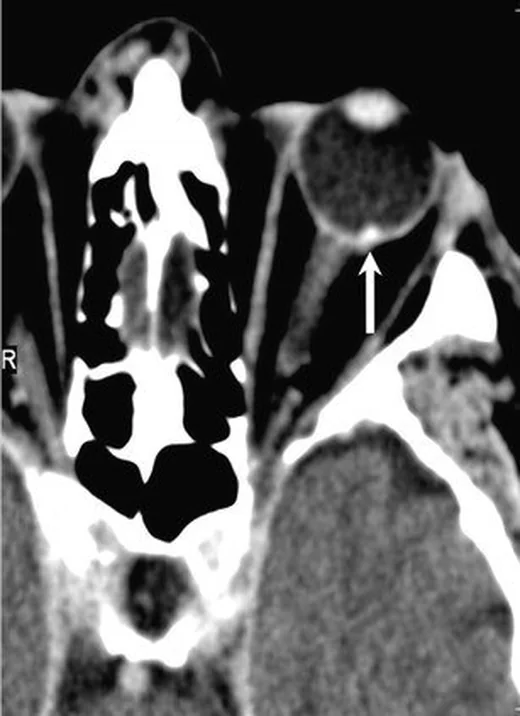
- Kontrastsız orbital BT'de büyük uveal kitle vitreus boşluğundan daha yüksek atenüasyonlu, glob duvarına oturan yumuşak doku olarak seçilebilir; küçük lezyonlar kesit çözünürlüğü ve yumuşak doku kontrastı nedeniyle görünmeyebilir.
- Kontrastlı
- Kontrastlı BT’de büyük uveal kitle kontrastlanabilir ve belirgin ekstra-skleral yumuşak doku uzanımı görülebilir; kontrastlanma paterni melanom için özgül değildir. Ekstraoküler uzanımın ayrıntılı değerlendirilmesinde MR daha elverişlidir.
Önerilen pencereler: Yumuşak doku (G 400 / M 40).
BT bulguları
- Koroid duvarından yükselen, globun iç konturunu bozan solid intraoküler yumuşak doku kitlesi.
- Büyük lezyonlar vitreus boşluğuna doğru çıkıntı yapabilir; ancak karakteristik mantar/bombe şekli ultrason ve MR ile daha iyi değerlendirilir, BT’de yumuşak doku ayrımı sınırlı olduğundan belirgin olmayabilir.
- Lezyonun vitreustan daha yüksek atenüasyonlu görünmesi kitleyi fark ettirebilir, ancak özgül bir dansite eşiği yoktur.
- Glob duvarının dışındaki yumuşak doku nodülü veya sklera boyunca kalınlaşma ekstra-skleral yayılım şüphesini doğurur.
- Uveal melanomlar kontrastlı görüntülemede kontrast alabilir; ancak bu bulgu hastalık spesifikliği açısından sınırlıdır.
- Kitlenin optik sinir başıyla ilişkisi ve tutulum şüphesi bildirilmelidir; optik sinir yolunun detaylı değerlendirilmesinde manyetik rezonans görüntüleme tercih edilir.
- Göz BT'si yalnızca orbital yapıları değerlendirdiği için karaciğer dahil uzak metastaz taraması ayrıca planlanmalıdır; uveal melanomda metastaz en sık karaciğere yayılır.
Normalde
Normal göz anatominin detaylı incelenmesi ultrasonografi, OCT ve MR ile yapılırken; BT yalnızca göz küresi konturu ve orbital kemik yapısını değerlendirmektedir. Orbital BT, küçük koroid melanomlarını tespit etmede yetersiz duyarlılığa sahiptir; negatif inceleme tanıyı dışlamaz ve klinik şüphe devam ederse ek modaliteler gerektirir.
Normal BT ile kıyasla
Aynı bölgenin, kaynak veri setinde patoloji içermediği belirtilen bir BT incelemesini kesit kesit kaydırın; organ sınırlarını açarak anatomiyi hasta görüntüsüyle karşılaştırın. Küçük rastlantısal bulgular tümüyle dışlanmamıştır.
Kaynak: TotalSegmentator v2.01 veri seti (Wasserthal ve ark., Radiology: Artificial Intelligence 2023), CC BY 4.0, vaka s0849; organ sınırları veri setinin otomatik segmentasyonundan, birleştirilerek sadeleştirildi. Görüntüler 2,5 mm kesit aralığına yeniden örneklendi.
Ayırıcı tanı
- Retina dekolmanı
- göz içi sıvı akümüülasyonu ile karakterizedir; solid bir kitleye göre farklılık gösterir, ancak kesin ayrım için ultrasonografi ve OCT gereklidir.
- Retinoblastom
- pediatrik popülasyonda en sık görülen intraoküler malignitedir; yaş farkı ve genetik etioloji açısından uveal melanomdan ayrılır.
- Koroid hemanjiyomu
- iyi sınırlı koroid kaynaklı kitle olabilir; BT görünümü özgül değildir ve ultrason/MR karakterizasyonu gerekir.
- Metastatik koroid odağı
- çoğu kez bilinen sistemik malignite bağlamında, bazen çok odaklı veya iki taraflı olabilir.
- Subretinal hemoraji
- retina arkasındaki yüksek dansiteli materyal kitleyi taklit edebilir; şekil ve klinik bağlamla ayırmak gerekir.
Tuzaklar
- Küçük koroid melanomunu normal BT diye raporlama; küçük lezyonlar BT'de seçilemeyebilir ve negatif çalışma dışlatıcı değildir.
- Tümör karakterizasyonu yalnızca tek bir görüntüleme moditesine dayanmamalı; BT bulguları ultrasonografi, MR ve klinik değerlendirme ile bütünleştirilmelidir.
- Göz içindeki yüksek yoğunluklu alanlar hemoraji veya retina dekolmanıyla ilişkili olabilir; lezyonun duvara olan ilişkisi ve şekli ardışık kesitlerde dikkatlice incelenmelidir.
- Belirgin ekstraoküler yumuşak doku kitle uzanımı düşündürür; yalnız skleral kontur asimetrisi invazyonu kanıtlamaz.
Kendini dene
Erişkinde koroid duvarına geniş tabanla oturan kitle ve sklera dışında nodüler doku görülüyor. BT açısından en doğru yorum nedir?
Cevabı göster
Uveal kitle, ekstra-skleral uzanım şüpheli. Duvara bağlı solid kitle ve dış yüzeyde nodül ekstra-skleral uzanım şüphesi doğurur; BT tek başına histolojik tanıyı kesinleştirmez. Retina dekolmanı uveal melanomla birlikte görülebilir; tanı klinik ve multimodal görüntüleme bulgularına dayanır.
Uveal tümörlerin evreleme ve tedavi değerlendirmesinde görüntüleme yöntemlerinin rolü nasıl tanımlanır?
Cevabı göster
BT, ultrason ve MR tamamlayıcı yöntemlerdir. BT, ultrason ve MR uveal tümörlerin evreleme ve tedavi değerlendirmesinde tamamlayıcı rol oynar.
İlgili konular
Kaynaklar
Bu sayfadaki 37 cümle ve 2 quiz sorusu aşağıdaki kaynaklardan alıntılarla tek tek karşılaştırıldı; 22 cümle bu karşılaştırmada düzeltildi (2026-10-08).
- Incidentally Detected Large Choroidal Melanoma in a 27-Year-Old Asymptomatic Woman: A Case Reportpmc.ncbi.nlm.nih.gov
- Widespread Metastatic Uveal Melanoma with Gastrointestinal and Gallbladder Involvement: A Case Reportpmc.ncbi.nlm.nih.gov
- SMARCB1 (INI1)-deficient malignant melanocytic neoplasm with histologically confirmed vertebral metastases in a young adult: a case reportpmc.ncbi.nlm.nih.gov
- Case Report: Therapeutic biopsy guided targeted therapy improves visual acuity and prolongs survival in bilateral uveal metastases as the initial presentation of lung adenocarcinomapmc.ncbi.nlm.nih.gov
- Primary amelanotic leptomeningeal melanocytosis mimicking subarachnoid hemorrhage: a case report of the deceptive masqueraderpmc.ncbi.nlm.nih.gov
- Ocular neoplastic disease.pubmed.ncbi.nlm.nih.gov
- Improving organs-at-risk sparing for choroidal melanoma patients: A CT-based two-beam strategy in ocular proton therapy with a dedicated eyeline.pubmed.ncbi.nlm.nih.gov
- Comparison of stereotactic radiotherapy and protons for uveal melanoma patients.pubmed.ncbi.nlm.nih.gov
- Clinical and radiomics parameter prognostication in metastatic uveal melanoma patients treated with hepatic arterial infusion chemotherapy.pubmed.ncbi.nlm.nih.gov
- Delayed Distant Recurrence of a Uveal Melanoma 4 Decades after Enucleation.pubmed.ncbi.nlm.nih.gov
- Geometrical accuracy of magnetic resonance imaging for ocular proton therapy planning.pubmed.ncbi.nlm.nih.gov
- A Technical Report for Definitive Treatment of Uveal Melanoma With Stereotactic Radiosurgery and Retrobulbar Anesthesia.pubmed.ncbi.nlm.nih.gov
- Fundus hypopigmentation and choroidal thinning associated with tebentafusp therapy: report of a case and literature review.pubmed.ncbi.nlm.nih.gov
- Clinical utility of pembrolizumab in the management of orbital recurrence of uveal melanoma: case report.pubmed.ncbi.nlm.nih.gov
- Don't Miss the Blind Spots: Incidental Detection of Choroidal Melanoma During Primary Care Evaluation of Visual Field Loss.pubmed.ncbi.nlm.nih.gov
- A Possible Link Between Cutaneous Melanoma and Uveal Melanoma: A Multicenter Retrospective Cohort Study.pubmed.ncbi.nlm.nih.gov
- Misdiagnosis of uveal melanoma and other intraocular malignancies in enucleated eyes: a 28-year national review.pubmed.ncbi.nlm.nih.gov
- Transformation of the extracellular matrix during uveal melanoma development, progression, and at the hepatic metastatic niche.pubmed.ncbi.nlm.nih.gov
- A Scoping Review of Artificial Intelligence in Ocular Oncology.pubmed.ncbi.nlm.nih.gov
- Tracer Techniques in Ophthalmology: Ocular Applications and Systemic Connections.pubmed.ncbi.nlm.nih.gov
- Advances in Positron Emission Tomography/Computed Tomography for Diagnosing and Managing Primary Posterior Uveal Melanoma.pubmed.ncbi.nlm.nih.gov
- Tumor or Inflammation? How Multi-Modality Image Fusion and Shear Wave Elastography Can Help Solve the Diagnostic Dilemma.pubmed.ncbi.nlm.nih.gov
- Long-term safety and effectiveness of the "OptEase" vena cava filter.pubmed.ncbi.nlm.nih.gov
- Incidentally Detected Large Choroidal Melanoma in a 27-Year-Old Asymptomatic Woman: A Case Report.pubmed.ncbi.nlm.nih.gov
- Intraocular Metastasis: Differential Diagnosis and Management.pubmed.ncbi.nlm.nih.gov
- Ocular Lymphatics in Health and Disease.pubmed.ncbi.nlm.nih.gov
- Proton Therapy in Uveal Melanoma.pubmed.ncbi.nlm.nih.gov
- Open Globe Injuries: Review of Evaluation, Management, and Surgical Pearls.pubmed.ncbi.nlm.nih.gov
- Guidelines for standard operation of imaging modalities in orbital diseases (2024).pubmed.ncbi.nlm.nih.gov
- Melanocytic lesions of the central nervous system: a case series.pubmed.ncbi.nlm.nih.gov
- Guidelines for preoperative visual function and imaging examination standards in vitreoretinal surgery (2025).pubmed.ncbi.nlm.nih.gov
- Current and Emerging Radiotherapy Options for Uveal Melanoma.pubmed.ncbi.nlm.nih.gov
- Addressing inter-device variations in optical coherence tomography angiography: will image-to-image translation systems help?pubmed.ncbi.nlm.nih.gov
- Diagnostic methods and therapeutic options of uveal melanoma with emphasis on MR imaging-Part II: treatment indications and complications.pubmed.ncbi.nlm.nih.gov
- International Harmonization of Nomenclature and Diagnostic Criteria (INHAND): Nonproliferative and Proliferative Lesions of the Rabbit.pubmed.ncbi.nlm.nih.gov
- International Harmonization of Nomenclature and Diagnostic Criteria (INHAND): Non-proliferative and Proliferative Lesions of the Non-human Primate ( M. fascicularis ).pubmed.ncbi.nlm.nih.gov
- Checkpoint inhibition and beyond: Precision immune engineering for the immune-privileged landscape of ocular malignancies.pubmed.ncbi.nlm.nih.gov
- Adverse events associated with chimeric antigen receptor T-cell therapy in ophthalmology: a narrative review.pubmed.ncbi.nlm.nih.gov
- Extraocular Extension in Melanoma at an Ocular Oncology Unit in Buenos Aires.pubmed.ncbi.nlm.nih.gov
- Extraocular spread of uveal melanoma to the breast: a rare clinical presentation.pubmed.ncbi.nlm.nih.gov
- Computed tomography in traumatic orbital emergencies: a pictorial essay-imaging findings, tips, and report flowchart.pubmed.ncbi.nlm.nih.gov
- Spotlight on the pediatric eye: a pictorial review of orbital anatomy and congenital orbital pathologies.pubmed.ncbi.nlm.nih.gov
- Changes of individual choroidal thickness post-uneventful cataract surgery determined by spectral-domain optical coherence tomography over a 3-month period.pubmed.ncbi.nlm.nih.gov
- Choroidal vascularity index in health and systemic diseases: a systematic review.pubmed.ncbi.nlm.nih.gov
- An investigation on choroidal and retinal thickness alterations in Posner-Schlossman syndrome patients.pubmed.ncbi.nlm.nih.gov
- Multimodal imaging in neuro-ophthalmology.pubmed.ncbi.nlm.nih.gov
- Differentiation of choroidal metastases based on primary cancer site: An imaging study.pubmed.ncbi.nlm.nih.gov
- Optic disc and peripapillary tumors.pubmed.ncbi.nlm.nih.gov
- Molecular Pathogenesis, Tumor Microenvironment and Health Disparities in Select Pediatric Solid Tumors: An Integrative Narrative Review.pubmed.ncbi.nlm.nih.gov
- Retinoblastoma - A comprehensive review, update and recent advances.pubmed.ncbi.nlm.nih.gov
- Genetic Risk Factors and Clinical Outcomes in Childhood Eye Cancers: A Review.pubmed.ncbi.nlm.nih.gov
- Intraocular and Ocular Adnexal Metastases: A Comprehensive Review.pubmed.ncbi.nlm.nih.gov
- Rectus Muscle Metastasis from Primary Uveal Melanoma: A Case Series and Literature Review.pubmed.ncbi.nlm.nih.gov
- Ocular metastasis in breast cancer: management of clinical case reports and a literature review.pubmed.ncbi.nlm.nih.gov
- Imaging in Pachychoroid Diseasepubmed.ncbi.nlm.nih.gov
- PET/CT and PET/MRI in ophthalmic oncology (Review).pubmed.ncbi.nlm.nih.gov
- Medical hyperspectral imaging: an updated review of technology advancements and biomedical applications.pubmed.ncbi.nlm.nih.gov
- Special Issue: EACR 2026 Congress: Innovative Cancer Science, 8-11 June 2026.pubmed.ncbi.nlm.nih.gov
- A Historical Survey of Key Epidemiological Studies of Ionizing Radiation Exposure.pubmed.ncbi.nlm.nih.gov
- Genetics and current research models of Mendelian tumor predisposition syndromes with ocular involvement.pubmed.ncbi.nlm.nih.gov
- Posterior choroidal leiomyoma: new findings from a case and literature review.pubmed.ncbi.nlm.nih.gov
- Magnetic Resonance Imaging in the Clinical Care for Uveal Melanoma Patients-A Systematic Review from an Ophthalmic Perspective.pubmed.ncbi.nlm.nih.gov
- Magnetic resonance imaging of the orbit, Part 2: Characterization of orbital pathologies.pubmed.ncbi.nlm.nih.gov
- Orbital Metastasis as a Presenting Feature of Papillary Thyroid Carcinoma: Case Report and Literature Review.pubmed.ncbi.nlm.nih.gov
- Practical guidelines on imaging of retinoblastoma: a 2025 update on behalf of the European Retinoblastoma Imaging Collaboration and the European Retinoblastoma Group.pubmed.ncbi.nlm.nih.gov
- Eye Plaque Brachytherapy for Choroidal Malignant Melanoma: A Case Report on the Use of Innovative Technology to Expand Access, Improve Practice, and Enhance Outcomes.pubmed.ncbi.nlm.nih.gov
- Imaging of Uveal Melanoma-Current Standard and Methods in Development.pubmed.ncbi.nlm.nih.gov
- Feasibility, Method and Early Outcome of Image-Guided Volumetric Modulated Arc Radiosurgery Followed by Resection for AJCC Stage IIA-IIIB High-Risk Large Intraocular Melanoma.pubmed.ncbi.nlm.nih.gov
- EACR 2025 Congress: Innovative Cancer Science, 16-19 June 2025.pubmed.ncbi.nlm.nih.gov
- Extracutaneous melanomas: a primer for the radiologist.pubmed.ncbi.nlm.nih.gov
- Imaging of adult ocular and orbital pathology--a pictorial review.pubmed.ncbi.nlm.nih.gov
- Surgical treatment of orbital tumors in a single center: Analysis and results.pubmed.ncbi.nlm.nih.gov
- The Immune Checkpoint Inhibitors Journey: From Early Promise to Lasting Impact.pubmed.ncbi.nlm.nih.gov
- Proceedings of the 15th International Congress on Circumpolar Health.pubmed.ncbi.nlm.nih.gov
- Primary amelanotic leptomeningeal melanocytosis mimicking subarachnoid hemorrhage: a case report of the deceptive masquerader.pubmed.ncbi.nlm.nih.gov
- Rare Case of Metastatic Melanoma With Biventricular Cardiac Involvement: Diagnostic Challenges and Multimodal Management Strategies.pubmed.ncbi.nlm.nih.gov
- Are liver metastases from uveal melanoma a clinical indication for dynamic PET? A comparison of Patlak parametric imaging with standard and delayed static SUV imaging using long axial field-of-view PET/CT.pubmed.ncbi.nlm.nih.gov
- Circulating Tumor DNA in Melanoma: Advances in Detection, Clinical Applications, and Integration with Emerging Technologies.pubmed.ncbi.nlm.nih.gov
- Diagnostic value of <sup>18</sup>F-FDG PET/CT in the follow-up of metastatic uveal melanoma.pubmed.ncbi.nlm.nih.gov
- SMARCB1 (INI1)-deficient malignant melanocytic neoplasm with histologically confirmed vertebral metastases in a young adult: a case report.pubmed.ncbi.nlm.nih.gov
- Widespread Metastatic Uveal Melanoma with Gastrointestinal and Gallbladder Involvement: A Case Report.pubmed.ncbi.nlm.nih.gov
- Systemic surveillance for uveal melanoma: Approach to optimization.pubmed.ncbi.nlm.nih.gov
- Clinical Applications of Artificial Intelligence in Uveal Melanoma.pubmed.ncbi.nlm.nih.gov
- Clinical Features and Initial Management Outcomes of Uveal Melanomas in a Single Tertiary Center in Egypt.pubmed.ncbi.nlm.nih.gov
- The evolving role of interventional radiology in ophthalmology: advancements in imaging, therapeutic applications, and future prospects, a narrative review.pubmed.ncbi.nlm.nih.gov
- Overcoming Biophysical Barriers in Melanoma Photomedicine: From Photodynamic Therapy to Smart Nanodelivery and Photoimmunotherapy.pubmed.ncbi.nlm.nih.gov
- Optical Coherence Tomography and Angiography in Hydroxychloroquine Retinopathy: A Narrative Review.pubmed.ncbi.nlm.nih.gov
- Stereotactic irradiation on linear accelerator - ultrasound versus MRI in choroidal melanoma volume calculation.pubmed.ncbi.nlm.nih.gov
- Is It Possible to Preserve Vision without Compromising Metastases-Free Survival by Use of Fully Fractionated Stereotactic Radiotherapy for Posterior Choroidal Melanoma?pubmed.ncbi.nlm.nih.gov
- Fluoroscopy-Guided Motion Management in Particle Therapy: Evolution, Challenges, and AI-Enabled Opportunities.pubmed.ncbi.nlm.nih.gov
- Potential therapeutic applications of stem cells in animal models of ocular affections.pubmed.ncbi.nlm.nih.gov
- Next-generation smart ophthalmic biomaterials: From passive response to active interaction and closed-loop control.pubmed.ncbi.nlm.nih.gov
- Interventions for central serous chorioretinopathy: a network meta-analysis.pubmed.ncbi.nlm.nih.gov
- Orbital Tumors-Clinical, Radiologic and Histopathologic Correlation.pubmed.ncbi.nlm.nih.gov
- Comparison of Vision Transformers and Convolutional Neural Networks in Medical Image Analysis: A Systematic Review.pubmed.ncbi.nlm.nih.gov
- New Frontiers in Diagnosis and Therapy of Circulating Tumor Markers in Cerebrospinal Fluid In Vitro and In Vivo.pubmed.ncbi.nlm.nih.gov
- Orbital tumours and tumour-like lesions: exploring the armamentarium of multiparametric imaging.pubmed.ncbi.nlm.nih.gov
- Using ovine eyes as a readily available source for the isolation and 2D or 3D cultivation of uveal melanocytes.pubmed.ncbi.nlm.nih.gov
- Hepatic metastasis surveillance in uveal melanoma: a retrospective cohort study from a UK tertiary centre (2006-2022).pubmed.ncbi.nlm.nih.gov
- Intraocular Lymphoma: A Review.pubmed.ncbi.nlm.nih.gov
- Primary Intraocular Lymphoma: Rad-Path and Ophthalmologic Correlation.pubmed.ncbi.nlm.nih.gov
- Research advances of matrix metalloproteinases family in uveal melanoma.pubmed.ncbi.nlm.nih.gov
- Case Report: Vogt-Koyanagi-Harada-like uveitis associated with combined dabrafenib/trametinib and cadonilimab therapy for cutaneous melanoma.pubmed.ncbi.nlm.nih.gov
- Recent Developments in the Diagnosis and Treatment of Disseminated and Rare Melanoma with Radiotheranostics.pubmed.ncbi.nlm.nih.gov
- Progressive Vision Loss From Uveal Melanoma with Extraocular Extension: A Case Report.pubmed.ncbi.nlm.nih.gov
- Uveal Melanoma Ground Truth Labeling in Machine Learning.pubmed.ncbi.nlm.nih.gov
- A Feasibility Study of Preclinical Ocular X-Ray FLASH Radiation Therapy.pubmed.ncbi.nlm.nih.gov
- Intraocular Tumors in Horses: Diagnosis, Tumor Classification, Oncologic Assessment and Therapy.pubmed.ncbi.nlm.nih.gov
- Uveodermatologic syndrome presenting with concurrent aseptic meningoencephalitis in a dog.pubmed.ncbi.nlm.nih.gov
- Restricted Diffusion on Diffusion-Weighted MRI in a Cat With Orbital Lymphoma and Presumptive Pulmonary Lymphoma.pubmed.ncbi.nlm.nih.gov
- Renal oncocytoma mimicking chromophobe renal cell carcinoma: Management using proposed diagnostic algorithm with emphasis on 99mTc-sestamibi SPECT/CT.pubmed.ncbi.nlm.nih.gov
- Deep learning-radiomics-SUVmax integration from <sup>18</sup>F-FDG PET/CT predicts synchronous distant metastasis in nasopharyngeal carcinoma.pubmed.ncbi.nlm.nih.gov
- A-eye: Automated 3D MRI segmentation and morphometric feature extraction for eye and orbit atlas construction.pubmed.ncbi.nlm.nih.gov
- Glaucoma in a Siberian Tiger (<i>Panthera tigris altaica</i>) Maintained Under Human Care: A Case Report.pubmed.ncbi.nlm.nih.gov
- Prostate Cancer With Orbital Metastasis.pubmed.ncbi.nlm.nih.gov
Eğitim amaçlıdır; hasta başında tanı ve tedavi kararının yerine geçmez. İçerik yapay zekâ destekli bir süreçle güncel literatüre göre cümle cümle kaynaklarla karşılaştırıldı, ancak uzman radyolog incelemesinden geçmedi. Klinik kararlarda güncel kılavuzları, kurum protokollerini ve radyoloji raporunu esas alın.