
Özet
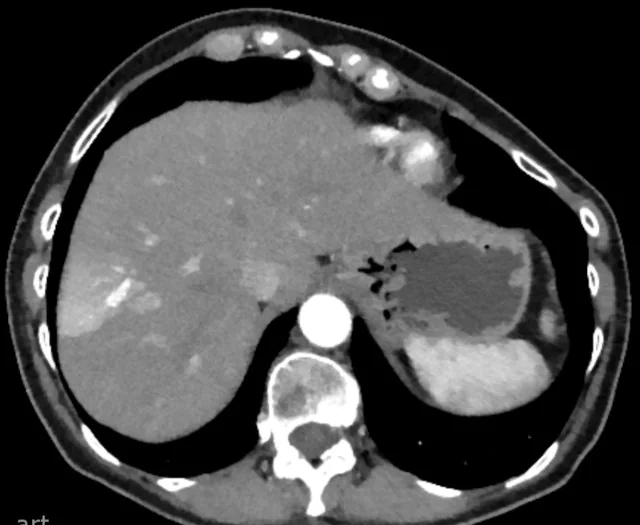
Arterioportal şant, hepatik arter sistemi ile portal venöz sistem arasında bağlantıdır; THAD, bölgesel hepatik arter ve portal venöz kanlanma oranındaki değişikliğe bağlı olarak arteriyel faz BT'de geçici parankim kontrastlanması şeklinde görülür. THAD, arteriyel faz BT'de kama biçimli ve geçici bir hiperatenüasyon alanı olarak görülebilir; arteriyel kanlanma oranının artması bölgesel atenüasyonu yükseltirken portal fazda karaciğer belirgin ve yaygın biçimde kontrastlanır. THAD'ların hipervasküler tümörleri taklit edebileceğini ve küçük arterioportal şantların nodüler görünebileceğini bilmek, görüntülerin daha doğru değerlendirilmesine yardımcı olur. THAD'nin olası nedenleri arasında portal ven akımındaki azalma, arterioportal şant, tümör, apse ve inflamatuvar hastalıklar bulunduğundan, altta yatan anormallikler ayrıca değerlendirilmelidir.
Faz ve pencere
- Arteriyel tanısal
- Arteriyel fazda geçici hiperatenüasyon alanı görülebilir; portal akım azalması, arterioportal şant veya diğer altta yatan intrahepatik anormallikler araştırılmalıdır.
- Portal tanısal
- THAD arteriyel faz BT'de geçici kontrastlanma alanı olarak görülür; portal fazda kontrastlanma farkının sürüp sürmediği değerlendirilmelidir.
- Gecikmiş
- Arterioportal şant alanları denge fazında izoatenü olabilir; bu nedenle arteriyel fazdaki geçici kontrastlanma görünümü diğer fazlarla birlikte değerlendirilmelidir.
Önerilen pencereler: Batın (G 400 / M 50), Karaciğer (G 150 / M 30).
BT bulguları
- Arteriyel fazda kama, üçgen veya coğrafi şekilli hiperatenüasyon; sıklıkla periferik/subkapsüler dağılım
- Arterioportal şantlar geçici kama biçimli veya nodüler kontrastlanma alanları oluşturabilir; görünüm özellikle sirotik karaciğerde hipervasküler tümörlerle karışabilir.
- Portal fazda lezyon benzeri farkın kaybolup çevre parankime yaklaşması
- Arterioportal şantlar, hipervasküler tümörleri taklit edebilen geçici parankim kontrastlanma alanları oluşturabilir.
- Arterioportal şantlar ve portal ven akımını azaltan anomaliler THAD'ye yol açabilir; bunların saptanması olası nedeni değerlendirmeye yardımcı olur.
- Portal dal tıkanıklığı, tümör, inflamasyon veya cerrahi/girişim odağına komşu bölgesel perfüzyon değişikliği
Normalde
Normal dinamik BT’de karaciğer parankimi arteriyel fazda hafif ve görece homojen, portal fazda ise yaygın ve dengeli kontrastlanır. Portal fazda karaciğerin kontrastlanması belirgin ve yaygın hale gelir; arteriyel fazdaki geçici hiperatenüasyonun diğer fazlardaki görünümüyle karşılaştırılması perfüzyon farkını değerlendirmeye yardımcı olur.
Normal BT ile kıyasla
Aynı bölgenin, kaynak veri setinde patoloji içermediği belirtilen bir BT incelemesini kesit kesit kaydırın; organ sınırlarını açarak anatomiyi hasta görüntüsüyle karşılaştırın. Küçük rastlantısal bulgular tümüyle dışlanmamıştır.
Kaynak: TotalSegmentator v2.01 veri seti (Wasserthal ve ark., Radiology: Artificial Intelligence 2023), CC BY 4.0, vaka s0541; organ sınırları veri setinin otomatik segmentasyonundan, birleştirilerek sadeleştirildi. Görüntüler 2,5 mm kesit aralığına yeniden örneklendi.
Ayırıcı tanı
- Arterioportal şantlar, özellikle sirotik karaciğerde amorf veya nodüler görünümleri nedeniyle hipervasküler tümörlerle karışabilir.
- Karaciğer infarktı
- portal fazda kontrastlanmama sürer ve segmental damar dağılımındaki kama silinmez.
- Üçüncü giriş etkileri fokal yağlanma veya yağdan korunmuş alanlar gibi yalancı lezyonlara yol açabilir; THAD ise bölgesel hepatik arter ve portal ven kanlanma oranındaki değişiklikle ilişkilidir.
- Portal ven dal trombozu
- ilgili dalda kalıcı dolum defekti/sonlanma ve ona uyan perfüzyon farkı olabilir; THAD tek başına şantın nedenini göstermez.
Tuzaklar
- Arteriyel tek fazdaki kama hiperatenüasyonu metastaz veya HCC diye adlandırmayın; portal fazda aynı alanın eşitlenmesini ve damarların içinden geçişini kontrol edin.
- THAD farklı portal venöz akım bozuklukları, arterioportal şantlar, tümörler, apseler ve inflamatuvar hastalıklarla ilişkili olabilir; olası nedenler ayrıca değerlendirilmelidir.
- Hepatik arter ve portal ven kontrast bolusunun karaciğere varış zamanları farklı olduğundan, fazlar arası karaciğer kontrastlanması bu zamanlama dikkate alınarak değerlendirilmelidir.
Kendini dene
Arteriyel faz BT'de bölgesel hepatik arter ve portal ven kanlanma oranındaki değişikliğe bağlı geçici parankim kontrastlanma alanına ne ad verilir?
Cevabı göster
THAD. Bölgesel arteriyel ve portal venöz kanlanma oranındaki değişiklik, arteriyel faz BT’de geçici bir kontrastlanma alanı oluşturabilir; bu görünüm THAD olarak adlandırılır.
Portal venöz akımın bölgesel azalması, arteriyel faz BT'de hangi geçici karaciğer görünümüne yol açabilir?
Cevabı göster
THAD. Portal akım azaldığında, bölgeyi besleyen hepatik arter kanı opaklaşmamış portal kanla seyrelmez; bu nedenle arteriyel fazda fokal atenüasyon artışı görülebilir.
İlgili konular
Kaynaklar
Bu sayfadaki 31 cümle ve 2 quiz sorusu aşağıdaki kaynaklardan alıntılarla otomatik olarak karşılaştırıldı; 22 cümle bu karşılaştırmada düzeltildi (2026-10-09).
- Transient Hepatic Attenuation Differences in Computed Tomography from Extrahepatic Portal Vein Compressionpmc.ncbi.nlm.nih.gov
- Arterioportal shunt incidental to treatment with oxaliplatin that mimics recurrent gastric cancer.pubmed.ncbi.nlm.nih.gov
- Nontumorous arterioportal shunts in the liver: CT and MRI findings considering mechanisms and fate.pubmed.ncbi.nlm.nih.gov
- Hepatic nodular regenerative lesions in patients with hereditary haemorrhagic telangiectasia: computed tomography and magnetic resonance findings.pubmed.ncbi.nlm.nih.gov
- Severe Liver Injury Complicated by Portal Hypertension and Traumatic Arterioportal Shunt: A Case Report.pubmed.ncbi.nlm.nih.gov
- Contemporary management pathways in liver trauma: predominant and successful use of non-operative strategies at a high-volume tertiary center.pubmed.ncbi.nlm.nih.gov
- Washout on Contrast-Enhanced Ultrasound of Benign Focal Liver Lesions-A Review on Its Frequency and Possible Causes.pubmed.ncbi.nlm.nih.gov
- A case of hepatic segmental atrophy mimicking spontaneously necrotized hepatocellular carcinoma.pubmed.ncbi.nlm.nih.gov
- CT and MRI imaging and interpretation of hepatic arterioportal shunts.pubmed.ncbi.nlm.nih.gov
- Imaging findings of mimickers of hepatocellular carcinoma.pubmed.ncbi.nlm.nih.gov
- Assessing Pancreatic Enhancement Variability in ICU Patients with CT Hypoperfusion Complex: A Retrospective Single-Center Study.pubmed.ncbi.nlm.nih.gov
- Case Report: Multimodality imaging features and serial metabolic changes on <sup>18</sup> F-FDG PET/CT in a dog with granulomatous hepatitis.pubmed.ncbi.nlm.nih.gov
- Ethnic-specific ZJU index thresholds for hepatic steatosis and fibrosis in Chinese MASLD.pubmed.ncbi.nlm.nih.gov
- Cardiac Surgery Management in Patients With Liver Cirrhosis.pubmed.ncbi.nlm.nih.gov
- Longitudinal Inpatient Trajectories After Splenic Artery Embolization in Cirrhosis: Real-World Evidence from Kazakhstan.pubmed.ncbi.nlm.nih.gov
- When Cancer Clots: An Extensive Radiologic Analysis of Cancer-Associated Thromboembolism.pubmed.ncbi.nlm.nih.gov
- Contrast-Enhanced CT Finding of Hot Spot Sign Secondary to Supra Hilar Mass Causing Superior Vena Cava Syndrome: A Case Report.pubmed.ncbi.nlm.nih.gov
- Liver Imaging Reporting and Data System (LI-RADS): A Comprehensive Review.pubmed.ncbi.nlm.nih.gov
- All About Multiparametric MRI Evaluation in Biliary Tree Complications After Liver Transplant.pubmed.ncbi.nlm.nih.gov
- Pilot study of an arterial enhancement fraction-based model for progression prediction in HCC undergoing chemoembolization.pubmed.ncbi.nlm.nih.gov
- Contrast-enhanced ultrasonography as a method of monitoring focal liver lesions - initial report.pubmed.ncbi.nlm.nih.gov
- Microengineering the Liver: Strategies for Constructing Functional Liver-on-a-Chip Devices.pubmed.ncbi.nlm.nih.gov
- Multi-modal AI for opportunistic screening, staging and progression risk stratification of steatotic liver disease.pubmed.ncbi.nlm.nih.gov
- Long-Term Care in Fontan Circulation: Surveillance and Management of Fontan-Associated Liver Disease and Protein-Losing Enteropathy.pubmed.ncbi.nlm.nih.gov
- Balancing metabolic optimization and reproductive safety in Polycystic Ovary Syndrome: a Bayesian-informed framework for GLP-1 receptor agonists.pubmed.ncbi.nlm.nih.gov
- Multimodal imaging features to diagnose abdominal complications of sickle cell disease.pubmed.ncbi.nlm.nih.gov
- Contrast-enhanced ultrasound in the evaluation and management of solid renal lesions based on EFSUMB guidelines.pubmed.ncbi.nlm.nih.gov
- Non-contrast microvascular flow imaging in abdominal ultrasound: a pictorial essay.pubmed.ncbi.nlm.nih.gov
- Interventional, surgical, and clinical management of Abernethy malformations: A case series and novel anatomic variant.pubmed.ncbi.nlm.nih.gov
- A One-Dimensional (1D) Computational Fluid Dynamics Study of Fontan-Associated Liver Disease (FALD).pubmed.ncbi.nlm.nih.gov
- Delayed hepatic artery pseudoaneurysm with arterioportal fistula after penetrating liver trauma successfully treated with coil embolization: a case report and focused literature review.pubmed.ncbi.nlm.nih.gov
- Restoration of hepatopetal portal flow in a cat with left hepatic arteriovenous malformation following left hepatic division resection and staged attenuation of acquired portosystemic shunts.pubmed.ncbi.nlm.nih.gov
- Splenic Artery Aneurysm With Arterioportal Fistula: An Unusual Cause of Portal Hypertension.pubmed.ncbi.nlm.nih.gov
- Adult Hepatic Infarction for Internists: A Practical Diagnostic and Management Pathway to Avoid Misdiagnosis, Unnecessary Drainage, and Delayed Vascular Recognition.pubmed.ncbi.nlm.nih.gov
- Gun-sight technique for recanalization of chronic noncirrhotic, nonmalignant extrahepatic portal vein obstruction.pubmed.ncbi.nlm.nih.gov
- Balloon-occluded hepatic arterial infusion for unresectable hepatocellular carcinoma: a phase II trial interim analysis.pubmed.ncbi.nlm.nih.gov
- Torsion of a pedunculated accessory hepatic lobe: Cross-sectional imaging and histopathological correlation.pubmed.ncbi.nlm.nih.gov
- Case Report: Hypervascular lipid-rich intrahepatic adrenocortical adenoma in the right posterior liver: a diagnostic challenge for hepatobiliary surgeons.pubmed.ncbi.nlm.nih.gov
- Dual-modality imaging with CEUS and MRI for early recurrence assessment in hepatocellular carcinoma following combined radiofrequency ablation and transarterial chemoembolization.pubmed.ncbi.nlm.nih.gov
- Contrast-Enhanced Low-Mechanical-Index Endoscopic Ultrasound for the Evaluation of Focal Liver Lesions.pubmed.ncbi.nlm.nih.gov
- DEB-TACE Combined with Immunotherapy and Targeted Therapy for Advanced Hepatocellular Carcinoma with Scapular Metastasis: A Case Report.pubmed.ncbi.nlm.nih.gov
- Imaging Characterization of a Cystic Duct Neuroendocrine Carcinoma in a Dog Using Contrast-Enhanced Ultrasonography and Multiphasic Computed Tomography.pubmed.ncbi.nlm.nih.gov
- Hepatic Adrenal Rest Tumour (HART) Preoperatively Diagnosed as Hepatocellular Carcinoma in a Patient With Chronic Hepatitis B: Radiological Similarities in Lesions.pubmed.ncbi.nlm.nih.gov
- Fulminant emphysematous hepatitis with pneumoperitoneum: A case report.pubmed.ncbi.nlm.nih.gov
- Imaging after Pancreaticoduodenectomy: How Can the Radiologist Help the Surgeon.pubmed.ncbi.nlm.nih.gov
- Computed tomography of pediatric abdominal trauma: optimizing utilization and enhancing diagnostic interpretation.pubmed.ncbi.nlm.nih.gov
- Evolving B-mode ultrasound-based techniques for assessing metabolic dysfunction-associated steatotic liver disease: Now and beyond.pubmed.ncbi.nlm.nih.gov
- Association of metabolic dysfunction-associated fatty liver disease with coronary CT angiography-derived plaque characteristics and cardiovascular events.pubmed.ncbi.nlm.nih.gov
- Focal Hyperechoic Hepatic Lesions in Northern Region of Saudi Arabia: Prevalence, Radiologic Features, and Clinical Relevance.pubmed.ncbi.nlm.nih.gov
- Single-center experience of interventional therapy for congenital portal-systemic shunt in children.pubmed.ncbi.nlm.nih.gov
- Acute portal vein thrombosis postimage-guided liver biopsy in common variable immunodeficiency.pubmed.ncbi.nlm.nih.gov
- Pseudotumoral portal cavernoma mimicking hilar cholangiocarcinoma: A diagnostic pitfall.pubmed.ncbi.nlm.nih.gov
- A Retrospective Study of Ultrasonographic Features of Hepatic Metastases Following Adrenal Cortical Carcinoma Resection.pubmed.ncbi.nlm.nih.gov
- Diagnostic challenges in hepatic metastatic olfactory neuroblastoma: a case report and literature review.pubmed.ncbi.nlm.nih.gov
- Role of liver transient elastography in detecting cirrhosis with esophageal and gastric varices and evaluating variceal severity.pubmed.ncbi.nlm.nih.gov
- Mechanisms, efficacy, and future perspectives of cellular-based therapies for liver fibrosis/cirrhosis: focusing on mesenchymal stromal cells.pubmed.ncbi.nlm.nih.gov
- Unveiling the Spectrum of Liver Endurance in Systemic Lupus Erythematosus: A Single-Center Experience From Kashmir, India.pubmed.ncbi.nlm.nih.gov
- Ultrasound Evaluation of Fontan-Associated Liver Disease: A State-of-the-Art Review.pubmed.ncbi.nlm.nih.gov
- A comparison of contrast-to-noise ratio of liver tumors between dynamic contrast-enhanced CT and respiration-tracked 4D-CT for radiotherapy targeting.pubmed.ncbi.nlm.nih.gov
- Hepatobiliary phase imaging in HCC: revisiting diagnostic algorithms and clinical utility of gadoxetic acid-enhanced MRI across international guidelines.pubmed.ncbi.nlm.nih.gov
- The characteristics of liver nodules in biliary atresia native liver survivors.pubmed.ncbi.nlm.nih.gov
- Bleeding Stomal Varices and Vascular Interventional Radiology Management: A Case Report.pubmed.ncbi.nlm.nih.gov
- Rescue transsplenic thrombectomy for portal remnant thrombosis after ALPPS stage 1.pubmed.ncbi.nlm.nih.gov
- Transabdominal Ultrasound-guided Transjugular Endovascular Mesocaval Shunt Creation in Extrahepatic Portal Vein Obstruction: A Single-center Experience.pubmed.ncbi.nlm.nih.gov
- EAT Thickness and BAT-Related Thermogenesis: Dual Imaging Phenotypes Associated with Hepatic Steatosis Severity in MASLD.pubmed.ncbi.nlm.nih.gov
- Biochemical-Anthropometric Indices Assessing Liver Steatosis Identified in Elastography in Children with Metabolic DysFunction-Associated Steatotic Liver Disease.pubmed.ncbi.nlm.nih.gov
- The Role of CEUS in the Diagnosis and Follow-Up of Pleuropulmonary Diseases and Interventional Procedures.pubmed.ncbi.nlm.nih.gov
- Understanding Photon-Counting CT: Physics, Detector Technology, and Image Reconstructions.pubmed.ncbi.nlm.nih.gov
- Dual-low spectral CT pulmonary angiography: a comparative study of image quality, radiation dose, and iodine intake with evaluation of pulmonary embolism detection.pubmed.ncbi.nlm.nih.gov
- Lysyl oxidase (LOX) family proteins in extracellular matrix homeostasis: roles in disease and radiation-induced pathogenesis.pubmed.ncbi.nlm.nih.gov
- Metabolic Regulation of Macrophages in Health and Disease.pubmed.ncbi.nlm.nih.gov
- TGF-beta inhibitors in cancer therapy: a review of the TGF-beta signal transduction pathway and current developments.pubmed.ncbi.nlm.nih.gov
- DNA-based characterization of primary hepatic MALT lymphoma reveals a rare FAT3 missense variant and Hippo pathway activation: a case report and literature review.pubmed.ncbi.nlm.nih.gov
- Underlying thrombotic conditions in patients with splenic infarction: a 10-year retrospective analysis.pubmed.ncbi.nlm.nih.gov
- Splenic infarction after endoscopic glue injection for gastric varices: proportion, exploratory correlates, and clinical outcomes from a propensity score-matched analysis.pubmed.ncbi.nlm.nih.gov
- Contrast-enhanced ultrasound of the small organs in children.pubmed.ncbi.nlm.nih.gov
- Acute mesenteric ischaemia: a pictorial review.pubmed.ncbi.nlm.nih.gov
- Case Report: Focal nodular hyperplasia of the liver in an adolescent-a case report and literature review.pubmed.ncbi.nlm.nih.gov
- Depicting Characteristic Staghorn Vessels in Solitary Fibrous Tumor of the Liver With Contrast-Enhanced Ultrasound and Ultrasound Localized Microscopy: A Case Report.pubmed.ncbi.nlm.nih.gov
- Case Report: Indocyanine green fluorescence imaging in complex focal nodular hyperplasia resection: report of two cases.pubmed.ncbi.nlm.nih.gov
- Computed Tomographic Findings of Liver Cirrhosis in Dogs: Comparison between Compensated and Decompensated Cirrhosis.pubmed.ncbi.nlm.nih.gov
- The Gastric Vein Variants: An Evidence-Based Systematic Review of Prevalence and Clinical Considerations.pubmed.ncbi.nlm.nih.gov
- Hepatic Hemangioma: Review of Imaging and Therapeutic Strategies.pubmed.ncbi.nlm.nih.gov
- Transient hepatic attenuation difference or fat sparing? Aberrant right gastric vein determining a pseudolesion at the border of the IInd/IIIrd liver segments. Review of developmental concepts.pubmed.ncbi.nlm.nih.gov
- Hepatic pseudolesions caused by alterations in intrahepatic hemodynamics.pubmed.ncbi.nlm.nih.gov
- HCC in the Era of Emerging MASH: The Role of Ultrasound in Surveillance and New Sonographic Features in Diagnosis.pubmed.ncbi.nlm.nih.gov
- Society for Cardiovascular Magnetic Resonance 2024 Cases of SCMR case series.pubmed.ncbi.nlm.nih.gov
- Benign and malignant focal liver lesions displaying rim arterial phase hyperenhancement on CT and MRI.pubmed.ncbi.nlm.nih.gov
- Computed Tomographic Findings in Dogs with Hepatic Bacterial Parenchymal Infection and Abscessation.pubmed.ncbi.nlm.nih.gov
- Comprehensive review of pulmonary embolism imaging: past, present and future innovations in computed tomography (CT) and other diagnostic techniques.pubmed.ncbi.nlm.nih.gov
- A Diagnostic Dilemma in Hepatic Cystic Lesions: Radiological Mimicry of Biliary Cystadenoma and Hydatid Cyst in a Histologically Confirmed Simple Hepatic Cyst.pubmed.ncbi.nlm.nih.gov
- Obesity and Cardiovascular Disease: An Obesity Medicine Association (OMA) Clinical Practice Statement (CPS) 2026.pubmed.ncbi.nlm.nih.gov
- Septic Pylephlebitis and Cavernous Transformation Presenting as Pyrexia of Unknown Origin: A Diagnostic Challenge.pubmed.ncbi.nlm.nih.gov
- Computed tomography of renal emergencies: A comprehensive diagnostic guide for radiology residents.pubmed.ncbi.nlm.nih.gov
- Anatomy of the intraosseous arterial microvasculature of the adult lumbar vertebral body and its role in fracture healing: a literature review and historical perspective.pubmed.ncbi.nlm.nih.gov
- Current Trends in Diagnosis, Treatment and Prognosis of Canine Insulinoma.pubmed.ncbi.nlm.nih.gov
- Management of Hepatocellular Carcinoma in Japan: JSH Consensus Statements and Recommendations 2021 Update.pubmed.ncbi.nlm.nih.gov
- Computed Tomographic Findings and Clinical Manifestations of Acute Severe Hypersensitivity to a Non-Ionic Iodinated Contrast Agent in a Castrated Male Dog: A Case Report.pubmed.ncbi.nlm.nih.gov
- Comparing the computed tomography radiologic features of cytokeratin 19-positive hepatocellular carcinoma to those of conventional hepatocellular carcinoma and intrahepatic cholangiocarcinoma.pubmed.ncbi.nlm.nih.gov
- Quercetin as a Multifunctional Flavonol: Molecular Insights and Therapeutic Applications.pubmed.ncbi.nlm.nih.gov
- Dissecting myocardial and systemic drivers of cardiac dysfunction in the murine CVB3 myocarditis model using microRNA-guided viral detargeting.pubmed.ncbi.nlm.nih.gov
- Renal Safety Assessment of Lipid-Lowering Drugs: Between Old Certainties and New Questions.pubmed.ncbi.nlm.nih.gov
- Amphiphile Blending Controls Micelle Morphology to Enhance <i>In Vitro</i> Performance and Selective <i>In Vivo</i> mRNA Delivery to Lung and Spleen.pubmed.ncbi.nlm.nih.gov
- Cosmic Signs in Radiology: A Pictorial Review.pubmed.ncbi.nlm.nih.gov
- Endocytosis-independent cytosolic entry of messenger RNA via fluorous bilayer zippering attenuating Toll-like receptor signaling and enables ischemic tissue salvage.pubmed.ncbi.nlm.nih.gov
- Sensory spinal interoceptive pathways and energy balance regulation.pubmed.ncbi.nlm.nih.gov
- FOLFOX-HAIC Plus Lenvatinib and Tislelizumab in Advanced Hepatocellular Carcinoma with Arteriovenous Fistulae: A Real-World Study.pubmed.ncbi.nlm.nih.gov
- Multimodal imaging techniques in Yttrium-90 radioembolization for hepatocellular carcinoma: a modality-oriented clinical review.pubmed.ncbi.nlm.nih.gov
- Hepatic mesenchymal hamartoma showing hepatobiliary-phase signal increase on gadoxetate disodium-enhanced magnetic resonance imaging: A case report.pubmed.ncbi.nlm.nih.gov
- Biomedical Materials and Fabrication Methods for Construction of In Vitro Neurovascular Unit Models.pubmed.ncbi.nlm.nih.gov
- Immunometabolism in Obesity-Associated Type 2 Diabetes: Molecular Mechanisms and Emerging Therapeutic Targets.pubmed.ncbi.nlm.nih.gov
Eğitim amaçlıdır; hasta başında tanı ve tedavi kararının yerine geçmez, tıbbi tavsiye değildir. Metinler yapay zekâ desteğiyle yazıldı ve otomatik bir adımda kaynak alıntılarıyla karşılaştırıldı; bu bir tıbbi doğrulama değildir ve içerik uzman radyolog incelemesinden geçmedi. Klinik kararlarda güncel kılavuzları, kurum protokollerini ve radyoloji raporunu esas alın.