Özet
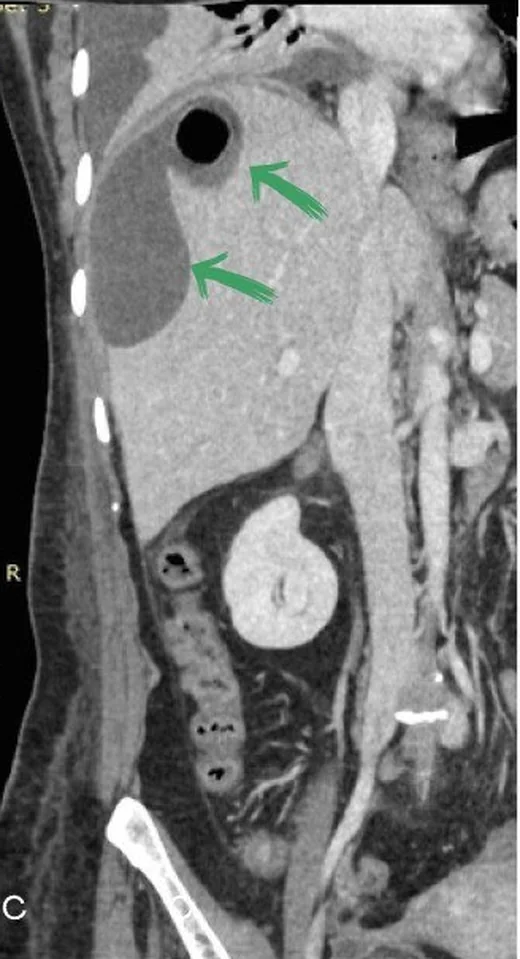
Biliyer sızıntı, safra yolunun cerrahi, endoskopik veya travmatik hasarıyla safranın karaciğer dışına ya da parankim içine geçmesidir; sınırlı safra koleksiyonuna biloma denir. Portal venöz kontrastlı BT ameliyat sonrası veya travma bağlamında koleksiyonun yerini, boyutunu, çevresini ve eşlik eden karaciğer hasarını hızla gösterir; sızıntı yerini çoğunlukla doğrudan kanıtlamaz. Safra kesesi yatağındaki küçük sıvı tek başına beklenen postoperatif değişiklik olabilir, bu nedenle klinik zamanlama ve seri incelemede büyüme önem kazanır. Enfekte koleksiyon veya yaygın biliyer peritonit atlanırsa hastanın kötüleşmesinin nedeni ve ek anatomik hasar gözden kaçabilir.
Faz ve pencere
- Portal tanısal
- Portal venöz fazda safra kesesi yatağı, perihepatik veya intrahepatik düşük atenüasyonlu koleksiyon, çevresel kapsül, peritoneal kalınlaşma/kontrastlanma, gaz ve eşlik eden karaciğer yaralanması araştırılır; bu faz koleksiyon/biloma saptamada tanısaldır, ancak koleksiyon görünümü aktif kaçak odağını tek başına göstermez.
- Kontrastsız
- Koleksiyonun BT'de değerlendirilmesi biloma tanısına katkı sağlar; biloma tanısında ultrasonografi, MR ve hepatobiliyer sintigrafi de kullanılabildiğinden atenüasyon tek başına tanısal kabul edilmemelidir.
Önerilen pencereler: Batın (G 400 / M 50), Karaciğer (G 150 / M 30).
BT bulguları
- Kolesistektomi sonrası safra kesesi yatağında ya da sistik kanal güdüğü çevresinde sınırlı sıvı koleksiyonu; karaciğer cerrahisi sonrasında rezeksiyon yüzüne veya perihepatik alana yerleşebilir.
- BT'de safra kesesi yatağı veya subhepatik bölgede görülen sıvı koleksiyonları biloma açısından değerlendirilir; BT bulguları özgül olmadığından tanı için klinik bilgi ve ek görüntüleme gerekebilir.
- BT ve ultrasonografide biloma tipik olarak dışarıda safra yollarıyla bağlantılı, net sınırlı bir sıvı koleksiyonu olarak izlenir; erken dönem değişiklikleri takip sırasında değerlendirilir.
- Konvansiyonel BT bulguları ve doku analizi, steril koleksiyonlar ile enfekte sıvı toplulukları arasında ayrım yapmada kullanılır; enfeksiyon şüphesi klinik ve laboratuvar verileriyle de desteklenmelidir.
- Seri BT'de düşük atenüasyonlu koleksiyonun büyümesi ya da yeni perihepatik sıvı birikmesi devam eden sızıntı için dolaylı kanıttır.
- Biliyer peritonit, gecikmiş tanının bildirilen komplikasyonları arasındadır.
- Kanal kesintisi, cerrahi klips çevresinde düzensizlik veya karaciğer laserasyonu olası kaynak düzeyini düşündürür; aktif kaçak için hepatobiliyer sintigrafi veya kontrastlı MRCP gerekebilir.
Normalde
Komplike olmayan kolesistektomi sonrası safra kesesi yatağında küçük miktarda basit sıvı görülebilir; normal iyileşme görünümünde belirgin büyüyen, kalın duvarlı veya gaz içeren sınırlı koleksiyon beklenmez. Karaciğer kapsülü ve peritoneal yüzeyler düzgün kalır; safra yollarında yeni kanal kesintisi ya da artan perihepatik sıvı oluşmaz. Kıyaslamada aynı yatağın önceki incelemedeki hacmini, koleksiyon kenarını ve peritoneal yüzey kontrastlanmasını kontrol et.
Normal BT ile kıyasla
Aynı bölgenin, kaynak veri setinde patoloji içermediği belirtilen bir BT incelemesini kesit kesit kaydırın; organ sınırlarını açarak anatomiyi hasta görüntüsüyle karşılaştırın. Küçük rastlantısal bulgular tümüyle dışlanmamıştır.
Kaynak: TotalSegmentator v2.01 veri seti (Wasserthal ve ark., Radiology: Artificial Intelligence 2023), CC BY 4.0, vaka s0541; organ sınırları veri setinin otomatik segmentasyonundan, birleştirilerek sadeleştirildi. Görüntüler 2,5 mm kesit aralığına yeniden örneklendi.
Ayırıcı tanı
- Operasyon sonrası bölgelerde görülen basit sıvı birikimleri beklenen iyileşme sürecinin parçası olabilir; safra kaçağı veya ciddi komplikasyon yoksa bu koleksiyonlar seri görüntülemede stabil seyretmeyi tercih eder.
- Hematoma başlangıçta subkapsüler sıvı koleksiyonu olarak yorumlanabilir; BT'de büyüme saptanırsa biloma da ayırıcı tanıda düşünülmelidir.
- Apse
- ameliyat sonrası gelişebilen komplikasyonlardandır; BT, postoperatif karın içi koleksiyonları ve apseleri değerlendirmede kullanılır.
- Cerrahi sonrası hematom ve biliyer kaçak gibi farklı komplikasyonlar BT ile değerlendirilebilir; biliyer bulguların daha ayrıntılı incelenmesinde MRCP kullanılabilir.
- Karaciğer kistleri genellikle rastlantısal olarak saptanan, sıvı dolu ve net zarla çevrili yapılar olup; operasyon sonrası yeni gelişen patolojik koleksiyonlardan öykü ve görüntüleme bulguları ile ayrılır.
Tuzaklar
- Tek bir BT'de sıvı yoğunluklu koleksiyon bilomayı doğrulamaz; safra sızıntısı fonksiyonel olduğundan aktif ekstravazasyon BT'de seçilmeyebilir.
- Postoperatif küçük hacimli gaz veya sıvı beklenen değişiklik olabilir; artış, duvar düzensizliği ve sistemik enfeksiyon bağlamı olmadan enfekte biloma etiketi koyma.
- BT'deki özgül olmayan bulgular tek başına biliyer kaçağı doğrulamaz; takip incelemelerinde koleksiyonun büyümesi gibi değişiklikler de değerlendirilmelidir.
Kendini dene
Kolesistektomi sonrası safra kesesi yatağında düşük atenüasyonlu koleksiyon, seri BT'de büyüyor; aktif kaçak BT'de görülmüyor. En uygun yorum nedir?
Cevabı göster
Biloma olasılığı yüksek. Ameliyat sonrası büyüyen düşük atenüasyonlu yatak koleksiyonu bilomayı düşündürür; CT sızıntıyı çoğunlukla dolaylı bulgularla gösterir. Hematom daha yoğun olabilir; kist önceden mevcut ve düzgün sınırlıdır; taş koleksiyon oluşturmaz.
Biloma en doğru nasıl tanımlanır?
Cevabı göster
Safra yolları dışında, iyi sınırlı safra koleksiyonu. Biloma, safra yolları dışında bulunan iyi sınırlı safra koleksiyonudur.
Kaynaklar
Bu sayfadaki 35 cümle ve 2 quiz sorusu aşağıdaki kaynaklardan alıntılarla otomatik olarak karşılaştırıldı; 6 cümle bu karşılaştırmada düzeltildi (2026-10-09).
- Refractory Intrahepatic Bile Leak in a Young Patient After Blunt Abdominal Trauma: Technique of Endoscopic Management Using Cyanoacrylate Glue-Lipiodol Combinationpmc.ncbi.nlm.nih.gov
- Biliary leak embolization with conformable embolicpmc.ncbi.nlm.nih.gov
- Post-cholecystectomy Bile Duct Injury in Mexico: Prevention, Diagnosis, Management, and Healthcare System Challengespmc.ncbi.nlm.nih.gov
- Iatrogenic portobiliary fistula treated with covered stent following percutaneous transhepatic biliary drainagepmc.ncbi.nlm.nih.gov
- Spontaneous choledochoduodenal fistula following complete common bile duct transection from penetrating abdominal trauma: an unexpected non-operative resolutionpmc.ncbi.nlm.nih.gov
- Etiology, Diagnosis, and Management of Bilomas: A Current Update.pubmed.ncbi.nlm.nih.gov
- Idiopathic Benign Impulsive Bilomas.pubmed.ncbi.nlm.nih.gov
- Clinical outcomes of primary arterial embolization in severe hepatic trauma: A systematic review.pubmed.ncbi.nlm.nih.gov
- Iatrogenic biliary leak treated by performing exploratory laparoscopic using indocyanine green (ICG) fluorescence. A case report and review of literature.pubmed.ncbi.nlm.nih.gov
- Role of multi-detector computed tomography for biliary complications after liver transplantation.pubmed.ncbi.nlm.nih.gov
- Biloma Secondary to Percutaneous Liver Biopsy Case Report.pubmed.ncbi.nlm.nih.gov
- Spontaneous biloma managed with endoscopic retrograde cholangiopancreatography and percutaneous drainage: a case report.pubmed.ncbi.nlm.nih.gov
- Endoscopic retrograde cholangiopancreatography is an effective treatment for bile leak after severe liver trauma.pubmed.ncbi.nlm.nih.gov
- CT-guided Thermal Ablation of Postoperative Isolated Bile Leakages-Evaluation of Safety and Therapeutic Effectiveness.pubmed.ncbi.nlm.nih.gov
- Biloma: A Rare Manifestation of Spontaneous Bile Leak.pubmed.ncbi.nlm.nih.gov
- Complications of high grade liver injuries: management and outcomewith focus on bile leaks.pubmed.ncbi.nlm.nih.gov
- [Spontaneous retroperitoneal biloma: A case report].pubmed.ncbi.nlm.nih.gov
- Perihepatic Biloma in a Non-cirrhotic Patient After Transjugular Intrahepatic Portosystemic Shunt (TIPS).pubmed.ncbi.nlm.nih.gov
- Comparative Analysis of Laparoscopic and Robotic Cholecystectomy: A Multihospital Retrospective Study.pubmed.ncbi.nlm.nih.gov
- Hepatobiliary-specific magnetic resonance contrast agents: role in biliary trauma.pubmed.ncbi.nlm.nih.gov
- Risk identification and technical modifications reduce the incidence of post-cholecystectomy bile leakage: analysis of 5675 laparoscopic cholecystectomies.pubmed.ncbi.nlm.nih.gov
- Iatrogenic portobiliary fistula treated with covered stent following percutaneous transhepatic biliary drainage.pubmed.ncbi.nlm.nih.gov
- MRI-Derived Evaluation of Liver Function and Its Extension to K-Edge Photon-Counting CT: Focus on Gadolinium-Based Functional Biliary Imaging.pubmed.ncbi.nlm.nih.gov
- Boerhaave Syndrome Caused by Pancreatitis-Induced Gastric Outlet Obstruction: A Case Report.pubmed.ncbi.nlm.nih.gov
- Cross-sectional imaging after pancreatic surgery: The dialogue between the radiologist and the surgeon.pubmed.ncbi.nlm.nih.gov
- Infarcts and ischemia in the abdomen: an imaging perspective with an emphasis on cross-sectional imaging findings.pubmed.ncbi.nlm.nih.gov
- Long-term safety and effectiveness of the "OptEase" vena cava filter.pubmed.ncbi.nlm.nih.gov
- Subhepatic Appendicitis: A Systematic Review of Clinical Presentation, Diagnostic Challenges, and Surgical Management.pubmed.ncbi.nlm.nih.gov
- Hepatico-Duodenal Fistula Following Iatrogenic Strasberg Type E4 Bile Duct Injury: A Case Report.pubmed.ncbi.nlm.nih.gov
- Early cross-sectional imaging following open and laparoscopic cholecystectomy: a primer for radiologists.pubmed.ncbi.nlm.nih.gov
- The 'nick' or 'clip'? A giant hepatic artery pseudoaneurysm complicating laparoscopic cholecystectomy.pubmed.ncbi.nlm.nih.gov
- Bile duct injury: to err is human; to refer is divine.pubmed.ncbi.nlm.nih.gov
- Post-cholecystectomy Bile Duct Injury in Mexico: Prevention, Diagnosis, Management, and Healthcare System Challenges.pubmed.ncbi.nlm.nih.gov
- Spontaneous choledochoduodenal fistula following complete common bile duct transection from penetrating abdominal trauma: an unexpected non-operative resolution.pubmed.ncbi.nlm.nih.gov
- Gallbladder Volvulus: A Great Mimicker of Acute Cholecystitis.pubmed.ncbi.nlm.nih.gov
- A Surgicel™ Surprise: Retained Oxidized Regenerated Cellulose Posing as a Biloma With Retained Gallstones After Subtotal Cholecystectomy.pubmed.ncbi.nlm.nih.gov
- Surgical Techniques: Robotic versus conventional Laparoscopic cholecystectomy IN benign Gallbladder disease: a randomized controlled, open, parallel, non-inferiority, single-center trial (STaRLING trial).pubmed.ncbi.nlm.nih.gov
- Cystic liver lesions: a pictorial review.pubmed.ncbi.nlm.nih.gov
- Post-operative complications of cholecystectomy: what the radiologist needs to know.pubmed.ncbi.nlm.nih.gov
- A Systematic Review about Imaging and Histopathological Findings for Detecting and Evaluating Electroporation Based Treatments Response.pubmed.ncbi.nlm.nih.gov
- Radiological Assessment After Pancreaticoduodenectomy for a Precision Approach to Managing Complications: A Narrative Review.pubmed.ncbi.nlm.nih.gov
- Interventional radiological treatment of hepatocellular carcinoma: an update.pubmed.ncbi.nlm.nih.gov
- CT of acute abdomen in the elderly.pubmed.ncbi.nlm.nih.gov
- Liver-gallbladder anatomical adjacency-related severe infection: a case report of liver abscess rupturing into the gallbladder inducing septic shock and literature review.pubmed.ncbi.nlm.nih.gov
- Intraoperative ultrasound enhancing safety of key steps in complex laparoscopic cholecystectomy: a single-blinded randomized controlled trial.pubmed.ncbi.nlm.nih.gov
- Case report: Clinical analysis and literature review of five cases of metastatic solid pseudopapillary tumor of the pancreas.pubmed.ncbi.nlm.nih.gov
- Severe acute pancreatitis: surgical indications and treatment.pubmed.ncbi.nlm.nih.gov
- Imaging of Abdominal Wall Masses, Masslike Lesions, and Diffuse Processes.pubmed.ncbi.nlm.nih.gov
- International Society of Paediatric Surgical Oncology (IPSO) Surgical Practice Guidelines.pubmed.ncbi.nlm.nih.gov
- Does laparoscopic surgery decrease the risk of atrial fibrillation after foregut surgery?pubmed.ncbi.nlm.nih.gov
- Technical and Clinical Outcome of Low-Milliampere CT Fluoroscopy-Guided Percutaneous Drainage Placement in Abdominal Fluid Collections after Liver Transplantation: A 16-Year Retrospective Analysis of 50 Consecutive Patients.pubmed.ncbi.nlm.nih.gov
- Peritoneal disease: key imaging findings that help in the differential diagnosis.pubmed.ncbi.nlm.nih.gov
- Cancer therapy related complications in the liver, pancreas, and biliary system: an imaging perspective.pubmed.ncbi.nlm.nih.gov
- Imaging panorama in postoperative complications after liver transplantation.pubmed.ncbi.nlm.nih.gov
- ESUR female pelvis group approach to cystic female pelvic lesions.pubmed.ncbi.nlm.nih.gov
- Case Report: From teratoma to adenocarcinoma: molecular insights into somatic-type malignancy in testicular germ cell tumors - two case reports and review of the literature.pubmed.ncbi.nlm.nih.gov
- The Role of CT in the Staging and Follow-Up of Testicular Tumors: Baseline, Recurrence and Pitfalls.pubmed.ncbi.nlm.nih.gov
- A Comprehensive Review of SURGICEL®: Efficacy, Applications, and Radiological Insights in Surgery.pubmed.ncbi.nlm.nih.gov
- Liver Imaging Reporting and Data System (LI-RADS): A Comprehensive Review.pubmed.ncbi.nlm.nih.gov
- Patterns of injury and violence in Yaoundé Cameroon: an analysis of hospital data.pubmed.ncbi.nlm.nih.gov
- Imaging Features of Post Main Hepatectomy Complications: The Radiologist Challenging.pubmed.ncbi.nlm.nih.gov
- Elucidating early CT after pancreatico-duodenectomy: a primer for radiologists.pubmed.ncbi.nlm.nih.gov
- Ultrasound and Cystic Echinococcosis.pubmed.ncbi.nlm.nih.gov
- Post-operative imaging in liver transplantation: state-of-the-art and future perspectives.pubmed.ncbi.nlm.nih.gov
- Imaging after percutaneous thermal and non-thermal ablation of hepatic tumour: normal appearances, progression and complications.pubmed.ncbi.nlm.nih.gov
- CT-Guided Drainage of Fluid Collections Following Liver Resection: Technical and Clinical Outcome of 143 Patients during a 14-Year Period.pubmed.ncbi.nlm.nih.gov
- Postoperative nutritional support after pancreaticoduodenectomy in adults.pubmed.ncbi.nlm.nih.gov
- Iatrogenic-related transplant injuries: the role of the interventional radiologist.pubmed.ncbi.nlm.nih.gov
- Endovascular and percutaneous embolization of hepatic artery pseudoaneurysm: Etiology, embolic agents and technical success, and experience from a single center.pubmed.ncbi.nlm.nih.gov
- Gd-EOB-DTP-enhanced MRC in the preoperative percutaneous management of intra and extrahepatic biliary leakages: does it matter?pubmed.ncbi.nlm.nih.gov
- Shear wave elastography in the differentiation of intra-abdominal hematoma and abscess.pubmed.ncbi.nlm.nih.gov
- Lymphoscintigraphy - Beyond Lymphedema.pubmed.ncbi.nlm.nih.gov
- Post-traumatic biloma intrahepatic a rare complication of closed abdominal trauma: A case report.pubmed.ncbi.nlm.nih.gov
- Complications after Nephron-sparing Interventions for Renal Tumors: Imaging Findings and Management.pubmed.ncbi.nlm.nih.gov
- Sonographic assessment of a suspected biloma: A case report and review of the literature.pubmed.ncbi.nlm.nih.gov
- CT Texture analysis and CT scores for characterization of fluid collections.pubmed.ncbi.nlm.nih.gov
- Benign mass-like lesion at the cholecystectomy bed: A case report of unusual postcholecystectomy imaging findings.pubmed.ncbi.nlm.nih.gov
- Biloma in a cat with cholelithiasis and suspected previous biliary peritonitis due to gallbladder rupture.pubmed.ncbi.nlm.nih.gov
- Demonstration of Hepatic Vein Abnormalities Using Contrast-Enhanced Sonography in Liver Diseases.pubmed.ncbi.nlm.nih.gov
- China Liver Cancer Guidelines for the Diagnosis and Treatment of Hepatocellular Carcinoma (2024 Edition).pubmed.ncbi.nlm.nih.gov
- Emergency, ABO-Incompatible Living Donor Liver Re-Transplantation for Graft Failure Complicated by Pneumonia-Associated Sepsis.pubmed.ncbi.nlm.nih.gov
- Contrast-enhanced ultrasound of transplant organs - liver and kidney - in children.pubmed.ncbi.nlm.nih.gov
- Cholecystogastric fistula masquerading as gastrointestinal stromal tumour: Unusual presentation of gallbladder adenomyomatosis - a case report.pubmed.ncbi.nlm.nih.gov
- Multimodal ultrasound in the diagnosis and treatment of caudate lobe Klebsiella pneumoniae liver abscess complicated by rare gas-containing inferior vena cava thrombosis: a case report.pubmed.ncbi.nlm.nih.gov
- Characterization of a single liver cystic mass: a metastasis of squamous cell carcinoma of the nasopharynx.pubmed.ncbi.nlm.nih.gov
- Transplant Indications in Polycystic Liver and Kidney Diseasepubmed.ncbi.nlm.nih.gov
- MASLD and Pancreatic Diseases: From Shared Mechanisms to Clinical Implications and Future Directions.pubmed.ncbi.nlm.nih.gov
- Three Types of Collateral Arterial Supply to the Spleen After Spleen-Preserving Distal Pancreatectomies with Splenic Vessels Resection-How to Use This Knowledge for Organ(s) Preservation in Locally Advanced and Borderline Resectable Pancreatic Head Cancers Surgery-Hemodynamic, Surgical and Oncological Outcomes of 134 Spleen-Preserving Pancreatectomies.pubmed.ncbi.nlm.nih.gov
- Utility of POCUS (Point of Care Ultrasound) in Renal Transplantation.pubmed.ncbi.nlm.nih.gov
- Clinical efficacy and safety of percutaneous drainage for post-operative fluid collection in patients with bladder cancer undergoing radical cystectomy and urinary diversion.pubmed.ncbi.nlm.nih.gov
- Comprehensive Imaging Insights into Post-Cholecystectomy Complications for Enhanced Clinical Practice.pubmed.ncbi.nlm.nih.gov
- A case report of biliary peritonitis from gallbladder injury: A rare complication of blunt abdominal trauma.pubmed.ncbi.nlm.nih.gov
- Emphysematous conditions of the abdomen and pelvis: pearls and pitfalls.pubmed.ncbi.nlm.nih.gov
- Retractor-related liver injury after surgery: MRI findings in a case.pubmed.ncbi.nlm.nih.gov
- Case Report: Intrahepatic bile duct injury during adhesiolysis mimicking anastomotic leak.pubmed.ncbi.nlm.nih.gov
- Pyogenic Liver Abscess Following Therapeutic Endoscopic Retrograde Cholangiopancreatography (ERCP) and Robot-Assisted Cholecystectomy: A Case Report.pubmed.ncbi.nlm.nih.gov
- A multi-disciplinary review of the potential association between closed-suction drains and surgical site infection.pubmed.ncbi.nlm.nih.gov
- Local-Regional Treatment of Hepatocellular Carcinoma: A Primer for Radiologists.pubmed.ncbi.nlm.nih.gov
- Vascular anomalies associated with hepatic shunting.pubmed.ncbi.nlm.nih.gov
- Gd-EOB-DTPA-MRCP to localize bile leakage after liver trauma and surgery: impact on treatment and outcome.pubmed.ncbi.nlm.nih.gov
- Role of Abdominal Contrast-Enhanced Computed Tomography in Diagnosing Gangrenous Gall Bladder Wall Perforation.pubmed.ncbi.nlm.nih.gov
- Cystic artery embolism after transarterial chemoembolization for hepatocellular carcinoma: A case report and review of the literature.pubmed.ncbi.nlm.nih.gov
- Perigastric appendagitis mimicking biliary colic: Recognition of the central dot sign on CT.pubmed.ncbi.nlm.nih.gov
- Pneumatosis intestinalis revisited: associated imaging findings, clinical correlation, management, risk stratification and future perspectives.pubmed.ncbi.nlm.nih.gov
- Hidden in plain sight: Extrapulmonary manifestations of tuberculosis in Asia.pubmed.ncbi.nlm.nih.gov
- Chronic Subdural Hematoma: Pathophysiology, Diagnosis, and the Emerging Role of Middle Meningeal Artery Embolization.pubmed.ncbi.nlm.nih.gov
- Beyond resection: imaging findings of expected and complicated postoperative changes in lung cancer.pubmed.ncbi.nlm.nih.gov
- Multidisciplinary perspective of hepatocellular carcinoma: A Pacific Northwest experience.pubmed.ncbi.nlm.nih.gov
- Biliary Peritonitis Secondary to Proximal Duodenal Perforation in a Cat.pubmed.ncbi.nlm.nih.gov
- Cecal Perforation Presenting as Apparent Peritoneal Carcinomatosis: Distinguishing Acute Peritonitis From Malignant Mimicry.pubmed.ncbi.nlm.nih.gov
- Temporal evolution of non-contrast CT markers of expansion relates to the dynamics of acute intracerebral hemorrhage.pubmed.ncbi.nlm.nih.gov
- Management of spontaneous abdominal wall hematomas: a narrative review with a focus on CTA-negative endovascular cases.pubmed.ncbi.nlm.nih.gov
- Hydatid cyst of the pancreas: Report of an undiagnosed case of pancreatic hydatid cyst and brief literature review.pubmed.ncbi.nlm.nih.gov
- Eccentric edema pattern preceding postoperative porencephalic cyst formation in subcortical hemorrhage: A case series and literature review.pubmed.ncbi.nlm.nih.gov
- Chronic Expanding Hematoma of the Postmastectomy Axilla: A Pictorial Review of Long-Term Multimodality Imaging.pubmed.ncbi.nlm.nih.gov
Eğitim amaçlıdır; hasta başında tanı ve tedavi kararının yerine geçmez, tıbbi tavsiye değildir. Metinler yapay zekâ desteğiyle yazıldı ve otomatik bir adımda kaynak alıntılarıyla karşılaştırıldı; bu bir tıbbi doğrulama değildir ve içerik uzman radyolog incelemesinden geçmedi. Klinik kararlarda güncel kılavuzları, kurum protokollerini ve radyoloji raporunu esas alın.