Özet
Vertebral arter diseksiyonu spontan gelişebileceği gibi boyun travması sonrasında da ortaya çıkabilir; oksipital-boyun ağrısına posterior dolaşım iskemisi eşlik edebilir. Boyun BT anjiyografi küçük çaplı vertebral arterde lümen daralmasını, intimal flebi ve diseksiyon psödoanevrizmasını gösterebilir. Duvar içi hematom lümen belirgin değişmeden de bulunabileceğinden, kuşku sürüyorsa yağ baskılı damar-duvar MR sekansları tamamlayıcı olabilir. V1’den kafa tabanına uzanan damar, iki taraflı çap ve baziler arter doluşuyla birlikte izlenmelidir. Lezyon hipoplazi ya da akım artefaktı sanılırsa beyin sapı veya serebellar iskemiye yol açan damar hasarı gözden kaçabilir.
Faz ve pencere
- BTA tanısal
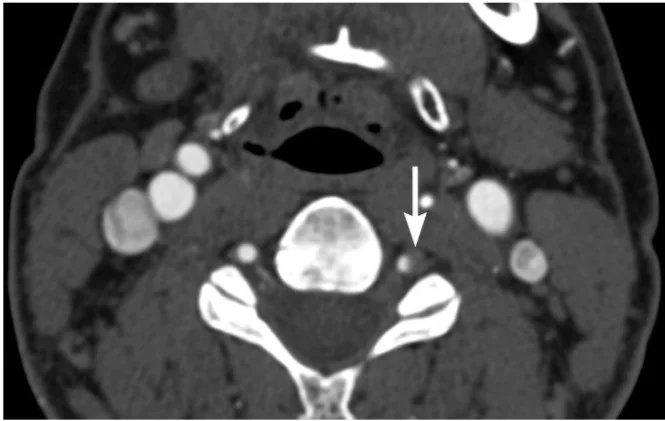
- CTA’da vertebral arterde fokal veya uzun segment daralma, düzgün ya da konik lümen daralması, intimal flep/çift lümen ve psödoanevrizma aranır.
Önerilen pencereler: Anjiyo (G 600 / M 150), Yumuşak doku (G 400 / M 40), Kemik (G 1800 / M 400).
BT bulguları
- V1–V3 segmentinde normal damar kalibresine göre uzun, düzgün konik daralma veya tam opasifikasyon kaybı izlenir.
- Eksantrik lümen daralmasıyla birlikte damar dış çapının büyümesi, duvar içi hematomun oluşturduğu genişlemeyi düşündürür.
- İntimal flep ve birbirinden ayrılan gerçek ve yalancı lümen, CTA’da doğrudan görülebilen güçlü diseksiyon bulgularıdır.
- Damar duvarına komşu kontrast birikimi ya da lümenle devamlı fokal sakküler çıkıntı diseksiyon psödoanevrizmasını gösterir.
- V2’de transvers foramen içindeki damar düzensizliği, komşu servikal kırık veya faset yaralanmasıyla aynı seviyede olabilir.
- Vertebral arterin ekstrakraniyal V1–V3 segmentlerini ve intrakraniyal V4 segmentini baziler arter birleşimine kadar izleyin. Tek zamanlı CTA akım yönünü göstermez; etkilenen arterde retrograd doluş veya akım tersine dönmesini kesinleştiremez.
- Vertebral arter hipoplazisi genellikle tüm damar boyunca diffüz küçük kalibreyle seyreder; segmental daralma ise travmatik vertebral arter yaralanmasını düşündürebilir.
Ölçütler ve sınıflamalar
- Denver/Biffl travmatik BCVI derecelendirmesi
- Derece I: lümen düzensizliği veya <%25 daralma; derece II: >%25 daralma ya da intimal flep veya intralüminal trombüs; derece III: psödoanevrizma; derece IV: oklüzyon; derece V: transeksiyon.
- Denver (Biffl) blunt cerebrovascular injury grading
- Yalnız künt travmatik servikal damar yaralanmalarında kullanılır. Derece I: damar duvarı düzensizliği veya diseksiyon/intramural hematom ile <%25 lümen daralması. Derece II: >%25 daralma ya da intimal flep/intraluminal trombüs eşliğindeki diseksiyon/intramural hematom. Derece III: psödoanevrizma; derece IV: damar oklüzyonu; derece V: transeksiyon. Spontan vertebral arter diseksiyonu bu travma ölçeğiyle derecelendirilmez.
Normalde
Normal vertebral arter, subklavyen arterden köken alıp V1–V3 boyunca düzgün konturla seyreder; transvers foramen içindeki V2 segmentinde opasifikasyon kesintisizdir. Hipoplazi genellikle vertebral arterin tümü boyunca yaygın küçük kalibreyle seyreder ve transvers foramen de küçük olabilir; darlıklar ise segmental olma eğilimindedir.
Normal BT ile kıyasla
Aynı bölgenin, kaynak veri setinde patoloji içermediği belirtilen bir BT incelemesini kesit kesit kaydırın; organ sınırlarını açarak anatomiyi hasta görüntüsüyle karşılaştırın. Küçük rastlantısal bulgular tümüyle dışlanmamıştır.
Kaynak: TotalSegmentator v2.01 veri seti (Wasserthal ve ark., Radiology: Artificial Intelligence 2023), CC BY 4.0, vaka s0622; organ sınırları veri setinin otomatik segmentasyonundan, birleştirilerek sadeleştirildi. Görüntüler 2,5 mm kesit aralığına yeniden örneklendi.
Ayırıcı tanı
- Konjenital vertebral arter hipoplazisi
- küçük damar kalibresi uzun seyir boyunca sabittir; eşlik eden kemik transvers foramen de küçük olabilir.
- Aterosklerotik plaklar intimal flep taklidi yapabilir ve yaşlı hastalarda yanlış pozitif verebilir.
- Akım kaynaklı yalancı diseksiyon
- çift fazlı/karışmış kontrast görünümü damar duvarı boyunca devam etmez ve kaynak kesitlerde gerçek flep doğrulanmaz.
- Vertebral arter ve vertebro-baziler kavşaklarda duplikasyon veya fenestrasyon nadir bir anatomik varyanttır; bu durum TVAI'ye ait çift lümen işareti ile karıştırılmamalıdır.
- Flep, duvar içi hematom veya psödoanevrizma gibi ek yapısal bulgular diseksiyonu destekler.
- Fibromüsküler displazi (FMD) çok odaklı darlık ve tortüoziteyle, aterosklerotik veya ülserli plak ise intimal flep benzeri görünümle diseksiyonu taklit edebilir.
Tuzaklar
- MIP’te şüpheli görünen intimal flep veya çift lümen bulgusunu multiplanar rekonstrüksiyonlarla da değerlendir; birden çok görünüm anatomi ve patolojiyi daha güvenle değerlendirmeye yardımcı olur.
- Hipoplastik arterde kontrastın geç dolması yalancı oklüzyon izlenimi verebilir; V1 kökeninden kafa tabanına kadar sürekliliği ve transvers foramen çapını kontrol et.
- Kötü bolus zamanlaması arteriyel ve venöz kontrastın eşzamanlı görünmesine ve çift lümen izlenimine yol açabilir; dental veya metalik artefaktlar da CTA yorumunu kısıtlayabilir.
- Küçük duvar içi hematomlar CTA’da gözden kaçabilir; MR’da yağ baskılı görüntüleme bu hematomları saptamada daha üstündür.
- İntimal flep veya çift lümen görünümünü multiplanar rekonstrüksiyonlarda doğrulayın; yetersiz bolus zamanlaması ve damar tortüozitesi çift lümen, aterosklerotik veya ülserli plak ise intimal flep izlenimi oluşturabilir.
Kendini dene
Boyun ağrısı sonrası CTA’da C1 düzeyinde eksantrik dar lümen, geniş dış kontur ve ince septum var. En olası tanı?
Cevabı göster
Vertebral arter diseksiyonu. Segmental dar lümenle dış kontur genişlemesi ve septum birlikte duvar ayrışmasını destekler. Hipoplazi genellikle tüm vertebral arter boyunca yaygın küçüklük gösterir; aterosklerotik veya ülserli plaklar CTA’da intimal flebi taklit edebilir.
Sol vertebral arter tüm boyun boyunca ince; transvers foramen de sağdan küçük ve lümen düzgün. Bu görünüm en çok neyi destekler?
Cevabı göster
Vertebral arter hipoplazisi. Damarın ve kemik kanalının birlikte uzun segmentli küçük olması gelişimsel hipoplaziyi destekler. Psödoanevrizma damar dışına kontrastla dolan bir çıkıntı olarak görülebilir; intimal flep çift lümen görünümü oluşturabilir.
Künt boyun travması sonrası vertebral arterde duvar düzensizliği ve <%25 lümen daralması var; intimal flep, trombüs, psödoanevrizma veya oklüzyon yok. Denver BCVI derecesi nedir?
Cevabı göster
Derece I. Denver sınıflamasında <%25 daralmalı duvar düzensizliği derece I’dir. Derece II daha ileri daralma veya intimal flep/trombüs; derece III psödoanevrizma; derece IV oklüzyondur.
Kaynaklar
Bu sayfadaki 52 cümle ve 3 quiz sorusu aşağıdaki kaynaklardan alıntılarla otomatik olarak karşılaştırıldı; 12 cümle bu karşılaştırmada düzeltildi (2026-10-09).
- Traumatic vertebral artery injury: a review of the screening criteria, imaging spectrum, mimics, and pitfallspmc.ncbi.nlm.nih.gov
- Cervical Artery Dissections: Etiopathogenesis and Managementpmc.ncbi.nlm.nih.gov
- A review of carotid and vertebral artery dissection.pubmed.ncbi.nlm.nih.gov
- [Dissection of the cervical arteries].pubmed.ncbi.nlm.nih.gov
- Carotid and Vertebral Dissection Imaging.pubmed.ncbi.nlm.nih.gov
- Cervical Artery Dissections: A Review.pubmed.ncbi.nlm.nih.gov
- Lateral medullary syndrome: a diagnostic approach illustrated through case presentation and literature review.pubmed.ncbi.nlm.nih.gov
- Imaging characteristics of symptomatic vertebral artery dissection: a systematic review.pubmed.ncbi.nlm.nih.gov
- Bilateral Internal Carotid and Left Vertebral Artery Dissection after Blunt Trauma: A Case Report and Literature Review.pubmed.ncbi.nlm.nih.gov
- The Clinical Features of Dissection of the Cervical Brain-Supplying Arteries.pubmed.ncbi.nlm.nih.gov
- High risk and low prevalence diseases: Spontaneous cervical artery dissection.pubmed.ncbi.nlm.nih.gov
- Traumatic vertebral artery injury: a review of the screening criteria, imaging spectrum, mimics, and pitfalls.pubmed.ncbi.nlm.nih.gov
- Dental procedures and stroke: a case of vertebral artery dissection.pubmed.ncbi.nlm.nih.gov
- Vertebral artery dissection in hypertensive disorders of pregnancy: a case series and literature review.pubmed.ncbi.nlm.nih.gov
- Posterior circulation hyperperfusion syndrome after superficial temporal artery-superior cerebellar artery bypass for vertebral artery dissection.pubmed.ncbi.nlm.nih.gov
- Self-inflicted vertebral artery dissection: a case report and review of literature.pubmed.ncbi.nlm.nih.gov
- Proximal and distal endovascular embolization of a penetrating V3 vertebral artery transection with adjunctive surgical ligation: A case report.pubmed.ncbi.nlm.nih.gov
- Contralateral vertebral artery dissection after an unprecedented 14-year interval with a persistent intimal flap: A case report.pubmed.ncbi.nlm.nih.gov
- A Metallic Screw Gun-Traumatic Vertebral Artery Dissection Injury: A Case Report and Literature Review.pubmed.ncbi.nlm.nih.gov
- Vertebral Artery Pseudoaneurysm in a Single-Vessel Posterior Circulation With Chronic Contralateral Occlusion and Recent Methamphetamine Use.pubmed.ncbi.nlm.nih.gov
- Photon-counting detector CT vs energy-integrating detector CT for the diagnosis of arterial dissection in the cervicocerebral region: A single-center case series.pubmed.ncbi.nlm.nih.gov
- Endovascular repair of traumatic innominate artery injury: case report.pubmed.ncbi.nlm.nih.gov
- Postpartum Vertebral Artery Dissection After Neck Massage Resulting in a Right Cerebellar Infarct: A Case Report and Literature Review.pubmed.ncbi.nlm.nih.gov
- Isolated Hypoglossal Nerve Palsy Associated with Internal Carotid Artery Dissection: A Systematic Review.pubmed.ncbi.nlm.nih.gov
- Extracranial Vertebral Artery Dissecting Aneurysm Presenting as Vertebrobasilar Stroke in a Young Adult: Case Report of Flow-Diverter Stenting.pubmed.ncbi.nlm.nih.gov
- Focused view CT angiography for selective visualization of stroke related arteries: technical feasibility.pubmed.ncbi.nlm.nih.gov
- Simultaneous Luminal and Hemodynamic Evaluation of the Cervical Arteries Using Nonenhanced 3D Quantitative Quiescent-Interval Slice-Selective Magnetic Resonance Angiography.pubmed.ncbi.nlm.nih.gov
- Association between fetal-type posterior cerebral artery variants and NIHSS-defined stroke severity in acute posterior circulation infarction.pubmed.ncbi.nlm.nih.gov
- Acute ischemic stroke caused by Percheron artery occlusion after vertebral artery stent placement: a case report.pubmed.ncbi.nlm.nih.gov
- A Guide to Patients with Acute Transient Vestibular Symptoms in the Emergency Department.pubmed.ncbi.nlm.nih.gov
- Middle cerebral artery dissection: pathophysiology, diagnosis, and therapeutic options.pubmed.ncbi.nlm.nih.gov
- Spontaneous Intracranial Vertebral Artery Dissection: A Rare Cause of Ischemic Stroke.pubmed.ncbi.nlm.nih.gov
- CT diagnosis and destiny of acute aortic intramural hematoma.pubmed.ncbi.nlm.nih.gov
- Neuroimaging for neurovascular complications of traumatic brain injury.pubmed.ncbi.nlm.nih.gov
- Operative Procedures for Ultrasound Assessment of Extracranial Artery Disease: A Narrative Review by the Italian Society for Vascular Investigation (SIDV).pubmed.ncbi.nlm.nih.gov
- High-Resolution 3T Intracranial Vessel Wall MRI in Patients Evaluated for Suspected Inflammatory Intracranial Vasculopathy: Morphologic and Follow-Up Findings from a Retrospective Case Series.pubmed.ncbi.nlm.nih.gov
- Giant dissecting aneurysm of the superior mesenteric artery with distal branch involvement and true lumen collapse: a case report.pubmed.ncbi.nlm.nih.gov
- Initial magnetic resonance imaging/magnetic resonance angiography may miss intracranial artery dissection in young adults with stroke: the role of subsequent imaging.pubmed.ncbi.nlm.nih.gov
- Two cases of traumatic aortic isthmus pseudoaneurysm successfully managed with endovascular repair: Multidisciplinary critical care and anesthetic perspective.pubmed.ncbi.nlm.nih.gov
- Severe Recurrent Hemorrhage of an Oncogenic Vertebrobasilar Junction Aneurysm Following Stent-Assisted Coil Embolization in Metastatic Testicular Choriocarcinoma.pubmed.ncbi.nlm.nih.gov
- Thoracic aortic pseudoaneurysm with esophageal compression due to brucellosis: a rare case report.pubmed.ncbi.nlm.nih.gov
- Treatment Strategy for Subaxial Minimal Facet/Lateral Mass Fractures: A Comprehensive Clinical Review.pubmed.ncbi.nlm.nih.gov
- A unique management strategy to bilateral vertebral artery occlusion following cervical trauma: illustrative case.pubmed.ncbi.nlm.nih.gov
- Incidence and outcomes of posterior circulation stroke following traumatic vertebral artery injury: A 6-year single-center retrospective cohort study.pubmed.ncbi.nlm.nih.gov
- Endovascular management of craniospinal arteriovenous fistula causing steal syndrome in neurofibromatosis type 1: a case report.pubmed.ncbi.nlm.nih.gov
- Extra-Carotid Arterial Webs: A Single-Center Series and Systematic Review.pubmed.ncbi.nlm.nih.gov
- Clot Migration after Tenecteplase (TNK): A Potential Cause of Neurological Deterioration in Stroke Patients.pubmed.ncbi.nlm.nih.gov
- Long-term safety and effectiveness of the "OptEase" vena cava filter.pubmed.ncbi.nlm.nih.gov
- Upper cervical chiropractic management of a patient with headaches, neck pain and a history of traumatic internal carotid artery compromise: a case report.pubmed.ncbi.nlm.nih.gov
- Long-term mental health and quality of life in patients after cervical artery dissection.pubmed.ncbi.nlm.nih.gov
- Spontaneous coronary artery dissection and vascular Ehlers-Danlos syndrome: a systematic review and case series.pubmed.ncbi.nlm.nih.gov
- Contemporary Strategies in the Management of Civilian Neck Zone II Vascular Trauma.pubmed.ncbi.nlm.nih.gov
- Commentary: an eye on PET quantification.pubmed.ncbi.nlm.nih.gov
- Congenital Anomalies and Variations of the Carotid and Vertebral Arteries: A Case-Based Imaging Review.pubmed.ncbi.nlm.nih.gov
- Segmental vertebral artery agenesis with deep cervical reconstitution in a cervicothoracic variant cluster.pubmed.ncbi.nlm.nih.gov
- Double vertebral artery-connected persisting proatlantal artery coexisting with a persisting carotid duct in an adult case: first evidence.pubmed.ncbi.nlm.nih.gov
- Enhanced Visualization of Intracranial Cortical Arteries Using Deep Learning Reconstruction in Vessel Wall MR Imaging.pubmed.ncbi.nlm.nih.gov
- A Practical Approach to Intracranial Dural Arteriovenous Fistulas: Pathogenesis, Classification and Management.pubmed.ncbi.nlm.nih.gov
- A machine-learning-based tool for stroke risk prediction in blunt cerebrovascular injury: development and preliminary evaluation.pubmed.ncbi.nlm.nih.gov
- Epidemiology and Screening of Traumatic Vertebral Artery Injuries at a Large Scandinavian Level 1 Trauma Center.pubmed.ncbi.nlm.nih.gov
- An Emergency Medicine Disposition Challenge: A Scoping Review of Isolated Transverse Process Fractures of the Cervical Spine.pubmed.ncbi.nlm.nih.gov
- Clinical Impact of Vertebral Artery Injury Detected by Computed Tomography Angiography in Cervical Trauma : A Neurosurgical Perspective.pubmed.ncbi.nlm.nih.gov
- Angiosuite-Based Awake Closed Reduction With Neurointerventional Standby for Cervical Fracture-Dislocation With Vertebral Artery Injury: A Technical Report.pubmed.ncbi.nlm.nih.gov
- Diagnosis and Management of Pediatric Blunt Cerebrovascular Injuries: A Narrative Review.pubmed.ncbi.nlm.nih.gov
- PFO closure in ischemic stroke: insights from a single-center real-world cohort.pubmed.ncbi.nlm.nih.gov
- Emergency endovascular treatment of stroke due to cervical artery dissection - impact of periprocedural GP IIb/IIIa inhibitor use on clinical outcome.pubmed.ncbi.nlm.nih.gov
- Conference Proceedings: Select Abstracts Presented at the 2025 Advocate Aurora Scientific Day.pubmed.ncbi.nlm.nih.gov
- Society for Cardiovascular Magnetic Resonance/European Society of Cardiovascular Imaging/American Society of Echocardiography/Society for Pediatric Radiology/North American Society for Cardiovascular Imaging Guidelines for the use of cardiovascular magnetic resonance in pediatric congenital and acquired heart disease : Endorsed by The American Heart Association.pubmed.ncbi.nlm.nih.gov
- Society for Cardiovascular Magnetic Resonance/European Society of Cardiovascular Imaging/American Society of Echocardiography/Society for Pediatric Radiology/North American Society for Cardiovascular Imaging Guidelines for the Use of Cardiac Magnetic Resonance in Pediatric Congenital and Acquired Heart Disease: Endorsed by The American Heart Association.pubmed.ncbi.nlm.nih.gov
- Traumatic Vertebral Artery Injury: Diagnosis, Natural History, and Key Considerations for Management.pubmed.ncbi.nlm.nih.gov
- Thoracic trauma WSES-AAST guidelines.pubmed.ncbi.nlm.nih.gov
- The Incidence, Characteristics and Outcomes of Vertebral Artery Injury Associated with Cervical Spine Trauma: A Systematic Review.pubmed.ncbi.nlm.nih.gov
- Drugs for preventing postoperative nausea and vomiting in adults after general anaesthesia: a network meta-analysis.pubmed.ncbi.nlm.nih.gov
- The Vulnerable Conduit: Uncovering Segment-Specific Pathological Susceptibility and Bony Co-dependence of the Vertebral Artery in a South Indian Cohort.pubmed.ncbi.nlm.nih.gov
- Vertebral Artery Hypoplasia and Posterior Circulation Vulnerability: A Systematic Review of Epidemiological, Hemodynamic, and Clinical Evidence.pubmed.ncbi.nlm.nih.gov
- Symptomatic right vertebral artery web treated with stent implantation and 6-month angiographic follow-up.pubmed.ncbi.nlm.nih.gov
- Drug-coated balloon angioplasty for symptomatic vertebral artery origin stenosis: a real-world analysis of efficacy and predictors for bailout stenting.pubmed.ncbi.nlm.nih.gov
- Retrospective analysis of image characteristics of 76 cases of cerebral vascular fenestrations.pubmed.ncbi.nlm.nih.gov
- 2022 ACC/AHA guideline for the diagnosis and management of aortic disease: A report of the American Heart Association/American College of Cardiology Joint Committee on Clinical Practice Guidelines.pubmed.ncbi.nlm.nih.gov
- Physiological and pathophysiological mechanisms of the molecular and cellular biology of angiogenesis and inflammation in moyamoya angiopathy and related vascular diseases.pubmed.ncbi.nlm.nih.gov
- Beyond the "string of beads": case-based exploration of diagnostic pitfalls and solutions in reversible cerebral vasoconstriction syndrome.pubmed.ncbi.nlm.nih.gov
- Reversible cerebral vasoconstriction syndrome: A narrative review.pubmed.ncbi.nlm.nih.gov
- Structural Restoration of an Unruptured Vertebral Artery Dissection Following Autologous Mesenchymal Stem Cell Therapy: A Case Report.pubmed.ncbi.nlm.nih.gov
- CT-Centered Multimodality Imaging of Arterial Wall Fragility in Acute Aortic Syndromes: A Narrative Review of Imaging Markers and Clinical Implications.pubmed.ncbi.nlm.nih.gov
- Vessel wall MR imaging of intracranial atherosclerosis.pubmed.ncbi.nlm.nih.gov
- Multimodal imaging in neuro-ophthalmology.pubmed.ncbi.nlm.nih.gov
- Idiopathic IgG4-negative perivascular fibrosis with extensive thoracic aortic, coronary artery, and supra-aortic branch involvement: A case report.pubmed.ncbi.nlm.nih.gov
- Middle cerebral artery fenestration presenting with cerebral ischemia: a case report and review of the literature.pubmed.ncbi.nlm.nih.gov
- A rare variant of double origin of the left vertebral artery.pubmed.ncbi.nlm.nih.gov
- Left Vertebral Artery Arising Directly From the Arch of the Aorta With a Prevailing Vascular Problem: A Case Report.pubmed.ncbi.nlm.nih.gov
- Sonographic Pearls for Imaging the Brachial Plexus and Its Pathologies.pubmed.ncbi.nlm.nih.gov
- Local pressure as a dominant hemodynamic driver of wall enhancement in anterior communicating artery aneurysms: a facet-level computational fluid dynamics and vessel wall imaging analysis.pubmed.ncbi.nlm.nih.gov
- Imaging of Non-atherosclerotic Vasculopathies.pubmed.ncbi.nlm.nih.gov
- MDCT Imaging of Non-Traumatic Thoracic Aortic Emergencies and Its Impact on Diagnosis and Management-A Reappraisal.pubmed.ncbi.nlm.nih.gov
- SCMR Position Paper (2020) on clinical indications for cardiovascular magnetic resonance.pubmed.ncbi.nlm.nih.gov
- CT Imaging Findings of Pulmonary Artery Stenosis: A Pictorial Review.pubmed.ncbi.nlm.nih.gov
- Cardiovascular and Clinical Manifestations of Marfan Syndrome and Other Inherited Connective Tissue Disorders with Coexisting Genetic Variants.pubmed.ncbi.nlm.nih.gov
- Cranial anatomy, palaeoneurology, palaeobiology and stratigraphic age of the large-bodied ornithopod, <i>Muttaburrasaurus langdoni</i> Bartholomai and Molnar, 1981, from the mid-Cretaceous of Australia.pubmed.ncbi.nlm.nih.gov
- Cryptogenic Multifocal Infarctions Involving Brain and Spinal Cord in a Patient With Patent Foramen Ovale: A Case Report.pubmed.ncbi.nlm.nih.gov
- The persistent proatlantal artery: types and subtypes.pubmed.ncbi.nlm.nih.gov
- Posterior Circulation Stroke After Subclavian Artery Thrombosis Following Low-Voltage Electrical Injury in an Active Woman With Previously Unrecognized Prothrombotic Risk Factors: A Case Report.pubmed.ncbi.nlm.nih.gov
- Angiography-Negative Subarachnoid Hemorrhage Detected After Emergent Percutaneous Coronary Intervention for Non-ST-Segment Elevation Myocardial Infarction: A Case Report.pubmed.ncbi.nlm.nih.gov
- Cannabis-Associated Spontaneous Coronary Artery Dissection in a Community Hospital: A Case-Based Focused Literature Review.pubmed.ncbi.nlm.nih.gov
- Non-invasive Vascular Laboratory Evaluation of the Upper Extremity.pubmed.ncbi.nlm.nih.gov
- Percutaneous transluminal angioplasty for vertebral artery stenosis due to primary central nervous system vasculitis: A case report.pubmed.ncbi.nlm.nih.gov
- Diagnostic challenges in internal carotid artery fenestration: a 78-year-old woman presenting with transient ischemic attack-a case report.pubmed.ncbi.nlm.nih.gov
- Vertebral Artery Dissection and PICA-Territory Stroke Associated with Chronic Atlantoaxial Structural Abnormality: A Case Report.pubmed.ncbi.nlm.nih.gov
- Delayed thrombosis of a ruptured anterior spinal artery aneurysm after prolonged morphological stability: illustrative case.pubmed.ncbi.nlm.nih.gov
- Internal carotid artery fenestration with contralateral internal carotid artery dissection: a case report and literature review.pubmed.ncbi.nlm.nih.gov
- Minimally invasive management of Stanford B aortic dissection involving the left subclavian artery.pubmed.ncbi.nlm.nih.gov
- Craniocervical arterial dissections with cerebral infarction: a five-case series with diagnostic application of vessel wall MRI.pubmed.ncbi.nlm.nih.gov
- Compression Syndromes of the Stylohyoid Complex: Neural, Arterial, and Venous Phenotypes in a Dynamic Neurovascular Corridor.pubmed.ncbi.nlm.nih.gov
Eğitim amaçlıdır; hasta başında tanı ve tedavi kararının yerine geçmez, tıbbi tavsiye değildir. Metinler yapay zekâ desteğiyle yazıldı ve otomatik bir adımda kaynak alıntılarıyla karşılaştırıldı; bu bir tıbbi doğrulama değildir ve içerik uzman radyolog incelemesinden geçmedi. Klinik kararlarda güncel kılavuzları, kurum protokollerini ve radyoloji raporunu esas alın.