Özet
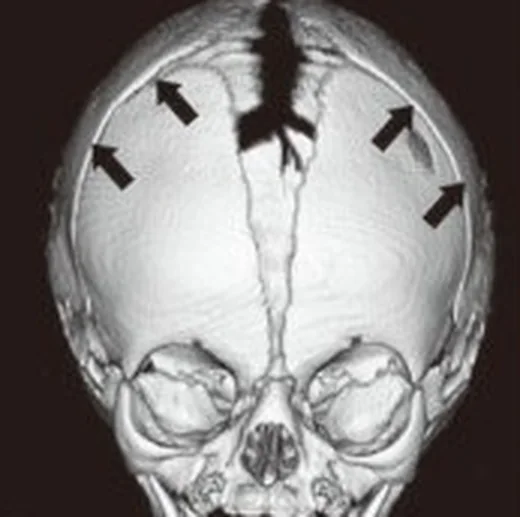
Koronal sütürün erken kemikleşmesi tek taraflı olduğunda ön plagiosefali, iki taraflı olduğunda kısa ve geniş kafa biçimi oluşturur. BT, sütür hattındaki kemik köprüsünü ve buna eşlik eden frontal, orbital ve sfenoid şekil değişikliğini birlikte göstererek tanıyı ve tutulum haritasını netleştirir. Bebeklerde iyonizan radyasyon riski nedeniyle BT, yalnızca gerekli klinik soruları yanıtlamak için ve düşük doz protokolü uygulanarak kullanılır; sütürlerin değerlendirilmesinde yaşa bağlı normal kapanma dönemleri referans alınır. Çoklu sütür tutulumu genellikle sendromiktir ve ek yapısal ve işlevsel komplikasyonlarla birliktedir.
Faz ve pencere
- Kontrastsız tanısal
- İnce kesitli kemik penceresinde frontal-parietal sınırdaki koronal sütürün kesintisiz kemikleşmesi, sütür çizgisinin silinmesi veya kemik köprüsü; tek taraflı olguda aynı tarafta sığ ön kraniyal fossa ve yükselmiş orbital çatı seçilir. İyotlu kontrast tanı için gerekli değildir.
Önerilen pencereler: Kemik (G 1800 / M 400).
BT bulguları
- Koronal sütür boyunca serrasyonlu radyolüsent hattın kaybı ve frontal-parietal kemik arasında kemik köprüleşmesi
- Tek taraflı sinostozda aynı tarafta basık frontal kemik ve sığ ön kraniyal fossa seçilir.
- Karşı frontal kemikte telafi edici kabarıklık; üstten görünümde oblik ön kafa konturu
- İpsilateral orbital çatının ve süperolateral orbital kenarın yükselmesi (harlequin orbit görünümü)
- İpsilateral sfenoid kanadının yükselmesi, karşıya kaymış anterior fontanel ve yüz asimetrisi izlenir.
- İki taraflı sinostozda kısalmış ön-arka kafa çapı, genişlemiş bipariyetal kontur ve iki taraflı orbital çatı yükselmesi
- Sagittal, metopik ve lambdoid gibi diğer sütürlerin tutulum durumları ve kombinasyon paternleri değerlendirilir.
Normalde
Aynı yaş grubundaki normal ince kesitli kemik BT'de koronal sütür frontal ve parietal kemikler arasında ince, kıvrımlı ve radyolüsent bir çizgi olarak izlenir; bebeklik döneminde açıklık ve serrasyonlar beklenir. Sağ ve sol orbital çatıların yüksekliğini, ön kraniyal fossaların derinliğini ve frontal kemik konturunu karşılaştır; tek taraflı sinostoz bu simetriyi bozar.
Normal BT ile kıyasla
Aynı bölgenin, kaynak veri setinde patoloji içermediği belirtilen bir BT incelemesini kesit kesit kaydırın; organ sınırlarını açarak anatomiyi hasta görüntüsüyle karşılaştırın. Küçük rastlantısal bulgular tümüyle dışlanmamıştır.
Kaynak: TotalSegmentator v2.01 veri seti (Wasserthal ve ark., Radiology: Artificial Intelligence 2023), CC BY 4.0, vaka s0103; organ sınırları veri setinin otomatik segmentasyonundan, birleştirilerek sadeleştirildi. Görüntüler 2,5 mm kesit aralığına yeniden örneklendi.
Ayırıcı tanı
- Pozisyonel (postüral) deformitede sütürler açıktır; kemik füzyonu bulunmaz.
- Metopik sinostoz
- orta hatta metopik sütür kapanması ve üçgensi alın vardır; koronal sütürler açık olabilir.
- Bilateral koronal sinostoz
- tek taraflı obliklikten çok kısa- geniş kafa ve iki taraflı orbital deformite yapar.
- Kranial sütür varyantı veya aksesuar sütür
- beklenen anatomik seyirde ince çizgi halinde devam eder ve eşlik eden kompansatuvar kafa biçimi yoktur.
Tuzaklar
- Tek bir kesitte sütürün seçilememesi füzyon kanıtı değildir; ince kesitleri ve çok düzlemli kemik rekonstrüksiyonlarını sütür boyunca izleyin.
- Koronal sütürün erken çocukluk öncesinde fizyolojik kapanması beklenmez; değerlendirme yalnızca çizgi görünürlüğüne değil, kemik köprüsü ve kafa/orbit şekline dayanmalıdır.
- Kafa tabanı asimetrisi ve kısmi sütür tutulumu üç boyutlu yüzey görüntüsünde gözden kaçabilir; aksiyel-koronal kesitlerde sfenoid kanatları ve orbital çatıları da inceleyin.
Kendini dene
Bebekte sağ koronal sütür kemik köprüsüyle kapanmış; sağ orbital çatı yüksek, sol frontal kemik bombeli. En olası tanı nedir?
Cevabı göster
Sağ koronal sinostoz. Koronal sütür füzyonuna aynı tarafta sığ ön fossa ve yükselmiş orbital çatı, karşı tarafta frontal kemik kabarıklığı eşlik eder. Pozisyonel plagiosefalide sütür açık ve tipik orbital çatı yükselmesi yoktur; metopik ve lambdoid tutulum farklı sütür ve kafa bölgelerini etkiler.
İki koronal sütürde de sinostoz var; kafa ön-arka yönde kısa ve iki orbital çatı yükselmiş. Hangi patern beklenir?
Cevabı göster
Bikoronal sinostoz. İki taraflı koronal füzyon ön-arka büyümeyi kısıtlayarak kısa-geniş kafa ve bilateral orbital deformite oluşturur. Sagittal sinostoz uzun-dar kafa yapar; metopik ridge orta hat bulgusudur ve pozisyonel deformitede sütürler açıktır.
Kaynaklar
Bu sayfadaki 35 cümle ve 2 quiz sorusu aşağıdaki kaynaklardan alıntılarla tek tek karşılaştırıldı; 8 cümle bu karşılaştırmada düzeltildi (2026-10-08).
- Craniosynostosis : Updates in Radiologic Diagnosispmc.ncbi.nlm.nih.gov
- Orbital volume, ophthalmic sequelae and severity in unilateral coronal synostosispmc.ncbi.nlm.nih.gov
- Talocalcaneal coalition in Muenke syndrome: report of a patient, review of the literature in FGFR-related craniosynostoses, and consideration of mechanism.pubmed.ncbi.nlm.nih.gov
- Quantification of Severity of Unilateral Coronal Synostosis.pubmed.ncbi.nlm.nih.gov
- Quantification of Bilateral Coronal Synostosis: Anterior Brachycephaly.pubmed.ncbi.nlm.nih.gov
- Early treatment of coronal synostosis with endoscopy-assisted craniectomy and postoperative cranial orthosis therapy: 16-year experience.pubmed.ncbi.nlm.nih.gov
- Morphological comparison of the craniofacial phenotypes of mouse models expressing the Apert FGFR2 S252W mutation in neural crest- or mesoderm-derived tissues.pubmed.ncbi.nlm.nih.gov
- Assessing Facial Asymmetry in Postoperative Patients With Unilateral Coronal Craniosynostosis.pubmed.ncbi.nlm.nih.gov
- The Relationship between Brachycephalic Head Features in Modern Persian Cats and Dysmorphologies of the Skull and Internal Hydrocephalus.pubmed.ncbi.nlm.nih.gov
- Sinus pericranii associated with syntelencephaly: a case report.pubmed.ncbi.nlm.nih.gov
- Objective Analysis of Fronto-Orbital Dysmorphology in Unilateral Coronal Craniosynostosis.pubmed.ncbi.nlm.nih.gov
- Current Trends in Management of Nonsyndromic Unilateral Coronal Craniosynostosis: A Cross-sectional Survey.pubmed.ncbi.nlm.nih.gov
- Craniometric Analysis of Endoscopic Suturectomy for Bilateral Coronal Craniosynostosis.pubmed.ncbi.nlm.nih.gov
- Intracranial volume in 15 children with bilateral coronal craniosynostosis.pubmed.ncbi.nlm.nih.gov
- Postsurgical Changes in Osseous Dysmorphology of the Midface and Mandible in Unilateral Coronal Craniosynostosis.pubmed.ncbi.nlm.nih.gov
- Craniofacial Dysmorphology in Infants With Non-Syndromic Unilateral Coronal Craniosynostosis.pubmed.ncbi.nlm.nih.gov
- Clinical and molecular characterization of TCF12 variants in an Asian pediatric cohort with craniosynostosis.pubmed.ncbi.nlm.nih.gov
- Helmet Therapy for Deformational Plagiocephaly: Clinical Outcomes and Considerations.pubmed.ncbi.nlm.nih.gov
- A Unique Case of Pure Bilateral Lambdoid Craniosynostosis and Progression to Mercedes-Benz Syndrome Following Spring Cranioplasty.pubmed.ncbi.nlm.nih.gov
- Inhibition of craniosynostosis and premature suture fusion in <i>Twist1</i> mutant mice with RNA nanoparticle gene therapy.pubmed.ncbi.nlm.nih.gov
- Developments in diagnostic and surgical techniques in children with sagittal suture craniosynostosis: a systematic review spanning the last 30 years.pubmed.ncbi.nlm.nih.gov
- Surgical Treatment for Scaphocephaly Using a Modified Melbourne Technique in Mexico: An Illustrative Case and Literature Review.pubmed.ncbi.nlm.nih.gov
- Non-syndromic craniosynostosis: contemporary concepts in biology, diagnosis, and distraction-based operative strategy.pubmed.ncbi.nlm.nih.gov
- Cranial Bone Density and Scalp Perfusion in Positional Plagiocephaly: Quantitative Assessment Using Low-Dose Computed Tomography.pubmed.ncbi.nlm.nih.gov
- Imaging Modalities in Craniosynostosis: A Systematic Review and Proposal of the ARCANA Protocol for Multimodal Radiation-Free Assessment.pubmed.ncbi.nlm.nih.gov
- Syndromic craniosynostosis: current concepts in intracranial hypertension, cranial base pathology, and surgical management.pubmed.ncbi.nlm.nih.gov
- Multisuture craniosynostosis and acquired Chiari malformation secondary to vitamin D deficiency rickets: illustrative case.pubmed.ncbi.nlm.nih.gov
- When Virchow's law fails: Crouzon syndrome as a test case for quantitative suture closure-endocranial shape relationships.pubmed.ncbi.nlm.nih.gov
- Cranial anatomy, palaeoneurology, palaeobiology and stratigraphic age of the large-bodied ornithopod, <i>Muttaburrasaurus langdoni</i> Bartholomai and Molnar, 1981, from the mid-Cretaceous of Australia.pubmed.ncbi.nlm.nih.gov
- Local delivery of FTY720 accelerates cranial allograft incorporation and bone formation.pubmed.ncbi.nlm.nih.gov
- Commentary: an eye on PET quantification.pubmed.ncbi.nlm.nih.gov
- Deep learning-based craniosynostosis classification via suture segmentation and mask-weighted classification.pubmed.ncbi.nlm.nih.gov
- Renier H-cranioplasty Modifies Skull Shape More Than Total Vault Remodeling in Nonsyndromic Scaphocephaly: Artificial Intelligence-based Study.pubmed.ncbi.nlm.nih.gov
- Emphasis on Early Prenatal Diagnosis and Perinatal Outcomes Analysis of Apert Syndrome.pubmed.ncbi.nlm.nih.gov
- Multisuture and Syndromic Craniosynostoses: Simplifying the Complex.pubmed.ncbi.nlm.nih.gov
- Neuroimaging in Kabuki syndrome and another KMT2D-related disorder.pubmed.ncbi.nlm.nih.gov
- Evaluation and Management of Nonsyndromic Craniosynostosis.pubmed.ncbi.nlm.nih.gov
- Distraction in anterior plagiocephaly: technique, risks, and long-term results.pubmed.ncbi.nlm.nih.gov
- Craniosynostosis incidence with abnormalities of orbital axis on patients under 8 years old.pubmed.ncbi.nlm.nih.gov
- Endoscopic-assisted Surgery in the Treatment of Isolated Frontosphenoidal Craniosynostosis.pubmed.ncbi.nlm.nih.gov
- Comparison of Cranial Vault Remodeling Versus Spring Cranioplasty for Nonsyndromic Unicoronal Craniosynostosis: Analysis of Outcomes.pubmed.ncbi.nlm.nih.gov
- Surgical Correction of Unicoronal Synostosis: Fronto-Orbital Distraction versus Calvarial Switch.pubmed.ncbi.nlm.nih.gov
- The 27 Facial Sutures: Timing and Clinical Consequences of Closure.pubmed.ncbi.nlm.nih.gov
- TGFβ-mediated dural progenitor cell migration into the coronal suture is crucial for preventing craniosynostosis.pubmed.ncbi.nlm.nih.gov
- Endoscopy in Craniosynostosis Surgery: Evolution and Current Trends.pubmed.ncbi.nlm.nih.gov
- Neurocognitive outcomes in children with craniosynostosis after surgical correction: a narrative review.pubmed.ncbi.nlm.nih.gov
- Neuroimaging in Nonsyndromic Craniosynostosis: Key Concepts to Unlock Innovation.pubmed.ncbi.nlm.nih.gov
- Exploring Different Management Modalities of Nonsyndromic Craniosynostosis.pubmed.ncbi.nlm.nih.gov
- Diagnosis of infant synostotic and nonsynostotic cranial deformities: a review for pediatricians.pubmed.ncbi.nlm.nih.gov
- Patterns of injury and violence in Yaoundé Cameroon: an analysis of hospital data.pubmed.ncbi.nlm.nih.gov
- Total laparoscopic radical hysterectomy for cervical cancer in prolapsed uterus.pubmed.ncbi.nlm.nih.gov
- The influence of closed sutures on cranial morphology in Apert and Crouzon syndromes: A quantitative analysis.pubmed.ncbi.nlm.nih.gov
- Preclinical modeling of Loeys-Dietz syndrome: insights into mechanisms and therapy.pubmed.ncbi.nlm.nih.gov
- Rare Diseases of the Orbit.pubmed.ncbi.nlm.nih.gov
- Artificial Intelligence Applications in Pediatric Craniofacial Surgery.pubmed.ncbi.nlm.nih.gov
- Review of imaging modalities and radiological findings of calvarial lesions.pubmed.ncbi.nlm.nih.gov
- Visual outcome in 5-year-old children operated for non-syndromic craniosynostosis.pubmed.ncbi.nlm.nih.gov
- Embryodysgenesis of the Lids and Orbit.pubmed.ncbi.nlm.nih.gov
- Craniosynostosis : Updates in Radiologic Diagnosis.pubmed.ncbi.nlm.nih.gov
- A modified approach to surgical correction of anterior plagiocephaly.pubmed.ncbi.nlm.nih.gov
- Syndromic craniosynostosis.pubmed.ncbi.nlm.nih.gov
- Acrocephalosyndactyly, Apert type, in a newborn: Cerebral sonography.pubmed.ncbi.nlm.nih.gov
- Phenotypic heterogeneity in Crouzon syndrome: A case of severe intracranial hypertension from isolated temporal squamosal suture synostosis with a de novo FGFR2 p.Cys342Tyr mutation.pubmed.ncbi.nlm.nih.gov
- Genetics versus environment in the pathophysiology of sagittal synostosis.pubmed.ncbi.nlm.nih.gov
- Preservation versus Structural Cranioplasty: A New Concept for Craniosynostosis Treatment.pubmed.ncbi.nlm.nih.gov
- Genetic Disorders Detectable by Fetal MRI: A Review.pubmed.ncbi.nlm.nih.gov
- Geometric Morphometric Study on Distinguishing Metopic Craniosynostosis from Metopic Ridging.pubmed.ncbi.nlm.nih.gov
- Craniosynostosis in Patients With X-Linked Hypophosphatemia: A Review.pubmed.ncbi.nlm.nih.gov
- Neuro-Ophthalmological Manifestations of Craniosynostosis: Current Perspectives.pubmed.ncbi.nlm.nih.gov
- Atypical Presentation of Undiagnosed Crouzon's Syndrome With Pansinusitis, Orbital Cellulitis, and Altered Mentation Successfully Managed With Functional Endoscopic Sinus Surgery: A Case Report.pubmed.ncbi.nlm.nih.gov
- Clinical and genetic features of syndromic craniosynostosis in 18 Chinese probands: novel candidate genes and phenotypes of known pathogenic genes.pubmed.ncbi.nlm.nih.gov
- Difference in anterior fontanelle closure between non-syndromic craniosynostosis and normal controls: a retrospective cross-sectional study.pubmed.ncbi.nlm.nih.gov
- Three contrasts in 3 min: Rapid, high-resolution, and bone-selective UTE MRI for craniofacial imaging with automated deep-learning skull segmentation.pubmed.ncbi.nlm.nih.gov
- Genetic advances in craniosynostosis.pubmed.ncbi.nlm.nih.gov
- Normative data for interorbital distance in a paediatric Caucasian population.pubmed.ncbi.nlm.nih.gov
- Current State-of-the-Art 3D MRI Sequences for Assessing Bone Morphology with Emphasis on Cranial and Spinal Imaging: A Narrative Review.pubmed.ncbi.nlm.nih.gov
- European recommendations on practices in pediatric neuroradiology: consensus document from the European Society of Neuroradiology (ESNR), European Society of Paediatric Radiology (ESPR) and European Union of Medical Specialists Division of Neuroradiology (UEMS).pubmed.ncbi.nlm.nih.gov
- Total Cranial Vault Remodeling Using Multidirectional Cranial Distraction Osteogenesis in Craniosynostosis.pubmed.ncbi.nlm.nih.gov
- Modern technology complements classic technique: 3D-printed inter-locking cutting guides for frontal sinus osteoma resection and reconstruction with split-calvarial bone graft.pubmed.ncbi.nlm.nih.gov
- Definitive reconstruction of frontal asymmetry in an adolescent with anterior plagiocephaly due to unilateral coronal craniosynostosis using a hybrid osteo-titanium technology based on an individualized approach: A case report.pubmed.ncbi.nlm.nih.gov
- Unilateral Versus Bilateral Fronto-Orbital Advancement in Non-Syndromic Unicoronal Craniosynostosis: A Systematic Review and Pooled Data Analysis.pubmed.ncbi.nlm.nih.gov
- Prevalence of motor development delay in children with craniosynostosis: a systematic review and meta-analysis.pubmed.ncbi.nlm.nih.gov
- Jansen metaphyseal chondrodysplasia: analysis of craniofacial manifestations.pubmed.ncbi.nlm.nih.gov
- Ocular Hypertelorism: Principles and Management.pubmed.ncbi.nlm.nih.gov
- Utilization of spectral filteration for ultra-low dose brain CT in pediatric patients for diagnosis of craniosynostosis: A phantom study.pubmed.ncbi.nlm.nih.gov
- Digital Twins as the Implementation Layer of Precision Medicine in Pediatric Neurosurgery.pubmed.ncbi.nlm.nih.gov
- Craniofacial Morphology and Dental Age Assessment in Pediatric Craniosynostosis: A Comparative Cross-Sectional Study.pubmed.ncbi.nlm.nih.gov
- Cranial nerves involvement in craniosynostosis: a systematic review.pubmed.ncbi.nlm.nih.gov
- Endoscopic-assisted versus open fronto-orbital distraction for unicoronal craniosynostosis: morphometric and technique considerations.pubmed.ncbi.nlm.nih.gov
- Craniosynostosis: Experience From a Single Tertiary Center in India.pubmed.ncbi.nlm.nih.gov
- Divergent Mechanisms of Cranial Suture Ossification in Normal Development and Pathologic Fusion.pubmed.ncbi.nlm.nih.gov
- Successful Delayed Elective Separation of Pygopagus Conjoined Twins With Shared Spinal Cord and Dura in a Resource-Limited Setting: A Case Report.pubmed.ncbi.nlm.nih.gov
- Sonographic markers for early diagnosis of fetal malformations.pubmed.ncbi.nlm.nih.gov
- Factors Associated with Helmet Therapy Outcomes in Positional Plagiocephaly.pubmed.ncbi.nlm.nih.gov
- Case Report: Three-dimensional characteristics of craniofacial morphology in facial asymmetry due to unilateral coronal synostosis.pubmed.ncbi.nlm.nih.gov
- Positional plagiocephaly: results of the osteopathic treatment of 424 infants. An observational retrospective cohort study.pubmed.ncbi.nlm.nih.gov
- Microcephaly, Agenesis of the Corpus Callosum, and Suspected Blake Pouch Cyst Presenting With Failure to Thrive in an Infant.pubmed.ncbi.nlm.nih.gov
Eğitim amaçlıdır; hasta başında tanı ve tedavi kararının yerine geçmez. İçerik yapay zekâ destekli bir süreçle güncel literatüre göre cümle cümle kaynaklarla karşılaştırıldı, ancak uzman radyolog incelemesinden geçmedi. Klinik kararlarda güncel kılavuzları, kurum protokollerini ve radyoloji raporunu esas alın.