Özet
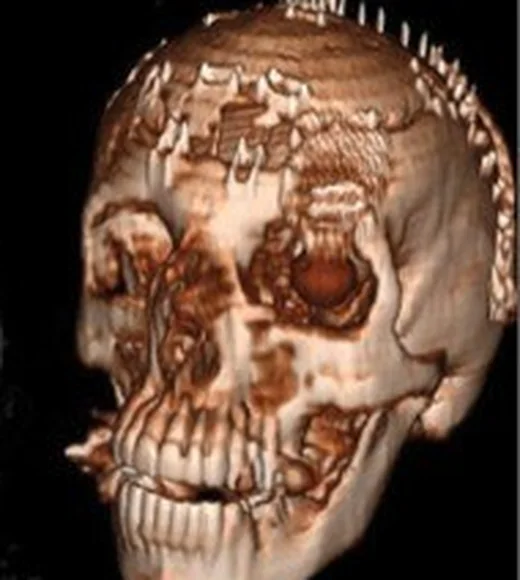
Kraniyotomi veya kraniyoplasti öyküsü olan hastada BT, kemik flebinin beklenen konturunu ve ameliyat sahası çevresindeki akut değişiklikleri gösterir. Postoperatif BT'de cerrahi yatakta az miktarda hava görülebilir ve genellikle birkaç hafta içinde veya daha kısa sürede geriler; ilerleyici basınçlanma gelişirse tansiyon pnömosefali söz konusu olabilir. Postkraniyoplasti enfeksiyonu yara ayrışması ve pürülan akıntıyla ortaya çıkabilir. Bu ayrım gözden kaçarsa normal iyileşme komplikasyon sanılabilir veya derin enfeksiyon ve ekstraaksiyel ampiyem atlanabilir.
Faz ve pencere
- Kontrastsız tanısal
- Kemik flebinin ve kraniyotomi hattının incelenmesinde kontrastsız BT yeterlidir; hava çok düşük atenüasyonlu, akut kanama ise çoğunlukla beyin parankiminden daha hiperdens görünür. Flep kenarındaki remodeling, litik odaklar, pnömosefali ve ekstraaksiyel koleksiyonun yoğunluğu birlikte değerlendirilir.
Önerilen pencereler G genişlik, M merkez; değerler Hounsfield birimi (HU)
- KemikG 1800 / M +400
- BeyinG 80 / M +40
- SubduralG 200 / M +75
- Yumuşak dokuG 400 / M +40
BT bulguları
- Kraniyotomi hattı — erken dönemde keskin, iyi sınırlı ve bazen paralel tram-track kenarlar; geç dönemde düzgün yuvarlak remodeling.
- Kemik flebi — cerrahi boşluğa oturan, kalvaryum konturunu izleyen yeniden yerleştirilmiş segment; vida veya plaklar eşlik edebilir.
- Flep rezorpsiyonu — flep kalınlığında azalma ve yamalı litik alanlar; seri BT'de ilerleme klinik bağlamda anlam kazanır.
- Postkraniyoplasti cerrahi alan enfeksiyonu yara ayrışması ve pürülan akıntıyla ortaya çıkabilir.
- Kraniyotomi sonrası BT'de cerrahi saha komşuluğunda ekstraaksiyel kan ve hava görülebilir; seri incelemelerde koleksiyonun boyutu ve eşlik eden orta hat kayması izlenebilir.
- Postoperatif pnömosefali — cerrahi sahaya yakın ekstraaksiyel hava; yeni kitle etkisi veya artış eski görüntüyle karşılaştırılmalıdır.
Normalde
Ameliyat görmemiş aynı düzey kalvaryumda dış ve iç korteks kesintisizdir; kraniyotomiye ait keskin sınırlı kemik penceresi, flep aralığı, tespit materyali ve cerrahi saha havası bulunmaz. Karşılaştırırken kemik flebinin kalınlığını ve kenar düzenini karşı taraf kalvaryumuyla, litik alanların ve yumuşak doku değişikliklerinin önceki incelemeye göre artıp artmadığını seri BT ile kıyasla.
Normal BT ile kıyasla
Aynı bölgenin, kaynak veri setinde patoloji içermediği belirtilen bir BT incelemesini kesit kesit kaydırın; organ sınırlarını açarak anatomiyi hasta görüntüsüyle karşılaştırın. Küçük rastlantısal bulgular tümüyle dışlanmamıştır.
Kaynak: TotalSegmentator v2.01 veri seti (Wasserthal ve ark., Radiology: Artificial Intelligence 2023), CC BY 4.0, vaka s0103; organ sınırları veri setinin otomatik segmentasyonundan, birleştirilerek sadeleştirildi. Görüntüler 2,5 mm kesit aralığına yeniden örneklendi.
Ayırıcı tanı
- Kemik flebi rezorpsiyonu
- flep incelmesi ve çok odaklı kayıp; progresyon seri incelemelerde belirginleşir.
- Cerrahi alan enfeksiyonu/osteomiyelit
- düzensiz kemik değişikliğine cilt kalınlaşması, yağlı planlarda kirlenme veya subgaleal-ekstradural koleksiyonun eşlik etmesi destekler.
- Radyasyon veya tümör ilişkili kemik değişikliği
- cerrahi sınırlara uymayan destrüksiyon ya da eşlik eden yumuşak doku kitlesi düşündürür.
- Kraniektomi
- kemik flebi geri konmamıştır; açıklık üzerinde yumuşak dokular ve olası beyin herniasyonu görülür.
- Postoperatif hematom
- koleksiyonun yoğunluğu ve şekli kan ürünleriyle uyumlu olabilir; enfeksiyondan ayrım için kontrastlı inceleme veya MR gerekebilir.
Tuzaklar
- Küçük postoperatif pnömosefali tek başına enfeksiyon değildir; kemik ve yumuşak doku bulguları ile ameliyat zamanlamasını birlikte oku.
- Flep kenarlarının geç dönemde düzgün yuvarlaklaşması remodeling olabilir; düzensiz lizis ve çevre koleksiyon yokken bunu otomatik olarak osteomiyelit sayma.
- Kontrastsız BT koleksiyonun steril sıvı mı ampiyem mi olduğunu kesinleştirmez; klinik kuşku varsa kontrastlı BT veya difüzyon MR bulguları gerekir.
- Postoperatif ekstraaksiyel koleksiyonun niteliği görüntülemeyle her zaman kesinleşmeyebilir; kontrastlı MR'da dural kontrastlanma olsa bile subdural ampiyem dışlanamayabilir.
Kendini dene
Postoperatif kraniyal BT'de cerrahi yatağında az miktarda hava görülmesi en uygun nasıl yorumlanır?
Cevabı göster
Birkaç hafta içinde veya daha kısa sürede gerileyebilen, kendini sınırlayan postoperatif pnömosefali. Cerrahi yatağında az miktarda postoperatif hava görülebilir; bu hava genellikle kendini sınırlar ve birkaç hafta içinde veya daha kısa sürede geriler.
Postkraniyoplasti sonrası cerrahi alan enfeksiyonu bildirilen bir olguda hangi yara bulguları görülmüştür?
Cevabı göster
Yara kenarlarının açılması ve pürülan akıntı. Bir olguda kraniyoplastiden dört ay sonra yara ayrışması ve pürülan akıntı görülmüş; intrakraniyal ve saçlı deri enfeksiyonu tanısı konmuştur.
Kaynaklar
Bu sayfadaki 32 cümle ve 2 quiz sorusu aşağıdaki kaynaklardan alıntılarla otomatik olarak karşılaştırıldı; 12 cümle bu karşılaştırmada düzeltildi (2026-10-09).
- Cost-effective reconstruction of long-standing lateral orbital rim defect with bone-prelaminated forehead flap using iliac crestpmc.ncbi.nlm.nih.gov
- Craniospinal cerebrospinal fluid volume changes after extreme bilateral frontotemporoparietal craniectomy and cranioplasty: a volumetric magnetic resonance imaging case reportpmc.ncbi.nlm.nih.gov
- Treatment strategies and prognostic outcomes in craniosynostosis with concurrent hydrocephalus: a case seriespmc.ncbi.nlm.nih.gov
- Treatment and Clinical Course of a Massive Malignant Proliferating Trichilemmal Tumorpmc.ncbi.nlm.nih.gov
- Intentional Self-Inflicted Transcranial Screwdriver Injury: A Case Reportpmc.ncbi.nlm.nih.gov
- Evaluation of skull bone viability and effect of early surgical intervention in electrical contact burns using 18 F-Sodium Fluoride PET-CT imaging.pubmed.ncbi.nlm.nih.gov
- Role of the "In-Window" Craniectomy in the Management of Serious Head Trauma: 12 Case Series, Technical Note, Literature Review, and Comparison With Other Surgical Managements.pubmed.ncbi.nlm.nih.gov
- Minimally invasive resection of a spheno-orbital tumor: Review of surgical techniques and a case report.pubmed.ncbi.nlm.nih.gov
- How I do it - exoscopic retractorless anterior skull base reconstruction using a pedicled pericranial flap for post-traumatic CSF leak.pubmed.ncbi.nlm.nih.gov
- Obesity and Skull Base Manifestations: Clinical Implications and Management.pubmed.ncbi.nlm.nih.gov
- A rare combination of a meningioma and an ethmoidal meningoencephalocele with osteo-dural defect: Diagnostic and therapeutic challenges.pubmed.ncbi.nlm.nih.gov
- Combined Interhemispheric and Endoscopic Endonasal Resection of a Rare Olfactory Schwannoma with Preservation of Olfactory Function.pubmed.ncbi.nlm.nih.gov
- Osteogenic biodegradable plates for cranioplasty in 6 patients across different age groups: clinical failure of promising concept? Patient series.pubmed.ncbi.nlm.nih.gov
- Shoulder complications in sickle cell disease: Challenges, management strategies, and future directions.pubmed.ncbi.nlm.nih.gov
- Sternoclavicular Joint Tracheal Fistula: An Unusual Postradiation Complication in a Laryngectomee.pubmed.ncbi.nlm.nih.gov
- Supramaximal Resection in Glioblastoma: Expanding Surgical Boundaries in the Era of Precision Neuro-Oncology-A Systematic Review.pubmed.ncbi.nlm.nih.gov
- Diagnostic imaging and emerging image-guided neurointervention in brain tumors: a narrative review.pubmed.ncbi.nlm.nih.gov
- Radiation Necrosis in Neuro-Oncology: Diagnostic Complexity and Precision Radiotherapy Strategies.pubmed.ncbi.nlm.nih.gov
- Intentional Self-Inflicted Transcranial Screwdriver Injury: A Case Report.pubmed.ncbi.nlm.nih.gov
- Epidural hematoma in a pediatric patient with Hutchinson-Gilford progeria syndrome: management considerations: a case report.pubmed.ncbi.nlm.nih.gov
- Surgical strategy to minimize dominant hemisphere retraction in an asymmetric giant tuberculum sellae meningioma with contralateral anterior cerebral artery positioning: A case report.pubmed.ncbi.nlm.nih.gov
- From Seizure to Cerebral Actinomycosis: A Deceptive Case and an Unexpected Diagnosis Behind a Pseudotumoral Lesion.pubmed.ncbi.nlm.nih.gov
- Aneurysm formation and postcoiling recurrence in HIV-associated vasculopathy: illustrative case.pubmed.ncbi.nlm.nih.gov
- Review of Fusariosis in Patients with Hematologic Malignancies.pubmed.ncbi.nlm.nih.gov
- Reconstruction of an orbital fracture in a mare using a 3D-printed patient-specific implant.pubmed.ncbi.nlm.nih.gov
- Patient-Specific Solutions for Cranial, Midface, and Mandible Reconstruction Following Ablative Surgery: Expert Opinion and a Consensus on the Guidelines and Workflow.pubmed.ncbi.nlm.nih.gov
- Osteotomies: Indications, Imaging Appearance, Surgical Techniques, and Complications.pubmed.ncbi.nlm.nih.gov
- Autologous skull graft resorption following cranioplasty: a case report and literature review.pubmed.ncbi.nlm.nih.gov
- Sonolucent Cranioplasties in Young Children: Technical Nuances and Challenges.pubmed.ncbi.nlm.nih.gov
- Microvascular reconstruction of aggressive mandibular desmoplastic fibroma in a child: case report.pubmed.ncbi.nlm.nih.gov
- Review of imaging modalities and radiological findings of calvarial lesions.pubmed.ncbi.nlm.nih.gov
- Comprehensive review of post-treatment imaging in head and neck cancers: from expected to unexpected and beyond.pubmed.ncbi.nlm.nih.gov
- High-affinity alphavbeta3 integrin targeted optical probe as a new imaging biomarker for early atherosclerosis: initial studies in Watanabe rabbits.pubmed.ncbi.nlm.nih.gov
- Antegrade Concorde position for leveraging the lateral supracerebellar infratentorial approach.pubmed.ncbi.nlm.nih.gov
- Intercontinental aeromedical transfers after decompressive craniectomy for severe traumatic brain injury: Systematic review and evidence-informed fitness-to-fly pathway.pubmed.ncbi.nlm.nih.gov
- Acute subdural hematoma in Anaplasma phagocytophilum infection: illustrative case.pubmed.ncbi.nlm.nih.gov
- Nano-flow intracalvariosseous infusion enables skull-to-brain delivery of BBB-impermeable molecular and nanoscale agents in mice and rabbits.pubmed.ncbi.nlm.nih.gov
- Dynamic Changes in Optic Nerve Sheath Diameter on Computed Tomography Predict Decompressive Efficacy and Outcomes in Severe Traumatic Brain Injury.pubmed.ncbi.nlm.nih.gov
- Evaluation and Management of Nonsyndromic Craniosynostosis.pubmed.ncbi.nlm.nih.gov
- Bone regeneration using activin A/BMP2 chimera (AB204) with collagen membrane in rats with calvarial defects.pubmed.ncbi.nlm.nih.gov
- Surgical Removal of Cranial Calcium Phosphate Bone Paste Micro-fragmented by Postoperative Head Trauma: A Case Report.pubmed.ncbi.nlm.nih.gov
- Fibrous dysplasia: Rare sphenoidal and parietal involvement.pubmed.ncbi.nlm.nih.gov
- Two Cases of Isolated Intracranial Aspergilloma Mimicking Convexity and Skull Base Meningioma: Diagnostic and Radiological Dilemmas.pubmed.ncbi.nlm.nih.gov
- Diabetic Ketoacidosis Complicated With Extensive Rhinocerebral Mucormycosis and Bilateral Amaurosis in a Pediatric Patient.pubmed.ncbi.nlm.nih.gov
- Point-of-Care Ultrasound in the Diagnosis of Pott's Puffy Tumor in a Pediatric Patient.pubmed.ncbi.nlm.nih.gov
- SMARCB1-deficient sinonasal carcinoma in a pediatric patient: Imaging findings and differential diagnosis of a rare entity.pubmed.ncbi.nlm.nih.gov
- Occipital plate-assisted posterior reduction for tumor-related severe atlantoaxial dislocation: a single-case surgical technique.pubmed.ncbi.nlm.nih.gov
- Operative diagnosis of a meningioma-like intraosseous skull lesion revealing multiple myeloma: Case report and literature review.pubmed.ncbi.nlm.nih.gov
- Crescentic "Semilunar" Cap-Like Pus-Fluid Level in Bacterial-Fungal Brain Abscess.pubmed.ncbi.nlm.nih.gov
- Bilateral Decompressive Craniectomy for Subdural Empyema: A Case Report.pubmed.ncbi.nlm.nih.gov
- The Short-Term Impact of Decompressive Craniectomy in Pediatric Patients with Severe Traumatic Brain Injury: A Retrospective Matched Cohort Study.pubmed.ncbi.nlm.nih.gov
- Risk factors for extra-axial hemorrhage during invasive monitoring using subdural electrodes.pubmed.ncbi.nlm.nih.gov
- Misleading Rare Case of Idiopathic Hypertrophic Pachymeningitis.pubmed.ncbi.nlm.nih.gov
- Grade III en-plaque meningioma mimicking subacute subdural hematoma: A case report.pubmed.ncbi.nlm.nih.gov
- Unusual Manifestations of Sinonasal Osteomas: A Narrative Review.pubmed.ncbi.nlm.nih.gov
- Vascularized anterolateral thigh free flap for salvage reconstruction of complex anterior skull base and nasion defects after failed conventional reconstruction- how I do it.pubmed.ncbi.nlm.nih.gov
- A Case of Pneumocephalus on Valsalva Maneuver: A Case Report and Literature Review.pubmed.ncbi.nlm.nih.gov
- Bacterial brain abscess.pubmed.ncbi.nlm.nih.gov
- COVID-19 Pandemic and Its Impact on Neurosurgery Practice in Malaysia: Academic Insights, Clinical Experience and Protocols from March till August 2020.pubmed.ncbi.nlm.nih.gov
- A Standardized Approach to MRI-Guided Stereotactic Laser Corpus Callosotomy: Technical Description and Pediatric Case Series.pubmed.ncbi.nlm.nih.gov
- Partial cortico-hippocampectomy in cats, as therapy for refractory temporal epilepsy: A descriptive cadaveric study.pubmed.ncbi.nlm.nih.gov
- Isolated Sphenoid Wing Dysplasia without Clinical Evidence of Neurofibromatosis Type 1: Reconstruction Using a 3-dimensional Model-assisted Patient-specific Titanium Mesh.pubmed.ncbi.nlm.nih.gov
- Predictors of temporalis muscle atrophy and head asymmetry following frontotemporal craniotomy: A retrospective analysis of clinical factors and volumetric comparison.pubmed.ncbi.nlm.nih.gov
- Clinical and Radiologic Features Correlated with Eye-Sparing Surgery vs. Orbital Exenteration for Lacrimal Gland Adenoid Cystic Carcinoma.pubmed.ncbi.nlm.nih.gov
- How Clinical and Radiological Findings in Chronic Mandibular Osteomyelitis Do Not Always Correlate: Diagnostic Dilemmas in Dental-Related Bone Inflammations.pubmed.ncbi.nlm.nih.gov
- Acquired external auditory canal stenosis: clinical characteristics, surgical strategies and prognostic analysis.pubmed.ncbi.nlm.nih.gov
- Case Report: Debridement with vacuum sealing drainage for conservative management of post-cranioplasty surgical site infection.pubmed.ncbi.nlm.nih.gov
- Migratory Preseptal Cellulitis Secondary to Rhinosinusitis Complicated by Left Frontal Subdural Empyema in a Child: A Case Report.pubmed.ncbi.nlm.nih.gov
- Symptomatic Postoperative Pneumocephalus: A Case Series and Review of Management Strategies.pubmed.ncbi.nlm.nih.gov
- Experience with PEEK Clamp Fixation of Custom Porous Hydroxyapatite Implants in Cranioplasty: A Preliminary Single-Center Feasibility Case Series.pubmed.ncbi.nlm.nih.gov
- Modern technology complements classic technique: 3D-printed inter-locking cutting guides for frontal sinus osteoma resection and reconstruction with split-calvarial bone graft.pubmed.ncbi.nlm.nih.gov
- Pictorial review of the post-operative cranium.pubmed.ncbi.nlm.nih.gov
- The "springform" technique in cranioplasty: custom made 3D-printed templates for intraoperative modelling of polymethylmethacrylate cranial implants.pubmed.ncbi.nlm.nih.gov
- Treatment strategies and prognostic outcomes in craniosynostosis with concurrent hydrocephalus: a case series.pubmed.ncbi.nlm.nih.gov
- Craniospinal cerebrospinal fluid volume changes after extreme bilateral frontotemporoparietal craniectomy and cranioplasty: a volumetric magnetic resonance imaging case report.pubmed.ncbi.nlm.nih.gov
- Recurrent parietal lobe supratentorial ependymoma, ZFTA fusion-positive, CNS WHO grade 3, with new dural and calvarial reactive changes in a child: illustrative case.pubmed.ncbi.nlm.nih.gov
- Chronic Post-craniotomy Fistula Persisting for Seven Years in a Patient With Neurofibromatosis Type 2.pubmed.ncbi.nlm.nih.gov
- Neurosurgical perspective on Pott's puffy tumor management of both adult and pediatric patients in Tasmania, Australia: illustrative cases.pubmed.ncbi.nlm.nih.gov
- Pott's Puffy Tumor Following Frontal Craniotomy: A Rare Delayed Complication in a Diabetic Elderly Woman.pubmed.ncbi.nlm.nih.gov
- Calvarial Tuberculosis: Shifting Paradigm from Surgical to Conservative Approach.pubmed.ncbi.nlm.nih.gov
- Optimal timing of cranioplasty post-decompressive craniectomy in traumatic brain injury: a systematic review, meta-analysis, and overview of ongoing trials.pubmed.ncbi.nlm.nih.gov
- Salvage reconstruction of an irradiated and infected scalp-calvarial defect following recurrent atypical meningioma: recipient-vessel strategy and multidisciplinary decision-making.pubmed.ncbi.nlm.nih.gov
- Novel Use of Chimeric Serratus Anterior Fascia-Latissimus Dorsi Flap for Composite Cranial Defect.pubmed.ncbi.nlm.nih.gov
- Material type versus defect size in adult cranioplasty: a multi-institutional analysis of 30-day outcomes and risk prediction modeling.pubmed.ncbi.nlm.nih.gov
- Three-dimensional personalized porous polyethylen cranioplasty in patients at increased risk of surgical site infection.pubmed.ncbi.nlm.nih.gov
- Risk factors for surgical site infections and assessment of vancomycin powder as a preventive measure in patients undergoing first-time cranioplasty.pubmed.ncbi.nlm.nih.gov
- Rigid sellar floor reconstruction in transsphenoidal surgery: prevention of cerebrospinal fluid leakage attributable to the water-hammer effect.pubmed.ncbi.nlm.nih.gov
- Stability of cranial defect size following decompressive craniectomy for traumatic brain injury in the pediatric population: A retrospective study.pubmed.ncbi.nlm.nih.gov
- Split Calvarial Grafting for Closure of Large Cranial Defects: The Ideal Option?pubmed.ncbi.nlm.nih.gov
- Assessment of Bone Regeneration in Rabbit Calvarial Defects Treated With Mineralized Collagen-Based Scaffolds Using In Vivo MicroCT and Three-Dimensional Rendering.pubmed.ncbi.nlm.nih.gov
- Beyond the Middle Ear: A Thorough Review of Cholesteatoma in the Nasal Cavity and Paranasal Sinuses.pubmed.ncbi.nlm.nih.gov
- Use of adhesive cranial bone flap fixation without hardware to improve mechanical strength, resist cerebrospinal fluid leakage, and maintain anatomical alignment: a laboratory study.pubmed.ncbi.nlm.nih.gov
- Craniofacial surgery for removing tumors in advanced stages that invade the anterior skull base.pubmed.ncbi.nlm.nih.gov
- Perforator-Sparing Microsurgical Clipping of Tandem Dominant-Hemisphere Middle Cerebral Artery Aneurysms: Geometry-Guided Reconstruction of a Wide-Neck Bifurcation and Dorsal M1 Fusiform Lesion.pubmed.ncbi.nlm.nih.gov
- Large intradiploic arachnoid cyst of the skull in child-a case report and new terminology proposition.pubmed.ncbi.nlm.nih.gov
- Review of the Brain's Behaviour after Injury and Disease for Its Application in an Agent-Based Model (ABM).pubmed.ncbi.nlm.nih.gov
- Hinge Craniotomy for Posterior Cranial Vault Expansion: Using the Keel to the Surgeon's Advantage.pubmed.ncbi.nlm.nih.gov
- Impact of Infection on Survival Outcomes in High-Grade Gliomas: A Retrospective Analysis of 26 Cases in Our Fifteen-Year Experience-<i>Janus Faced Phenomenon</i>.pubmed.ncbi.nlm.nih.gov
- Transcranial Magnetic Resonance-Guided Histotripsy for Brain Surgery: Pre-clinical Investigation.pubmed.ncbi.nlm.nih.gov
- Endoscopic management of cerebrospinal fluid rhinorrhea.pubmed.ncbi.nlm.nih.gov
- Clinical and microdissection genotyping analyses of the effect of intra-arterial cytoreductive chemotherapy in the treatment of lacrimal gland adenoid cystic carcinoma.pubmed.ncbi.nlm.nih.gov
- Purely cystic meningioma: extremely rare clinical and radiographic mimic of intra-axial glioblastoma multiforme with systematic review of the literature. Illustrative case.pubmed.ncbi.nlm.nih.gov
- Primary glioblastoma with spontaneous transdural invasion and contiguous calvarial/mastoid osteolysis: a case report and literature review.pubmed.ncbi.nlm.nih.gov
- Consensus on the prevention and repair of titanium mesh exposed wound after cranioplasty (2024 edition).pubmed.ncbi.nlm.nih.gov
- Scalp Reconstruction of an Extensive Full-thickness Postresection Defect of a Recurrent Scalp Sarcoma in a 3-year-old Boy.pubmed.ncbi.nlm.nih.gov
- The Chinese carpet flap for anterior cranial fossa reconstruction in cases of depressed frontal fractures: 10 years' experience at a tertiary referral center.pubmed.ncbi.nlm.nih.gov
- Optimal timing of ventriculoperitoneal shunt insertion relative to cranioplasty post-decompressive craniectomy: a frequentist network meta-analysis.pubmed.ncbi.nlm.nih.gov
- Pulsatile Exophthalmos Due to Inadequate Orbital Reconstruction Following Fronto-Orbito-Ethmoidal Fibrous Dysplasia Resection.pubmed.ncbi.nlm.nih.gov
- Mesenchymal stem cells (MSCs) as skeletal therapeutics - an update.pubmed.ncbi.nlm.nih.gov
- Anterolateral, lateral, and posterior corridors to complex skull base lesions in sphenocavernous and petroclival regions: microsurgical anatomy with three-dimensional reconstructions and illustrative cases.pubmed.ncbi.nlm.nih.gov
- Enhanced Recovery After Surgery Consensus Protocol for Cerebral Bypass in Moyamoya Disease.pubmed.ncbi.nlm.nih.gov
- Extended frontotemporal craniotomy with orbitozygomatic glenoid fossa osteotomy for resection of giant trigeminal schwannoma: illustrative case.pubmed.ncbi.nlm.nih.gov
- Giant calvarial solitary fibrous tumor with intracranial and extracranial extension in an elderly patient: imaging and surgical considerations.pubmed.ncbi.nlm.nih.gov
- A rare calvarial aneurysmal bone cyst in an adult: Case report and literature review.pubmed.ncbi.nlm.nih.gov
- Intra-Axial Cerebral Schwannoma in a Child: A Case Report.pubmed.ncbi.nlm.nih.gov
Eğitim amaçlıdır; hasta başında tanı ve tedavi kararının yerine geçmez, tıbbi tavsiye değildir. Metinler yapay zekâ desteğiyle yazıldı ve otomatik bir adımda kaynak alıntılarıyla karşılaştırıldı; bu bir tıbbi doğrulama değildir ve içerik uzman radyolog incelemesinden geçmedi. Klinik kararlarda güncel kılavuzları, kurum protokollerini ve radyoloji raporunu esas alın.