Özet
Şüpheli fiziksel istismarda, özellikle yaşa uygun olmayan mekanizmayla açıklanamayan tüm kaburga kırıkları ve göğüs duvarı yaralanmaları dikkatle incelenmeli, ancak tek başına kırığın yeri tanı koydurucu değildir. Kaburga kırıklarının değerlendirilmesinde temel inceleme radyografik iskelet taramasıdır; göğüs BT'si klinik kuşkuya göre kırıkların saptanmasında ek inceleme olarak kullanılabilir, ancak radyasyon maruziyetini artırır. Birden fazla seviyede kırık veya farklı iyileşme bulguları yaralanmaların tek olayla açıklanıp açıklanamayacağı sorusunu gündeme getirir, fakat tek başına mekanizmayı ya da failin kimliğini kanıtlamaz. Kırığı kaçırmak çocuğun güvenliğini etkileyen değerlendirmeyi geciktirebilir; iyileşme kallusunu normal varyant veya metabolik kemik değişikliğini travma diye yorumlamak da yanlış sonuca yol açabilir.
Faz ve pencere
- Kontrastsız tanısal
- İnce kesit göğüs BT'si kaburga kırıklarının saptanmasında kullanılabilir ve duyarlılığı artırabilir; ancak radyasyon maruziyeti dikkate alınmalıdır. Eşlik eden damar veya mediastinal yaralanma sorusu varsa protokol buna göre seçilir.
- Kemik algoritması tanısal
- İnce kesit toraks BT, kaburga kırıklarını ve iyileşme bulgularını yüksek çözünürlükte gösterebilir; ancak bu yaklaşım radyasyon yükü taşıdığı için klinik kuşkuya dayandırılmalıdır.
Önerilen pencereler: Kemik (G 1800 / M 400), Yumuşak doku (G 400 / M 40), Akciğer (G 1500 / M -600).
BT bulguları
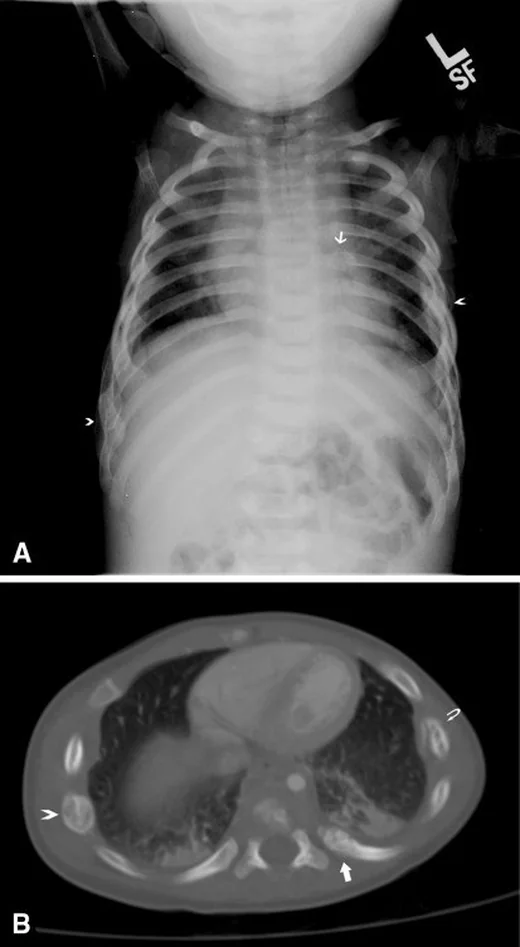
- Posterior kaburga kırığı — vertebra-kaburga bileşkesine yakın kortikal düzensizlik veya kallus; sensitiviteyi artırmak için radyografide oblik görünümler eklenmelidir.
- Kostovertebral eklem dislokasyonu — kaburga başının eklemden yer değiştirmesi; nadir görülen bir yaralanmadır.
- Kaburga kırıkları radyografide ve tek düzlemde kolayca kaçabilir; multipl görünümlerde veya tomografide geniş tarama alanı ve takibi önemlidir.
- İyileşen kırık — kortikal kalınlaşma, periostal yeni kemik ve kaburga konturunda kallus; iyileşme görünümü akut kırık hattından farklı olabilir.
- Çok seviyeli yaralanma — farklı kaburga seviyelerinde kırıklar; sağ-sol dağılımı ve benzer ya da farklı iyileşme görünümünü ayrı ayrı haritalayın.
- Göğüs duvarı yumuşak doku yaralanması — kaburga komşuluğunda şişlik, ödem veya hematom görünümü; NAT vakalarında en sık görülen ve ayırıcı tanıda önemli olan bulgulardan biridir.
- Eşlik eden torasik yaralanma — kontüzyon, pnömotoraks veya plevral sıvı/kan; kemik bulgusu değerlendirilirken akciğer ve plevra da taranmalıdır.
Normalde
Kaburga kırıklarının radyografik değerlendirmesinde, ön-arka ve lateral görünümlere oblik görünümler eklenmesi duyarlılığı artırabilir.
Normal BT ile kıyasla
Aynı bölgenin, kaynak veri setinde patoloji içermediği belirtilen bir BT incelemesini kesit kesit kaydırın; organ sınırlarını açarak anatomiyi hasta görüntüsüyle karşılaştırın. Küçük rastlantısal bulgular tümüyle dışlanmamıştır.
Kaynak: TotalSegmentator v2.01 veri seti (Wasserthal ve ark., Radiology: Artificial Intelligence 2023), CC BY 4.0, vaka s1278; organ sınırları veri setinin otomatik segmentasyonundan, birleştirilerek sadeleştirildi. Görüntüler 2,5 mm kesit aralığına yeniden örneklendi.
Ayırıcı tanı
- Raşitizm/metabolik kemik hastalığı
- yaygın mineralizasyon bozukluğu ve birden fazla kemikte şekil değişikliği; izole fokal travmatik korteks kesintisinden farklı örüntü verir.
- Doğum veya resüsitasyonla ilişkili kırık
- öykü, zamanlama ve dağılım bağlamında ele alınır; BT görünümü tek başına nedeni belirlemez.
- Hareket veya parsiyel hacim artefaktı
- kaburga kırıklarını değerlendirmek için BT kullanılabilir; ancak bu yöntem daha fazla radyasyon maruziyetine yol açar.
Tuzaklar
- Kaburga kırığının yeri istismar açısından tek başına kesin tanı koydurmaz; yaş, gelişim düzeyi, açıklanan mekanizma, eşlik eden yaralanmalar ve tüm iskelet değerlendirmesiyle yorumlayın.
- Erken kırıkta kallus bulunmayabilir ve ince kırık hattı gözden kaçabilir; farklı rekonstrüksiyon düzlemlerinde kaburga yayını baştan sona izleyin.
- İyileşme evresindeki kallus kaburga konturunu kalınlaştırabilir; akut kırık hattını ve eski yaralanmanın yeniden şekillenmesini ayrı tarif edin, tarihlendirmeyi BT'den kesinleştirmeyin.
- BT kaburga kırıklarını gösterebilse de çocuk istismarı incelemesinde standart iskelet taramasının yerini almaz; istemin klinik bağlamını ve mevcut tüm görüntüleri birlikte değerlendirin.
Kendini dene
Şüpheli istismar değerlendirmesinde posterior kaburga korteksinde kesinti ve komşu kallus görülüyor; başka seviyelerde de iyileşen kırıklar var. En doğru görüntüleme yorumu nedir?
Cevabı göster
Çok seviyeli kaburga kırıkları. Birden fazla seviyede kortikal kesinti ve kallus çok seviyeli kırıkları gösterir; bulgu istismar kuşkusunu artırabilir ancak mekanizma yalnız BT ile belirlenemez. Metabolik kemik hastalıkları yaygın mineralizasyon bozukluğu oluştururken, normal eklem varyantları düzgün konturlarla seyreder; şüpheli kırık hatları multi-düzlemli tomografide tekrarlanmalıdır.
Şüpheli istismar değerlendirmesinde yapılan toraks görüntülemede, posterior kostovertebral bileşkede iki tarafta simetrik, düzgün kortike eklem konturları görülmekte olup; kırık hattı, kallus veya çevresinde yumuşak doku şişliği saptanmamaktadır. Bu bulgular en iyi aşağıdakilerden hangisi ile açıklanır?
Cevabı göster
Normal kostovertebral eklem görünümü. Tanımlanan görüntüde kortikal bütünlük devam etmekte, kallus ya da akut kırık hattı bulunmamakta ve çevrede yumuşak doku reaksiyonu yoktur. Bu durum, kaburgaların doğal anatomik yapısını yansıtan normal bir kostovertebral eklem görünümünü işaret eder.
İlgili konular
- Çocukta toraks travması: akciğer kontüzyonu, pnömotoraks ve hemotoraks
- Şüpheli fiziksel istismarda kafa içi yaralanma
Kaynaklar
Bu sayfadaki 36 cümle ve 2 quiz sorusu aşağıdaki kaynaklardan alıntılarla otomatik olarak karşılaştırıldı; 11 cümle bu karşılaştırmada düzeltildi (2026-10-09).
- Imaging and clinical features of intra-abdominal injuries in children with suspected physical abusepmc.ncbi.nlm.nih.gov
- Consensus Recommendations of the Academic College of Emergency Experts in India on the Evaluation and Management of Polytrauma in Children Presenting to the Emergency Department in Indiapmc.ncbi.nlm.nih.gov
- Acute management of spinal fractures: What you need to knowpmc.ncbi.nlm.nih.gov
- Identification and Evaluation of Non-Accidental Trauma in the Pediatric Population: A Clinical Reviewpmc.ncbi.nlm.nih.gov
- The sternum in detail: a review of the anatomy and pathologies of the sternumpmc.ncbi.nlm.nih.gov
- Left fourth and sixth costovertebral dislocation abutting the aorta.pubmed.ncbi.nlm.nih.gov
- Outcomes of indeterminate fractures identified on skeletal surveys obtained during non-accidental trauma evaluations.pubmed.ncbi.nlm.nih.gov
- Imaging of pediatric musculoskeletal trauma: Age-specific considerations and challenges.pubmed.ncbi.nlm.nih.gov
- Post-mortem imaging in suspected child physical abuse: a systematic review.pubmed.ncbi.nlm.nih.gov
- Comparing imaging modalities and healing criteria for the estimation of fracture age: a systematic review.pubmed.ncbi.nlm.nih.gov
- Imaging and clinical features of intra-abdominal injuries in children with suspected physical abuse.pubmed.ncbi.nlm.nih.gov
- Severe trauma care: advances and future directions in diagnostic and therapeutic techniques and information technology support.pubmed.ncbi.nlm.nih.gov
- Diagnostic Accuracy and Failure Mode Analysis of a Deep Learning Algorithm for the Detection of Cervical Spine Fractures.pubmed.ncbi.nlm.nih.gov
- Spontaneous bacteremia and spontaneous bacterial peritonitis share similar prognosis in patients with cirrhosis: a cohort study.pubmed.ncbi.nlm.nih.gov
- Pneumothorax and Hemothorax: Practical Approaches for Radiologists.pubmed.ncbi.nlm.nih.gov
- Emergency Department Imaging of Pediatric Patients with Blunt Thoracic Trauma: A Systematic Review, Meta-Analysis, and Practice Management Guideline.pubmed.ncbi.nlm.nih.gov
- Beyond the Usual Course: A Rare Case of Persistent Traumatic Pulmonary Pneumatoceles With 8-Year Favorable Evolution.pubmed.ncbi.nlm.nih.gov
- Pilgrimage to sacrifice: Mechanisms, causes, and time of death of the Western Andean Capacocha of the Southern Tawantinsuyu.pubmed.ncbi.nlm.nih.gov
- Analysis of imaging features and clinical manifestations in children with congenital rib deformities: a retrospective study.pubmed.ncbi.nlm.nih.gov
- Urgent and emergent pediatric cardiovascular imaging.pubmed.ncbi.nlm.nih.gov
- Pediatric fatal head and neck injury in a 9-year medical examiner case series: autopsy findings and cervical spine dissection techniques.pubmed.ncbi.nlm.nih.gov
- Long-term safety and effectiveness of the "OptEase" vena cava filter.pubmed.ncbi.nlm.nih.gov
- CPR related injuries of the chest wall: direct and indirect fractures.pubmed.ncbi.nlm.nih.gov
- A Quick and Comprehensive Guide to Differential Diagnosis of Neck and Back Pain: a Narrative Review.pubmed.ncbi.nlm.nih.gov
- Imaging of Spondylodiscitis: A Comprehensive Updated Review-Multimodality Imaging Findings, Differential Diagnosis, and Specific Microorganisms Detection.pubmed.ncbi.nlm.nih.gov
- Infant, maternal and pregnancy associated risk factors for offspring fractures during infancy - A population-based study.pubmed.ncbi.nlm.nih.gov
- Innovative Dynamic Ultrasound Diagnosis of First Rib Stress Fracture in an Adolescent Athlete-A Case Report.pubmed.ncbi.nlm.nih.gov
- Does osteogenesis imperfecta predispose infants to metaphyseal fractures? A systematic review.pubmed.ncbi.nlm.nih.gov
- Case report: A systematic approach for the forensic evaluation of child abuse: lessons from a complex case.pubmed.ncbi.nlm.nih.gov
- Management and outcomes of blunt and penetrating traumatic aortic injuries in children.pubmed.ncbi.nlm.nih.gov
- Biomechanics of chest wall injury: implications for surgical stabilization and failure prevention.pubmed.ncbi.nlm.nih.gov
- International Society of Paediatric Surgical Oncology (IPSO) Surgical Practice Guidelines.pubmed.ncbi.nlm.nih.gov
- Brachial Plexopathies: A Comprehensive Radiologic Method Integrating Ultrasound and MRI.pubmed.ncbi.nlm.nih.gov
- Exploring the Vasculitis-Tumors Link: Epidemiological Patterns, Mechanistic Insights, and Clinical Implications.pubmed.ncbi.nlm.nih.gov
- Orthopaedic diagnostic pitfalls in fibroblast growth factor 23-mediated hypophosphatemic rickets/osteomalacia in fibrous dysplasia/McCune-Albright syndrome: Two burosumab-treated cases.pubmed.ncbi.nlm.nih.gov
- Case Report: RYR1-related myopathy with hypoxic ischemic encephalopathy-a case of severe neonatal presentation due to a <i>de novo</i> variant of uncertain significance.pubmed.ncbi.nlm.nih.gov
- Beyond the genome: a rare case report of cutis laxa.pubmed.ncbi.nlm.nih.gov
- Perioperative Care of an Eleven-Year-Old Child With Osteogenesis Imperfecta Type II During Posterior Spinal Fusion.pubmed.ncbi.nlm.nih.gov
- Prospective Diagnostic Accuracy and Technical Feasibility of Artificial Intelligence-Assisted Rib Fracture Detection on Chest Radiographs: Observational Study.pubmed.ncbi.nlm.nih.gov
- Pediatric abusive spine trauma: a review of whole-spine imaging essentials.pubmed.ncbi.nlm.nih.gov
- Computed Tomography-Verified Deep Learning Model for Rib Fracture Prediction and Complication Association from Chest Radiographs.pubmed.ncbi.nlm.nih.gov
- A pictorial essay of thoracic wall diseases: multiple pathologies in the same anatomical site.pubmed.ncbi.nlm.nih.gov
- Genome sequencing in a cohort of 32 fetuses with genetic skeletal disorders.pubmed.ncbi.nlm.nih.gov
- Injuries in Children Undergoing Subspecialty Abuse Evaluations Because of Intimate Partner Violence.pubmed.ncbi.nlm.nih.gov
- Yield of injury testing for contacts of children evaluated for physical abuse.pubmed.ncbi.nlm.nih.gov
- Commentary: an eye on PET quantification.pubmed.ncbi.nlm.nih.gov
- High-affinity alphavbeta3 integrin targeted optical probe as a new imaging biomarker for early atherosclerosis: initial studies in Watanabe rabbits.pubmed.ncbi.nlm.nih.gov
- Patterns of injury and violence in Yaoundé Cameroon: an analysis of hospital data.pubmed.ncbi.nlm.nih.gov
- Congenital and Breed-Associated Vertebral Anomalies in Dogs and Cats: Developmental Anatomy, Genetic Determinants, and Biological Significance.pubmed.ncbi.nlm.nih.gov
- Bilateral abducens nerve palsy following ligamentous C1-C2 distraction.pubmed.ncbi.nlm.nih.gov
- Spinal facet joint biomechanics and mechanotransduction in normal, injury and degenerative conditions.pubmed.ncbi.nlm.nih.gov
- Musculoskeletal Ultrasound and Protein-Based Hydrogels: Novel Approaches for the Diagnosis and Treatment of Sports Injuries.pubmed.ncbi.nlm.nih.gov
- Effects of early surgery (within 48 hours) <i>vs.</i> delayed surgery on the incidence of pulmonary complications in elderly patients with multiple rib fractures.pubmed.ncbi.nlm.nih.gov
- Chest Wall and Diaphragmatic Injuries: Imaging Evaluation and Clinical Considerations.pubmed.ncbi.nlm.nih.gov
- Effectiveness of simulation-based training on child abuse recognition for clerkship students and residents.pubmed.ncbi.nlm.nih.gov
- Practical approach to the diagnosis, management, and treatment of pediatric patients with bone fragility: an expert opinion.pubmed.ncbi.nlm.nih.gov
- Axial Spondyloarthritis: Mimics and Pitfalls of Imaging Assessment.pubmed.ncbi.nlm.nih.gov
- A Putative Role of Apolipoprotein L1 Polymorphism in Renal Parenchymal Scarring Following Febrile Urinary Tract Infection in Nigerian Under-Five Children: Proposal for a Case-Control Association Study.pubmed.ncbi.nlm.nih.gov
- Consensus Recommendations of the Academic College of Emergency Experts in India on the Evaluation and Management of Polytrauma in Children Presenting to the Emergency Department in India.pubmed.ncbi.nlm.nih.gov
- Acute management of spinal fractures: What you need to know.pubmed.ncbi.nlm.nih.gov
- Guidance for a clinical and forensic diagnosis of pediatric abusive head trauma: a narrative review.pubmed.ncbi.nlm.nih.gov
- ESR Essentials: imaging of suspected child abuse-practice recommendations by the European Society of Paediatric Radiology.pubmed.ncbi.nlm.nih.gov
- Pathophysiological hypotheses of the triad in abusive infant shaking: A systematic review and analysis of corroborated cases.pubmed.ncbi.nlm.nih.gov
- Has This Child Experienced Physical Abuse?: The Rational Clinical Examination Systematic Review.pubmed.ncbi.nlm.nih.gov
- Skeletal growth and development dictate the processes of vertebral fracture in the pediatric spine; a review emphasizing fracture biomechanics of the vertebral body during the period of skeletal immaturity.pubmed.ncbi.nlm.nih.gov
- Surgical stabilization of rib fractures (SSRF): the WSES and CWIS position paper.pubmed.ncbi.nlm.nih.gov
- Lung Ultrasound: Its Findings and New Applications in Neonatology and Pediatric Diseases.pubmed.ncbi.nlm.nih.gov
- 2.5-mm articulated endoluminal forceps using a compliant mechanism.pubmed.ncbi.nlm.nih.gov
- Point-of-care ultrasonography for diagnosing thoracoabdominal injuries in patients with blunt trauma.pubmed.ncbi.nlm.nih.gov
- A Multispecialty Approach to the Identification and Diagnosis of Nonaccidental Trauma in Children.pubmed.ncbi.nlm.nih.gov
- Narrative review of chest wall ultrasound: a practical approach.pubmed.ncbi.nlm.nih.gov
- Postmortem CT: Applications in Clinical and Forensic Medicine.pubmed.ncbi.nlm.nih.gov
- The Role of Thoracic Ultrasound for Diagnosis of Diseases of the Chest Wall, the Mediastinum, and the Diaphragm-Narrative Review and Pictorial Essay.pubmed.ncbi.nlm.nih.gov
- Osteotomies: Indications, Imaging Appearance, Surgical Techniques, and Complications.pubmed.ncbi.nlm.nih.gov
- Multimodal Imaging of Osteosarcoma: From First Diagnosis to Radiomics.pubmed.ncbi.nlm.nih.gov
- Early one-stage posterior-only surgery for congenital cervicothoracic scoliosis in children: medium- and long-term follow-up.pubmed.ncbi.nlm.nih.gov
- 2025 American Thyroid Association Management Guidelines for Adult Patients with Differentiated Thyroid Cancer.pubmed.ncbi.nlm.nih.gov
- Pediatric emergency medicine point-of-care ultrasound: summary of the evidence.pubmed.ncbi.nlm.nih.gov
- Trends in documenting and coding of child physical abuse in hospitalised children and adolescents in Germany: a nationwide administrative data analysis.pubmed.ncbi.nlm.nih.gov
- Performance and Yield of Retinal Examinations in Cases of Suspected Physical Abuse Without Intracranial Injury.pubmed.ncbi.nlm.nih.gov
- Near-pair patch generative adversarial network for data augmentation of focal pathology object detection models.pubmed.ncbi.nlm.nih.gov
- Intelligent robot-assisted fracture reduction for pelvic fractures: a clinical study.pubmed.ncbi.nlm.nih.gov
- Implementation of pediatric and fetal postmortem imaging into clinical practice: a multi-society statement from the ESPR, SPR, SLARP, AOSPR, WFPI, and IAFR.pubmed.ncbi.nlm.nih.gov
- Pediatric trauma management in low-resource emergency departments: from first contact to safe disposition - a narrative review.pubmed.ncbi.nlm.nih.gov
- 2022 ACC/AHA guideline for the diagnosis and management of aortic disease: A report of the American Heart Association/American College of Cardiology Joint Committee on Clinical Practice Guidelines.pubmed.ncbi.nlm.nih.gov
- 2022 ACC/AHA Guideline for the Diagnosis and Management of Aortic Disease: A Report of the American Heart Association/American College of Cardiology Joint Committee on Clinical Practice Guidelines.pubmed.ncbi.nlm.nih.gov
- Cranial Defect Reconstruction With Custom 3D-Printed Hydroxyapatite Scaffolds Augmented With rhBMP-2 or Dipyridamole in a Nonhuman Primate Model.pubmed.ncbi.nlm.nih.gov
- Accidental Diagnosis of Type VII Osteogenesis Imperfecta in an Infant Presenting With Pneumonia and Rickets-Like Rib Fractures: A Case Report.pubmed.ncbi.nlm.nih.gov
- Preoperative Burosumab With Delayed FGF23 Recovery and High Postoperative Bone Turnover in Tumor-Induced Osteomalacia.pubmed.ncbi.nlm.nih.gov
- Congenital Scoliosis: A Comprehensive Review of Diagnosis, Management, and Surgical Decision-Making in Pediatric Spinal Deformity-An Expanded Narrative Review.pubmed.ncbi.nlm.nih.gov
- Identification and Evaluation of Non-Accidental Trauma in the Pediatric Population: A Clinical Review.pubmed.ncbi.nlm.nih.gov
- Interpreting Osteogenesis Imperfecta Variants of Uncertain Significance in the Context of Physical Abuse: A Case Series.pubmed.ncbi.nlm.nih.gov
- Research progress and narrative review of totally implantable venous access ports.pubmed.ncbi.nlm.nih.gov
- Pediatric Emergency Medicine Didactics and Simulation (PEMDAS): Armed Penetrating Trauma.pubmed.ncbi.nlm.nih.gov
- High Spinal Cord Injury After a Minor Fall in a 23-Month-Old Girl With Atlantoaxial Instability Associated With Morquio Type A: A Case Report.pubmed.ncbi.nlm.nih.gov
- Mandibular Inflammatory Myofibroblastic Tumors: A Literature Review with a New Case Presentation.pubmed.ncbi.nlm.nih.gov
- Accessory Articulation of Elongated Anterior Tubercles of the Transverse Processes at C5-C6 in a Young Adult Female Patient: A Case Report.pubmed.ncbi.nlm.nih.gov
- Sacroiliac Joint Anatomical Variants and Their Association with Spinopelvic Alignment: A Whole-Spine CT Study.pubmed.ncbi.nlm.nih.gov
- Transforming spinal surgery with innovations in biologics and additive manufacturing.pubmed.ncbi.nlm.nih.gov
- Structure-aware multi-task learning with domain generalization for robust vertebrae analysis in spinal CT.pubmed.ncbi.nlm.nih.gov
- An Overview of Meta-Analyses on the Surgical Stabilization of Rib Fractures in Adults: A Narrative Umbrella Review (2020-2025).pubmed.ncbi.nlm.nih.gov
- Conservative Treatment of Pediatric Fractures-Narrative Review of Acceptable Deformity and Remodeling Potential.pubmed.ncbi.nlm.nih.gov
- A case series of 99mTc-MDP bone scintigraphy (planar and SPECT CT) in mucormycosis in the era of COVID 19.pubmed.ncbi.nlm.nih.gov
- Utilization of a mechanical hinge-powered operative table in thoracic spinal cord decompression and fusion: a report of two cases.pubmed.ncbi.nlm.nih.gov
- Current treatment strategies and prospects for chest wall defect repair and reconstruction.pubmed.ncbi.nlm.nih.gov
- An Adult Case of Chest Wall Langerhans Cell Histiocytosis Mimicking Malignancy and Responding to Targeted Therapy.pubmed.ncbi.nlm.nih.gov
- Review of imaging modalities and radiological findings of calvarial lesions.pubmed.ncbi.nlm.nih.gov
- Can transient neonatal osteosclerosis be differentiated from malignant infantile osteopetrosis?pubmed.ncbi.nlm.nih.gov
- Whole-body magnetic resonance imaging in rheumatology: advancements, key applications and future perspectives.pubmed.ncbi.nlm.nih.gov
- Results of an expert Delphi consensus from the Italian Society of Medical and Interventional Radiology (SIRM) and the Italian Society of Rheumatology (SIR) on standardized requesting and reporting magnetic resonance imaging in patients with suspected or known axial spondyloarthritis.pubmed.ncbi.nlm.nih.gov
- Axial Imaging in Spondyloarthritis.pubmed.ncbi.nlm.nih.gov
- Pivotal role of the synovioentheseal complex in the imaging of arthritis and rheumatic diseasespubmed.ncbi.nlm.nih.gov
- Multiple fractures in infants who have Ehlers-Danlos/hypermobility syndrome and or vitamin D deficiency: A case series of 72 infants whose parents were accused of child abuse and neglect.pubmed.ncbi.nlm.nih.gov
- The radiographic approach to child abuse.pubmed.ncbi.nlm.nih.gov
- Fifty Shades of PSMA-Avid Rib Lesions: A Comprehensive Review.pubmed.ncbi.nlm.nih.gov
Eğitim amaçlıdır; hasta başında tanı ve tedavi kararının yerine geçmez, tıbbi tavsiye değildir. Metinler yapay zekâ desteğiyle yazıldı ve otomatik bir adımda kaynak alıntılarıyla karşılaştırıldı; bu bir tıbbi doğrulama değildir ve içerik uzman radyolog incelemesinden geçmedi. Klinik kararlarda güncel kılavuzları, kurum protokollerini ve radyoloji raporunu esas alın.