Özet
Çocuklarda böbreğin görece büyük olması, perirenal yağ dokusunun daha az olması ve kaburga kafesinin daha esnek olması künt travmada renal yaralanmaya yatkınlığı artırır. Stabil hastada intravenöz kontrastlı BT parankim, damar pedikülü ve komşu retroperitoneumu gösterir; gecikmiş görüntüler toplayıcı sistem kaçağını ortaya çıkarabilir. Hematüri olmaması böbrek hasarını dışlamaz ve majör damar yaralanması belirgin hematüri yapmayabilir. Üreteropelvik bileşke kopması, devaskülarizasyon veya idrar kaçağının atlanması böbrek işlev kaybını ve geç komplikasyonları geciktirebilir.
Faz ve pencere
- Arteriyel tanısal
- Renal arter dallarında kesilme, tromboz veya aktif kontrast kaçağı; segmental arter tıkanmasında beslenme alanına uyan kama biçimli kontrastlanmayan parankim aranır.
- Portal tanısal
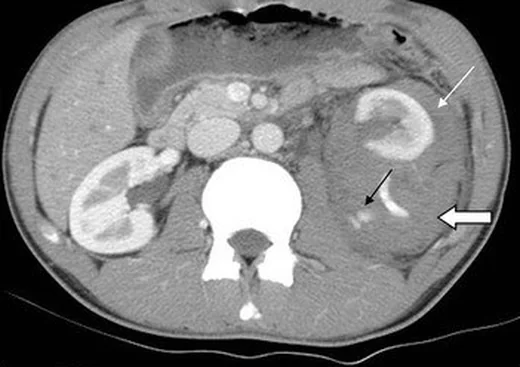
- Renal parankim veya pelvis laserasyonuna üriner ekstravazasyon eşlik edebilir; gecikmiş BT görüntüleri kaçağın değerlendirilmesine yardımcı olur. Renal pedikül avulsiyonu ve medial kutupta devaskülarizasyon, ağır renal travmada görülebilir.
- BT ürografi tanısal
- Gecikmiş boşaltım görüntülerinde kontrastlı idrar renal pelvis dışına sızarak yarık boyunca veya perirenal alanda birikir; medial ekstravazasyon üreteropelvik bileşke yaralanmasını düşündürür.
Önerilen pencereler: Batın (G 400 / M 50), Anjiyo (G 600 / M 150).
BT bulguları
- Renal parankim veya pelvis laserasyonuna üriner ekstravazasyon eşlik edebilir; gecikmiş BT görüntüleri kaçağın değerlendirilmesine yardımcı olur.
- Travma sonrası izlemde subkapsüler koleksiyon görülebilir ve sürebilir.
- Renal travmada BT’de perirenal hematom görülebilir; pararenal hematom da eşlik edebilir.
- Renal travma sonrasında alt pol infarktı görülebilir.
- Renal travmada ana renal arter yaralanması ve renal hilus avulsiyonu görülebilir.
- Üriner ekstravazasyon — gecikmiş BT görüntülerinde toplayıcı sistem yaralanmasına eşlik eden kontrast kaçağının izlenmesi.
- Üreteropelvik bileşke yaralanmasında gecikmiş BT görüntüleri üriner ekstravazasyonu değerlendirmeye ve yaralanmanın atlanmasını önlemeye yardımcı olur.
Normalde
Travma BT’sinde renal morfolojiyi, böbrek kaynaklı kanamayı ve ürinoma varlığını değerlendirin. Gecikmiş BT’de üriner ekstravazasyonu ve üreterde kontrast bulunup bulunmadığını değerlendirin.
Normal BT ile kıyasla
Aynı bölgenin, kaynak veri setinde patoloji içermediği belirtilen bir BT incelemesini kesit kesit kaydırın; organ sınırlarını açarak anatomiyi hasta görüntüsüyle karşılaştırın. Küçük rastlantısal bulgular tümüyle dışlanmamıştır.
Kaynak: TotalSegmentator v2.01 veri seti (Wasserthal ve ark., Radiology: Artificial Intelligence 2023), CC BY 4.0, vaka s0119; organ sınırları veri setinin otomatik segmentasyonundan, birleştirilerek sadeleştirildi. Görüntüler 2,5 mm kesit aralığına yeniden örneklendi.
Ayırıcı tanı
- Renal travmanın değerlendirilmesinde enfeksiyöz ve vasküler renal nedenler de ayırıcı tanıda yer alır.
- Böbrek kontüzyonu, çocuklarda künt travma sonrası görülebilen renal yaralanma biçimlerinden biridir.
- Üreteropelvik bileşke obstrüksiyonu önceden var olabilir ve düşük enerjili travma sonrası tanınabilir.
- Dalak veya karaciğer kaynaklı kan
- hematom böbreği dıştan sarabilir; renal parankim ve damarlar korunmuşsa komşu solid organı izleyin.
Tuzaklar
- Renal travma BT’sinde damar kaynaklı bulguları ve infarktı değerlendirirken arteriyel ve venöz faz görüntülerini birlikte inceleyin.
- Perirenal sıvıyı hematom kabul edip gecikmiş fazı atlama; toplayıcı sistem yaralanması için kontrastlı idrarın dağılımını izle.
- Gecikmiş BT’de üreterde kontrast bulunup bulunmadığını değerlendirin; bu bulgu gözlem grubunda daha düşük müdahale olasılığıyla ilişkili bulunmuştur.
- Normal idrar tahlilini dışlama ölçütü sayma; görüntüde damar pedikülü, parankim ve pelvis hasarını doğrudan değerlendir.
Kendini dene
S2’deki çocuklarda grade IV renal travma ve üriner ekstravazasyon çalışmasında kaç üreteropelvik bileşke rüptürü bildirilmiştir?
Cevabı göster
5. Çalışmanın 19 olguluk kohortunda 5 üreteropelvik bileşke rüptürü bildirilmiştir.
Gecikmiş BT görüntüsünde kontrastlı idrar renal pelvisin medialine yayılıyor, distal üreter seçilmiyor. Yaralanma nerede?
Cevabı göster
Üreteropelvik bileşke. Mediale yönelen idrar kaçağı ve distal üreterin opaklaşmaması bileşke ayrılmasını düşündürür. Mesane yaralanması pelvik ekstravazasyon yapar; korteks laserasyonu kendi parankiminde kalır; dalak hilusu üriner sistem değildir.
Kaynaklar
Bu sayfadaki 36 cümle ve 2 quiz sorusu aşağıdaki kaynaklardan alıntılarla otomatik olarak karşılaştırıldı; 20 cümle bu karşılaştırmada düzeltildi (2026-10-09).
- Management of high-grade pediatric renal trauma in tertiary referral hospital in Indonesia: A case series and literature reviewpmc.ncbi.nlm.nih.gov
- Management of pediatric renal trauma with urinary extravasation: a retrospective study in a single clinical centerpmc.ncbi.nlm.nih.gov
- Ureteral contrast findings as a potential predictor for invasive intervention in high‐grade pediatric renal trauma: A retrospective analysispmc.ncbi.nlm.nih.gov
- Pediatric renal trauma: 17 years of experience at a major Scandinavian trauma centerpmc.ncbi.nlm.nih.gov
- The role of interventional radiology for pediatric blunt renal traumapmc.ncbi.nlm.nih.gov
- Contemporary management of pediatric renal trauma.pubmed.ncbi.nlm.nih.gov
- Renal pseudoaneurysm after blunt trauma in a 10-year-old girl: A case report.pubmed.ncbi.nlm.nih.gov
- Routine repeat imaging may be avoidable for asymptomatic pediatric patients with renal trauma.pubmed.ncbi.nlm.nih.gov
- Variation in management of pediatric post-traumatic urine leaks.pubmed.ncbi.nlm.nih.gov
- The role of interventional radiology for pediatric blunt renal trauma.pubmed.ncbi.nlm.nih.gov
- Complete ureteropelvic-junction disruption following renal trauma: conservative management.pubmed.ncbi.nlm.nih.gov
- Management of major blunt pediatric renal trauma: single-center experience.pubmed.ncbi.nlm.nih.gov
- Predictive factors for conservative treatment failure in grade IV pediatric blunt renal trauma.pubmed.ncbi.nlm.nih.gov
- Contemporary management of pediatric high grade renal trauma: 10 year experience at a level 1 trauma centre.pubmed.ncbi.nlm.nih.gov
- Does contrast-enhanced ultrasound have a role in evaluation and management of pediatric renal trauma? A preliminary experience.pubmed.ncbi.nlm.nih.gov
- Routine Urology Consultation and Follow-up After Pediatric Blunt Renal Trauma is Likely Unnecessary.pubmed.ncbi.nlm.nih.gov
- Is Excretory-Phase Computerized Tomography Important for Evaluation of Pediatric High-Grade Renal Trauma?pubmed.ncbi.nlm.nih.gov
- Use of adult criteria for slice imaging may limit unnecessary radiation exposure in children presenting with hematuria and blunt abdominal trauma.pubmed.ncbi.nlm.nih.gov
- Pediatric Genitourinary Trauma.pubmed.ncbi.nlm.nih.gov
- Congenital lumbar and umbilical hernias in lumbo-costo-vertebral syndrome with ipsilateral renal agenesis: A rare case report with literature review.pubmed.ncbi.nlm.nih.gov
- Obstructive Sleep Apnea: Epidemiology, Pathophysiology, Complications, Diagnosis, Management, and Emerging Fibrosis-Linked Remodeling.pubmed.ncbi.nlm.nih.gov
- When Stones Escape: A Rare Radiologic Finding of Retroperitoneal Stone Extrusion Following American Association for the Surgery of Trauma (AAST) Grade IV Blunt Renal Trauma in a Chronically Hydronephrotic Kidney.pubmed.ncbi.nlm.nih.gov
- The Role of Interventional Radiology in Renal Trauma: A Narrative Review.pubmed.ncbi.nlm.nih.gov
- Computed tomography of pediatric abdominal trauma: optimizing utilization and enhancing diagnostic interpretation.pubmed.ncbi.nlm.nih.gov
- Computed tomography of renal emergencies: A comprehensive diagnostic guide for radiology residents.pubmed.ncbi.nlm.nih.gov
- Management and Outcomes of Blunt Renal Trauma: A Retrospective Analysis from a High-Volume Urban Emergency Department.pubmed.ncbi.nlm.nih.gov
- Imaging and clinical features of intra-abdominal injuries in children with suspected physical abuse.pubmed.ncbi.nlm.nih.gov
- The Diagnosis and Management of Pediatric Blunt Abdominal Trauma-A Comprehensive Review.pubmed.ncbi.nlm.nih.gov
- Non-Traumatic Unilateral Spontaneous Adrenal Mass Rupture: A Retrospective Case Series Study.pubmed.ncbi.nlm.nih.gov
- Solid Organ Injuries: To Irradiate or Operate?pubmed.ncbi.nlm.nih.gov
- Imaging of renal emergencies: Review of infectious, hemorrhagic, vascular, and traumatic etiologies.pubmed.ncbi.nlm.nih.gov
- Pediatric ureteropelvic junction disruption with renal laceration: organ-saving management through delayed diagnosis and surgical repair.pubmed.ncbi.nlm.nih.gov
- Management of pediatric renal trauma with urinary extravasation: a retrospective study in a single clinical center.pubmed.ncbi.nlm.nih.gov
- Stillbirth Investigations: An Iconographic and Concise Diagnostic Workup in Perinatal Pathology.pubmed.ncbi.nlm.nih.gov
- The Use of Contrast-enhanced Ultrasound in Pediatrics: A Case Series.pubmed.ncbi.nlm.nih.gov
- Fetal MRI: abdominal cystic lesions.pubmed.ncbi.nlm.nih.gov
- A Case of Myelin Oligodendrocyte Glycoprotein Antibody Disease in a Pediatric Patient: Clinical Presentation, Treatment Response, and Follow-Up Considerations.pubmed.ncbi.nlm.nih.gov
- Review of COVID-19, part 1: Abdominal manifestations in adults and multisystem inflammatory syndrome in children.pubmed.ncbi.nlm.nih.gov
- Imaging in the COVID-19 era: Lessons learned during a pandemic.pubmed.ncbi.nlm.nih.gov
- Musculoskeletal ultrasound in the emergency department: a narrative review for general radiologists.pubmed.ncbi.nlm.nih.gov
- International Society of Paediatric Surgical Oncology (IPSO) Minimally Invasive Surgery (MIS) Guidelines.pubmed.ncbi.nlm.nih.gov
- Fenoldopam for preventing and treating acute kidney injury.pubmed.ncbi.nlm.nih.gov
- Fibroepithelial Polyp of the Proximal Ureter Presenting as Chronic Hematuria and Hydronephrosis in an Adolescent: A Case Report.pubmed.ncbi.nlm.nih.gov
- Renal and Genitourinary Ultrasound Evaluation in Emergency and Critical Care: An Overview.pubmed.ncbi.nlm.nih.gov
- ESR Essentials: renal imaging in children-practice recommendations by the European Society of Paediatric Radiology.pubmed.ncbi.nlm.nih.gov
- Traumatic Kidney in a Patient With Unilateral Renal Cystic Disease.pubmed.ncbi.nlm.nih.gov
- A Comprehensive Review of SURGICEL®: Efficacy, Applications, and Radiological Insights in Surgery.pubmed.ncbi.nlm.nih.gov
- Multimodal imaging features to diagnose abdominal complications of sickle cell disease.pubmed.ncbi.nlm.nih.gov
- Complications after Nephron-sparing Interventions for Renal Tumors: Imaging Findings and Management.pubmed.ncbi.nlm.nih.gov
- Guidelines for the use of flow cytometry and cell sorting in immunological studies (third edition).pubmed.ncbi.nlm.nih.gov
- Interaction of P2 purinergic receptors with cellular macromolecules.pubmed.ncbi.nlm.nih.gov
- Evaluation of Pediatric Patients with Blunt Abdominal Trauma: A Systematic Review, Meta-Analysis, and Practice Management Recommendations.pubmed.ncbi.nlm.nih.gov
- Pediatric emergency department point-of-care ultrasound diagnosis of unprovoked iliofemoral deep vein thrombosis in an adolescent: A case report.pubmed.ncbi.nlm.nih.gov
- Urinary Biomarkers in Urological Oncology: From Biological Origin to Clinical Decision-Making-A Narrative Review.pubmed.ncbi.nlm.nih.gov
- Middle cerebral artery dissection: pathophysiology, diagnosis, and therapeutic options.pubmed.ncbi.nlm.nih.gov
- Microfluidic organ-on-a-chip for modeling coronary artery disease: Recent applications, limitations and potential.pubmed.ncbi.nlm.nih.gov
- Exploring the Nexus: A Systematic Review on the Interplay of the Methylenetetrahydrofolate Reductase (MTHFR) Gene C677T Genotype, Hyperhomocysteinemia, and Spontaneous Cervical/Vertebral Artery Dissection in Young Adults.pubmed.ncbi.nlm.nih.gov
- Interdisciplinary Management of Traumatic Injuries to the Kidneys and Urinary Tract Caused by Blunt Abdominopelvic Trauma.pubmed.ncbi.nlm.nih.gov
- Microvascular Flow Imaging: A State-of-the-Art Review of Clinical Use and Promise.pubmed.ncbi.nlm.nih.gov
- Dual Challenges: Addressing Post-Traumatic Retroperitoneal Urinoma in the Context of Pyeloureteral Duplication.pubmed.ncbi.nlm.nih.gov
- Ureteral contrast findings as a potential predictor for invasive intervention in high-grade pediatric renal trauma: A retrospective analysis.pubmed.ncbi.nlm.nih.gov
- Kidney and uro-trauma: WSES-AAST guidelines.pubmed.ncbi.nlm.nih.gov
- Splenial Lesions of the Corpus Callosum: Disease Spectrum and MRI Findings.pubmed.ncbi.nlm.nih.gov
- Congenital oligomeganephronia: computed tomography appearance.pubmed.ncbi.nlm.nih.gov
- 2025 American Thyroid Association Management Guidelines for Adult Patients with Differentiated Thyroid Cancer.pubmed.ncbi.nlm.nih.gov
- International Society of Paediatric Surgical Oncology (IPSO) Surgical Practice Guidelines.pubmed.ncbi.nlm.nih.gov
- Diagnostic Approach to Macrocephaly in Children.pubmed.ncbi.nlm.nih.gov
- Acute Renal Infarction as an Initial Manifestation of Factor V Leiden Mutation: A Case Report.pubmed.ncbi.nlm.nih.gov
- Infarcts and ischemia in the abdomen: an imaging perspective with an emphasis on cross-sectional imaging findings.pubmed.ncbi.nlm.nih.gov
- Spilling the beans: an inside scoop on the imaging of renal parenchymal disease.pubmed.ncbi.nlm.nih.gov
- Reninoma in an adolescent boy with negative selective renal vein sampling: a case report and review of the literature.pubmed.ncbi.nlm.nih.gov
- KILT syndrome revealed by right iliac fossa pain in an 11-year-old boy: A case report.pubmed.ncbi.nlm.nih.gov
- The crucial role of multimodality ultrasound in the postoperative evaluation of pediatric ischemic diseases.pubmed.ncbi.nlm.nih.gov
- Isolated renal artery occlusion in blunt abdominal trauma: a literature review with a case report.pubmed.ncbi.nlm.nih.gov
- Bioorthogonal Fluorogenic Reporters for Noninvasive Imaging and Urinalysis of Immunotherapeutic Response in Renal Cell Carcinoma.pubmed.ncbi.nlm.nih.gov
- Expanding Role of Contrast-Enhanced Ultrasound and Elastography in the Evaluation of Abdominal Pathologies in Children.pubmed.ncbi.nlm.nih.gov
- Contrast-enhanced ultrasound (CEUS) in urgent and emergent pediatric conditions: a comprehensive review.pubmed.ncbi.nlm.nih.gov
- Role of USG and CT in the Evaluation of Abdominal Trauma.pubmed.ncbi.nlm.nih.gov
- Use of Contrast-Enhanced Ultrasound in Suspected Traumatic or Spontaneous Renal Injury in Cats: A Case Series.pubmed.ncbi.nlm.nih.gov
- A rare case of angiosarcoma of the ureter.pubmed.ncbi.nlm.nih.gov
- Primary antiphospholipid syndrome presenting with unilateral renal infarction and C4d-positive cortical necrosis: a case report with a pooled analysis of 24 cases.pubmed.ncbi.nlm.nih.gov
- Contrast-Enhanced Ultrasound (CEUS) in Non-Traumatic Abdominal Emergencies.pubmed.ncbi.nlm.nih.gov
- Bilateral Renal Infarction Associated With Left Renal Artery Thrombosis and Predominant Left Renal Infarction: A Case Report.pubmed.ncbi.nlm.nih.gov
- Transarterial embolization in musculoskeletal care: an indication-stratified narrative review.pubmed.ncbi.nlm.nih.gov
- Idiopathic Midaortic Syndrome: An Unusual Case of Acute Kidney Injury (AKI) in Secondary Hypertension With Renal Collaterals in an Adult.pubmed.ncbi.nlm.nih.gov
- Pediatric endocrine disorders: a review of intra-abdominal findings and appropriate imaging.pubmed.ncbi.nlm.nih.gov
- Sonographic Anatomy and Normal Measurements of the Human Kidneys: A Comprehensive Review.pubmed.ncbi.nlm.nih.gov
- Imaging of renal pseudotumors in children: a comprehensive review.pubmed.ncbi.nlm.nih.gov
- Surgical Treatment of Adrenal Neuroblastoma in Children - A Narrative Review.pubmed.ncbi.nlm.nih.gov
- Presentation and Management of High-Grade Pancreatic Injuries: Case Series.pubmed.ncbi.nlm.nih.gov
- Isolated Blunt Pancreatic Head Injury with Evolving Acute Peripancreatic Fluid Collection in a Child Successfully Managed Conservatively.pubmed.ncbi.nlm.nih.gov
- Patterns of injury and violence in Yaoundé Cameroon: an analysis of hospital data.pubmed.ncbi.nlm.nih.gov
- Long-term safety and effectiveness of the "OptEase" vena cava filter.pubmed.ncbi.nlm.nih.gov
- Transcatheter arterial embolization for traumatic adrenal hemorrhage with contrast extravasation: case series and literature review.pubmed.ncbi.nlm.nih.gov
- Multimodal imaging in neuro-ophthalmology.pubmed.ncbi.nlm.nih.gov
- Venoarterial extracorporeal membrane oxygenation in adults with cardiogenic shock.pubmed.ncbi.nlm.nih.gov
- The Interface of Trauma Surgery and Interventional Radiology: The Trauma Surgeon's Perspective.pubmed.ncbi.nlm.nih.gov
- The 2023 WSES guidelines on the management of trauma in elderly and frail patients.pubmed.ncbi.nlm.nih.gov
- Management of Hemorrhagic Shock: Physiology Approach, Timing and Strategies.pubmed.ncbi.nlm.nih.gov
- Adrenalectomy for primary aldosteronism and its related surgical characteristics.pubmed.ncbi.nlm.nih.gov
- Acute Renal Infarction in a Patient Presenting With Abdominal Pain and Hypertensive Emergency.pubmed.ncbi.nlm.nih.gov
- Adult Hepatic Infarction for Internists: A Practical Diagnostic and Management Pathway to Avoid Misdiagnosis, Unnecessary Drainage, and Delayed Vascular Recognition.pubmed.ncbi.nlm.nih.gov
- Acute Renal Infarction Secondary to Atrial Fibrillation: A Rare Cause of Sudden Flank Pain.pubmed.ncbi.nlm.nih.gov
- Association of Chiropractic Colleges Educational Conference and Research Agenda Conference 2026: Connected Care.pubmed.ncbi.nlm.nih.gov
- 2025 Heart Disease and Stroke Statistics: A Report of US and Global Data From the American Heart Association.pubmed.ncbi.nlm.nih.gov
- Glomerulonephritis through the lens of ultrasound and radiology.pubmed.ncbi.nlm.nih.gov
- Peripheral primitive neuroectodermal tumor of the kidney presenting with pulmonary tumor embolism: A case report.pubmed.ncbi.nlm.nih.gov
- Meditation for the primary and secondary prevention of cardiovascular disease.pubmed.ncbi.nlm.nih.gov
- Value and limitations of sonography in kidney transplant recipients with special attention to the resistive index - An update.pubmed.ncbi.nlm.nih.gov
- Renal Trauma: A 4-Year Retrospective Review of Injury Severity, Treatment Approaches, and Outcomes from a Polish Trauma Center.pubmed.ncbi.nlm.nih.gov
- Ureteropelvic junction disruption associated with Chance fracture dislocation: A case of seat belt injury.pubmed.ncbi.nlm.nih.gov
- Resuscitative Effect of Centhaquine (Lyfaquin ® ) in Hypovolemic Shock Patients: A Randomized, Multicentric, Controlled Trial.pubmed.ncbi.nlm.nih.gov
- Applications of bioimpedance measurement in clinical and allied fields: a comprehensive review.pubmed.ncbi.nlm.nih.gov
- A Comprehensive Review of Transjugular Intrahepatic Portosystemic Shunt-Related Complications.pubmed.ncbi.nlm.nih.gov
- Urotrauma: AUA guideline.pubmed.ncbi.nlm.nih.gov
Eğitim amaçlıdır; hasta başında tanı ve tedavi kararının yerine geçmez, tıbbi tavsiye değildir. Metinler yapay zekâ desteğiyle yazıldı ve otomatik bir adımda kaynak alıntılarıyla karşılaştırıldı; bu bir tıbbi doğrulama değildir ve içerik uzman radyolog incelemesinden geçmedi. Klinik kararlarda güncel kılavuzları, kurum protokollerini ve radyoloji raporunu esas alın.