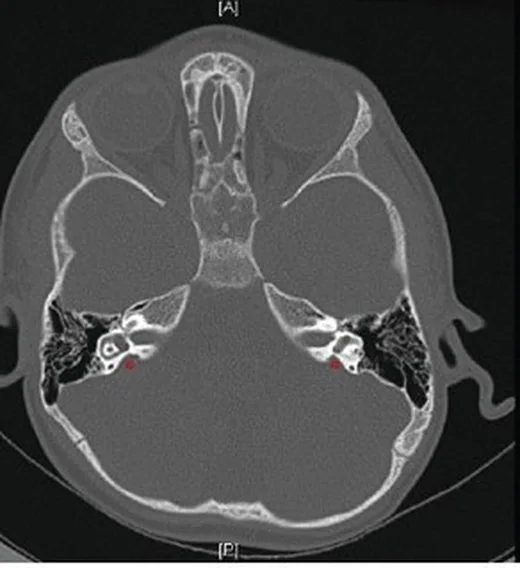
Özet
Geniş vestibüler akuadukt, işitme kaybıyla ilişkili olabilen bir iç kulak malformasyonudur. Temporal kemik BT, kemik vestibüler akuaduktun değerlendirilmesinde tercih edilen görüntüleme yöntemidir. Geniş vestibüler akuadukt tek taraflı veya iki taraflı olabilir. İşitme kaybı araştırılırken temporal kemik BT ve MR iç kulak malformasyonlarını gösterebilir. Radyolojik olarak geniş vestibüler akuadukt saptanması, tek başına klinik geniş vestibüler akuadukt sendromu tanısı anlamına gelmez; görüntüleme bulgusu işitme fenotipi ve klinik bağlamla birlikte yorumlanır.
Faz ve pencere
- Kontrastsız tanısal
- Orta nokta ölçümü aksiyel düzlemde yapılabilir; Cincinnati ölçütleri için Boston ve arkadaşları orta noktada koronal, operkulumda aksiyel düzlemi önermiştir. Pöschl düzleminde orta nokta ölçümleri yüksek tekrarlanabilirlik gösterir. Vestibüler akuadukt kemik bir yapı olduğundan EVA değerlendirmesinde BT tercih edilen yöntemdir.
Önerilen pencereler G genişlik, M merkez; değerler Hounsfield birimi (HU)
- KemikG 1800 / M +400
BT bulguları
- Akuadukt orta nokta ve operkulum genişliklerini mutlak eşiklerle ölç; tek başına karşı kulak asimetrisini genişleme sayma, çünkü EVA iki taraflı olabilir.
- Normalde endolenfatik duktus proksimalde dar, distalde daha geniş ve yassıdır; bu görünüm tek başına genişleme sayılmaz.
- EVA'da HRCT'de geniş vestibüler akuadukt görülür; otosklerozda ise BT'de osteosklerotik değişiklikler görülebilir.
- Pöschl düzlemine paralel oblik kesitlerde kanalın uzun seyri daha iyi izlenir; orta nokta ve operkulum ölçüm düzlemleri ayrı tanımlanmalıdır.
- Eşlik eden koklear inkomplet partisyon gibi kokleovestibüler malformasyon iç kulak malformasyonu birlikteliğini düşündürür.
- Yüksek çözünürlüklü temporal kemik BT'de vestibüler akuadukt ölçümleri aksiyel ya da Pöschl düzlemi gibi kanal eksenine uygun yeniden yapılandırılmış düzlemlerde yapılır.
- Orta nokta ve operkulum genişlikleri ayrı ölçüm noktaları olarak değerlendirilir; Boston ve arkadaşları orta nokta ölçümü için koronal, operkulum ölçümü için aksiyel düzlem önermiştir.
Ölçütler ve sınıflamalar
- Cincinnati: akuadukt orta nokta genişliği
- >0,9 mm (pratikte ≥1,0 mm)
- Cincinnati: operkulum genişliği
- >1,9 mm (pratikte ≥2,0 mm)
- Valvassori ölçütü: akuadukt orta nokta genişliği
- ≥1,5 mm
Normalde
Normalde herhangi bir düzlemde zor izlenen, ince kemik kanalı posterior labirentten posterior fossaya uzanır. Aynı aksiyel ya da kanal eksenine uygun oblik düzeyde iki tarafın orta nokta ve operkulum genişliklerini karşılaştır; tek başına görsel asimetri yerine ölçüm düzlemini de eşleştir.
Ayırıcı tanı
- Büyük vestibüler akuadukt (LVA) veya geniş vestibüler akuadukt (EVA) tanısı, ölçülen çapın normatif dağılımın %95 diliminin üzerine çıkmasıyla konulur.
- İç kulak malformasyonu
- akuadukt genişliğine ek olarak kokleada inkomplet partisyon gibi şekil değişikliği bulunur.
- Üçüncü pencere anomalileri ses veya basınçla tetiklenen vertigo ve/veya düşük frekanslı hava-kemik aralığıyla ilişkili olabilir; EVA bu anomaliler arasındadır.
- Otoskleroz işitme kaybının ayırıcı tanısında yer alır; BT'de otosklerozla ilişkili osteosklerotik değişiklikler görülebilir. Otosklerozdaki stapes tabanı değişikliği, vestibüler akuadukt genişlemesiyle aynı anatomik bulgu olarak değerlendirilmez.
Tuzaklar
- Standart aksiyel kesit, akuadukt eksenine oblik düşebilir; aynı kanal düzlemine göre yeniden formatlama olmadan sınırda ölçümü kesin genişleme diye adlandırma.
- Valvassori–Clemis ve Cincinnati ölçütleri aynı orta nokta eşiğini kullanmaz; kullanılan ölçüm yöntemini ve düzlemini raporda belirt, Pöschl ve aksiyel ölçümleri karıştırma.
- Akuadukt çapı hacmini güvenilir biçimde yansıtmayabileceğinden, sınırda olgularda çap ölçümünü tek başına yorumlama.
- BT kemik akuaduktu gösterir; endolenfatik kese ve yumuşak doku bileşeni için MR anatomisi daha elverişlidir.
Kendini dene
Aksiyel Cincinnati ölçümünde işitme kaybı araştırılan çocukta akuadukt orta noktası 1,1 mm, operkulumu 1,8 mm ölçülüyor. Hangi yorum uyumludur?
Cevabı göster
Orta nokta genişlemiş. Cincinnati eşiklerine göre orta noktanın 1,0 mm ve üzerinde olması genişleme lehinedir; operkulum 2,0 mm eşiğinin altındadır.
Akuadukt genişlemesine koklear şekil anomalisi eşlik ediyorsa bu birliktelik en çok neyi destekler?
Cevabı göster
İç kulak malformasyonu. EVA, koklear inkomplet partisyon gibi diğer kokleovestibüler malformasyonlarla birlikte görülebilir; bu nedenle eşlik eden koklear şekil anomalisi iç kulak malformasyonu birlikteliğini destekler.
Kaynaklar
Bu sayfadaki 40 cümle ve 2 quiz sorusu aşağıdaki kaynaklardan alıntılarla otomatik olarak karşılaştırıldı; 20 cümle bu karşılaştırmada düzeltildi (2026-10-10).
- Insidious Cases of Enlarged Vestibular Aqueduct (EVA) Syndrome Resembling Otosclerosis: Clinical Features for Differential Diagnosis and the Role of High-Resolution Computed Tomography in the Pre-Operative Settingpmc.ncbi.nlm.nih.gov
- Branchio-oto-renal syndrome in a young Han Chinese female: a case report and review of the literaturepmc.ncbi.nlm.nih.gov
- Genetic Determinants of Non-Syndromic Enlarged Vestibular Aqueduct: A Reviewpmc.ncbi.nlm.nih.gov
- Inner-Ear Disorders Presenting with Air–Bone Gaps: A Reviewpmc.ncbi.nlm.nih.gov
- Diagnostic Value of SLC26A4 Mutation Status in Hereditary Hearing Loss With EVApmc.ncbi.nlm.nih.gov
- Imaging of Pediatric Hearing Loss.pubmed.ncbi.nlm.nih.gov
- Radiographic Evaluation of Children with Hearing Loss.pubmed.ncbi.nlm.nih.gov
- Diagnostic Evaluation of Children with Sensorineural Hearing Loss.pubmed.ncbi.nlm.nih.gov
- Otologic disorders causing dizziness, including surgery for vestibular disorders.pubmed.ncbi.nlm.nih.gov
- Spectrum of Third Window Abnormalities: Semicircular Canal Dehiscence and Beyond.pubmed.ncbi.nlm.nih.gov
- Analysis between phenotypes and genotypes of inner ear malformation.pubmed.ncbi.nlm.nih.gov
- Inner-Ear Disorders Presenting with Air-Bone Gaps: A Review.pubmed.ncbi.nlm.nih.gov
- Diagnostic yield of MRI for pediatric hearing loss: a systematic review.pubmed.ncbi.nlm.nih.gov
- Diagnostic yield of computed tomography scan for pediatric hearing loss: a systematic review.pubmed.ncbi.nlm.nih.gov
- [Enlarged vestibular aqueduct syndrome: etiology, clinical features, diagnostics, and rehabilitation of the patients].pubmed.ncbi.nlm.nih.gov
- Assessment of the Clinical Benefit of Imaging in Children With Unilateral Sensorineural Hearing Loss: A Systematic Review and Meta-analysis.pubmed.ncbi.nlm.nih.gov
- Pathophysiologic phenotyping of idiopathic sudden sensorineural hearing loss: toward precision management.pubmed.ncbi.nlm.nih.gov
- Insidious Cases of Enlarged Vestibular Aqueduct (EVA) Syndrome Resembling Otosclerosis: Clinical Features for Differential Diagnosis and the Role of High-Resolution Computed Tomography in the Pre-Operative Setting.pubmed.ncbi.nlm.nih.gov
- When hearing loss mimics autism: Enlarged vestibular aqueduct syndrome in an 11-year-old child-A case report.pubmed.ncbi.nlm.nih.gov
- Bilateral sensorineural hearing loss in children: causes and long-term progression.pubmed.ncbi.nlm.nih.gov
- Diagnostic value of the inner ear computed tomography measurements in detecting congenital sensorineural hearing loss: a comparative study.pubmed.ncbi.nlm.nih.gov
- Update on diagnostic procedures in third window syndromes.pubmed.ncbi.nlm.nih.gov
- Does CISS MRI Reliably Depict the Endolymphatic Duct in Children with and without Vestibular Aqueduct Enlargement?pubmed.ncbi.nlm.nih.gov
- Characteristics of the Facial Canal-Lateral Canal Dehiscence: The Under-recognized Third Window.pubmed.ncbi.nlm.nih.gov
- Cochlear Implants in Inner Ear Malformations-Considerations Regarding the Role of Imaging in Preoperative Evaluation.pubmed.ncbi.nlm.nih.gov
- Non-invasive imaging modalities for diagnosing pulsatile tinnitus: a comprehensive review and recommended imaging algorithm.pubmed.ncbi.nlm.nih.gov
- Histopathology of Inner Ear Malformations: Potential Prognostic Factors and Their Influence in the Decision-Making Between CI and ABI.pubmed.ncbi.nlm.nih.gov
- Imaging of Skull Base Tumors.pubmed.ncbi.nlm.nih.gov
- Hearing disorders - findings on computed tomography and magnetic resonance imaging: pictorial essay.pubmed.ncbi.nlm.nih.gov
- Systematic approaches for reviewing neuro-imaging scans in ophthalmology.pubmed.ncbi.nlm.nih.gov
- Radiological diagnosis of cochlear incomplete partition type 3 (IP-III) in a 4-year-old male: A case report.pubmed.ncbi.nlm.nih.gov
- Key pre-operative CT parameters for cochlear implantation: a focused radiologic review with surgical relevance.pubmed.ncbi.nlm.nih.gov
- American Academy of Audiology Clinical Consensus Statement: Assessment of Vestibular Function in the Pediatric Population.pubmed.ncbi.nlm.nih.gov
- The preoperative temporal bone CT: a mnemonic for reducing surgical risk.pubmed.ncbi.nlm.nih.gov
- Pre-operative High-Resolution CT and MRI Evaluation in Pediatric Cochlear Implant Candidates: Correlation With Surgical Findings and Outcomes.pubmed.ncbi.nlm.nih.gov
- Origin of endolymphatic sac tumor.pubmed.ncbi.nlm.nih.gov
- Surgery of the ear and the lateral skull base: pitfalls and complications.pubmed.ncbi.nlm.nih.gov
- Emerging and re-emerging infectious disease in otorhinolaryngology.pubmed.ncbi.nlm.nih.gov
- Volumetry improves the assessment of the vestibular aqueduct size in inner ear malformation.pubmed.ncbi.nlm.nih.gov
- Retrospective Review of Midpoint Vestibular Aqueduct Size in the 45° Oblique (Pöschl) Plane and Correlation with Hearing Loss in Patients with Enlarged Vestibular Aqueduct.pubmed.ncbi.nlm.nih.gov
- Does endolymphatic hydrops affect cochlear and vestibular nerve volumes? An MRI-based morphometric study.pubmed.ncbi.nlm.nih.gov
- Endolymphatic hydrops and intracranial hypertension: a quantitative MRI analysis.pubmed.ncbi.nlm.nih.gov
- Secondary endolymphatic hydrops: a clinical and literature overview.pubmed.ncbi.nlm.nih.gov
- A Practical Diagnostic Approach to Pediatric Episodic Vestibular Syndrome.pubmed.ncbi.nlm.nih.gov
- A <i>CHD7</i> intronic variant induces aberrant splicing and structural alterations in the CHD7 DNA-binding domain to cause CHARGE syndrome.pubmed.ncbi.nlm.nih.gov
- Optimising POU3F4 variant interpretation through gene-specific evidence in X-linked hearing loss.pubmed.ncbi.nlm.nih.gov
- Clinical utility of exome sequencing in hearing loss: a retrospective cohort study.pubmed.ncbi.nlm.nih.gov
- Phenotypic Expansion of <i>PPP1R12A</i>-Related Syndrome: A Novel Splicing Variant Associated with Hearing Loss and Inner Ear Malformations.pubmed.ncbi.nlm.nih.gov
- Unilateral enlarged vestibular aqueduct syndrome: clinical profiles, <i>SLC26A4</i> mutations, and the diagnostic utility of the ASNR waveform.pubmed.ncbi.nlm.nih.gov
- Enlarged vestibular aqueduct concomitant with endolymphatic hydrops.pubmed.ncbi.nlm.nih.gov
- Hearing Loss Assessment in Childrenpubmed.ncbi.nlm.nih.gov
- Approach to the patient: genetics and management of congenital hypothyroidism.pubmed.ncbi.nlm.nih.gov
- Branchio-oto-renal syndrome: a narrative review.pubmed.ncbi.nlm.nih.gov
- Thyroid dyshormonogenesis caused by iodotyrosine deiodinase pathogenic variant: three cases presenting in adolescence.pubmed.ncbi.nlm.nih.gov
- Cancer predisposition syndromes: an imaging review.pubmed.ncbi.nlm.nih.gov
- Multimodal imaging in conductive hearing loss: Optimising CT, MRI and CTA for accurate diagnosis and management.pubmed.ncbi.nlm.nih.gov
- "Genetic tumor syndromes of the head and neck: Update in the genomic era".pubmed.ncbi.nlm.nih.gov
- Intelligent segmentation and measurement based on U-HRCT to explore the anatomical characteristics of the inner ear in unilateral Meniere's disease: a retrospective quantitative study.pubmed.ncbi.nlm.nih.gov
- Vestibular Aqueduct and Temporal Bone Radioanatomy in Patients With and Without Meniere Disease: A Retrospective Cross-Sectional Analysis With Implications for Endolymphatic Sac Surgery.pubmed.ncbi.nlm.nih.gov
- Observation of MRI-Based Endolymphatic Hydrops and Clinical Symptoms in Patients With Definite Meniere's Disease Over Time: A Case Series.pubmed.ncbi.nlm.nih.gov
- Is CT or MRI the optimal imaging investigation for the diagnosis of large vestibular aqueduct syndrome and large endolymphatic sac anomaly?pubmed.ncbi.nlm.nih.gov
- Cochlear duct length variability in prelingual sensorineural hearing loss: Emphasis on Waardenburg syndrome and implications for cochlear implantation.pubmed.ncbi.nlm.nih.gov
- Bilateral Enlarged Vestibular Aqueduct: Auditory, Genetic and Radiological Characterization, and Benefits of Cochlear Implants.pubmed.ncbi.nlm.nih.gov
- Prevalence of the endolymphatic sac hypoplasia in a cohort of individuals without Meniere disease.pubmed.ncbi.nlm.nih.gov
- Imaging in congenital inner ear malformations-An algorithmic approach.pubmed.ncbi.nlm.nih.gov
- TUBB3 and KIF21A in neurodevelopment and disease.pubmed.ncbi.nlm.nih.gov
- A systematic review on the imaging findings in auditory neuropathy spectrum disorder.pubmed.ncbi.nlm.nih.gov
- Head and Neck MRI Findings in CHARGE Syndrome.pubmed.ncbi.nlm.nih.gov
- Severe hydrocephalus complicated with benign paroxysmal positional vertigo: one case report.pubmed.ncbi.nlm.nih.gov
- Utility and outcome of piezoelectric bone conduction implant in managing mixed hearing loss with incomplete partition type 2 and enlarged vestibular aqueduct.pubmed.ncbi.nlm.nih.gov
- Clinical and Genetic Features in <i>EYA1</i>-Associated Branchio-Oto Syndrome: Cochlear Nerve Deficiency in Five of Thirteen Patients.pubmed.ncbi.nlm.nih.gov
- Auditory Characteristics in Children With Enlarged Vestibular Aqueduct.pubmed.ncbi.nlm.nih.gov
- Vestibular Evoked Myogenic Potentials and Wideband Acoustic Immittance as Screening Tools for Large Vestibular Aqueduct Syndrome.pubmed.ncbi.nlm.nih.gov
- [Prediction of hearing change in children with enlarged vestibular aqueduct with different genotypes by linear mixed-effects model].pubmed.ncbi.nlm.nih.gov
- Bilateral Low-Frequency Air-Bone Gap Following Spinal Anesthesia: An Unusual Audiometric Presentation: Case Report.pubmed.ncbi.nlm.nih.gov
- Greater Cochlear Damage in Otogenic Versus Meningogenic Meningitis: Hearing Rehabilitation Implications.pubmed.ncbi.nlm.nih.gov
- Longitudinal outcomes of auditory and spoken language skills following unilateral and bilateral cochlear implantation in children and young adults with inner ear malformations.pubmed.ncbi.nlm.nih.gov
- Comparison of radiological abnormalities between the jugular bulb and the vestibular aqueduct in patients with Ménière's disease.pubmed.ncbi.nlm.nih.gov
- The Prevalence of High-Riding Jugular Bulb in Patients with Suspected Endolymphatic Hydrops.pubmed.ncbi.nlm.nih.gov
- Volumetric atlas of the rat inner ear from microCT and iDISCO+ cleared temporal bones.pubmed.ncbi.nlm.nih.gov
- Imaging of inner ear malformations: a primer for radiologists.pubmed.ncbi.nlm.nih.gov
- Familial pattern of large vestibular aqueduct syndrome in a Chinese family.pubmed.ncbi.nlm.nih.gov
- The Internal Otic Region of Oromerycids (Artiodactyla, Oromerycidae), Early Camelids (Artiodactyla, Camelidae), and the Vicuña (Artiodactyla, Camelidae), Including Notes on Intraspecific and Subadult Ontogenetic Variation.pubmed.ncbi.nlm.nih.gov
- Mechanistic insights into third-window syndromes through numerical modeling: A PRISMA scoping review.pubmed.ncbi.nlm.nih.gov
- Petrosal morphology and cochlear function in Mesozoic stem therians.pubmed.ncbi.nlm.nih.gov
- Brazilian Society of Otology task force - cochlear implant ‒ recommendations based on strength of evidence.pubmed.ncbi.nlm.nih.gov
- Surgical procedure of intratympanic injection and inner ear pharmacokinetics simulation in domestic pigs.pubmed.ncbi.nlm.nih.gov
- Magnetic Resonance Imaging-Based Delineation of Organs at Risk in the Head and Neck Region.pubmed.ncbi.nlm.nih.gov
- Current Trends, Controversies, and Future Directions in the Evaluation and Management of Superior Canal Dehiscence Syndrome.pubmed.ncbi.nlm.nih.gov
- Clinical High-Resolution Imaging of the Inner Ear by Using Magnetic Resonance Imaging (MRI) and Cone Beam Computed Tomography (CBCT).pubmed.ncbi.nlm.nih.gov
- A diagnostic model based on magnetic resonance imaging for Menière’s disease: a multicentre studypubmed.ncbi.nlm.nih.gov
- Cochlear Implantation: The Volumetric Measurement of Vestibular Aqueduct and Gusher Prediction.pubmed.ncbi.nlm.nih.gov
- First record of a basal mammaliamorph from the early Late Triassic Ischigualasto Formation of Argentina.pubmed.ncbi.nlm.nih.gov
- Comparative Anatomy of the Bony Labyrinth (Inner Ear) of Placental Mammals.pubmed.ncbi.nlm.nih.gov
- Reevaluation of Enlarged Vestibular Aqueduct.pubmed.ncbi.nlm.nih.gov
- Neuroimaging in Kabuki syndrome and another KMT2D-related disorder.pubmed.ncbi.nlm.nih.gov
- New heterodont odontocetes from the Oligocene Pysht Formation in Washington State, U.S.A., and a reevaluation of Simocetidae (Cetacea, Odontoceti).pubmed.ncbi.nlm.nih.gov
- Correlation Between Air-Bone Gap and Vestibular Aqueduct Size in Enlarged Vestibular Aqueduct Syndrome: A Systematic Review.pubmed.ncbi.nlm.nih.gov
- Genetic Determinants of Non-Syndromic Enlarged Vestibular Aqueduct: A Review.pubmed.ncbi.nlm.nih.gov
- When is the vestibular aqueduct enlarged? A statistical analysis of the normative distribution of vestibular aqueduct size.pubmed.ncbi.nlm.nih.gov
- Position and Dimension of the Inner Ear in Midterm Fetuses.pubmed.ncbi.nlm.nih.gov
- Radiological Perspectives in Congenital Sensorineural Hearing Loss: Insights from Cochlear Implant Candidates.pubmed.ncbi.nlm.nih.gov
- Clinical portrait of cochlear implantation in patients with incomplete partition type-III malformation.pubmed.ncbi.nlm.nih.gov
Eğitim amaçlıdır; hasta başında tanı ve tedavi kararının yerine geçmez, tıbbi tavsiye değildir. Metinler yapay zekâ desteğiyle yazıldı ve otomatik bir adımda kaynak alıntılarıyla karşılaştırıldı; bu bir tıbbi doğrulama değildir ve içerik uzman radyolog incelemesinden geçmedi. Klinik kararlarda güncel kılavuzları, kurum protokollerini ve radyoloji raporunu esas alın.