Özet
Kafa tabanı travması petröz internal karotid arterin kemik kanalını etkileyebilir ve eşlik eden damar hasarı akut nörolojik kötüleşme riski taşır. İnce kesitli BT kırıkların ayrıntılı değerlendirilmesini sağlar; damar yaralanması şüphesinde arter lümeni BT anjiyografiyle değerlendirilir. Karotid kanal kırıkları ICA yaralanmasıyla ilişkilidir; damar lümeni BTA ile ayrıca değerlendirilmelidir ve kanal tutulumu raporda belirtilmelidir. Bu ilişki atlanırsa eşlik eden diseksiyon, stenoz veya oklüzyonun araştırılması gecikebilir.
Faz ve pencere
- Kontrastsız tanısal
- Temporal kemik BT'sinde kırıkların karotid kanal gibi kritik yapılarla ilişkisini değerlendirin. Temporal kemik kırıkları ince kesitli BT ve çok düzlemli rekonstrüksiyonlarla ayrıntılı değerlendirilebilir.
- BTA tanısal
- Arteriyel BT anjiyografide petroz internal karotid arter lümeninde düzensizlik, daralma, intimal flep, dolum kesintisi veya psödoanevrizma gibi eşlik eden damar yaralanması bulguları aranır; normal lümen kemik kanal kırığını dışlamaz.
Önerilen pencereler G genişlik, M merkez; değerler Hounsfield birimi (HU)
- KemikG 1800 / M +400
- AnjiyoG 600 / M +150
- BeyinG 80 / M +40
BT bulguları
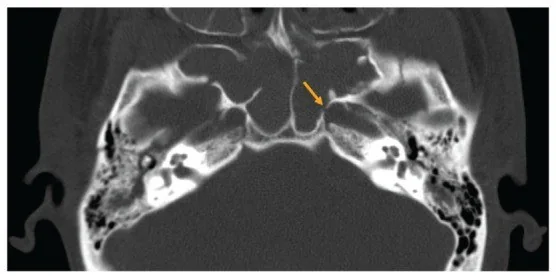
- Karotid kanalı tutan petröz temporal kemik kırıkları ICA yaralanmasıyla ilişkilidir ve BTA ile değerlendirilmesi düşünülebilir.
- Karotid kanal korteksinde fokal kesinti, BT'de kemik korteks bütünlüğünün bozulduğunu gösterir ve kırık hattı çevresinde değerlendirilir.
- Karotid kanalı tutan petröz temporal kemik kırıkları ICA yaralanmasıyla ilişkili bulunmuştur; damar lümeni BTA ile ayrıca değerlendirilir.
- Petroz internal karotid arter yaralanmaları BTA'da diseksiyon, stenoz/oklüzyon veya psödoanevrizma gibi bulgularla değerlendirilebilir.
- BTA'da diseksiyon veya intimal flep bulguları aranır.
- BTA'da psödoanevrizma bulgusu aranır.
- Kafa tabanı kırığına eşlik edebilen intrakraniyal kanama bulguları ayrıca değerlendirilir.
- Karotid kanal veya petroz temporal kemik tutulumlu kafa tabanı kırığı, künt serebrovasküler yaralanma açısından tarama ölçütlerinde yer alabilir; BTA kararı yerel travma protokolü ve klinik bağlamla birlikte verilmelidir.
Normalde
Temporal kemik BT'sinde karotid kanal konturunda düzensizlik olup olmadığı değerlendirilir. BTA, ICA lümenini değerlendirmede kullanılır; kemik kanal tutulumu BT'de ayrıca incelenir.
Normal BT ile kıyasla
Aynı bölgenin, kaynak veri setinde patoloji içermediği belirtilen bir BT incelemesini kesit kesit kaydırın; organ sınırlarını açarak anatomiyi hasta görüntüsüyle karşılaştırın. Küçük rastlantısal bulgular tümüyle dışlanmamıştır.
Kaynak: TotalSegmentator v2.01 veri seti (Wasserthal ve ark., Radiology: Artificial Intelligence 2023), CC BY 4.0, vaka s0103; organ sınırları veri setinin otomatik segmentasyonundan, birleştirilerek sadeleştirildi. Görüntüler 2,5 mm kesit aralığına yeniden örneklendi.
Ayırıcı tanı
- Kafa tabanı kırıklarını taklit edebilen anatomik yapılar, gerçek kırıklardan ayırt edilmelidir.
- Karotid kanal dehisansı
- BT'de karotid kanalın kemik korteksinde kesinti görülebilir.
- Vazospazm, travma sonrası serebrovasküler komplikasyonların ayırıcı tanısında yer alır.
- Karotid kanal kırığı ICA yaralanmasıyla ilişkili olabilir; BTA arter lümenini ayrıca değerlendirir.
Tuzaklar
- Kemik kanal kırığını arter diseksiyonu olarak adlandırma; bu iki bulgu farklı serilerde değerlendirilir ve biri diğerini otomatik kanıtlamaz.
- Temporal kemikteki fissür ve kanallar gerçek kırıklardan ayırt edilmelidir; bu anatomik yapılar kırık hattıyla karıştırılmamalıdır.
- Yalnız BTA'yı okuyup ince kemik kırığını atlama; kemik rekonstrüksiyonunu ayrı gözden geçir.
- BTA'da damar yaralanması bulgusu saptanmaması karotid kanal kırığını dışlamaz; kemik yapı ve kırık ilişkisi BT'de ayrıca değerlendirilir.
Kendini dene
Kafa tabanı kırığı karotid kanala uzanıyor. Klinik ve travma ölçütleri damar taramasını gerektiriyorsa arter lümenini hangi inceleme değerlendirir?
Cevabı göster
BT anjiyografi. BT anjiyografi petroz internal karotid arter lümenini opaklaştırarak damar yaralanması bulgularını araştırır; kontrastsız kemik BT kanal kırığını gösterir, lümeni değerlendirmez. Damar taraması kararı travma bağlamı ve yerel BCVI ölçütleriyle verilir.
Karotid kanal duvarında kırık var, BTA'da arter lümeni düzenli. En doğru ifade hangisidir?
Cevabı göster
Kanal kırığı var, lümen hasarı gösterilmedi. Kemik kanal tutulumu kemik BT bulgusudur; normal BTA lümeni kanal kırığını dışlamaz ve kanal ilişkisi kemik BT'de ayrıca değerlendirilir. Görüntüde gösterilmeyen diseksiyon veya psödoanevrizma kesin tanı olarak yazılamaz.
İlgili konular
Kaynaklar
Bu sayfadaki 38 cümle ve 2 quiz sorusu aşağıdaki kaynaklardan alıntılarla otomatik olarak karşılaştırıldı; 19 cümle bu karşılaştırmada düzeltildi (2026-10-10).
- Otorrhagia in Chronic Otitis Media: An Unexpected Presentation of Internal Carotid Artery Rupturepmc.ncbi.nlm.nih.gov
- The necessity of CT/CTA scans on pediatric cerebrovascular injury after blunt trauma – a single center studypmc.ncbi.nlm.nih.gov
- Transarterial Embolization via the Occipital Artery for a Posterior Condylar Canal Dural Arteriovenous Fistula Following Head Traumapmc.ncbi.nlm.nih.gov
- The preoperative temporal bone CT: a mnemonic for reducing surgical riskpmc.ncbi.nlm.nih.gov
- Absent internal carotid artery during neck exploration for penetrating traumapmc.ncbi.nlm.nih.gov
- The identification of a subgroup of children with traumatic subarachnoid hemorrhage at low risk of neuroworsening.pubmed.ncbi.nlm.nih.gov
- Temporal Bone Trauma: Typical CT and MRI Appearances and Important Points for Evaluation.pubmed.ncbi.nlm.nih.gov
- Role of mastoid pneumatization in temporal bone fractures.pubmed.ncbi.nlm.nih.gov
- Utilization of Computed Tomography in Temporal Bone Fractures at a Large Level I Trauma Center.pubmed.ncbi.nlm.nih.gov
- Pipeline embolization device and subsequent vessel sacrifice for treatment of a bleeding carotid pseudoaneurysm at the skull base: a case report.pubmed.ncbi.nlm.nih.gov
- Utilization of computed tomography in pediatric temporal fractures: A dose reduction approach.pubmed.ncbi.nlm.nih.gov
- Traumatic Injury of the Petrous Part of the Temporal Bone: Keys for Reporting a Complex Diagnosis.pubmed.ncbi.nlm.nih.gov
- Petrous apex cholesterol granuloma involving the sphenoid sinus.pubmed.ncbi.nlm.nih.gov
- Factors associated with blunt internal carotid artery injury in petrous temporal bone fractures.pubmed.ncbi.nlm.nih.gov
- Utility of Computed Tomography Angiography in Characterizing Vascular Injury From Sphenoid Fractures.pubmed.ncbi.nlm.nih.gov
- High Resolution Computed Tomography Atlas of the Porcine Temporal Bone and Skull Base: Anatomical Correlates for Traumatic Brain Injury Research.pubmed.ncbi.nlm.nih.gov
- Concomitant abducens and facial nerve palsies following blunt head trauma associated with bone fracture.pubmed.ncbi.nlm.nih.gov
- Recurrent Streptococcus Pneumoniae 23 F meningitis due to cerebrospinal fluid leakage from the ear cannel: a case report.pubmed.ncbi.nlm.nih.gov
- Multi-Center Validation of the McGovern Pediatric Blunt Cerebrovascular Injury Screening Score.pubmed.ncbi.nlm.nih.gov
- Diagnosis of carotid arterial injury in major trauma using a modification of Memphis criteria.pubmed.ncbi.nlm.nih.gov
- Transarterial Embolization via the Occipital Artery for a Posterior Condylar Canal Dural Arteriovenous Fistula Following Head Trauma.pubmed.ncbi.nlm.nih.gov
- Diagnosis and Management of Pediatric Blunt Cerebrovascular Injuries: A Narrative Review.pubmed.ncbi.nlm.nih.gov
- The necessity of CT/CTA scans on pediatric cerebrovascular injury after blunt trauma - a single center study.pubmed.ncbi.nlm.nih.gov
- Multimodal imaging in neuro-ophthalmology.pubmed.ncbi.nlm.nih.gov
- Multimodal imaging in conductive hearing loss: Optimising CT, MRI and CTA for accurate diagnosis and management.pubmed.ncbi.nlm.nih.gov
- Morphological and Epidemiological Analysis of the Sphenoid Sinus Based on Computed Tomography and Magnetic Resonance Imaging: A Narrative Review.pubmed.ncbi.nlm.nih.gov
- Death by hanging: possibilities and limits of medico-legal evidence.pubmed.ncbi.nlm.nih.gov
- The Importance of Trigeminal Cisternography in the Percutaneous Treatment of Idiopathic Trigeminal Neuralgia.pubmed.ncbi.nlm.nih.gov
- Did George Floyd Die of Cardioinhibition From Pressure on His Neck?pubmed.ncbi.nlm.nih.gov
- Neuroimaging for neurovascular complications of traumatic brain injury.pubmed.ncbi.nlm.nih.gov
- Emerging and re-emerging infectious disease in otorhinolaryngology.pubmed.ncbi.nlm.nih.gov
- Prevalence of Intracranial and Cervical Artery Abnormalities in Patients with Hypermobile Ehlers-Danlos Syndrome and Hypermobility Spectrum Disorders Presenting to an Academic Headache Clinic.pubmed.ncbi.nlm.nih.gov
- Carotid artery dissection linked to intermittent apnoeic swimming: A case-control study.pubmed.ncbi.nlm.nih.gov
- Hominin Variability and Evolutionary Relationships at Guattari Cave During the Middle and Late Pleistocene (San Felice Circeo, Latina, Italy).pubmed.ncbi.nlm.nih.gov
- Aquatic sloths (<i>Thalassocnus</i>) from the Miocene of Chile and the evolution of marine mammal herbivory in the Pacific Ocean.pubmed.ncbi.nlm.nih.gov
- New developments in the biology of fibroblast growth factors.pubmed.ncbi.nlm.nih.gov
- Middle cerebral artery dissection: pathophysiology, diagnosis, and therapeutic options.pubmed.ncbi.nlm.nih.gov
- Exchange-free single-pass gateway balloon-assisted neuroform atlas stenting for symptomatic high-grade intracranial atherosclerotic stenosis: clinical and angiographic outcomes.pubmed.ncbi.nlm.nih.gov
- Operative Procedures for Ultrasound Assessment of Extracranial Artery Disease: A Narrative Review by the Italian Society for Vascular Investigation (SIDV).pubmed.ncbi.nlm.nih.gov
- Computed Tomography Imaging of Thoracic Aortic Surgery: Distinguishing Life-Saving Repairs from Life-Threatening Complications.pubmed.ncbi.nlm.nih.gov
- Ultrasound of the Cheek: Examination Technique, Anatomy, and Abnormal Findings.pubmed.ncbi.nlm.nih.gov
- Atherosclerotic Abdominal Aortic Aneurysms on Computed Tomography Angiography: A Narrative Review on Spectrum of Findings, Structured Reporting, Treatment, Secondary Complications and Differential Diagnosis.pubmed.ncbi.nlm.nih.gov
- Imaging for the diagnosis and management of traumatic brain injury.pubmed.ncbi.nlm.nih.gov
- Role of Clinical and Multimodality Neuroimaging in the Evaluation of Brain Death/Death by Neurologic Criteria and Recent Highlights from 2023 Updated Guidelines.pubmed.ncbi.nlm.nih.gov
- Prevention of in-stent restenosis with drug-eluting balloons in patients with postirradiated carotid stenosis accepting percutaneous angioplasty and stenting.pubmed.ncbi.nlm.nih.gov
- Carotid Artery Injury during Transsphenoidal Pituitary Surgery: Lessons from a 15-Year Modern Microsurgery Cohort.pubmed.ncbi.nlm.nih.gov
- The cavernous sinus: An anatomic study with clinical implication.pubmed.ncbi.nlm.nih.gov
- Imaging of skull base: Pictorial essay.pubmed.ncbi.nlm.nih.gov
- Differential diagnosis of jugular foramen lesions.pubmed.ncbi.nlm.nih.gov
- Total laparoscopic radical hysterectomy for cervical cancer in prolapsed uterus.pubmed.ncbi.nlm.nih.gov
- Patterns of injury and violence in Yaoundé Cameroon: an analysis of hospital data.pubmed.ncbi.nlm.nih.gov
- An Overview of the Diagnostic and Treatment Strategies for Aortic Disease.pubmed.ncbi.nlm.nih.gov
- Post-Traumatic Cerebral Infarction: A Narrative Review of Pathophysiology, Diagnosis, and Treatment.pubmed.ncbi.nlm.nih.gov
- International Society of Paediatric Surgical Oncology (IPSO) Surgical Practice Guidelines.pubmed.ncbi.nlm.nih.gov
- Long-term safety and effectiveness of the "OptEase" vena cava filter.pubmed.ncbi.nlm.nih.gov
- Image-Guided Percutaneous Spinal Biopsy: CT or C-Arm Guidance?pubmed.ncbi.nlm.nih.gov
- A rare case of large left internal maxillary artery pseudoaneurysm secondary to mandibular fracture: A case report and review of the literature.pubmed.ncbi.nlm.nih.gov
- Extravertebral low back pain: a scoping review.pubmed.ncbi.nlm.nih.gov
- Danger points, complications and medico-legal aspects in endoscopic sinus surgery.pubmed.ncbi.nlm.nih.gov
- Management Protocol for Ballistic and Other High-Energy Avulsive Facial Injuries-An Update for the 21st Century.pubmed.ncbi.nlm.nih.gov
- Severe trauma care: advances and future directions in diagnostic and therapeutic techniques and information technology support.pubmed.ncbi.nlm.nih.gov
- Flat-panel conebeam CT in the clinic: history and current state.pubmed.ncbi.nlm.nih.gov
- 2.5-mm articulated endoluminal forceps using a compliant mechanism.pubmed.ncbi.nlm.nih.gov
- Comprehensive review of surgical microscopes: technology development and medical applications.pubmed.ncbi.nlm.nih.gov
- Rare Diseases of the Orbit.pubmed.ncbi.nlm.nih.gov
- 2025 Heart Disease and Stroke Statistics: A Report of US and Global Data From the American Heart Association.pubmed.ncbi.nlm.nih.gov
- Heart Disease and Stroke Statistics-2023 Update: A Report From the American Heart Association.pubmed.ncbi.nlm.nih.gov
- Animal welfare aspects in respect of the slaughter or killing of pregnant livestock animals (cattle, pigs, sheep, goats, horses).pubmed.ncbi.nlm.nih.gov
- Commentary: an eye on PET quantification.pubmed.ncbi.nlm.nih.gov
- Effect of blending Jersey and Holstein-Friesian milk on Cheddar cheese processing, composition, and quality.pubmed.ncbi.nlm.nih.gov
- Imaging and Management of Blunt Cerebrovascular Injury.pubmed.ncbi.nlm.nih.gov
- Pulsatile Tinnitus: A Comprehensive Clinical Approach to Diagnosis and Management.pubmed.ncbi.nlm.nih.gov
- Hypoglossal Nerve Neuropathies-Analysis of Causes and Anatomical Background.pubmed.ncbi.nlm.nih.gov
- The preoperative temporal bone CT: a mnemonic for reducing surgical risk.pubmed.ncbi.nlm.nih.gov
- Intraoperative high-resolution CT reveals electrode misplacement undetected by skull X-ray following cochlear implantation for IP-III inner ear malformation.pubmed.ncbi.nlm.nih.gov
- Intrapetrous Internal Carotid Artery Pseudoaneurysm Secondary to Malignant Otitis Externa: A Case Report.pubmed.ncbi.nlm.nih.gov
- Aortitis as a High-Risk Vascular Syndrome: Integrating Phenotype-Driven Diagnosis, Multidisciplinary Assessment, and Personalised Management.pubmed.ncbi.nlm.nih.gov
- How Common is Dysphagia After Anterior Cervical Spine Surgery, What Drives it, and Can it be Prevented? An Umbrella Review of Systematic Evidence.pubmed.ncbi.nlm.nih.gov
- Prevention of infection in aortic or aortoiliac peripheral arterial reconstruction.pubmed.ncbi.nlm.nih.gov
- Early middle meningeal artery embolization for small acute epidural hematomas: a clinical study from a single center.pubmed.ncbi.nlm.nih.gov
- Surgical Techniques and Materials Used in the Treatment of Complicated Otomastoiditis: A Systematic Review.pubmed.ncbi.nlm.nih.gov
- Anatomic, Radiographic, and Computed Tomographic Study of the Skull in the Persian Squirrel (Sciurus anomalus).pubmed.ncbi.nlm.nih.gov
- Endovascular treatment of blunt injury of the extracranial internal carotid artery: the prospect and dilemma.pubmed.ncbi.nlm.nih.gov
- Do not forget the contralateral side: late onset bilateral carotid dissecting aneurysms.pubmed.ncbi.nlm.nih.gov
- Mechanical stress from the hyoid bone as a potential etiology of bony-related ischemic stroke secondary to carotid artery dissection: A case report and systematic review.pubmed.ncbi.nlm.nih.gov
- Compression Syndromes of the Stylohyoid Complex: Neural, Arterial, and Venous Phenotypes in a Dynamic Neurovascular Corridor.pubmed.ncbi.nlm.nih.gov
- Blunt Cerebrovascular Injury: A Visual Case Report with Computed Tomography Angiography Findings Revealing Carotid and Vertebral Artery Dissection.pubmed.ncbi.nlm.nih.gov
- Hidden ruptured internal carotid artery aneurysm causing occult epistaxis, melena, syncope, and hemodynamic collapse: a case report.pubmed.ncbi.nlm.nih.gov
- Computed Tomographic Patterns of Traumatic Brain Injury in a Nigerian Tertiary Hospital.pubmed.ncbi.nlm.nih.gov
- Delayed Expanding Intracerebral Pneumatocele Following Severe Craniofacial Trauma: A Case Report With Serial Imaging Correlation.pubmed.ncbi.nlm.nih.gov
- A Case of Pneumocephalus on Valsalva Maneuver: A Case Report and Literature Review.pubmed.ncbi.nlm.nih.gov
- Calcified Chondroid Mesenchymal Neoplasm of the Temporomandibular Joint: A Rare and Recently Described Benign Tumor.pubmed.ncbi.nlm.nih.gov
- Severe Pediatric Polytrauma Complicated by Stroke After Fall From Swamp Buggy.pubmed.ncbi.nlm.nih.gov
- The necessity of CT scans on pediatric carotid injury after blunt trauma - An analysis of the traumaregister DGU<sup>®</sup>.pubmed.ncbi.nlm.nih.gov
- Anatomical Step-by-Step Dissection of Complex Skull Base Approaches for Trainees: Surgical Anatomy of the Endoscopic Endonasal Middle-Inferior Clivectomy, Odontoidectomy, and Far-Medial Approach.pubmed.ncbi.nlm.nih.gov
- Morphometric and morphologic analysis of the foramen spinosum in the Slovenian population with clinical correlations.pubmed.ncbi.nlm.nih.gov
- Temporal Bone Fractures on High-Resolution CT: Bridging Radiologic Detail with Otologic Anatomy and Surgical Implications.pubmed.ncbi.nlm.nih.gov
- Life-threatening pneumocephalus from middle ear defect causing cerebrospinal fluid leakage into the eustachian tube: illustrative case.pubmed.ncbi.nlm.nih.gov
- Initial experience with the antithrombogenic-coated CARESTO stent for acute symptomatic cervical internal carotid artery dissections: multicenter study.pubmed.ncbi.nlm.nih.gov
- Diagnostic yield and utilization patterns of head and neck computed tomography angiography.pubmed.ncbi.nlm.nih.gov
- Ophthalmic Complications After Dental Procedures: Scoping Review.pubmed.ncbi.nlm.nih.gov
- Delayed presentation and rupture of an intracranial pseudoaneurysm following penetrating trauma: illustrative case.pubmed.ncbi.nlm.nih.gov
- Zero-TE MRI: principles and applications in the head and neck.pubmed.ncbi.nlm.nih.gov
- Traumatic Penetrating Neck Injury with Right Common Carotid Artery Dissection and Stenosis Effectively Managed with Stenting: A Case Report and Review of the Literature.pubmed.ncbi.nlm.nih.gov
- Post-Traumatic Middle Cerebral Artery Pseudoaneurysm Following Depressed Skull Fracture: Case Report and PRISMA-Guided Literature Review.pubmed.ncbi.nlm.nih.gov
- AI-Based Approaches for the Identification and Quantification of Traumatic Brain Injury in Computed Tomography Imaging: Systematic Review.pubmed.ncbi.nlm.nih.gov
- Understanding Photon-Counting CT: Physics, Detector Technology, and Image Reconstructions.pubmed.ncbi.nlm.nih.gov
- Photon-Counting CT: Technology, Current and Potential Future Clinical Applications, and Overview of Approved Systems and Those in Various Stages of Research and Development.pubmed.ncbi.nlm.nih.gov
- Traumatic oculomotor nerve palsy treated with transnasal endoscopic decompression through the optic strut.pubmed.ncbi.nlm.nih.gov
- Brazilian Society of Otology task force - cochlear implant ‒ recommendations based on strength of evidence.pubmed.ncbi.nlm.nih.gov
- Initial Assessment of the Facial Trauma Patient.pubmed.ncbi.nlm.nih.gov
- Clinician-Guided Deep Learning Segmentation of Skull Base Pneumatization on Computed Tomography Using 3D Slicer and MONAI Label.pubmed.ncbi.nlm.nih.gov
- Combined Transpetrosal Approach for Salvage Surgery in the Treatment of Recurrent and Advanced Nasopharyngeal Carcinoma: A Case Report.pubmed.ncbi.nlm.nih.gov
- Congenital Anomalies and Variations of the Carotid and Vertebral Arteries: A Case-Based Imaging Review.pubmed.ncbi.nlm.nih.gov
- Coronary artery disease imaging with total-body PET.pubmed.ncbi.nlm.nih.gov
- pubmed.ncbi.nlm.nih.govpubmed.ncbi.nlm.nih.gov
Eğitim amaçlıdır; hasta başında tanı ve tedavi kararının yerine geçmez, tıbbi tavsiye değildir. Metinler yapay zekâ desteğiyle yazıldı ve otomatik bir adımda kaynak alıntılarıyla karşılaştırıldı; bu bir tıbbi doğrulama değildir ve içerik uzman radyolog incelemesinden geçmedi. Klinik kararlarda güncel kılavuzları, kurum protokollerini ve radyoloji raporunu esas alın.