Özet
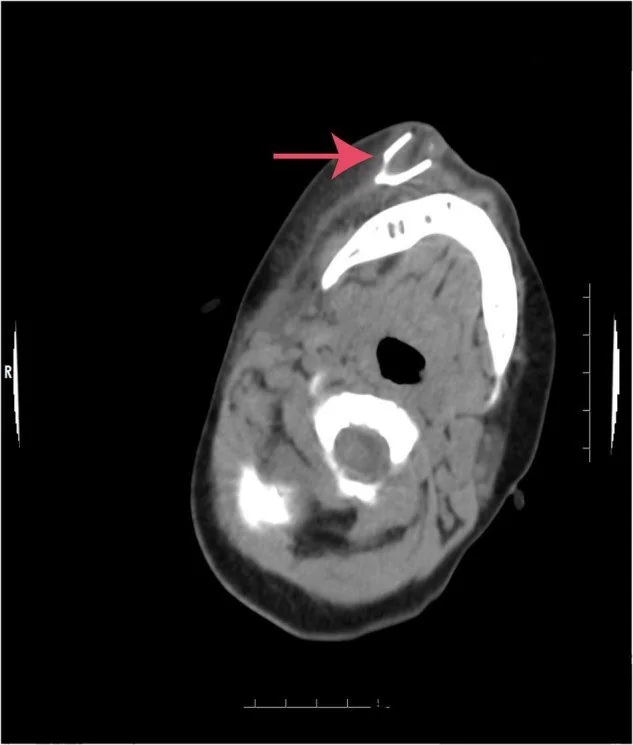
Penetran yüz yaralanmasında küçük cam, metal, taş, ahşap veya plastik parçalar yara yolu dışında kalabilir ve klinik muayenede fark edilmeyebilir. BT, yumuşak dokuda gömülü yabancı cisimlerin lokalizasyonuna yardımcı olabilir. Penetran boyun yaralanmalarında ve çoğu penetran yüz yaralanmasında MDCTA ilk basamak görüntüleme yöntemidir. Gözden kaçan parçalar enfeksiyon, kronik inflamasyon ve yara iyileşmesinde gecikmeye yol açabilir.
Faz ve pencere
- Kontrastsız tanısal
- Bazı yabancı cisimler BT'de radyoopak veya hiperdens olarak görülebilir; metal cisimler görüntü yorumunu güçleştiren artefaktlara yol açabilir. BT, yumuşak dokudaki yabancı cismin saptanmasına ve lokalizasyonuna yardımcı olabilir.
- Kemik algoritması tanısal
- BT, orbita yabancı cisimlerini saptamaya ve kemik ile yumuşak doku yaralanmalarını değerlendirmeye yardımcı olur.
Önerilen pencereler G genişlik, M merkez; değerler Hounsfield birimi (HU)
- Yumuşak dokuG 400 / M +40
- KemikG 1800 / M +400
BT bulguları
- Yabancı cisim — BT'de fokal hiperdensite veya radyoopak odak olarak görülebilir.
- Metal artefaktı — metal cisimlerin oluşturduğu artefaktlar BT görüntülerinin yorumlanmasını güçleştirebilir.
- Ahşap parça — akut dönemde BT'de hava atenüasyonunda görünebilir.
- Plastik yabancı cisim — BT'de hipodens yumuşak doku kitlesi olarak görülebilir.
- Yabancı cisimle ilişkili sinüs traktı — BT'de mandibulaya uzanan bir trakt görülebilir.
- Komşu yumuşak doku şişliği — yabancı cismin çevresinde şişlik görülebilir.
- Komşu yapıların değerlendirilmesi — penetran yüz travmasında BT ile önemli komşu anatomik yapılar değerlendirilmelidir.
Normalde
Yüz yumuşak dokusundaki yabancı cismin BT'de konumunu ve komşu kemik yapılarla ilişkisini değerlendirin; orbita travmasında yabancı cismin orbita içindeki yerini lokalize edin. Orbital travmada yabancı cismin yerini ve orbita kemik ve yumuşak dokularıyla ilişkisini BT'de değerlendirin.
Ayırıcı tanı
- Yüksek atenüasyonlu yabancı cisim mandibula kortikal kırığını taklit edebilir; korteksi BT'de dikkatle değerlendirin.
- Ortodontik aparey parçası
- travma sonrası kopan parçalar komşu yumuşak dokulara yer değiştirebilir.
- Ahşap yabancı cisim BT'de hava ile karışabilir; travmatik orbital amfizem varlığında bu olasılığı göz önünde bulundurun.
Tuzaklar
- Ahşabı otomatik olarak parlak cisim bekleyerek aramayın; kuru ahşap havaya yakın düşük atenüasyon gösterebilir ve yara trasesi boyunca izlenmelidir.
- Metal cisimlerin oluşturduğu artefaktlar BT görüntülerinin yorumlanmasını güçleştirebilir.
- Yüksek atenüasyonlu yabancı cisim mandibula kortikal kırığını taklit edebilir; korteks bütünlüğünü dikkatle değerlendirin.
- BT'de ahşap yabancı cisim hava gibi görünebilir; travmatik orbital amfizem varlığında bu görünüm ayırıcı tanıyı güçleştirebilir.
- Ahşap BT'de düşük atenüasyonda görünebilir ve travmatik amfizem varlığında hava ile karışabilir.
Kendini dene
Radyoopak yüz yabancı cisminde komşu kemik ilişkisiyle birlikte lokalizasyonu en iyi sağlayan ilk basamak yöntem hangisidir?
Cevabı göster
BT. BT yabancı cismin lokalizasyonunu ve komşu kemikle ilişkisini gösterebilir; bu bağlamda ilk ve en duyarlı yöntemdir.
Akut dönemde BT'de hava atenüasyonunda görünebilen yabancı cisim hangi materyal olabilir?
Cevabı göster
Ahşap. Ahşap yabancı cisim akut dönemde BT'de hava atenüasyonunda görünebilir.
İlgili konular
Kaynaklar
Bu sayfadaki 34 cümle ve 2 quiz sorusu aşağıdaki kaynaklardan alıntılarla otomatik olarak karşılaştırıldı; 23 cümle bu karşılaştırmada düzeltildi (2026-10-11).
- Oropharyngeal impalement injury traversing the parapharyngeal space in a childpmc.ncbi.nlm.nih.gov
- Retained Orthodontic Bracket in a Facial Soft Tissue Laceration Following Trauma: Clinical Management and Literature Reviewpmc.ncbi.nlm.nih.gov
- Novel Technique in Performing Ocular Ultrasound in Trauma: A Case Seriespmc.ncbi.nlm.nih.gov
- Retained Feather Foreign Bodies in the Cheek of a Pediatric Patient: A Case Reportpmc.ncbi.nlm.nih.gov
- Acute Pansinusitis Caused by a Retained Merocel Pack Forgotten for 50 Days: A Case Report With Histopathologic Insightspmc.ncbi.nlm.nih.gov
- Imaging of Orbital Trauma and Emergent Non-traumatic Conditions.pubmed.ncbi.nlm.nih.gov
- Transsphenoidal and infralabyrinthine approach of the petrous apex cholesterol granuloma.pubmed.ncbi.nlm.nih.gov
- Intraoperative navigation in craniofacial surgery.pubmed.ncbi.nlm.nih.gov
- Parotidectomy for the treatment of parotid sialocoele in 14 dogs.pubmed.ncbi.nlm.nih.gov
- A systematic approach to CT evaluation of orbital trauma.pubmed.ncbi.nlm.nih.gov
- Repair of orbital floor fractures using bioresorbable poly-L/DL-lactide plates.pubmed.ncbi.nlm.nih.gov
- Removal of a broken needle using three-dimensional computed tomography: a case report.pubmed.ncbi.nlm.nih.gov
- Use of a slit-lamp microscope for treating impacted facial foreign bodies in the emergency department.pubmed.ncbi.nlm.nih.gov
- Violence-related periorbital trauma with a retained foreign body: a case report.pubmed.ncbi.nlm.nih.gov
- Diagnostic and therapeutic aspects in the treatment of gunshot wounds of the viscerocranium.pubmed.ncbi.nlm.nih.gov
- Managing Complications in Facial Cosmetic Treatment.pubmed.ncbi.nlm.nih.gov
- Mandibular symphyseal fracture simulated by a foreign body in the chin.pubmed.ncbi.nlm.nih.gov
- Rothia mucilaginosa, rarely isolated pathogen as an etiological factor of infection of soft tissues in young, healthy woman.pubmed.ncbi.nlm.nih.gov
- Three-dimensional printed model reconstruction in intraoperative use for glass penetrating facial tissue removal.pubmed.ncbi.nlm.nih.gov
- Harm From Foreign Body Ingestion in Adults and Children: A Systematic Review of Case Reports.pubmed.ncbi.nlm.nih.gov
- What Lies Beneath? Using Point of Care Ultrasound (POCUS) to Identify Soft Tissue Foreign Bodies in Children and Adults: A Literature Review.pubmed.ncbi.nlm.nih.gov
- Commentary: an eye on PET quantification.pubmed.ncbi.nlm.nih.gov
- Patterns of injury and violence in Yaoundé Cameroon: an analysis of hospital data.pubmed.ncbi.nlm.nih.gov
- Clinical experience in the management of penetrating stab wounds to the neck: A retrospective analysis of 5 cases.pubmed.ncbi.nlm.nih.gov
- Surgical Techniques and Materials Used in the Treatment of Complicated Otomastoiditis: A Systematic Review.pubmed.ncbi.nlm.nih.gov
- Venous Thromboembolism in Neonates, Children, and Adolescents: A Comprehensive Narrative Review of Risk Factors, Diagnosis, Treatment, and Prevention.pubmed.ncbi.nlm.nih.gov
- Ballistic head and neck injuries: management rationale and outcomes in a case series.pubmed.ncbi.nlm.nih.gov
- The effect of postoperative antibiotics in reducing complications following primary surgical closure of oroantral communications secondary to tooth extraction: a retrospective multicenter study.pubmed.ncbi.nlm.nih.gov
- Clinical decision-making algorithm for the management of Oroantral fistula: A comprehensive guide.pubmed.ncbi.nlm.nih.gov
- Effect of blending Jersey and Holstein-Friesian milk on Cheddar cheese processing, composition, and quality.pubmed.ncbi.nlm.nih.gov
- Asymptomatic penetrating neck injuries: Course and outcome following CT angiography and oesophagography.pubmed.ncbi.nlm.nih.gov
- Multimodal imaging in neuro-ophthalmology.pubmed.ncbi.nlm.nih.gov
- Advanced magnetic resonance neurography for preoperative facial nerve assessment and surgical planning in parotid tumors: a review of current evidence and surgical translation.pubmed.ncbi.nlm.nih.gov
- Virtual Surgical Planning for Management of Acute Maxillofacial Trauma.pubmed.ncbi.nlm.nih.gov
- Presentation and Management of Facial Fractures: An Experience from a Tertiary-Care Teaching Institute in India.pubmed.ncbi.nlm.nih.gov
- The cavernous sinus: An anatomic study with clinical implication.pubmed.ncbi.nlm.nih.gov
- Comparison of accuracy between panoramic radiography, cone-beam computed tomography, and ultrasonography in detection of foreign bodies in the maxillofacial region: an in vitro study.pubmed.ncbi.nlm.nih.gov
- Determining a reliably visible and inexpensive surface fiducial marker for use in MRI: a research study in a busy Australian Radiology Department.pubmed.ncbi.nlm.nih.gov
- What are the 100 most cited fungal genera?pubmed.ncbi.nlm.nih.gov
- Current concepts in penetrating and blast injury to the central nervous system.pubmed.ncbi.nlm.nih.gov
- Challenges in Detecting Small Glass Particles: A Case Study of Persistent Forehead Swelling Post-surgery.pubmed.ncbi.nlm.nih.gov
- High-Pressure Injection Injuries to the Face: An Unusual Case, Review of the Literature, and Proposed Management Algorithm.pubmed.ncbi.nlm.nih.gov
- Atraumatic Orbital Emphysema in a Young Woman.pubmed.ncbi.nlm.nih.gov
- Anatomical Reasons for an Impaired Internal Jugular Flow.pubmed.ncbi.nlm.nih.gov
- Imaging assessment of penetrating injury of the neck and face.pubmed.ncbi.nlm.nih.gov
- International Society of Paediatric Surgical Oncology (IPSO) Surgical Practice Guidelines.pubmed.ncbi.nlm.nih.gov
- Role of Adipose-Derived Mesenchymal Stem Cells in Bone Regeneration.pubmed.ncbi.nlm.nih.gov
- Point-of-care treatment of geometrically complex midfacial critical-sized bone defects with 3D-Printed scaffolds and autologous stromal vascular fraction.pubmed.ncbi.nlm.nih.gov
- Comprehensive Management of Rheumatic Diseases Affecting the Temporomandibular Joint.pubmed.ncbi.nlm.nih.gov
- Temporomandibular Joint Defects: Etiology and Reconstruction Strategy: A Narrative Review.pubmed.ncbi.nlm.nih.gov
- Preclinical evaluation of patient-specific 3D-printed PDLLA/SrHAp implants in a minipig segmental mandibular defect model.pubmed.ncbi.nlm.nih.gov
- Management strategies for unanticipated remnants following tooth extraction: A case report.pubmed.ncbi.nlm.nih.gov
- The Application of Cone Beam Computed Tomography (CBCT) on the Diagnosis and Management of Maxillofacial Trauma.pubmed.ncbi.nlm.nih.gov
- Radiodiagnostic properties of maxillary antroliths: a retrospective cone beam computed tomography study.pubmed.ncbi.nlm.nih.gov
- Engineering of Bioresorbable Polymers for Tissue Engineering and Drug Delivery Applications.pubmed.ncbi.nlm.nih.gov
- Bioprinting revolution: Innovative design of 3D bioactive scaffolds for living organs and transdermal tissues.pubmed.ncbi.nlm.nih.gov
- Transformative biomechanics and mechanobiology breakthroughs shaping the future of health and medicine.pubmed.ncbi.nlm.nih.gov
- High-Frequency and Ultra-High-Frequency Ultrasound in Dermatologic Diseases and Aesthetic Medicine.pubmed.ncbi.nlm.nih.gov
- Biomedical polymers: synthesis, properties, and applications.pubmed.ncbi.nlm.nih.gov
- Few incidentally found interesting foreign objects in human body: a case series.pubmed.ncbi.nlm.nih.gov
- Missed intranasal wooden foreign bodies on computed tomography.pubmed.ncbi.nlm.nih.gov
- Modern management of maxillofacial trauma in the emergency department.pubmed.ncbi.nlm.nih.gov
- Cytidine diphosphate diacylglycerol synthase 2 is a synthetic lethal target in mesenchymal-like cancers.pubmed.ncbi.nlm.nih.gov
- Tissue Engineering and Regenerative Medicine: Perspectives and Challenges.pubmed.ncbi.nlm.nih.gov
- Research Progress in Biomedical Materials.pubmed.ncbi.nlm.nih.gov
- Neuroimaging for neurovascular complications of traumatic brain injury.pubmed.ncbi.nlm.nih.gov
- Differential causes of masticatory muscle disorders in dogs: a review of diagnosis, treatment and long-term management.pubmed.ncbi.nlm.nih.gov
- Global Burden of Deep Neck Space Abscesses: Epidemiology, Challenges, and Outcomes.pubmed.ncbi.nlm.nih.gov
- Overview of Ultrasound in Dentistry for Advancing Research Methodology and Patient Care Quality with Emphasis on Periodontal/Peri-implant Applications.pubmed.ncbi.nlm.nih.gov
- Nasotracheal intubation for airway management during anesthesia.pubmed.ncbi.nlm.nih.gov
- Imaging foreign bodies in head and neck trauma: a pictorial review.pubmed.ncbi.nlm.nih.gov
- Advances and Challenges in Wearable Sensors for Health Monitoring.pubmed.ncbi.nlm.nih.gov
- Choosing the right animal model for osteomyelitis research: Considerations and challenges.pubmed.ncbi.nlm.nih.gov
- International Consensus Statement on Obstructive Sleep Apnea.pubmed.ncbi.nlm.nih.gov
- A review of the oral health of individuals with disabilities in Puerto Rico and among U.S. Hispanics.pubmed.ncbi.nlm.nih.gov
- Retained Orthodontic Bracket in a Facial Soft Tissue Laceration Following Trauma: Clinical Management and Literature Review.pubmed.ncbi.nlm.nih.gov
- Oropharyngeal impalement injury traversing the parapharyngeal space in a child.pubmed.ncbi.nlm.nih.gov
- Acute Pansinusitis Caused by a Retained Merocel Pack Forgotten for 50 Days: A Case Report With Histopathologic Insights.pubmed.ncbi.nlm.nih.gov
- Diagnostic Concordance Between Clinical and Histopathologic Diagnoses of Oral Mucosal Lesions: A Retrospective Study.pubmed.ncbi.nlm.nih.gov
- Radiographic Identification of Foreign Bodies in the Maxillofacial Region: A Case Report and Review for Aesthetic Surgery Planning.pubmed.ncbi.nlm.nih.gov
- Inferior Rectus Myositis After Orbital Fracture Repair With the Medpor® Implant in a 38-Year-Old Male Patient.pubmed.ncbi.nlm.nih.gov
- The Impact of a Horse Kick: A Systematic Review of Horse-Related Maxillofacial Trauma.pubmed.ncbi.nlm.nih.gov
- Epistaxis and Destructive Computed Tomographic Features in Canine Nasal Transitional Carcinoma: Frequent Cribriform Plate Destruction but Uncommon CT-Detected Brain Parenchymal Involvement.pubmed.ncbi.nlm.nih.gov
- From pixels to precision: Imaging technologies shaping oculofacial plastic surgery practice.pubmed.ncbi.nlm.nih.gov
- Ultrasonographic and CBCT analysis of foreign bodies and dental materials.pubmed.ncbi.nlm.nih.gov
- Application of ultrasound biomicroscopy in ocular trauma caused by chestnut-burr spines.pubmed.ncbi.nlm.nih.gov
- Radiological characteristics of mixed composition intraorbital foreign body.pubmed.ncbi.nlm.nih.gov
- Computed Tomographic and Magnetic Resonance Imaging Diagnosis of Concurrent Sinonasal Aspergillosis and Meningoencephalocele in a Dog.pubmed.ncbi.nlm.nih.gov
- Deep learning in neurosurgery: a systematic literature review with a structured analysis of applications across subspecialties.pubmed.ncbi.nlm.nih.gov
- Transbasal penetrating traumatic brain injury caused by a rifle rod: A case report.pubmed.ncbi.nlm.nih.gov
- Vascular embolization as an adjunct to surgical removal of percutaneously inserted foreign bodies in the pharynx to avoid the risk of massive bleeding: a case report.pubmed.ncbi.nlm.nih.gov
- Penetrating orbital floor injury by an undetected foreign body: a case report.pubmed.ncbi.nlm.nih.gov
- Residual foreign body inflammation caused by a lumber beam penetrating the facial region: a case report.pubmed.ncbi.nlm.nih.gov
- A Computed Tomography Scan Near Miss of an Intraorbital Wooden Foreign Body.pubmed.ncbi.nlm.nih.gov
- Pyogenic Granuloma in the Sinonasal Cavity: A Potential 38-Year Latency Following Foreign Body Entrapment.pubmed.ncbi.nlm.nih.gov
- Retroperitoneal glass foreign body with renal parenchymal involvement after 25 years of silent retention: a case report.pubmed.ncbi.nlm.nih.gov
- Case Report: Soft-tissue-preserving fixation for displaced segmental maxillary fractures involving partially detached bone segments.pubmed.ncbi.nlm.nih.gov
- Injury Patterns in Soccer-Induced Maxillofacial Fractures and Ocular Trauma: A Narrative Review.pubmed.ncbi.nlm.nih.gov
- A curious case of a comestible cough candy.pubmed.ncbi.nlm.nih.gov
- An extremely rare case: Transorbital penetrating intracranial injury by wooden foreign body. Case report.pubmed.ncbi.nlm.nih.gov
- Invasive Fungal Infections and Oomycoses in Cats: 1. Diagnostic approach.pubmed.ncbi.nlm.nih.gov
- Minimally Invasive Subtemporal Intradural Approach for Penetrating Orbitocranial Injury by Wooden Foreign Body Into the Lateral Wall of the Cavernous Sinus.pubmed.ncbi.nlm.nih.gov
- Behind the Unilateral Rhinorrhea: Delayed Pediatric Intranasal Foreign Bodies Presenting as Chronic Sinonasal Disease and Severe Complications.pubmed.ncbi.nlm.nih.gov
- Foreign body removal from nasal cavity in transorbital injury of long bamboo stick penetrating nasopharyngeal region: a case report.pubmed.ncbi.nlm.nih.gov
- Retained Bullet in the Orbit Following a Gunshot Wound: Management of Subsequent Complications.pubmed.ncbi.nlm.nih.gov
- Novel approach to a severe craniomaxillofacial trauma in a military working dog using a customized 3D-printed mold for printed polymethylmethacrylate (PMMA) plate-a case report.pubmed.ncbi.nlm.nih.gov
- Extradural Hematoma Following Low-Order Domestic Blast Injury From a Pressure Cooker: A Case Report and Literature Review.pubmed.ncbi.nlm.nih.gov
- The pagers explosions in Beirut: Injury profiles, surgical care, and medical interventions-A descriptive study from a tertiary care medical center.pubmed.ncbi.nlm.nih.gov
- Zygomatic Sialadenitis as a Rare Cause of Exophthalmos in a Dog.pubmed.ncbi.nlm.nih.gov
- Mitigating facial nerve injury risks in aesthetic surgery: A narrative review of surgical practices and anatomicsal challenges.pubmed.ncbi.nlm.nih.gov
- Integrated polyetheretherketone patient-specific implants for multi-subunit midface concavity: a retrospective case series.pubmed.ncbi.nlm.nih.gov
- Needle breakage during dental anesthesia: Management strategies and its associated preventive measures.pubmed.ncbi.nlm.nih.gov
- Odontogenic Maxillary Sinusitis With Sequestrum-Like Bone Formation Mimicking Fungal Sinusitis: A Case Report.pubmed.ncbi.nlm.nih.gov
- Imaging-Guided Algorithmic Management of Mandibular Condylar Fractures: A 13-Year Institutional Analysis of 495 Joints.pubmed.ncbi.nlm.nih.gov
- Orthodontic Implants: Novelty and Evolution in Veterinary Orthodontics-Retrospective Case Series Report.pubmed.ncbi.nlm.nih.gov
- pubmed.ncbi.nlm.nih.govpubmed.ncbi.nlm.nih.gov
Eğitim amaçlıdır; hasta başında tanı ve tedavi kararının yerine geçmez, tıbbi tavsiye değildir. Metinler yapay zekâ desteğiyle yazıldı ve otomatik bir adımda kaynak alıntılarıyla karşılaştırıldı; bu bir tıbbi doğrulama değildir ve içerik uzman radyolog incelemesinden geçmedi. Klinik kararlarda güncel kılavuzları, kurum protokollerini ve radyoloji raporunu esas alın.