
Özet
Acil toraks BT'sinde jeneratör ve kablolar sık karşılaşılan, fakat kalp odacıklarıyla ilişkisi bilinmediğinde yanlış komplikasyon yorumuna yol açabilen cihazlardır. BT; transvenöz, epikardiyal, terk edilmiş ve tamamen deri altı sistemlerin anatomik güzergâhını doğrudan gösterir. Kablonun kalbe girmeyen subkutan ICD yapısını veya koroner sinüs üzerinden geçen sol ventrikül elektrodunu tanımak malpozisyon sanısını önler. Beklenen elektrot pozisyonlarının bilinmesi, yanlış yorumlamayı önlemek için esastır.
Faz ve pencere
- Kontrastsız tanısal
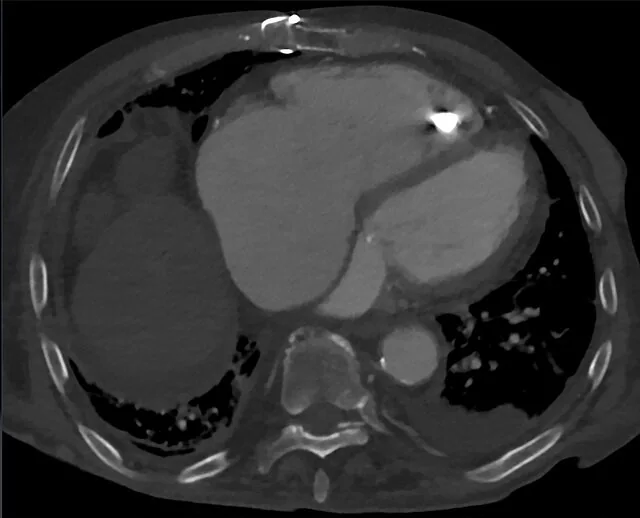
- Jeneratör gövdesi ve elektrotlar toraks BT'de belirgin şekilde izlenir; BT, cihazın yerleşimi ve olası komplikasyonlar hakkında detaylı bilgi sağlar.
Önerilen pencereler G genişlik, M merkez; değerler Hounsfield birimi (HU)
- MediastenG 350 / M +50
- Yumuşak dokuG 400 / M +40
BT bulguları
- Jeneratörün pektoral subkutan veya subpektoral cepte, kablo giriş tarafına bağlı bulunması
- Sağ atriyum pacing elektrodu tipik olarak sağ atriyum apendiksine J biçimli bir kıvrımla uzanır; Bachmann demeti gibi farklı atriyal hedefler de kullanılabilir.
- Sağ ventrikül elektrodunun triküspit kapağı geçerek sağ ventrikül apeksinde veya septumunda sonlanması
- Resenkronizasyon sisteminde sol ventrikül elektrodu koroner sinüsten bir lateral veya posterolateral kardiyak vene ilerler ve epikardiyal yüzey boyunca seyreder.
- Jeneratör bağlantı noktasından başlayarak elektrotları kalp ucuna kadar dikkatle izle; bağlantı pinlerinin jeneratör konnektör bloğuna oturup oturmadığını değerlendir.
- Subkutan ICD elektrodunun sternum yanında deri altı planda ilerlemesi ve kalp boşluğuna girmemesi
- Epikardiyal elektrodun göğüs duvarından kalbin yüzeyine ulaşan cerrahi güzergâhı
- Transvenöz sağ ventrikül elektrodu triküspit kapağı geçer; koroner sinüs üzerinden ilerleyen sol ventrikül elektrodu ise triküspit kapağı geçmeden kardiyak ven içinde sonlanır.
Normalde
Doğal kalpte intrakardiyak metal yapı yoktur; cihazlı bireyde ise atriyal elektrot apendikste, ventriküler elektrot ventrikül apeksinde, CRT sisteminde ise sol ventrikül elektrodu koroner sinüs üzerinden posterolateral epikardiyal vine yerleşmiştir. Sternum önündeki subkutan ICD elektrodu miyokarda girmez ve transvenöz yoldan değil, parasternal deri altından yerleştirilir.
Normal BT ile kıyasla
Aynı bölgenin, kaynak veri setinde patoloji içermediği belirtilen bir BT incelemesini kesit kesit kaydırın; organ sınırlarını açarak anatomiyi hasta görüntüsüyle karşılaştırın. Küçük rastlantısal bulgular tümüyle dışlanmamıştır.
Kaynak: TotalSegmentator v2.01 veri seti (Wasserthal ve ark., Radiology: Artificial Intelligence 2023), CC BY 4.0, vaka s1278; organ sınırları veri setinin otomatik segmentasyonundan, birleştirilerek sadeleştirildi. Görüntüler 2,5 mm kesit aralığına yeniden örneklendi.
Ayırıcı tanı
- Terk edilmiş elektrot
- jeneratörle devamlı bağlantısı olmayan, ucu kapalı eski kablo parçası olarak seyreder.
- Epikardiyal elektrot
- intravasküler yoldan değil, kalp yüzeyine cerrahi erişim izinden ulaşır.
- Subkutan ICD
- sternum önünde yüzeyel seyreder ve kalp odacıklarına transvenöz giriş yapmaz.
- Sol ventrikül pacing elektrodu
- koroner sinüs yoluyla sol ventrikül posterolateral epikardiyal vine ulaşır; bu sey, sağ ventrikül kaçıran elektrotun malpoziyonu ile ayırt edilmelidir.
Tuzaklar
- Koroner sinüsteki sol ventrikül elektrodu posterior seyri nedeniyle ekstrakardiyak sanılabilir; koroner sinüs ostiumuna kadar geriye doğru izle.
- İnce kırık ve izolasyon arızalarını saptamak için elektrotlar jeneratör bağlantısından başlayarak ucuna kadar dikkatlice takip edilmelidir.
- Subkutan ICD'nin sternum önündeki kalın elektrodu sağ ventrikül kablosu değildir; miyokard veya büyük ven içine girmez.
- Sağ ventrikül elektrodu apeks dışında sağ ventrikül çıkış yolunda da sonlanabilir.
Kendini dene
Biventriküler pacing sisteminde koroner sinüs yoluyla sol ventrikül duvarındaki epikardiyal vene uzanan elektrot hangisidir?
Cevabı göster
Sol ventrikül koroner ven elektrodu. Biventriküler sistemde sol ventrikül elektrodu koroner sinüs yoluyla sol ventrikül duvarındaki epikardiyal vene ilerler.
Sol parasternal deri altı planda uzanan, defibrilasyon için transvenöz elektrot gerektirmeyen elektrot hangi sisteme aittir?
Cevabı göster
Subkutan ICD kablosu. S-ICD, defibrilasyon için transvenöz elektrot kullanmaz; algılama elektrotları ve şok bobinleri içeren elektrodu sol parasternal deri altı planda yer alır.
Bu konunun yer aldığı turlar
İlgili konular
- Kalp pili/ICD elektrot malpozisyonu ve perforasyonu
- Kardiyak cihaz cebi enfeksiyonu ve elektrot ilişkili tromboz
Kaynaklar
Bu sayfadaki 33 cümle ve 2 quiz sorusu aşağıdaki kaynaklardan alıntılarla otomatik olarak karşılaştırıldı; 16 cümle bu karşılaştırmada düzeltildi (2026-10-09).
- Where Does It Lead? Imaging Features of Cardiovascular Implantable Electronic Devices on Chest Radiograph and CTpmc.ncbi.nlm.nih.gov
- Radiography of Cardiac Conduction Devices: A Pictorial Review of Pacemakers and Implantable Cardioverter Defibrillatorspmc.ncbi.nlm.nih.gov
- The many faces of atrioventricular block in myocarditis: a case series and proposed clinical strategy highlighting cardiovascular magnetic resonance-guided diagnosis, device selection, and disease monitoring.pubmed.ncbi.nlm.nih.gov
- Extravascular Implantable Cardioverter-Defibrillator Therapy for Malignant Ventricular Arrhythmias in a Child with Congenital Long QT Syndrome: A Case Report.pubmed.ncbi.nlm.nih.gov
- Advancements in pacing and ICD technologies: Potential implications for complex congenital heart disease in adults.pubmed.ncbi.nlm.nih.gov
- Diagnostic and Management Challenges in a Non-Infectious Pacemaker Pocket Swelling: A Case Report and Literature Review.pubmed.ncbi.nlm.nih.gov
- The Two-Device Problem: A Comprehensive Framework for Managing Transvalvular CIED Leads in the Era of Transcatheter Tricuspid Intervention.pubmed.ncbi.nlm.nih.gov
- Management of Idiopathic Outflow Tract Ventricular Arrhythmias.pubmed.ncbi.nlm.nih.gov
- Paravalvular positioning of a cardiac implantable electronic device electrode during tricuspid valve replacement.pubmed.ncbi.nlm.nih.gov
- Epicardial ventricular arrhythmia ablation: a clinical consensus statement of the European Heart Rhythm Association of the European Society of Cardiology and the Heart Rhythm Society, the Asian Pacific Heart Rhythm Society, the Latin American Heart Rhythm Society, and the Canadian Heart Rhythm Society.pubmed.ncbi.nlm.nih.gov
- Trajectory-specific motion-induced electromotive force assessment of pacemaker-carrying workers in MRI environments.pubmed.ncbi.nlm.nih.gov
- Myval Beyond the Aortic Valve: Device-Anatomy Interaction, Procedural Strategy, and Clinical Evidence in Mitral, Tricuspid, and Pulmonary Positions.pubmed.ncbi.nlm.nih.gov
- Infections in mechanical circulatory support.pubmed.ncbi.nlm.nih.gov
- Primary cardiac angiosarcoma initially presenting with sick sinus syndrome and pericardial effusion: a case report.pubmed.ncbi.nlm.nih.gov
- Small but lethal: cystic tumour of the atrioventricular node-a case report.pubmed.ncbi.nlm.nih.gov
- Hypertensive crisis in the critically ill.pubmed.ncbi.nlm.nih.gov
- Cardiac Magnetic Resonance and Cardiac Implantable Electronic Devices: Are They Truly Still "Enemies"?pubmed.ncbi.nlm.nih.gov
- European Heart Rhythm Association (EHRA) international consensus document on how to prevent, diagnose, and treat cardiac implantable electronic device infections-endorsed by the Heart Rhythm Society (HRS), the Asia Pacific Heart Rhythm Society (APHRS), the Latin American Heart Rhythm Society (LAHRS), International Society for Cardiovascular Infectious Diseases (ISCVID) and the European Society of Clinical Microbiology and Infectious Diseases (ESCMID) in collaboration with the European Association for Cardio-Thoracic Surgery (EACTS).pubmed.ncbi.nlm.nih.gov
- Fluoroless Workflow for Pulsed Field Ablation of Atrial Fibrillation Using the Sphere-9 and VARIPULSE Catheters.pubmed.ncbi.nlm.nih.gov
- Intracardiac Echocardiography during Invasive Electrophysiological Procedures: a Scientific Statement of the European Heart Rhythm Association of the ESC, and the European Association of Percutaneous Cardiovascular Interventions of the ESC.pubmed.ncbi.nlm.nih.gov
- Practical guide on the use of the PulseSelect pulsed field ablation system for atrial fibrillation ablation procedures.pubmed.ncbi.nlm.nih.gov
- Adult congenital heart disease: a review of the moderately complex lesions.pubmed.ncbi.nlm.nih.gov
- Transcatheter Mitral Valve Replacement in Failed Mitral Bioprosthesis: Case Report.pubmed.ncbi.nlm.nih.gov
- Coronary sinus and cardiac venous anatomy for cardiac resynchronization therapy: A Clinician's view.pubmed.ncbi.nlm.nih.gov
- Transvenous Coronary Sinus Lead Placement in Systemic Right Ventricle With D-TGA and Atrial Baffle.pubmed.ncbi.nlm.nih.gov
- Ablation in Adult Congenital Heart Disease Using a Dual-Energy, Lattice-Tip, Large-Footprint, Map-and-Ablate Catheter.pubmed.ncbi.nlm.nih.gov
- Long-term safety and effectiveness of the "OptEase" vena cava filter.pubmed.ncbi.nlm.nih.gov
- First Reported Extravascular-ICD Insertion in a Patient With Prior Sternotomy for Valvular Surgery.pubmed.ncbi.nlm.nih.gov
- A Contemporary Review of Subcutaneous and Extravascular Implantable Cardiac Defibrillators.pubmed.ncbi.nlm.nih.gov
- Transapical epicardial temporary pacemaker lead implantation in patients with transapical TAVI.pubmed.ncbi.nlm.nih.gov
- Advances in Epicardial Access for Ventricular Tachycardia Ablation: From Historical Techniques to Carbon Dioxide Insufflation.pubmed.ncbi.nlm.nih.gov
- Advances in Catheter Ablation of Ventricular Tachycardia: Technical Considerations and Contemporary Approaches.pubmed.ncbi.nlm.nih.gov
- Single-Session Transcatheter Aortic and Tricuspid Valve-in-Valve Implantation in a Patient with Prior Multivalve Surgery and a Chronic Transvenous Pacing Lead: A Case-Based Review of Procedural Strategy.pubmed.ncbi.nlm.nih.gov
- Re-evaluation of the risks to public health related to the presence of bisphenol A (BPA) in foodstuffs.pubmed.ncbi.nlm.nih.gov
- Meeting Abstracts - Academy of Managed Care Pharmacy Nexus 2019.pubmed.ncbi.nlm.nih.gov
- Psychological therapies for panic disorder with or without agoraphobia in adults: a network meta-analysis.pubmed.ncbi.nlm.nih.gov
- Surgical and Transcatheter Tricuspid Valve Interventions: An Electrophysiology-Focused Review.pubmed.ncbi.nlm.nih.gov
- Programmed ventricular stimulation for risk stratification in symptomatic athletes with nonischemic left ventricular scar and preserved ejection fraction.pubmed.ncbi.nlm.nih.gov
- Left Bundle Branch Area Pacing in Heart Failure: A Physiological Alternative to Conventional Biventricular Cardiac Resynchronization Therapy and a Step Towards Personalized Device Therapy.pubmed.ncbi.nlm.nih.gov
- ECG and Anatomical Features in Patients of Left Coronary Cusp Ventricular Arrhythmias With R Wave in Lead I.pubmed.ncbi.nlm.nih.gov
- A 71-year-old woman with acute chest pain and ST-segment elevation.pubmed.ncbi.nlm.nih.gov
- Presumed Primary Cardiac Angiosarcoma With Atrioventricular Groove Rupture and Right Coronary Artery Compromise: A Case Report and Literature Review.pubmed.ncbi.nlm.nih.gov
- Long-Term Survival after Repeat Resection and Multimodal Therapy for Primary Cardiac Angiosarcoma: A Case Report.pubmed.ncbi.nlm.nih.gov
- Massage for low-back pain.pubmed.ncbi.nlm.nih.gov
- Impact structures in Africa: A review.pubmed.ncbi.nlm.nih.gov
- New developments in the antiviral treatment of hepatitis C.pubmed.ncbi.nlm.nih.gov
- The Benefit and Harm of an Implantable Cardiac Defibrillator in a Patient with Heart Failure: A Case Report and Literature Review.pubmed.ncbi.nlm.nih.gov
- Unusual migration of implantable cardioverter defibrillator that clinically mimicking breast cancer: A case report.pubmed.ncbi.nlm.nih.gov
- Catecholaminergic Polymorphic Ventricular Tachycardia: Clinical Characteristics, Diagnostic Evaluation and Therapeutic Strategies.pubmed.ncbi.nlm.nih.gov
- Pre- and post-procedural cardiac imaging (computed tomography and magnetic resonance imaging) in electrophysiology: a clinical consensus statement of the European Heart Rhythm Association and European Association of Cardiovascular Imaging of the European Society of Cardiology.pubmed.ncbi.nlm.nih.gov
- 2019 HRS/EHRA/APHRS/LAHRS expert consensus statement on catheter ablation of ventricular arrhythmias.pubmed.ncbi.nlm.nih.gov
- Physical rehabilitation approaches for the recovery of function and mobility following stroke.pubmed.ncbi.nlm.nih.gov
- Persistent Left Superior Vena Cava Mimicking Central Venous Catheter Malposition After Left Internal Jugular Access: A Case Report.pubmed.ncbi.nlm.nih.gov
- Acute Innominate Vein Dissection During Pacemaker Revision Procedure: A Case Report and Conservative Management.pubmed.ncbi.nlm.nih.gov
- Catheter-directed thrombectomy combined with angioplasty and stent implantation for superior vena cava syndrome: a case report.pubmed.ncbi.nlm.nih.gov
- Association Between Inferior Vena Cava Location and the Number of Deployments of a Leadless Pacemaker.pubmed.ncbi.nlm.nih.gov
- Perioperative Point-of-Care Ultrasound Utilization in Abdominal Organ Transplantation. Part II: Postoperative Care.pubmed.ncbi.nlm.nih.gov
- Workup and management of rhythm disorders in myocarditis and inflammatory cardiomyopathy: a clinical consensus statement of the European Heart Rhythm Association and the Heart Failure Association of the ESC, the ESC Working Group on Myocardial & Pericardial Diseases, the European Association of Preventive Cardiology of the ESC, the Heart Rhythm Society, the Asian Pacific Heart Rhythm Society, and the Latin American Heart Rhythm Society.pubmed.ncbi.nlm.nih.gov
- Therapeutic Challenges in Total Situs Inversus Associated with Sick Sinus Syndrome, Ventricular Arrhythmias, and Heart Failure with Preserved Ejection Fraction: Narrative Review and Case Report.pubmed.ncbi.nlm.nih.gov
- Thoracoscopic right atrial access for septal lead implantation: a novel minimally invasive technique (case report).pubmed.ncbi.nlm.nih.gov
- Factors associated with complexity during transvenous lead extraction and confirmation of a very-low-risk subset.pubmed.ncbi.nlm.nih.gov
- Successful Cardiac Resynchronization Therapy With Defibrillator Implantation in a Patient With Isolated Dextrocardia and Situs Inversus Totalis: Role of High-Resolution Three-Dimensional Computed Tomography in Procedural Planning.pubmed.ncbi.nlm.nih.gov
- Carbon Dioxide Insufflation for Assessment of Pericardial Adhesions and Informed Decision-Making for Percutaneous Epicardial Access in a Patient With Prior Cardiac Surgery.pubmed.ncbi.nlm.nih.gov
- New Diseases Related to Cardiac Implantable Electronic Devices (CIEDs): An Overview.pubmed.ncbi.nlm.nih.gov
- NCCP-ICS joint consensus-based clinical practice guidelines on medical thoracoscopy.pubmed.ncbi.nlm.nih.gov
- International Society of Paediatric Surgical Oncology (IPSO) Surgical Practice Guidelines.pubmed.ncbi.nlm.nih.gov
- Axillary Versus Subclavian Venous Access for Permanent Pacemaker Implantation: Complications, Evolving Techniques and Practical Recommendations.pubmed.ncbi.nlm.nih.gov
- Cardiac implantable electronic device upgrades and downgrades: a Clinical Consensus Statement of the European Heart Rhythm Association (EHRA) of the ESC, the Asia Pacific Heart Rhythm Association (APHRS), Canadian Heart Rhythm Society (CHRS), Heart Rhythm Society (HRS), and the Latin American Heart Rhythm Society (LAHRS).pubmed.ncbi.nlm.nih.gov
- Choosing Between Tricuspid Repair or Replacement: Decision Algorithms.pubmed.ncbi.nlm.nih.gov
- Artificial Intelligence and the Future of Cardiac Implantable Electronic Devices: Diagnostics, Monitoring, and Therapy.pubmed.ncbi.nlm.nih.gov
- Cardiac lead perforation: Mechanisms, detection, and therapeutic approaches.pubmed.ncbi.nlm.nih.gov
- Leadless pacemaker tine fracture and dislocation: two case reports.pubmed.ncbi.nlm.nih.gov
- Safety and efficacy of completely transthoracic echocardiography guided leadless pacemaker implantation assisted by Panna guide wire: initial clinical experience.pubmed.ncbi.nlm.nih.gov
- Delayed right ventricular perforation 3 years after permanent pacemaker implantation: a case report.pubmed.ncbi.nlm.nih.gov
- Advanced Cardiac Imaging for Risk Prediction of Pacing-Induced Cardiomyopathy: A Narrative Literature Review.pubmed.ncbi.nlm.nih.gov
- Forward Dynamics: Modern Insights into Mitral Systolic Anterior Motion.pubmed.ncbi.nlm.nih.gov
- In Vitro Assessment of 3T MRI Effects on Non-3T-Compatible Cardiac Implantable Electronic Devices.pubmed.ncbi.nlm.nih.gov
- Complication imaging after laparoscopic Roux-en-Y gastric bypass: clues to the diagnosis and pitfalls.pubmed.ncbi.nlm.nih.gov
- Infective Endocarditis with Gerbode Defect and DRESS Syndrome: A Rare Case Report.pubmed.ncbi.nlm.nih.gov
- Left Ventricular and Lung Perforation Caused by a Pacemaker Lead Requiring Emergency Surgical Repair in a Nonagenarian.pubmed.ncbi.nlm.nih.gov
- Right Atrial Perforation With Pericardial Effusion and Visceral Pericardial Flap Observed During Pacemaker Implantation: An Echocardiographic Case Report.pubmed.ncbi.nlm.nih.gov
- The long journey of a retained guidewire, from vein to aorta leading to cardiac tamponade: a case report.pubmed.ncbi.nlm.nih.gov
- Tricuspid valve regurgitation: current diagnosis and treatment.pubmed.ncbi.nlm.nih.gov
- Radiology of cardiac devices and their complications.pubmed.ncbi.nlm.nih.gov
- UK Kidney Association Clinical Practice Guideline on vascular access for haemodialysis.pubmed.ncbi.nlm.nih.gov
- Phosphate binders for preventing and treating chronic kidney disease-mineral and bone disorder (CKD-MBD).pubmed.ncbi.nlm.nih.gov
- Phosphate binders for preventing and treating chronic kidney disease-mineral and bone disorder (CKD-MBD).pubmed.ncbi.nlm.nih.gov
- Practical conduct of open heart procedures for congenital heart lesions.pubmed.ncbi.nlm.nih.gov
- Wide Complex Irregular Rhythm in a Paced Patient: A Clinical Approach.pubmed.ncbi.nlm.nih.gov
- Beta-blockers and inhibitors of the renin-angiotensin aldosterone system for chronic heart failure with preserved ejection fraction.pubmed.ncbi.nlm.nih.gov
- Pulsed field ablation for paroxysmal atrial fibrillation and atrial flutter in a patient with dextrocardia and prior secundum atrial septal defect repair: a case report.pubmed.ncbi.nlm.nih.gov
- Incidental noninvasive diagnosis of isolated persistent left superior vena cava in asymptomatic adults: A case report.pubmed.ncbi.nlm.nih.gov
- Case series: the right parasternal view and its prognostic value in detecting pathological abnormalities on transthoracic echocardiography.pubmed.ncbi.nlm.nih.gov
- Innovative Management of Rhythm Disorders in Adults with Congenital Heart Disease.pubmed.ncbi.nlm.nih.gov
- Initial Experience of the Medtronic Aurora Extravascular Implantable Cardioverter in Children in a UK Centre.pubmed.ncbi.nlm.nih.gov
- Silent misplacement: leadless pacemaker in the left ventricle discovered over a year later-How did it end up there? Could it explain the stroke?pubmed.ncbi.nlm.nih.gov
- Malposition of Central Venous Catheter into Coronary Sinus throughout the Persistent Left Superior Vena Cava and Other Complications Related to Catheterization.pubmed.ncbi.nlm.nih.gov
- An Electronic Device Floating in Hemothorax: When POCUS Helps to FOCUS.pubmed.ncbi.nlm.nih.gov
- Malignant Neoplasms Arising in the Cardiac Pacemaker Cavity: A Systematic Review.pubmed.ncbi.nlm.nih.gov
- Exosomes activate hippocampal microglia in atrial fibrillation through long-distance heart-brain communication.pubmed.ncbi.nlm.nih.gov
- Left Bundle Branch Area Pacing as a Rescue Strategy After Failed Cardiac Resynchronization Therapy in a Patient With Persistent Left Superior Vena Cava, Absent Coronary Sinus Branches, After Bilateral Maze Procedure: A Case Report.pubmed.ncbi.nlm.nih.gov
- Bachmann's bundle pacing: toward physiologic atrial activation.pubmed.ncbi.nlm.nih.gov
- Surgical Ablation of Atrial Fibrillation Using the Left Atrial Roof Approach.pubmed.ncbi.nlm.nih.gov
- Non-invasive assessment of left atrial activation using lead V8 during Bachmann bundle pacing.pubmed.ncbi.nlm.nih.gov
- Personalized Test Bolus MSCT Protocol for Optimal Coronary Sinus Venous Visualization in Candidates for Cardiac Resynchronization Therapy.pubmed.ncbi.nlm.nih.gov
- Nurse practitioner-led CIED monitoring during MRI in pediatric and adult patients with congenital heart disease.pubmed.ncbi.nlm.nih.gov
- The 'CIED Team' Approach to Device-Related Complications.pubmed.ncbi.nlm.nih.gov
- Perioperative management of cardiac implantable electronic devices: a state of the art narrative review.pubmed.ncbi.nlm.nih.gov
- Leadless Pacing for Delayed Heart Block After Transcatheter Tricupid Valve Replacement.pubmed.ncbi.nlm.nih.gov
- Epicardial Lead Dysfunction in a Patient With Mechanical Tricuspid Valve-A Challenging Complication.pubmed.ncbi.nlm.nih.gov
- Conduction system pacing as a rescue strategy for unsuccessful cardiac resynchronisation therapy implantation.pubmed.ncbi.nlm.nih.gov
- Alternating bundle branch block and infra-Hisian Mobitz II block: an educational case of rapidly progressive His-Purkinje disease.pubmed.ncbi.nlm.nih.gov
Eğitim amaçlıdır; hasta başında tanı ve tedavi kararının yerine geçmez, tıbbi tavsiye değildir. Metinler yapay zekâ desteğiyle yazıldı ve otomatik bir adımda kaynak alıntılarıyla karşılaştırıldı; bu bir tıbbi doğrulama değildir ve içerik uzman radyolog incelemesinden geçmedi. Klinik kararlarda güncel kılavuzları, kurum protokollerini ve radyoloji raporunu esas alın.