Özet
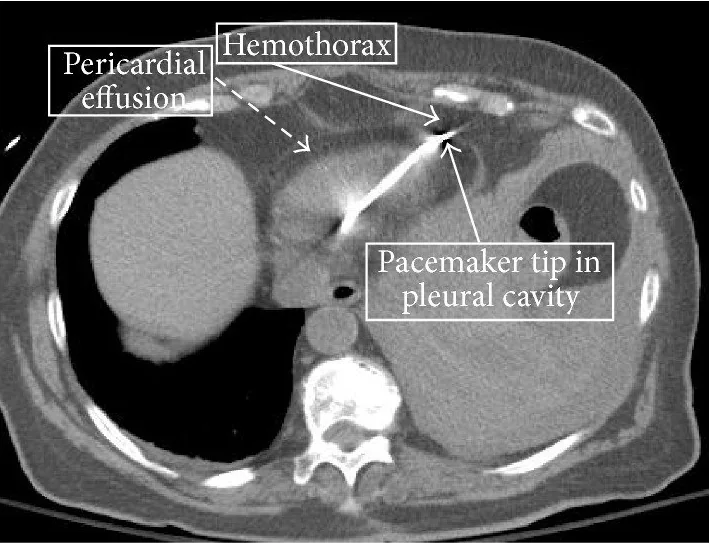
Göğüs ağrısı veya nefes darlığıyla başvuran cihazlı hastada BT, elektrot perforasyonunu ve ucun konumunu değerlendirebilir. BT, elektrotun konumunu ve miyokardı geçerek kalp dışına uzanıp uzanmadığını gösterebilir. Elektrot perforasyonu, perikardiyal efüzyon veya tamponad olmadan da görülebilir. Elektrot perforasyonu perikardiyal efüzyon ve tamponada; eşlik eden damar veya kalp yaralanması ise hemotoraksa yol açabilir.
Faz ve pencere
- Kontrastsız tanısal
- İnce kesitli BT'de elektrot ucunun miyokardı geçerek kalp dışına uzanımı ve eşlik eden perikardiyal sıvı araştırılır.
- Kontrastlı
- Damar yaralanması kuşkusunda BT, eşlik eden aktif kanamanın yerini gösterebilir.
Önerilen pencereler G genişlik, M merkez; değerler Hounsfield birimi (HU)
- MediastenG 350 / M +50
- Yumuşak dokuG 400 / M +40
- AnjiyoG 600 / M +150
BT bulguları
- Elektrot ucunun miyokard dış konturunu aşarak epikardiyal yağda veya perikard boşluğunda sonlanması
- Elektrot perforasyonu sağ ventrikül miyokardını veya sağ atriyum serbest duvarını geçebilir.
- CRT'de sol ventrikül elektrodu koroner sinüsün posterolateral dalına yerleştirilebilir. Sol kalp boşluğunda izlenen elektrot malpozisyon açısından değerlendirilmelidir.
- Yeni gelişen perikardiyal sıvı; yoğun içerik veya pıhtı hemoperikardiyumu düşündürür
- BT'de elektrot malpozisyonu ve perforasyonu değerlendirilebilir.
- Elektrot perforasyonu perikardiyal efüzyon veya tamponadla; eşlik eden damar ya da kalp yaralanması plevral efüzyon ve hemotoraksla ilişkili olabilir.
- BT'de elektrot ucunun plevral aralığa veya akciğer parankimine uzanımı ile eşlik eden plevral efüzyon ve hemotoraks değerlendirilebilir.
Normalde
Elektrot ucunun miyokardı geçerek miyokard dışına uzanması perforasyonu; sol kalp boşluğunda izlenmesi ise malpozisyonu düşündürür. Bulguları klinik durum ve cihaz sorgulamasıyla birlikte görüntüleme yöntemleri üzerinden değerlendirin.
Normal BT ile kıyasla
Aynı bölgenin, kaynak veri setinde patoloji içermediği belirtilen bir BT incelemesini kesit kesit kaydırın; organ sınırlarını açarak anatomiyi hasta görüntüsüyle karşılaştırın. Küçük rastlantısal bulgular tümüyle dışlanmamıştır.
Kaynak: TotalSegmentator v2.01 veri seti (Wasserthal ve ark., Radiology: Artificial Intelligence 2023), CC BY 4.0, vaka s0977; organ sınırları veri setinin otomatik segmentasyonundan, birleştirilerek sadeleştirildi. Görüntüler 2,5 mm kesit aralığına yeniden örneklendi.
Ayırıcı tanı
- Koroner sinüs yoluyla yerleştirilen sol ventrikül elektrodu normal bir CRT yerleşimi olabilir; patent foramen ovale üzerinden sol ventriküle geçen elektrot ise malpozisyon örneğidir.
- BT'de elektrot ucunun miyokardı geçerek epikardiyal yüzeyin ötesine uzanımı perforasyonu gösterir.
- Perikardiyal efüzyon olmaması elektrot perforasyonunu dışlamaz.
- Sol ventriküle malpozisyon, elektrodun patent foramen ovale üzerinden geçmesiyle oluşabilir.
Tuzaklar
- BT, elektrot ucunun konumunu ve miyokardı geçerek kalp dışına uzanımını gösterebilir.
- BT'de elektrot ucunun miyokardı geçerek epikardiyal yüzeyin ötesine uzanımı perforasyonu gösterir.
- Elektrot perforasyonu başlangıçta normal cihaz parametreleriyle birlikte bulunabilir; normal ölçümler perforasyonu dışlamaz.
- Perforasyon değerlendirmesinde cihaz sorgusunu görüntülemeyle birlikte ele alın; perforasyon için yerleşik tanı ölçütlerinin bulunmaması değerlendirmeyi güçleştirebilir.
Kendini dene
Cihazı olan hastada elektrot ucu sağ ventrikül dış konturunun ötesinde ve perikard sıvısı içinde. En olası sorun nedir?
Cevabı göster
Elektrot perforasyonu. Miyokard dışına uzanan uç perforasyonu destekler; koroner sinüs elektrodu posterior venöz seyir gösterir, kist ve divertikül metal ucun duvarı geçmesini açıklamaz.
Bir elektrot koroner sinüs yoluyla posterolateral ven boyunca ilerleyip sol ventrikül tarafına yerleştiriliyor. Bu neyi temsil eder?
Cevabı göster
Koroner sinüs üzerinden yerleştirilen sol ventrikül elektrodu. CRT sırasında koroner sinüs üzerinden sol ventrikül elektrodu yerleştirilebilir; PFO ile sol ventriküle geçen elektrot malpozisyondur, duvarı geçen uç perforasyondur.
Bu konunun yer aldığı turlar
İlgili konular
- Pacemaker, ICD ve kardiyak cihazların normal konfigürasyonları
- Kardiyak cihaz cebi enfeksiyonu ve elektrot ilişkili tromboz
Kaynaklar
Bu sayfadaki 35 cümle ve 2 quiz sorusu aşağıdaki kaynaklardan alıntılarla otomatik olarak karşılaştırıldı; 17 cümle bu karşılaştırmada düzeltildi (2026-10-10).
- Imaging in patients with cardiovascular implantable electronic devices: part 2—imaging after device implantation. EACVI/EHRA clinical consensus statementdiscovery.ucl.ac.uk
- Diagnosis and management of iatrogenic cardiac perforation caused by pacemaker and defibrillator leadsacademic.oup.com
- How I Do It: Evaluating Cardiac Implantable Devices and Noncardiac Mimics on Chest Radiographspubs.rsna.org
- Modified CT Technique Improves Image Quality for Assessment of Cardiac Conduction Device Lead Perforationpubs.rsna.org
- A Shocking Case of Pacemaker Lead Perforationpmc.ncbi.nlm.nih.gov
- Subclinical cardiac perforation by cardiac implantable electronic device leads detected by cardiac computed tomographypubmed.ncbi.nlm.nih.gov
- Inadvertent Lead Malposition in the Left Heart during Implantation of Cardiac Electric Devices: A Systematic Reviewpubmed.ncbi.nlm.nih.gov
- Cardiac CT: Imaging of and Through Cardiac Devicespubmed.ncbi.nlm.nih.gov
- Implantable Cardioverter-Defibrillator (ICD) Lead-Induced Septal and Left Ventricular Perforation in Hypertrophic Cardiomyopathy: A Case Reportpmc.ncbi.nlm.nih.gov
- Non-pulmonary postoperative complications of cardiothoracic surgerypmc.ncbi.nlm.nih.gov
- Single‐Center Evaluation of the Myval Balloon‐Expandable Transcatheter Heart Valve: A Follow‐Up Study: A Retrospective Cohort Studypmc.ncbi.nlm.nih.gov
- Study protocol for an international prospective non-randomized trial evaluating the long-term outcomes of sutureless aortic valve replacement versus stented aortic valve replacement for aortic-valve stenosis in patients at risk to severe valve obstruction: the SAVI-AVR trialpmc.ncbi.nlm.nih.gov
- Cardiac lead perforation: Mechanisms, detection, and therapeutic approaches.pubmed.ncbi.nlm.nih.gov
- Non-pulmonary postoperative complications of cardiothoracic surgery.pubmed.ncbi.nlm.nih.gov
- Conference Proceedings: Select Abstracts Presented at the 2025 Advocate Aurora Scientific Day.pubmed.ncbi.nlm.nih.gov
- Voltage-Associated Abdominal Pain During Bedside Temporary Transvenous Pacing: A Case Report.pubmed.ncbi.nlm.nih.gov
- Case Report: A wrong turn: malpositioned pacemaker leads reveal undiagnosed PAPVD after emergency implantation.pubmed.ncbi.nlm.nih.gov
- Emergent surgical repair via minimally invasive left anterior thoracotomy for left ventricular perforation during transfemoral transcatheter aortic valve implantation: a case report.pubmed.ncbi.nlm.nih.gov
- Innovative Management of Rhythm Disorders in Adults with Congenital Heart Disease.pubmed.ncbi.nlm.nih.gov
- Coronary sinus and cardiac venous anatomy for cardiac resynchronization therapy: A Clinician's view.pubmed.ncbi.nlm.nih.gov
- Advances in Epicardial Access for Ventricular Tachycardia Ablation: From Historical Techniques to Carbon Dioxide Insufflation.pubmed.ncbi.nlm.nih.gov
- When Patent Foramen Ovale (PFO) Can Cause Trouble-A Misplacement of Pacemaker Lead Into the Left Ventricle.pubmed.ncbi.nlm.nih.gov
- Hypertrophic cardiomyopathy: state of the art on diagnosis and current therapeutic approach.pubmed.ncbi.nlm.nih.gov
- Intraprocedural echocardiographic guidance in transcatheter aortic valve implantation.pubmed.ncbi.nlm.nih.gov
- A Case of Bilaterally Inaccessible Subclavian Veins.pubmed.ncbi.nlm.nih.gov
- Single-Center Evaluation of the Myval Balloon-Expandable Transcatheter Heart Valve: A Follow-Up Study: A Retrospective Cohort Study.pubmed.ncbi.nlm.nih.gov
- Non-invasive assessment of left atrial activation using lead V8 during Bachmann bundle pacing.pubmed.ncbi.nlm.nih.gov
- Cardiac Resynchronization Therapy Implantation in a Double-Barrel Coronary Sinus.pubmed.ncbi.nlm.nih.gov
- Inadvertent Placement of Pacing Leads Into the Left Ventricle.pubmed.ncbi.nlm.nih.gov
- Delayed Septal Perforation Presenting as Ischaemic Stroke: A Rare Complication of Left Bundle Branch Pacing.pubmed.ncbi.nlm.nih.gov
- Successful Extraction of Entrapped CIED Lead After TTVR.pubmed.ncbi.nlm.nih.gov
- Right ventricular lead perforation with iatrogenic injury to an intercostal artery causing haemothorax after pacemaker implant.pubmed.ncbi.nlm.nih.gov
- Atrial lead perforation early after device implantation-a case report and literature review.pubmed.ncbi.nlm.nih.gov
- Hemopneumothorax due to subacute right ventricular perforation by a pacemaker lead with subtle clinical presentation.pubmed.ncbi.nlm.nih.gov
- Implantable Cardioverter-Defibrillator (ICD) Lead-Induced Septal and Left Ventricular Perforation in Hypertrophic Cardiomyopathy: A Case Report.pubmed.ncbi.nlm.nih.gov
- Group B <i>Streptococcus</i> Sepsis with Cardiac Abscesses in a Neonate with Migrated Umbilical Catheter: Literature Review.pubmed.ncbi.nlm.nih.gov
- Multimodality echocardiography in structural heart disease: the evolving role of the interventional imager.pubmed.ncbi.nlm.nih.gov
- Myval Beyond the Aortic Valve: Device-Anatomy Interaction, Procedural Strategy, and Clinical Evidence in Mitral, Tricuspid, and Pulmonary Positions.pubmed.ncbi.nlm.nih.gov
- Transesophageal Echocardiography in Transcatheter Mitral Valve Replacement.pubmed.ncbi.nlm.nih.gov
- Current Management of Infective Endocarditis: A Narrative Review Focused on Unmet Clinical Needs and the Multidisciplinary Approach.pubmed.ncbi.nlm.nih.gov
- Long-Term Complications Related to Cardiac Implantable Electronic Devices.pubmed.ncbi.nlm.nih.gov
- Case Report: Transient Complete Atrioventricular Block During Coronary Sinus Reducer Implantation: An Unexpected Complication.pubmed.ncbi.nlm.nih.gov
- Atrial resynchronization: an overlooked concept in heart failure and conduction system pacing: review of selected literature with emphasis on atrial anatomy.pubmed.ncbi.nlm.nih.gov
- Transfemoral TAVR in Chronic Type A Aortic Dissection and Severe Aortic Stenosis.pubmed.ncbi.nlm.nih.gov
- Loss of nigral excitation of cholinergic interneurons contributes to parkinsonian motor impairments.pubmed.ncbi.nlm.nih.gov
- 2025 Heart Disease and Stroke Statistics: A Report of US and Global Data From the American Heart Association.pubmed.ncbi.nlm.nih.gov
- Ventilation/Perfusion Relationships and Gas Exchange: Measurement Approaches.pubmed.ncbi.nlm.nih.gov
- Primary cardiac angiosarcoma initially presenting with sick sinus syndrome and pericardial effusion: a case report.pubmed.ncbi.nlm.nih.gov
- Incidental noninvasive diagnosis of isolated persistent left superior vena cava in asymptomatic adults: A case report.pubmed.ncbi.nlm.nih.gov
- Covered Stent Correction of Sinus Venosus ASD With Anomalous Left Sinus Interarterial Right Coronary Artery.pubmed.ncbi.nlm.nih.gov
- Surgical and Transcatheter Tricuspid Valve Interventions: An Electrophysiology-Focused Review.pubmed.ncbi.nlm.nih.gov
- Acute Innominate Vein Dissection During Pacemaker Revision Procedure: A Case Report and Conservative Management.pubmed.ncbi.nlm.nih.gov
- Left Ventricular and Lung Perforation Caused by a Pacemaker Lead Requiring Emergency Surgical Repair in a Nonagenarian.pubmed.ncbi.nlm.nih.gov
- Delayed right ventricular perforation 3 years after permanent pacemaker implantation: a case report.pubmed.ncbi.nlm.nih.gov
- Impact of Leadless Pacemaker Implantation Position on Subclinical Right Ventricular Perforation.pubmed.ncbi.nlm.nih.gov
- Pathogenesis and Surgical Treatment of Dextro-Transposition of the Great Arteries (D-TGA): Part II.pubmed.ncbi.nlm.nih.gov
- Long-term safety and effectiveness of the "OptEase" vena cava filter.pubmed.ncbi.nlm.nih.gov
- Transjugular Leadless Pacing in Massive Biatrial Dilation: A Straight Path to the Heart.pubmed.ncbi.nlm.nih.gov
- Atrial leadless device dislodgment and intracardiac echocardiogram (ICE)-guided device retrieval after leadless pacemaker implantation: A case report.pubmed.ncbi.nlm.nih.gov
- Right Atrial Perforation With Pericardial Effusion and Visceral Pericardial Flap Observed During Pacemaker Implantation: An Echocardiographic Case Report.pubmed.ncbi.nlm.nih.gov
- Transvenous Lead Extraction in a Real-World Cohort: Clinical Characteristics, Outcomes, and Performance of the SAFeTY Score.pubmed.ncbi.nlm.nih.gov
- Bow-and-arrow sign on point-of-care ultrasound for diagnosis of pacemaker lead-induced heart perforation: A case report and literature review.pubmed.ncbi.nlm.nih.gov
- Imaging in Infective Endocarditis-Current Opinions and Trends in Cardiac Computed Tomography.pubmed.ncbi.nlm.nih.gov
- Tips and Tricks in Thoracic Radiology for Beginners: A Findings-Based Approach.pubmed.ncbi.nlm.nih.gov
- Right Internal Mammary Artery Perforation and Large Mediastinal Hematoma Formation as a Complication of Radial Access Coronary Angiography: A Case Report.pubmed.ncbi.nlm.nih.gov
- Helix-fixation atrial leadless pacing for rhythm-mediated cardiogenic shock after acute myocardial infarction.pubmed.ncbi.nlm.nih.gov
- Intracardiac Echocardiography during Invasive Electrophysiological Procedures: a Scientific Statement of the European Heart Rhythm Association of the ESC, and the European Association of Percutaneous Cardiovascular Interventions of the ESC.pubmed.ncbi.nlm.nih.gov
- Complications of catheter-directed interventions in acute pulmonary embolism: a narrative expert review with guidance on management.pubmed.ncbi.nlm.nih.gov
- Pacemaker lead in lung, a rare case.pubmed.ncbi.nlm.nih.gov
- Delayed Diagnosis of Congenital Heart Diseases in Adults: Opportunities for Improving Diagnostic Strategies.pubmed.ncbi.nlm.nih.gov
- Ultrasound in Extracorporeal Membrane Oxygenation: An ELSO State-of-the-Art Review.pubmed.ncbi.nlm.nih.gov
- Chinese Guidelines for the Diagnosis and Treatment of Heart Failure 2024.pubmed.ncbi.nlm.nih.gov
- EHRA expert consensus statement and practical guide on optimal implantation technique for conventional pacemakers and implantable cardioverter-defibrillators: endorsed by the Heart Rhythm Society (HRS), the Asia Pacific Heart Rhythm Society (APHRS), and the Latin-American Heart Rhythm Society (LAHRS).pubmed.ncbi.nlm.nih.gov
- Pericardial approach for cardiac therapies: old practice with new ideas.pubmed.ncbi.nlm.nih.gov
- Case Report: Electrode perforation with normal pacemaker parameters leading to hemorrhagic shock: a rare case report of the "penetration-exit-re-entry" phenomenon.pubmed.ncbi.nlm.nih.gov
- Atrial electrogram amplitude-guided Bachmann bundle pacing implantation: A single-center experience.pubmed.ncbi.nlm.nih.gov
- Inadvertent Left Ventricular Implantation of a Leadless Pacemaker Managed by Percutaneous Extraction.pubmed.ncbi.nlm.nih.gov
- Platypnea-Orthodeoxia After TAVI for Severe Aortic Regurgitation: A Breathless Surprise.pubmed.ncbi.nlm.nih.gov
- Case Report: Sequential leadless pacing after battery depletion in a patient with recurrent device-related infection.pubmed.ncbi.nlm.nih.gov
- Right Ventricular Implantation of an Aveir™ AR Device for Bradycardia in a 90-Year-Old Woman with Atrial Fibrillation and Small Right Ventricular Dimensions.pubmed.ncbi.nlm.nih.gov
- Subcutaneous Defibrillation and Coronary Sinus Pacing After Ventricular Fibrillation With Right Ventricular Metastasis.pubmed.ncbi.nlm.nih.gov
- Subacute pacemaker lead migration with cardiac perforation and extracardiac extension into lung parenchyma with associated pneumothorax.pubmed.ncbi.nlm.nih.gov
- Safety and Clinical Outcomes of Transvenous Lead Extraction for Cardiac Device Infections in the Very Elderly.pubmed.ncbi.nlm.nih.gov
- Utilization and complications of catheter ablation therapy for cardiac arrhythmias in congenital heart disease: a retrospective cross-sectional study.pubmed.ncbi.nlm.nih.gov
- Left Bundle Branch Area Pacing as a Rescue Strategy After Failed Cardiac Resynchronization Therapy in a Patient With Persistent Left Superior Vena Cava, Absent Coronary Sinus Branches, After Bilateral Maze Procedure: A Case Report.pubmed.ncbi.nlm.nih.gov
- Left Bundle Branch Area Pacing in Heart Failure: A Physiological Alternative to Conventional Biventricular Cardiac Resynchronization Therapy and a Step Towards Personalized Device Therapy.pubmed.ncbi.nlm.nih.gov
- Synchronized left anterior/posterior fasciculars pacing - a modified strategy for difficult left ventricular lead implantation during CRT-D: A case report.pubmed.ncbi.nlm.nih.gov
- Late intrathoracic migration of a retained temporary epicardial pacing wire associated with middle lobe atelectasis and hemoptysis 15 years after aortic valve replacement: a case report.pubmed.ncbi.nlm.nih.gov
- Contemporary Review of Multi-Modality Cardiac Imaging Evaluation of Infective Endocarditis.pubmed.ncbi.nlm.nih.gov
- Dual-Energy CT Images: Pearls and Pitfalls.pubmed.ncbi.nlm.nih.gov
- Role of Cardiac CT in the Evaluation of Valvular Heart Disease.pubmed.ncbi.nlm.nih.gov
- Transcatheter Tricuspid Valve Annuloplasty with the Cardioband System: A Step-by-Step Guide.pubmed.ncbi.nlm.nih.gov
- Transseptal puncture in cardiovascular interventions: a clinical consensus statement of the European Heart Rhythm Association, the Heart Failure Association, the European Association of Percutaneous Cardiovascular Interventions, the European Association of Cardiovascular Imaging of the ESC, and the Association for European Paediatric and Congenital Cardiology.pubmed.ncbi.nlm.nih.gov
- An Interesting Case of Acute Asymptomatic Lead Perforation of a Permanent Cardiac Pacemaker.pubmed.ncbi.nlm.nih.gov
- Minimal Cardiac Perforation by Lead Pacemaker Complicated with Pericardial Effusion and Impending Tamponade: Optimal Management with No Pericardiocentesis Driven by Echocardiography.pubmed.ncbi.nlm.nih.gov
- Subacute Right Ventricular Perforation by Pacemaker Lead Causing Left-Sided Hemothorax and Epicardial Hematoma.pubmed.ncbi.nlm.nih.gov
- Mitral Valve Leaflet Modification: A Working Group Position Statement on Best Practices and Step-by-Step Guide.pubmed.ncbi.nlm.nih.gov
- Current Status of CT Imaging Before Common Transcatheter Interventions for Structural Heart Disease.pubmed.ncbi.nlm.nih.gov
- Advances in Imaging for Tricuspid Transcatheter Edge-to-Edge Repair: Lessons Learned and Future Perspectives.pubmed.ncbi.nlm.nih.gov
- Novel technique for leadless pacemaker implantation in the small right atrial appendage: a case report.pubmed.ncbi.nlm.nih.gov
- Electrocautery-assisted Pacemaker Lead Extraction: A Comparative Evaluation of Cutting Versus Coagulation Modes on a Porcine Muscle Model with Clinical Translation.pubmed.ncbi.nlm.nih.gov
- Apical Lead Position Increases the Risk of Right Ventricular Lead Perforation: A Retrospective Cohort Study.pubmed.ncbi.nlm.nih.gov
- Central Venous Catheter Tracking Into a Persistent Left Superior Vena Cava in a Patient With Complete Heart Block.pubmed.ncbi.nlm.nih.gov
- Pediatric ECPR as Bridge to Surgery: Successful Management of Refractory Cardiac Arrest in High-Risk ICD Lead Extraction.pubmed.ncbi.nlm.nih.gov
- Transvenous Lead Extraction Using Mechanical Rotational Dilator Sheaths: A 19-Year Single-Center Experience from a Pediatric Cardiology Center.pubmed.ncbi.nlm.nih.gov
- An Electronic Device Floating in Hemothorax: When POCUS Helps to FOCUS.pubmed.ncbi.nlm.nih.gov
- Transesophageal Echocardiography and Clinical Significance of Giant Eustachian Valve during Cardiac Surgery: A Narrative Review.pubmed.ncbi.nlm.nih.gov
- Conduction system pacing as a rescue strategy for unsuccessful cardiac resynchronisation therapy implantation.pubmed.ncbi.nlm.nih.gov
- Pacemaker Implantation in Persistent Left-Sided Superior Vena Cava: Challenges and Strategies.pubmed.ncbi.nlm.nih.gov
- Navigating Misplaced Leads: A Case of Left Ventricle (LV) Lead Placement via a Patent Foramen Ovale (PFO) in a Dual-Chamber Permanent Pacemaker (PPM).pubmed.ncbi.nlm.nih.gov
Eğitim amaçlıdır; hasta başında tanı ve tedavi kararının yerine geçmez, tıbbi tavsiye değildir. Metinler yapay zekâ desteğiyle yazıldı ve otomatik bir adımda kaynak alıntılarıyla karşılaştırıldı; bu bir tıbbi doğrulama değildir ve içerik uzman radyolog incelemesinden geçmedi. Klinik kararlarda güncel kılavuzları, kurum protokollerini ve radyoloji raporunu esas alın.