Özet
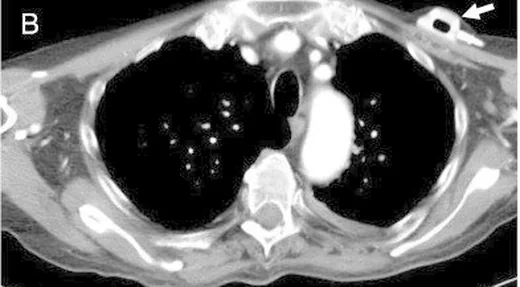
İmplante portta rezervuar, bağlantı noktası ve kateter gövdesi; tünelli kateterde ise cilt altı tünel ve venöz hat mekanik arıza veya enfeksiyon kaynağı olabilir. Toraks BT’si portun göğüs duvarındaki yönelimini, kateter bütünlüğünü ve klavikula-birinci kosta geçişini komşu anatomiyle birlikte değerlendirir. Kırık kateterden kaçak veya distal fragmanın sağ kalp ve pulmoner artere embolizasyonu, cihazın işlevsizliğinin ötesinde ciddi komplikasyon oluşturur. Gözden kaçan pinch-off zamanla tam kopmaya, rezervuar dönmesi erişim güçlüğüne, port cebi enfeksiyonu ise yumuşak doku ve dolaşım yolu komplikasyonlarına yol açabilir.
Faz ve pencere
- Kontrastsız tanısal
- Kontrastsız BT’de port haznesi ve kateter ucu görülebilir; kateter içi akımın ve kaçak olup olmadığının değerlendirilmesi için kontrastlı akım doğrulama incelemesi gerekir.
- Kateterden kontrastlı akım incelemesi tanısal
- Porttan kontrast verilerek yapılan hedefli akım incelemesinde bağlantı veya gövde kırığından kaçak, port cebi/tünel boyunca ekstravazasyon ve kontrastın kateter ucundan damar içine serbest çıkışı değerlendirilebilir; bu inceleme rutin mekanik BT değerlendirmesinin parçası değildir.
Önerilen pencereler G genişlik, M merkez; değerler Hounsfield birimi (HU)
- Yumuşak dokuG 400 / M +40
- MediastenG 350 / M +50
- KemikG 1800 / M +400
BT bulguları
- Rezervuar rotasyonu — cilt altındaki hazne ters dönmüş veya eğik durur; septumun cilde göre yönü değişir ve iğne erişimi güçleşebilir.
- Port implantasyonu çevresindeki göğüs duvarında küçük hematomlar görülebilir ve genellikle ek tedavi olmaksızın tamamen geriler.
- Pinch-off bulgusu — subklavyen girişli kateter klavikula ile birinci kosta arasında sıkışır; lümeni daralabilir veya konturunda çentiklenme görülebilir.
- Kateter kırığı ve ayrışması — kateter gövdesinde veya rezervuar bağlantısında süreksizlik ya da kateterin bağlantı noktasından ayrılması görülür.
- Distal fragman embolizasyonu — kopmuş parça sağ kalp boşluklarında veya pulmoner arterde izlenebilir.
- Kateter ucu malpozisyonu — uç hedeflenen santral ven yerine küçük kollateral damara, azygos sistemine veya damar dışına yönelmiştir.
- Port cebi/tünel çevresi değişikliği — sıvı, yumuşak doku kalınlaşması, yağlı planlarda kirlenme veya gaz bulunabilir; BT ile enfeksiyon tek başına kanıtlanmaz.
- Kateterden kontrast kaçağı — enjeksiyon sırasında kontrast kateterin devamlılığını terk ederek port cebine, tünel boyunca dokuya veya mediastene yayılır.
Ölçütler ve sınıflamalar
- Pinch-off syndrome derecelendirmesi
- Pinch-off, klavikula ile birinci kosta arasında hafif kıvrılma ve sıkışma olarak görülebilir; ilerleyen incelemede kateter kırığı saptanabilir.
- Pinch-off, kateter kırığı ve migrasyonu
- Pinch-off, klavikula ile birinci kosta arasında hafif kıvrılma ve sıkışma şeklinde görülebilir ve ilerleyen dönemde kateter kırığıyla sonuçlanabilir. Kopan distal parçanın sağ kalbe veya pulmoner artere embolizasyonu eşlik edebilir.
Normalde
Normal port haznesi cilt altı cebinde beklenen yönde durur; rezervuar-kateter birleşimi ve kateter gövdesi kesintisizdir, klavikula-birinci kosta geçişinde fokal ezilme yoktur. Kateter göğüs duvarından SVC’ye izlenir. Port cebi çevresindeki sıvı veya gaz cerrahi zamanlama ve önceki görüntülerle birlikte değerlendirilir; tek başına enfeksiyon göstermez.
Normal BT ile kıyasla
Aynı bölgenin, kaynak veri setinde patoloji içermediği belirtilen bir BT incelemesini kesit kesit kaydırın; organ sınırlarını açarak anatomiyi hasta görüntüsüyle karşılaştırın. Küçük rastlantısal bulgular tümüyle dışlanmamıştır.
Kaynak: TotalSegmentator v2.01 veri seti (Wasserthal ve ark., Radiology: Artificial Intelligence 2023), CC BY 4.0, vaka s1278; organ sınırları veri setinin otomatik segmentasyonundan, birleştirilerek sadeleştirildi. Görüntüler 2,5 mm kesit aralığına yeniden örneklendi.
Ayırıcı tanı
- Kateter kıvrılması
- tüp kesintisizdir ve keskin dönüş yapar; gerçek kırıkta konturda kopma veya iki serbest uç izlenir.
- Normal subklavyen geçiş açısı
- kateter klavikula altına yönelir fakat fokal çentik, lümen incelmesi ya da kemikler arasında ezilme görülmez.
- Port cebi hematomu
- port implantasyonu çevresindeki göğüs duvarında küçük hematomlar görülebilir ve bunlar genellikle ek tedavi olmaksızın tamamen geriler.
- Port cebi enfeksiyonu
- çevresel yumuşak doku inflamasyonu ve bazen koleksiyon/gaz eşlik edebilir; steril postoperatif değişiklikle ayrım klinik ve zamana bağlıdır.
- Kateter çevresinde fibrin kılıfı
- kateter ucu etrafında ince kılıf oluşumu enjeksiyonda artmış direnç yapar; kateter gövdesindeki yapısal süreksizlik değildir.
Tuzaklar
- Pinch-off en iyi kateterin klavikula-birinci kosta geçişinde görülür; tek bir aksiyel kesitte tüpün çapraz görünmesi kırık olarak yorumlanmamalıdır.
- Kısmi kateter çatlağı kontrastsız görüntüde fark edilmeyebilir; fluoroskopik akım incelemesi veya cihazdan kontrast verilmiş seri kaçak alanını gösterebilir.
- Kopan parça çok ince olabilir ve damar içinde kıvrılarak görünür; koronal/sagittal reformat ve ince kesitlerde hattın tümünü izleyerek parçanın distal ucunu bul.
- Rezervuar rotasyonu — haznenin dönmesi, portun iğneyle delinmesini engelleyebilir; görüntüdeki konum değişikliği hazneye erişim güçlüğüyle birlikte değerlendirilmelidir.
Kendini dene
Subklavyen port kateteri klavikula-birinci kosta arasında fokal daralmış ve distal devamlılığı kesilmiş. En olası mekanizma?
Cevabı göster
Pinch-off kırığı. Klavikula ile birinci kosta arasındaki pinch-off kateterde kırıkla sonuçlanabilir; kırık kateter fragmanları embolize olabilir. Rezervuarın dönmesi hazneye iğneyle erişimi engelleyebilir; kateterdeki kopma veya fragmantasyon ise ayrı bir mekanik komplikasyondur.
Port haznesi cilt altında dönmüş görünüyorsa, kateter kırığını doğrudan gösteren BT bulgusu hangisidir?
Cevabı göster
Kateter gövdesinde süreksizlik. Kateter gövdesindeki süreksizlik, haznenin konumundan ayrı bir kırık veya ayrışma bulgusudur. Haznenin eğik durması rotasyonu düşündürür; diğer seçenekler kateter kırığını doğrudan göstermez.
İlgili konular
Kaynaklar
Bu sayfadaki 43 cümle ve 2 quiz sorusu aşağıdaki kaynaklardan alıntılarla otomatik olarak karşılaştırıldı; 14 cümle bu karşılaştırmada düzeltildi (2026-10-09).
- Complications of central venous port systems: a pictorial reviewpmc.ncbi.nlm.nih.gov
- Late fracture of Groshong ports: A report of the three cases.pubmed.ncbi.nlm.nih.gov
- International Society of Paediatric Surgical Oncology (IPSO) Surgical Practice Guidelines.pubmed.ncbi.nlm.nih.gov
- Long-term safety and effectiveness of the "OptEase" vena cava filter.pubmed.ncbi.nlm.nih.gov
- From Donor Liver to Recipient Pulmonary Artery: Embolization of a Transected Central Venous Catheter During Liver Transplantation, A Rare Complication of Organ Procurement.pubmed.ncbi.nlm.nih.gov
- Stepwise dual-access endovascular retrieval of a fractured PICC embolized to the pulmonary arteries: A case report.pubmed.ncbi.nlm.nih.gov
- Extraction of fractured inferior vena cava filter strut from pulmonary artery using Inari FlowTriever system.pubmed.ncbi.nlm.nih.gov
- Research progress and narrative review of totally implantable venous access ports.pubmed.ncbi.nlm.nih.gov
- Patterns of injury and violence in Yaoundé Cameroon: an analysis of hospital data.pubmed.ncbi.nlm.nih.gov
- Commentary: an eye on PET quantification.pubmed.ncbi.nlm.nih.gov
- Troubleshooting intrathecal pumps in pain management: A clinical review.pubmed.ncbi.nlm.nih.gov
- Imaging of pediatric gastrostomy tube malposition: Pearls and pitfalls.pubmed.ncbi.nlm.nih.gov
- A Primer on Anatomy, Biophysics, Pathology, Imaging and Treatment of the Intervertebral Disc and the Anterior Spinal Column: The Discogenic, Intervertebral, Spinal Column (DISC) ASPN Workgroup.pubmed.ncbi.nlm.nih.gov
- Supra-pectoralis major implantation of totally implantable venous access ports in emaciated oncology patients: a single-center retrospective study.pubmed.ncbi.nlm.nih.gov
- Multicenter evaluation of anatomical landmark versus technology-assisted techniques for chemotherapy venous access device implantation.pubmed.ncbi.nlm.nih.gov
- Our Experience of 500 Chemo Port Placements with Cephalic Vein Cut Down Technique-A Saviour for Cancer Treatment.pubmed.ncbi.nlm.nih.gov
- Hepatic Artery Infusion Pumps: A Surgical Toolkit for Intraoperative Decision-Making and Management of Hepatic Artery Infusion-Specific Complications.pubmed.ncbi.nlm.nih.gov
- Advanced implantable drug delivery technologies: transforming the clinical landscape of therapeutics for chronic diseases.pubmed.ncbi.nlm.nih.gov
- EHRA expert consensus statement and practical guide on optimal implantation technique for conventional pacemakers and implantable cardioverter-defibrillators: endorsed by the Heart Rhythm Society (HRS), the Asia Pacific Heart Rhythm Society (APHRS), and the Latin-American Heart Rhythm Society (LAHRS).pubmed.ncbi.nlm.nih.gov
- Anatomic considerations for central venous cannulation.pubmed.ncbi.nlm.nih.gov
- Mechanisms of aortic dissection: From pathological changes to experimental and <i>in silico</i> models.pubmed.ncbi.nlm.nih.gov
- Right Atrial Cardiac Calcified Amorphous Tumors in Young Women: Two Case Reports and a Narrative Review of the Literature.pubmed.ncbi.nlm.nih.gov
- Management of Central Venous Access in Children With Intestinal Failure: A Position Paper From the NASPGHAN Intestinal Rehabilitation Special Interest Group.pubmed.ncbi.nlm.nih.gov
- Recommended Clinical Trial End Points for Dialysis Catheters.pubmed.ncbi.nlm.nih.gov
- Infection of a venous port - beware of the Mycobacterium.pubmed.ncbi.nlm.nih.gov
- Imaging in the COVID-19 era: Lessons learned during a pandemic.pubmed.ncbi.nlm.nih.gov
- Clinical guidelines for the management of cytostatic extravasation in children.pubmed.ncbi.nlm.nih.gov
- Balloon tamponade for central venous catheter-related perforations: A minimally invasive, vessel-sparing case series.pubmed.ncbi.nlm.nih.gov
- Complication-related Removal of Central Venous Ports: Comparison of Subclavian and Upper Arm Approaches.pubmed.ncbi.nlm.nih.gov
- Pacemaker leads as a potential source of problems in patients who might need a central venous access port.pubmed.ncbi.nlm.nih.gov
- Guidelines on the Use of Therapeutic Apheresis in Clinical Practice-Evidence-Based Approach From the Writing Committee of the American Society for Apheresis: The Tenth Special Issue.pubmed.ncbi.nlm.nih.gov
- Electrosurgery in pediatric catheter interventions.pubmed.ncbi.nlm.nih.gov
- Giant right atrial thrombus unmasking Behçet's disease: A rare cardiovascular manifestation.pubmed.ncbi.nlm.nih.gov
- Transhepatic venous access as a vessel-preserving salvage strategy for temporary hemodialysis in venous access exhaustion.pubmed.ncbi.nlm.nih.gov
- Three-Dimensional Disassemblable Scaffolds for Breast Reconstruction.pubmed.ncbi.nlm.nih.gov
- A bioengineered artificial interstitium supports long-term islet xenograft survival in nonhuman primates without immunosuppression.pubmed.ncbi.nlm.nih.gov
- 3D-Printed Multidimensional Bionic Mg-MC/PLGA Composite for Tailored Repair of Segmental Long Bone Defects.pubmed.ncbi.nlm.nih.gov
- A Narrative Review of Perioperative Peripheral Nerve Injuries After Major Surgery: Clinical Recognition, Electrodiagnostic Evaluation, and Rehabilitation Implications.pubmed.ncbi.nlm.nih.gov
- A replenishable peritoneal implant for localized delivery and peritoneal fluid sampling in ovarian cancer.pubmed.ncbi.nlm.nih.gov
- Plaque Prolapse in Carotid Artery Stenting: Mechanisms, Imaging and Device-Based Prevention.pubmed.ncbi.nlm.nih.gov
- Degradable scaffold-mediated synergistic matrix formation by endogenous cells: an in vivo manufacturing strategy for off-the-shelf vascular grafts to address clinical shortages.pubmed.ncbi.nlm.nih.gov
- A Race Against Time: Endovascular Removal of an Intracardiac Foreign Body.pubmed.ncbi.nlm.nih.gov
- Pinch-off syndrome leading to catheter fracture: a rare complication of central venous port systems, a case report.pubmed.ncbi.nlm.nih.gov
- RAPID-HANDLE Technique for Catheter Retrieval From the Pulmonary Artery Using a Homemade Snare With Adjustable Loop.pubmed.ncbi.nlm.nih.gov
- Management of Pediatric Pulmonary Vein Stenosis.pubmed.ncbi.nlm.nih.gov
- Blueprints of Architected Materials: A Guide to Metamaterial Design for Tissue Engineering.pubmed.ncbi.nlm.nih.gov
- Beyond the abdominal and pelvic cavity: abdominal wall and spinal "Aunt Minnies".pubmed.ncbi.nlm.nih.gov
- Ultrasound-guided axillary vein versus internal jugular vein access for totally implantable venous access ports in breast cancer: a retrospective comparison of patient-reported outcomes.pubmed.ncbi.nlm.nih.gov
- Once yearly cell-based therapy for sustained and dose-tunable delivery of monoclonal antibodies.pubmed.ncbi.nlm.nih.gov
- Prosthetic Corneal Surgery: A Narrative Review of Current Keratoprostheses and the Future Prospects of New Biomaterials.pubmed.ncbi.nlm.nih.gov
- Acute traumatic injury of the aorta: presentation, diagnosis, and treatment.pubmed.ncbi.nlm.nih.gov
- Distinct neurochemical influences on fMRI response polarity in the striatum.pubmed.ncbi.nlm.nih.gov
- Development and preclinical results of a transcatheter aortic valve implant with novel polymeric leaflets.pubmed.ncbi.nlm.nih.gov
- Manufacturing, Processing, and Characterization of Self-Expanding Metallic Stents: A Comprehensive Review.pubmed.ncbi.nlm.nih.gov
- Advances in Biomaterials and Technologies for Vascular Embolization.pubmed.ncbi.nlm.nih.gov
- Evaluation of causal heart diseases in cardioembolic stroke by cardiac computed tomography.pubmed.ncbi.nlm.nih.gov
- Abdominal and pelvic radiographs of medical devices and materials-Part 1: gastrointestinal and vascular devices and materials.pubmed.ncbi.nlm.nih.gov
- Bone tumor imaging, then and now: review article.pubmed.ncbi.nlm.nih.gov
- Navicular Height by Weight-bearing Ultrasound: A Reliable and Valid Tool for Assessing the Medial Longitudinal Arch in Physically Active Adults.pubmed.ncbi.nlm.nih.gov
- Molecular Determinants of Intravitreal Anti-VEGF Durability: Drug Architecture, Intraocular Pharmacokinetics, Target Biology and Treatment Resistance.pubmed.ncbi.nlm.nih.gov
- Trunk Injection for Arthropod Pest Management in Woody Plants: A Comparative Perspective Under Greenhouse and Field Conditions.pubmed.ncbi.nlm.nih.gov
- Pinch-off syndrome-related port catheter migration requiring surgical extraction combined with coronary artery bypass grafting.pubmed.ncbi.nlm.nih.gov
- Complex venous access in superior vena cava syndrome secondary to gray zone lymphoma, case report.pubmed.ncbi.nlm.nih.gov
- Successful long-term palliative pain management using an intrathecal catheter adapted as a lumbar drain connected to an external infusion pump: A case report.pubmed.ncbi.nlm.nih.gov
- Implantable venous access port catheter fracture in a severely obese lung cancer patient undergoing chemotherapy: a case report.pubmed.ncbi.nlm.nih.gov
- A Single-Institution Audit of Chemo-PORT Placements During Breast Surgery with Literature Review for Management of Common Complications.pubmed.ncbi.nlm.nih.gov
- Cardiac implantable electronic device upgrades and downgrades: a Clinical Consensus Statement of the European Heart Rhythm Association (EHRA) of the ESC, the Asia Pacific Heart Rhythm Association (APHRS), Canadian Heart Rhythm Society (CHRS), Heart Rhythm Society (HRS), and the Latin American Heart Rhythm Society (LAHRS).pubmed.ncbi.nlm.nih.gov
- Guidelines for Central Venous Port Placement and Management (Abridged Translation of the Japanese Version).pubmed.ncbi.nlm.nih.gov
- Chinese expert consensus and practice guideline of totally implantable access port for digestive tract carcinomas.pubmed.ncbi.nlm.nih.gov
- The state of trial registrations in the field of Orthopaedics in years 2015-2020. A meta-epidemiological study.pubmed.ncbi.nlm.nih.gov
- The open abdomen in trauma, acute care, and vascular and endovascular surgery: comprehensive, expert, narrative review.pubmed.ncbi.nlm.nih.gov
- Prevention and treatment of catheter-related venous thrombosis in long-term parenteral nutrition: A SINuC position statement.pubmed.ncbi.nlm.nih.gov
- Machine learning-based prediction of drug response in ischemia reperfusion animal model.pubmed.ncbi.nlm.nih.gov
- When to remove implantable vascular access ports? a retrospective analysis of 376 patients with breast cancer and implantable vascular access ports.pubmed.ncbi.nlm.nih.gov
- Cardiac Migration of Chemoport Catheter-A Rare Complication: Review of Literature and Our Experience.pubmed.ncbi.nlm.nih.gov
- Performing median arcuate ligament release surgery in celiac artery compression syndrome: Insights from a tertiary care hospital.pubmed.ncbi.nlm.nih.gov
- Endovascular removal of intra-cardiac fractured port catheters due to pinch off syndrome: Report of 3 cases.pubmed.ncbi.nlm.nih.gov
- Integrative cardiovascular disease therapy: Linoleic acid restriction, enhanced external counterpulsation, and emerging nanotherapies.pubmed.ncbi.nlm.nih.gov
- Chemoport Fracture due to Catheter Pinch Off Syndrome: A Rare Complication of Subclavian Vein Approach Revisited.pubmed.ncbi.nlm.nih.gov
- Interventions for restoring patency of occluded central venous catheter lumens.pubmed.ncbi.nlm.nih.gov
- Does laparoscopic surgery decrease the risk of atrial fibrillation after foregut surgery?pubmed.ncbi.nlm.nih.gov
- Effectiveness of different antibiotic lock solutions on catheter-related infections of hemodialysis patients: a systematic review and meta-analysis.pubmed.ncbi.nlm.nih.gov
- Risk factors and incidence of central venous access device-related thrombosis in hospitalized children: a systematic review and meta-analysis.pubmed.ncbi.nlm.nih.gov
- Vascular Access in Pediatric Oncology and Hematology: State of the Art.pubmed.ncbi.nlm.nih.gov
- Internal jugular vein versus subclavian vein as the percutaneous insertion site for totally implantable venous access devices: a meta-analysis of comparative studies.pubmed.ncbi.nlm.nih.gov
- Management of femoral large-bore access and closure during microaxial flow pump-supported interventions.pubmed.ncbi.nlm.nih.gov
- Safety and feasibility assessment of implantable chest wall venous access port for patients with acute leukemia.pubmed.ncbi.nlm.nih.gov
- Successful percutaneous transvenous retrieval of intravascular fractured port catheter: a single center experience.pubmed.ncbi.nlm.nih.gov
- Successful Image-Guided Retrieval of an Embolized Fragment of a Fractured Haemodialysis Catheter Tip from the Pulmonary Artery.pubmed.ncbi.nlm.nih.gov
- Challenging Percutaneous Extraction of an Intracardiac Implantable Chamber Catheter.pubmed.ncbi.nlm.nih.gov
- 2025 Heart Disease and Stroke Statistics: A Report of US and Global Data From the American Heart Association.pubmed.ncbi.nlm.nih.gov
- Development of a Novel, Pulmonary Endovascular Device to Treat Patients With Pulmonary Hypertension.pubmed.ncbi.nlm.nih.gov
- End-to-side anterior interosseous nerve transfer augmentation of ulnar nerve function in moderate and severe cubital tunnel syndrome; a randomised controlled trial protocol.pubmed.ncbi.nlm.nih.gov
- Targeting Cellulite as a Metabolic-Dermal Interface: Effects of Tirzepatide and a Multi-Pathway Topical Therapy (G21) in a 12-Month Observational Study.pubmed.ncbi.nlm.nih.gov
- Breast Reconstruction After Cancer: Historical Development, Modern Techniques, and Psychological Impact.pubmed.ncbi.nlm.nih.gov
- Feasibility of an implantable bioreactor for renal cell therapy using silicon nanopore membranes.pubmed.ncbi.nlm.nih.gov
- Comparative assessment of seven surgical procedures in Carpal Tunnel Syndrome: a network meta-analysis empowering physician-patient decision-making.pubmed.ncbi.nlm.nih.gov
- Fracture and atypical migration of an implantable central venous access device.pubmed.ncbi.nlm.nih.gov
- Comparative structural analysis of polyurethane and silicone catheters of totally implantable venous access devices by micro-computed tomography.pubmed.ncbi.nlm.nih.gov
- Brachial insertion of fully implantable venous catheters for chemotherapy: complications and quality of life assessment in 35 patients.pubmed.ncbi.nlm.nih.gov
Eğitim amaçlıdır; hasta başında tanı ve tedavi kararının yerine geçmez, tıbbi tavsiye değildir. Metinler yapay zekâ desteğiyle yazıldı ve otomatik bir adımda kaynak alıntılarıyla karşılaştırıldı; bu bir tıbbi doğrulama değildir ve içerik uzman radyolog incelemesinden geçmedi. Klinik kararlarda güncel kılavuzları, kurum protokollerini ve radyoloji raporunu esas alın.