Özet
MEN1, paratiroid, ön hipofiz ve duodenopankreatik nöroendokrin tümörlerle ortaya çıkabilen kalıtsal bir tümör yatkınlığıdır. ENETS konsensüs önerilerine göre MEN1 ile ilişkili gastroduodenopankreatik nöroendokrin tümörlerin lokalizasyonu ve uzak metastazların değerlendirilmesinde kontrastlı bilgisayarlı tomografi kullanılır. Küçük duodenal veya pankreatik odaklar BT'de görünmeyebilir; hipofiz için olağan abdomen BT'si tanısal inceleme değildir. MEN1'de GEP-NEN yönetimi, çoklu senkron ve metakron tümörler nedeniyle sporadic olgulardan farklıdır.
Faz ve pencere
- Kontrastsız
- Pankreas ve adrenal bezlerin başlangıç dansitesi, yağ içeriği veya belirgin kalsifikasyon görülebilir; küçük solid duodenopankreatik odakları saptamak için kontrastsız seri yeterli değildir.
- Arteriyel tanısal
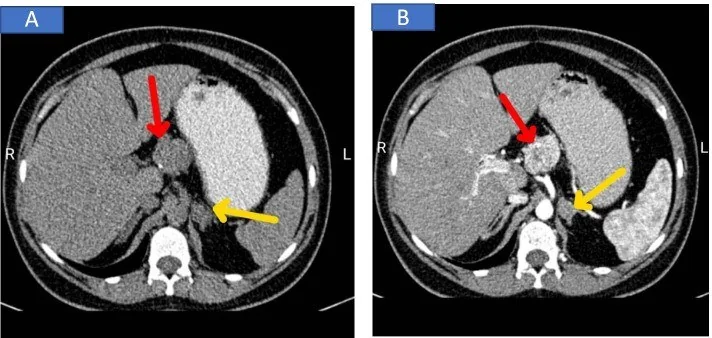
- MEN1 ile ilişkili gastroduodenopankreatik nöroendokrin tümörlerin tanı ve evrelemesinde ENETS konsensüs önerileri doğrultusunda kontrastlı bilgisayarlı tomografi protokolleri uygulanır.
- Portal tanısal
- MEN1 izlemesinde kullanılan abdominal BT protokolü kontrastsız, arteriyel ve portal venöz fazları içerir.
Önerilen pencereler: Batın (G 400 / M 50), Karaciğer (G 150 / M 30), Yumuşak doku (G 400 / M 40).
BT bulguları
- Pankreas başı, gövdesi ve kuyruğu boyunca birbirinden ayrı, düzgün sınırlı solid odakların sayısını ve dağılımını haritala.
- ENETS konsensüs önerilerine göre gastroenteropancreatic nöroendokrin tümörlerin yerinin ve yayılımının değerlendirilmesinde kontrastlı bilgisayarlı tomografi önerilir.
- MEN1 ile ilişkili gastroduodenopankreatik nöroendokrin tümörlerin değerlendirilmesinde, hem pankreas hem de duodenum kaynaklı lezyonların varlığı dikkate alınır.
- Karaciğerde arteriyel seride belirginleşen odakları portal seriyle karşılaştır; birden fazla benzer odak yayılım olasılığını gündeme getirir.
- MEN1'de adrenal tümörler daha nadir olmakla birlikte, bu tümörlerin de değerlendirilmesi gerekebilir.
- Ön hipofiz tümörlerinin değerlendirilmesinde rutin abdomen BT'si yetersizdir; yüksek çözünürlüklü dinamik kontrastlı manyetik rezonans görüntüleme gereklidir.
Ölçütler ve sınıflamalar
- Klinik MEN1 tanımı
- AACE 2025 konsensüs belgesi, MEN1 tanısı ve genetik test endikasyonları için sağlık çalışanlarına kanıta dayalı rehberlik sunar.
Normalde
ENETS konsensüs önerilerine göre gastroduodenopankreatik nöroendokrin tümörlerin değerlendirilmesinde çok fazlı kontrastlı bilgisayarlı tomografi kullanılır; bu protokollerde tümör odakları çevre pankreas parankiminden farklı kontrastlanma gösterir. MEN1'de duodenal NET odakları CT/MRI'da anatomik olarak saptanmayabilir. MEN1 ilişkili duodenopankreatik NET değerlendirmesinde pankreas ve duodenumdaki primer lezyonları, karaciğer metastazlarıyla birlikte çok fazlı BT veya MR'da incele.
Normal BT ile kıyasla
Aynı bölgenin, kaynak veri setinde patoloji içermediği belirtilen bir BT incelemesini kesit kesit kaydırın; organ sınırlarını açarak anatomiyi hasta görüntüsüyle karşılaştırın. Küçük rastlantısal bulgular tümüyle dışlanmamıştır.
Kaynak: TotalSegmentator v2.01 veri seti (Wasserthal ve ark., Radiology: Artificial Intelligence 2023), CC BY 4.0, vaka s0541; organ sınırları veri setinin otomatik segmentasyonundan, birleştirilerek sadeleştirildi. Görüntüler 2,5 mm kesit aralığına yeniden örneklendi.
Ayırıcı tanı
- Pankreatik duktal adenokarsinom
- çoğu kez çevre pankreasa göre daha az kontrastlanır; kanal kesilmesi, proksimal kanal genişlemesi veya kontur çekintisi eşlik edebilir.
- Solid psödopapiller neoplazi
- sıklıkla büyük, kapsüllü ve heterojen solid-kistik kitle görünümü verir; çok sayıda küçük erken boyanan odak şeklinde olmaz.
- Pankreatik asiner hücreli karsinom
- genellikle belirgin kitle etkisi yapan, heterojen ve büyük lezyondur; MEN1'e bağlı çok odaklı örüntü beklenen görünüm değildir.
- Pankreas içi metastaz
- bilinen primer tümör, başka organ metastazları ve pankreas dışı hastalık dağılımıyla birlikte yorumlanır.
- Adrenal kortikal adenom
- adrenal bez içinde sınırlı nodüldür; pankreatik veya duodenal tümörlerle birlikteliği sendrom tanısını tek başına kanıtlamaz.
Tuzaklar
- Pankreasın lobüler parankim boyanması seri boyunca değişebilir; şüpheli odak için yalnız mutlak parlaklığa değil, aynı seviyedeki çevre parankime ve diğer kontrast serisine bak.
- Küçük duodenal gastrinoma duvar içinde silik kalabilir; negatif BT, klinik ya da biyokimyasal şüphe sürerken duodenal hastalığı dışlamaz.
- Bir adrenal nodülün MEN1 bağlamında görülmesi sendromik kökenini kanıtlamaz; bez morfolojisini diğer organ bulgularından ayrı tarif et.
- Hipofiz nöroendokrin tümörlerin (PitNET) ve özellikle küçük işlevsel tümörlerin değerlendirilmesinde yüksek çözünürlüklü dinamik kontrastlı manyetik rezonans görüntüleme gereklidir.
Kendini dene
MEN1 öyküsü olan kişide pankreasın farklı bölümlerinde birkaç erken boyanan solid odak var. En olası yorum hangisi?
Cevabı göster
Çok odaklı pankreatik nöroendokrin tümör (pNET). MEN1’li kişilerde pankreasın farklı bölgelerinde saptanan erken kontrastlanan solid odaklar, çok odaklı pankreatik nöroendokrin tümörlerle (pNET) uyumlu olabilir.
MEN1 izlem BT'sinde kuyrukta yuvarlak nodül dalakla aynı şekilde kontrastlanıyor. En olası taklitçi nedir?
Cevabı göster
İntrapankreatik dalak dokusu. Kuyruk yerleşimli nodülün dalakla eşleşen kontrast davranışı aksesuar dalak dokusunu destekler. Endokrin karsinom genellikle dalakla aynı boyanma örüntüsünü izlemez; kistik neoplazi ve psödokist sıvı içerikli görünümleriyle ayrılır.
İlgili konular
Kaynaklar
Bu sayfadaki 39 cümle ve 2 quiz sorusu aşağıdaki kaynaklardan alıntılarla tek tek karşılaştırıldı; 6 cümle bu karşılaştırmada düzeltildi (2026-10-09).
- Phenotype-driven cascade screening in a Syrian family with clinically consistent multiple endocrine neoplasia type 2Apmc.ncbi.nlm.nih.gov
- 18 F-FDOPA PET/CT for neuroendocrine tumors in multiple endocrine neoplasia type 1pmc.ncbi.nlm.nih.gov
- Multiple skin and subcutaneous metastasis as initial manifestation in neuroendocrine carcinoma lung: A rare case reportpmc.ncbi.nlm.nih.gov
- Parathyroid Carcinoma: A Report of Two Casespmc.ncbi.nlm.nih.gov
- Coexistence of Multiple Endocrine Neoplasia Type 2B and Centri‐Acinar Emphysema With Alpha‐1 Antitrypsin Deficiency: A Case Reportpmc.ncbi.nlm.nih.gov
- Recent Topics Around Multiple Endocrine Neoplasia Type 1.pubmed.ncbi.nlm.nih.gov
- Metastatic multiple endocrine neoplasia type 1: report of one case.pubmed.ncbi.nlm.nih.gov
- [Diagnostics and treatment in functional pancreatic neuroendocrine tumours].pubmed.ncbi.nlm.nih.gov
- Utility of FDG-PET Imaging for Risk Stratification of Pancreatic Neuroendocrine Tumors in MEN1.pubmed.ncbi.nlm.nih.gov
- Pancreatic Neuroendocrine Neoplasms: 2020 Update on Pathologic and Imaging Findings and Classification.pubmed.ncbi.nlm.nih.gov
- Insulinoma: a multicenter, retrospective analysis of three decades of experience (1983-2014).pubmed.ncbi.nlm.nih.gov
- Bronchopulmonary Neuroendocrine Neoplasms and Their Precursor Lesions in Multiple Endocrine Neoplasia Type 1.pubmed.ncbi.nlm.nih.gov
- Familial isolated pituitary adenomas (FIPA). Case report of four families and review of literature.pubmed.ncbi.nlm.nih.gov
- An assessment of 18 F-FDG PET/CT for thoracic screening and risk stratification of pulmonary nodules in multiple endocrine neoplasia type 1.pubmed.ncbi.nlm.nih.gov
- Peptide Receptor Radionuclide Therapy with 177 Lu-DOTATATE for Metastatic Neuroendocrine Tumor Occurring in Association with Multiple Endocrine Neoplasia Type 1 and Cushing's Syndrome.pubmed.ncbi.nlm.nih.gov
- Multifocal Insulinoma as the Unique Presenting Feature of Multiple Endocrine Neoplasia Type 1 in an Adolescent.pubmed.ncbi.nlm.nih.gov
- Serendipitous Discovery and Characterization of Two Different Pathologies on 68 Ga-DOTATATE and 68 Ga-Exendin PET/CT in a Patient With Hyperinsulinemic Hypoglycemia Leading to Diagnosis of MEN-1.pubmed.ncbi.nlm.nih.gov
- <sup>18</sup>F-FDOPA PET/CT for neuroendocrine tumors in multiple endocrine neoplasia type 1.pubmed.ncbi.nlm.nih.gov
- GHRH and insulin hypersecretion from a pancreatic neuroendocrine tumor in multiple endocrine neoplasia type 1.pubmed.ncbi.nlm.nih.gov
- A contemporary overview of multiple endocrine neoplasia syndromes: MEN syndromes 1-5 and beyond.pubmed.ncbi.nlm.nih.gov
- Molecular, Biochemical, and Bioimaging Markers of MEN Syndromes.pubmed.ncbi.nlm.nih.gov
- Pancreatic neuroendocrine tumors in patients with tuberous sclerosis: a multicenter study and systematic review.pubmed.ncbi.nlm.nih.gov
- Multiple endocrine neoplasia type 1 with concurrent Cushing's disease, prolactinoma, and multifocal pancreatic neuroendocrine tumors including insulinoma: a case report.pubmed.ncbi.nlm.nih.gov
- Long-term survival and molecular heterogeneity of sporadic multifocal non-functional pancreatic neuroendocrine tumors.pubmed.ncbi.nlm.nih.gov
- Surgical Management of Gastroenteropancreatic Neuroendocrine Tumors.pubmed.ncbi.nlm.nih.gov
- Primary hepatic neuroendocrine tumor with multifocal liver involvement: A case report and review of the literature.pubmed.ncbi.nlm.nih.gov
- Improved detection and localization of insulinoma using small field-of-view diffusion-weighted MRI: A case report.pubmed.ncbi.nlm.nih.gov
- Challenges of early detection of pancreatic cancer.pubmed.ncbi.nlm.nih.gov
- Case Report: Unicentric Castleman disease at the superior border of the pancreatic body mimicking a pancreatic neuroendocrine tumor: a case report and literature review.pubmed.ncbi.nlm.nih.gov
- Case Report: The cystic masquerade in type 1 Von Hippel-Lindau disease: coexisting clear cell renal cell carcinoma and an imaging-suspected pancreatic neuroendocrine tumor.pubmed.ncbi.nlm.nih.gov
- Radiologically Probable Late-Onset Von Hippel-Lindau Syndrome: A Case Report.pubmed.ncbi.nlm.nih.gov
- Incidental cystic pancreatic neuroendocrine neoplasm and differential diagnosis.pubmed.ncbi.nlm.nih.gov
- Nodal metastasis from an occult duodenal gastrinoma amid an overlap of xanthogranulomatous and type 1 autoimmune pancreatitis: A case report.pubmed.ncbi.nlm.nih.gov
- Hepatic metastasis of mucinous adenocarcinoma with neuroendocrine differentiation harboring a rare HER2 R678Q mutation: a case report and literature review.pubmed.ncbi.nlm.nih.gov
- Contrast-enhanced endoscopic ultrasonography differentiated pancreatic schwannoma from concurrent neuroendocrine tumor.pubmed.ncbi.nlm.nih.gov
- APC-rearranged solid pseudopapillary neoplasm-pancreatic neuroendocrine tumor collision tumor: a molecularly resolved case report.pubmed.ncbi.nlm.nih.gov
- From companion animals to patients: interspecies lessons in neuroendocrine oncology.pubmed.ncbi.nlm.nih.gov
- Pancreatic Metastasis of Clear Cell Renal Cell Carcinoma: Challenges in Percutaneous Biopsy and Contrast-Enhanced Ultrasound Imaging Features.pubmed.ncbi.nlm.nih.gov
- Endoscopic Management of Gastro-Entero-Pancreatic Neuroendocrine Tumours: An Overview of Proposed Resection and Ablation Techniques.pubmed.ncbi.nlm.nih.gov
- Multiple endocrine neoplasia 1: a broad overview.pubmed.ncbi.nlm.nih.gov
- Case Report: Investigation and characterization of a multiple endocrine neoplasia type 1 case and its pedigree.pubmed.ncbi.nlm.nih.gov
- Adrenocortical carcinoma as a manifestation of Birt-Hogg-Dubé syndrome.pubmed.ncbi.nlm.nih.gov
- Functional pituitary adenoma imaging.pubmed.ncbi.nlm.nih.gov
- [<sup>68</sup>Ga]Ga-DOTATATE PET/CT and PET/MR enhances the detection of pituitary ACTH-secreting adenomas in cushing's disease.pubmed.ncbi.nlm.nih.gov
- The clinical value of [<sup>18</sup>F]-fluoro-ethyl-L-tyrosine PET ([<sup>18</sup>F]FET-PET) correlated with MRI in patients with functioning pituitary adenomas: an observational cohort study.pubmed.ncbi.nlm.nih.gov
- American Association of Clinical Endocrinology Consensus Statement on Management of Multiple Endocrine Neoplasia Type 1.pubmed.ncbi.nlm.nih.gov
- Pitfall in necrotizing pancreatitis: Organized hematoma with arteriovenous fistula mimicking a splenic artery pseudoaneurysm.pubmed.ncbi.nlm.nih.gov
- Peribiliary Inflammatory Phlegmon Masquerading as Cholangiocarcinoma in Janus Kinase 2 V617F-positive Primary Myelofibrosis: A Multimodality Imaging Diagnosis.pubmed.ncbi.nlm.nih.gov
- An Intraductal Papillary Mucinous Neoplasm-Like Lesion Manifesting as a Duodenal Polyp: A Rare Case Report.pubmed.ncbi.nlm.nih.gov
- Adrenohepatic Adhesion/Fusion Mimicking Hepatic Invasion: Two Cases of Benign Right Adrenal Lesions and a Review of the Literature.pubmed.ncbi.nlm.nih.gov
- CT Atlas of the Coelomic Cavity in the Yellow-Legged Gull (<i>Larus michahellis</i>).pubmed.ncbi.nlm.nih.gov
- Imaging of pancreatic hepatoid adenocarcinoma: a scoping review.pubmed.ncbi.nlm.nih.gov
- CT and MRI findings of intraductal tubulopapillary neoplasm of the pancreas.pubmed.ncbi.nlm.nih.gov
- Large periampullary mass with vascular contact: Diagnostic and surgical decision-making in a solid pseudopapillary neoplasm.pubmed.ncbi.nlm.nih.gov
- Case Report: Delayed diagnosis of pancreatic solid pseudopapillary neoplasm in a boy initially misdiagnosed as traumatic retroperitoneal hematoma.pubmed.ncbi.nlm.nih.gov
- Solid pseudopapillary neoplasm of the pancreas: a rare tumor case report.pubmed.ncbi.nlm.nih.gov
- Morphologic Features and Clinical Outcomes of Acinar Cell Carcinoma of the Pancreas: A Multicenter Retrospective Study of 37 Patients in South Korea.pubmed.ncbi.nlm.nih.gov
- Acinar cell carcinoma of the pancreas: can CT and MR features predict survival?pubmed.ncbi.nlm.nih.gov
- INI1-Deficient malignancy involving the pancreas and jejunum: Expanding the clinical spectrum.pubmed.ncbi.nlm.nih.gov
- Synchronous Duodenal and Pancreatic Metastases From Clear Cell Renal Cell Carcinoma 18 Years After Nephrectomy: A Case Report.pubmed.ncbi.nlm.nih.gov
- Case Report: Alternative biopsy targets plus CEUS-guided omental puncture: enabling CLDN18.2 detection and precision therapy enrollment in pancreatic cancer.pubmed.ncbi.nlm.nih.gov
- Is adrenal adenoma to carcinoma transformation possible?-Illustrative cases and literature review.pubmed.ncbi.nlm.nih.gov
- Bilateral Adrenal Hyperplasia: Pathogenesis and Treatment.pubmed.ncbi.nlm.nih.gov
- Disorders of the adrenal cortex: Genetic and molecular aspects.pubmed.ncbi.nlm.nih.gov
- Complementary detection strategies for circulating tumor cells in breast cancer: clinical implications of combining immunofluorescence and cytopathological staining.pubmed.ncbi.nlm.nih.gov
- MicroRNAs in Breast Cancer: Diagnostic and Prognostic Potential, Challenges, and Clinical Reliability.pubmed.ncbi.nlm.nih.gov
- Machine learning-based integration of DCE-MRI radiomics for STAT3 expression prediction and survival stratification in breast cancer.pubmed.ncbi.nlm.nih.gov
- Neuroendocrine tumors of unknown primary: a case report and review of tumors with gastroenteropancreatic features.pubmed.ncbi.nlm.nih.gov
- Surgical Strategies for Tumors of the Pancreas and Duodenum.pubmed.ncbi.nlm.nih.gov
- A Comprehensive Review on Neuroendocrine Neoplasms: Presentation, Pathophysiology and Management.pubmed.ncbi.nlm.nih.gov
- The Driver Role of Pathologists in Endocrine Oncology: What Clinicians Seek in Pathology Reports.pubmed.ncbi.nlm.nih.gov
- Targeted Therapy for Advanced Thyroid Cancer: Kinase Inhibitors and Beyond.pubmed.ncbi.nlm.nih.gov
- Kidney, Pituitary, Eyes, and Nose Involved in Antineutrophil Cytoplasmic Antibody-Associated Vasculitis: A Case Report and Literature Review.pubmed.ncbi.nlm.nih.gov
- Clinical features of MEN1 in children, adolescents, and young adults: a single-center study.pubmed.ncbi.nlm.nih.gov
- Hypercortisolism: Causes, Consequences and Clinical Significance - A Review of Pathophysiology.pubmed.ncbi.nlm.nih.gov
- Groove pancreatitis, diagnosis, and management strategies: a case series.pubmed.ncbi.nlm.nih.gov
- Status of Lymph Node Metastasis and Efficacy of Lymph Node Dissection Along the Superior Mesenteric Artery in Pancreatic Head Cancer: Clinicopathological Analysis of Patients Undergoing Pancreatoduodenectomy With Circumferential Lymph Nodes Dissection Along the Superior Mesenteric Artery.pubmed.ncbi.nlm.nih.gov
- Common cystic pancreatic neoplasms: A comprehensive magnetic resonance imaging-based review of typical and atypical imaging features.pubmed.ncbi.nlm.nih.gov
- Organoids glimpse: the nexus for diverse tumor heterogeneity.pubmed.ncbi.nlm.nih.gov
- Special Issue: EACR 2026 Congress: Innovative Cancer Science, 8-11 June 2026.pubmed.ncbi.nlm.nih.gov
- EACR 2025 Congress: Innovative Cancer Science, 16-19 June 2025.pubmed.ncbi.nlm.nih.gov
- Role of Endoscopic Ultrasonography in Management of Pancreaticobiliary Cancers: Recent Trends and Advances.pubmed.ncbi.nlm.nih.gov
- Endoscopic Ultrasound for the Management of Pancreatic Neuroendocrine Tumors: Diagnosis, Treatment, and Future Perspectives.pubmed.ncbi.nlm.nih.gov
- Assessment of prognostic stratification in colorectal cancer liver metastases using preoperative CT habitat imaging.pubmed.ncbi.nlm.nih.gov
- FROM DISCOVERY SCIENCE TO THE CLINIC - HERITABLE ENDOCRINE CANCERS AND RELATED DISORDERS: Functional imaging in hereditary endocrine neoplasms: evolving modalities and clinical implications.pubmed.ncbi.nlm.nih.gov
- Multiple Endocrine Neoplasia Type 1 Presenting as Recurrent Overt Gastrointestinal Bleeding and Ulceration: A Diagnostic Challenge.pubmed.ncbi.nlm.nih.gov
- Progress report on multiple endocrine neoplasia type 1.pubmed.ncbi.nlm.nih.gov
- International Society of Paediatric Surgical Oncology (IPSO) Surgical Practice Guidelines.pubmed.ncbi.nlm.nih.gov
- Patterns of injury and violence in Yaoundé Cameroon: an analysis of hospital data.pubmed.ncbi.nlm.nih.gov
- Commentary: an eye on PET quantification.pubmed.ncbi.nlm.nih.gov
- Intrapancreatic accessory spleen mimicking pancreatic malignancy: Diagnostic role of Tc-99m heat-damaged red blood cell scintigraphy.pubmed.ncbi.nlm.nih.gov
- Splenoses and Other Ectopic and Heterotopic Splenic Tissue: The Use of Long-Lasting Enhancement in Contrast-Enhanced Ultrasound to Avoid Unnecessary Intervention.pubmed.ncbi.nlm.nih.gov
- Epidermoid Cysts in an Intrapancreatic Accessory Spleen Mimicking Pancreatic Neoplasms: Two Case Reports and a Literature Review of Japanese Cases.pubmed.ncbi.nlm.nih.gov
- Usefulness of endoscopic ultrasonography for differentiating between non-functional pancreatic neuroendocrine neoplasm and intrapancreatic accessory spleen.pubmed.ncbi.nlm.nih.gov
- The Right Key, the Wrong Lock: TIGIT Checkpoint Blockade and the Road to Precision Immunotherapy.pubmed.ncbi.nlm.nih.gov
- Brunner's gland hamartoma in the setting of a duodenal diverticulum: A case report.pubmed.ncbi.nlm.nih.gov
- Duodenal leiomyoma: a case report of upper gastrointestinal hemorrhage from a giant duodenal tumor.pubmed.ncbi.nlm.nih.gov
- Response of HER2 positive gallbladder adenocarcinoma to trastuzumab emtansine (T-DM1): a case report and literature review.pubmed.ncbi.nlm.nih.gov
- Phenotype-driven cascade screening in a Syrian family with clinically consistent multiple endocrine neoplasia type 2A.pubmed.ncbi.nlm.nih.gov
- Coexistence of Multiple Endocrine Neoplasia Type 2B and Centri-Acinar Emphysema With Alpha-1 Antitrypsin Deficiency: A Case Report.pubmed.ncbi.nlm.nih.gov
- Calcified liver metastases from medullary thyroid carcinoma in a Multiple Endocrine Neoplasia Type 2A patient.pubmed.ncbi.nlm.nih.gov
- Diagnostic Management of Gastroenteropancreatic Neuroendocrine Neoplasms: Technique Optimization and Tips and Tricks for Radiologists.pubmed.ncbi.nlm.nih.gov
- Role of Endoscopic Ultrasound in the Diagnosis of Pancreatic Neuroendocrine Neoplasms.pubmed.ncbi.nlm.nih.gov
- Diagnostic imaging of gastrointestinal neuroendocrine neoplasms with a focus on ultrasound.pubmed.ncbi.nlm.nih.gov
- Basic Principles and Role of Endoscopic Ultrasound in Diagnosis and Differentiation of Pancreatic Cancer from Other Pancreatic Lesions: A Comprehensive Review of Endoscopic Ultrasound for Pancreatic Cancer.pubmed.ncbi.nlm.nih.gov
- Endoscopic Ultrasound-Guided Pancreatic Tissue Sampling: Lesion Assessment, Needles, and Techniques.pubmed.ncbi.nlm.nih.gov
- Controversies in EUS: Do we need miniprobes?pubmed.ncbi.nlm.nih.gov
- A Novel Pathogenic MEN1 Gene Variant Identified in a Family With Multiple Pancreatic Neuroendocrine Tumors.pubmed.ncbi.nlm.nih.gov
- Contrast-Enhanced CT Features for Identifying Primary Origin and Differentiation Grade of Neuroendocrine Liver Metastases.pubmed.ncbi.nlm.nih.gov
- A retrospective comparative study of CT and MRI findings of different types of pancreatic serous cystic neoplasms: Correlation with histopathology.pubmed.ncbi.nlm.nih.gov
- Multiple Incidental Pancreatic Neuroendocrine Tumors in a Patient With Suspected Duodenal Papillary Adenocarcinoma: A Case Report.pubmed.ncbi.nlm.nih.gov
- Primary Bilateral Macronodular Adrenal Hyperplasia Associated With <i>ARMC5</i> Variant and Pituitary Microadenoma.pubmed.ncbi.nlm.nih.gov
- Thymic neuroendocrine tumours: molecular landscape, immune microenvironment and therapeutic perspectives.pubmed.ncbi.nlm.nih.gov
- Schwannoma Likely Arising from the Pancreatic Head Nerve Plexus That Mimicked a Mucinous Cystic Neoplasm and Was Treated by Pancreaticoduodenectomy: A Case Report.pubmed.ncbi.nlm.nih.gov
- Giant solid pseudopapillary neoplasm of the pancreas in an adolescent girl: a case report with narrative review.pubmed.ncbi.nlm.nih.gov
Eğitim amaçlıdır; hasta başında tanı ve tedavi kararının yerine geçmez. İçerik yapay zekâ destekli bir süreçle güncel literatüre göre cümle cümle kaynaklarla karşılaştırıldı, ancak uzman radyolog incelemesinden geçmedi. Klinik kararlarda güncel kılavuzları, kurum protokollerini ve radyoloji raporunu esas alın.