Özet
Hipofizit, hipofiz bezini ve/veya infundibulumu etkileyen inflamatuvar bir süreçtir; otoimmün hastalıklar ve gebelik sonrası dönemle ilişkili olabilir, ayrıca immünoterapi veya sistemik hastalıklarla ilişkili biçimleri vardır. Sellar lezyonların değerlendirilmesinde MR tercih edilen yöntemdir; BT kalsifikasyonları doğrulamak ve kemik yapı invazyonunu göstermek için yararlıdır. BT'de diffüz büyüme görülmesi tek başına adenomu, metastazı veya inflamasyonu ayırmaz; klinik bağlam ve MR ile birlikte yorumlanmalıdır. İnfundibulum tutulumu, görüntüleme bulgularının ayırıcı tanıyı daraltmasına yardımcı olabilir.
Faz ve pencere
- Kontrastsız
- Kontrastsız BT sellar kalsifikasyonları ve kemik yapı invazyonunu gösterebilir; sellar lezyonların değerlendirilmesinde MR tercih edilen yöntemdir. Bu faz hipofizit için tanısal değildir.
Önerilen pencereler G genişlik, M merkez; değerler Hounsfield birimi (HU)
- BeyinG 80 / M +40
- Yumuşak dokuG 400 / M +40
- KemikG 1800 / M +400
BT bulguları
- Kontrastlı hipofiz MRG’sinde simetrik bez büyümesi, homojen kontrastlanma ve orta hatta kalınlaşmış stalk hipofiziti destekleyebilir; bu özellikler özgül değildir. Sellar lezyonların değerlendirilmesinde MRG tercih edilen yöntemdir; BT kalsifikasyonları doğrulamak ve kemik yapı invazyonunu göstermek için yararlıdır.
- İnfundibulum kalınlaşması, hipofizit dahil inflamatuvar biçimlerde MRI'da görülebilir.
- Hipofizit kitle etkisine bağlı baş ağrısı ve optik kiazma basısına bağlı görme bozukluklarıyla ortaya çıkabilir.
- Kemik destrüksiyonu enfeksiyöz veya neoplastik nedenleri düşündürür.
- Sarkoidoz, IgG4 ilişkili hastalık ve Langerhans hücreli histiyositoz hipofiz bölgesini tutabilen sistemik hastalıklar arasındadır.
- Takip MRI'larında parsiyel boş sella görünümü veya hipofiz boyutunda değişiklikler görülebilir.
Normalde
Kontrastlı hipofiz MRG’sinde normal hipofiz bezi ve infundibulum homojen kontrastlanır. İnfundibulum kalınlaşması MRG ile değerlendirilir ve hipofizitte görülebilir.
Normal BT ile kıyasla
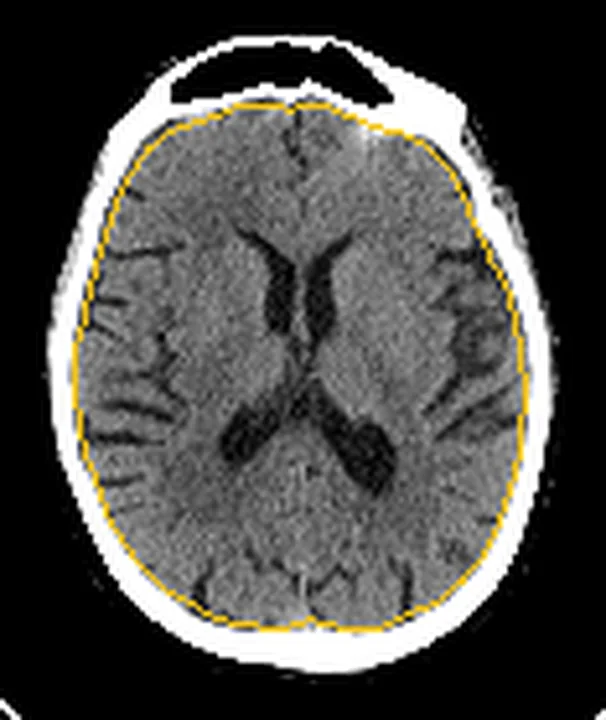
Aynı bölgenin, kaynak veri setinde patoloji içermediği belirtilen bir BT incelemesini kesit kesit kaydırın; organ sınırlarını açarak anatomiyi hasta görüntüsüyle karşılaştırın. Küçük rastlantısal bulgular tümüyle dışlanmamıştır.
Kaynak: TotalSegmentator v2.01 veri seti (Wasserthal ve ark., Radiology: Artificial Intelligence 2023), CC BY 4.0, vaka s0103; organ sınırları veri setinin otomatik segmentasyonundan, birleştirilerek sadeleştirildi. Görüntüler 2,5 mm kesit aralığına yeniden örneklendi.
Ayırıcı tanı
- Fonksiyon göstermeyen hipofiz makroadenomları genellikle daha büyük, asimetrik ve heterojen olabilir; MR bulguları ayırıcı tanıya katkı sağlar.
- Bilinen malignite bağlamında stalk kalınlaşması ve sellar kitle MRI'da hipofiz metastazını düşündürebilir; kemik destrüksiyonu ise enfeksiyöz veya neoplastik nedenlere işaret edebilir.
- Lenfoma, hipofiz bölgesini tutabilen hematolojik maligniteler arasındadır.
- Sellar menenjiyom
- meninks kökenli tümör olup sella bölgesinde yerleşebilir; görme bozukluğu ve hormonal yetmezlik yapabilir.
- Hipofiz apopleksisi bez içindeki kanama veya infarktla ilişkili akut bir klinik sendromdur; kontrastsız BT sellar kitlede kanamayı düşündüren yüksek atenüasyon gösterebilir.
- Metastaz ve Langerhans hücreli histiyositoz sellar ayırıcı tanısında yer alır; her ikisinde de infundibulum kalınlaşması görülebilir.
Tuzaklar
- Glandın kontrastlı BT'deki diffüz belirginleşmesini hipofizit için özgül kabul etme; adenom, fizyolojik büyüme ve diğer infiltratif hastalıklar benzer görünebilir.
- İmmün kontrol noktası inhibitörü ilişkili hipofizitte MR bulguları minimal olabilir veya görülmeyebilir; bu nedenle görüntüleme bulgularının yokluğu hipofiziti dışlamaz.
- İmmün kontrol noktası inhibitörü kullanan hastada MR normal veya minimal değişiklik gösterebilir; görüntüleme negatifliği hipofiziti dışlamaz.
- Belirgin kemik destrüksiyonu enfeksiyöz veya neoplastik nedenleri düşündürür; kemik bulgusu tek başına tanı koydurmaz.
Kendini dene
Sellar BT'de kemik destrüksiyonu olmadan diffüz dolgunluk görüldüğünde doğru yaklaşım nedir?
Cevabı göster
BT tek başına ayırmaz; MRI ve klinik bağlamla değerlendir. BT bulgusu tek başına adenom, metastaz veya inflamasyonu ayırmaz; kemik destrüksiyonu enfeksiyöz/neoplastik lehinedir ve yorum MR ve klinikle yapılmalıdır.
Sellar BT'de kemik destrüksiyonu hangi neden gruplarını akla getirir?
Cevabı göster
Enfeksiyon ve neoplazi. Kemik destrüksiyonu enfeksiyöz ya da neoplastik bir süreci düşündürebilir. Bu görüntüleme bulgusu tek başına kesin tanı koydurmaz.
İlgili konular
Kaynaklar
Bu sayfadaki 36 cümle ve 2 quiz sorusu aşağıdaki kaynaklardan alıntılarla otomatik olarak karşılaştırıldı; 19 cümle bu karşılaştırmada düzeltildi (2026-10-12).
- Infiltrative and inflammatory systemic disorders involving the pituitary glandpmc.ncbi.nlm.nih.gov
- Metastatic large cell neuroendocrine carcinoma: a rare cause of hypopituitarismpmc.ncbi.nlm.nih.gov
- Immune-Mediated Hypophysitis: An Updated Reviewpmc.ncbi.nlm.nih.gov
- Sellar Lesions: Novel Aspects in Diagnosis and Managementpmc.ncbi.nlm.nih.gov
- Pituitary neuroendocrine tumors: imaging features, clinical relevance, and a proposal for standardized MRI reportingpmc.ncbi.nlm.nih.gov
- Co-Occurrence of Craniopharyngioma and IgG4-Related Hypophysitis: An Epiphenomenon or a Mere Coincidence?pubmed.ncbi.nlm.nih.gov
- Immune-Mediated Hypophysitis: An Updated Review.pubmed.ncbi.nlm.nih.gov
- Infiltrative and inflammatory systemic disorders involving the pituitary gland.pubmed.ncbi.nlm.nih.gov
- An overview of hypopituitarism's causes.pubmed.ncbi.nlm.nih.gov
- Case Report: Tislelizumab-associated secondary adrenal insufficiency in a patient with lung squamous cell carcinoma.pubmed.ncbi.nlm.nih.gov
- Reversible predominant thyrotropin axis dysfunction with meningitis in suspected lymphocytic hypophysitis.pubmed.ncbi.nlm.nih.gov
- Ectopic Adrenocorticotropic Hormone Syndrome in a Patient Diagnosed With Lung Adenocarcinoma and Hospitalized Due to Diabetic Ketonuria: A Case Report.pubmed.ncbi.nlm.nih.gov
- A rare case of dual hormone-secreting pulmonary neuroendocrine tumor causing concurrent Cushing syndrome and acromegaly.pubmed.ncbi.nlm.nih.gov
- Pituitary neuroendocrine tumors: imaging features, clinical relevance, and a proposal for standardized MRI reporting.pubmed.ncbi.nlm.nih.gov
- Xanthomatous hypophysitis with optic chiasm edema: First documented clinical case.pubmed.ncbi.nlm.nih.gov
- Pediatric endocrine disorders: a review of intracranial findings and appropriate imaging.pubmed.ncbi.nlm.nih.gov
- Targeted proteomics reveal histiocytosis-associated neurodegeneration signatures.pubmed.ncbi.nlm.nih.gov
- Deep learning classification of nasal anatomical variants on computed tomography for endoscopic sinus surgery.pubmed.ncbi.nlm.nih.gov
- Sellar Lesions: Novel Aspects in Diagnosis and Management.pubmed.ncbi.nlm.nih.gov
- How can MRI descriptors be optimally combined to predict idiopathic intracranial hypertension?pubmed.ncbi.nlm.nih.gov
- Ophthalmologic assessment and intracranial pressure in children: diagnostic methods, clinical correlations, and future directions.pubmed.ncbi.nlm.nih.gov
- The Immune Checkpoint Inhibitors Journey: From Early Promise to Lasting Impact.pubmed.ncbi.nlm.nih.gov
- Pituitary Stalk Enlargement With Panhypopituitarism and Arginine Vasopressin Deficiency in Lung Adenocarcinoma: Metastatic Infundibular Disease or Paraneoplastic Hypophysitis?pubmed.ncbi.nlm.nih.gov
- The Diagnostic Challenge of Hypophysitis vs. Non-Functioning Pituitary Macroadenomas: An Updated Review and Comparative Analysis of Distinguishing Criteria.pubmed.ncbi.nlm.nih.gov
- Foreign body granuloma mimicking pituitary adenoma: Case report and literature review.pubmed.ncbi.nlm.nih.gov
- Pituitary Metastasis in Lung Cancer Patients: Case Series and Review of the Literature.pubmed.ncbi.nlm.nih.gov
- Pituitary T-lymphoblastic lymphoma combined with pituitary adenoma: a rare case report.pubmed.ncbi.nlm.nih.gov
- Ectopic Pituitary Neuroendocrine Tumors/Adenomas Around the Sella Turcicapubmed.ncbi.nlm.nih.gov
- Erdheim-Chester Disease Presenting as a Suprasellar Mass.pubmed.ncbi.nlm.nih.gov
- Granulomatous Diseases of the CNS: Aetiology, Neuroradiological Features and Clinical Findings.pubmed.ncbi.nlm.nih.gov
- Magnetic resonance imaging features of hypophysitis in patients with cancer treated with immune checkpoint inhibitors.pubmed.ncbi.nlm.nih.gov
- Autoimmune disease of head and neck, imaging, and clinical review.pubmed.ncbi.nlm.nih.gov
- Hypophysitis, the Growing Spectrum of a Rare Pituitary Disease.pubmed.ncbi.nlm.nih.gov
- Morphological and Epidemiological Analysis of the Sphenoid Sinus Based on Computed Tomography and Magnetic Resonance Imaging: A Narrative Review.pubmed.ncbi.nlm.nih.gov
- Use of three-dimensional-printed models for preoperative planning in endoscopic endonasal surgery for tuberculum sellae meningioma: A case report and literature review.pubmed.ncbi.nlm.nih.gov
- Sella Turcica Shape as a Marker for Breed and Sex Classification in Sheep.pubmed.ncbi.nlm.nih.gov
- Sellar chondroma in a pediatric patient treated endoscopically: illustrative case.pubmed.ncbi.nlm.nih.gov
- Adult onset multisystem Langerhans cell histiocytosis initially presenting with arginine vasopressin deficiency: a case report.pubmed.ncbi.nlm.nih.gov
- Intrasellar meningioma versus pituitary apoplexy in the setting of postpartum hemorrhage: a case report.pubmed.ncbi.nlm.nih.gov
- Severe IL-6-dominant immune-mediated inflammatory response complicated by probable arginine vasopressin deficiency following ivonescimab-based therapy in advanced EGFR-mutant lung squamous cell carcinoma: a case report.pubmed.ncbi.nlm.nih.gov
- Metastatic large cell neuroendocrine carcinoma: a rare cause of hypopituitarism.pubmed.ncbi.nlm.nih.gov
- Imaging of pituitary tumors: an update with the 5th WHO Classifications-part 2. Neoplasms other than PitNET and tumor-mimicking lesions.pubmed.ncbi.nlm.nih.gov
- Neuroimaging of hypophysitis: etiologies and imaging mimics.pubmed.ncbi.nlm.nih.gov
- Hemorrhagic sellar lesion mimicking pituitary adenoma apoplexy: MRI follow-up suggesting Rathke cleft cyst.pubmed.ncbi.nlm.nih.gov
- Trauma Unmasking Pituitary Apoplexy: Coexisting Epidural Hematoma and Sellar Mass - A Case Report with Selected Cases from the Literature.pubmed.ncbi.nlm.nih.gov
- Case Report: Pediatric ACTH-secreting pituitary adenoma presenting with hypertension and anuria.pubmed.ncbi.nlm.nih.gov
- Functional pituitary adenoma imaging.pubmed.ncbi.nlm.nih.gov
- Who and how to screen for endogenous hypercortisolism in adrenal and pituitary incidentaloma.pubmed.ncbi.nlm.nih.gov
- Image-Guided Precision Medicine in the Diagnosis and Treatment of Pheochromocytomas and Paragangliomas.pubmed.ncbi.nlm.nih.gov
- Postoperative Pituitary MRI Findings in Acromegaly: A Pictorial Review.pubmed.ncbi.nlm.nih.gov
- Immune checkpoint inhibitor-related endocrinopathies: from immune crosstalk to predictive biomarkers and precision management.pubmed.ncbi.nlm.nih.gov
- Intracranial neuroendocrine carcinoma with coexisting pituitary adenoma: a case report and comprehensive literature review.pubmed.ncbi.nlm.nih.gov
- Sexual Dimorphism and Inter-Century Variability in Sella Turcica and Sphenoid Sinus Pneumatization: A Computed Tomography Study of the Romanian Population.pubmed.ncbi.nlm.nih.gov
- Impact of endoscopy and related technologies on indications for transsphenoidal pituitary surgery for growth hormone-producing pituitary neuroendocrine tumors in McCune-Albright syndrome: illustrative case.pubmed.ncbi.nlm.nih.gov
- TTF-1-positive primary papillary epithelial tumor of the sella with long-term recurrence after multiple resections.pubmed.ncbi.nlm.nih.gov
- Multidisciplinary Management of Pediatric Craniopharyngioma: From Diagnosis to Long-Term Outcomes.pubmed.ncbi.nlm.nih.gov
- Isolated Maxillary Extracranial Metastasis of a Suprasellar Germinoma.pubmed.ncbi.nlm.nih.gov
- Comparative outcomes of transcranial craniotomy and endoscopic endonasal surgery for craniopharyngioma: a single-center retrospective cohort study.pubmed.ncbi.nlm.nih.gov
- Pituitary metastasis revisited: a retrospective single-center experience with diagnostic challenges and surgical nuances. Illustrative cases.pubmed.ncbi.nlm.nih.gov
- Multimodal management of giant prolactinoma with extensive amyloid spherule deposition: a case report with review of the literature.pubmed.ncbi.nlm.nih.gov
- A differentiated thyroid carcinoma-specific graded prognostic assessment for brain metastases: derivation in a 10,306-patient cohort and external validation.pubmed.ncbi.nlm.nih.gov
- Role of Surgery in the Multimodal Treatment of Pituitary Carcinoma: A Retrospective Single-Institution Case Series.pubmed.ncbi.nlm.nih.gov
- Stereotactic radiosurgery for pituitary metastases: a systematic review and single-arm meta-analysis of local control and survival outcomes.pubmed.ncbi.nlm.nih.gov
- A Case of Concurrent Autoimmune Thyroiditis and Adrenal Insufficiency Following Nivolumab Therapy for Advanced Renal Cell Carcinoma.pubmed.ncbi.nlm.nih.gov
- Endocrine Adverse Events Induced by Cancer Treatments: The Role of <sup>18</sup>F-Fluorodeoxyglucose Positron Emission Tomography.pubmed.ncbi.nlm.nih.gov
- A Biphasic Presentation of Diffuse Large B-cell Lymphoma Metastasis to the Hypothalamus-pituitary Axis: A Case Report and Literature Review.pubmed.ncbi.nlm.nih.gov
- Clinical and imaging manifestations of metastases from rare sites.pubmed.ncbi.nlm.nih.gov
- Transnasal Endoscopic Resection of a Pituitary Metastasis From a Tonsillar Squamous Cell Carcinoma (SCC): A Case Report and a Review of the Literature.pubmed.ncbi.nlm.nih.gov
- Blind spots in brain imaging: a pictorial essay.pubmed.ncbi.nlm.nih.gov
- Immune Checkpoint Inhibitor-Induced Endocrine Dysfunction: Early Detection of Symptoms and Timely Intervention.pubmed.ncbi.nlm.nih.gov
- Clinical presentation, investigation findings, and outcomes of hypophysitis in sarcoidosis: a systematic review.pubmed.ncbi.nlm.nih.gov
- Diagnostic Challenge of Immune Checkpoint Inhibitor-Induced Hypophysitis in Patient With Melanoma.pubmed.ncbi.nlm.nih.gov
- Pregnancy-unmasked latent autoimmune arginine vasopressin deficiency with anti-rabphilin-3a antibody positivity.pubmed.ncbi.nlm.nih.gov
- Pituitary stalk biopsy - A systematic review of the safety and efficacy of stalk lesion biopsy.pubmed.ncbi.nlm.nih.gov
- "Multifocal, intra-axial Langerhans cell histiocytosis presenting with central diabetes insipidus in teenage pregnancy: A case report".pubmed.ncbi.nlm.nih.gov
- Erdheim-Chester Disease Mimicking a Malignant Pituitary Stalk Tumor With Ventricular Dissemination: A Case Report.pubmed.ncbi.nlm.nih.gov
- Sellar, suprasellar, and parasellar masses: Imaging features and neurosurgical approaches.pubmed.ncbi.nlm.nih.gov
- Neuroimaging of pediatric tumors of the sellar region-A review in light of the 2021 WHO classification of tumors of the central nervous system.pubmed.ncbi.nlm.nih.gov
- Neoplasms and tumor-like lesions of the sellar region: imaging findings with correlation to pathology and 2021 WHO classification.pubmed.ncbi.nlm.nih.gov
- Clinical characteristics, management, and prognosis of pembrolizumab-induced hypophysitis: retrospective analysis based on case reports.pubmed.ncbi.nlm.nih.gov
- A case report on the co-presentation of pituitary abscess and POEMS-like syndrome.pubmed.ncbi.nlm.nih.gov
- A case report of delayed-diagnosed adult multisystem Langerhans cell histiocytosis with isolated MAP2K1 somatic mutation and systematic literature review.pubmed.ncbi.nlm.nih.gov
- Suprasellar germinoma: intraoperative findings from an endoscopic endonasal approach. Illustrative case.pubmed.ncbi.nlm.nih.gov
- Beyond MRI: Unveiling metabolic signatures of primary hypophysitis with <sup>18</sup>F-FDG PET.pubmed.ncbi.nlm.nih.gov
- Pituitary tuberculosis in the pediatric population: a systematic review and case report.pubmed.ncbi.nlm.nih.gov
- Pituitary apoplexy within a prolactin-secreting macroadenoma in a child: A rare clinical entity with radiological correlation.pubmed.ncbi.nlm.nih.gov
- Mimickers of pituitary tumors.pubmed.ncbi.nlm.nih.gov
- Nivolumab rechallenge after pituitary apoplexy associated with nivolumab plus ipilimumab in a patient with pituitary adenoma and rectal melanoma: a case report and literature review.pubmed.ncbi.nlm.nih.gov
- Central Diabetes Insipidus Following Steroid Replacement for Hypoadrenalism in Pembrolizumab-Induced Hypophysitis.pubmed.ncbi.nlm.nih.gov
- PITUITARY METASTASIS FROM BLADDER UROTHELIAL CARCINOMA: A RARE CASE REPORT AND A REVIEW OF THE LITERATURE ON PITUITARY METASTASIS OVER THE LAST DECADE.pubmed.ncbi.nlm.nih.gov
- Endoscopic endonasal approach for resection of sellar leiomyosarcoma metastasis: illustrative case.pubmed.ncbi.nlm.nih.gov
- The Rise of Oncoendocrinology: How Modern Cancer Therapies Are Reshaping Endocrine Practice.pubmed.ncbi.nlm.nih.gov
- Pituitary metastasis as an endocrine-neuro-ophthalmologic emergency: clinical red flags and outcomes from a contemporary tertiary-center series.pubmed.ncbi.nlm.nih.gov
- Case report of transsphenoidal meningocele presenting as airway obstruction and panhypopituitarism: Radiological findings and the role of CSF flow analysis.pubmed.ncbi.nlm.nih.gov
- Pituitary magnetic resonance imaging abnormalities and 1-year growth response in children with idiopathic growth hormone deficiency.pubmed.ncbi.nlm.nih.gov
- Diagnosis of hyperprolactinemia in women: A Position Statement from the Brazilian Federation of Gynecology and Obstetrics Associations (Febrasgo) and the Brazilian Society of Endocrinology and Metabolism (SBEM).pubmed.ncbi.nlm.nih.gov
- Distinctive Characteristics of Rare Sellar Lesions Mimicking Pituitary Adenomas: A Collection of Unusual Neoplasms.pubmed.ncbi.nlm.nih.gov
- Secondary Adrenal Insufficiency and Multisystem Endocrinopathy Following Immune Checkpoint Inhibitor Therapy.pubmed.ncbi.nlm.nih.gov
- Approach to thyroid disorders associated with immune checkpoint inhibitors and tyrosine kinase inhibitors.pubmed.ncbi.nlm.nih.gov
- Pituitary and COVID-19 vaccination: a systematic review.pubmed.ncbi.nlm.nih.gov
- Clinical characteristics, management, and prognosis of ipilimumab-induced hypophysitis: a retrospective analysis of 76 cases.pubmed.ncbi.nlm.nih.gov
Eğitim amaçlıdır; hasta başında tanı ve tedavi kararının yerine geçmez, tıbbi tavsiye değildir. Metinler yapay zekâ desteğiyle yazıldı ve otomatik bir adımda kaynak alıntılarıyla karşılaştırıldı; bu bir tıbbi doğrulama değildir ve içerik uzman radyolog incelemesinden geçmedi. Klinik kararlarda güncel kılavuzları, kurum protokollerini ve radyoloji raporunu esas alın.