Özet
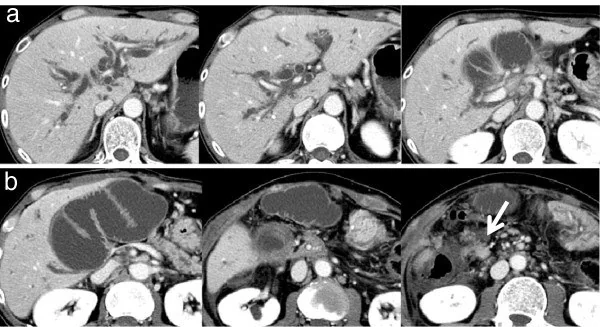
Billroth II, Roux-en-Y veya pankreatikoduodenektomi sonrası afferent ansın tıkanması, safra ve pankreas salgılarının boşalamadığı mekanik bir komplikasyondur. Portal venöz fazlı BT cerrahi anatomiyi, kapalı ve sıvı dolu ansı, tıkanma nedenini ve biliyer-pankreatik sonuçları birlikte gösterir. Basit tıkanma akut pankreatit veya kolanjitle ortaya çıkabilir; ans gerilimi arttıkça duvar iskemisi ve perforasyon riski doğar. Ameliyat bağlantısını izlememek genişlemiş ansı kist ya da kitle sanmaya, tıkanma ve komplikasyonun gecikmesine yol açabilir.
Faz ve pencere
- Portal tanısal
- İntravenöz kontrastlı portal fazda gastroenterik rekonstrüksiyon takip edilir; sıvıyla dolu, genişlemiş C veya U biçimli afferent ans, lümene uzanan valvulae conniventes, geçiş noktası ve olası kitle/adezyon seçilir. Bu bulgular obstrüksiyonun şiddeti ve etiyolojisi hakkında bilgi verir.
Önerilen pencereler: Batın (G 400 / M 50), Yumuşak doku (G 400 / M 40).
BT bulguları
- C-loop işareti — gastroenterik anastomozdan proksimale izlenen, sıvıyla dolu ve belirgin genişlemiş C veya U biçimli afferent ans.
- Keyboard işareti — ans lümenine doğru çıkıntı yapan, aralıklı valvulae conniventes kıvrımları; sıvı içeriğinde ansı tanımaya yardım eder.
- Geçiş noktası — geniş afferent segmentin normal kalibreli bağırsağa geçtiği yerdir; kütle varlığı, damar burkulması veya yapışıklık izlenmesi altta yatan nedeni ayırt etmeye yardımcı olur.
- Rekonstrüksiyon anatomisini bilmek, afferent ansın aorta ve superior mezenter arter arasında uzanan sıvı dolu C biçimli yapısını ayırt etmeyi sağlar.
- Pankreatikobiliyer kanal genişlemesi — safra yolu ve/veya pankreas kanalında genişleme, salgıların tıkalı ansa boşalamadığını gösterebilir.
- Anastomoz çevresinde fokal barsak duvar kalınlaşması veya yumuşak doku kitlesi lokal nüksü ve obstrüksiyon nedeni olarak değerlendirilir.
- Mezenter damarlarının kümelenmesi veya dönmesi — ansın kökünde damar kalabalığı ve girdap internal herni ya da volvulus nedenini destekler.
- Anasit ve peritoneal kontrastlanma, kaynaklarda özellikle karinosizis ile ilişkilendirilir; ileri derecede barsak duvar kalınlaşması ve kıvrım kaybı ise yüksek basınca bağlı perforasyonu işaret edebilir.
Normalde
Obstrüksiyon bulunmadığında afferent ans, obstrüksiyonlu durumdaki gibi belirgin C-loop görünümü veya aşırı sıvı distansiyonu göstermeyebilir. Önceki görüntülerle karşılaştırıldığında yeni oluşan belirgin sıvı distansiyonu, 8 mm'den büyük safra yolu veya 5 mm'den büyük pankreas kanalı genişlemesi obstrüksiyonu destekler.
Normal BT ile kıyasla
Aynı bölgenin, kaynak veri setinde patoloji içermediği belirtilen bir BT incelemesini kesit kesit kaydırın; organ sınırlarını açarak anatomiyi hasta görüntüsüyle karşılaştırın. Küçük rastlantısal bulgular tümüyle dışlanmamıştır.
Kaynak: TotalSegmentator v2.01 veri seti (Wasserthal ve ark., Radiology: Artificial Intelligence 2023), CC BY 4.0, vaka s0119; organ sınırları veri setinin otomatik segmentasyonundan, birleştirilerek sadeleştirildi. Görüntüler 2,5 mm kesit aralığına yeniden örneklendi.
Ayırıcı tanı
- Pankreatik psödokist
- pankreas çevresinde sınırlı sıvı koleksiyonudur; afferent ans gibi devamlı bir duvarı ve lümene uzanan valvulae kıvrımları bulunmaz.
- Rezeke mide çevresindeki yumuşak doku kitlesi veya fokal barsak duvar kalınlaşması lokal nüksünü ve obstrüksiyon nedeni olarak değerlendirilir.
- Efferent ans obstrüksiyonu
- efferent ansın tıkanması, mide içeriğinin afferent ansa yönelip onu doldurmasına yol açabilir; ansların seyrini izlemek doğru tanıyı destekler.
- Internal herni veya volvulus
- mezenter damarlarının yer değiştirmesi, kümelenmesi ya da dönmesi tıkanmanın mekanizmasını gösterir; afferent ans genişlemesi eşlik edebilir.
- Postoperatif adezyon
- genişlemiş barsaktan normal kalibreli barsağa ani geçiş noktası ile karakterizedir; kitle veya başka bir açık neden içermez.
Tuzaklar
- Farklı rekonstrüksiyon tekniklerinde anatomik değişkenlik vardır; koronal BT düzlemi ansların seyrini izlemeyi kolaylaştırır.
- Dolu olmayan normal afferent ans da sıvı içermeyebilir; obstrüksiyon kararını yalnız görünürlüğe değil, genişlemeye ve geçiş bulgusuna dayandırın.
- Pankreas başı komşuluğundaki sıvı dolu ans psödokist sanılabilir; valvulae conniventes'in (jejunal kıvrımların) ans lümenine çıkmasını ve anastomozla devamlılığını arayın.
- Perforasyon gibi ileri durumlarda keyboard işareti kaybolabilir; bu durumda asit, peritoneal tutulum ve anastomoz bölgesi detaylı incelenmelidir.
Kendini dene
Billroth II öyküsü olan hastada koronal BT, anastomozdan pankreas başına uzanan sıvı dolu C biçimli ans ve lümene çıkıntılı kıvrımlar gösteriyor. Tanı nedir?
Cevabı göster
Afferent loop obstrüksiyonu. Anastomozla devamlı C biçimli sıvı ans ve valvulae conniventes birlikte afferent loop obstrüksiyonunu destekler. Psödokist barsak kıvrımları taşımaz; efferent ans anatomik olarak diğer koldur, solid pankreas tümörü ise lümen devamlılığı göstermez.
Mezenter damarlarının girdap oluşturduğu (whirl sign) görülen genişlemiş ans olgusunda hangi mekanizma öncelikli olarak sorgulanmalıdır?
Cevabı göster
Internal herni ve strangülasyon. Kaynaklara göre mezenter damarlarının girdap oluşturması (whirl sign), internal herni veya volvulus tanısını destekler; bu durum mekanik tıkanmaya ve iskemi riskine yol açar.
Kaynaklar
Bu sayfadaki 37 cümle ve 2 quiz sorusu aşağıdaki kaynaklardan alıntılarla tek tek karşılaştırıldı; 14 cümle bu karşılaştırmada düzeltildi (2026-10-09).
- Using Multidetector-Row CT for the Diagnosis of Afferent Loop Syndrome Following Gastroenterostomy Reconstructionpmc.ncbi.nlm.nih.gov
- Management of afferent loop obstruction: Reoperation or endoscopic and percutaneous interventions?pubmed.ncbi.nlm.nih.gov
- Acute afferent loop obstruction treated by endoscopic decompression. Case report and review of literature.pubmed.ncbi.nlm.nih.gov
- Afferent loop obstruction following laparoscopic distal gastrectomy with Billroth-II gastrojejunostomy.pubmed.ncbi.nlm.nih.gov
- Percutaneous Cholangioscopic Lithotripsy for Afferent Loop Syndrome Caused by Enterolith Development after Roux-en-Y Hepaticojejunostomy: A Case Report.pubmed.ncbi.nlm.nih.gov
- Successful treatment of remnant gastric cancer with afferent loop syndrome managed by percutaneous transhepatic cholangial drainage followed by elective gastrectomy: a case report.pubmed.ncbi.nlm.nih.gov
- [Two cases of afferent loop obstruction associated with peritoneal dissemination after total gastrectomy].pubmed.ncbi.nlm.nih.gov
- PTCD-stent complex for recurrent malignant afferent loop obstruction after pancreaticoduodenectomy.pubmed.ncbi.nlm.nih.gov
- Acute pancreatitis, a rare complication of afferent loop obstruction: A case report.pubmed.ncbi.nlm.nih.gov
- Afferent loop obstruction with obstructive jaundice and ileus due to an enterolith after distal gastrectomy: A case report.pubmed.ncbi.nlm.nih.gov
- [A Case of Roux-en-Y Loop Reconstruction Using a Modified Aboral Pouch Technique for Y-Limb Obstruction Following Distal Gastrectomy].pubmed.ncbi.nlm.nih.gov
- [Percutaneous Transhepatic Cholangiodrainage to Alleviate Symptoms of Afferent Loop Obstruction--A Case Report].pubmed.ncbi.nlm.nih.gov
- Percutaneous Transhepatic Self-expanding Metallic Stent Placement for the Treatment of Malignant Afferent Loop Obstruction.pubmed.ncbi.nlm.nih.gov
- Percutaneous transhepatic metallic stent insertion for malignant afferent loop obstruction following pancreaticoduodenectomy: a case report.pubmed.ncbi.nlm.nih.gov
- Acute Necrotizing Pancreatitis Secondary to Adhesive Afferent Loop Syndrome Six Years After Total Gastrectomy With Roux-en-Y Reconstruction: A Case Report.pubmed.ncbi.nlm.nih.gov
- Successful Cholangioscopy-Guided Stone Extraction in a Choledocholithiasis Patient With Afferent Loop Stenosis After Pancreaticoduodenectomy.pubmed.ncbi.nlm.nih.gov
- Pancreatitis due to afferent loop syndrome: A case report and a brief review of the literature.pubmed.ncbi.nlm.nih.gov
- Ileosigmoid knot: Diagnostic value of CT in a rare double-volvulus entity.pubmed.ncbi.nlm.nih.gov
- Splenic Vein Embolization for Intraperitoneal Bleeding Caused by Splenic Vein Branch Injury after Percutaneous Trans-splenic Vein Puncture: A Case Report.pubmed.ncbi.nlm.nih.gov
- Complication imaging after laparoscopic Roux-en-Y gastric bypass: clues to the diagnosis and pitfalls.pubmed.ncbi.nlm.nih.gov
- Gastric Antral Perforation Caused by a Percutaneous Endoscopic Gastrojejunostomy Tube: A Case Report.pubmed.ncbi.nlm.nih.gov
- Gastrointestinal Bleeding due to Intussuscepted Duodenal Lipoma: A Case Report.pubmed.ncbi.nlm.nih.gov
- "Bulb-like" sign: Small bowel closed loop obstruction in incarcerated Spigelian hernia.pubmed.ncbi.nlm.nih.gov
- Duodenal imaging on the spotlight: from A to Z.pubmed.ncbi.nlm.nih.gov
- Intestinal obstruction secondary to a transmesocolic internal hernia: a case report and review of the literature.pubmed.ncbi.nlm.nih.gov
- Jejunojejunal Intussusception Following Roux-en-Y Gastrectomy for Gastric Adenocarcinoma.pubmed.ncbi.nlm.nih.gov
- Case Report: A rare cause of acute abdomen: retrograde efferent loop intussusception into the gastric remnant following Billroth II gastrectomy.pubmed.ncbi.nlm.nih.gov
- "Pseudo coffee bean sign" without sigmoid volvulus: A case report and literature review.pubmed.ncbi.nlm.nih.gov
- Severe acute pancreatitis in the early postoperative period due to afferent loop syndrome following gastrectomy for gastric cancer.pubmed.ncbi.nlm.nih.gov
- Afferent loop syndrome in a patient having incomplete annular pancreas.pubmed.ncbi.nlm.nih.gov
- Adhesional Small Bowel Obstruction at Term: Unmasking a Rare Surgical Emergency in Late Pregnancy.pubmed.ncbi.nlm.nih.gov
- Early Presentation of Internal Hernia After Laparoscopic Roux-en-Y Gastric Bypass.pubmed.ncbi.nlm.nih.gov
- Role of the EUS in the Treatment of Biliopancreatic Disease in Patients with Surgically Altered Anatomy.pubmed.ncbi.nlm.nih.gov
- Therapeutic Endoscopic Ultrasound in Biliopancreatic Disease.pubmed.ncbi.nlm.nih.gov
- Current Evidence on Endoscopic Biliary Drainage in the Era of Surgically Altered Anatomy: A Narrative Review.pubmed.ncbi.nlm.nih.gov
- International Consensus Statements on Endoscopic Ultrasound-Guided Biliary Drainage: Results From the 1st JGES International in 2025.pubmed.ncbi.nlm.nih.gov
- Endoscopic ultrasound-directed transenteric ERCP in patients with benign and malignant diseases and inaccessible biliary system.pubmed.ncbi.nlm.nih.gov
- Treatment of benign biliary strictures with expandable biodegradable stents: Safety and efficacy in a single center.pubmed.ncbi.nlm.nih.gov
- Imaging after Pancreaticoduodenectomy: How Can the Radiologist Help the Surgeon.pubmed.ncbi.nlm.nih.gov
- Elective Repair of Atypical Internal Hernia Following Roux-En-Y Gastric Bypass in a Patient With Recurrent Obstructive Symptoms: A Case Report.pubmed.ncbi.nlm.nih.gov
- Descending colon volvulus in a patient with persistent left mesocolon: A case report.pubmed.ncbi.nlm.nih.gov
- Embryo Sign on Abdominal CT as the Footprint of Cecal Volvulus: Improved Practice Through Lessons Learned from a Case Report.pubmed.ncbi.nlm.nih.gov
- Imaging the postoperative patient: long-term complications of gastrointestinal surgery.pubmed.ncbi.nlm.nih.gov
- Integrated Insights into Metabolic and Bariatric Surgery: Improving Life Quality and Reducing Mortality in Obesity.pubmed.ncbi.nlm.nih.gov
- Arteriogenic hemorrhage of the anastomotic loop after choledochojejunostomy: case series and literature review.pubmed.ncbi.nlm.nih.gov
- Lumbar Sympathetic Radiofrequency Ablation for Peripheral Arterial Disease: A Short-Term, Self-Controlled, Retrospective Pilot Study of 16 Patients.pubmed.ncbi.nlm.nih.gov
- Navigating chronic pancreatitis pain: a pathophysiological and therapeutic overview.pubmed.ncbi.nlm.nih.gov
- International Harmonization of Nomenclature and Diagnostic Criteria (INHAND): Non-proliferative and Proliferative Lesions of the Non-human Primate ( M. fascicularis ).pubmed.ncbi.nlm.nih.gov
- GLP-1 Receptor Agonists in Obstructive Sleep Apnea: A Translational Perspective on Mechanisms and Clinical Implications.pubmed.ncbi.nlm.nih.gov
- When the "Y" Becomes an "O": A Narrative Review of Roux-en-O Complication After Roux-en-Y Gastric Bypass-Incidence, Diagnosis, Management, and Prevention.pubmed.ncbi.nlm.nih.gov
- Heart-brain axis pathophysiological understanding and clinical impact.pubmed.ncbi.nlm.nih.gov
- Intestinal Malrotation Through Acute Obstructive Abdomen in an Adolescent From Northeastern Brazil: A Case Report.pubmed.ncbi.nlm.nih.gov
- Gastroschisis: diagnosis, prognosis and treatment options.pubmed.ncbi.nlm.nih.gov
- Effect of transcutaneous auricular vagus nerve stimulation on postoperative gastrointestinal dysfunction in patients with gynecological abdominal or pelvic tumors: a study protocol for a prospective, single-center, randomized, controlled clinical trial.pubmed.ncbi.nlm.nih.gov
- Acute kidney injury in urological conditions.pubmed.ncbi.nlm.nih.gov
- Uncut Roux-en-Y reconstruction after distal gastrectomy for gastric cancer.pubmed.ncbi.nlm.nih.gov
- To cut or not to cut? A prospective randomized controlled trial on short-term outcomes of the uncut Roux-en-Y reconstruction for gastric cancer.pubmed.ncbi.nlm.nih.gov
- Single Purse-String Suture for Reinforcement of Duodenal Stump During Laparoscopic Radical Gastrectomy for Gastric Cancer.pubmed.ncbi.nlm.nih.gov
- Imaging of gastrointestinal foreign body obstructions in dogs and cats.pubmed.ncbi.nlm.nih.gov
- In-office fluoroscopy is an underutilized tool in the work-up of the bariatric and foregut patient.pubmed.ncbi.nlm.nih.gov
- Endoscopic salvage for afferent loop syndrome: the antegrade lumen-apposing metal stent technique.pubmed.ncbi.nlm.nih.gov
- Management and outcomes of sigmoid volvulus: a retrospective cohort study of 46 patients at a tertiary care center.pubmed.ncbi.nlm.nih.gov
- Endoscopic Transluminal Stent Placement for Malignant Afferent Loop Obstruction.pubmed.ncbi.nlm.nih.gov
- Using multidetector-row CT for the diagnosis of afferent loop syndrome following gastroenterostomy reconstruction.pubmed.ncbi.nlm.nih.gov
- Afferent limb percutaneous jejunostomy to treat pancreatic leak after pancreaticoduodenectomy: a case report.pubmed.ncbi.nlm.nih.gov
- Jejunogastric Intussusception after Pylorus Resecting Pancreaticoduodenectomy: A Rare Case Report and Review of the Literature.pubmed.ncbi.nlm.nih.gov
- Endoscopic metal enteral stent placement for malignant afferent loop syndrome after pancreaticoduodenectomy.pubmed.ncbi.nlm.nih.gov
- Bowel Obstruction Caused by Broad Ligament Hernia Successfully Repaired by Laparoscopy in an Elderly Patient: A Case Report.pubmed.ncbi.nlm.nih.gov
- Human biomarker navigator.pubmed.ncbi.nlm.nih.gov
- Chronic pruritus: a narrative review.pubmed.ncbi.nlm.nih.gov
- Afferent loop syndrome secondary to recurrent pancreatic adenocarcinoma post-Whipple procedure: case report.pubmed.ncbi.nlm.nih.gov
- Successful endoscopic duodenal stent placement for afferent loop obstruction following Billroth II gastrectomy: a case report.pubmed.ncbi.nlm.nih.gov
- Diagnosis of colonic volvulus: findings on multidetector CT with three-dimensional reconstructions.pubmed.ncbi.nlm.nih.gov
- Management of colonic volvulus.pubmed.ncbi.nlm.nih.gov
- Heart Meets Brain: Insights into Neurocardiac Pathophysiology.pubmed.ncbi.nlm.nih.gov
- Clinical management for malignant afferent loop obstruction.pubmed.ncbi.nlm.nih.gov
- The Lingering Battle of Persistent Hypoaldosteronism Following Adrenalectomy for Primary Aldosteronism: A Case Report.pubmed.ncbi.nlm.nih.gov
- Appendiceal Perforation From Muscular Thinning in Limited Cutaneous Systemic Sclerosis: A Case Report.pubmed.ncbi.nlm.nih.gov
- A case report of jejunogastric intussusception complicated by torsion: 17 years after subtotal gastrectomy.pubmed.ncbi.nlm.nih.gov
- Efficacy and safety of double-balloon enteroscopy-assisted endoscopic retrograde cholangiopancreatography in surgically altered anatomy: A systematic review and meta-analysis.pubmed.ncbi.nlm.nih.gov
- Afferent Loop Syndrome with Intestinal Ischemia due to Internal Hernia after Whipple Operation for T2N1M0 Pancreatic Cancer.pubmed.ncbi.nlm.nih.gov
- Long-term safety and effectiveness of the "OptEase" vena cava filter.pubmed.ncbi.nlm.nih.gov
- High-affinity alphavbeta3 integrin targeted optical probe as a new imaging biomarker for early atherosclerosis: initial studies in Watanabe rabbits.pubmed.ncbi.nlm.nih.gov
- Current Status and Surgical Technique for Restorative Proctocolectomy with Ileal Pouch Anal Anastomosispubmed.ncbi.nlm.nih.gov
- Normal and Abnormal Postoperative Imaging Findings after Gastric Oncologic and Bariatric Surgery.pubmed.ncbi.nlm.nih.gov
- Mesopancreas-Anatomical Insights and Its Implications for Diagnosis and Clinical and Surgical Practice.pubmed.ncbi.nlm.nih.gov
- Surgical Indications and Techniques for Adrenalectomy.pubmed.ncbi.nlm.nih.gov
- Biliary Reconstruction for Intrahepatic Bile Duct Strictures and Optimal Jejunal Limb Length in Congenital Biliary Dilation Surgery: A Literature Review and Consensus Statements From the AOB Consensus Meeting.pubmed.ncbi.nlm.nih.gov
- Successful reconstruction with gastrojejunostomy and pancreaticobiliary junction anastomosis to the duodenum after duodenal peripapillary adenocarcinoma resection.pubmed.ncbi.nlm.nih.gov
- Case Report: Delayed intra-abdominal hemorrhage in a patient with a duodenal stump tumor after Billroth II gastrectomy.pubmed.ncbi.nlm.nih.gov
- Diagnostic investigation, intervention, and outcome for post-subtotal gastrectomy patients who present with jaundice.pubmed.ncbi.nlm.nih.gov
- 2019 HRS/EHRA/APHRS/LAHRS expert consensus statement on catheter ablation of ventricular arrhythmias.pubmed.ncbi.nlm.nih.gov
- 2019 HRS/EHRA/APHRS/LAHRS expert consensus statement on catheter ablation of ventricular arrhythmias.pubmed.ncbi.nlm.nih.gov
- 2019 HRS/EHRA/APHRS/LAHRS expert consensus statement on catheter ablation of ventricular arrhythmias.pubmed.ncbi.nlm.nih.gov
- The effectiveness of adding Braun anastomosis to standard Child reconstruction to reduce delayed gastric emptying after pancreatoduodenectomy (REMBRANDT): study protocol for a multicentre randomised-controlled trial.pubmed.ncbi.nlm.nih.gov
- Once in a Bile - the Incidence of Bile Reflux Post-Bariatric Surgery.pubmed.ncbi.nlm.nih.gov
- Enterolith causing acute afferent loop syndrome after Billroth II gastrectomy: a case report.pubmed.ncbi.nlm.nih.gov
- Operative management of acute abdomen after bariatric surgery in the emergency setting: the OBA guidelines.pubmed.ncbi.nlm.nih.gov
- Exploring the neglected segment of the intestine: the duodenum and its pathologies.pubmed.ncbi.nlm.nih.gov
- Imaging assessment after pancreaticoduodenectomy: reconstruction techniques-normal findings and complications.pubmed.ncbi.nlm.nih.gov
Eğitim amaçlıdır; hasta başında tanı ve tedavi kararının yerine geçmez. İçerik yapay zekâ destekli bir süreçle güncel literatüre göre cümle cümle kaynaklarla karşılaştırıldı, ancak uzman radyolog incelemesinden geçmedi. Klinik kararlarda güncel kılavuzları, kurum protokollerini ve radyoloji raporunu esas alın.