Özet
Polikistik karaciğer hastalığı, karaciğer parankiminin kistlerle yer değiştirmesiyle seyreden kalıtsal bozuklukları kapsar; izole görülebilir veya polikistik böbrek hastalığına eşlik edebilir. Polikistik karaciğer hastalığında BT veya MR ile kist dağılımı, korunmuş karaciğer hacmi ve portal hipertansiyon gibi komplikasyonların varlığı incelenebilir; ADPKD'de karaciğerle birlikte böbrek hacmi de abdominal görüntülemede değerlendirilir. Büyük hepatik kistler komşu organlara, safra yollarına ve portal veya hepatik venlere bası yapabilir; safra yolu basısı kolestaza, venöz bası ise portal hipertansiyona yol açabilir. Kistik yükün yalnız karaciğerde sanılması, eşlik eden otozomal dominant polikistik böbrek hastalığının gözden kaçmasına yol açabilir.
Faz ve pencere
- Kontrastsız tanısal
- BT'de karaciğer boyunca yaygın, safra yollarıyla bağlantısız kistik odaklar görülebilir; tek kesit kistlerin tüm dağılımını göstermeyebilir.
- Portal tanısal
- BT veya MR'da kist dağılımı, korunmuş karaciğer hacmi ve portal hipertansiyon gibi komplikasyonlar değerlendirilebilir.
Önerilen pencereler G genişlik, M merkez; değerler Hounsfield birimi (HU)
- KaraciğerG 150 / M +30
- BatınG 400 / M +50
BT bulguları
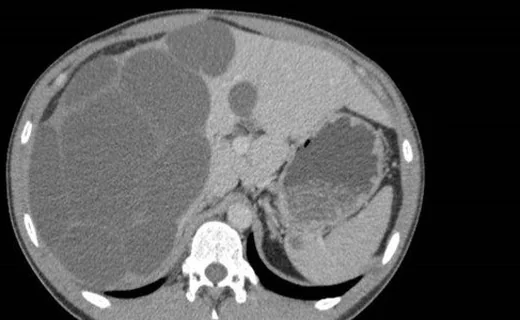
- Karaciğerin farklı segmentlerine dağılmış, sayı ve boyutları değişen çoklu kistik odaklar
- Polikistik karaciğer hastalığında basit kistler de bulunabilir; basit kistler homojen sıvı içeriklidir.
- Kistler arasında kalan sağlam karaciğer parankiminin geniş ya da sınırlı adacıklar halinde izlenmesi
- Büyük kistler portal veya hepatik venlerde bası ya da tıkanıklığa, safra yollarında basıya yol açabilir.
- Karaciğer hacminde artış ve komşu mide, duodenum veya böbreklerde kitle etkisi
- ADPKD eşlik ettiğinde böbreklerde bilateral çoklu kistler görülebilir.
- Kist içi kanama veya enfeksiyon gibi komplikasyonlar gelişebilir.
Ölçütler ve sınıflamalar
- EASL 2022 tanımına göre polikistik karaciğer hastalığı
- >10 hepatik parankim kisti; kistler safra yollarıyla bağlantısız olmalı
- Gigot sınıflaması
- Tip I: <10 büyük (>10 cm) kist ve geniş korunmuş parankim alanları; Tip II: karaciğere yaygın dağılmış orta boy kistler arasında tanınabilir parankim; Tip III: yaygın küçük ve orta boy kistler ile az miktarda kalan parankim alanları. Gigot morfolojik bir sınıflamadır; Tip I 10'dan az kist içerebildiği için tek başına 10'dan fazla kist gerektiren polikistik karaciğer hastalığı tanımını karşılamayabilir.
Normalde
Normal karaciğer parankimi homojen bir doku hacmi oluşturur ve portal ven dalları düzenli biçimde segmentlere yayılır; böbrek kortekslerinde çok sayıda yuvarlak sıvı boşluğu beklenmez. Aynı seviyelerde kistlerin sayısını ve yayılımını, geriye kalan parankim adacıklarını, portal/hepatik damarların itilmesini ve iki böbreğin boyutunu ve kist yükünü karşılaştır.
Normal BT ile kıyasla
Aynı bölgenin, kaynak veri setinde patoloji içermediği belirtilen bir BT incelemesini kesit kesit kaydırın; organ sınırlarını açarak anatomiyi hasta görüntüsüyle karşılaştırın. Küçük rastlantısal bulgular tümüyle dışlanmamıştır.
Kaynak: TotalSegmentator v2.01 veri seti (Wasserthal ve ark., Radiology: Artificial Intelligence 2023), CC BY 4.0, vaka s0541; organ sınırları veri setinin otomatik segmentasyonundan, birleştirilerek sadeleştirildi. Görüntüler 2,5 mm kesit aralığına yeniden örneklendi.
Ayırıcı tanı
- Az sayıda basit hepatik kist, karaciğerde 10’dan fazla kist bulunmasına dayanan polikistik karaciğer hastalığı tanımını karşılamaz.
- Biliyer hamartomlar çok sayıda ve diffüz olduğunda metastazları taklit edebilir; BT'de her iki loba yayılmış düşük atenüasyonlu odaklar görülebilir.
- Caroli hastalığı
- kistik görünümlü alanlar intrahepatik safra yollarıyla devamlıdır ve portal damar noktası içerebilir
- Peribiliyer kistler, karaciğerde görülen kistik lezyonların ayırıcı tanısında yer alır.
- ADPKD ile ilişkili yaygın hepatik kistler, eşlik eden infiltratif metastaz yükünün konvansiyonel görüntülemede olduğundan az değerlendirilmesine yol açabilir.
Tuzaklar
- Kist sayısını tek kesitte saymak hastalık yükünü eksik gösterir; karaciğerin tamamını inceleyip iki böbreği de aynı taramada değerlendir.
- Gigot sınıflamasında tipi belirlerken kistlerin sayı ve boyutuyla birlikte korunmuş parankim alanlarını da dikkate al.
- İzole karaciğer kistleri polikistik hastalıkla eşdeğer değildir; aile öyküsü, kist yükü ve böbrek görünümü birlikte yorumlanır.
- Hemorajik kist basit sıvı görünümünden sapabilir; her kompleks odağı otomatik olarak tümör sayma.
- Kist içi kanama, karaciğerdeki kompleks kistik lezyonların olası nedenlerinden biridir; ayırıcı tanıda kistik neoplaziler de bulunur.
Kendini dene
Polikistik karaciğer hastalığı en sık hangi kalıtsal böbrek hastalığıyla birliktelik gösterir?
Cevabı göster
Otozomal dominant polikistik böbrek hastalığı. Polikistik karaciğer hastalığı izole görülebilse de en sık otozomal dominant polikistik böbrek hastalığıyla birliktedir.
Gigot tip III görünümünü en iyi tanımlayan özellik hangisidir?
Cevabı göster
Yaygın kistler, az korunmuş parankim. Tip III'te küçük ve orta boy kistler karaciğere yaygın ve diffüz dağılır; normal parankim alanları azdır. Az sayıda büyük kist ve geniş korunmuş parankim alanları Tip I ile uyumludur.
İlgili konular
- Basit karaciğer kisti
- Kompleks veya hemorajik karaciğer kisti
- Biliyer hamartomlar (von Meyenburg kompleksleri)
- Peribiliyer kistler
Kaynaklar
Bu sayfadaki 40 cümle ve 2 quiz sorusu aşağıdaki kaynaklardan alıntılarla otomatik olarak karşılaştırıldı; 16 cümle bu karşılaştırmada düzeltildi (2026-10-12).
- Scoping Review on Polycystic Liver Disease in PKD1/PKD2 Gene Carriers: Genetic Aspects, Pathophysiology, and Therapeutic Approachespmc.ncbi.nlm.nih.gov
- Medical Management of Polycystic Liver Disease: A Position Statement From the European Reference Network on Hepatological Diseasespmc.ncbi.nlm.nih.gov
- Key Aspects in the Nutritional Management of Polycystic Liver Disease Patientspmc.ncbi.nlm.nih.gov
- Transplant Indications in Polycystic Liver and Kidney Diseasepmc.ncbi.nlm.nih.gov
- KDIGO 2025 ADPKD guideline: a commentary on diagnosis and management of hepatopancreatic manifestations by the ERA Working Group Genes & Kidneypmc.ncbi.nlm.nih.gov
- Sarcopenia and chronic liver diseases.pubmed.ncbi.nlm.nih.gov
- Hepatic cysts and liver abscess.pubmed.ncbi.nlm.nih.gov
- Evaluation of hepatic cystic lesions.pubmed.ncbi.nlm.nih.gov
- Congenital Cystic Lesions of the Bile Ducts: Imaging-Based Diagnosis.pubmed.ncbi.nlm.nih.gov
- Clinical management of polycystic liver disease.pubmed.ncbi.nlm.nih.gov
- Treatment of polycystic liver disease. Update on the management.pubmed.ncbi.nlm.nih.gov
- Magnetic resonance imaging of fibropolycystic liver disease: the spectrum of ductal plate malformations.pubmed.ncbi.nlm.nih.gov
- Rare benign tumors of the liver: still rare?pubmed.ncbi.nlm.nih.gov
- Management of portal hypertension and ascites in polycystic liver disease.pubmed.ncbi.nlm.nih.gov
- Differentiating Cystic Liver Lesions: A Review of Imaging Modalities, Diagnosis and Management.pubmed.ncbi.nlm.nih.gov
- Surgical management of non-parasitic hepatic cysts A single center experience and a review of the literature.pubmed.ncbi.nlm.nih.gov
- Non-infectious Hepatic Cystic Lesions: A Narrative Review.pubmed.ncbi.nlm.nih.gov
- Imaging manifestations of Caroli disease with autosomal recessive polycystic kidney disease: a case report and literature review.pubmed.ncbi.nlm.nih.gov
- Autosomal Recessive Polycystic Kidney Diseasepubmed.ncbi.nlm.nih.gov
- Congenital hepatic fibrosis in an adult female combined with Von Meyenburg complex and autosomal dominant polycystic kidney disease: a case report.pubmed.ncbi.nlm.nih.gov
- Congenital biliary abnormalities in adults: a practical CT and MRI guide.pubmed.ncbi.nlm.nih.gov
- KDIGO 2025 ADPKD guideline: a commentary on diagnosis and management of hepatopancreatic manifestations by the ERA Working Group Genes & Kidney.pubmed.ncbi.nlm.nih.gov
- Symptom relief and quality of life after combined partial hepatectomy and cyst fenestration in highly symptomatic polycystic liver disease.pubmed.ncbi.nlm.nih.gov
- Long-term safety and effectiveness of the "OptEase" vena cava filter.pubmed.ncbi.nlm.nih.gov
- Scoping Review on Polycystic Liver Disease in PKD1/PKD2 Gene Carriers: Genetic Aspects, Pathophysiology, and Therapeutic Approaches.pubmed.ncbi.nlm.nih.gov
- Recapitulating Liver Embryology-Lessons to Be Learned for Liver Diseases.pubmed.ncbi.nlm.nih.gov
- Imaging insights into pediatric liver masses: A comprehensive minireview for hepatology practice.pubmed.ncbi.nlm.nih.gov
- Evidence for a tubular basement membrane-cilia connection in autosomal dominant polycystic kidney disease pathogenesis.pubmed.ncbi.nlm.nih.gov
- Clinical rather than genetic factors predict hepatic cyst burden and growth in autosomal dominant polycystic kidney disease: a cohort study of 332 genotyped patients.pubmed.ncbi.nlm.nih.gov
- Advances in Molecular Mechanisms of Kidney Disease: Integrating Renal Tumorigenesis of Hereditary Cancer Syndrome.pubmed.ncbi.nlm.nih.gov
- CT and MRI of adrenal gland pathologies.pubmed.ncbi.nlm.nih.gov
- Infected von Meyenburg complex causing recurrent gram‑negative septicaemia: the critical diagnostic role of FDG‑PET/CT in a patient with hidradenitis suppurativa.pubmed.ncbi.nlm.nih.gov
- Extensive Von Meyenburg Complexes Mimicking Diffuse Hepatic Metastases: Diagnostic Role of MRI and Magnetic Resonance Cholangiopancreatography.pubmed.ncbi.nlm.nih.gov
- Congenital hepatic fibrosis and related ciliopathies across the life course: current management, disease burden, and unmet needs in the era of genomic diagnosis and translational therapeutics.pubmed.ncbi.nlm.nih.gov
- Renal Tumors of Childhood: Radiologic-Pathologic Correlation Part 2. The 2nd Decade: From the Radiologic Pathology Archives.pubmed.ncbi.nlm.nih.gov
- Human biomarker navigator.pubmed.ncbi.nlm.nih.gov
- Budd-Chiari-like pathology in dolphins.pubmed.ncbi.nlm.nih.gov
- A Comprehensive Review on LncRNAs/miRNAs-DNMT1 Axis in Human Cancer: Mechanistic and Clinical Application.pubmed.ncbi.nlm.nih.gov
- Hepatic adenomatosis leading to liver failure and symptomatic extrinsic cardiac compression treated with liver transplantation: a case report and literature review.pubmed.ncbi.nlm.nih.gov
- Key Aspects in the Nutritional Management of Polycystic Liver Disease Patients.pubmed.ncbi.nlm.nih.gov
- Laparoscopic deroofing of a recurrent giant simple hepatic cyst in a geriatric female: Case report.pubmed.ncbi.nlm.nih.gov
- Bridging pancreatic and hepatic development: overlapping genes and their role in diabetes.pubmed.ncbi.nlm.nih.gov
- Special Issue: EACR 2026 Congress: Innovative Cancer Science, 8-11 June 2026.pubmed.ncbi.nlm.nih.gov
- Autosomal Dominant Polycystic Kidney Disease Presenting as a Painless Epigastric Mass: A Case Report.pubmed.ncbi.nlm.nih.gov
- Imaging Pitfalls in Evaluating Liver Metastases in Breast Cancer With Autosomal Dominant Polycystic Kidney Disease-Associated Polycystic Liver: A Case Report.pubmed.ncbi.nlm.nih.gov
- Complex cystic liver lesions: classification, diagnosis, and management.pubmed.ncbi.nlm.nih.gov
- Infarcts and ischemia in the abdomen: an imaging perspective with an emphasis on cross-sectional imaging findings.pubmed.ncbi.nlm.nih.gov
- Contrast-Enhanced CT Finding of Hot Spot Sign Secondary to Supra Hilar Mass Causing Superior Vena Cava Syndrome: A Case Report.pubmed.ncbi.nlm.nih.gov
- Case Report: Multimodality imaging features and serial metabolic changes on <sup>18</sup> F-FDG PET/CT in a dog with granulomatous hepatitis.pubmed.ncbi.nlm.nih.gov
- Associating liver partition and portal vein ligation for staged hepatectomy (ALPPS) as a double-edged sword: leveraging imaging evaluation to maximize benefits and mitigate risks.pubmed.ncbi.nlm.nih.gov
- Obstructive jaundice induced by postoperative intra-cystic infection with polycystic liver disease: a rare case report and literature review.pubmed.ncbi.nlm.nih.gov
- Polycystic Liver Disease: Pathophysiology, Diagnosis and Treatment.pubmed.ncbi.nlm.nih.gov
- Beyond Loss of Kidney Function: Patient Care in Autosomal Dominant Polycystic Kidney Disease.pubmed.ncbi.nlm.nih.gov
- An updated review of cystic hepatic lesions.pubmed.ncbi.nlm.nih.gov
- Mucinous cystic neoplasms of the liver: current insights into epidemiology, diagnosis, and treatment.pubmed.ncbi.nlm.nih.gov
- Metabolic and Anti-Inflammatory Effects of Berberine-Rationale for Its Therapeutic Potential in Polycystic Ovary Syndrome.pubmed.ncbi.nlm.nih.gov
- Radiologic-Pathologic Correlation in Biliary Cystic Neoplasms: Insights From a Single-Centre Experience.pubmed.ncbi.nlm.nih.gov
- Spectrum of Biliary Lesions/Neoplasms in Hepatic Parenchyma with Reference to a Precursor of Small Duct-Type Intrahepatic Cholangiocarcinoma: Comprehensive Categorization into Three Groups.pubmed.ncbi.nlm.nih.gov
- Apixaban Causing Hepatic Cystic Bleeding: A Rare but a Life-Threatening Complication.pubmed.ncbi.nlm.nih.gov
- Extensive solitary lymphatic malformation of the liver in a child: a case report and literature review.pubmed.ncbi.nlm.nih.gov
- Compression of the Porta Hepatis in a Patient With Hepatic Cysts Secondary to Autosomal Dominant Polycystic Kidney Disease: A Case Report.pubmed.ncbi.nlm.nih.gov
- Cholangiocyte biology in primary sclerosing cholangitis and other cholangiopathies: pathogenesis, clinical insights, and experimental tools.pubmed.ncbi.nlm.nih.gov
- Cystic lesions and their mimics involving the intrahepatic bile ducts and peribiliary space: diagnosis, complications, and management.pubmed.ncbi.nlm.nih.gov
- Current and potential methods to assess kidney structure and morphology in term and preterm neonates.pubmed.ncbi.nlm.nih.gov
- Multiomics Analysis-Based Biomarkers in Diagnosis of Polycystic Ovary Syndrome.pubmed.ncbi.nlm.nih.gov
- Intraoperative Pneumatocele Formation during Liver Transplantation for Polycystic Liver Disease: Successful Non-Operative Management.pubmed.ncbi.nlm.nih.gov
- Limitations of MELD in Isolated Polycystic Liver Disease: Fatal Traumatic Cyst Rupture Complicated by Abdominal Compartment Syndrome.pubmed.ncbi.nlm.nih.gov
- Precision Medicine in Pediatric Nephrology: From Shared Clinical Phenotypes to Genotype-Guided Diagnosis and Management.pubmed.ncbi.nlm.nih.gov
- Navigating Ovarian-Adnexal Reporting and Data System Magnetic Resonance Imaging (O-RADS MRI): A Review of Its Evolution, Current Advances, and Persistent Challenges in Ovarian Imaging.pubmed.ncbi.nlm.nih.gov
- Not only a small liver - The pathologist's perspective in the pediatric liver transplant setting.pubmed.ncbi.nlm.nih.gov
- International Harmonization of Nomenclature and Diagnostic Criteria (INHAND): Non-proliferative and Proliferative Lesions of the Non-human Primate ( M. fascicularis ).pubmed.ncbi.nlm.nih.gov
- Congenital and hereditary cystic diseases of the abdomen.pubmed.ncbi.nlm.nih.gov
- Coexistence of Autoantibodies against the Golgi Complex and Ro52 Antigen in a Patient with Nonspecific Interstitial Pneumonia.pubmed.ncbi.nlm.nih.gov
- Transplant Indications in Polycystic Liver and Kidney Diseasepubmed.ncbi.nlm.nih.gov
- A Rare Case of Extensive Relapsing Disseminated Hydatid Disease with Multi-Organ Involvement: A Case Report.pubmed.ncbi.nlm.nih.gov
- Cross-Species Insights into Autosomal Dominant Polycystic Kidney Disease: Provide an Alternative View on Research Advancement.pubmed.ncbi.nlm.nih.gov
- Childhood tuberous sclerosis complex in southern Sweden: a paradigm shift in diagnosis and treatment.pubmed.ncbi.nlm.nih.gov
- The Clinical Manifestation and Management of Autosomal Dominant Polycystic Kidney Disease in China.pubmed.ncbi.nlm.nih.gov
- A Practical Approach to Polycystic Liver Disease.pubmed.ncbi.nlm.nih.gov
- Surgical management and longterm follow-up of non-parasitic hepatic cysts.pubmed.ncbi.nlm.nih.gov
- 2025 Heart Disease and Stroke Statistics: A Report of US and Global Data From the American Heart Association.pubmed.ncbi.nlm.nih.gov
- 2024 Heart Disease and Stroke Statistics: A Report of US and Global Data From the American Heart Association.pubmed.ncbi.nlm.nih.gov
- Breast cystic echinococcosis with ultrasonographic "cerebral gyrus sign": a case report.pubmed.ncbi.nlm.nih.gov
- Liver Imaging Reporting and Data System (LI-RADS): A Comprehensive Review.pubmed.ncbi.nlm.nih.gov
- Magnetic Resonance Imaging Features of Hepatic Hydatid Disease: A Pictorial Review with Emphasis on Atypical Presentations and Differential Diagnosis.pubmed.ncbi.nlm.nih.gov
- Rare hilar giant cystic cholangiogenic adenoma: a case report and literature review.pubmed.ncbi.nlm.nih.gov
- Case Report: Two rare cases of aggressive fibromatosis originating in the intestinal tract.pubmed.ncbi.nlm.nih.gov
- Polycystic liver disease with lethal abdominal wall rupture: a case report.pubmed.ncbi.nlm.nih.gov
- Polycystic Liver Disease: Advances in Understanding and Treatment.pubmed.ncbi.nlm.nih.gov
- Traumatic Ruptured Hepatic Cyst Managed by Laparoscopic Fenestration Assisted With Indocyanine Green (ICG) Fluorescence: A Case Report.pubmed.ncbi.nlm.nih.gov
- Caroli cyst presenting as recurrent biliary colic with cholesterol cholelithiasis: A case report and review of the literature.pubmed.ncbi.nlm.nih.gov
- Recurrent Fever and Biliary Ectasia Leading to the Diagnosis of Caroli Syndrome: A Diagnostic Challenge.pubmed.ncbi.nlm.nih.gov
- A Diagnostic Dilemma in Hepatic Cystic Lesions: Radiological Mimicry of Biliary Cystadenoma and Hydatid Cyst in a Histologically Confirmed Simple Hepatic Cyst.pubmed.ncbi.nlm.nih.gov
- Incidence and clinicopathological analysis of portal vein and inferior vena cava thrombosis in autopsy cases of autosomal dominant polycystic kidney disease.pubmed.ncbi.nlm.nih.gov
- Giant Hydronephrosis Secondary to Ureteral Obstruction Imposed by Massive Hepatomegaly in a Patient with Polycystic Liver Disease: A Case Report.pubmed.ncbi.nlm.nih.gov
- Hepatic cysts: a survival guide.pubmed.ncbi.nlm.nih.gov
- 불분명한 소아 복부 종괴: 영상 기반 진단 접근법.pubmed.ncbi.nlm.nih.gov
- Preliminary investigation of the clinical value of thoracic ultrasound in pediatric pleuropulmonary blastoma: a comparative analysis with computed tomography and pathology.pubmed.ncbi.nlm.nih.gov
- ESR Essentials: Gynaecological causes of acute pelvic pain in women: a primer for emergent evaluation-practice recommendations by the European Society of Emergency Radiology.pubmed.ncbi.nlm.nih.gov
- Multifaceted Imaging of Renal Lesions With an Emphasis on Cross-Sectional Imaging.pubmed.ncbi.nlm.nih.gov
- Case Report: Retroperitoneal bronchogenic cyst mimicking adrenal mass: Clinical implications and comprehensive literature analysis.pubmed.ncbi.nlm.nih.gov
- Narrative review of the current management of ectopic varices: an update.pubmed.ncbi.nlm.nih.gov
- Amebic Liver Abscess in a Patient with Polycystic Liver Disease: A Case Report.pubmed.ncbi.nlm.nih.gov
- Variable Expressivity in Type 2 Familial Partial Lipodystrophy Related to a Pathogenic <i>LMNA</i> Variant R482: Maternal Transmission to Non-Identical Twins.pubmed.ncbi.nlm.nih.gov
- Factors Associated with Survival to Discharge in Cats with Spontaneous Hemoperitoneum.pubmed.ncbi.nlm.nih.gov
- Congenital non-parasitic hepatic cyst complicated by hepatoduodenal fistula: a rare case report.pubmed.ncbi.nlm.nih.gov
- Peribiliary cysts: Two case reports.pubmed.ncbi.nlm.nih.gov
- Central role for cholangiocyte pathobiology in cholestatic liver diseases.pubmed.ncbi.nlm.nih.gov
- Fetal MRI: abdominal cystic lesions.pubmed.ncbi.nlm.nih.gov
- Imaging of synchronous multifocal renal masses: a case report.pubmed.ncbi.nlm.nih.gov
- Managing Hepatic Cysts in the Setting of Surgery for Cholecystitis.pubmed.ncbi.nlm.nih.gov
- CT-guided percutaneous aspiration and bleomycin sclerotherapy for symptomatic hepatic cysts: technique and three-year outcomes.pubmed.ncbi.nlm.nih.gov
- Differentiating multilocular hepatic cysts from mucinous cystic neoplasms: characteristic imaging signs and a machine learning diagnostic framework.pubmed.ncbi.nlm.nih.gov
- Case Report: Adult UESL mimicking a simple hepatic cyst and initially misdiagnosed as a benign lesion.pubmed.ncbi.nlm.nih.gov
- Specific liver volume parameters in cirrhotic patients with peribiliary cysts.pubmed.ncbi.nlm.nih.gov
Eğitim amaçlıdır; hasta başında tanı ve tedavi kararının yerine geçmez, tıbbi tavsiye değildir. Metinler yapay zekâ desteğiyle yazıldı ve otomatik bir adımda kaynak alıntılarıyla karşılaştırıldı; bu bir tıbbi doğrulama değildir ve içerik uzman radyolog incelemesinden geçmedi. Klinik kararlarda güncel kılavuzları, kurum protokollerini ve radyoloji raporunu esas alın.