Özet
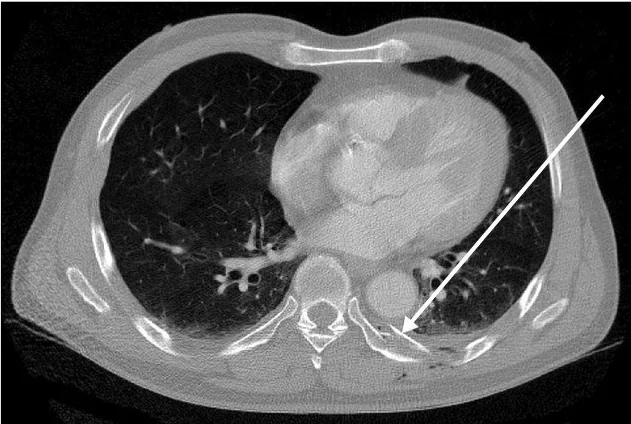
Toraks BT mevcutsa, kaburgalar ve göğüs duvarı sistematik olarak incelenir. BT, grafide seçilemeyen ince kırıkları ve deplase fragmanları gösterebilir; aynı incelemede plevra, akciğer ve göğüs duvarı yaralanmaları da değerlendirilir. Rapor, kırıkların numarasını ve anatomik sektörünü, kırık çizgisi özelliklerini ve yer değiştirme derecesini açıkça belirtmelidir. Kırıkların sayısı ve dağılımı yaralanma şiddeti ve eşlik eden akciğer, plevra veya interkostal damar yaralanmaları hakkında ipucu verebilir.
Faz ve pencere
- Kontrastsız tanısal
- İnce kesitli toraks BT'de (2–3 mm) akut kaburga kırıkları saptanabilir; 5 mm kesit kalınlığı kırık özelliklerini bulanıklaştırıp gizleyebilir. Kontrast, yalnız kırık hattını göstermek için gerekli değildir.
- Kemik algoritması tanısal
- Aksiyel kesitlere ek olarak mevcut koronal ve sagital rekonstrüksiyonları birlikte inceleyin.
Önerilen pencereler G genişlik, M merkez; değerler Hounsfield birimi (HU)
- KemikG 1800 / M +400
- AkciğerG 1500 / M −600
- MediastenG 350 / M +50
BT bulguları
- Kortikal kesinti — korteks veya kemik matriksi boyunca keskin, düşük atenüasyonlu ince çizgi ya da kortikal düzensizlik.
- Buckle kırığı — kaburga konturunda bükülme/kırışma; hafif olguda korteks kesintisi olmayabilir, daha belirgin olguda tek korteks etkilenebilir; tam ayrışma şart değildir.
- Deplase kırık — BT'de kırığın yer değiştirme derecesi ve komşu kırıklarla ilişkisi tarif edilebilir.
- Kırık dağılımı — kırıklar taraf, kaburga numarası ve ön, lateral ya da posterior ark yerleşimiyle kaydedilir.
- Ekstraplevral hematom — göğüs duvarı içinde, ekstraplevral yağ çizgisini yer değiştiren koleksiyon plevral sıvıdan ayrılmalıdır; kaburga kırığı eşlik edebilir.
- Pnömotoraks veya hemotoraks — kırık tarafındaki plevral hava ya da sıvı, kemik bulgusundan ayrı kaydedilir.
- Akciğer kontüzyonu/laserasyonu — kontüzyon yamalı buzlu cam veya konsolidasyon; laserasyon ise travmatik hava ya da sıvı içerebilen parankimal kavite oluşturabilir.
- BT'de yelken segmenti oluşturan kaburga kırıkları tanımlanabilir; klinik yelken göğüs, göğüs duvarının paradoksal hareketiyle tanımlanır.
Normalde
Normal kaburgada korteks kesintisiz izlenir ve kostal yay komşu kesitlerde takip edilebilir. Şüpheli alanda kortikal basamak, buckle biçimli bükülme veya ince düşük atenüasyonlu çizgi arayın; bulguyu komşu kesit ve koronal planda doğrulayın.
Normal BT ile kıyasla
Aynı bölgenin, kaynak veri setinde patoloji içermediği belirtilen bir BT incelemesini kesit kesit kaydırın; organ sınırlarını açarak anatomiyi hasta görüntüsüyle karşılaştırın. Küçük rastlantısal bulgular tümüyle dışlanmamıştır.
Kaynak: TotalSegmentator v2.01 veri seti (Wasserthal ve ark., Radiology: Artificial Intelligence 2023), CC BY 4.0, vaka s1278; organ sınırları veri setinin otomatik segmentasyonundan, birleştirilerek sadeleştirildi. Görüntüler 2,5 mm kesit aralığına yeniden örneklendi.
Ayırıcı tanı
- İyileşmekte olan ve eski kaburga kırıkları akut kırıklardan ayrı kaydedilmelidir.
- Kaburga stres kırığı tekrarlayan gövde kası kasılmasına bağlı yüklenme ile gelişebilir.
- Patolojik kırık
- altta yatan kemik hastalığında patolojik kırık gelişebilir, BT'de litik lezyon ve kortikal yıkım gibi atipik bulgular altta yatan lezyonu düşündürmelidir.
Tuzaklar
- Kaburga kırıkları aksiyel değerlendirmede gözden kaçabilir; şüpheli alanı komşu kesitlerde ve koronal rekonstrüksiyonda yeniden izleyin.
- Ön arkta görülen buckle tipi kırıklar belirgin ayrışma göstermeyebilir; yalnız deplase fragman aramayın.
- Kırık sayımında ince kemik rekonstrüksiyonunu kullanın ve ardışık kaburgaları tek tek izleyin.
- Normal göğüs radyografisi küçük kaburga kırığını dışlamaz; küçük pnömotoraks ve akciğer kontüzyonu da grafide gözden kaçabilir.
- Kırığın bulunduğu kaburga ve anatomik sektörünü açık ve ayrıntılı biçimde tarif edin.
Kendini dene
Akut kaburga kırığı şüphesinde BT kesit kalınlığı için doğru yaklaşım hangisidir?
Cevabı göster
İnce kesit (2-3 mm) ve koronal/sagital rekonstrüksiyon; kalın kesit kırığı gizleyebilir. Kalın kesitler longitudinal parsiyel volüm etkisiyle kırık özelliklerini bulanıklaştırıp gizleyebilir; 2-3 mm kesit ve rekonstrüksiyon kullanılmalıdır.
Künt toraks travmasından kısa süre sonra, kaburga kırığı komşuluğunda yamalı buzlu cam opasitesi ve küçük pnömotoraks var. Opasitenin en olası travmatik karşılığı nedir?
Cevabı göster
Akciğer kontüzyonu. Travma sonrası BT'de akciğer kontüzyonu ve laserasyon gibi parankimal yaralanmalar ayrıca değerlendirilir.
İlgili konular
Kaynaklar
Bu sayfadaki 35 cümle ve 2 quiz sorusu aşağıdaki kaynaklardan alıntılarla otomatik olarak karşılaştırıldı; 26 cümle bu karşılaştırmada düzeltildi (2026-10-12).
- Chest Wall and Diaphragmatic Injuries: Imaging Evaluation and Clinical Considerationsjksronline.org
- Traumatic Rib Injury: Patterns, Imaging Pitfalls, Complications, and Treatmentpubs.rsna.org
- Multidetector CT for Evaluation of the Extrapleural Spacepubs.rsna.org
- Imaging Manifestations of Chest Traumapubs.rsna.org
- Missed rib fractures on evaluation of initial chest CT for trauma patients: pattern analysis and diagnostic value of coronal multiplanar reconstruction images with multidetector row CTpmc.ncbi.nlm.nih.gov
- Point-of-care ultrasound (POCUS) diagnosis of rib fractureslink.springer.com
- Rib Fractures in Professional Baseball Pitchers: Mechanics, Epidemiology, and Managementpmc.ncbi.nlm.nih.gov
- ACR Appropriateness Criteria® Rib Fracturespubmed.ncbi.nlm.nih.gov
- Deep learning for acute rib fracture detection in CT data: a systematic review and meta-analysispmc.ncbi.nlm.nih.gov
- Erector Spinae Plane Block as an Analgesic Intervention in Acute Rib Fractures: A Scoping Reviewpmc.ncbi.nlm.nih.gov
- Factors associated with occult acute rib fractures on chest CT after negative radiography in older fall patientspmc.ncbi.nlm.nih.gov
- 외상 환자의 흉부 CT에서 인공지능을 이용한 갈비뼈 골절 진단pmc.ncbi.nlm.nih.gov
- When to pursue acute rib fracture fixation.pubmed.ncbi.nlm.nih.gov
- Deep learning for acute rib fracture detection in CT data: a systematic review and meta-analysis.pubmed.ncbi.nlm.nih.gov
- RibFractureSys: A gem in the face of acute rib fracture diagnoses.pubmed.ncbi.nlm.nih.gov
- Acute rib fracture caused by preoperative positioning for direct lateral interbody fusion: A case report.pubmed.ncbi.nlm.nih.gov
- A Case Report on a Hybrid Approach to Managing Acute Large Bowel Obstruction Secondary to Spigelian Hernia.pubmed.ncbi.nlm.nih.gov
- [Diagnosis of Rib Fracture Using Artificial Intelligence on Chest CT Images of Patients with Chest Trauma].pubmed.ncbi.nlm.nih.gov
- The value of deep learning-based computer aided diagnostic system in improving diagnostic performance of rib fractures in acute blunt trauma.pubmed.ncbi.nlm.nih.gov
- Factors associated with occult acute rib fractures on chest CT after negative radiography in older fall patients: A retrospective observational study.pubmed.ncbi.nlm.nih.gov
- Trauma Ultrasound.pubmed.ncbi.nlm.nih.gov
- Transdiaphragmatic Chest Wall Herniation.pubmed.ncbi.nlm.nih.gov
- Prospective validation of the Rib Injury Guidelines for traumatic rib fractures.pubmed.ncbi.nlm.nih.gov
- Blunt rupture of the thoracic duct after severe thoracic trauma.pubmed.ncbi.nlm.nih.gov
- Outcomes of single fraction stereotactic ablative radiotherapy for lung metastases.pubmed.ncbi.nlm.nih.gov
- Three-dimensional mapping of sternum fractures from high-energy trauma.pubmed.ncbi.nlm.nih.gov
- Chest Wall and Diaphragmatic Injuries: Imaging Evaluation and Clinical Considerations.pubmed.ncbi.nlm.nih.gov
- Biomechanics of chest wall injury: implications for surgical stabilization and failure prevention.pubmed.ncbi.nlm.nih.gov
- From rib fixation to dynamic chest wall reconstruction: historical lessons for modern surgical stabilization of rib fractures.pubmed.ncbi.nlm.nih.gov
- Regional anesthesia strategies for proximal humerus fracture surgery: anatomical considerations, diaphragm-sparing techniques, and expert perspectives-a narrative review.pubmed.ncbi.nlm.nih.gov
- Ultrasound and shockwave therapy for acute fractures in adults.pubmed.ncbi.nlm.nih.gov
- Interventions for treating proximal humeral fractures in adults.pubmed.ncbi.nlm.nih.gov
- Imaging of pediatric musculoskeletal trauma: Age-specific considerations and challenges.pubmed.ncbi.nlm.nih.gov
- Diagnostic accuracy of rib fracture detection in forensic post-mortem photon counting CT.pubmed.ncbi.nlm.nih.gov
- Beyond the break: development and validation of a new classification system for acute traumatic rib fractures.pubmed.ncbi.nlm.nih.gov
- A retrospective study of radial fractures in racehorses in California, 2006-2022.pubmed.ncbi.nlm.nih.gov
- Atypical cerebral fat embolism syndrome in an elderly patient with comorbidities following fracture: A case report.pubmed.ncbi.nlm.nih.gov
- Computed Tomography-Verified Deep Learning Model for Rib Fracture Prediction and Complication Association from Chest Radiographs.pubmed.ncbi.nlm.nih.gov
- Effects of early surgery (within 48 hours) <i>vs.</i> delayed surgery on the incidence of pulmonary complications in elderly patients with multiple rib fractures.pubmed.ncbi.nlm.nih.gov
- Novel nomogram for predicting paradoxical chest wall movement in patients with flail segment of traumatic rib fracture: a retrospective cohort study.pubmed.ncbi.nlm.nih.gov
- Thoracic trauma in children.pubmed.ncbi.nlm.nih.gov
- Surgical versus nonsurgical interventions for flail chest.pubmed.ncbi.nlm.nih.gov
- CPR related injuries of the chest wall: direct and indirect fractures.pubmed.ncbi.nlm.nih.gov
- American Society of Biomechanics Journal of Biomechanics Award 2013: cortical bone tissue mechanical quality and biological mechanisms possibly underlying atypical fractures.pubmed.ncbi.nlm.nih.gov
- Congenital and Breed-Associated Vertebral Anomalies in Dogs and Cats: Developmental Anatomy, Genetic Determinants, and Biological Significance.pubmed.ncbi.nlm.nih.gov
- Combined posterior-anterior surgery with autologous bone grafting for multi-segmental spinal tuberculosis.pubmed.ncbi.nlm.nih.gov
- Comparative Outcomes of Surgical Stabilization and Nonoperative Management for Rib Fractures: A Quasi-experimental Study.pubmed.ncbi.nlm.nih.gov
- Is fixation of a single end of flail segment rib fractures enough?pubmed.ncbi.nlm.nih.gov
- Determining the clinical significance of the Chest Wall Injury Society taxonomy for multiple rib fractures.pubmed.ncbi.nlm.nih.gov
- The 2023 WSES guidelines on the management of trauma in elderly and frail patients.pubmed.ncbi.nlm.nih.gov
- Evaluation of AI developed for rib fracture detection in identifying vertebral fractures on abdominal CT.pubmed.ncbi.nlm.nih.gov
- Skeletal growth and development dictate the processes of vertebral fracture in the pediatric spine; a review emphasizing fracture biomechanics of the vertebral body during the period of skeletal immaturity.pubmed.ncbi.nlm.nih.gov
- Point-of-care ultrasound (POCUS) diagnosis of rib fractures.pubmed.ncbi.nlm.nih.gov
- A Rare Case of Intramediastinal Humeral Head Fracture Dislocation Through the Thoracic Inlet.pubmed.ncbi.nlm.nih.gov
- Video-Assisted Thoracoscopic Surgery (VATS)-Aided Simultaneous Fixation of Scapular Body and Rib Fractures: A Case Report.pubmed.ncbi.nlm.nih.gov
- Musculoskeletal Ultrasound and Protein-Based Hydrogels: Novel Approaches for the Diagnosis and Treatment of Sports Injuries.pubmed.ncbi.nlm.nih.gov
- Thoracic wall trauma-misdiagnosed lesions on radiographs and usefulness of ultrasound, multidetector computed tomography and magnetic resonance imaging.pubmed.ncbi.nlm.nih.gov
- Magnetic resonance imaging evaluation of oblique injuries: Introduction of the deadrise sign.pubmed.ncbi.nlm.nih.gov
- Surgical management of complex non-union in chest wall instability: focus on posterior rib fractures, parasternal cartilage rupture, and costal margin injury.pubmed.ncbi.nlm.nih.gov
- Deep learning and hybrid architectures for atypical and complex bone fracture diagnosis: a systematic review of performance and clinical validity.pubmed.ncbi.nlm.nih.gov
- Rupture of a Nonaneurysmal Left Sinus of Valsalva Into the Pericardium.pubmed.ncbi.nlm.nih.gov
- Staged management of severe polytrauma with pericardial and diaphragmatic rupture and open pelvic ring injury: a case report with literature review.pubmed.ncbi.nlm.nih.gov
- Traumatic basilar artery incarceration following longitudinal clival fracture: illustrative case.pubmed.ncbi.nlm.nih.gov
- Predisposing Anatomy for Thoracic Outlet Syndrome and Functional Outcomes after Supraclavicular Thoracic Outlet Decompression in Athletes.pubmed.ncbi.nlm.nih.gov
- Case reports with literature review of an aneurysmal bone cyst in the maxilla and mandible of two juvenile dogs.pubmed.ncbi.nlm.nih.gov
- Evolution of temporomandibular joint reconstruction: from autologous tissue transplantation to alloplastic joint replacement.pubmed.ncbi.nlm.nih.gov
- Thoracic outlet syndrome in patients with clavicle fracture: Case report and national analysis.pubmed.ncbi.nlm.nih.gov
- Monocyte cluster identification during the early stage of fracture healing in an ovariectomized mouse model.pubmed.ncbi.nlm.nih.gov
- Evaluation of the efficacy of physical agent modalities in patients with fractures: a systematic review and network meta-analysis.pubmed.ncbi.nlm.nih.gov
- A Systematic Approach to the Evaluation of Acute Musculoskeletal Injuries in the Emergency Department.pubmed.ncbi.nlm.nih.gov
- Isolated Lesser Trochanter Fractures in Adults: A Systematic Review of Malignant, Infectious, and Benign Etiologies.pubmed.ncbi.nlm.nih.gov
- Risk Factors for Pathologic Fracture in Dogs With Confirmed or Suspected Appendicular Osteosarcoma Treated With Low- or Standard-Dose-Rate Palliative External Beam Radiation Therapy.pubmed.ncbi.nlm.nih.gov
- Xanthogranulomatous Osteomyelitis as a Bone Tumor Mimic: A Systematic Review of Pre-biopsy Diagnostic Clues and Management Decision Points.pubmed.ncbi.nlm.nih.gov
- Open Chest Wound with Sternal Fracture in the Emergency Department, a Case Report.pubmed.ncbi.nlm.nih.gov
- Detection, Classification, and Segmentation of Rib Fractures From CT Data Using Deep Learning Models: A Review of Literature and Pooled Analysis.pubmed.ncbi.nlm.nih.gov
- Advances in Artificial Intelligence for Wrist Joint Injury Diagnosis.pubmed.ncbi.nlm.nih.gov
- Accidental Diagnosis of Type VII Osteogenesis Imperfecta in an Infant Presenting With Pneumonia and Rickets-Like Rib Fractures: A Case Report.pubmed.ncbi.nlm.nih.gov
- Fifty Shades of PSMA-Avid Rib Lesions: A Comprehensive Review.pubmed.ncbi.nlm.nih.gov
- Superscan Pattern on Bone Scintigraphy: A Comprehensive Review.pubmed.ncbi.nlm.nih.gov
- Paget's disease of bone with superimposed osseous metastasis from lung carcinoma: A case report.pubmed.ncbi.nlm.nih.gov
- Diagnosis of a patient with pulmonary and skeletal cryptococcosis: A case report and literature review.pubmed.ncbi.nlm.nih.gov
- Diffuse and Prolonged Bone Pain Revealing Tumor-Induced Osteomalacia: A Case Report.pubmed.ncbi.nlm.nih.gov
- Emergency radiology of severe acute injury in extreme alpine summer sports: a pictorial essay.pubmed.ncbi.nlm.nih.gov
- Pneumothorax and Hemothorax: Practical Approaches for Radiologists.pubmed.ncbi.nlm.nih.gov
- Lung Parenchymal and Airway Injuries: Differential Diagnosis and Severity Grading.pubmed.ncbi.nlm.nih.gov
- ARDS management in trauma patients.pubmed.ncbi.nlm.nih.gov
- The Anticoagulation Dilemma: Concurrent Traumatic Brain Hemorrhage and Cerebral Venous Thrombosis in a Blast Injury Patient.pubmed.ncbi.nlm.nih.gov
- Effect of a liberal fluid fasting policy before surgery on the incidence of aspiration: a single centre retrospective observational study.pubmed.ncbi.nlm.nih.gov
- Anthropogenic Vessel Strike as a Threat to Spotted Seals (<i>Phoca largha</i>) in Korean Waters: A Multimodal Forensic Investigation.pubmed.ncbi.nlm.nih.gov
Eğitim amaçlıdır; hasta başında tanı ve tedavi kararının yerine geçmez, tıbbi tavsiye değildir. Metinler yapay zekâ desteğiyle yazıldı ve otomatik bir adımda kaynak alıntılarıyla karşılaştırıldı; bu bir tıbbi doğrulama değildir ve içerik uzman radyolog incelemesinden geçmedi. Klinik kararlarda güncel kılavuzları, kurum protokollerini ve radyoloji raporunu esas alın.