Özet
Akut fibrinöz ve organize pnömoni (AFOP), akut ya da subakut solunum bozulmasıyla ortaya çıkabilen nadir bir histopatolojik akciğer hasarı paternidir. AFOP'ta BT'de yamalı buzlu cam, konsolidasyon veya kitle benzeri opasiteler görülebilir; bu bulgular tanıyı tek başına doğrulamaz. AFOP'un klinik ve görüntüleme bulguları özgül olmayıp enfeksiyon, diffüz alveoler hasar ve organize pnömoniyle örtüşebilir; bu örtüşme tanıyı güçleştirir. AFOP'u yalnız BT görünümünden kesinleştirmek mümkün değildir; radyolojik bulgular özgül olmadığından kesin tanı için histopatolojik değerlendirme gerekir.
Faz ve pencere
- HRCT tanısal
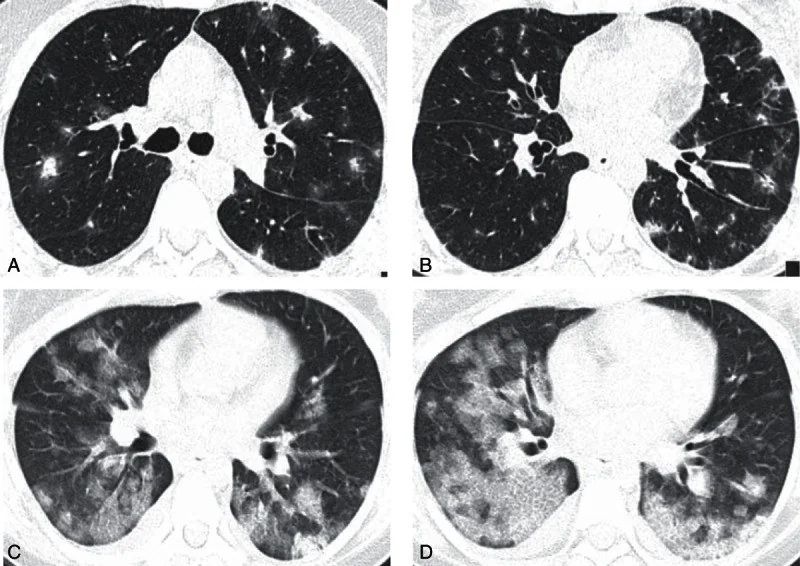
- İnce kesitli görüntülerde yamalı buzlu cam, konsolidasyon veya kitle benzeri opasiteler görülebilir; konsolidasyonla birlikte hava bronkogramı da izlenebilir. Görüntüleme bulguları tanısal olarak özgül olmadığından, kesin tanı ancak doku örnekleme ile konulabilir.
Önerilen pencereler: Akciğer (G 1500 / M -600), Mediasten (G 350 / M 50).
BT bulguları
- Yamalı hava boşluğu opasiteleri — buzlu cam ve konsolidasyon aynı incelemede farklı odaklarda veya iç içe alanlarda bulunabilir.
- Konsolidasyon içinde hava bronkogramı görülebilir; kaynaklarda AFOP ile ilişkili örneklerde farklı akciğer bölgeleri bildirilmiştir.
- Dağılım değişken olabilir: bilateral, yamalı konsolidasyon ve buzlu cam alanları görülebilir; bazı olgularda alt loblar baskındır, ancak tek bir dağılım tanıyı koydurmaz.
- İnce retiküler çizgiler — buzlu cam ya da konsolidasyon çevresinde interlobüler/intralobüler çizgilenme eşlik edebilir.
- Zamansal değişkenlik — seri BT'de bir opasitenin kısmen gerilerken başka bölgede yeni konsolidasyon gelişmesi organize akciğer hasarıyla uyumludur ancak AFOP'a özgü değildir.
- AFOP'ta bilateral opasiteler, konsolidasyonlar veya nodüler opasiteler görülebilir; ters halo ise kaynakta organize pnömoninin görüntüleme bulgusu olarak listelenmiştir.
Normalde
AFOP'ta BT'de buzlu cam opasiteleri ve konsolidasyon görülebilir; bu bulgular histolojik tanıyı tek başına koydurmaz.
Normal BT ile kıyasla
Aynı bölgenin, kaynak veri setinde patoloji içermediği belirtilen bir BT incelemesini kesit kesit kaydırın; organ sınırlarını açarak anatomiyi hasta görüntüsüyle karşılaştırın. Küçük rastlantısal bulgular tümüyle dışlanmamıştır.
Kaynak: TotalSegmentator v2.01 veri seti (Wasserthal ve ark., Radiology: Artificial Intelligence 2023), CC BY 4.0, vaka s1278; organ sınırları veri setinin otomatik segmentasyonundan, birleştirilerek sadeleştirildi. Görüntüler 2,5 mm kesit aralığına yeniden örneklendi.
Ayırıcı tanı
- Organize pnömoni
- perilobüler kavisli opasiteler, periferik/peribronkovasküler konsolidasyon ve göç eden lezyonlar örtüşür; AFOP ayrımı görüntüden değil doku paterninden yapılır.
- Diffüz alveoler hasar
- yaygın bilateral buzlu cam ve konsolidasyon ağır klinik tabloda benzer görünür; klinik bağlam ve histopatoloji belirleyicidir.
- Akut eozinofilik pnömonide bilateral konsolidasyon ve buzlu cam opasitelerine interlobüler septal kalınlaşma ve küçük plevral efüzyonlar eşlik edebilir; eozinofili ve örnekleme bulguları ayırıcı tanıda yardımcıdır.
- Enfeksiyöz bronkopnömoni AFOP ile ayırıcı tanıda düşünülmelidir; AFOP solunum yolu enfeksiyonlarıyla ilişkili olabildiğinden, AFOP ile uyumlu görünüm enfeksiyonu dışlamaz.
- Kardiyojenik pulmoner ödem
- perihiler buzlu cam, düzgün septal kalınlaşma, damar dolgunluğu ve plevral efüzyon konjesyonu destekler.
Tuzaklar
- Bilateral alt zon konsolidasyonu AFOP'a özgü değildir; görüntüleme paternini kesin histolojik tanı gibi raporlamayın.
- Ters halo organize pnömonide görülebilen bir BT bulgusudur; AFOP tanısı için tek başına yeterli değildir ve histopatolojik doğrulama gerekir.
- Hızlı değişen opasiteler her zaman enfeksiyonun yayılması anlamına gelmez; seri incelemeyi önceki anatomik odaklarla bire bir karşılaştırın ve klinik/histolojik veriyi dikkate alın.
Kendini dene
Akut dispneli hastada BT'de bilateral yamalı buzlu cam ve bazal hava bronkogramlı konsolidasyon var. Hangi sonuç doğrudur?
Cevabı göster
AFOP olasılıklardan biridir. AFOP böyle bir alveoler opasite paterniyle görülebilir, ancak BT bulguları özgül değildir ve tanı histopatolojik örüntünün gösterilmesini gerektirir. Ödem klinik/radyolojik eşlikçilerle ayrılır; hava bronkogramı AFOP'u dışlamaz.
AFOP'un temel histopatolojik özelliği hangisidir?
Cevabı göster
Alveol boşluklarında fibrin topları ve organize pnömoni bulguları. AFOP, alveol boşluklarında fibrin birikimi ve organize pnömoni bulgularıyla tanımlanır; hiyalin membranlar ve eozinofiller tipik AFOP bulguları değildir.
İlgili konular
Kaynaklar
Bu sayfadaki 33 cümle ve 2 quiz sorusu aşağıdaki kaynaklardan alıntılarla otomatik olarak karşılaştırıldı (2026-10-09).
- Acute fibrinous and organizing pneumonia presents as right lung upper lobe cavitary lesion: Case report and literature reviewpmc.ncbi.nlm.nih.gov
- Acute fibrinous and organizing pneumonia after bone marrow transplantation, an underrecognized, severe conditionpmc.ncbi.nlm.nih.gov
- Pulmonary tuberculosis associated acute fibrinous and organizing pneumonia: A case report and literature reviewpmc.ncbi.nlm.nih.gov
- Acute fibrinous and organizing pneumonia in a patient with Sjögren’s syndrome and Legionella pneumonia: a case report and literature reviewpmc.ncbi.nlm.nih.gov
- Acute fibrinous and organizing pneumonia: two case reports and literature reviewpmc.ncbi.nlm.nih.gov
- Pathogenesis, Imaging, and Evolution of Acute Lung Injury.pubmed.ncbi.nlm.nih.gov
- Radio-pathological correlation of organizing pneumonia (OP): a pictorial review.pubmed.ncbi.nlm.nih.gov
- Acute fibrinous and organizing pneumonia: two case reports and literature review.pubmed.ncbi.nlm.nih.gov
- Acute fibrinous and organizing pfneumonia: two case reports and literature review.pubmed.ncbi.nlm.nih.gov
- A systematic review of pathological findings in COVID-19: a pathophysiological timeline and possible mechanisms of disease progression.pubmed.ncbi.nlm.nih.gov
- [Acute fibrinous and organizing pneumonia: a case report and review of the literature].pubmed.ncbi.nlm.nih.gov
- Acute fibrinous and organizing pneumonia as initial presentation of primary Sjögren's syndrome: a case report and literature review.pubmed.ncbi.nlm.nih.gov
- Imaging of the Spectrum of Acute Lung Injury.pubmed.ncbi.nlm.nih.gov
- From the radiologic pathology archives: organization and fibrosis as a response to lung injury in diffuse alveolar damage, organizing pneumonia, and acute fibrinous and organizing pneumonia.pubmed.ncbi.nlm.nih.gov
- Diagnostic procedures and clinico-radiological findings of acute fibrinous and organizing pneumonia: a systematic review and pooled analysis.pubmed.ncbi.nlm.nih.gov
- Life after acute fibrinous and organizing pneumonia: a case report of a patient 30 months after diagnosis and review of the literature.pubmed.ncbi.nlm.nih.gov
- Acute fibrinous and organizing pneumonia presents as right lung upper lobe cavitary lesion: Case report and literature review.pubmed.ncbi.nlm.nih.gov
- [Chinese expert consensus on the pathological diagnosis of interstitial lung disease with transbronchial lung cryobiopsy specimens].pubmed.ncbi.nlm.nih.gov
- Algorithmic Approach to the Diagnosis of Organizing Pneumonia: A Correlation of Clinical, Radiologic, and Pathologic Features.pubmed.ncbi.nlm.nih.gov
- Acute fibrinous and organizing pneumonia after bone marrow transplantation, an underrecognized, severe condition.pubmed.ncbi.nlm.nih.gov
- Acute exacerbation in fibrotic interstitial lung disease: an international working group report.pubmed.ncbi.nlm.nih.gov
- Histologic patterns of chronic interstitial lung disease in dogs.pubmed.ncbi.nlm.nih.gov
- Organizing Pneumonia As the Initial Manifestation of Systemic Lupus Erythematosus: Case Report and Literature Review.pubmed.ncbi.nlm.nih.gov
- Drug-Induced Pulmonary Toxicity in the Era of Immunotherapy and Biologics: A Narrative Review of Mechanism, Diagnosis, and Management.pubmed.ncbi.nlm.nih.gov
- A Mimic of Metastatic Malignancy: Dietary Supplement-Associated Drug-Induced Lung Injury Presenting as Multiple Pulmonary Nodules With an Acute Fibrinous and Organizing Pneumonia Pattern.pubmed.ncbi.nlm.nih.gov
- A Rare Case of Acute Fibrinous Organizing Pneumonia in a Patient With Post-obstructive Pneumonia and Malignancy.pubmed.ncbi.nlm.nih.gov
- Potential association of bronchoalveolar lavage lipid-laden macrophages with disease severity and corticosteroid response in interstitial lung disease: a pilot study.pubmed.ncbi.nlm.nih.gov
- Clinicopathologic Features of Isolated AFOP Nodules Radiologically Mimicking Malignancy in Post COVID-19 Patients: A Case Series Study.pubmed.ncbi.nlm.nih.gov
- Immunotherapy related organizing pneumonia mimicking metastatic progression in a patient with endometrial cancer: A case report.pubmed.ncbi.nlm.nih.gov
- Psittacosis chlamydia pneumonia complicated with organizing pneumonia: a case report and literature review.pubmed.ncbi.nlm.nih.gov
- Prognostic Impact of Aetiology in Adult Hemophagocytic Lymphohistiocytosis: Insights from an Intensive Care Unit Experience.pubmed.ncbi.nlm.nih.gov
- A case report: Acute fibrinous and organizing pneumonia.pubmed.ncbi.nlm.nih.gov
- Spontaneous massive hemothorax as a complication of necrotizing pneumonia in a patient with severe acute respiratory syndrome coronavirus 2 induced acute respiratory distress syndrome: a case report.pubmed.ncbi.nlm.nih.gov
- <i>Chlamydia psittaci</i> infection-associated acute fibrinous and organizing pneumonitis: A case report.pubmed.ncbi.nlm.nih.gov
- Daptomycin eosinophilic pneumonia, a systematic review of the literature and case series.pubmed.ncbi.nlm.nih.gov
- Rare interstitial lung diseases: a narrative review.pubmed.ncbi.nlm.nih.gov
- Differences in Dynamics of Lung Computed Tomography Patterns between Survivors and Deceased Adult Patients with COVID-19.pubmed.ncbi.nlm.nih.gov
- Acute and chronic eosinophilic pneumonia: an overview.pubmed.ncbi.nlm.nih.gov
- Differential diagnosis of pulmonary sarcoidosis: a review.pubmed.ncbi.nlm.nih.gov
- Clinicopathological Outlines of Post-COVID-19 Pulmonary Fibrosis Compared with Idiopathic Pulmonary Fibrosis.pubmed.ncbi.nlm.nih.gov
- Proposed clinical phases for the improvement of personalized treatment of checkpoint inhibitor-related pneumonitis.pubmed.ncbi.nlm.nih.gov
- Case Report: Diagnosis of Myelodysplastic Syndrome in a 72-Year-Old Female With Interstitial Lung Disease.pubmed.ncbi.nlm.nih.gov
- Reversed halo sign as a radiological feature of tuberculosis - Report of two cases.pubmed.ncbi.nlm.nih.gov
- Case Report: Chronic eosinophilic pneumonia with acute-like presentation and diagnostic challenges.pubmed.ncbi.nlm.nih.gov
- Longitudinal change of idiopathic inflammatory myopathy-associated interstitial lung disease on high-resolution computed tomography, a prospective cohort study.pubmed.ncbi.nlm.nih.gov
- MDA5-associated juvenile dermatomyositis and interstitial lung disease from rapidly progressive to silent: a report of three cases in South African children and a review of the literature.pubmed.ncbi.nlm.nih.gov
- Diagnosing lung involvement in inflammatory rheumatic diseases-Where do we currently stand?pubmed.ncbi.nlm.nih.gov
- Morphological and functional findings in COVID-19 lung disease as compared to Pneumonia, ARDS, and High-Altitude Pulmonary Edema.pubmed.ncbi.nlm.nih.gov
- Radiologic patterns of interstitial lung disease: a pictorial review based on the 2025 European Respiratory Society/American Thoracic Society Classification.pubmed.ncbi.nlm.nih.gov
- Pulmonary Complications of Cancer Therapy: Clinical Presentations, Imaging Patterns, and Management Strategies.pubmed.ncbi.nlm.nih.gov
- Imaging findings of thoracic manifestations of Crohn's disease and ulcerative colitis.pubmed.ncbi.nlm.nih.gov
- The 2025 ATS/ERS update of the international multidisciplinary classification of the interstitial pneumonias: implications for the pathologist.pubmed.ncbi.nlm.nih.gov
- Diagnosis and Management of Small Airways Disease.pubmed.ncbi.nlm.nih.gov
- Probable Tigecycline-Induced Acute Eosinophilic Pneumonia: A Case Report.pubmed.ncbi.nlm.nih.gov
- Medication-induced lung disease in children.pubmed.ncbi.nlm.nih.gov
- Diagnosis and management of acute eosinophilic pneumonia masquerading as malignancy and community-acquired pneumonia in an elderly male: a case report.pubmed.ncbi.nlm.nih.gov
- Invasive Pulmonary Aspergillosis-Mimicking <i>Pseudomonas aeruginosa</i> Pneumonia in Immunocompromised Patients: Radiologic Differentiation.pubmed.ncbi.nlm.nih.gov
- Management of pneumonia by the emergency radiologist.pubmed.ncbi.nlm.nih.gov
- Host, Pathogen, and Pulmonary Anatomy in Pneumonia: An Integrated Imaging and Clinical Perspective.pubmed.ncbi.nlm.nih.gov
- Pulmonary Alveolar Proteinosis-Like Presentation of Murine Typhus in a Previously Healthy Adult.pubmed.ncbi.nlm.nih.gov
- Fulminant Multisystem IgA Vasculitis With Diffuse Alveolar Hemorrhage, Severe Gastrointestinal Hemorrhage, Paralytic Ileus, and Renal Involvement in an Adolescent: A Case Report.pubmed.ncbi.nlm.nih.gov
- An Atypical Presentation of Pulmonary Oedema Secondary to Suspected Anabolic Steroid-Induced Cardiomyopathy.pubmed.ncbi.nlm.nih.gov
- Whipple's disease with multiple serous effusions as the clinical manifestation: a case report and literature review.pubmed.ncbi.nlm.nih.gov
- Clinical spectrum and treatment of thyroid lymphoma: results of a cohort study of 61 patients.pubmed.ncbi.nlm.nih.gov
- Delayed mechanical thrombectomy after systemic thrombolysis in massive unilateral pulmonary thromboembolism.pubmed.ncbi.nlm.nih.gov
- CT findings of lung injury during breast cancer treatment.pubmed.ncbi.nlm.nih.gov
- CT Features of Granulomatous-Lymphocytic Interstitial Lung Disease (GLILD): The "Kebab Sign" as a Marker to Support Differential Diagnosis.pubmed.ncbi.nlm.nih.gov
- Critical complications in cancer patients admitted to the ICU in the era of immunotherapy: recognition, differential diagnosis, and management.pubmed.ncbi.nlm.nih.gov
- Chest CT in covid-19 pneumonia's follow-up: A 30 patients case series.pubmed.ncbi.nlm.nih.gov
- 2.5-mm articulated endoluminal forceps using a compliant mechanism.pubmed.ncbi.nlm.nih.gov
- Lung Imaging in Acute Hypoxemic Respiratory Failure: From Physics to Bedside Applications.pubmed.ncbi.nlm.nih.gov
- The first CT-based classification system for pulmonary actinomycosis: correlating imaging patterns with therapeutic strategies and prognosis in a highly misdiagnosed disease.pubmed.ncbi.nlm.nih.gov
- Uncommon Causes of Interlobular Septal Thickening on CT Images and Their Distinguishing Features.pubmed.ncbi.nlm.nih.gov
- Fleischner Society: Glossary of Terms for Thoracic Imaging.pubmed.ncbi.nlm.nih.gov
- Two in one: Overlapping CT findings of COVID-19 and underlying lung diseases.pubmed.ncbi.nlm.nih.gov
- Imaging in the COVID-19 era: Lessons learned during a pandemic.pubmed.ncbi.nlm.nih.gov
- Clinical Spectrum, Radiological Findings, and Outcomes of Severe Toxoplasmosis in Immunocompetent Hosts: A Systematic Review.pubmed.ncbi.nlm.nih.gov
- Incidental Lung Lesions on the CT Component of Oncologic FDG PET/CT: A Pictorial Review of Interpretive Pitfalls and Diagnostic Clues.pubmed.ncbi.nlm.nih.gov
- Migratory Pulmonary Infiltrates Mimicking Malignancy, Tuberculosis, and Sarcoidosis in an Apparently Immunocompetent Adult: A Case of Tissue-Proven Invasive Fungal Disease Due to a Non-<i>marneffei</i><i>Penicillium</i> Species.pubmed.ncbi.nlm.nih.gov
- Clinical features of immune checkpoint inhibitor-related pneumonitis in older patients with lung cancer receiving immune checkpoint inhibitors-based therapy: a retrospective study.pubmed.ncbi.nlm.nih.gov
- Everolimus-Induced Pulmonary Toxicity in a Lung Transplant Recipient: A Case Report.pubmed.ncbi.nlm.nih.gov
- A case report of acute fibrinous and organizing pneumonia.pubmed.ncbi.nlm.nih.gov
- Postoperative Pulmonary Complications: Clinical and Imaging Insightspubmed.ncbi.nlm.nih.gov
- Ten Questions on Using Lung Ultrasonography to Diagnose and Manage Pneumonia in Hospital-at-Home Model: Part II-Confounders and Mimickers.pubmed.ncbi.nlm.nih.gov
- Lung Ultrasound After COVID-19: A Pivotal Moment for Clinical Integration-Navigating Challenges and Seizing Opportunities.pubmed.ncbi.nlm.nih.gov
- Prolonged COVID-19 Pneumonia in Patients with Hematologic Malignancies: Clinical Significance and Serial CT Findings.pubmed.ncbi.nlm.nih.gov
- Clinical Insights and Therapeutic Strategies for the Treatment of Interstitial Lung Disease in Patients with Anti-Neutrophil Cytoplasmic Antibody-Associated Vasculitis: Current Trends and Future Directions.pubmed.ncbi.nlm.nih.gov
- <i>Chlamydia</i> beyond the genital tract: a major contributor to community-acquired pneumonia.pubmed.ncbi.nlm.nih.gov
- Human biomarker navigator.pubmed.ncbi.nlm.nih.gov
- EACR 2025 Congress: Innovative Cancer Science, 16-19 June 2025.pubmed.ncbi.nlm.nih.gov
- AWMF S2k Guideline: Diagnosis and Assessment of Lung Disease Caused by Occupational Silica Dust Exposure (Silicosis) - Disease No. 4101 as per Occupational Diseases Ordinance (BKV) Annex 1.pubmed.ncbi.nlm.nih.gov
- Imaging in animal models: bridging experimental findings and human pathophysiology.pubmed.ncbi.nlm.nih.gov
- Antimicrobial prescribing guidelines for horses in Australia.pubmed.ncbi.nlm.nih.gov
- Coexistence of Autoantibodies against the Golgi Complex and Ro52 Antigen in a Patient with Nonspecific Interstitial Pneumonia.pubmed.ncbi.nlm.nih.gov
- <i>Aspergillus fumigatus</i>-induced acute fibrinous and organizing pneumonia complicated by spontaneous subcutaneous and mediastinal emphysema: a case report and literature review.pubmed.ncbi.nlm.nih.gov
- Acute Fibrinous and Organizing Pneumonia Versus Organizing Pneumonia: A Comparative Study of Clinical, Radiological, Histological, and Immunophenotypic Features.pubmed.ncbi.nlm.nih.gov
- Lipoid Pneumonia: HRCT and MRI Spectrum, Diagnostic Pitfalls, and Imaging-Based Diagnostic Workflow.pubmed.ncbi.nlm.nih.gov
- Flares and definition of worsening in inflammatory myopathies: a narrative review of the literature.pubmed.ncbi.nlm.nih.gov
- Bacterial Granulomatous Lung Diseases: Radiological Findings and Differential Diagnosis.pubmed.ncbi.nlm.nih.gov
- Chest-CT mimics of COVID-19 pneumonia-a review article.pubmed.ncbi.nlm.nih.gov
- Mimickers of novel coronavirus disease 2019 (COVID-19) on chest CT: spectrum of CT and clinical features.pubmed.ncbi.nlm.nih.gov
- Noninfectious Acute Lung Injury Syndromes Early After Hematopoietic Stem Cell Transplantation.pubmed.ncbi.nlm.nih.gov
- Multidisciplinary Approach to the Diagnosis of Idiopathic Interstitial Pneumonias: Focus on the Pathologist's Key Role.pubmed.ncbi.nlm.nih.gov
- Pleuroparenchymal Fibroelastosis: Its Pathological Characteristics.pubmed.ncbi.nlm.nih.gov
- E-cigarette or vaping product use-associated lung injury without pulmonary symptoms: A case report and literature review.pubmed.ncbi.nlm.nih.gov
- Acute Fibrinous and Organizing Pneumonia (AFOP) in Children: A Case Report and Literature Review.pubmed.ncbi.nlm.nih.gov
- Lung-Predominant Hyperinflammatory Syndrome in Therapy-Related Myelodysplastic Syndrome Responsive to Interleukin-1 Blockade.pubmed.ncbi.nlm.nih.gov
- Update on cryptogenic organizing pneumonia.pubmed.ncbi.nlm.nih.gov
- The many faces of cryptogenic organizing pneumonia (COP).pubmed.ncbi.nlm.nih.gov
- Organizing Pleuritis Presenting as Recurrent Lymphocyte Predominant, Exudative Effusion.pubmed.ncbi.nlm.nih.gov
- Postinfluenza Organizing Pneumonia in an Older Adult Successfully Treated With Corticosteroids: A Case Report.pubmed.ncbi.nlm.nih.gov
- Pulmonary diffuse large B-cell lymphoma with concurrent organizing pneumonia: a case report.pubmed.ncbi.nlm.nih.gov
- Korean Guidelines for Diagnosis and Management of Interstitial Lung Disease: Cryptogenic Organizing Pneumonia.pubmed.ncbi.nlm.nih.gov
- Case Report: Adult fibrinous bronchitis associated with lymphatic reflux: a probable diagnosis based on convergent evidence.pubmed.ncbi.nlm.nih.gov
- Cause of Death Analysis in a 9½-Year-Old with COVID-19 and Dravet Syndrome.pubmed.ncbi.nlm.nih.gov
Eğitim amaçlıdır; hasta başında tanı ve tedavi kararının yerine geçmez, tıbbi tavsiye değildir. Metinler yapay zekâ desteğiyle yazıldı ve otomatik bir adımda kaynak alıntılarıyla karşılaştırıldı; bu bir tıbbi doğrulama değildir ve içerik uzman radyolog incelemesinden geçmedi. Klinik kararlarda güncel kılavuzları, kurum protokollerini ve radyoloji raporunu esas alın.