Özet
Kronik eozinofilik pnömoni çoğunlukla haftalar içinde gelişen öksürük ve nefes darlığıyla başvurur; astım öyküsü sık eşlik eder. HRCT'de bilateral periferik konsolidasyon ve buzlu cam alanları görülebilir. HRCT'de orta-üst akciğer alanlarında periferik opasiteler görülebilir; ters halo daha az sıklıkta izlenir ve organize pnömoni, sarkoidoz, vaskülit ve enfeksiyon gibi başka hastalıklarda da görülebilir. Kronik eozinofilik pnömonideki periferik opasiteler, benzer klinik ve radyolojik görünümler nedeniyle enfeksiyöz pnömoniyle karışabilir ve tanıyı güçleştirebilir.
Faz ve pencere
- HRCT tanısal
- Kontrastsız ince kesitlerde bilateral, çoğu kez periferik ve subplevral konsolidasyon/buzlu cam alanları; santral akciğerin görece korunması ve bazı olgularda üst zon ağırlığı aranır. Ters halo görünümü CEP'de görülebilir ancak başka hastalıklarda da ortaya çıktığından tanısal değildir.
Önerilen pencereler G genişlik, M merkez; değerler Hounsfield birimi (HU)
- AkciğerG 1500 / M −600
- MediastenG 350 / M +50
BT bulguları
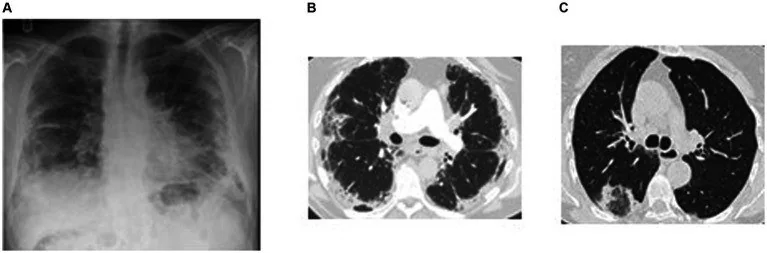
- Periferik subplevral konsolidasyon — plevra boyunca uzanan, santral akciğere göre daha belirgin hava boşluğu opasiteleri.
- Periferik buzlu cam ve konsolidasyon — opasiteler buzlu camdan hava boşluğu konsolidasyonuna kadar değişebilir ve birlikte görülebilir; merkezi buzlu camı çevreleyen konsolidasyon halkası ise ters halo paternidir.
- Santral alanların göreli korunması — santral alanlar dış zonlara kıyasla daha az etkilenebilir.
- Üst lob baskınlığı — bazı olgularda periferik opasiteler üst loblarda baskın olabilir.
- Uzamış belirtilerde, tedavi sonrasında plevraya paralel çizgisel bantlar veya lober atelektazi görülebilir.
- Ters halo (atoll) görünümü — merkezi buzlu camın kısmi ya da tam konsolidasyon halkasıyla çevrelenmesidir; CEP'ye özgü değildir.
- Görüntüleme bulguları tek başına tanı koydurmaz; tanı, 2-4 haftadır süren solunum yakınmaları, periferik kan eozinofilisi (≥1000/mm3) veya BAL eozinofilisi (≥%40) ve diğer bilinen eozinofilik pnömoni nedenlerinin dışlanmasıyla desteklenir.
Normalde
Aynı lobun subplevral dış üçte biriyle hilus çevresini karşılaştırarak dış zon konsolidasyonunun santrale göre baskınlığını, karşı akciğer eş düzeyini ve damar görünürlüğünün korunup korunmadığını değerlendirin.
Normal BT ile kıyasla
Aynı bölgenin, kaynak veri setinde patoloji içermediği belirtilen bir BT incelemesini kesit kesit kaydırın; organ sınırlarını açarak anatomiyi hasta görüntüsüyle karşılaştırın. Küçük rastlantısal bulgular tümüyle dışlanmamıştır.
Kaynak: TotalSegmentator v2.01 veri seti (Wasserthal ve ark., Radiology: Artificial Intelligence 2023), CC BY 4.0, vaka s1278; organ sınırları veri setinin otomatik segmentasyonundan, birleştirilerek sadeleştirildi. Görüntüler 2,5 mm kesit aralığına yeniden örneklendi.
Ayırıcı tanı
- Organize pnömoni
- CEP ile HRCT görünümü örtüşebilir; CEP'de konsolidasyonlar organize pnömoniye kıyasla daha seyrek peribronkovasküler dağılım ve ters halo gösterir.
- İlaç ilişkili eozinofilik pnömoni
- ilaçlar bilinen nedenler arasındadır; değerlendirmede ilaçla zamansal ilişki göz önünde bulundurulur.
- İlaç ilişkili eozinofilik pnömoni
- amiodaron ve nitrofurantoin gibi ilaçlara bağlı gelişebilir; ilaçla zamansal ilişki sorgulanmalı ve diğer nedenler dışlanmalıdır.
- Kronik enfeksiyon
- enfeksiyonlar, ortak klinik ve radyolojik görünümler nedeniyle eozinofilik pnömoniyle karışabilir; ayırıcı tanıda dışlanmalıdır.
Tuzaklar
- Ters halo işaretini CEP tanısı olarak okumayın; organize pnömoni, enfeksiyon, vaskülit ve sarkoidoz da halka benzeri opasite oluşturabilir.
- Tek BT'de periferik dağılımın görülmesi göçü kanıtlamaz; önceki incelemeyi aynı anatomik seviyelerde karşılaştırın.
- Plevraya paralel çizgisel opasiteler aktif konsolidasyon olmayabilir; önceki görüntülerde gerileme ve eşlik eden hacim kaybını arayın.
Kendini dene
Astım öyküsü ve periferik eozinofilisi olan bir hastanın BT'sinde periferik subplevral konsolidasyon ve santral alanlarda göreli korunma görülüyor. En uyumlu tanı hangisidir?
Cevabı göster
Kronik eozinofilik pnömoni. Astım öyküsü, periferik eozinofili ve periferik subplevral konsolidasyonla santral korunma kronik eozinofilik pnömoniyi destekler. Organize pnömoniyle HRCT bulguları örtüşebileceğinden tanı bu bulgularla tek başına kesinleşmez.
Periferik konsolidasyon halkasının ortasında buzlu cam bulunan ters halo, hangi tanıyı tek başına kanıtlar?
Cevabı göster
Hiçbirini; işaret özgül değildir. Ters halo CEP'de görülebilir, ancak organize pnömoni, enfeksiyon ve vaskülit gibi başka süreçlerde de ortaya çıkar. Bu nedenle dağılım, klinik ve önceki görüntülerle birlikte yorumlanır.
İlgili konular
Kaynaklar
Bu sayfadaki 33 cümle ve 2 quiz sorusu aşağıdaki kaynaklardan alıntılarla otomatik olarak karşılaştırıldı; 8 cümle bu karşılaştırmada düzeltildi (2026-10-10).
- Fibrotic chronic eosinophilic pneumonia: from inflammation to fibrosis and therapeutic implicationspmc.ncbi.nlm.nih.gov
- New perspectives in the treatment of chronic eosinophilic pneumonia in the era of targeted therapiespmc.ncbi.nlm.nih.gov
- CT Findings of Asthma and Asthma-Mimicking Conditionspmc.ncbi.nlm.nih.gov
- Successful management of chronic eosinophilic pneumonia triggered by immune checkpoint inhibitor: a case report and literature reviewpmc.ncbi.nlm.nih.gov
- Acute and chronic eosinophilic pneumonia: an overviewpmc.ncbi.nlm.nih.gov
- Acute and chronic eosinophilic pneumonia: an overview.pubmed.ncbi.nlm.nih.gov
- [Lung imaging in severe asthma].pubmed.ncbi.nlm.nih.gov
- COVID-19 and its Mimics: What the Radiologist Needs to Know.pubmed.ncbi.nlm.nih.gov
- Chapter 18: Allergic bronchopulmonary aspergillosis.pubmed.ncbi.nlm.nih.gov
- [Eosinophilic diseases of the lungs].pubmed.ncbi.nlm.nih.gov
- COVID-19 mimics on chest CT: a pictorial review and radiologic guide.pubmed.ncbi.nlm.nih.gov
- Radiographic Distribution as a Diagnostic Clue in Pulmonary Disease.pubmed.ncbi.nlm.nih.gov
- [Chronic eosinophilic pneumonia: Report of one case].pubmed.ncbi.nlm.nih.gov
- Cardiopulmonary and Gastrointestinal Manifestations of Eosinophil- associated Diseases and Idiopathic Hypereosinophilic Syndromes: Multimodality Imaging Approach.pubmed.ncbi.nlm.nih.gov
- CT Findings of Asthma and Asthma-Mimicking Conditions.pubmed.ncbi.nlm.nih.gov
- Indeterminate dendritic cell neoplasm accompanied by eosinophilic pneumonia successfully treated by systemic steroid therapy: Report of the first case with muscular and parotid involvement and review of published work.pubmed.ncbi.nlm.nih.gov
- [Imaging of eosinophilic pneumonia : Differential diagnosis in radiological practice].pubmed.ncbi.nlm.nih.gov
- Eosinophilic Lung Diseases.pubmed.ncbi.nlm.nih.gov
- Chronic Eosinophilic Pneumonia: A Diagnostic Challenge With Atypical Bronchoalveolar Lavage Findings and an Organizing Pneumonia Pattern.pubmed.ncbi.nlm.nih.gov
- Three-year sustained remission with mepolizumab in a rare eosinophilic disease: idiopathic chronic eosinophilic pneumonia.pubmed.ncbi.nlm.nih.gov
- Chronic Eosinophilic Pneumonia: A Pneumopathy With Many Faces.pubmed.ncbi.nlm.nih.gov
- New perspectives in the treatment of chronic eosinophilic pneumonia in the era of targeted therapies.pubmed.ncbi.nlm.nih.gov
- CT findings of lung injury during breast cancer treatment.pubmed.ncbi.nlm.nih.gov
- Pulmonary toxocariasis presenting as migratory pulmonary infiltrates and mediastinal lymphadenopathy: a case report and literature review.pubmed.ncbi.nlm.nih.gov
- Pulmonary Manifestations in Patients With Hematologic Malignancies: In Pursuit of an Accurate Diagnosis.pubmed.ncbi.nlm.nih.gov
- Unusual pediatric lung infections: imaging findings.pubmed.ncbi.nlm.nih.gov
- Case report: A suspected case of chronic pulmonary sparganosis characterized by migrating cavities and tunnel sign.pubmed.ncbi.nlm.nih.gov
- Managing Patients with Hypereosinophilic Syndrome: A Statement from the Italian Society of Allergy, Asthma, and Clinical Immunology (SIAAIC).pubmed.ncbi.nlm.nih.gov
- Radiologic patterns of interstitial lung disease: a pictorial review based on the 2025 European Respiratory Society/American Thoracic Society Classification.pubmed.ncbi.nlm.nih.gov
- Case Report: Chronic eosinophilic pneumonia with acute-like presentation and diagnostic challenges.pubmed.ncbi.nlm.nih.gov
- Non-metastatic causes of multiple pulmonary nodules.pubmed.ncbi.nlm.nih.gov
- Dermatologic Clues to Emerging Tropical Infections: A Narrative Review for Early Recognition and Differential Diagnosis.pubmed.ncbi.nlm.nih.gov
- Migratory Pulmonary Infiltrates Mimicking Malignancy, Tuberculosis, and Sarcoidosis in an Apparently Immunocompetent Adult: A Case of Tissue-Proven Invasive Fungal Disease Due to a Non-<i>marneffei</i><i>Penicillium</i> Species.pubmed.ncbi.nlm.nih.gov
- The reverse halo sign in emergency chest CT: A diagnostic guide across diverse pulmonary conditions.pubmed.ncbi.nlm.nih.gov
- Endobronchial epithelioid leiomyoma (leiomyoblastoma) causing complete right-lung atelectasis: A case report.pubmed.ncbi.nlm.nih.gov
- Allergic Bronchopulmonary Aspergillosis (ABPA) Without Asthma: A Case Report and Review of the ABPA Imaging Spectrum.pubmed.ncbi.nlm.nih.gov
- Clinical Insights and Therapeutic Strategies for the Treatment of Interstitial Lung Disease in Patients with Anti-Neutrophil Cytoplasmic Antibody-Associated Vasculitis: Current Trends and Future Directions.pubmed.ncbi.nlm.nih.gov
- Case Report: The "atoll sign": a case series on an unusual radiological pattern of immune-mediated pneumonitis.pubmed.ncbi.nlm.nih.gov
- Distinguishing Organizing Pneumonia from Malignancy During Cancer Surveillance: Predominant Diagnostic Value of Imaging over Systemic Inflammatory Biomarkers.pubmed.ncbi.nlm.nih.gov
- Medication-induced lung disease in children.pubmed.ncbi.nlm.nih.gov
- Hypereosinophilic syndrome with pulmonary and hepatic involvement mimicking autoimmune disease.pubmed.ncbi.nlm.nih.gov
- Clinical practice guideline for the diagnosis of granulomatous-lymphocytic interstitial lung disease in patients with common variable immunodeficiency disorders: an ERS Clinical Research Collaboration.pubmed.ncbi.nlm.nih.gov
- Management of pneumonia by the emergency radiologist.pubmed.ncbi.nlm.nih.gov
- Drug-Induced Interstitial Lung Disease in Lung Cancer Patients.pubmed.ncbi.nlm.nih.gov
- Uncommon Causes of Interlobular Septal Thickening on CT Images and Their Distinguishing Features.pubmed.ncbi.nlm.nih.gov
- Mimickers of novel coronavirus disease 2019 (COVID-19) on chest CT: spectrum of CT and clinical features.pubmed.ncbi.nlm.nih.gov
- Probable Tigecycline-Induced Acute Eosinophilic Pneumonia: A Case Report.pubmed.ncbi.nlm.nih.gov
- Spurious Fingertip Oxygen Desaturation During the 6-Minute Walk Test in a Patient With NSIP and Raynaud Phenomenon: The Value of Forehead Pulse Oximetry and Transcutaneous Oxygen Tension.pubmed.ncbi.nlm.nih.gov
- Fatal Catheter-Related Hematogenous Disseminated MSSA Sepsis in an Immunocompromised Lung Cancer Patient: A Case Report.pubmed.ncbi.nlm.nih.gov
- Spectral CT-derived peripheral iodine concentration in acute pulmonary embolism: association with subsegmental emboli and pulmonary infarction.pubmed.ncbi.nlm.nih.gov
- When Virchow's Triad Goes on Overdrive: Catastrophic Multi-System Thrombosis in the Setting of New-Onset Heart Failure in a Previously Healthy Man.pubmed.ncbi.nlm.nih.gov
- Not So Crystal Clear: Pulmonary Crystal-Storing Histiocytosis Without Haematological Disease: A Unique Radiological Manifestation and Review of the Literature.pubmed.ncbi.nlm.nih.gov
- Clinical differentiation between pediatric pulmonary tuberculosis and <i>Mycoplasma pneumoniae</i> pneumonia (Review).pubmed.ncbi.nlm.nih.gov
- Lung squamous cell carcinoma complicated with immune checkpoint inhibitor-associated active tuberculosis: a case report and literature review.pubmed.ncbi.nlm.nih.gov
- COVID-19 pneumonia: the great radiological mimicker.pubmed.ncbi.nlm.nih.gov
- Eosinophilic granulomatosis with polyangiitis - Advances in pathogenesis, diagnosis, and treatment.pubmed.ncbi.nlm.nih.gov
- Human inherited CCR2 deficiency underlies progressive polycystic lung disease.pubmed.ncbi.nlm.nih.gov
- Lipoid Pneumonia: HRCT and MRI Spectrum, Diagnostic Pitfalls, and Imaging-Based Diagnostic Workflow.pubmed.ncbi.nlm.nih.gov
- Optimizing transducer choice for the detection of alveolar-interstitial syndrome in dogs and cats: an evidence-based review.pubmed.ncbi.nlm.nih.gov
- Rapid Progressive Dendriform Pulmonary Ossification due to Eosinophilic Pneumonia.pubmed.ncbi.nlm.nih.gov
- A Mimic of Metastatic Malignancy: Dietary Supplement-Associated Drug-Induced Lung Injury Presenting as Multiple Pulmonary Nodules With an Acute Fibrinous and Organizing Pneumonia Pattern.pubmed.ncbi.nlm.nih.gov
- Organizing Pneumonia As the Initial Manifestation of Systemic Lupus Erythematosus: Case Report and Literature Review.pubmed.ncbi.nlm.nih.gov
- Dupilumab-induced Eosinophilic Granulomatosis with Polyangiitis Complicated by Peripheral Neuropathic Pain: a Case Report and Literature Review.pubmed.ncbi.nlm.nih.gov
- ANCA-negative EGPA with migratory pulmonary masses: A case report of mepolizumab response and literature review.pubmed.ncbi.nlm.nih.gov
- Pulmonary Complications of Cancer Therapy: Clinical Presentations, Imaging Patterns, and Management Strategies.pubmed.ncbi.nlm.nih.gov
- Drug-induced eosinophilic pneumonia: a real-world data mining study of the FAERS and Vigibase database reveals potential safety signals and risk patterns.pubmed.ncbi.nlm.nih.gov
- Artificial intelligence and radiomics in drug-induced interstitial lung disease.pubmed.ncbi.nlm.nih.gov
- Drug-Induced Pulmonary Toxicity in the Era of Immunotherapy and Biologics: A Narrative Review of Mechanism, Diagnosis, and Management.pubmed.ncbi.nlm.nih.gov
- Pulmonary actinomycosis and pulmonary nocardiosis mimicking lung cancer: A case series and narrative review.pubmed.ncbi.nlm.nih.gov
- Autoimmune Pulmonary Alveolar Proteinosis in a Patient With Chronic Disseminated Blastomycosis: A Case Report.pubmed.ncbi.nlm.nih.gov
- Acute Endobronchial Dissemination of a Tuberculoma Following EBUS-GS-Guided Transbronchial Biopsy: A Case Report.pubmed.ncbi.nlm.nih.gov
- Invasive pulmonary aspergillosis as a sentinel manifestation of good syndrome in a patient with thymoma.pubmed.ncbi.nlm.nih.gov
- Reversed halo sign: from a clinico-radiologic-pathologic point of view.pubmed.ncbi.nlm.nih.gov
- Chronic Eosinophilic Pneumonia Masquerading as Non-resolving Upper Lobe Pneumonia.pubmed.ncbi.nlm.nih.gov
- Diffuse cystic lung diseases-a primer for radiologists.pubmed.ncbi.nlm.nih.gov
- Amiodarone-induced granulomatous lung injury mimicking organizing pneumonia: a case report.pubmed.ncbi.nlm.nih.gov
- CT Features of Granulomatous-Lymphocytic Interstitial Lung Disease (GLILD): The "Kebab Sign" as a Marker to Support Differential Diagnosis.pubmed.ncbi.nlm.nih.gov
- Ten Questions on Using Lung Ultrasonography to Diagnose and Manage Pneumonia in Hospital-at-Home Model: Part II-Confounders and Mimickers.pubmed.ncbi.nlm.nih.gov
- Challenges and opportunities in the management of severe pneumonia. Key concepts from the Seventh Annual Meeting of Spanish Experts 2025.pubmed.ncbi.nlm.nih.gov
- The role of lung ultrasound and ultrasound elastography in diagnosis of interstitial lung diseases.pubmed.ncbi.nlm.nih.gov
- Microscopic polyangiitis with pulmonary involvement: Case Report.pubmed.ncbi.nlm.nih.gov
- Fibrotic Pulmonary Sarcoidosis-From Pathogenesis to Management.pubmed.ncbi.nlm.nih.gov
- Paragonimiasis Following Ingestion of Frozen Freshwater Crab: Two Case Reports.pubmed.ncbi.nlm.nih.gov
- A 71-year-old man presenting with cough and bilateral pulmonary opacities.pubmed.ncbi.nlm.nih.gov
- The first CT-based classification system for pulmonary actinomycosis: correlating imaging patterns with therapeutic strategies and prognosis in a highly misdiagnosed disease.pubmed.ncbi.nlm.nih.gov
- Comparison of clinical features and prognosis in patients with cryptogenic and secondary organizing pneumonia.pubmed.ncbi.nlm.nih.gov
- Cryptogenic organising pneumonia: current understanding of an enigmatic lung disease.pubmed.ncbi.nlm.nih.gov
- A Case Report of Mesalazine-Induced Pulmonary Injury in a Patient With Ulcerative Colitis.pubmed.ncbi.nlm.nih.gov
- Diagnosis and Treatment Pathway for Eosinophilic Granulomatosis with Polyangiitis in the Allergy Department.pubmed.ncbi.nlm.nih.gov
- A Scoping Review of Eosinophilic Pneumonia and Antidepressants: An Association Not to Be Overlooked.pubmed.ncbi.nlm.nih.gov
- Thoracoscopic management of easily neglected extralobar pulmonary sequestration presenting with torsion and infarction in children: three case reports and literature review.pubmed.ncbi.nlm.nih.gov
- The Silent Intruder: A Case Report of an Incidentally Discovered Solitary Fibrous Tumor of the Lung.pubmed.ncbi.nlm.nih.gov
- Analysis of the clinicopathological characteristics of pulmonary sclerosing pneumocytoma (PSP).pubmed.ncbi.nlm.nih.gov
- Postoperative Pulmonary Complications: Clinical and Imaging Insightspubmed.ncbi.nlm.nih.gov
- Cigarette smoking decreases macrophage-dependent clearance to impact the biological effects of occupational and environmental particle exposures.pubmed.ncbi.nlm.nih.gov
- Guidelines on the Use of Therapeutic Apheresis in Clinical Practice-Evidence-Based Approach From the Writing Committee of the American Society for Apheresis: The Tenth Special Issue.pubmed.ncbi.nlm.nih.gov
- Hepatopulmonary syndrome has low prevalence of pulmonary vascular abnormalities on chest computed tomography.pubmed.ncbi.nlm.nih.gov
- Assessment of CT quantitative characteristics derived from CT in connective tissue disease-associated interstitial lung disease.pubmed.ncbi.nlm.nih.gov
- Pneumothorax and Hemothorax: Practical Approaches for Radiologists.pubmed.ncbi.nlm.nih.gov
- Pulmonary Alveolar Proteinosis-Like Presentation of Murine Typhus in a Previously Healthy Adult.pubmed.ncbi.nlm.nih.gov
- Fulminant Multisystem IgA Vasculitis With Diffuse Alveolar Hemorrhage, Severe Gastrointestinal Hemorrhage, Paralytic Ileus, and Renal Involvement in an Adolescent: A Case Report.pubmed.ncbi.nlm.nih.gov
- Furazolidone-associated drug-induced interstitial lung disease: A case report and literature review.pubmed.ncbi.nlm.nih.gov
- Novel BPI3Vc-vectored surface displayed fusion and hemagglutinin-neuraminidase antigens elicit broadly neutralizing antibodies in cattle.pubmed.ncbi.nlm.nih.gov
- Kratom-Associated Pulmonary Toxicity: A Systematic Review of Case Reports and Forensic Series with a Proposed Clinical Phenotype Classification.pubmed.ncbi.nlm.nih.gov
- Case Report: Acute interstitial pneumonia as the initial presentation of Anti-EJ antisynthetase syndrome: a case of severe respiratory failure with rapid response to cyclophosphamide.pubmed.ncbi.nlm.nih.gov
- Case Report: When inotropy backfires-dobutamine-associated eosinophilic myocarditis.pubmed.ncbi.nlm.nih.gov
- Chronic eosinophilic pneumonia with endobronchial nodules: a case report.pubmed.ncbi.nlm.nih.gov
- Eosinophilic Organ Complications Associated with Dupilumab Therapy - Narrative Review and Current Evidence.pubmed.ncbi.nlm.nih.gov
- Mesalamine-Induced Eosinophilic Pneumonia.pubmed.ncbi.nlm.nih.gov
Eğitim amaçlıdır; hasta başında tanı ve tedavi kararının yerine geçmez, tıbbi tavsiye değildir. Metinler yapay zekâ desteğiyle yazıldı ve otomatik bir adımda kaynak alıntılarıyla karşılaştırıldı; bu bir tıbbi doğrulama değildir ve içerik uzman radyolog incelemesinden geçmedi. Klinik kararlarda güncel kılavuzları, kurum protokollerini ve radyoloji raporunu esas alın.