Özet
Solunum ve kalp hareketi görüntü kalitesini düşürür; kalın kesitlerde küçük yapılar arasındaki ortalama (parsiyel hacim etkisi) ölçümleri etkiler. Solunum ve kardiyak hareket artefaktları akciğer parankimi ve vasküler yapıların görüntü kalitesini düşürerek değerlendirilmesini zorlaştırır; ayrıca kesit kalınlığına bağlı parsiyel hacim etkisi Hounsfield birimi değerlerini değiştirebilir. Kesit kalınlığı ve rekonstrüksiyon parametrelerinin değişimi nodül ölçümlerini ve karakterizasyonunu etkileyebilir; ince kesit morfolojisi ve ardışık görüntülerin birlikte kullanılması değerlendirme standartlarını oluşturur. Görüntülemede belirsiz bulguların yönetimi, gereksiz takip işlemlerinin önlenmesi ve tanısal gecikmelerin minimize edilmesi açısından dikkatli protokolleri gerektirir.
Faz ve pencere
- Kontrastsız tanısal
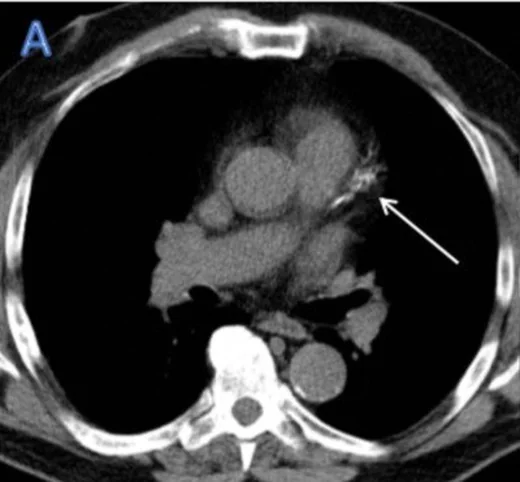
- Kardiyak ve solunum hareket artefaktları, akciğer penceresinde akciğer parankimi ve damar bulgularının saptanmasını ve değerlendirilmesini zorlaştırabilir.
Önerilen pencereler G genişlik, M merkez; değerler Hounsfield birimi (HU)
- AkciğerG 1500 / M −600
- MediastenG 350 / M +50
BT bulguları
- Solunum hareketinde bronş ve damar sınırları yaygın olarak bulanıklaşır.
- Kardiyak ve solunum hareketi artefaktları akciğer penceresinde vasküler sınırları yumuşatarak veya tekrarlayarak görüntü kalitesini düşürür.
- Kardiyak ve solunum hareket artefaktları, akciğer penceresinde damar ve parankim sınırlarının değerlendirilmesini zorlaştırabilir.
- Kalın kesitlerde parsiyel hacim etkisi, ölçülen atenüasyon değerlerini etkileyebilir.
- Nodüler lezyonların incelenmesinde kesit kalınlığının etkisi göz önünde bulundurulmalı; ince kesit morfolojisi ve zaman içindeki evrim değerlendirmeye dahil edilmelidir.
- Kesit kalınlığı ve rekonstrüksiyon algoritması ile kernel seçimi pulmoner nodül hacim ölçümünü etkileyebilir; subsolid nodüllerde rekonstrüksiyon algoritması ve kernel özellikle dikkate alınmalıdır.
- Solunum hareketi artefaktları akciğer parankimi ve vasküler yapıların değerlendirilmesini zorlaştırarak görüntü kalitesini düşürür.
Ölçütler ve sınıflamalar
- Nodül karakterizasyonu için önerilen sürekli ince kesit kalınlığı
- Nodül karakterizasyonunda ince kesit BT morfolojisi değerlendirmeye dahil edilmelidir.
Normalde
Şüpheli odakların değerlendirilmesinde ince kesit tomografi morfolojisi, bulguların örtüşüp örtüşmediği ve zaman içindeki değişimleri klinik bağlamla birlikte ele alınmalıdır.
Normal BT ile kıyasla
Aynı bölgenin, kaynak veri setinde patoloji içermediği belirtilen bir BT incelemesini kesit kesit kaydırın; organ sınırlarını açarak anatomiyi hasta görüntüsüyle karşılaştırın. Küçük rastlantısal bulgular tümüyle dışlanmamıştır.
Kaynak: TotalSegmentator v2.01 veri seti (Wasserthal ve ark., Radiology: Artificial Intelligence 2023), CC BY 4.0, vaka s1278; organ sınırları veri setinin otomatik segmentasyonundan, birleştirilerek sadeleştirildi. Görüntüler 2,5 mm kesit aralığına yeniden örneklendi.
Ayırıcı tanı
- Solid nodüllerin hacim ölçümünü kesit kalınlığı, segmentasyon kalitesi ve inspirasyon düzeyi etkileyebilir.
- Akciğer lezyonları karakterize edilirken ince kesit BT morfolojisi, görüntüleme bulgularının uyumu ve zaman içindeki değişim klinik bağlamla birlikte değerlendirilmelidir.
- Parsiyel hacim etkisi
- küçük lezyonların BT ile karakterizasyonunu güçleştirebilir.
- Hareket artefaktı
- aynı kesimde damar ve bronş sınırlarını yaygın olarak bulanıklaştırır.
Tuzaklar
- Belirli hastalıkların bilgisayarlı tomografi bulguları diğer pulmoner patolojilerin görüntüleriyle örtüşebilmekte ve tanıyı zorlaştırmaktadır.
- Lezyon bazlı değerlendirmede ince kesit BT morfolojisi, görüntüleme bulgularının uyumu ve zaman içindeki değişim klinik bağlamla birlikte ele alınmalıdır.
- Kesit kalınlığı ve segmentasyon kalitesi nodül hacim ölçümünü etkileyebilir.
- Nodül analizlerinde kesit kalınlığı ve rekonstrüksiyon algoritması/kernel seçimi sonuçları önemli ölçüde etkileyebilmektedir.
- Küçük akciğer nodüllerinin değerlendirilmesinde ince kesit BT morfolojisi ve zaman içindeki değişim dikkate alınmalıdır.
Kendini dene
Kardiyak ve solunum hareketi artefaktları akciğer penceresinde hangi etkiyi yaratır?
Cevabı göster
Vasküler yapıların niteliksel ve kantitatif değerlendirmesini azaltır. Hareket artefaktları, akciğer penceresinde akciğer parankimi ve damar anormalliklerinin saptanmasını ve niteliksel ya da kantitatif değerlendirilmesini zorlaştırır.
Pulmoner nodüllerin BT hacim ölçümünü etkileyebilen faktörler arasında hangileri vardır?
Cevabı göster
Kesit kalınlığı ve segmentasyon kalitesi. Nodül hacim ölçümünü kesit kalınlığı ve segmentasyon kalitesi etkileyebilir; solid nodüllerde inspirasyon düzeyi, subsolid nodüllerde ise rekonstrüksiyon algoritması ve kernel de etkili olabilir.
İlgili konular
Kaynaklar
Bu sayfadaki 32 cümle ve 2 quiz sorusu aşağıdaki kaynaklardan alıntılarla otomatik olarak karşılaştırıldı; 28 cümle bu karşılaştırmada düzeltildi (2026-10-09).
- Development of a new Python-based cardiac phantom for myocardial SPECT imaging.pubmed.ncbi.nlm.nih.gov
- Incidental Lung Lesions on the CT Component of Oncologic FDG PET/CT: A Pictorial Review of Interpretive Pitfalls and Diagnostic Clues.pubmed.ncbi.nlm.nih.gov
- AI-accelerated 3D gradient echo versus ultrashort echo time MRI for lung nodule detection and measurement.pubmed.ncbi.nlm.nih.gov
- Understanding Photon-Counting CT: Physics, Detector Technology, and Image Reconstructions.pubmed.ncbi.nlm.nih.gov
- Bridging Targeting Precision and Oncologic Safety: Localization Accuracy for Margin Adequacy in Cone-Beam Computed Tomography-Guided Pulmonary Nodule Resection.pubmed.ncbi.nlm.nih.gov
- Equity gaps in pulmonary nodule risk prediction for never-smokers: a real-world evidence-informed narrative review and policy analysis.pubmed.ncbi.nlm.nih.gov
- Management of suspicious nodules in lung cancer screening - a narrative review of monitoring strategies based on nodule features and further needs.pubmed.ncbi.nlm.nih.gov
- Revolutionizing lung cancer screening: the rise of artificial intelligence integrating circulating tumor markers.pubmed.ncbi.nlm.nih.gov
- "Two-For-One": 4D Cardiac and Pulmonary MR Imaging From a Single Acquisition Using bSTAR.pubmed.ncbi.nlm.nih.gov
- Deep learning-based motion correction: cardiac motion artifact and image quality improvements on chest CT.pubmed.ncbi.nlm.nih.gov
- SPOT THE BOT: A comparative quality assessment of AI-generated written instructions for lung ultrasound training.pubmed.ncbi.nlm.nih.gov
- Lipoid Pneumonia: HRCT and MRI Spectrum, Diagnostic Pitfalls, and Imaging-Based Diagnostic Workflow.pubmed.ncbi.nlm.nih.gov
- Artificial Intelligence for the Diagnosis of Respiratory Diseases in Dogs and Cats: A Systematic Review.pubmed.ncbi.nlm.nih.gov
- A Survey on Deep Learning in COVID-19 Diagnosis.pubmed.ncbi.nlm.nih.gov
- 2.5-mm articulated endoluminal forceps using a compliant mechanism.pubmed.ncbi.nlm.nih.gov
- Life-Threatening Hemoptysis Secondary to a Pulmonary Artery Retained Calcified Fibrin Sheath Embolus Related to a Central Venous Catheter: A Case Report.pubmed.ncbi.nlm.nih.gov
- Simultaneous 3D structural-functional assessment of pediatric lung using 0.55-T MRI: a feasibility study.pubmed.ncbi.nlm.nih.gov
- Acute Traumatic Aortic Injury: What the Radiologist Needs to Know.pubmed.ncbi.nlm.nih.gov
- Quality assurance and quantitative imaging biomarkers in low-dose CT lung cancer screening.pubmed.ncbi.nlm.nih.gov
- Long-term safety and effectiveness of the "OptEase" vena cava filter.pubmed.ncbi.nlm.nih.gov
- Application value of high-resolution CT imaging features combined with texture analysis in patients with solitary pulmonary nodules.pubmed.ncbi.nlm.nih.gov
- Application of an improved YOLOv5s-based deep learning model for automated detection of pulmonary adenocarcinoma <i>in situ</i> and minimally invasive adenocarcinoma.pubmed.ncbi.nlm.nih.gov
- Wedge resection for pulmonary sequestration guided by indocyanine green fluorescence and 3-dimensional reconstruction.pubmed.ncbi.nlm.nih.gov
- Subject-specific modeling framework for particle deposition using computational fluid dynamics.pubmed.ncbi.nlm.nih.gov
- Potential Role of Intrapulmonary Concomitant Lesions in Differentiating Non-Neoplastic and Neoplastic Ground Glass Nodules.pubmed.ncbi.nlm.nih.gov
- Attention-Enhanced Hybrid Bidirectional LSTM and Temporal Convolutional Network for Early Detection of Lung Cancer in Low-Dose CT Scans.pubmed.ncbi.nlm.nih.gov
- Optimizing surgical decision-making for lung adenocarcinoma by preoperatively identifying pathological high-risk factors: retrospective development and prospective validation of a deep learning model.pubmed.ncbi.nlm.nih.gov
- Dynamic Convolution Enhanced Attention Network for Pulmonary Nodule Detection.pubmed.ncbi.nlm.nih.gov
- The intersection of artificial intelligence and lung nodule research: current applications and future prospects.pubmed.ncbi.nlm.nih.gov
- Endemic Mycoses for Pulmonary Clinicians: From Nodules to ARDS.pubmed.ncbi.nlm.nih.gov
- Case Report: Thoracic SMARCA4-deficient undifferentiated tumor with extraocular muscle metastasis: a rare case hidden in diplopia.pubmed.ncbi.nlm.nih.gov
- CT Findings of Asthma and Asthma-Mimicking Conditions.pubmed.ncbi.nlm.nih.gov
- Deep-learning based quantitative evaluation of postoperative atelectasis following right upper lobectomy.pubmed.ncbi.nlm.nih.gov
- Not All PET-Avid Endobronchial Lesions Are Malignant: A Case of Chronic Foreign Body Aspiration.pubmed.ncbi.nlm.nih.gov
- Allergic Bronchopulmonary Aspergillosis (ABPA) Without Asthma: A Case Report and Review of the ABPA Imaging Spectrum.pubmed.ncbi.nlm.nih.gov
- Radiologist's Guide to the Ninth Edition TNM Staging System for Quantitative and Qualitative Assessment of Pleural Mesothelioma.pubmed.ncbi.nlm.nih.gov
- The blind spots on chest computed tomography: what do we miss.pubmed.ncbi.nlm.nih.gov
- Feasibility of chest spiral 3D ultrashort echo time magnetic resonance imaging for intrathoracic metastasis work-up in breast cancer.pubmed.ncbi.nlm.nih.gov
- Comparison of the efficacy of spiral CT combined with advanced multiplanar reconstruction in detecting the progression of pneumoconiosis.pubmed.ncbi.nlm.nih.gov
- Clinical usability of 3D gradient-echo-based ultrashort echo time imaging: Is it enough to facilitate diagnostic decision in real-world practice?pubmed.ncbi.nlm.nih.gov
- Pulmonary MRI in Newborns and Children.pubmed.ncbi.nlm.nih.gov
- Contemporary 0.55 T MRI to visualize interstitial lung disease - An exploratory study.pubmed.ncbi.nlm.nih.gov
- Diffuse cystic lung diseases-a primer for radiologists.pubmed.ncbi.nlm.nih.gov
- Special Issue: EACR 2026 Congress: Innovative Cancer Science, 8-11 June 2026.pubmed.ncbi.nlm.nih.gov
- EACR 2025 Congress: Innovative Cancer Science, 16-19 June 2025.pubmed.ncbi.nlm.nih.gov
- Computer-aided diagnosis systems for lung cancer: challenges and methodologies.pubmed.ncbi.nlm.nih.gov
- The Impact of CT Reconstruction Parameters on Emphysema Index Quantification, HU-Based Measurements, and Goddard Score in COPD Assessment: A Prospective Study.pubmed.ncbi.nlm.nih.gov
- Image-domain deep learning denoising for low-dose chest CT on a single 128-slice CT platform: a retrospective image-quality assessment.pubmed.ncbi.nlm.nih.gov
- Segmental vertebral artery agenesis with deep cervical reconstitution in a cervicothoracic variant cluster.pubmed.ncbi.nlm.nih.gov
- Cardiovascular Computed Tomography Angiographic Assessment of Simple Cardiac Shunts in Adults.pubmed.ncbi.nlm.nih.gov
- Coronary computed tomography angiography for clinical practice.pubmed.ncbi.nlm.nih.gov
- Single-Bolus Sequential Triple-Rule-Out CT Angiography: Image Quality and Radiation Dose on Wide-Area Detector and Dual-Source CT.pubmed.ncbi.nlm.nih.gov
- Aortic root motion artifacts on non-electrocardiographic-gated chest CT: A comparison of five CT scanner protocols including an ultrafast wide-detector CT system.pubmed.ncbi.nlm.nih.gov
- Beyond the limits of space and time: Can 4D imaging enhance postmortem investigation?pubmed.ncbi.nlm.nih.gov
- Where Does the Signal Go? Technical Challenges of CT Perfusion in Lacunar and Infratentorial Stroke.pubmed.ncbi.nlm.nih.gov
- A review of deep learning in medical imaging: Imaging traits, technology trends, case studies with progress highlights, and future promises.pubmed.ncbi.nlm.nih.gov
- Commentary: an eye on PET quantification.pubmed.ncbi.nlm.nih.gov
- High-affinity alphavbeta3 integrin targeted optical probe as a new imaging biomarker for early atherosclerosis: initial studies in Watanabe rabbits.pubmed.ncbi.nlm.nih.gov
- Future Applications of Cardiothoracic CT.pubmed.ncbi.nlm.nih.gov
- Persistent 131I uptake in the thyroglossal duct after thyroid ablation: A case report and literature review.pubmed.ncbi.nlm.nih.gov
- A Noninvasive Circulating Tumor DNA Methylation Classifier to Identify Benign Pulmonary Nodules.pubmed.ncbi.nlm.nih.gov
- Dual-energy computed tomography in children: Technique and clinical applications.pubmed.ncbi.nlm.nih.gov
- Conventional chest CT features are associated with Ki-67 labeling index in lung adenocarcinoma: a single-center retrospective radiopathologic study.pubmed.ncbi.nlm.nih.gov
- From radiologic morphology to component proportion: a multicenter study on the progression and prognosis of lung adenocarcinoma with cystic airspaces.pubmed.ncbi.nlm.nih.gov
- Respiratory symptoms associated with a new lobe-based bronchial scoring system in an urban Chinese low-dose CT screening population.pubmed.ncbi.nlm.nih.gov
- MR-Guided Adaptive Radiotherapy in Lung Cancer: Current Landscape and Future Directions.pubmed.ncbi.nlm.nih.gov
- Advances in Fluorescent Adjuncts in Pediatric Surgery: A Comprehensive Review of Applications of Indocyanine Green Across Surgical Specialties.pubmed.ncbi.nlm.nih.gov
- Evidence-based guideline diagnosis, treatment, prevention and aftercare of oropharyngeal and hypopharyngeal carcinoma.pubmed.ncbi.nlm.nih.gov
- Ultra-high spatial resolution at photon-counting computed tomography: technical insights and sustainable applications in cardiothoracic imaging.pubmed.ncbi.nlm.nih.gov
- Clinical TNM Lung Cancer Staging: A Diagnostic Algorithm with a Pictorial Review.pubmed.ncbi.nlm.nih.gov
- Clinical symptoms and prognosis of patients with pulmonary nodules: a real-world cohort study.pubmed.ncbi.nlm.nih.gov
- Has computer-aided diagnosis now outperformed radiologists in the accurate localization of lung nodules?-a multicenter retrospective study.pubmed.ncbi.nlm.nih.gov
- Analysis of pleural reaction following CT-guided hookwire localization for pulmonary nodules.pubmed.ncbi.nlm.nih.gov
- Diagnosis of Mucormycosis: Current Situation, Challenges and Future Prospects.pubmed.ncbi.nlm.nih.gov
- Fleischner Society: Glossary of Terms for Thoracic Imaging.pubmed.ncbi.nlm.nih.gov
- The role of radiological imaging in the management of severe and difficult-to-treat asthma.pubmed.ncbi.nlm.nih.gov
- CT Imaging Features of Pulmonary Sarcoidosis: Typical and Atypical Radiological Features and Their Differential Diagnosis.pubmed.ncbi.nlm.nih.gov
- Quantitative peri-lesional densitometry mapping via thin-slice volume rendering enhances differentiation of pneumonic-type lung cancer and inflammatory pneumonia.pubmed.ncbi.nlm.nih.gov
- Follicle-like niches outside the cortex? 3D phase-contrast µCT revealed medullary B cell nodules in mucosa-draining lymph nodes.pubmed.ncbi.nlm.nih.gov
- Diagnostic Imaging Features of Mammary Gland Tumors in Dogs and Cats.pubmed.ncbi.nlm.nih.gov
- Lung Nodule Detection from Feature Engineering to Deep Learning in Thoracic CT Images: a Comprehensive Review.pubmed.ncbi.nlm.nih.gov
- FDG-PET/CT pitfalls in oncological head and neck imaging.pubmed.ncbi.nlm.nih.gov
- Assessing Pulmonary Embolisms on Unenhanced CT Images Using Electron Density Images Derived from Dual-Layer Spectral Detector CT: A Single-centre Prospective Study Conducted at the Emergency Departmentpubmed.ncbi.nlm.nih.gov
- Acute pelvic pain: A pictorial review with magnetic resonance imaging.pubmed.ncbi.nlm.nih.gov
- PET/MRI attenuation estimation in the lung: A review of past, present, and potential techniques.pubmed.ncbi.nlm.nih.gov
- Inter-Slice Representation Outweighs Bounding-Box Supervision Extent in Lightweight 2.5D Pulmonary Nodule Detection: A Whole-Volume Benchmark on LUNA16.pubmed.ncbi.nlm.nih.gov
- The eye is a common site of granulomatosis with polyangiitis. A collaborative study.pubmed.ncbi.nlm.nih.gov
- International Society of Paediatric Surgical Oncology (IPSO) Surgical Practice Guidelines.pubmed.ncbi.nlm.nih.gov
- Clinicoradiologic features and evolutionary characteristics of pulmonary focal mucinous adenocarcinomas across different density patterns: a retrospective multi-center study.pubmed.ncbi.nlm.nih.gov
- Diagnostic performance of an artificial intelligence algorithm for detecting pneumoperitoneum on abdominal CT scans.pubmed.ncbi.nlm.nih.gov
- Artificial intelligence as an independent reader of risk-dominant lung nodules: influence of CT reconstruction parameters.pubmed.ncbi.nlm.nih.gov
- Deep learning models for CT image classification: a comprehensive literature review.pubmed.ncbi.nlm.nih.gov
- Imaging Evaluation of Pulmonary and Non-Ischaemic Cardiovascular Manifestations of COVID-19.pubmed.ncbi.nlm.nih.gov
- Pulsed field ablation in medicine: irreversible electroporation and electropermeabilization theory and applications.pubmed.ncbi.nlm.nih.gov
- Lung cancer detection in CT scans using extracted nodule features and precise multistage segmentation with deep learning based ensemble model.pubmed.ncbi.nlm.nih.gov
- Malignancy in Ground-Glass Opacity Using Multivariate Regression and Deep Learning Models: A Proof-of-Concept Study.pubmed.ncbi.nlm.nih.gov
- Factors influencing the outcome of volumetry tools for pulmonary nodule analysis: a systematic review and attempted meta-analysis.pubmed.ncbi.nlm.nih.gov
- Automated CT-Based Quantification of Pulmonary Fibrosis Using Deep Learning-Based Lung Segmentation.pubmed.ncbi.nlm.nih.gov
- Comparative analysis of two-dimensional and three-dimensional machine learning models for predicting the degree of invasion in lung non-mucinous adenocarcinomas presenting as subsolid nodules.pubmed.ncbi.nlm.nih.gov
- Multisystem Imaging Manifestations of COVID-19, Part 1: Viral Pathogenesis and Pulmonary and Vascular System Complications.pubmed.ncbi.nlm.nih.gov
- Microwave technologies for biomedical diagnosis and therapy: advances, challenges, and perspectives.pubmed.ncbi.nlm.nih.gov
- Radiological Mimickers of COVID-19 Pneumonia: A Pictorial Review.pubmed.ncbi.nlm.nih.gov
- 3D Segmentation Algorithms for Computerized Tomographic Imaging: a Systematic Literature Review.pubmed.ncbi.nlm.nih.gov
- Patterns of injury and violence in Yaoundé Cameroon: an analysis of hospital data.pubmed.ncbi.nlm.nih.gov
- Society for Cardiovascular Magnetic Resonance 2024 Cases of SCMR case series.pubmed.ncbi.nlm.nih.gov
- Ultrasound Imaging Technologies for Breast Cancer Detection and Management: A Review.pubmed.ncbi.nlm.nih.gov
- A Dataset of Pulmonary Lesions With Multiple-Level Attributes and Fine Contours.pubmed.ncbi.nlm.nih.gov
- High-Resolution Computed Tomography: Lights and Shadows in Improving Care for SSc-ILD Patients.pubmed.ncbi.nlm.nih.gov
- Impact of Contrast-Enhanced Mammography on Breast Imaging Reporting and Data System (BI-RADS) Reclassification: Correlation With Histopathology and Clinical Outcomes.pubmed.ncbi.nlm.nih.gov
- Screening for Lung Cancer: CHEST Guideline and Expert Panel Report.pubmed.ncbi.nlm.nih.gov
Eğitim amaçlıdır; hasta başında tanı ve tedavi kararının yerine geçmez, tıbbi tavsiye değildir. Metinler yapay zekâ desteğiyle yazıldı ve otomatik bir adımda kaynak alıntılarıyla karşılaştırıldı; bu bir tıbbi doğrulama değildir ve içerik uzman radyolog incelemesinden geçmedi. Klinik kararlarda güncel kılavuzları, kurum protokollerini ve radyoloji raporunu esas alın.