Özet
Femur boyun stres kırığı, tekrarlayan yüklenmenin normal kemikte oluşturduğu yorgunluk kırığı veya daha düşük yükün zayıflamış kemikte oluşturduğu yetersizlik kırığı şeklinde gelişebilir. BT, kortikal ve subkondral kemikteki ince kırık hatlarını gösterebilir; erken kemik iliği değişikliklerinin saptanmasında MRG daha duyarlıdır. Süperolateral tensiyon tarafındaki kırıklar deplasman açısından daha yüksek risk taşırken, inferomedial kompresyon tarafındaki kırıklar genellikle daha stabildir. Tanının kaçması çizginin tamamlanmasına ve deplasmanlı femur boyun kırığına ilerleme riskini gözden kaçırır.
Faz ve pencere
- Kontrastsız tanısal
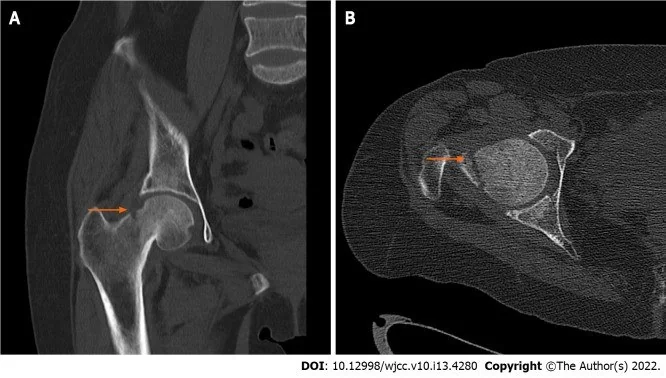
- Tensiyon tarafı süperolateral femur boynunda; kompresyon tarafı ise inferomedial femur boynunda yerleşir ve genellikle daha stabildir. BT incelemelerinde kortikal bütünlük, alt-kortikal kırık hattı ve erken çökme ile birlikte subkondral skleroz izlenir.
- Kemik algoritması tanısal
- Femur boynuna paralel koronal eğik rekonstrüksiyonlarda kırık çizgisinin korteks başlangıcı ve boyun genişliği boyunca uzanımı belirginleştirilir. Kemik iliği ödemi BT ile gösterilemeyeceğinden BT negatifliği erken stres yaralanmasını dışlamaz.
Önerilen pencereler: Kemik (G 1800 / M 400).
BT bulguları
- Süperolateral korteks kırığı — femur boynunun üst kısmında görülen kortikal hat tensiyon tarafını düşündürür.
- İnferomedial korteks kırığı — femur boynunun alt-medial bölgesinde görülen kortikal hat ve çevresindeki sklerotik değişiklik kompresyon tarafını düşündürür.
- Kortikal reaksiyon — yük taşıyan kortekste sınırlı kalınlaşma veya periostal yeni kemik.
- Çizginin boyun boyunca ilerlemesi — koronal eğik planda femur boynu genişliği içindeki uzanım tarif edilir.
- BT, kortikal ve subkondral kemik bütünlüğünü ve ince kırık hatlarını gösterebilir; femur boyun stres kırıkları deplase olabilir.
- BT'de ödem yokluğu — kemik iliği ödemi bir BT bulgusu değildir; şüphe ve ağrı sürerken MRG ile araştırılır.
Ölçütler ve sınıflamalar
- Shin-Gillingham MRG sınıflamasında kompresyon yaralanması
- MRG'de femur boynu kemik iliği ödemi belirgin bir kırık hattı olmadan görülebilir; kırık hattı varsa uzanımı femur boynu genişliğinin %50'sinden az veya fazla olarak değerlendirilir.
- Fullerton-Snowdy
- Tip I: kompresyon tarafı (stabil); Tip II: tensiyon tarafı (yüksek deplasman riski); Tip III: deplase kırık (kortikal hizalama kaybı, yüksek komplikasyon riski).
Normalde
Erken evrede femur boyun stres kırığı radyografide çoğu kez seçilemeyebilir. Femur boynu stres kırığında kırık hattının süperolateral veya inferomedial yerleşimini ve deplasman durumunu değerlendirin.
Normal BT ile kıyasla
Aynı bölgenin, kaynak veri setinde patoloji içermediği belirtilen bir BT incelemesini kesit kesit kaydırın; organ sınırlarını açarak anatomiyi hasta görüntüsüyle karşılaştırın. Küçük rastlantısal bulgular tümüyle dışlanmamıştır.
Kaynak: TotalSegmentator v2.01 veri seti (Wasserthal ve ark., Radiology: Artificial Intelligence 2023), CC BY 4.0, vaka s1256; organ sınırları veri setinin otomatik segmentasyonundan, birleştirilerek sadeleştirildi. Görüntüler 2,5 mm kesit aralığına yeniden örneklendi.
Ayırıcı tanı
- Subkondral yetersizlik kırığı veya femur başı osteonekrozu
- bu durumlar femur boyun stres kırığıyla benzer kalça ağrısı tablolarına ve erken görüntülemede örtüşen bulgulara yol açabilir.
- Femur başı osteonekrozu
- subkondral başta serpijinöz sklerotik sınır veya çökme görülür; boyun korteksinden başlayan stres çizgisi değildir.
- Osteoartritte kıkırdak kaybıyla ilişkili yaygın kemik iliği lezyonları görülebilir; femur boyun stres kırığında ise femur boynundan geçen kırık hattı ve çevresinde ödem izlenebilir.
- Pubik ramus stres kırığı
- çizgi femur boynunda değil pubik ramus korteksindedir.
- Subkondral yetersizlik kırığı
- femur başı eklem yüzüne paralel/subkondral yerleşir, boyun korteksinden başlamaz.
Tuzaklar
- Kompresyon tarafı kırıklar radyografik olarak çok hafif bulgular verebilir; klinik şüphe devam ediyorsa ileri görüntüleme gereklidir.
- BT'de görünür kırık yokluğu erken stres reaksiyonunu dışlamaz; ağrı ve yüklenme öyküsüyle klinik şüphe sürüyorsa MRG bulgusu aranmalıdır.
- Bu kaynaklarda kırık hattının uzanım yüzdesi MRG üzerinden değerlendirilmiştir.
Kendini dene
Fullerton-Snowdy sınıflamasında femur boynunun süperolateral tensiyon tarafındaki kırık hangi tiptir?
Cevabı göster
Tip II. Fullerton-Snowdy sınıflamasında Tip II tensiyon tarafı kırığıdır; süperolateral femur boynunda yerleşir.
BT’de kırık hattı görülmese de tekrarlayan koşu sonrası kasık ağrısı sürüyorsa erken kemik iliği değişikliklerini saptamada en duyarlı yöntem hangisidir?
Cevabı göster
MRG. MRG, erken kemik iliği değişikliklerini göstermede en duyarlı yöntemdir.
İlgili konular
Kaynaklar
Bu sayfadaki 37 cümle ve 2 quiz sorusu aşağıdaki kaynaklardan alıntılarla otomatik olarak karşılaştırıldı; 19 cümle bu karşılaştırmada düzeltildi (2026-10-09).
- Optimizing diagnosis and management of ONFH, FNSF, and SIFpmc.ncbi.nlm.nih.gov
- The Unique Features of Pediatric Sports Injuries: The Hippmc.ncbi.nlm.nih.gov
- Total Hip Arthroplasty for Bilateral Femoral Neck Stress Fracture: A Case Report and Review of the Literaturepmc.ncbi.nlm.nih.gov
- Undisplaced transcervical femoral neck stress fracture in a recreational runner: A case reportpmc.ncbi.nlm.nih.gov
- Stress Fracture Along with Transient Osteoporosis in a 72-Year-Old Female with Hip Pain: A Case Reportpmc.ncbi.nlm.nih.gov
- [Femoral neck stress fracture].pubmed.ncbi.nlm.nih.gov
- [Femoral neck stress fractures].pubmed.ncbi.nlm.nih.gov
- Femoral neck stress fracture.pubmed.ncbi.nlm.nih.gov
- Femoral Neck Stress Fractures: MRI Risk Factors for Progression.pubmed.ncbi.nlm.nih.gov
- A case report of missed femoral neck stress fracture.pubmed.ncbi.nlm.nih.gov
- Femoral Neck Stress Fracture: Can MRI Grade Help Predict Return-to-Running Time?pubmed.ncbi.nlm.nih.gov
- Femoral neck stress fracture in a young female recruit: case report.pubmed.ncbi.nlm.nih.gov
- Femoral neck stress fractures after trampoline exercise: A case report.pubmed.ncbi.nlm.nih.gov
- Femoral neck stress fracture and femoroacetabular impingement.pubmed.ncbi.nlm.nih.gov
- Femoral Neck Stress Fractures in Children Younger Than 10 Years of Age.pubmed.ncbi.nlm.nih.gov
- Femoral neck stress fracture in a female athlete: a case report.pubmed.ncbi.nlm.nih.gov
- Femoral neck stress fracture in a military trainee.pubmed.ncbi.nlm.nih.gov
- Femoral Neck Stress Fracture in a Female Runner.pubmed.ncbi.nlm.nih.gov
- Negative magnetic resonance imaging in femoral neck stress fracture with joint effusion: a case report.pubmed.ncbi.nlm.nih.gov
- Optimizing diagnosis and management of ONFH, FNSF, and SIF.pubmed.ncbi.nlm.nih.gov
- Insufficiency Fracture of the Neck of the Talus After Total Knee Arthroplasty.pubmed.ncbi.nlm.nih.gov
- Risk factors for atypical femur fractures with and without bisphosphonate treatment: a national nested case-control study.pubmed.ncbi.nlm.nih.gov
- Eight months of misdiagnosis: Intra-articular osteoid osteoma in a 48-year-old woman.pubmed.ncbi.nlm.nih.gov
- Imaging of pediatric musculoskeletal trauma: Age-specific considerations and challenges.pubmed.ncbi.nlm.nih.gov
- The Unique Features of Pediatric Sports Injuries: The Hip.pubmed.ncbi.nlm.nih.gov
- Optimal position of intramedullary nails in the femoral head following spiral blade resection for revision of intertrochanteric fractures: a biomechanical analysis.pubmed.ncbi.nlm.nih.gov
- Bilateral neck of femur stress fractures in unilateral hip pain: Is magnetic resonance imaging (MRI) of the contralateral hip necessary?pubmed.ncbi.nlm.nih.gov
- Isolated Lesser Trochanter Fractures in Adults: A Systematic Review of Malignant, Infectious, and Benign Etiologies.pubmed.ncbi.nlm.nih.gov
- Biomechanical Study of the Preventive Effect of Different Cephalomedullary Fixation Methods on the Occurrence of Femoral Neck Fractures in Osteoporotic Femurs.pubmed.ncbi.nlm.nih.gov
- Combination of 3D and 2D Small and Wide Angle X-Ray Scattering Imaging Reveals Diminished Bone Quality in the Superior Human Femoral Neck Cortex.pubmed.ncbi.nlm.nih.gov
- Initiation of Collapse in Osteonecrosis of the Femoral Head: A Patient-Specific Finite Element Simulation Study.pubmed.ncbi.nlm.nih.gov
- Current State-of-the-Art 3D MRI Sequences for Assessing Bone Morphology with Emphasis on Cranial and Spinal Imaging: A Narrative Review.pubmed.ncbi.nlm.nih.gov
- The Role of Structural Deterioration and Biomechanical Changes of the Necrotic Lesion in Collapse Mechanism of Osteonecrosis of the Femoral Head.pubmed.ncbi.nlm.nih.gov
- Invited Perspective: It is Time to Rename SCFE.pubmed.ncbi.nlm.nih.gov
- Which trajectory should we choose? - Defining safe entry-target pathways and underlying femoral morphology for bone marrow injection in osteonecrosis of the femoral head.pubmed.ncbi.nlm.nih.gov
- Functional morphology of trabecular system in human proximal femur: a perspective from P45 sectional plastination and 3D reconstruction finite element analysis.pubmed.ncbi.nlm.nih.gov
- Exploring the Effectiveness of "Four-Point" Configuration Cannulated Compression Screw Implantation Protocol for the Fixation of Pauwels Type III Femoral Neck Fractures in Adults.pubmed.ncbi.nlm.nih.gov
- Guide to lower extremity radiologic measurements: part 1 hip.pubmed.ncbi.nlm.nih.gov
- Medial Malleolar Fracture Fixation with Stainless Steel, Titanium, Magnesium, and PLGA Screws: A Finite Element Analysis.pubmed.ncbi.nlm.nih.gov
- Sequential stress fractures of the ulna and radius in a patient with neurofibromatosis type 1: A case report.pubmed.ncbi.nlm.nih.gov
- Bisphosphonate-Related Atypical Femoral Fractures: A Comprehensive Review.pubmed.ncbi.nlm.nih.gov
- Case Report: Combined posterolateral and direct anterior approaches for total hip arthroplasty in osteonecrosis of the femoral head with a rare massive osteophyte with literature review.pubmed.ncbi.nlm.nih.gov
- Revision hip arthroscopy: Current concepts and considerations in diagnosis, evaluation, and management.pubmed.ncbi.nlm.nih.gov
- Magnetic Resonance Imaging-Based Cohesive Extended Finite Element Modeling of Atypical Femoral Fracture.pubmed.ncbi.nlm.nih.gov
- Effects of different reduction patterns on stress distribution in patients with intertrochanteric fractures with intramedullary nail fixation: a finite element analysis.pubmed.ncbi.nlm.nih.gov
- "Close to the tip, with little bone to grip": stabilizing two periprosthetic proximal femur fractures above a distal femur megaprosthesis using a combination of DHS and 3.5 mm screws.pubmed.ncbi.nlm.nih.gov
- Biodegradable Magnesium-Based Implants in Sports Orthopedic Surgery: Advances in Alloy Design, Surface Engineering, and Translational Evidence.pubmed.ncbi.nlm.nih.gov
- A Plea for a Paradigm Shift from X-Ray to Ultrasound in Adults: An Update for Emergency Physicians, General Practitioners, Orthopedists and Sports Medicine Physicians.pubmed.ncbi.nlm.nih.gov
- Towards the diagnosis of osteoporosis - contributions from coincidental diagnostic imaging findings in chiropractors' practice.pubmed.ncbi.nlm.nih.gov
- Single-baseline virtual progression modeling of Crowe type I-III developmental dysplasia of the hip: a finite element study of stress-location migration.pubmed.ncbi.nlm.nih.gov
- A Case Report of Pipkin Type II Femoral Head Fracture Managed by Ganz Safe Surgical Dislocation and Headless Compression Screw (Herbert Screw) Fixation: A Stepwise Technical Description and Clinical Outcome.pubmed.ncbi.nlm.nih.gov
- Undisplaced transcervical femoral neck stress fracture in a recreational runner: A case report.pubmed.ncbi.nlm.nih.gov
- Uncommon Twist: Femoral Neck Stress Fracture in a High-Performance Athlete With an Incidental Diagnosis of Femoroacetabular Impingement.pubmed.ncbi.nlm.nih.gov
- Bilateral femoral neck stress fractures in elderly individuals: A case report and literature review.pubmed.ncbi.nlm.nih.gov
- Femoral Neck Stress Fractures in South Korean Male Military Recruits.pubmed.ncbi.nlm.nih.gov
- Femoral Neck Stress Fractures in Sport: A Current Concepts Review.pubmed.ncbi.nlm.nih.gov
- A Systematic Approach to the Evaluation of Acute Musculoskeletal Injuries in the Emergency Department.pubmed.ncbi.nlm.nih.gov
- Impact of Preoperative Waiting Time on Intraoperative Blood Transfusion in Older Patients with Hip Fracture: A Retrospective Cohort Study.pubmed.ncbi.nlm.nih.gov
- Osteonecrosis of the humeral head under corticosteroid therapy for non-medical reason in a 14-year-old female patient: A case report.pubmed.ncbi.nlm.nih.gov
- Synergistic Effects of Hydroxyapatite Nanoparticles and Platelet Rich Fibrin on Femoral Head Avascular Necrosis Repair in a Rat Model.pubmed.ncbi.nlm.nih.gov
- Impact of comorbidities in patients with erosive hand osteoarthritis (EHOA), a monocentric study.pubmed.ncbi.nlm.nih.gov
- Initial lateral stress radiographs predict instability in fragility fractures of the pelvis type I and II: a prospective observational study.pubmed.ncbi.nlm.nih.gov
- How to minimize complications during and after periacetabular osteotomy : lessons learned from over 700 patients with and without concomitant hip arthroscopy.pubmed.ncbi.nlm.nih.gov
- Risk Factors Associated With Nonunion Following Periacetabular Osteotomy for Treatment of Symptomatic Hip Dysplasia.pubmed.ncbi.nlm.nih.gov
- Microdamage accumulation in the femoral head and its association with subchondral insufficiency fractures: A retrospective study.pubmed.ncbi.nlm.nih.gov
- Stress Fracture Along with Transient Osteoporosis in a 72-Year-Old Female with Hip Pain: A Case Report.pubmed.ncbi.nlm.nih.gov
- Senescence-driven osteonecrosis of the femoral head in the elderly-a distinct pathophysiological entity.pubmed.ncbi.nlm.nih.gov
- Magnetic resonance imaging of the elbow.pubmed.ncbi.nlm.nih.gov
- Axial Spondyloarthritis: Mimics and Pitfalls of Imaging Assessment.pubmed.ncbi.nlm.nih.gov
- Long-term safety and effectiveness of the "OptEase" vena cava filter.pubmed.ncbi.nlm.nih.gov
- Intra-articular Osteoid Osteoma of the Femoral Neck Mimicking Inflammatory Hip Disease: A Case Report and Review of the Literature.pubmed.ncbi.nlm.nih.gov
- Osteoid osteoma of the femoral neck as a rare cause of hip pain in a 50-year-old male: A case report.pubmed.ncbi.nlm.nih.gov
- A 50-year perspective on the use and potential of artiodactyl calcanei in bone adaptation studies.pubmed.ncbi.nlm.nih.gov
- Evaluating the Effectiveness of Yttrium-90 Glass Microspheres in the Treatment of Hepatocellular Carcinoma, Intrahepatic Cholangiocarcinoma, and Metastatic Colorectal Cancer in Practice: Protocol for the Prospective PROACTIF Phase IV Registry Study in France.pubmed.ncbi.nlm.nih.gov
- The Effect of Tobacco Smoking on Musculoskeletal Health: A Systematic Review.pubmed.ncbi.nlm.nih.gov
- 2025 Heart Disease and Stroke Statistics: A Report of US and Global Data From the American Heart Association.pubmed.ncbi.nlm.nih.gov
- Bilateral subcapital femoral fractures associated with transient osteoporosis of the hip in pregnancy: a case report.pubmed.ncbi.nlm.nih.gov
- Acetabular Fracture Following Total Hip Replacement in a Patient With Neglected Developmental Dysplasia of the Hip: A Case Report.pubmed.ncbi.nlm.nih.gov
- 'THA for DDH: replacement principles and techniques - femoral side'.pubmed.ncbi.nlm.nih.gov
- Constrained acetabular liner total hip arthroplasty versus conventional hemiarthroplasty for unstable comminuted femoral intertrochanteric fractures in elderly patients with neurological disorders.pubmed.ncbi.nlm.nih.gov
- Society of Skeletal Radiology- white paper. Guidelines for the diagnostic management of incidental solitary bone lesions on CT and MRI in adults: bone reporting and data system (Bone-RADS).pubmed.ncbi.nlm.nih.gov
- Management and treatment of femoral neck stress fractures in recreational runners: a report of four cases and review of the literature.pubmed.ncbi.nlm.nih.gov
- Lower limb stress fractures in sport: Optimising their management and outcome.pubmed.ncbi.nlm.nih.gov
- Reconstruction with megaprosthesis for recurrent nonunion of an atypical periprosthetic femoral fracture in an elderly patient.pubmed.ncbi.nlm.nih.gov
- Diagnosis, Treatment, and Current Controversies in Multiligament Knee Injuries: A Narrative Review.pubmed.ncbi.nlm.nih.gov
- Zero Echo Time MRI for Osseous Assessment of Sports-Related Pathology in Athletes: A Pictorial Essay.pubmed.ncbi.nlm.nih.gov
- Osteotomies: Indications, Imaging Appearance, Surgical Techniques, and Complications.pubmed.ncbi.nlm.nih.gov
- The "double-intra" pertrochanteric femur fracture: an irreducible and redisplaceable fracture pattern.pubmed.ncbi.nlm.nih.gov
- Calcaneal Insufficiency Fracture: An Underrecognized Cause of Atraumatic Heel Pain in Older Adults.pubmed.ncbi.nlm.nih.gov
- High-Mileage Running-Induced Heel Strike Anemia in a 46-Year-Old Female.pubmed.ncbi.nlm.nih.gov
- Inferior Pubic Rami Stress Fracture in a High School Sprinter: A Case Report.pubmed.ncbi.nlm.nih.gov
- Hip joint image quality screening based on the Diffusion Mamba model.pubmed.ncbi.nlm.nih.gov
- Ischiopubic Osteochondrosis (Van Neck-Odelberg Disease) as a Rare Cause of Pediatric Hip Pain: A Systematic Review.pubmed.ncbi.nlm.nih.gov
- 2.5-mm articulated endoluminal forceps using a compliant mechanism.pubmed.ncbi.nlm.nih.gov
- Commentary: an eye on PET quantification.pubmed.ncbi.nlm.nih.gov
- What is the rate and degree of deformity in femoral diaphyseal nonunion? A CT-based retrospective cohort study.pubmed.ncbi.nlm.nih.gov
- Bisphosphonate-Associated Atypical Femoral Fractures: A Description of Surgical Techniques in the Revision Fixation Setting With an Emphasis on Avoiding Varus Malalignment: A Two-Case Report.pubmed.ncbi.nlm.nih.gov
- Radiological Assessment of Atypical Femoral Fractures: A 10-Year Experience Across Two Centres.pubmed.ncbi.nlm.nih.gov
- The tantalum screw for treating femoral head necrosis: rationale and results.pubmed.ncbi.nlm.nih.gov
- Effect of intramedullary nail length on the biomechanical performance of internal fixation for subtrochanteric femoral fractures.pubmed.ncbi.nlm.nih.gov
- Comparing the outcome of pediatric femoral neck fracture between Ti-Robot surgery and traditional surgery.pubmed.ncbi.nlm.nih.gov
- Clinical application of the femoral neck system in the treatment of femoral neck fractures.pubmed.ncbi.nlm.nih.gov
- Shoulder instability and associated shoulder injuries in patients with epilepsy.pubmed.ncbi.nlm.nih.gov
- Evidence-Based Management and Functional Outcomes of Femoral Head Avascular Necrosis: A Systematic Review.pubmed.ncbi.nlm.nih.gov
- Lateral rectus abdominis approach fixation of a high-energy both-column acetabular fracture after total hip arthroplasty with retention of a stable acetabular cup: a case report.pubmed.ncbi.nlm.nih.gov
- Case Report: Total hip arthroplasty via the direct anterior approach using a cementless revision stem without corrective osteotomy for fibrous dysplasia.pubmed.ncbi.nlm.nih.gov
- Exercise-responsive crosstalk within local muscle-bone units in osteosarcopenia: from mechanotransduction to secretome signalling.pubmed.ncbi.nlm.nih.gov
- Treatment of posterolateral tibial plateau fractures: a narrative review and therapeutic strategy.pubmed.ncbi.nlm.nih.gov
- Evaluation of posterolateral tibial plateau fracture treatment using a modified anterolateral bimuscular approach: a technical note and retrospective study.pubmed.ncbi.nlm.nih.gov
- Lag screw cutout risk factors in geriatric intertrochanteric femur fractures.pubmed.ncbi.nlm.nih.gov
- Fractures Around Collared and Collarless Hip Stems Initiate in High Strain Regions: A Combined Cadaveric Experiment and Finite Element Analysis.pubmed.ncbi.nlm.nih.gov
- The ratio between the screw distance and femoral neck width on lateral radiography is a reliable predictor of femoral head necrosis: a clinical review and corresponding numerical simulations.pubmed.ncbi.nlm.nih.gov
- Treatment and Rehabilitation Approaches for Stress Fractures in Long-Distance Runners: A Literature Review.pubmed.ncbi.nlm.nih.gov
- Pediatric stress fractures: a pictorial essay.pubmed.ncbi.nlm.nih.gov
- DIFFERENTIAL DIAGNOSTIC PROCESS AND CLINICAL DECISION MAKING IN A YOUNG ADULT FEMALE WITH LATERAL HIP PAIN: A CASE REPORT.pubmed.ncbi.nlm.nih.gov
Eğitim amaçlıdır; hasta başında tanı ve tedavi kararının yerine geçmez, tıbbi tavsiye değildir. Metinler yapay zekâ desteğiyle yazıldı ve otomatik bir adımda kaynak alıntılarıyla karşılaştırıldı; bu bir tıbbi doğrulama değildir ve içerik uzman radyolog incelemesinden geçmedi. Klinik kararlarda güncel kılavuzları, kurum protokollerini ve radyoloji raporunu esas alın.