Özet
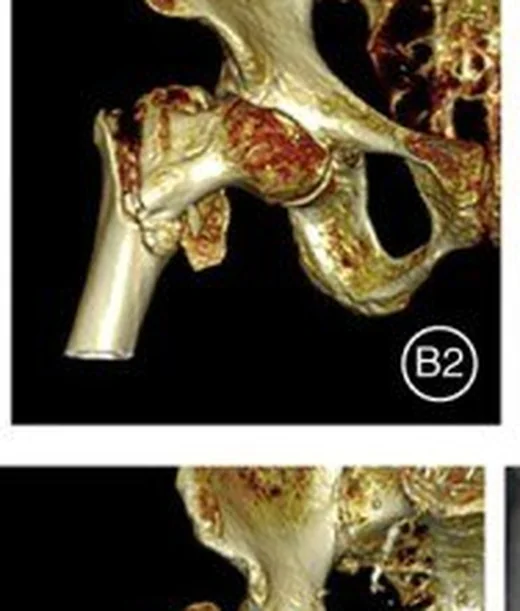
İntertrokanterik kırık, femur boynu ile şaft arasındaki trokanterik bölgede, çoğunlukla düşme sonrası gelişen ekstrakapsüler bir kırık örüntüsüdür. Kontrastsız BT ve üç boyutlu rekonstrüksiyon, kırık çizgilerinin seyrini ve trokanterik bölgedeki kırık morfolojisini değerlendirmeye yardımcı olur. Büyük veya küçük trokanter fragmanlarının ayrışması ve ters oblik uzanım instabil örüntüyü düşündürür. Grafiye dayalı sınıflama kırığın karmaşıklığını olduğundan az gösterebilir; üç boyutlu kontrastsız BT kırık morfolojisinin daha ayrıntılı değerlendirilmesini sağlar.
Faz ve pencere
- Kontrastsız tanısal
- İntertrokanterik kırık değerlendirmesinde görüntüleme alanı femur başını, boynu, her iki trokanteri ve proksimal şaftı kapsamalıdır. İntravenöz kontrast gerekmez.
- Kemik algoritması tanısal
- 3B BT, küçük trokanter fragmanın boyutu ve uzantısı, posterokoronal parçanın ön genişlemesi, lateral duvar ve ön korteks kırıkları ile anteromedial inferior köşe komminüsyonu gibi kırık özelliklerini değerlendirir.
Önerilen pencereler: Kemik (G 1800 / M 400), Yumuşak doku (G 400 / M 40).
BT bulguları
- İntertrokanterik ana hat — büyük trokanterden küçük trokantere veya trokanterler arasındaki kortekse uzanan oblik kırık.
- Posteromedial parçalanma — küçük trokanter ve komşu calcar korteksinin ayrı fragman olarak ayrılması destek kaybını gösterir.
- Lateral duvar kesintisi — kırık hattı büyük trokanterin lateral korteksine ulaşır ve parçayı şafttan ayırır.
- Ters oblik örüntü — AO/OTA 31-A3 kırıkları ters oblik veya transvers kırıklar olarak sınıflandırılır.
- Transtrokanterik/transvers uzanım — yataya yakın hat lateral korteksten çıkarak trokanterik parçayı ayırabilir.
- İntertrokanterik kırıklar eşlik eden femur boyun, asetabulum veya diğer kemik yaralanmaları ile birlikte görülebilir.
- Parçalı eklem dışı uzanım — ana hattın femur boynuna, subtrokanterik şaft bölümüne veya eklem içine devamı aranır.
Ölçütler ve sınıflamalar
- AO/OTA 31-A (2018)
- AO/OTA 2018 trokanterik kırık sınıflamasında lateral duvar bütünlüğü dikkate alınır; lateral duvar kalınlığı ölçümü tekrarlanabilir bulunmuştur. Lateral duvar kalınlığı ölçümü, lateral duvar yetersizliğini değerlendirmede tekrarlanabilir bulunmuştur; lateral duvar yetersizliği kırık instabilitesiyle ilişkilidir.
- Evans
- Evans, intertrokanterik femur kırıklarını sınıflandırmak için kullanılan sistemlerden biridir.
Normalde
İntertrokanterik kırıkta lateral duvar, posteromedial korteks ve küçük trokanter fragmanının morfolojisi değerlendirilir; ön-arka görüntüde pozitif veya nötral kortikal destek, daha iyi sekonder stabiliteyle ilişkilidir.
Normal BT ile kıyasla
Aynı bölgenin, kaynak veri setinde patoloji içermediği belirtilen bir BT incelemesini kesit kesit kaydırın; organ sınırlarını açarak anatomiyi hasta görüntüsüyle karşılaştırın. Küçük rastlantısal bulgular tümüyle dışlanmamıştır.
Kaynak: TotalSegmentator v2.01 veri seti (Wasserthal ve ark., Radiology: Artificial Intelligence 2023), CC BY 4.0, vaka s1256; organ sınırları veri setinin otomatik segmentasyonundan, birleştirilerek sadeleştirildi. Görüntüler 2,5 mm kesit aralığına yeniden örneklendi.
Ayırıcı tanı
- Femur boyun kırığı
- femur boynu kırıkları, intertrokanterik ve subtrokanterik kırıklardan ayrı bir proksimal femur kırık kategorisidir.
- Subtrokanterik kırık
- bu kırık grubunun görüntülemede morfolojisi ve parçalanma derecesi değerlendirilir.
- Büyük trokanter avulsiyonu
- izole fragman büyük trokanterde sınırlıdır; küçük trokanter ve calcar sağlam kalabilir.
- Patolojik kırık
- kırık çevresinde litik, sklerotik veya kemik korteksini genişleten lezyon görülür.
Tuzaklar
- Lateral duvar bütünlüğü trokanterik kırık sınıflamasında dikkate alınır; lateral duvar kalınlığı ölçümü ön-arka grafilerde değerlendirilmiş ve tekrarlanabilir bulunmuştur.
- Küçük trokanter fragmanının distal uzanımı ve posterior koronal fragmanın anterior genişliği, kırık sınıflamasında dikkate alınan morfolojik özelliklerdir.
- AO/OTA 31-A3 alt tipleri basit oblik, basit transvers ve kama ya da çok parçalı kırık örüntülerini içerir.
- Düşük BT HU değerleri daha kötü kemik kalitesiyle ilişkilidir ve instabil intertrokanterik kırık örüntüleriyle bağlantı göstermiştir.
Kendini dene
İntertrokanterik kırıkta ön-arka görüntüde pozitif veya nötral kortikal destek neyle ilişkilidir?
Cevabı göster
Daha iyi sekonder stabiliteyle. Ön-arka görüntüde pozitif veya nötral kortikal destek, lateral görüntüde redükte ya da öne yer değiştirmiş fragmanla birlikte olduğunda daha iyi sekonder stabiliteyle ilişkilidir.
AO/OTA 31-A3 kırıklarının alt tipleri hangi örüntüleri içerir?
Cevabı göster
Basit oblik, basit transvers ve kama/çok parçalı örüntüler. AO/OTA 31-A3 alt tipleri basit oblik, basit transvers ve kama ya da çok parçalı kırık örüntülerini içerir.
İlgili konular
Kaynaklar
Bu sayfadaki 37 cümle ve 2 quiz sorusu aşağıdaki kaynaklardan alıntılarla otomatik olarak karşılaştırıldı; 11 cümle bu karşılaştırmada düzeltildi (2026-10-09).
- Evaluation of reduction quality and implant positioning in intertrochanteric fracture fixation: A review of key radiographic parameterspmc.ncbi.nlm.nih.gov
- Ipsilateral femoral neck, intertrochanteric and acetabular fractures with posterior dislocation of the hip: A case report and literature reviewpmc.ncbi.nlm.nih.gov
- 3D virtual surgical planning of fractures in hip arthrodesis: a systematic review, case series and recommendations for treatmentpmc.ncbi.nlm.nih.gov
- Extending the intermedullary nail will not reduce the potential risk of femoral head varus in PFNA patients biomechanically: a clinical review and corresponding numerical simulationpmc.ncbi.nlm.nih.gov
- Total hip arthroplasty for Crowe type IV developmental dysplasia of the hip combined with intertrochanteric fracture: a case report and literature reviewpmc.ncbi.nlm.nih.gov
- Simple guidelines for evaluating intraoperative alignment after the reduction of intertrochanteric fractures.pubmed.ncbi.nlm.nih.gov
- [Proposal of a novel comprehensive classification for femoral intertrochanteric fractures].pubmed.ncbi.nlm.nih.gov
- Ipsilateral intertrochantric and femoral head fracture without dislocation of the hip. Potentially misleading radiograph: a case report and review of literature.pubmed.ncbi.nlm.nih.gov
- Total hip arthroplasty for Crowe type IV developmental dysplasia of the hip combined with intertrochanteric fracture: a case report and literature review.pubmed.ncbi.nlm.nih.gov
- Silent iatrogenic pseudoaneurysm after intertrochanteric fracture fixation with proximal femoral nailing and cerclage wiring: case report and review of literature.pubmed.ncbi.nlm.nih.gov
- Correlation analysis between PFNA insertion point and neck-shaft angle in intertrochanteric fractures, and selection of PFNA (240 mm) under varying radius of femoral curvature.pubmed.ncbi.nlm.nih.gov
- Diagnostic imaging concordance study: Are traction radiographs necessary in a hip fracture?pubmed.ncbi.nlm.nih.gov
- Three-dimensional mapping of intertrochanteric fracture lines.pubmed.ncbi.nlm.nih.gov
- A comprehensive 3D CT based classification of intertrochanteric fracture.pubmed.ncbi.nlm.nih.gov
- CT analysis of femoral malrotation after intramedullary nailing of trochanteric fractures.pubmed.ncbi.nlm.nih.gov
- Selection of internal fixation method for femoral intertrochanteric fractures using a finite element method.pubmed.ncbi.nlm.nih.gov
- Classification of femur trochanteric fracture: Evaluating the reliability of Tang classification.pubmed.ncbi.nlm.nih.gov
- Association of abductor hip muscle atrophy with fall-related proximal femur fractures in the elderly.pubmed.ncbi.nlm.nih.gov
- Fragility fractures of the proximal femur: review and update for radiologists.pubmed.ncbi.nlm.nih.gov
- Proximal femoral morphometry and its association with hip fracture patterns: a systematic review with meta-analysis.pubmed.ncbi.nlm.nih.gov
- Intraoperative Traction for Cephalomedullary Nailing in Amputation Patients.pubmed.ncbi.nlm.nih.gov
- Intertrochanteric Fracture Secondary to Solitary Osteochondroma: A Case Report and Literature Review.pubmed.ncbi.nlm.nih.gov
- Association of Bone Quality Measured by Noncontrast Computed Tomography Scan and Three-dimensional Computed Tomography-based Fracture Pattern in Intertrochanteric Femur Fracture in Adults.pubmed.ncbi.nlm.nih.gov
- A novel figure-of-eight polymeric cerclage wiring technique for greater trochanter fixation in revision arthroplasty and conversion of failed proximal femur fracture fixations to total hip arthroplasty.pubmed.ncbi.nlm.nih.gov
- The Effect of Lag Screw Position on Rotational Stability and Stress Concentration in Unstable Basicervical Intertrochanteric Fractures: A Finite Element Analysis.pubmed.ncbi.nlm.nih.gov
- The Efficacy of a Double Wiring Technique in Cementless Hemiarthroplasty for Unstable Basicervical Intertrochanteric Fractures: A Propensity Score-Matched Analysis of Femoral Neck Fractures.pubmed.ncbi.nlm.nih.gov
- Osteotomies: Indications, Imaging Appearance, Surgical Techniques, and Complications.pubmed.ncbi.nlm.nih.gov
- Surgical fixation of ipsilateral femoral neck and shaft fractures: a matter of debate?pubmed.ncbi.nlm.nih.gov
- Outcome of intramedullary nailing treatment for intertrochanteric femoral fractures.pubmed.ncbi.nlm.nih.gov
- Primary hyperparathyroidism presenting with pathological fractures mimicking malignancy: a case from Tanzania.pubmed.ncbi.nlm.nih.gov
- Superficial femoral artery thrombosis after PFNA in an intertrochanteric fracture patient with sarcopenia and copd: a rare case report.pubmed.ncbi.nlm.nih.gov
- Reappraising the fascia iliaca compartment block and pericapsular nerve group block for geriatric hip fractures: a narrative review.pubmed.ncbi.nlm.nih.gov
- Association of Long Versus Standard-Length Cephalomedullary Nail Constructs with Posterior Sagging in Intertrochanteric Fractures with Posteromedial Comminution: A Retrospective Comparative Study.pubmed.ncbi.nlm.nih.gov
- Should We Reconstruct Coronal Plane Fractures in Multifragmentary Pertrochanteric Fractures? A Randomized Controlled Trial.pubmed.ncbi.nlm.nih.gov
- Cable-Plate augmentation improves the therapeutic effect of intramedullary nailing for AO/OTA type A2.3 intertrochanteric fractures with large coronal fragments: a double-center retrospective study.pubmed.ncbi.nlm.nih.gov
- Gold wrist-assisted PFNA reduces internal complications and enhances recovery in obese osteoporotic patients with intertrochanteric femur fractures.pubmed.ncbi.nlm.nih.gov
- Biomechanical Study of the Preventive Effect of Different Cephalomedullary Fixation Methods on the Occurrence of Femoral Neck Fractures in Osteoporotic Femurs.pubmed.ncbi.nlm.nih.gov
- The "double-intra" pertrochanteric femur fracture: an irreducible and redisplaceable fracture pattern.pubmed.ncbi.nlm.nih.gov
- Anterior Plate Supplemented Proximal Femoral Nail for Comminuted 4-part Intertrochanteric Femur Fracture with the Coronal Splitting of Greater Trochanter: A Case Report.pubmed.ncbi.nlm.nih.gov
- Application value of auxiliary anterolateral hip mini-incision combined with traction-free reduction and internal fixation in complex intertrochanteric fractures in older adult patients.pubmed.ncbi.nlm.nih.gov
- Advances in internal fixation methods for intertrochanteric femoral fractures: A narrative review.pubmed.ncbi.nlm.nih.gov
- Risk factors for intertrochanteric femoral fractures with concomitant lateral wall involvement in elderly women.pubmed.ncbi.nlm.nih.gov
- Incidence of Complications in Proximal Femoral Nailing for Comminuted Intertrochanteric Femur Fractures in a Rural Population: A Retrospective Analysis.pubmed.ncbi.nlm.nih.gov
- Conversion to Hip Arthroplasty After Internal Fixation Failure in an Intertrochanteric Femoral Fracture: A Case Report.pubmed.ncbi.nlm.nih.gov
- Transtrochanteric Transverse Fracture of Proximal Femur in Pediatric Child: A Rare Variant: Case Report and Surgical Management.pubmed.ncbi.nlm.nih.gov
- Radiological Outcomes of Reamed Short Proximal Femoral Nailing in Intertrochanteric Fractures in Patients Aged 50 Years and Above.pubmed.ncbi.nlm.nih.gov
- Well-leg compartment syndrome after orthopedic surgery in the hemi-lithotomy position: a three-case series and literature review.pubmed.ncbi.nlm.nih.gov
- Isolated Lesser Trochanter Fractures in Adults: A Systematic Review of Malignant, Infectious, and Benign Etiologies.pubmed.ncbi.nlm.nih.gov
- When to Think and Do Bipolar in Inter Trochanteric Fractures.pubmed.ncbi.nlm.nih.gov
- THE EFFECTS OF INTRAARTICULAR AND PERIARTICULAR KNEE PAIN MANAGEMENT ON THE REHABILITATION OF PATIENTS WITH KNEE OSTEOARTHRITIS AFTER CEPHALOMEDULLARY FIXATION OF PERTROCHANTERIC FRACTURES.pubmed.ncbi.nlm.nih.gov
- Bernese periacetabular osteotomy (PAO): from its local inception to its worldwide adoption.pubmed.ncbi.nlm.nih.gov
- Male-female spatio-temporal differences of age-related bone changes show faster bone deterioration in older women at femoral regions associated with incident hip fracture.pubmed.ncbi.nlm.nih.gov
- Current concepts in the management of proximal femoral osteochondromas: a narrative review.pubmed.ncbi.nlm.nih.gov
- Glossary of terms for musculoskeletal radiology.pubmed.ncbi.nlm.nih.gov
- Anatomy-driven automated subsegmentation of pelvic and proximal femoral CT into clinically relevant subregions and landmarks.pubmed.ncbi.nlm.nih.gov
- Femoral Malunion and Its Correction: A Review.pubmed.ncbi.nlm.nih.gov
- Inter- and Intra-Observer Reliability of the New Comprehensive Classification of Intertrochanteric Fracture of the Femur.pubmed.ncbi.nlm.nih.gov
- Allogeneic blood transfusion after hip fracture: risk factors and associated outcomes.pubmed.ncbi.nlm.nih.gov
- Inferior Screw Referenced Calcar Tip Apex Distance as the Most Accurate Predictor of Mechanical Cut Out in Dual-Screw Proximal Femoral Nails.pubmed.ncbi.nlm.nih.gov
- Reliability of lateral wall-thickness measurement in trochanteric fractures and parameters associated with lateral wall integrity.pubmed.ncbi.nlm.nih.gov
- A novel biomechanical model for reproducing and analysing the causal mechanisms of PFNA "cut-in" phenomenon.pubmed.ncbi.nlm.nih.gov
- Recovery trajectories of spatiotemporal gait after bipolar hemiarthroplasty versus closed reduction and internal fixation for unstable intertrochanteric fracture: a prospective wearable-sensor study.pubmed.ncbi.nlm.nih.gov
- Intertrochanteric (Reverse Oblique) Fracture Subclassifications AO/OTA 31-A3 Have No Effect on Outcomes or Postoperative Complications.pubmed.ncbi.nlm.nih.gov
- Knee Osteoarthritis (KOA) Severity Influences Proximal Femoral Biomechanics and Predicts Pertrochanteric Fracture Instability: A Retrospective Radiographic Study.pubmed.ncbi.nlm.nih.gov
- Decision Making in the Management of Extracapsular Fractures of the Proximal Femur - is the Dynamic Hip Screw the Prevailing Gold Standard?pubmed.ncbi.nlm.nih.gov
- Surgical interventions for treating extracapsular hip fractures in older adults: a network meta-analysis.pubmed.ncbi.nlm.nih.gov
- Biomechanical comparison of PFNA combined with the modified candy-package wiring technique versus PFNA alone in complex unstable intertrochanteric femoral fractures: A biomechanical model study.pubmed.ncbi.nlm.nih.gov
- Case of implant failure following osteosynthesis for an intertrochanteric femoral fracture using a carbon fiber intramedullary nail.pubmed.ncbi.nlm.nih.gov
- Proximal femoral bionic nail (PFBN) versus InterTAN nail for intertrochanteric femoral fractures in elderly patients: a systematic review and meta-analysis.pubmed.ncbi.nlm.nih.gov
- Traction radiographs improve evaluation of complex intertrochanteric fractures: Surgeon experience-independent effects in a nationwide simulation-based study.pubmed.ncbi.nlm.nih.gov
- Short versus long proximal femoral nail anti-rotation-II (PFNA-II) in the management of unstable intertrochanteric fractures.pubmed.ncbi.nlm.nih.gov
- Analysis of factors affecting the surgical efficacy for elderly intertrochanteric fracture.pubmed.ncbi.nlm.nih.gov
- Factors associated with intracapsular versus extracapsular hip fracture patterns in elderly patients following low-energy falls: a retrospective analysis from a single tertiary-care center in China.pubmed.ncbi.nlm.nih.gov
- Evaluating the Association of Serum 25-Hydroxyvitamin D, Osteocalcin, Periostin, and Estradiol Levels With Hip Fracture Type and Severity in Patients Attending a Tertiary Care Center.pubmed.ncbi.nlm.nih.gov
- Between Accessibility and Reliability: High Confidence, Low Control in General-Purpose Multimodal Models for Hip Fracture Radiograph Interpretation.pubmed.ncbi.nlm.nih.gov
- Non-union after bisphosphonate-associated atypical femoral fractures: a review of the current literature.pubmed.ncbi.nlm.nih.gov
- Controversies in the Treatment Strategies of Intertrochanteric Fractures: A Scoping Review and Discussion of a Literature-Based Algorithm.pubmed.ncbi.nlm.nih.gov
- 320 mm InterTan nail optimizes biomechanics in AO/OTA 31A2.3 fractures: superior stress distribution, micromotion, and strain for enhanced healing.pubmed.ncbi.nlm.nih.gov
- Profunda Femoris Artery Pseudoaneurysm After Proximal Nailing: A Case Report.pubmed.ncbi.nlm.nih.gov
- Association of Different Levels of Vitamin D Deficiency and Hip Fracture in Indian Population: A Cross-sectional Study.pubmed.ncbi.nlm.nih.gov
- Surgical Technique: Management of a Pathological Fracture in the Femoral Neck: Case Report and Literature Review.pubmed.ncbi.nlm.nih.gov
- Malignant Transformation of Musculoskeletal Lesions with Imaging-Pathology Correlation-Part 1: Bone Lesions.pubmed.ncbi.nlm.nih.gov
- Thigh textiloma: a case report of a rare iatrogenic mass following orthopedic surgery.pubmed.ncbi.nlm.nih.gov
- Towards the diagnosis of osteoporosis - contributions from coincidental diagnostic imaging findings in chiropractors' practice.pubmed.ncbi.nlm.nih.gov
- Treatment for subtrochanteric fracture and subsequent nonunion in an adult patient with osteopetrosis: A case report and review of the literature.pubmed.ncbi.nlm.nih.gov
- Outcome of the modified Dunn procedure in severe slipped capital femoral epiphysis.pubmed.ncbi.nlm.nih.gov
- A novel classification system based on the lateral view of 3D-CT for predicting the reducibility of intertrochanteric fractures: a retrospective study.pubmed.ncbi.nlm.nih.gov
- Finite-Element Comparison of a Proximal Femoral Laterally Bionic Intramedullary Nail (PFLBN) Versus PFNA and PFBN for AO/OTA 31-A3.1 Intertrochanteric Fractures.pubmed.ncbi.nlm.nih.gov
- New Prognostic Factors in Operated Extracapsular Hip Fractures: Infection and GammaTScore.pubmed.ncbi.nlm.nih.gov
- Conservative Treatment of Pediatric Fractures-Narrative Review of Acceptable Deformity and Remodeling Potential.pubmed.ncbi.nlm.nih.gov
- Research on Classification Criteria for the Reducibility and Irreducibility of Intertrochanteric Femoral Fractures.pubmed.ncbi.nlm.nih.gov
- The effect of calcar femoral neck plating on vascularity of the femoral head and neck.pubmed.ncbi.nlm.nih.gov
- Simultaneous minimally invasive surgery improves outcomes and reduces complications in elderly with combined osteoporotic fractures.pubmed.ncbi.nlm.nih.gov
- Cement Augmentation of the Blade in Proximal Femoral Nailing for Trochanteric Fractures in Elderly Patients: A Retrospective Comparison of Mechanical Stability and Complications.pubmed.ncbi.nlm.nih.gov
- Functional and Radiological Outcomes of Unstable Proximal Femur Fractures Fixed With Anatomical Proximal Locking Compression Plate.pubmed.ncbi.nlm.nih.gov
- Ultra-low dose hip CT-based automated measurement of volumetric bone mineral density at proximal femoral subregions.pubmed.ncbi.nlm.nih.gov
- Long-term safety and effectiveness of the "OptEase" vena cava filter.pubmed.ncbi.nlm.nih.gov
- Biomechanical Comparison of Three Different Fixation Methods for Unstable Basicervical Intertrochanteric Fractures Using a Novel Cephalomedullary Nail.pubmed.ncbi.nlm.nih.gov
- Biomechanical Analysis of Fixation Strength in Unstable Intertrochanteric Femoral Fracture Models Based on the Caput-Collum-Diaphyseal Angle of Cephalomedullary Nails and Position of Lag Screws.pubmed.ncbi.nlm.nih.gov
- Single Ilioinguinal Approach to Treat Complex Acetabular Fractures with Quadrilateral Plate Involvement: Outcomes Using a Novel Dynamic Anterior Plate-Screw System.pubmed.ncbi.nlm.nih.gov
- The state of trial registrations in the field of Orthopaedics in years 2015-2020. A meta-epidemiological study.pubmed.ncbi.nlm.nih.gov
- The Impact of Medial Cortical Reduction on the Outcomes of Fixation in Unstable Intertrochanteric Fractures.pubmed.ncbi.nlm.nih.gov
- What's New in Osteogenesis Imperfecta.pubmed.ncbi.nlm.nih.gov
- Conservative treatments of bone marrow lesions.pubmed.ncbi.nlm.nih.gov
- Decoding the behaviour of extracapsular proximal femur fracture- dislocation - A systematic review of a rare fracture pattern.pubmed.ncbi.nlm.nih.gov
- Study on the predictive value of femoral head HU values in hip fractures.pubmed.ncbi.nlm.nih.gov
- Impact of Surgical Timing on Hospital Length of Stay Following Hemiarthroplasty and Internal Fixation for Hip Fractures: A Six-Year Retrospective Cohort Study.pubmed.ncbi.nlm.nih.gov
- A sophisticated fracture classification system of the proximal femur trochanteric region (AO/OTA-31A) based on 3D-CT images.pubmed.ncbi.nlm.nih.gov
- Evaluation of reduction quality and implant positioning in intertrochanteric fracture fixation: A review of key radiographic parameters.pubmed.ncbi.nlm.nih.gov
- Complete vastus release to repair complex proximal femoral fractures: description and follow-up in four cats.pubmed.ncbi.nlm.nih.gov
- Successful staged hip replacement in septic hip osteoarthritis in osteopetrosis: a case report.pubmed.ncbi.nlm.nih.gov
- Case Report: Distal tibial physeal fracture secondary to septic physitis and osteomyelitis in a Boxer puppy.pubmed.ncbi.nlm.nih.gov
- Unveiling a Silent Bone Lesion: Pathological Fracture in a Child With Non-Ossifying Fibroma.pubmed.ncbi.nlm.nih.gov
- Combined application of antibiotic bone cement and bone transport technique in tibial osteomyelitis with bone defect: A case report.pubmed.ncbi.nlm.nih.gov
- Family-based whole-exome sequencing implicates a variant in lysyl oxidase like 4 in atypical femur fractures.pubmed.ncbi.nlm.nih.gov
Eğitim amaçlıdır; hasta başında tanı ve tedavi kararının yerine geçmez, tıbbi tavsiye değildir. Metinler yapay zekâ desteğiyle yazıldı ve otomatik bir adımda kaynak alıntılarıyla karşılaştırıldı; bu bir tıbbi doğrulama değildir ve içerik uzman radyolog incelemesinden geçmedi. Klinik kararlarda güncel kılavuzları, kurum protokollerini ve radyoloji raporunu esas alın.