Özet
Posterior kalça çıkıkları genellikle yüksek enerjili travmayla ilişkilidir; bunlara femur başı kırıkları eşlik edebilir ve femur başı kırıklarında asetabulum kırıkları sık görülen eşlik eden yaralanmalardandır. BT, femur başı kırığının yapısını ve yer değiştirmesini, eklem aralığındaki olası fragmanları ve kalça ekleminin genel durumunu değerlendirmeye yardımcı olur. Redüksiyon sonrası BT, eklem aralığındaki olası fragmanları ve eşlik eden kırıkları değerlendirmek için kullanılır. Eşlik eden kırıkların ve eklem içi serbest parçaların saptanması eklem uyumunu değerlendirmeye yardımcı olur; redüksiyon sonrası konsantrik olmayan redüksiyon serbest parçaları düşündürebilir ve bu parçalar erken dejenerasyona yol açabilir.
Faz ve pencere
- Kontrastsız tanısal
- BT, femur başı kırığının yapısını ve yer değiştirmesini, eklem aralığındaki olası fragmanları ve kalça ekleminin genel durumunu gösterir. BT, eklem aralığındaki olası kırık fragmanlarını değerlendirmeye yardımcı olur.
- Kemik algoritması tanısal
- Posterior kalça çıkığı ve eşlik eden kırıklar, BT'nin aksiyel görüntüleri ile koronal ve sagittal rekonstrüksiyonlarında değerlendirilebilir. BT, eklem içindeki olası kemik fragmanlarını değerlendirmeye yardımcı olur.
Önerilen pencereler G genişlik, M merkez; değerler Hounsfield birimi (HU)
- KemikG 1800 / M +400
- Yumuşak dokuG 400 / M +40
BT bulguları
- Posterior kalça çıkığında BT, femur başı kırığının yapısını ve yer değiştirmesini değerlendirmeye yardımcı olur.
- Posterior duvar kırığı — asetabulumun arka kenarında tek veya çoklu kemik fragmanı ve marjinal impaksiyon görülebilir.
- Posterior kalça çıkıklarına asetabulumun posterior duvar ve posterior kolon kırıkları eşlik edebilir.
- Femur başı impaksiyon kırıkları, özellikle kırık çıkıklarında ve transvers asetabulum kırıklarında asetabulum kırıklarıyla birlikte görülebilir.
- Eklem içi fragman — asetabular fossa içinde serbest kemik/osteokondral parça ya da redükte eklem aralığında sıkışmış fragman.
- Konsantrik olmayan redüksiyon — femur başı ile asetabulum arasında asimetrik açıklık, eklem aralığı genişlemesi veya araya giren parça.
Ölçütler ve sınıflamalar
- Pipkin femur başı kırığı sınıflaması
- Tip I: fovea capitis altındaki kırık; Tip II: fovea üstündeki kırık; Tip III: Tip I/II kırığına femur boyun kırığının eşlik etmesi; Tip IV: femur başı kırığına asetabulum kırığının eşlik etmesi.
Normalde
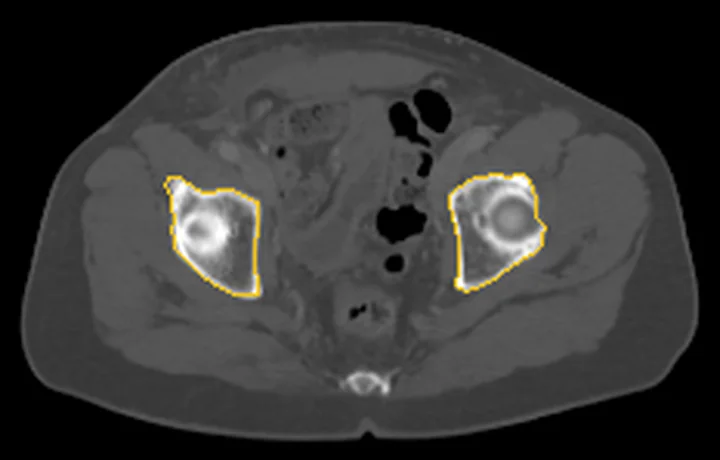
BT'de kalça ekleminin genel durumu ve eklem aralığındaki olası fragmanlar değerlendirilebilir. Aynı kesit düzeyinde iki femur başının asetabulum merkezine göre konumunu, eklem aralığı simetrisini ve posterior duvar konturunu kıyaslayın.
Normal BT ile kıyasla
Aynı bölgenin, kaynak veri setinde patoloji içermediği belirtilen bir BT incelemesini kesit kesit kaydırın; organ sınırlarını açarak anatomiyi hasta görüntüsüyle karşılaştırın. Küçük rastlantısal bulgular tümüyle dışlanmamıştır.
Kaynak: TotalSegmentator v2.01 veri seti (Wasserthal ve ark., Radiology: Artificial Intelligence 2023), CC BY 4.0, vaka s1256; organ sınırları veri setinin otomatik segmentasyonundan, birleştirilerek sadeleştirildi. Görüntüler 2,5 mm kesit aralığına yeniden örneklendi.
Ayırıcı tanı
- Anterior kalça çıkığında femur başı iliak veya obturator konumda olabilir.
- Posterior duvar kırığı olmadan subluksasyon ile tam çıkık ayrımında BT'de baş-çanak ilişkisini değerlendirin; posterior çıkıkta baş sıklıkla süperiora deplase izlenir, asetabular soket boş kalır ve Shenton çizgisi bozulur.
- Femur başı kırığı
- baş konturunda impaksiyon veya fragman vardır, ancak ana eklem ilişkisi redükte olabilir.
- Kalça protezi çıkığı, total kalça artroplastisinin bilinen bir komplikasyonudur.
Tuzaklar
- Redüksiyon sonrası baş yerine dönmüş olsa da fossa içindeki küçük fragman eklem uyumunu bozabilir; eklem aralığını çevresel olarak tarayın.
- Posterior asetabulum duvarı femur başı kırığıyla birlikte kırılabilir; pelvis BT'sinde uygun rekonstrüksiyonlar femur başı kırığının değerlendirilmesine katkı sağlar.
- Femur başı impaksiyonu — travmatik çökme ve karşılıklı asetabular kenar hasarı ile ilişkilendirilmeli; kırık çıkığı paternleri sırasında sık görüldüğünü akılda tutunuz.
Kendini dene
Redüksiyon sonrası BT'de medial eklem aralığı geniş ve eklem içinde osteokondral fragman görülüyor. En olası açıklama nedir?
Cevabı göster
Sıkışmış eklem fragmanı. Eklem aralığındaki kemik yoğunluklu odak ve konsantrik olmayan redüksiyon sıkışmış fragmanı destekler.
Femur başı asetabulumun arkasında, posterior kenarda kortikal kopma var. Başın fovea üstündeki kırığına asetabulum kırığı da eşlik ediyor. Pipkin tipi nedir?
Cevabı göster
Tip IV. Pipkin Tip IV femur başı kırığına asetabulum kırığının eşlik etmesini tanımlar. Tip I ve II kırığın fovea capitis'e göre konumunu, Tip III buna femur boyun kırığının eşlik etmesini, Tip IV ise asetabulum kırığının eşlik etmesini ifade eder.
Kaynaklar
Bu sayfadaki 38 cümle ve 2 quiz sorusu aşağıdaki kaynaklardan alıntılarla otomatik olarak karşılaştırıldı; 16 cümle bu karşılaştırmada düzeltildi (2026-10-12).
- Fractures of the femoral head: a narrative reviewpmc.ncbi.nlm.nih.gov
- Posterior hip dislocation in a non-professional football player: a case report and review of the literature.pubmed.ncbi.nlm.nih.gov
- [Effectiveness of proximal femur reconstruction combined with total hip arthroplasty for Crowe type Ⅳ developmental dysplasia of hip].pubmed.ncbi.nlm.nih.gov
- Asymmetric bilateral hip dislocation in young man: a case report.pubmed.ncbi.nlm.nih.gov
- Traumatic hip dislocation in the paediatric population: A case series from a specialist centre.pubmed.ncbi.nlm.nih.gov
- [Low energy hip dislocation in elderly patient].pubmed.ncbi.nlm.nih.gov
- Recurrent traumatic hip dislocation in an 8-year-old boy.pubmed.ncbi.nlm.nih.gov
- Arthroscopic Treatment of Traumatic Hip Dislocations in Children and Adolescents: A Preliminary Study.pubmed.ncbi.nlm.nih.gov
- Magnetic resonance imaging in traumatic posterior hip dislocation.pubmed.ncbi.nlm.nih.gov
- [Traumatic hip dislocation in a 6-year-old male child: Seldom but demanding].pubmed.ncbi.nlm.nih.gov
- Femoroacetabular Variations Are Predisposing Factors for Traumatic Posterior Hip Dislocation.pubmed.ncbi.nlm.nih.gov
- Acute limb ischemia following closed reduction of a hip arthroplasty dislocation.pubmed.ncbi.nlm.nih.gov
- MRI Evaluation of Posterior Capsular Dehiscence After Posterior Approach Total Hip Arthroplasty.pubmed.ncbi.nlm.nih.gov
- Femoroacetabular Impingement Is Associated With Sports-Related Posterior Hip Instability in Adolescents: A Matched-Cohort Study.pubmed.ncbi.nlm.nih.gov
- Acetabular superior wall fractures: a distinct acetabular fracture entity.pubmed.ncbi.nlm.nih.gov
- Isolated screw fixation of posterior wall fractures.pubmed.ncbi.nlm.nih.gov
- Functional Outcome and Hip Survival Rate in Traumatic Femoral Head Fractures.pubmed.ncbi.nlm.nih.gov
- Glossary of terms for musculoskeletal radiology.pubmed.ncbi.nlm.nih.gov
- Pre-Reduction Position of Posterior Wall Fragment is Associated with Intra-Articular Displacement.pubmed.ncbi.nlm.nih.gov
- Morphology-Guided Surgical Management of Complex Traumatic Hip Fracture-Dislocations and Acetabular Fractures: A Six-Case Series Illustrating Morphology-Based Surgical Approaches.pubmed.ncbi.nlm.nih.gov
- Femoroacetabular stabilization using a suspensory fixation device in post-traumatic hip instability after hip fracture-dislocation: technique and report of 6 cases.pubmed.ncbi.nlm.nih.gov
- What's in a name? Lower extremity fracture eponyms (Part 2).pubmed.ncbi.nlm.nih.gov
- Incongruent reduction following post-traumatic hip dislocations as an indicator of intra-articular loose bodies: A prospective study of 117 dislocations.pubmed.ncbi.nlm.nih.gov
- Three-Step Arthroscopy-Assisted Reduction and Internal Fixation for Schatzker IV With Lateral Depression Pattern (AO 41B3.3) Tibial Plateau Fracture-Dislocations.pubmed.ncbi.nlm.nih.gov
- The Role of Imaging Techniques to Define a Peri-Prosthetic Hip and Knee Joint Infection: Multidisciplinary Consensus Statements.pubmed.ncbi.nlm.nih.gov
- Staged treatment of osteonecrosis of the femoral head induced by delayed treatment of polytrauma complicated by chronic acetabular fracture and hip dislocation: a case report.pubmed.ncbi.nlm.nih.gov
- Achieving Safe Zone Cup Positioning in Total Hip Arthroplasty using Anatomical Landmarks: A Prospective Computed Tomography-based Evaluation.pubmed.ncbi.nlm.nih.gov
- 3D printing technology-assisted total hip arthroplasty for acute proximal femoral fracture and Hartofilakidis type II developmental dysplasia of the hip: a case report and literature review.pubmed.ncbi.nlm.nih.gov
- Spectrum of neuropathic skeletal injuries in children: a pictorial essay.pubmed.ncbi.nlm.nih.gov
- Hereditary multiple exostoses: an educational review.pubmed.ncbi.nlm.nih.gov
- Accuracy and Reliability of Multimodal Imaging in Diagnosing Knee Sports Injuriespubmed.ncbi.nlm.nih.gov
- Factors associated with symptom development in bilateral hip dysplasia with comparable acetabular coverage.pubmed.ncbi.nlm.nih.gov
- Functional Outcomes of Surgical Management of Posterior Wall Acetabular Fractures: A Prospective Study.pubmed.ncbi.nlm.nih.gov
- The Predictive Factors for Post-Traumatic Hip Osteoarthritis After Surgical Treatment of Acetabular Fractures: A Retrospective Cohort of 130 Patients.pubmed.ncbi.nlm.nih.gov
- Efficacy Comparison of Open Reduction and Robot-Aided Infra-Acetabular and Posterior Column Screws Fixation in Complex Acetabular Fractures Surgery: Union Plate Versus Reconstruction Plate.pubmed.ncbi.nlm.nih.gov
- From Diagnosis to Decision-Making: A Systematic Review of the Management of Reverse Hill-Sachs Lesions after Posterior Shoulder Dislocations.pubmed.ncbi.nlm.nih.gov
- Mid-Term outcomes following fresh-frozen humeral head osteochondral allograft reconstruction for reverse Hill Sachs lesion: a case series.pubmed.ncbi.nlm.nih.gov
- Transfer of the lesser tuberosity for reverse Hill-Sachs lesions after neglected posterior dislocations of the shoulder: A retrospective clinical study of 13 cases.pubmed.ncbi.nlm.nih.gov
- Glenohumeral cartilage lesions: reviewing diagnostic imaging strategies and preoperative evaluation.pubmed.ncbi.nlm.nih.gov
- Assessment of a painful shoulder arthroplasty.pubmed.ncbi.nlm.nih.gov
- Current understanding of articular cartilage lesions in femoroacetabular impingement syndrome.pubmed.ncbi.nlm.nih.gov
- Hip Arthroscopy for Incarcerated Acetabular Labrum following Reduction of Traumatic Hip Dislocation: Three Case Reports.pubmed.ncbi.nlm.nih.gov
- A Systematic Approach to the Evaluation of Acute Musculoskeletal Injuries in the Emergency Department.pubmed.ncbi.nlm.nih.gov
- Standardized Image-Based Arthroscopic Technique for Hip Synovial Chondromatosis: Long-Term Patient Outcomes.pubmed.ncbi.nlm.nih.gov
- Magnetic resonance imaging of knee arthropathies: A pictorial review.pubmed.ncbi.nlm.nih.gov
- Rabbit models of hip dysplasia: a narrative review.pubmed.ncbi.nlm.nih.gov
- Robot-Assisted Hip Arthroscopy for the Treatment of Femoroacetabular Impingement Syndrome Combined With Labral Injury: Surgical Technique.pubmed.ncbi.nlm.nih.gov
- Guide to lower extremity radiologic measurements: part 1 hip.pubmed.ncbi.nlm.nih.gov
- Robot-assisted elimination of side disparity in acetabular cup placement by right-handed surgeons during total hip arthroplasty: a comparative study of manual and robotic techniques.pubmed.ncbi.nlm.nih.gov
- Prevalence of directional asymmetry within the acetabulum and its implications for age estimation.pubmed.ncbi.nlm.nih.gov
- A three-dimensional digital study on clinical anatomy of the acetabulum in elderly population aged 65-84 years in inner Mongolia, China.pubmed.ncbi.nlm.nih.gov
- Beyond Pipkin IV: Management of Femoral Head-neck Fracture-dislocation with Posterior Acetabular Wall and Peritrochanteric Fracture in an Adolescent Using a Modified Kocher-Langenbeck Approach.pubmed.ncbi.nlm.nih.gov
- Hip Arthroscopy-Assisted Management of Pipkin Types I and II Femoral Head Fracture-Dislocations: Mid-Term Clinical and Radiographic Outcomes.pubmed.ncbi.nlm.nih.gov
- Femoral head fractures systematic review and meta-analysis.pubmed.ncbi.nlm.nih.gov
- Traumatic Obturator Variant of Anterior Hip Dislocation - A Case Series.pubmed.ncbi.nlm.nih.gov
- Labral repair restoring stability in a mildly dysplastic hip with concomitant femoral head and neck fracture-dislocation: a case report.pubmed.ncbi.nlm.nih.gov
- Hip Microinstability: Current Concepts in Diagnosis, Surgical Management, and Outcomes A Narrative Review.pubmed.ncbi.nlm.nih.gov
- Isolated Unilateral Posterior Sacroiliac Dislocation With an Intact Anterior Pelvic Ring: Case Report of an Unusual Injury Pattern.pubmed.ncbi.nlm.nih.gov
- A Novel Radiographic Classification of the Proximal Tibiofibular Joint.pubmed.ncbi.nlm.nih.gov
- The most common bone tumors of the upper extremity in childhood and adolescence and their treatment: a review of the current literature.pubmed.ncbi.nlm.nih.gov
- Catastrophic Failure of a Prosthetic Femoral Stem due to Component Malposition: A Case Report.pubmed.ncbi.nlm.nih.gov
- Artificial intelligence-driven preoperative CT 3D planning: a narrative review on improving the accuracy of acetabular cup angle and size in total hip arthroplasty.pubmed.ncbi.nlm.nih.gov
- Ipsilateral Knee Pain After Total Hip Arthroplasty: Pathogenesis and Intervention Strategies-A Narrative Review.pubmed.ncbi.nlm.nih.gov
- Atypical and unclassifiable hip dislocation with capsule and labrum incarceration: a case report and review of the literature.pubmed.ncbi.nlm.nih.gov
- Autologous Bone Marrow Mononuclear Cells (BMMCs) for the Treatment of Uncomplicated Grade 2 Ununited Anconeal Process (UAP) in Six Dogs: Preliminary Results.pubmed.ncbi.nlm.nih.gov
- Commentary: an eye on PET quantification.pubmed.ncbi.nlm.nih.gov
- Magnetic Resonance Imaging Versus Computed Tomography for Three-Dimensional Bone Imaging of Musculoskeletal Pathologies: A Review.pubmed.ncbi.nlm.nih.gov
- 2.5-mm articulated endoluminal forceps using a compliant mechanism.pubmed.ncbi.nlm.nih.gov
- Patterns of injury and violence in Yaoundé Cameroon: an analysis of hospital data.pubmed.ncbi.nlm.nih.gov
- Emergency radiology of severe acute injury in extreme alpine summer sports: a pictorial essay.pubmed.ncbi.nlm.nih.gov
- Safe passage analysis for both column screw fixation technique in posterior column acetabular fractures.pubmed.ncbi.nlm.nih.gov
- Diagnostic value of multiple projection angle X-ray and CT 3D reconstruction for long-term unreduced posterior hip dislocation.pubmed.ncbi.nlm.nih.gov
- A Case Report of Pipkin Type II Femoral Head Fracture Managed by Ganz Safe Surgical Dislocation and Headless Compression Screw (Herbert Screw) Fixation: A Stepwise Technical Description and Clinical Outcome.pubmed.ncbi.nlm.nih.gov
- Arthroscopic-Assisted Removal of Incarcerated Fragment following Manual Reduction of Posterior Hip Dislocation in Acute Polytrauma Patient: A Case Report.pubmed.ncbi.nlm.nih.gov
- The Unique Features of Pediatric Sports Injuries: The Hip.pubmed.ncbi.nlm.nih.gov
- Current concepts in the management of high-energy tibial plateau fractures: a narrative review.pubmed.ncbi.nlm.nih.gov
- Articular impactions in acetabular fractures.pubmed.ncbi.nlm.nih.gov
- Progress of fracture mapping technology based on CT three-dimensional reconstruction.pubmed.ncbi.nlm.nih.gov
- Management of Femoral Head Fractures: A Systematic Review.pubmed.ncbi.nlm.nih.gov
- MRI in shoulder arthropathies: A short review.pubmed.ncbi.nlm.nih.gov
- Risk factors for post-traumatic osteoarthritis following surgical treatment of acetabular posterior wall fractures: a retrospective study.pubmed.ncbi.nlm.nih.gov
- A preoperative inflammation-oxidative stress imbalance strongly predicts post-traumatic arthritis after acetabular fracture fixation.pubmed.ncbi.nlm.nih.gov
- Influence of associated femoral head fractures on surgical outcomes following osteosynthesis in posterior wall acetabular fractures.pubmed.ncbi.nlm.nih.gov
- Patellar Tracking: An Old Problem with New Insights.pubmed.ncbi.nlm.nih.gov
- Anatomy-driven automated subsegmentation of pelvic and proximal femoral CT into clinically relevant subregions and landmarks.pubmed.ncbi.nlm.nih.gov
- A novel technique for posterior internal fixation of acetabular fractures.pubmed.ncbi.nlm.nih.gov
- Acetabular Bone Defect Classifications in Revision Total Hip Arthroplasty: A Systematic Review of the Literature.pubmed.ncbi.nlm.nih.gov
- Intraoperative Fluoroscopy for Minimally Invasive Periacetabular Osteotomy: A Standardized Step-By-Step Operative Technique.pubmed.ncbi.nlm.nih.gov
- Extensive Periprosthetic Lucencies and Acetabular Protrusio in a Hip Hemiarthroplasty: A Case Report.pubmed.ncbi.nlm.nih.gov
- Arthroscopic Management of a Bucket-Handle Acetabular Labral Tear in a Pediatric Patient: A Rare Case Report with Associated Fleck Sign.pubmed.ncbi.nlm.nih.gov
- Impaction Injury of the Femoral Head After Traumatic Posterior Hip Dislocation: A Literature Review and Case Study.pubmed.ncbi.nlm.nih.gov
- Salvaging Femur Head in a Pipkin Type III Femoral Head Fracture with Open Reduction and Internal Fixation Using Herbert Screw Fixation: A Rare Case Report.pubmed.ncbi.nlm.nih.gov
- The role of applying radiological modifiers to the Letournel classification and its clinical implications.pubmed.ncbi.nlm.nih.gov
- Traumatic hip dislocations in a pediatric cohort: The importance of advanced imaging.pubmed.ncbi.nlm.nih.gov
- A Novel Method of Treatment of Small Osteolabral Avulsions Associated with Posterior Fracture dislocation of the Hip.pubmed.ncbi.nlm.nih.gov
- Asymmetric Bilateral Hip Dislocations: A Case Report and Historical Review of the Literature.pubmed.ncbi.nlm.nih.gov
- Imaging of osteoarthritis from the ankle through the midfoot.pubmed.ncbi.nlm.nih.gov
- Can Pre-operative MRI Predict the Need for Salter's Osteotomy in DDH Children Undergoing Open Reduction?pubmed.ncbi.nlm.nih.gov
- Weight-bearing computed tomography in knee pathologies: current evidence and future perspectives.pubmed.ncbi.nlm.nih.gov
- Acute cemented total hip arthroplasty combined with open reduction and internal fixation for elderly acetabular fractures: a two-center retrospective cohort study.pubmed.ncbi.nlm.nih.gov
- Case Report: Pseudotumor due to Trunnionosis in Ceramic-on-Ceramic THA Monoblock Acetabular Cup Disengagement.pubmed.ncbi.nlm.nih.gov
- Total Hip Arthroplasty without Subtrochanteric Shortening Osteotomy in a Neglected Posterior Hip Dislocation: A Case Report.pubmed.ncbi.nlm.nih.gov
- Association of knee ligament injury with pelvic and acetabular fractures: a retrospective cohort study.pubmed.ncbi.nlm.nih.gov
- Femoral head fractures: anatomy, diagnosis and management.pubmed.ncbi.nlm.nih.gov
- Subcapital Realignment of the Displaced Pediatric Radial Head-Technical Description and Early Clinical Results.pubmed.ncbi.nlm.nih.gov
- Evaluation of Changes in Hip Morphology in a Rabbit Model of Patellar Dislocation via Computed Tomography Imaging.pubmed.ncbi.nlm.nih.gov
- Comprehensive assessment of acetabular morphology in developmental dysplasia of the hip: introducing novel parameters for pediatric evaluation.pubmed.ncbi.nlm.nih.gov
- Staged Emergency Caesarean Section and Cementless Total Hip Arthroplasty Within a Single Anaesthetic Episode for Pipkin Type III Femoral Head Fracture-Dislocation in a Gravid Patient: A Case Report.pubmed.ncbi.nlm.nih.gov
- Custom-Made 3D-Printed Implants for Paprosky Type 3A and 3B Acetabular Defects: Early Surgical and Functional Outcomes from a Multicentre Study.pubmed.ncbi.nlm.nih.gov
- Metallosis Following Total Hip Arthroplasty: A Case Report.pubmed.ncbi.nlm.nih.gov
- Acute total hip arthroplasty for anterior hip fracture-dislocation: a case report.pubmed.ncbi.nlm.nih.gov
Eğitim amaçlıdır; hasta başında tanı ve tedavi kararının yerine geçmez, tıbbi tavsiye değildir. Metinler yapay zekâ desteğiyle yazıldı ve otomatik bir adımda kaynak alıntılarıyla karşılaştırıldı; bu bir tıbbi doğrulama değildir ve içerik uzman radyolog incelemesinden geçmedi. Klinik kararlarda güncel kılavuzları, kurum protokollerini ve radyoloji raporunu esas alın.