
Özet
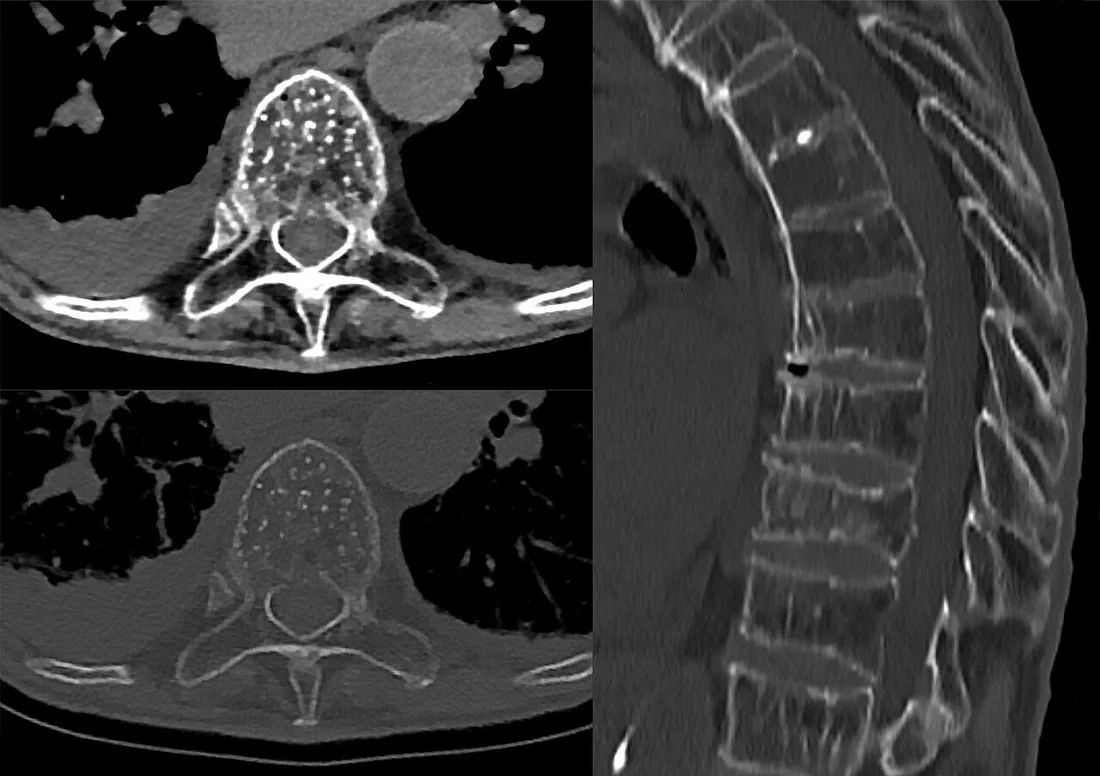
Osteoporotik vertebral deformite yaşlı erişkinde düşük enerjili travma, yeni sırt-bel ağrısı veya başka nedenle çekilen BT sırasında saptanabilir. BT kemik yapıyı iyi gösterir; kortikal yıkım ve posterior eleman tutulumunun değerlendirilmesine, benign-malign ayrımına ve akut-kronik değerlendirmeye katkı sağlar. Önceki görüntülerle karşılaştırma kırığın yaşını değerlendirmeye yardımcı olur; akutluk belirsizse MR’da kemik iliği ödeminin bulunmaması eski kırık lehinedir. Kitle benzeri yumuşak doku bileşeni patolojik kırık kuşkusunu artırabilir; spinal kanala uzanan yumuşak doku basısı nörolojik yapılara bası oluşturabilir.
Faz ve pencere
- Kontrastsız tanısal
- Sagittal yeniden yapılandırılmış BT görüntüleri vertebra kırıklarının tesadüfen saptanmasına yardımcı olur; BT kemik yapıyı iyi göstererek kortikal yıkım ve posterior eleman tutulumunu ortaya koyabilir.
Önerilen pencereler G genişlik, M merkez; değerler Hounsfield birimi (HU)
- KemikG 1800 / M +400
- Yumuşak dokuG 400 / M +40
BT bulguları
- Ön, orta veya arka korpus yüksekliğinin azalması kama, bikonkav ya da yaygın ezilme biçiminde deformasyon oluşturur.
- Üst veya alt son plakta çökme, kortikal basamaklanma ve trabeküler impaksiyon kırığı destekler.
- Kırık hattı keskin sınırlı olabilir; benign kırıkta kemik iliği içi hava yarığı (vakum çentek belirtisi) güvenilir bir bulgu olarak görülebilir.
- Arka korteksin içe yer değiştirmiş parçası spinal kanala retropulse olabilir; sagittal görünümde kanal çapı ve tekal kese düzeyi birlikte incelenir.
- İntravertebral hava veya vakum yarığı benign vertebra kırığı için güvenilir bir gösterge olabilir.
- Birden fazla seviyedeki benzer çökme kırılganlık lehinedir; yine de eşlik eden odaksal litik lezyon ayrıca aranır.
- Korpusun genişlemesi, posterior eleman tutulumu, destrüktif kemik odağı veya kitle benzeri epidural/paravertebral doku patolojik kırık açısından kuşku uyandırır.
- Genant semikantitatif yöntemi D4–L4 vertebraların görsel olarak yükseklik azalması ve morfolojik değişiklik açısından değerlendirilmesine dayanır; orta torasik ve torakolomber bölgede normal ön kama görünümü erken osteoporotik çökmeden ayırt edilmeli, komşu vertebralara göre şekil değişiklikleri nitel yorumda belirtilmelidir.
Ölçütler ve sınıflamalar
- Genant hafif deformite
- %20-25 vertebra yüksekliği kaybı
- Genant orta deformite
- %26-40 vertebra yüksekliği kaybı
- Genant ağır deformite
- >%40 vertebra yüksekliği kaybı
- Genant semikantitatif vertebral deformite derecesi
- Derece 0 normaldir; derece 1 hafif yükseklik kaybı (%20-25), derece 2 orta kayıp (%26-40), derece 3 ağır kayıp (>%40) olarak tanımlanır. Sistem radyografik görsel derecelendirme için geliştirilmiştir; BT’de ölçülen deformiteye aktarılırken morfoloji ve kırık bulguları da göz önünde tutulmalıdır.
Normalde
Normal ve uygun pozisyonlu görüntülemede son plaklar yatay, komşu vertebraların şekil ve boyutu benzerdir. BT’de vertebraları yalnız aksiyel kesitlerde incelemek kırıkların gözden kaçmasına yol açabileceğinden sagittal yeniden yapılandırmaları da değerlendir; kırığın yaşını belirlemek için önceki görüntülerle karşılaştır.
Normal BT ile kıyasla
Aynı bölgenin, kaynak veri setinde patoloji içermediği belirtilen bir BT incelemesini kesit kesit kaydırın; organ sınırlarını açarak anatomiyi hasta görüntüsüyle karşılaştırın. Küçük rastlantısal bulgular tümüyle dışlanmamıştır.
Kaynak: TotalSegmentator v2.01 veri seti (Wasserthal ve ark., Radiology: Artificial Intelligence 2023), CC BY 4.0, vaka s1338; organ sınırları veri setinin otomatik segmentasyonundan, birleştirilerek sadeleştirildi. Görüntüler 2,5 mm kesit aralığına yeniden örneklendi.
Ayırıcı tanı
- Metastatik veya malign çökme lehine posterior korteksin dışbükey bombeleşmesi, posterior eleman tutulumu ya da yumuşak doku bileşeni bulunabilir; bu özellikler benign kırıkla ayrımda yardımcıdır.
- Akut travmatik kırık
- yüksek enerjili öykü ve posterior eleman/kemik arkı kırıkları eşlik edebilir; yalnız korpus kama deformitesi osteoporozu kanıtlamaz.
- Schmorl nodülü
- disk materyali son plakta sınırlı bir çökme yapar; tüm korpus yüksekliğinin azalması beklenmez.
- Gelişimsel kama vertebranın değerlendirilmesinde normal ön kama görünümünü erken osteoporotik çökmeden ayırmak güç olabilir; seri görüntülerle karşılaştırma yardımcı olur.
- Enfeksiyöz spondilodiskit
- komşu iki son plakta düzensiz yıkım ve disk aralığında daralma/erozyon ön plandadır; izole ön kama çökmesi tipik değildir.
Tuzaklar
- Tek bir yüksekliği komşu seviyeye oranlayıp Genant derecesini kesin kırık tanısı gibi sunma; dejenerasyon, eski gelişimsel şekil ve komşu vertebra kırıkları karşılaştırmayı bozabilir.
- Kırığın yaşı belirsizse önceki görüntülerle karşılaştırma ve MR’da kemik iliği ödeminin değerlendirilmesi yardımcı olabilir.
- Malign kırık lehine posterior korteksin dışbükey bombeleşmesi, posterior eleman tutulumu veya yumuşak doku bileşeni aranmalıdır.
- Akut travma görüntüsünde paravertebral kanama ve ödemi otomatik olarak tümör kitlesi sayma; kitle benzeri solid doku yerine düzgün sınırlı yumuşak doku kalınlaşması olup olmadığını incele.
Kendini dene
BT’de saptanan vertebra kırığının yaşı belirsiz olduğunda, kaynakta problem çözücü yöntem olarak belirtilen görüntüleme hangisidir?
Cevabı göster
MR. Kaynak, MR ve nükleer tıbbın vertebra kırıklarının yaşını ve etiyolojisini belirlemede problem çözücü yöntemler olarak kullanıldığını belirtir; seçenekler içinde MR bu amaçla uygun yanıttır.
Önceki BT’de olmayan çökme ile birlikte korpus genişlemesi ve paravertebral solid doku var. En olası neden grubu hangisidir?
Cevabı göster
Neoplastik patolojik kırık. Ekspansiyon ve solid paravertebral yumuşak doku, basit osteoporotik impaksiyon yerine tümör infiltrasyonlu patolojik kırığı düşündürür. Gelişimsel kama eski ve düzgün konturludur; Schmorl nodülü fokal son plak herniasyonudur.
Kaynaklar
Bu sayfadaki 41 cümle ve 2 quiz sorusu aşağıdaki kaynaklardan alıntılarla otomatik olarak karşılaştırıldı; 14 cümle bu karşılaştırmada düzeltildi (2026-10-09).
- Imaging of vertebral fracturespmc.ncbi.nlm.nih.gov
- Quantitative assessment of zonal trabecular volumetric bone mineral density in middle-aged and elderly women using quantitative computed tomography.pubmed.ncbi.nlm.nih.gov
- Bone imaging in hypoparathyroidism.pubmed.ncbi.nlm.nih.gov
- A retrospective analysis of bone mineral status in patients requiring spinal surgery.pubmed.ncbi.nlm.nih.gov
- Effect of Low-Intensity Vibration on Bone Strength, Microstructure, and Adiposity in Pre-Osteoporotic Postmenopausal Women: A Randomized Placebo-Controlled Trial.pubmed.ncbi.nlm.nih.gov
- Combination of sacral-alar-iliac screw and cortical bone trajectory screw techniques for lumbosacral fixation: technical note.pubmed.ncbi.nlm.nih.gov
- The impact of a distal expansion mechanism added to a standard pedicle screw on pullout resistance. A biomechanical study.pubmed.ncbi.nlm.nih.gov
- Applications of finite element simulation in orthopedic and trauma surgery.pubmed.ncbi.nlm.nih.gov
- Reliability and application of the new morphological classification system for chronic symptomatic osteoporotic thoracolumbar fracture.pubmed.ncbi.nlm.nih.gov
- Noncontrast Chest Computed Tomographic Imaging of Obesity and the Metabolic Syndrome: Part II Noncardiovascular Findings.pubmed.ncbi.nlm.nih.gov
- Balloon kyphoplasty combined with posterior pedicle screw fixation for the treatment of osteoporotic thoracolumbar burst fractures.pubmed.ncbi.nlm.nih.gov
- Prophylactic vertebroplasty versus kyphoplasty in osteoporosis: A comprehensive biomechanical matched-pair study by in vitro compressive testing.pubmed.ncbi.nlm.nih.gov
- Change in spinal bone mineral density as estimated by Hounsfield units following osteoporosis treatment with romosozumab, teriparatide, denosumab, and alendronate: an analysis of 318 patients.pubmed.ncbi.nlm.nih.gov
- Kyphoplasty for osteoporotic vertebral fractures with posterior wall injury.pubmed.ncbi.nlm.nih.gov
- Long-term follow-up study of osteoporotic vertebral compression fracture treated using balloon kyphoplasty and vertebroplasty.pubmed.ncbi.nlm.nih.gov
- Oral Food Supplement with Bio-Activated Silicium and Vitamins D3 and K2 in the Conservative Management of Osteoporotic Vertebral Compression Fractures.pubmed.ncbi.nlm.nih.gov
- Postmenopausal Osteoporosis: From Molecular Pathways to Therapeutic Targets-A Mechanism-to-Practice Framework Integrating Pharmacotherapy, Fall Prevention, and Adherence into Patient-Centered Care.pubmed.ncbi.nlm.nih.gov
- A Primer on Anatomy, Biophysics, Pathology, Imaging and Treatment of the Intervertebral Disc and the Anterior Spinal Column: The Discogenic, Intervertebral, Spinal Column (DISC) ASPN Workgroup.pubmed.ncbi.nlm.nih.gov
- Radiomics in spinal research: a narrative review.pubmed.ncbi.nlm.nih.gov
- Artificial intelligence in spine care: A scoping review of diagnostic applications.pubmed.ncbi.nlm.nih.gov
- Osteoporosis in Adult Patients Undergoing Spinal Reconstructive Surgery: Associated Complications and Management.pubmed.ncbi.nlm.nih.gov
- Massive fecaloma causing bilateral hydronephrosis and acute kidney injury: a case report and review of the literature.pubmed.ncbi.nlm.nih.gov
- Armed Kyphoplasty: An Indirect Central Canal Decompression Technique in Burst Fractures.pubmed.ncbi.nlm.nih.gov
- Morphological characteristics of lumbar vertebral bodies and regional distribution patterns of bone mineral density: a CT study.pubmed.ncbi.nlm.nih.gov
- MDCT Morphometry of the Thoracolumbar Junction in a Turkish Cohort: Surgical, Radiological, and Forensic Implications.pubmed.ncbi.nlm.nih.gov
- An Anatomically Guided and Optimization-Refined Radiomics Framework for Opportunistic Osteoporosis Assessment from Lumbar Spine MRI.pubmed.ncbi.nlm.nih.gov
- Comparison of Bilateral and Unilateral Applications of Percutaneous Vertebroplasty and Kyphoplasty Procedures.pubmed.ncbi.nlm.nih.gov
- Osteoporotic vertebral fractures: an update.pubmed.ncbi.nlm.nih.gov
- Factors Influencing the Development of Metachronous Fractures in Patients with Osteoporotic Vertebral Fractures Treated with Conservative Management or Vertebroplasty.pubmed.ncbi.nlm.nih.gov
- Anatomy of the intraosseous arterial microvasculature of the adult lumbar vertebral body and its role in fracture healing: a literature review and historical perspective.pubmed.ncbi.nlm.nih.gov
- Section on innovative spine research and novel technologies: fusion cage design, materials, and coatings: Science versus hype.pubmed.ncbi.nlm.nih.gov
- Identifying osteoporotic vertebral endplate and cortex fractures.pubmed.ncbi.nlm.nih.gov
- Review of the Imaging Features of Benign Osteoporotic and Malignant Vertebral Compression Fractures.pubmed.ncbi.nlm.nih.gov
- Long-term safety and effectiveness of the "OptEase" vena cava filter.pubmed.ncbi.nlm.nih.gov
- Radiological Diagnosis and Advances in Imaging of Vertebral Compression Fractures.pubmed.ncbi.nlm.nih.gov
- Spinal lesions: a comprehensive radiologic overview.pubmed.ncbi.nlm.nih.gov
- The value of magnetic resonance imaging and computed tomography in the study of spinal disorders.pubmed.ncbi.nlm.nih.gov
- An exploratory multimodal imaging and clinicopathological strategy for suspected Kümmell's disease in the absence of MRI.pubmed.ncbi.nlm.nih.gov
- Vertebral body osteonecrosis: Evolving imaging features over time.pubmed.ncbi.nlm.nih.gov
- Management of bone metastases in patients with breast cancer: review of bone-modifying therapy, emerging new agents, and future directions.pubmed.ncbi.nlm.nih.gov
- Exercise for myeloma patients with bone disease: a scoping review.pubmed.ncbi.nlm.nih.gov
- Pseudomyogenic hemangioendothelioma of the thoracolumbar spine: A case-based review of a rare cause of vertebral collapse and neurological deficit.pubmed.ncbi.nlm.nih.gov
- Intrabody Cage Augmentation in Kümmell Disease and Osteoporotic Burst Fractures: Technical Insights and Narrative Review of Current Evidence.pubmed.ncbi.nlm.nih.gov
- Unveiling Primary Bone Tumors of the Spine: A Review of Essential Imaging Clues.pubmed.ncbi.nlm.nih.gov
- Approach to the Pediatric Patient With Glucocorticoid-Induced Osteoporosis.pubmed.ncbi.nlm.nih.gov
- Predictors of vertebral fractures in patients with severe osteoporosis: a sub-analysis of the Japanese Osteoporosis Intervention Trial-05 (JOINT-05).pubmed.ncbi.nlm.nih.gov
- Association of vertebral fractures with worsening degenerative changes of the spine: a longitudinal study.pubmed.ncbi.nlm.nih.gov
- m2ABQ-a proposed refinement of the modified algorithm-based qualitative classification of osteoporotic vertebral fractures.pubmed.ncbi.nlm.nih.gov
- Bone morbidity in pediatric acute lymphoblastic leukemia.pubmed.ncbi.nlm.nih.gov
- Combine Short-Segment Fixation and Leverage Reduction Technique to Correct Kyphotic Angle in Kümmell's Disease.pubmed.ncbi.nlm.nih.gov
- Microvascular anatomy and mapping of intraosseous arterioles in the human L1 vertebral body: a histological study, literature comparison, and relevance for fracture healing.pubmed.ncbi.nlm.nih.gov
- Clinical and biomechanical outcomes of single-position anterior fixation in anterior lumbar interbody fusion.pubmed.ncbi.nlm.nih.gov
- Commentary: an eye on PET quantification.pubmed.ncbi.nlm.nih.gov
- High-affinity alphavbeta3 integrin targeted optical probe as a new imaging biomarker for early atherosclerosis: initial studies in Watanabe rabbits.pubmed.ncbi.nlm.nih.gov
- Long-Term Prognosis and Risk Factors for Low Back Pain-Related Disorders in the General Population: A 7-Year Follow-Up of the Wakayama Spine Study.pubmed.ncbi.nlm.nih.gov
- Diagnosis of vertebral fractures in children: is a simplified algorithm-based qualitative technique reliable?pubmed.ncbi.nlm.nih.gov
- Artificial Intelligence in Spine Neuroimaging: Diagnostic and Prognostic Utility of Novel Biomarkers in Lower Back Pain.pubmed.ncbi.nlm.nih.gov
- Enhanced Detection Performance of Acute Vertebral Compression Fractures Using a Hybrid Deep Learning and Traditional Quantitative Measurement Approach: Beyond the Limitations of Genant Classification.pubmed.ncbi.nlm.nih.gov
- International Society of Paediatric Surgical Oncology (IPSO) Surgical Practice Guidelines.pubmed.ncbi.nlm.nih.gov
- Beyond the definitions of the phenotypic complications of sickle cell disease: an update on management.pubmed.ncbi.nlm.nih.gov
- Geriatric spine fractures - Demography, changing trends, challenges and special considerations: A narrative review.pubmed.ncbi.nlm.nih.gov
- Clinical applications and prospects of 3D printing guide templates in orthopaedics.pubmed.ncbi.nlm.nih.gov
- Classifying thoracolumbar fractures: role of quantitative imaging.pubmed.ncbi.nlm.nih.gov
- Schmorl's nodes are associated with prevalent osteoporotic vertebral fracture and low bone mineral density: a population-based thoracic spine MRI study in older men and women.pubmed.ncbi.nlm.nih.gov
- Axial Spondyloarthritis: Mimics and Pitfalls of Imaging Assessment.pubmed.ncbi.nlm.nih.gov
- Differentiating Tuberculous and Pyogenic Spondylodiscitis: Part II: MRI/CT Features, Prediction Models, and the Role of PET/CT-A Narrative Review.pubmed.ncbi.nlm.nih.gov
- <i>Mycobacteroides abscessus</i> complex vertebral osteomyelitis and discitis of the thoracolumbar spine: a systematic review of management and outcomes with illustrative case.pubmed.ncbi.nlm.nih.gov
- Infectious Spondylodiscitis of Bacterial Causes in Adults: Epidemiology, Pathophysiology, Diagnostic and Treatment Challenges.pubmed.ncbi.nlm.nih.gov
- Multidisciplinary management of spinal metastases: what the radiologist needs to know.pubmed.ncbi.nlm.nih.gov
- A Guide to Improving the Care of Patients with Fragility Fractures, Edition 2.pubmed.ncbi.nlm.nih.gov
- Imaging of Multiple Myeloma: Present and Future.pubmed.ncbi.nlm.nih.gov
- Imaging of bone marrow pitfalls with emphasis on MRI.pubmed.ncbi.nlm.nih.gov
- Lumbar Plexus Disorders Presenting as Low Back Pain: A Narrative Review of a Practical Diagnostic Imaging Approach.pubmed.ncbi.nlm.nih.gov
- Myositis Ossificans of the Soleus Muscle.pubmed.ncbi.nlm.nih.gov
- Paravertebral soft tissue swelling on magnetic resonance images helps in differentiation between osteoporotic and malignant vertebral fractures.pubmed.ncbi.nlm.nih.gov
- Chest CT-based automated vertebral fracture assessment using artificial intelligence and morphologic features.pubmed.ncbi.nlm.nih.gov
- Biomechanical Behavior of Injected Cement Spacers versus Traditional Cages in Low-Density Lumbar Spine under Compression Loading.pubmed.ncbi.nlm.nih.gov
- Recommendations of the International Consensus Meeting (ICM) 2025 on Spinal Infections: Part A Pyogenic Spondylodiscitis.pubmed.ncbi.nlm.nih.gov
- A review of current treatment of lumbar posterior ring apophysis fracture with lumbar disc herniation.pubmed.ncbi.nlm.nih.gov
- Comparative review of vertebroplasty and kyphoplasty.pubmed.ncbi.nlm.nih.gov
- Percutaneous vertebroplasty for osteoporotic vertebral compression fracture.pubmed.ncbi.nlm.nih.gov
- Long-term Performance and Durability of Biomaterials and Implant Designs in Total Joint Arthroplasty and Spinal Fusion.pubmed.ncbi.nlm.nih.gov
- Advancements in biomaterials and bioactive solutions for lumbar spine fusion cages: Current trends and future perspectives.pubmed.ncbi.nlm.nih.gov
- Spinal Involvement in Patients with Chronic Non-Bacterial Osteomyelitis (CNO): An Analysis of Distinctive Imaging Features.pubmed.ncbi.nlm.nih.gov
- Diagnostic decision-making, vertebral augmentation, and osteoporosis therapy in vertebral compression fractures: a narrative review.pubmed.ncbi.nlm.nih.gov
- Diagnostic value of an S1-normalized CT hounsfield unit ratio for identifying acute fractures in complex thoracolumbar osteoporotic deformities.pubmed.ncbi.nlm.nih.gov
- Surgical Treatment of Pathologic Spinal Fractures in Osteoporosis: Two Clinical Cases.pubmed.ncbi.nlm.nih.gov
- Brucellar spondylodiscitis mimicking lumbar discectomy with cauda equina syndrome: A case report.pubmed.ncbi.nlm.nih.gov
- Delayed diagnosis of spinal tuberculosis mimicking spondyloarthritis: a case report.pubmed.ncbi.nlm.nih.gov
- Spinal-origin abdominal pain secondary to silent osteoporotic compression fractures: A case report.pubmed.ncbi.nlm.nih.gov
- Biportal Endoscopic Foraminotomy with Unilateral Screw Fixation Using a Dynamic Rod for Radiculopathy Due to Osteoporotic Compression Fracture.pubmed.ncbi.nlm.nih.gov
- Asymptomatic Multiple Bilateral Segmental Pulmonary Embolisms Caused by Cement After Multilevel Vertebroplasty: A Case Report and Literature Review.pubmed.ncbi.nlm.nih.gov
- Single-position robot-assisted lateral lumbar corpectomy with minimally invasive posterior spinal fusion for traumatic burst fracture showing MRI-demonstrated indirect decompression: illustrative case.pubmed.ncbi.nlm.nih.gov
- Non-osteoporotic L4 vertebral compression fracture after low-voltage electrical injury without secondary trauma: A rare case report.pubmed.ncbi.nlm.nih.gov
- Complications of vertebral augmentation in metastatic spinal fractures: a systematic review of multiple study designs.pubmed.ncbi.nlm.nih.gov
- Inter-observer reliability of osteoporotic fracture classification across imaging modalities for thoracolumbar osteoporotic fractures.pubmed.ncbi.nlm.nih.gov
- Shaping the future of spinal implants: advancing bioactive composites with 3D printing for next-generation surgical care.pubmed.ncbi.nlm.nih.gov
- Towards the diagnosis of osteoporosis - contributions from coincidental diagnostic imaging findings in chiropractors' practice.pubmed.ncbi.nlm.nih.gov
- Diabetes, Osteosarcopenia, and Immobilization: A Novel Nomogram for Predicting Kümmell's Disease After Osteoporotic Vertebral Fractures.pubmed.ncbi.nlm.nih.gov
- Anatomical and biological reconstruction of traumatic complete burst fractures of the thoracolumbar vertebrae using pedicle fixation combined with stent-armed kyphoplasty and intracorporeal bone grafting: technique rationale, 7-year experience and clinical, imaging, and histological outcomes.pubmed.ncbi.nlm.nih.gov
- Multivariate Risk Factor Analysis and Clinical Prediction Model Construction of Intercostal Neuralgia Following Single-Segment Osteoporotic Thoracic Vertebral Compression Fractures.pubmed.ncbi.nlm.nih.gov
- Compression fracture of the T12 vertebra combined with diaphragmatic hernia after low-energy trauma: a case report and literature review.pubmed.ncbi.nlm.nih.gov
- Multilevel Lumbar CT Attenuation Beyond L1: Comparison with QCT-Derived Volumetric Bone Mineral Density and Prevalent Fragility Fracture Status in a Diagnostic Referral Cohort.pubmed.ncbi.nlm.nih.gov
- Intraoperative three-dimensional imaging-guided vertebral body stenting for cleft-associated very severe osteoporotic vertebral compression fractures: a surgical technique case series.pubmed.ncbi.nlm.nih.gov
- Clinical Outcomes of Balloon Kyphoplasty for Osteoporotic Vertebral Fractures With Posterior Element Injury: A Retrospective Study.pubmed.ncbi.nlm.nih.gov
- Biomaterials for vertebral body repair: interior augmentation and total replacement-a literature review of bone fusion outcomes in clinical studies.pubmed.ncbi.nlm.nih.gov
- Risk Factors for Vertebral Compression Fracture Following Spine Stereotactic Body Radiation Therapy.pubmed.ncbi.nlm.nih.gov
- Breast Cancer Metastases Presenting as Musculoskeletal Complaints.pubmed.ncbi.nlm.nih.gov
- Performance Comparison of Machine Learning Using Radiomic Features and CNN-Based Deep Learning in Benign and Malignant Classification of Vertebral Compression Fractures Using CT Scans.pubmed.ncbi.nlm.nih.gov
- Pediatric Spinal Cord Injury: A Review.pubmed.ncbi.nlm.nih.gov
- Malformed vertebrae: a clinical and imaging review.pubmed.ncbi.nlm.nih.gov
Eğitim amaçlıdır; hasta başında tanı ve tedavi kararının yerine geçmez, tıbbi tavsiye değildir. Metinler yapay zekâ desteğiyle yazıldı ve otomatik bir adımda kaynak alıntılarıyla karşılaştırıldı; bu bir tıbbi doğrulama değildir ve içerik uzman radyolog incelemesinden geçmedi. Klinik kararlarda güncel kılavuzları, kurum protokollerini ve radyoloji raporunu esas alın.