Özet
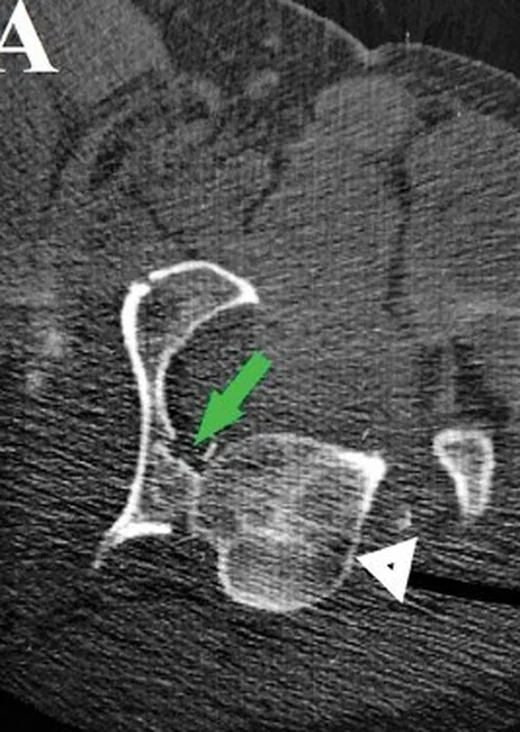
Marginal impaksiyon, asetabular eklem kenarından kopan osteokondral parçanın komşu süngerimsi kemiğe gömülmesiyle oluşan eklem yüzü yaralanmasıdır; posterior duvar kırığı ve kalça çıkığıyla sık birliktelik gösterebilir. Kontrastsız ince kesit BT, periferik çökme alanını, içine gömülmüş fragmanı, eklem basamağını ve eklem içi serbest cismi ortaya koyar. Lezyon küçük bir duvar kırığı gibi görünebilir ancak yük taşıyan eklem kenarının gerçek konturu değişmiştir. Impaksiyon ya da serbest parçanın atlanması eklem uyum bozukluğunu ve femur başı hasarıyla birlikteliği eksik bırakabilir.
Faz ve pencere
- Kontrastsız tanısal
- Asetabular periferik eklem kenarında subkondral bası çukuru, bu çukura gömülü kortikal/osteokondral fragman ve komşu trabeküler kemikte kompaksiyon kemik penceresinde izlenir; eklem aralığında ayrı serbest fragman bulunabilir. Aksiyel görüntüler posterior veya anterior kenardaki impaksiyonu ve fragman yönelimini; koronal ve sagittal kemik algoritmalı rekonstrüksiyonlar eklem yüzü basamağını, asetabular kubbe impaksiyonunu ve femur başıyla karşılıklı hasarı gösterir. Tanı için kontrast gerekmez.
Önerilen pencereler: Kemik (G 1800 / M 400).
BT bulguları
- Periferik eklem kenarı çökmesi — asetabular rim'in subkondral çizgisi lokal olarak içe basar.
- Gömülü osteokondral parça — eklem kenarından ayrılan kemik-kıkırdak fragmanı komşu süngerimsi kemiğe sıkışmış halde durur.
- Trabeküler kemik kompaksiyonu — impakte parçanın altındaki komşu süngerimsi kemiğin ezilerek daraldığı bölge izlenir.
- Eklem yüzü basamağı — periferik eklem yayı femur başıyla düzgün temasını kaybeder.
- Eklem içi serbest cisim — ayrılmış kemik veya osteokondral parça asetabular fossa ya da eklem aralığında izlenir.
- Posterior duvar kırığı birlikteliği — arka rim parçalanması aynı kenarda marginal impaksiyonla eşlik edebilir.
- Femur başı karşı yüz impaksiyonu — aynı çıkık mekanizmasında başın karşı yüzünde çökme veya osteokondral defekt bulunabilir.
- Kubbe impaksiyonu ayrımı — yük taşıyan asetabular kubbede ayrıca çökme veya impaksiyon olup olmadığını koronal/sagittal rekonstrüksiyonlarda değerlendirin; bu bulguyu periferik marginal impaksiyonla eş anlamlı kullanmayın.
Normalde
Normal asetabular kenarda lunat eklem yüzünün subkondral çizgisi düzgün ve kesintisizdir; kenar fragmanı çevre süngerimsi kemiğe gömülü değildir ve femur başıyla eklem yayı uyumludur. Aynı kenarın karşı taraftaki eş düzeyini kullanarak kontur çökmesini, eklem basamağını ve eklem içi ayrı parçayı kıyaslayın.
Normal BT ile kıyasla
Aynı bölgenin, kaynak veri setinde patoloji içermediği belirtilen bir BT incelemesini kesit kesit kaydırın; organ sınırlarını açarak anatomiyi hasta görüntüsüyle karşılaştırın. Küçük rastlantısal bulgular tümüyle dışlanmamıştır.
Kaynak: TotalSegmentator v2.01 veri seti (Wasserthal ve ark., Radiology: Artificial Intelligence 2023), CC BY 4.0, vaka s1256; organ sınırları veri setinin otomatik segmentasyonundan, birleştirilerek sadeleştirildi. Görüntüler 2,5 mm kesit aralığına yeniden örneklendi.
Ayırıcı tanı
- Serbest eklem içi fragman
- eklem aralığında ayrı kemik parçası vardır ancak kenarda gömülmüş subkondral çökme olmayabilir.
- Posterior duvarın basit kırığı
- kenar fragmanı ayrılmıştır fakat komşu eklem yüzünde içine gömülme ve trabeküler kompaksiyon yoktur.
- Asetabular kubbe impaksiyonu
- çökme periferik kenar yerine üst-medial yük taşıyan kubbede merkezlenir.
- Femur başı impaksiyonu
- subkondral çökme asetabular tarafta değil femur başı konturunda yer alır.
Tuzaklar
- İmpakte osteokondral fragmanı yalnızca serbest cisim diye raporlamayın; kemik penceresinde fragmanın nereden koptuğunu ve kenardaki çökme yatağını birlikte arayın.
- Posterior duvar kırıklarında eklem kenarı parçalanması marginal impaksiyonu maskeleyebilir; femur başı ile rim arasındaki temas hattını ardışık aksiyel kesitlerde izleyin.
- Küçük impaksiyon tek aksiyel kesitte yok olabilir; koronal ve sagittal reformasyonlarda eklem yayının devamlılığını kontrol edin.
- Femur başı osteokondral lezyonunu asetabular rim impaksiyonu ile karıştırmayın; iki karşılıklı eklem yüzünü ayrı ayrı işaretleyin.
Kendini dene
Posterior rim'de subkondral çökme yatağına gömülmüş osteokondral fragman ve eklem basamağı görülüyor. En doğru tanı hangisidir?
Cevabı göster
Marginal impaksiyon. Eklem kenarı parçasının komşu kemiğe gömülmesi ve rim konturunun çökmesi marginal impaksiyondur. Basit duvar kırığında gömülme yoktur; Pipkin kırığı femur başındadır, çatı elevasyonu ise yukarı yer değiştirmiş kubbe parçasını tanımlar.
Femur başı eklem yüzü sağlam; posterior asetabular rimde subkondral çökme yatağı ve bu düzeyde eklem içi kemik fragmanı var. Fragmanın olası asetabular kaynağı hangisidir?
Cevabı göster
Rim impaksiyon yatağı. Femur başı yüzü sağlamken posterior asetabular rimde çökme yatağı ve komşu fragman görülmesi, fragmanın kaynağında marginal impaksiyon aranmasını destekler. Femur başı kırığı, sakral hematom, iliak kontüzyon ve simfiz osteofiti bu rim bulgusunu açıklamaz.
Kaynaklar
Bu sayfadaki 38 cümle ve 2 quiz sorusu aşağıdaki kaynaklardan alıntılarla tek tek karşılaştırıldı; 2 cümle bu karşılaştırmada düzeltildi (2026-10-08).
- Quantitative 3D assessment of marginal impaction volume in posterior wall acetabular fractures: a pilot studypmc.ncbi.nlm.nih.gov
- Functional Outcomes of Surgical Management of Posterior Wall Acetabular Fractures: A Prospective Studypmc.ncbi.nlm.nih.gov
- A novel plate design for anatomic reduction of posterior acetabular column and wall fractures: A retrospective comparative study of the Paseos plate versus the pelvic reconstruction platepmc.ncbi.nlm.nih.gov
- Acetabular superior wall fractures: a distinct acetabular fracture entitypmc.ncbi.nlm.nih.gov
- The trifecta approach: a staged alternative to the extended iliofemoral approach for complex acetabular fractures—technique and case reportpmc.ncbi.nlm.nih.gov
- Articular disimpaction in acetabular fractures.pubmed.ncbi.nlm.nih.gov
- Marginal impaction in complex posterior wall acetabular fractures: role of allograft and mid-term results.pubmed.ncbi.nlm.nih.gov
- Articular impactions in acetabular fractures.pubmed.ncbi.nlm.nih.gov
- Marginal impaction in posterior wall fractures of the acetabulum.pubmed.ncbi.nlm.nih.gov
- Mapping of acetabular posterior wall fractures using a three-dimensional virtual reconstruction software.pubmed.ncbi.nlm.nih.gov
- Surgical Treatment of Marginal Impaction Injuries of The Acetabulum Associated with Posterior Wall Fractures.pubmed.ncbi.nlm.nih.gov
- Radiographic Determinants of Early Failure After Posterior Wall Acetabular Fracture Fixation.pubmed.ncbi.nlm.nih.gov
- Osteosynthesis for Geriatric Acetabular Fractures: An Epidemiological and Clinico-Radiological Study Related to Marginal or Roof Impaction.pubmed.ncbi.nlm.nih.gov
- Quantitative 3D assessment of marginal impaction volume in posterior wall acetabular fractures: a pilot study.pubmed.ncbi.nlm.nih.gov
- Anatomical reduction of marginal impaction in posterior wall acetabular fractures ensures mid-term satisfactory outcomes.pubmed.ncbi.nlm.nih.gov
- Efficient hip joint distraction using the AO large femoral distractor in treating acetabular fractures associated with marginal impaction and intraarticular incarcerated fragments.pubmed.ncbi.nlm.nih.gov
- Outcomes of posterior wall acetabular fractures with marginal impaction using greater trochanter autografting: A prospective cohort study.pubmed.ncbi.nlm.nih.gov
- The role of applying radiological modifiers to the Letournel classification and its clinical implications.pubmed.ncbi.nlm.nih.gov
- Minimally invasive screws fixation of displaced fractures of the acetabulum: a 7 years single center experience.pubmed.ncbi.nlm.nih.gov
- Functional Outcomes of Surgical Management of Posterior Wall Acetabular Fractures: A Prospective Study.pubmed.ncbi.nlm.nih.gov
- Tips and tricks for the treatment of marginal impaction in acetabular fractures.pubmed.ncbi.nlm.nih.gov
- The Unique Features of Pediatric Sports Injuries: The Hip.pubmed.ncbi.nlm.nih.gov
- Traumatic osteochondral injury of the femoral head treated by mosaicplasty: a report of two cases.pubmed.ncbi.nlm.nih.gov
- A Case Report of Pipkin Type II Femoral Head Fracture Managed by Ganz Safe Surgical Dislocation and Headless Compression Screw (Herbert Screw) Fixation: A Stepwise Technical Description and Clinical Outcome.pubmed.ncbi.nlm.nih.gov
- Rabbits as preclinical animal models of cam morphology: proof of concept.pubmed.ncbi.nlm.nih.gov
- Osteotomies: Indications, Imaging Appearance, Surgical Techniques, and Complications.pubmed.ncbi.nlm.nih.gov
- Impaction Injury of the Femoral Head After Traumatic Posterior Hip Dislocation: A Literature Review and Case Study.pubmed.ncbi.nlm.nih.gov
- Acute total hip arthroplasty with concomitant surgical fixation in delayed acetabular fractures: functional and radiological outcomes in a prospective cohort.pubmed.ncbi.nlm.nih.gov
- Delayed fixation of neglected acetabular fractures: clinical challenges and mid-term outcomes of a prospective case series.pubmed.ncbi.nlm.nih.gov
- The Relationship Between Fracture Area and Standing Pelvic Sagittal Inclination in Patients With Subchondral Fracture of the Femoral Head.pubmed.ncbi.nlm.nih.gov
- Osteonecrosis of the Femoral Head: Evolution of Contemporary Management Strategies.pubmed.ncbi.nlm.nih.gov
- Safety, Feasibility, and Preliminary Efficacy of Allogeneic MSCs to Treat Advanced Femoral Head Osteonecrosis (ALOFEM): A Pilot Study in Young Onco-Hematological Patients.pubmed.ncbi.nlm.nih.gov
- Acute Osteochondral Fractures in the Lower Extremities - Approach to Identification and Treatment.pubmed.ncbi.nlm.nih.gov
- Arthroscopic osteosynthesis of femoral head malunion.pubmed.ncbi.nlm.nih.gov
- Graft Incorporation and Cup Migration in Acetabular Impaction Bone Grafting for Revision Hip Arthroplasty: A Systematic Review and Meta-Analysis of 1093 Hips.pubmed.ncbi.nlm.nih.gov
- Clinical Applications of 3-Dimensional Printing Technology in Hip Joint.pubmed.ncbi.nlm.nih.gov
- Pericollapse Stage of Osteonecrosis of the Femoral Head: A Last Chance for Joint Preservation.pubmed.ncbi.nlm.nih.gov
- Osteoarthritis, adipokines and the translational research potential in small animal patients.pubmed.ncbi.nlm.nih.gov
- Delay in hip reductions due to the advent of rapid CT scans in the trauma setting.pubmed.ncbi.nlm.nih.gov
- Acetabular superior wall fractures: a distinct acetabular fracture entity.pubmed.ncbi.nlm.nih.gov
- The trifecta approach: a staged alternative to the extended iliofemoral approach for complex acetabular fractures-technique and case report.pubmed.ncbi.nlm.nih.gov
- Constrained cups appear incapable of meeting the demands of revision THA.pubmed.ncbi.nlm.nih.gov
- Favourable 16-year outcome of an acetabular reinforcement ring with suboptimal host-bone coverage: the role of biological and mechanical stabilisation.pubmed.ncbi.nlm.nih.gov
- Acetabular Bone Defect Classifications in Revision Total Hip Arthroplasty: A Systematic Review of the Literature.pubmed.ncbi.nlm.nih.gov
- Management and outcome of displaced acetabular fractures in the oldest-old: a retrospective analysis of orif and acute total hip arthroplasty.pubmed.ncbi.nlm.nih.gov
- Quantitative three-dimensional fracture mapping reveals subtype-specific morphology of acetabular roof column and wall fractures.pubmed.ncbi.nlm.nih.gov
- An unprecedented pan-brachial injury: A case report of ipsilateral floating shoulder, floating elbow, and acetabular fracture following a psychosis-induced fall.pubmed.ncbi.nlm.nih.gov
- A novel plate design for anatomic reduction of posterior acetabular column and wall fractures: A retrospective comparative study of the Paseos plate versus the pelvic reconstruction plate.pubmed.ncbi.nlm.nih.gov
- Treatment of Acetabular Fractures by Acute Arthroplasty: A Comparison of Trabecular Metal Cages With a Cemented Bimobile Acetabular Component Versus a Polyethylene Liner.pubmed.ncbi.nlm.nih.gov
- Midfoot "H-Plate" for operative fixation of posterior wall acetabular fractures: a technical trick and case series.pubmed.ncbi.nlm.nih.gov
- Outcomes of Iso-Elastic Acetabular Cup in Primary Total Hip Arthroplasty with 5-Year Minimum Follow-Up: A Systematic Review.pubmed.ncbi.nlm.nih.gov
- Glossary of terms for musculoskeletal radiology.pubmed.ncbi.nlm.nih.gov
- Complications of hip preserving surgery.pubmed.ncbi.nlm.nih.gov
- Internal-locking intramedullary nails (talons, claws, wings, wedge-locks, endopins): a mechanics-guided scoping review of designs, failure signatures, and technique imperatives.pubmed.ncbi.nlm.nih.gov
- Constrained acetabular liner total hip arthroplasty versus conventional hemiarthroplasty for unstable comminuted femoral intertrochanteric fractures in elderly patients with neurological disorders.pubmed.ncbi.nlm.nih.gov
- A review of imaging modalities for the hip.pubmed.ncbi.nlm.nih.gov
- The state of trial registrations in the field of Orthopaedics in years 2015-2020. A meta-epidemiological study.pubmed.ncbi.nlm.nih.gov
- Radiographically occult and subtle fractures: a pictorial review.pubmed.ncbi.nlm.nih.gov
- A Guide to Improving the Care of Patients with Fragility Fractures, Edition 2.pubmed.ncbi.nlm.nih.gov
- The role of orthobiologics in hip preservation surgery.pubmed.ncbi.nlm.nih.gov
- MR imaging in sports-related glenohumeral instability.pubmed.ncbi.nlm.nih.gov
- Radiographic outcomes of CT-based robotic-assisted versus manual direct anterior total hip arthroplasty with an acetabular-only registration workflow: a retrospective cohort study.pubmed.ncbi.nlm.nih.gov
- MAKO Robotic-Arm-Assisted Versus Conventional Dual-Incision Total Hip Arthroplasty: A Propensity-Score-Matched Retrospective Study.pubmed.ncbi.nlm.nih.gov
- Morphological Characteristics of the Posterior Wall Associated with Complex Acetabular Fractures: A Radiological Study Using 3D Software and Fracture Mapping Technique.pubmed.ncbi.nlm.nih.gov
- Isolated screw fixation of posterior wall fractures.pubmed.ncbi.nlm.nih.gov
- Management of Femoral Head Fractures: A Systematic Review.pubmed.ncbi.nlm.nih.gov
- Arthroscopic Reduction and Internal Fixation in Patients with Acetabular Posterior Wall Fractures.pubmed.ncbi.nlm.nih.gov
- Direct Inferior Hip Dislocation With Intertrochanteric Fracture in an Adult: A Rare Case and Review of the Literature.pubmed.ncbi.nlm.nih.gov
- Medium-term outcomes of hybrid total hip arthroplasty in cats: Cemented femoral stem and cementless acetabular cup in 17 hips (2020-2023).pubmed.ncbi.nlm.nih.gov
- Special contoured pelvic brim reconstruction titanium plate combined with trans-plate buttress screws (quadrilateral screws) for acetabular fractures with quadrilateral plate involvement through the anterior ilioinguinal approach.pubmed.ncbi.nlm.nih.gov
- Unusual Pattern of Osteochondral Marginal Impaction in Acetabular Fractures: A Report of Two Cases.pubmed.ncbi.nlm.nih.gov
- The pararectus approach in acetabular fracture fixation: evidence of reproducibility and learnability.pubmed.ncbi.nlm.nih.gov
- MRI of the hip for the evaluation of femoroacetabular impingement; past, present, and future.pubmed.ncbi.nlm.nih.gov
- Osteoarthritis: From Palliation to Prevention: AOA Critical Issues.pubmed.ncbi.nlm.nih.gov
- Quasi-static mechanical evaluation of canine cementless total hip replacement broaches: effect of tooth design on broach and stem insertion.pubmed.ncbi.nlm.nih.gov
- Balloon acetabuloplasty for cartilage impaction reduction in traumatic acetabular fractures: a case series and technical note.pubmed.ncbi.nlm.nih.gov
- Outcome of Large-Diameter Jumbo Cups or Acetabular Mesh with Impaction Bone Grafting for Acetabular Defects in Primary and Revision Total Hip Arthroplasty: A Case Series.pubmed.ncbi.nlm.nih.gov
- Acute cemented total hip arthroplasty combined with open reduction and internal fixation for elderly acetabular fractures: a two-center retrospective cohort study.pubmed.ncbi.nlm.nih.gov
- Acute Total Hip Arthroplasty with or Without Internal Fixation for Acetabular Fractures in the Elderly: A Case Series.pubmed.ncbi.nlm.nih.gov
- Pelvis/acetabulum: management of geriatric injuries.pubmed.ncbi.nlm.nih.gov
- Outcomes after surgical treatment of acetabular fractures: a review.pubmed.ncbi.nlm.nih.gov
- Functional outcomes more than 5 years following acetabulum fracture.pubmed.ncbi.nlm.nih.gov
- Rapidly destructive hip osteoarthritis: a diagnosis not to miss.pubmed.ncbi.nlm.nih.gov
- Musculoskeletal Infection: The Great Mimickers on Imaging.pubmed.ncbi.nlm.nih.gov
- Current understanding of articular cartilage lesions in femoroacetabular impingement syndrome.pubmed.ncbi.nlm.nih.gov
- The Presentation, Clinical Diagnosis, Risk Factors, and Management of Rapidly Progressive Hip Osteoarthritis: A Narrative Literature Review.pubmed.ncbi.nlm.nih.gov
- Bilateral rapidly destructive coxopathy in rheumatoid arthritis.pubmed.ncbi.nlm.nih.gov
- Conservative treatments of bone marrow lesions.pubmed.ncbi.nlm.nih.gov
- Pubic-Related Radiographic Findings in Male Football Players With Long-Standing Groin Pain, and Asymptomatic Controls - Are They Clinically Relevant?pubmed.ncbi.nlm.nih.gov
- Radiological manifestation of avascular necrosis (AVN) in sickle cell disease (SCD): a review of diagnostic imaging.pubmed.ncbi.nlm.nih.gov
- Intraligamentous synovial osteochondroma of the ligamentum teres: a series of 14 cases.pubmed.ncbi.nlm.nih.gov
Eğitim amaçlıdır; hasta başında tanı ve tedavi kararının yerine geçmez. İçerik yapay zekâ destekli bir süreçle güncel literatüre göre cümle cümle kaynaklarla karşılaştırıldı, ancak uzman radyolog incelemesinden geçmedi. Klinik kararlarda güncel kılavuzları, kurum protokollerini ve radyoloji raporunu esas alın.