Özet
Ön kolon kırığında iliopektineal çizgi kesintisi anterior kolon tutulumunu gösterir; kırık hattına inferior pubik ramus kırığı neredeyse her zaman eşlik eder. BT incelemesi, eklem içi lezyonların ayrıntılı analizini sağlar ve çok düzlemli rekonstrüksiyonlarla kırık tiplerinin ayırt edilmesine yardımcı olur. İliopektineal çizgideki kesinti ön kolon bileşenini düşündürür; posterior kolondan eşlik eden hemitransvers hat ayrı olarak aranmalıdır. Anterior ve posterior hatları duvar düzeyinde yanlış yorumlamamak için yalnız distal kesitlerle sınırlı kalmayın, tüm ardışık BT görüntülerini inceleyin.
Faz ve pencere
- Kontrastsız tanısal
- Aksiyel BT'de anterior kolon önde değerlendirilir; kolon ayrışması yatay bir kırık hattıyla temsil edilir ve anterior yer değiştirme ön kolon kırığını gösterir. Çok düzlemli ve 3B BT rekonstrüksiyonları, karmaşık asetabular kırık örüntülerinin ve eklem ilişkisinin doğru sınıflandırılması için ek inceleme olarak önerilir.
Önerilen pencereler G genişlik, M merkez; değerler Hounsfield birimi (HU)
- KemikG 1800 / M +400
- Yumuşak dokuG 400 / M +40
BT bulguları
- Anterior kolon tutulumu olan kırıklarda inferior ramus kırığı neredeyse her zaman eşlik eder.
- Aksiyel BT'de kolon ayrışması yatay bir kırık çizgisiyle temsil edilir ve öne doğru yer değiştirme ön kolon kırığını gösterir.
- İliuma kraniyal uzanım — hat asetabulumun üzerinden kalça kemiği içinde değişken yükseklikte devam eder; iliak krest veya ön iliak kanatta çıkabilir.
- İliopektineal çizgi kesintisi — pelvisin iç ön kolon konturunda basamaklanma veya kopma görülür.
- Düşük enerjili kırıklarda bildirildiği üzere anterior kolon tutulumuna parçalanma ve impakte kemik fragmanları eşlik edebilir.
- Asetabulumun medial duvarını oluşturan quadrilateral yüzey mediale yer değiştirebilir ve femur başı deplasmanına yol açabilir.
- Asetabular çatı başlıca yük taşıyan alanı temsil eder; BT'de superior kubbe impaksiyonu ve marjinal impaksiyon zonları aranmalıdır.
- Posterior hemitransvers bileşen — asetabulumun yalnız arka bölümünde görülen transvers ek çizgi varsa ön kolon kırığıyla ilişkili örüntüyü oluşturur.
Ölçütler ve sınıflamalar
- Judet–Letournel temel kırık örüntüleri
- Letournel sınıflamasında ön kolon kırığı, izole iliopektineal çizgi kesintisi ve sıklıkla eşlik eden inferior ramus kırığı ile karakterize temel bir tiptir. Yüksek ön kolon bileşeni olan kırıklarda hat iliak fossaya ve iliak kreste uzanabilir; posterior transvers hat eşlik ederse ilişkili kırık örüntüsü oluşur.
- AO/OTA asetabulum sınıflaması
- AO/OTA sınıflaması Letournel sınıflamasını temel alır; Letournel değerlendirmesinde iliopektineal çizgi ön kolonun medial bölümünü temsil eder ve kesintisi ön kolon tutulumunu gösterir.
- Anterior column/posterior hemitransverse
- Ön kolon kırığına, asetabulumun arka kısmından geçen transvers (hemitransvers) bir çizgi eşlik edebilir; bu iki bileşen birlikte ACPHT (ön kolon + posterior hemitransvers) olarak adlandırılan ilişkili bir örüntü oluşturur.
Normalde
Normal pelviste iliopektineal çizgi, pelvik brim boyunca düzgün kesintisiz ilerler; anterior asetabular kolon iliumdan pubik ramusa kesintisiz kemik desteği verir. Karşı tarafın ramus başlangıcını, asetabular ön yüzünü ve iliak kanattaki kraniyal devamı kıyaslayın; kırıkta aradığınız değişiklik, bu hatta basamaklanma ve kolon segmentinin komşu kemiğe göre yer değiştirmesidir.
Normal BT ile kıyasla
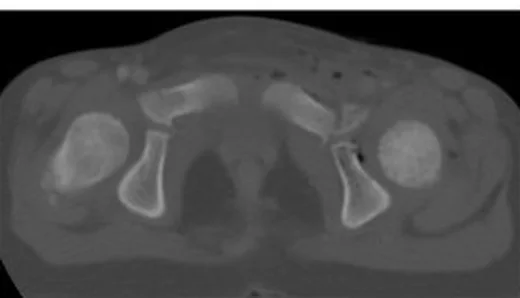
Aynı bölgenin, kaynak veri setinde patoloji içermediği belirtilen bir BT incelemesini kesit kesit kaydırın; organ sınırlarını açarak anatomiyi hasta görüntüsüyle karşılaştırın. Küçük rastlantısal bulgular tümüyle dışlanmamıştır.
Kaynak: TotalSegmentator v2.01 veri seti (Wasserthal ve ark., Radiology: Artificial Intelligence 2023), CC BY 4.0, vaka s1256; organ sınırları veri setinin otomatik segmentasyonundan, birleştirilerek sadeleştirildi. Görüntüler 2,5 mm kesit aralığına yeniden örneklendi.
Ayırıcı tanı
- Ön duvar kırığında inferior pubik ramus genellikle sağlam kalırken, ön kolon kırığında inferior ramus kırığı neredeyse her zaman mevcuttur.
- Aksiyel BT’de transvers kırık bileşeni dikey, kolon ayrışması ise yatay kırık hattıyla temsil edilir; ön kolon tutulumu iliopektineal çizgi kesintisiyle gösterilir.
- Ön kolon ve posterior hemitransvers
- ön kolon çizgisine, asetabulumun yalnız arka bölümünde görülen tipik transvers bir hemitransvers bileşen eşlik eder.
Tuzaklar
- Ön kolon çizgisinin iliak kanattaki proksimal çıkışı asetabulumdan uzak görünebilir; ramustan başlayarak hattı geriye doğru izleyin ve yalnız eklem kenarında aramayı bırakmayın.
- İliopektineal çizgi kesintisi ön kolon tutulumunu gösterir; ancak yalnız konvansiyonel grafilerle değerlendirmede güvenilirlik daha düşük olduğundan aksiyel veya 3B BT önerilir.
- İskiopubik ramus kırığı ön kolon tutulumunun neredeyse her zaman eşlik ettiği bir bulgudur; ramus kırığına bakılıp asetabular devam incelenmezse ön kolon kırığı kaçırılabilir.
- Ön kolon ve posterior hemitransvers kırık gibi karmaşık tiplerin sınıflandırılması güç olabileceğinden, posterior bileşenin değerlendirilmesinde çok düzlemli ve 3B BT rekonstrüksiyonları önerilir.
- Ön kolon + posterior hemitransvers örüntüsünde posterior bileşen, asetabulumun yalnız arka bölümündeki tipik transvers kırık hattıdır; sınıflandırmayı BT’nin çok düzlemli görüntülerinde değerlendirin.
Kendini dene
Görüntülemede izole iliopektineal çizgi kesintisine inferior pubik ramus kırığının eşlik ettiği temel asetabulum kırık tipi hangisidir?
Cevabı göster
Ön kolon kırığı. İzole iliopektineal çizgi kesintisine inferior ramus kırığının eşlik etmesi Letournel sınıflamasında ön kolon kırığını tanımlar; izole ilioiskiyal çizgi kesintisi arka kolonu, her iki çizginin kesintisi ise ön ve arka kolon tutulumunu gösterir.
Ön kolon kırığına, asetabulumun yalnız arka bölümünde görülen tipik transvers kırık hattı eşlik ediyor. Bu ek bileşen hangisidir?
Cevabı göster
Posterior hemitransvers. Ön kolon ayrışmasına asetabulumun yalnız posterior bölümündeki tipik transvers hat eşlik etmesi ACPHT örüntüsünü tanımlar.
İlgili konular
Kaynaklar
Bu sayfadaki 42 cümle ve 2 quiz sorusu aşağıdaki kaynaklardan alıntılarla otomatik olarak karşılaştırıldı; 24 cümle bu karşılaştırmada düzeltildi (2026-10-12).
- Algorithms in acetabular fracture classificationspmc.ncbi.nlm.nih.gov
- Pubic root fractures are commonly misread as anterior column fractures by radiologists: Single-institution study from a level 1 trauma center.pubmed.ncbi.nlm.nih.gov
- Fixation of Pubic and Acetabular Pathologic Fracture with Curvafix Nail and Concurrent Total Hip Arthroplasty: A Case Report.pubmed.ncbi.nlm.nih.gov
- Anterior column acetabular fractures extending to the sacroiliac region: A case series defining an atypical injury pattern.pubmed.ncbi.nlm.nih.gov
- Reverse guide wire technique for percutaneous anterior column screw of the acetabulum: A second look at the technique and a step-by-step guide. A surgical technique.pubmed.ncbi.nlm.nih.gov
- Intraoperative Imaging in Pelvic Surgery.pubmed.ncbi.nlm.nih.gov
- [Mid-term results of total hip arthroplasty for treatment of ankylosing spondylitis].pubmed.ncbi.nlm.nih.gov
- Acetabular fractures in elderly.pubmed.ncbi.nlm.nih.gov
- The ongoing relevance of acetabular fracture classification.pubmed.ncbi.nlm.nih.gov
- The Pararectus Approach in Acetabular Surgery: Radiological and Clinical Outcome.pubmed.ncbi.nlm.nih.gov
- Bony landmarks, distances and their correlations to each other, which can be used during periacetabular osteotomy: a CT study performed on dysplastic hips.pubmed.ncbi.nlm.nih.gov
- Algorithms in acetabular fracture classifications.pubmed.ncbi.nlm.nih.gov
- [Operative treatment of old acetabular fractures].pubmed.ncbi.nlm.nih.gov
- The difference in the corridor of the antegrade posterior column screw according to the presence of pelvic dysmorphism.pubmed.ncbi.nlm.nih.gov
- Clinical results of acetabular fracture management with the Pararectus approach.pubmed.ncbi.nlm.nih.gov
- Musculoskeletal Hydatid Cyst around Pelvis: A Case Report and Review of Literature.pubmed.ncbi.nlm.nih.gov
- A rare seizure: A case of seizure-induced central acetabular fracture-dislocation in a patient with chronic kidney disease and hepatitis-B.pubmed.ncbi.nlm.nih.gov
- Comparative outcomes of Bernese periacetabular osteotomy in adolescents, young adults, and middle-aged adults : a minimum two-year follow-up.pubmed.ncbi.nlm.nih.gov
- Clinical outcomes of internal iliosciatic fixation using a conventional reconstruction plate via an anterior approach for acetabular fractures involving the posterior column.pubmed.ncbi.nlm.nih.gov
- Compression Osteosynthesis Without Iliac Crest Osteotomy Through the Anterior Iliac Approach for Incomplete High Anterior Column Fractures of the Acetabulum: A Case Series and Surgical Technique.pubmed.ncbi.nlm.nih.gov
- Lateral rectus abdominis approach fixation of a high-energy both-column acetabular fracture after total hip arthroplasty with retention of a stable acetabular cup: a case report.pubmed.ncbi.nlm.nih.gov
- The Predictive Factors for Post-Traumatic Hip Osteoarthritis After Surgical Treatment of Acetabular Fractures: A Retrospective Cohort of 130 Patients.pubmed.ncbi.nlm.nih.gov
- Association of prophylactic transcatheter arterial embolization with perioperative blood loss and operative time in complex acetabular fractures: a propensity score-matched retrospective study.pubmed.ncbi.nlm.nih.gov
- Management and outcome of displaced acetabular fractures in the oldest-old: a retrospective analysis of orif and acute total hip arthroplasty.pubmed.ncbi.nlm.nih.gov
- Systematic Review of Combined Pelvic Ring and Acetabular Injuries: What Do We Know From the Literature?pubmed.ncbi.nlm.nih.gov
- Erectile dysfunction after acetabular fracture.pubmed.ncbi.nlm.nih.gov
- Three-Dimensional Printing and Fracture Mapping in Pelvic and Acetabular Fractures: A Systematic Review and Meta-Analysis.pubmed.ncbi.nlm.nih.gov
- Comparing outcomes of acetabular fracture fixation in early career versus experienced orthopaedic trauma surgeons.pubmed.ncbi.nlm.nih.gov
- Navigation-Assisted Percutaneous Fixation of an Anterior Column and Posterior Hemitransverse Fracture in an Elderly Patient: A Case Report.pubmed.ncbi.nlm.nih.gov
- External iliac artery entrapment associated with pelvic fracture. A case report.pubmed.ncbi.nlm.nih.gov
- Limitations of CT-based planning in anterior pelvic ring fixation: a study of fluoroscopy-guided pubic ramus screws.pubmed.ncbi.nlm.nih.gov
- Diagnostic value of multiple projection angle X-ray and CT 3D reconstruction for long-term unreduced posterior hip dislocation.pubmed.ncbi.nlm.nih.gov
- Quadrilateral plate fractures.pubmed.ncbi.nlm.nih.gov
- Management of Acetabular Fractures with Total Hip Replacement: A Narrative Literature Review.pubmed.ncbi.nlm.nih.gov
- Acetabular superior wall fractures: a distinct acetabular fracture entity.pubmed.ncbi.nlm.nih.gov
- Femoroacetabular stabilization using a suspensory fixation device in post-traumatic hip instability after hip fracture-dislocation: technique and report of 6 cases.pubmed.ncbi.nlm.nih.gov
- Intrapelvic migration of a trial femoral head during direct anterior approach total hip arthroplasty: a case report and literature review.pubmed.ncbi.nlm.nih.gov
- Does the Reliability and Accuracy of the Judet and Letournel Classification System for Acetabular Fractures Increase using a Novel Algorithm?pubmed.ncbi.nlm.nih.gov
- Management of Geriatric Acetabulum Fracture - A Case Report.pubmed.ncbi.nlm.nih.gov
- Acute Total Hip Arthroplasty with or Without Internal Fixation for Acetabular Fractures in the Elderly: A Case Series.pubmed.ncbi.nlm.nih.gov
- Total Hip Arthroplasty with Cage Application for Complex Posterior Hip Dislocation and Acetabular Fracture in a Patient with Prior Patellectomy: A Case Report.pubmed.ncbi.nlm.nih.gov
- Treatment of Acetabular Fractures by Acute Arthroplasty: A Comparison of Trabecular Metal Cages With a Cemented Bimobile Acetabular Component Versus a Polyethylene Liner.pubmed.ncbi.nlm.nih.gov
- Anatomy-driven automated subsegmentation of pelvic and proximal femoral CT into clinically relevant subregions and landmarks.pubmed.ncbi.nlm.nih.gov
- A novel plate design for anatomic reduction of posterior acetabular column and wall fractures: A retrospective comparative study of the Paseos plate versus the pelvic reconstruction plate.pubmed.ncbi.nlm.nih.gov
- Results of Transverse Acetabular Fracture Fixation with Both Column Screws Only Versus Plate and Column Screw Combination: A Comparative Analysis for Choosing the Best Method.pubmed.ncbi.nlm.nih.gov
- Modified Ilio-femoral approach: An update.pubmed.ncbi.nlm.nih.gov
- Combined Anterior Pelvic (CAP) approach for fracture acetabulum fixation - Functional outcome evaluation and predictors of outcome.pubmed.ncbi.nlm.nih.gov
- Minimally invasive stabilisation of anterior pelvic ring injuries through anterior infix versus percutaneous anterior retrograde pubic screw: a prospective comparative cohort study.pubmed.ncbi.nlm.nih.gov
- Open reduction and internal fixation versus percutaneous multiple-trajectory screw fixation for unstable pelvic fractures with severe polytrauma: a prospective study.pubmed.ncbi.nlm.nih.gov
- Acetabular Distraction versus Cup-Cage Construct in the Management of Chronic Pelvic Discontinuity: A Comparative Study.pubmed.ncbi.nlm.nih.gov
- Comprehensive Management of Different Types of Pelvic Fractures Through Multiple Disciplines: A Case Series.pubmed.ncbi.nlm.nih.gov
- The Diagnosis and Treatment of Acetabular Bone Loss in Revision Hip Arthroplasty: An International Consensus Symposium.pubmed.ncbi.nlm.nih.gov
- Emphasizing the Diagnostic Value of Digital Tomosynthesis in Detecting Hip Fractures.pubmed.ncbi.nlm.nih.gov
- Association between sacroiliac joint reduction quality and acetabular fracture alignment: a comparative study of the lateral window and pararectus approaches.pubmed.ncbi.nlm.nih.gov
- Managing periprosthetic fractures: perspectives on periprosthetic pelvic fractures.pubmed.ncbi.nlm.nih.gov
- Morphology-Guided Surgical Management of Complex Traumatic Hip Fracture-Dislocations and Acetabular Fractures: A Six-Case Series Illustrating Morphology-Based Surgical Approaches.pubmed.ncbi.nlm.nih.gov
- Super-acute massive osteolysis of the femoral head after acetabular fracture fixation : a comparative study with conventional post-traumatic osteonecrosis requiring total hip arthroplasty.pubmed.ncbi.nlm.nih.gov
- Surgical management of severely displaced IPRF: operative technique, indications, and preliminary clinical outcomes.pubmed.ncbi.nlm.nih.gov
- Special screw corridors and imaging in pelvic ring trauma.pubmed.ncbi.nlm.nih.gov
- Subcutaneous anterior pelvic bridge - an innovative technique for fixation of selective acetabular fracture: a case series and literature review.pubmed.ncbi.nlm.nih.gov
- Guidance for Treatment of Pelvic Acetabular Injuries with Precise Minimally Invasive Internal Fixation Based on the Orthopaedic Surgery Robot Positioning System.pubmed.ncbi.nlm.nih.gov
- Robot-assisted Minimally-invasive Internal Fixation of Pelvic Ring Injuries: A Single-center Experience.pubmed.ncbi.nlm.nih.gov
- Planning, guidance, and quality assurance of pelvic screw placement using deformable image registration.pubmed.ncbi.nlm.nih.gov
- Patterns of injury and violence in Yaoundé Cameroon: an analysis of hospital data.pubmed.ncbi.nlm.nih.gov
- Retrospective comparative study between conservative management and surgical fixation of pelvic insufficiency fractures.pubmed.ncbi.nlm.nih.gov
- Minimally invasive surgery for concomitant pericardial and diaphragmatic rupture after blunt trauma: a case report.pubmed.ncbi.nlm.nih.gov
- Acute cemented total hip arthroplasty combined with open reduction and internal fixation for elderly acetabular fractures: a two-center retrospective cohort study.pubmed.ncbi.nlm.nih.gov
- Intraoperative Fluoroscopy for Minimally Invasive Periacetabular Osteotomy: A Standardized Step-By-Step Operative Technique.pubmed.ncbi.nlm.nih.gov
- Feasibility study of a robot-assisted endoscopic technique for plate osteosyntheses of the acetabulum and anterior pelvic ring.pubmed.ncbi.nlm.nih.gov
- Three-Dimensional Hands-on Total Hip Arthroplasty Simulation After Surgically Treated Acetabular Fractures: A Technical Note on 8 Cases.pubmed.ncbi.nlm.nih.gov
- Management of Intraoperative Acetabular Fractures in Total Hip Arthroplasty: A Current Concept Review.pubmed.ncbi.nlm.nih.gov
- Comparison of primary total hip arthroplasty with limited open reduction and internal fixation vs open reduction and internal fixation for geriatric acetabular fractures: a systematic review and meta-analysis.pubmed.ncbi.nlm.nih.gov
- Surgical interventions for treating intracapsular hip fractures in older adults: a network meta-analysis.pubmed.ncbi.nlm.nih.gov
- Characteristic analysis and surgical exploration for acetabular roof fractures: Multicenter retrospective cohort study.pubmed.ncbi.nlm.nih.gov
- Pericapsular Nerve Group (PENG) Block in Pediatric Patients Undergoing Hip and Pelvic Surgical Procedures: An Educational Focused Review.pubmed.ncbi.nlm.nih.gov
- Pericapsular Nerve Group Block and Iliopsoas Plane Block: A Scoping Review of Quadriceps Weakness after Two Proclaimed Motor-Sparing Hip Blocks.pubmed.ncbi.nlm.nih.gov
- Large pelvic tubercle in orangutans relates to the adductor longus muscle.pubmed.ncbi.nlm.nih.gov
- Quantitative three-dimensional fracture mapping reveals subtype-specific morphology of acetabular roof column and wall fractures.pubmed.ncbi.nlm.nih.gov
- Staged management of a Tile C3 pelvic ring injury with bilateral sacroiliac disruption and T-shaped sacral fracture.pubmed.ncbi.nlm.nih.gov
- Retrograde posterior column acetabular screw: robotically assisted and CT-guided minimally invasive procedure.pubmed.ncbi.nlm.nih.gov
- Acetabular fractures adjacent to heterotopic renal allografts: report of two cases managed with delayed total hip replacement.pubmed.ncbi.nlm.nih.gov
- Patients with an acetabular fracture treated with acute total hip arthroplasty and additional fixation: a cohort study with functional and radiological follow-ups.pubmed.ncbi.nlm.nih.gov
- Complications and outcomes after operative treatment of low-energy pelvic ring and acetabular fractures.pubmed.ncbi.nlm.nih.gov
- Clinical impact of early postoperative routine radiology in isolated pelvic injuries: a retrospective study.pubmed.ncbi.nlm.nih.gov
- Does use of a quadrilateral surface plate improve outcome in elderly acetabular fractures?pubmed.ncbi.nlm.nih.gov
- The Central Entry Point for Infra-Acetabular Screw Placement: Defining an Anatomical Entry Zone and Evaluating Its Clinical Efficacy.pubmed.ncbi.nlm.nih.gov
- The role of applying radiological modifiers to the Letournel classification and its clinical implications.pubmed.ncbi.nlm.nih.gov
- Digital measurement and safety parameter analysis of the infra-acetabular screw pathway.pubmed.ncbi.nlm.nih.gov
- Impact of fracture type on conversion to total hip arthroplasty following surgical repair of acetabular fractures: a systematic review and meta-analysis.pubmed.ncbi.nlm.nih.gov
- Functional outcomes more than 5 years following acetabulum fracture.pubmed.ncbi.nlm.nih.gov
- Isolated screw fixation of posterior wall fractures.pubmed.ncbi.nlm.nih.gov
- Long-Term Outcome of Patients with a Floating Hip Injury of Müller Type A: An Analysis of Prognostic Factors Linked to Functional Outcomes.pubmed.ncbi.nlm.nih.gov
- Plating of the Pelvis and Acetabulum via the Laparoscopic Technique: An Alternative Method for ORIF.pubmed.ncbi.nlm.nih.gov
- Balloon acetabuloplasty for cartilage impaction reduction in traumatic acetabular fractures: a case series and technical note.pubmed.ncbi.nlm.nih.gov
- Acute total hip arthroplasty with concomitant surgical fixation in delayed acetabular fractures: functional and radiological outcomes in a prospective cohort.pubmed.ncbi.nlm.nih.gov
- Internal-locking intramedullary nails (talons, claws, wings, wedge-locks, endopins): a mechanics-guided scoping review of designs, failure signatures, and technique imperatives.pubmed.ncbi.nlm.nih.gov
- The trifecta approach: a staged alternative to the extended iliofemoral approach for complex acetabular fractures-technique and case report.pubmed.ncbi.nlm.nih.gov
- Association of Long Versus Standard-Length Cephalomedullary Nail Constructs with Posterior Sagging in Intertrochanteric Fractures with Posteromedial Comminution: A Retrospective Comparative Study.pubmed.ncbi.nlm.nih.gov
- Posterior Acetabular Wall Fracture Mimicking a Subcapital Femoral Neck Fracture on Plain Radiographs: A Diagnostic Pitfall and the Role of Intraoperative Fluoroscopy: A Case Report.pubmed.ncbi.nlm.nih.gov
- Protrusio Acetabuli in Osteogenesis Imperfecta: A Two-Center Study on Incidence and Associated Factors.pubmed.ncbi.nlm.nih.gov
- Comparison of anterior-only and combined anterior-posterior approaches for complex acetabular fractures.pubmed.ncbi.nlm.nih.gov
- Acetabular Bone Defect Classifications in Revision Total Hip Arthroplasty: A Systematic Review of the Literature.pubmed.ncbi.nlm.nih.gov
- Outcome of Large-Diameter Jumbo Cups or Acetabular Mesh with Impaction Bone Grafting for Acetabular Defects in Primary and Revision Total Hip Arthroplasty: A Case Series.pubmed.ncbi.nlm.nih.gov
- Longitudinal Density and Volume Changes of Periacetabular Cancellous and Cortical Bone.pubmed.ncbi.nlm.nih.gov
- An unprecedented pan-brachial injury: A case report of ipsilateral floating shoulder, floating elbow, and acetabular fracture following a psychosis-induced fall.pubmed.ncbi.nlm.nih.gov
- Functional Outcomes of Surgical Management of Posterior Wall Acetabular Fractures: A Prospective Study.pubmed.ncbi.nlm.nih.gov
- Revision of a Failed Primary Total Hip Arthroplasty following Excessive Reaming with a Medial Cup Protrusion.pubmed.ncbi.nlm.nih.gov
- Minimally invasive plate osteosynthesis on anterior pelvic ring injury and anterior column acetabular fracture.pubmed.ncbi.nlm.nih.gov
- Letournel-Judet Classification of Acetabular Fractures: A Systematic Review of Reliability and Association With Post-traumatic Arthritis.pubmed.ncbi.nlm.nih.gov
- Unexpected Metal Ion Elevation and Adverse Tissue Reactions in Trident II Dual Mobility Constructs With Ceramic Heads.pubmed.ncbi.nlm.nih.gov
- Combined and Modified Gibson and Ilioinguinal Approaches in Type II + III Internal Hemipelvectomy for Periacetabular Tumors.pubmed.ncbi.nlm.nih.gov
Eğitim amaçlıdır; hasta başında tanı ve tedavi kararının yerine geçmez, tıbbi tavsiye değildir. Metinler yapay zekâ desteğiyle yazıldı ve otomatik bir adımda kaynak alıntılarıyla karşılaştırıldı; bu bir tıbbi doğrulama değildir ve içerik uzman radyolog incelemesinden geçmedi. Klinik kararlarda güncel kılavuzları, kurum protokollerini ve radyoloji raporunu esas alın.