Özet
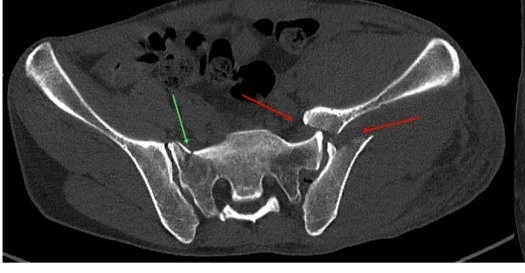
Yandan gelen kuvvet hemipelvisi iç rotasyona iter; ön halkada ramus kırığına aynı tarafta sakral ala kompresyonu veya iliak kanat hasarı eşlik edebilir. BT, sakrumun kortikal impaksiyonunu, SI ekleme uzanımı ve LC-III'teki karşı taraf dış rotasyon bileşenini göstererek örüntünün kapsamını belirler. LC yaralanmaları yalnız ön ramus kırığı gibi görünse de posterior halka deformasyonu gizli instabilitenin ana ipucu olabilir. Sakral foramene uzanan kırık veya presakral hematom bildirilmezse nöral ve kanama komplikasyonları eksik değerlendirilir.
Faz ve pencere
- Kontrastsız tanısal
- Kemik penceresinde yatay/kısa oblik pubik ramus kırığı, iç rotasyona bağlı örtüşme ve aynı tarafta sakral ala kortikal impaksiyonu veya iliak crescent fragmanı izlenir; aktif kanama için kontrastlı faz gereklidir.
- Portal tanısal
- Kontrastlı travma BT'sinde pelvik hematom, serbest sıvı ve eşlik eden organ yaralanması değerlendirilir; hematom içinde kontrast ekstravazasyonu (blush) aranır. Çok fazlı çekimde odağın fazlar arasında büyümesi veya hematom planlarına yayılması aktif kanamayı destekler.
- Arteriyel tanısal
- Belirgin hematom veya klinik şüphede arteriyel fazda damar dışına çıkan kontrast odağı ve psödoanevrizma aranır; LC mekanizması aktif kanamayı dışlamaz.
- Kemik algoritması tanısal
- Aksiyel kemik kesitleri sakral ala kompresyonunu ve foraminal uzanımı; koronal rekonstrüksiyonlar hemipelvis yüksekliği ile karşı taraf SI eklemindeki açılmayı gösterir.
Önerilen pencereler: Kemik (G 1800 / M 400), Yumuşak doku (G 400 / M 40), Anjiyo (G 600 / M 150).
BT bulguları
- Pubik ramus kırığı — çoğunlukla transvers/horizontal yönelimli çizgi superior veya inferior ramustan geçer; uçların örtüşmesi iç rotasyonla ilişkili olabilir.
- İpsilateral sakral ala impaksiyonu — kanat korteksinde içe basılan veya kırışan kontur, LC-I posterior bileşenini oluşturur.
- Sakral kırık uzanımı — kırık sakral foramenlere, kanala veya SI eklem yüzüne ulaşabilir; sinir çıkışlarıyla ilişkisi gösterilir.
- İliak crescent kırığı — LC-II'de arka iliak kanatta vertikal kırık fragmanı sakruma bağlı kalırken iliak kanadın geri kalanı SI eklemden ayrılabilir.
- İç rotasyon deformasyonu — ipsilateral obturator halka daralır veya üst üste biner; hemipelvisin ön kısmı orta hatta yaklaşır.
- LC-III karşı taraf açılması — kırığın karşısındaki hemipelvis dış rotasyon ve SI ön açıklığı göstererek APC benzeri bileşen oluşturur.
- Presakral/perivezikal hematom — yumuşak doku kanı ve aktif kontrast odağı kemik yaralanmasından ayrı tarif edilir.
- Sakral kanal/foramen etkilenmesi — fragman basısı veya daralma nöral anatomik komşuluk nedeniyle raporlanır.
Ölçütler ve sınıflamalar
- Young–Burgess LC
- LC-I: ramus kırığı ve ipsilateral sakral kompresyon; LC-II: ramus kırığı ve ipsilateral posterior iliak crescent kırığı/arka SI yaralanması; LC-III: aynı tarafta LC bileşeni ile karşı hemipelviste APC tipi dış rotasyon, 'windswept pelvis'.
- Tile
- Tip A stabil; tip B rotasyonel instabil ancak vertikal stabil; tip C hem rotasyonel hem vertikal instabildir. LC örüntülerinde sınıfı yalnız ramus sayısı değil posterior SI kompleksin durumu belirler.
Normalde
Normal BT'de sakral ala korteksi düzgün, SI eklem yüzleri paralel ve iki obturator foramen benzer şekildedir; pubik ramus korteksi kesintisizdir. Yaralı tarafı karşı tarafla aynı koronal seviyede karşılaştırın: sakral konturda içe basılma, obturator halkanın daralması, ramus örtüşmesi ve karşı SI eklem açılması iç rotasyon örüntüsünü gösterir.
Normal BT ile kıyasla
Aynı bölgenin, kaynak veri setinde patoloji içermediği belirtilen bir BT incelemesini kesit kesit kaydırın; organ sınırlarını açarak anatomiyi hasta görüntüsüyle karşılaştırın. Küçük rastlantısal bulgular tümüyle dışlanmamıştır.
Kaynak: TotalSegmentator v2.01 veri seti (Wasserthal ve ark., Radiology: Artificial Intelligence 2023), CC BY 4.0, vaka s1256; organ sınırları veri setinin otomatik segmentasyonundan, birleştirilerek sadeleştirildi. Görüntüler 2,5 mm kesit aralığına yeniden örneklendi.
Ayırıcı tanı
- APC açık kitap
- simfizis ve ön SI eklem dış rotasyonla açılır; LC'de yaralı tarafta iç rotasyon ve sakral kompresyon baskındır.
- Dikey makaslama
- posterior halkada ayrışmaya kraniyal hemipelvis kayması eşlik eder; LC örüntüsündeki iç rotasyon tek başına vertikal instabiliteyi göstermez.
- Sakral yetersizlik kırığı
- sakral alada lineer veya kavisli hipoatenuan kırık çizgileri ile SI eklem yakınında osteoskleroz görülür; akut ramus kırığı veya iç rotasyon deformasyonu eşlik etmeyebilir.
- İzole iliak kanat kırığı
- SI eklem ve karşı halka bütünlüğü korunabilir; LC-II crescent yaralanmasında SI bağlantısı/arka iliak fragman ilişkisi bozulur.
- Asetabular kolon kırığı
- kırık asetabular eklem yüzü veya kolonu izler; yalnız ramus ve sakral ala kırığıyla tanımlanan halka örüntüsünden farklıdır.
Tuzaklar
- İç rotasyon nedeniyle ramus fragmanlarının üst üste gelmesi kırığı saklayabilir; oblik ve koronal kemik rekonstrüksiyonlarında ramus korteksini takip edin.
- Sakral ala impaksiyonu hafif skleroz taklı olabilir; impaksiyon hattını karşı taraf sakral kanatla kıyaslayarak doğrulayın ve kırığın foramenlere uzanımını ardışık kesitlerde inceleyin.
- LC-III'te karşı taraf APC bileşeni gözden kaçabilir; yalnız en belirgin kırığın olduğu hemipelvisi değil, karşı SI eklem ile simfizisi de okuyun.
Kendini dene
Aynı tarafta pubik ramus kırığı ile sakral ala impaksiyonu görülüyor; iliak crescent fragmanı yok. En olası alt tip hangisidir?
Cevabı göster
LC-I. LC-I, ramus kırığına ipsilateral sakral kompresyon eşlik etmesiyle tanımlanır. LC-II'de posterior iliak crescent/arka SI bileşeni; LC-III'te karşı hemipelvis APC açılması bulunur. APC-III, Young–Burgess sınıflamasındaki anteroposterior kompresyon (APC) yaralanma grubundadır.
Sol ramus ve sakral kompresyon kırıklarına ek olarak sağ SI eklem açılmış ve sağ hemipelvis dış rotasyona uğramış. Bu örüntü nedir?
Cevabı göster
LC-III windswept. LC-III aynı taraftaki LC bileşenine karşı hemipelviste APC tipi dış rotasyon eklenmesidir. APC-I'de karşı LC-sakral kompresyon bileşeni yoktur; dikey makaslama kraniyal translasyonla, Tile-A stabilite sınıfıyla ilgilidir.
Kaynaklar
Bu sayfadaki 46 cümle ve 2 quiz sorusu aşağıdaki kaynaklardan alıntılarla tek tek karşılaştırıldı; 6 cümle bu karşılaştırmada düzeltildi (2026-10-08).
- Mid-term follow-up of superior pubic ramus osteotomy in locked symphysis pubis with urethral injury: A case reportpmc.ncbi.nlm.nih.gov
- Case Report on Locked Pubic Symphysis with Concomitant Ipsilateral Acetabular Fracturepmc.ncbi.nlm.nih.gov
- A novel percutaneous crossed screws fixation in treatment of Day type II crescent fracture–dislocation: A finite element analysispmc.ncbi.nlm.nih.gov
- Atypical Pelvic Crescent Fracture Caused by Vertical Shear Forcepmc.ncbi.nlm.nih.gov
- Non-osteoporotic L4 vertebral compression fracture after low-voltage electrical injury without secondary trauma: A rare case reportpmc.ncbi.nlm.nih.gov
- Locked pubic symphysis into the obturator foramen: a rare case presentation and literature review.pubmed.ncbi.nlm.nih.gov
- Voluntary exercise ameliorates neuropathic pain by suppressing calcitonin gene-related peptide and ionized calcium-binding adapter molecule 1 overexpression in the lumbar dorsal horns in response to injury to the cervical spinal cord.pubmed.ncbi.nlm.nih.gov
- A novel percutaneous crossed screws fixation in treatment of Day type II crescent fracture-dislocation: A finite element analysis.pubmed.ncbi.nlm.nih.gov
- Lateral Compression Type 2 Pelvic Fractures-A Clinical Study of Fracture Displacement Measurement and Closed Reduction.pubmed.ncbi.nlm.nih.gov
- Posterior locked lateral compression injury of the pelvis in geriatric patients: an infrequent and specific variant of the fragility fracture of pelvis.pubmed.ncbi.nlm.nih.gov
- The lateral stress radiograph: an effective alternative to examination under anesthesia for identifying occult instability in minimally displaced lateral compression pelvic ring injuries.pubmed.ncbi.nlm.nih.gov
- Maisonneuve fracture.pubmed.ncbi.nlm.nih.gov
- Accuracy and Safety of Lateral Vertebral Notch-Referred Technique Used in Subaxial Cervical Pedicle Screw Placement.pubmed.ncbi.nlm.nih.gov
- Utility of intraoperative electromyography in placing C7 pedicle screws.pubmed.ncbi.nlm.nih.gov
- Treatment of posterolateral tibial plateau fractures through the articular line approach.pubmed.ncbi.nlm.nih.gov
- [Proposal of a novel comprehensive classification for femoral intertrochanteric fractures].pubmed.ncbi.nlm.nih.gov
- Petrous bone fracture: a virtual trauma analysis.pubmed.ncbi.nlm.nih.gov
- [Radiological diagnosis of pelvic ring fractures].pubmed.ncbi.nlm.nih.gov
- Risser growth plate injury in unstable paediatric pelvic fractures: a multicentre retrospective study.pubmed.ncbi.nlm.nih.gov
- Biomechanics of Osteoporotic Fracture Fixation.pubmed.ncbi.nlm.nih.gov
- An International Continence Society (ICS)/ International Urogynecological Association (IUGA) joint report on the terminology for the assessment and management of obstetric pelvic floor disorders.pubmed.ncbi.nlm.nih.gov
- Percutaneous spinopelvic fixation technique using external fixation for focal kyphosis reduction in U-type sacral fractures: a case report.pubmed.ncbi.nlm.nih.gov
- CT of Sacral Fractures: Classification Systems and Management.pubmed.ncbi.nlm.nih.gov
- Long-term safety and effectiveness of the "OptEase" vena cava filter.pubmed.ncbi.nlm.nih.gov
- Assessment of the posterior pelvic ring during examination under anesthesia changes surgeons' classification and treatment decisions of anterior posterior compression pelvic ring injuries.pubmed.ncbi.nlm.nih.gov
- Occult bladder injury in low displacement anterior-posterior compression pelvic fractures type I: a retrospective analysis of incidence and predictors.pubmed.ncbi.nlm.nih.gov
- Initial lateral stress radiographs predict instability in fragility fractures of the pelvis type I and II: a prospective observational study.pubmed.ncbi.nlm.nih.gov
- Comprehensive Management of Different Types of Pelvic Fractures Through Multiple Disciplines: A Case Series.pubmed.ncbi.nlm.nih.gov
- Siatic nerve: beyond the sacral foramen.pubmed.ncbi.nlm.nih.gov
- The Ilioinguinal Approach: State of the Art.pubmed.ncbi.nlm.nih.gov
- Short-term results of surgical treatment of acetabular fractures using the modified Stoppa approach.pubmed.ncbi.nlm.nih.gov
- Transarterial embolization in musculoskeletal care: an indication-stratified narrative review.pubmed.ncbi.nlm.nih.gov
- Fatal Spontaneous Retroperitoneal Hematoma Following Intense Physical Exertion in a Young Healthy Male: A Case Report.pubmed.ncbi.nlm.nih.gov
- ESR Essentials: trauma team and the role of Interventional Radiology-practice recommendations by the Cardiovascular and Interventional Radiological Society of Europe.pubmed.ncbi.nlm.nih.gov
- Explainable Knowledge-Guided Algorithm for Contrast Extravasation Detection on Computed Tomography.pubmed.ncbi.nlm.nih.gov
- Giant splenic artery pseudoaneurysm fistulizing to the colon: A case report and focused literature review.pubmed.ncbi.nlm.nih.gov
- Spinal lesions: a comprehensive radiologic overview.pubmed.ncbi.nlm.nih.gov
- Delayed rupture of right external iliac artery pseudoaneurysm after removal of foreign body from small intestine: a case report.pubmed.ncbi.nlm.nih.gov
- Combined Post-traumatic Pseudoaneurysms of the Superior Gluteal and Aberrant Obturator Arteries: A Case Report.pubmed.ncbi.nlm.nih.gov
- Special screw corridors and imaging in pelvic ring trauma.pubmed.ncbi.nlm.nih.gov
- Pelvic ring injuries: recent advances in diagnosis and treatment.pubmed.ncbi.nlm.nih.gov
- Traumatic lumbosacral instability: part 2-indications and techniques for surgical management.pubmed.ncbi.nlm.nih.gov
- Surgical Management of a Lateral Compression (LC)III Pelvic Ring Fracture With Type I Crescent Fracture-Dislocation: A Case Report.pubmed.ncbi.nlm.nih.gov
- Modified Ilio-femoral approach: An update.pubmed.ncbi.nlm.nih.gov
- Persistent impairment after surgically treated lateral compression pelvic injury.pubmed.ncbi.nlm.nih.gov
- Knowledge gaps in high-energy sacral fracture treatment and management.pubmed.ncbi.nlm.nih.gov
- Adult degenerative scoliosis: challenges in diagnosis, pain management, and surgical decision-making.pubmed.ncbi.nlm.nih.gov
- Beyond Chordoma: A Comprehensive Review of Sacral Lesions.pubmed.ncbi.nlm.nih.gov
- Staged management of a Tile C3 pelvic ring injury with bilateral sacroiliac disruption and T-shaped sacral fracture.pubmed.ncbi.nlm.nih.gov
- Simultaneous Cesarean Delivery and Pelvic Stabilization for Open-Book Pelvic Injury in Late Pregnancy: A Case Report.pubmed.ncbi.nlm.nih.gov
- Minimally invasive stabilisation of anterior pelvic ring injuries through anterior infix versus percutaneous anterior retrograde pubic screw: a prospective comparative cohort study.pubmed.ncbi.nlm.nih.gov
- Total hip arthroplasty for sequelae of childhood hip disorders: Current review of management to achieve hip centre restoration.pubmed.ncbi.nlm.nih.gov
- A multimodality review of male urethral imaging: pearls and pitfalls with an update on urethral stricture treatment.pubmed.ncbi.nlm.nih.gov
- Clinico-demographical Profile of Pelvis and Acetabular Fracture Presenting in Tertiary Care Center of Nepal: An Observational Study.pubmed.ncbi.nlm.nih.gov
- Immediate management of a stable patient with unstable pelvis.pubmed.ncbi.nlm.nih.gov
- Transcatheter Arterial Embolization for Hemorrhagic Pelvic Fracture: Review Article.pubmed.ncbi.nlm.nih.gov
- Computed tomography of pediatric abdominal trauma: optimizing utilization and enhancing diagnostic interpretation.pubmed.ncbi.nlm.nih.gov
- Retroperitoneal anatomy with the aid of pathologic fluid: An imaging pictorial review.pubmed.ncbi.nlm.nih.gov
- Iliosacral Screw Fixation for Treating Sacral Fractures: A Modified Pedicle-Guided Fixation Technique in Prone Position.pubmed.ncbi.nlm.nih.gov
- Total laparoscopic radical hysterectomy for cervical cancer in prolapsed uterus.pubmed.ncbi.nlm.nih.gov
- Hemipelvis malrotation deformity leading to instability: The need for careful preoperative radiographic evaluation in total hip arthroplasty.pubmed.ncbi.nlm.nih.gov
- The Standing Forward Flexion Test in Manual Therapy: A Critical Review and a Functional Reinterpretation.pubmed.ncbi.nlm.nih.gov
- Minimally invasive circumferential fixation using TIFI and INFIX for unstable pelvic ring injuries: a prospective evaluation of clinical and radiological outcomes.pubmed.ncbi.nlm.nih.gov
- Reliability of interobserver and intraobserver assessments of the Tile versus Young-Burgess classifications for pelvic ring injuries.pubmed.ncbi.nlm.nih.gov
- Paediatric pelvic fractures - an updated literature review.pubmed.ncbi.nlm.nih.gov
- Symphyseal fixation in open book injuries cannot fully compensate anterior SI joint injury-A biomechanical study in a two-leg alternating load model.pubmed.ncbi.nlm.nih.gov
- Development and evaluation of a multi-axis loading simulator for the spine, pelvis, and lumbosacral region.pubmed.ncbi.nlm.nih.gov
- Robotic-assisted percutaneous iliac fixation: Outcomes, history, and review.pubmed.ncbi.nlm.nih.gov
- Parathyroid Hormone in the Management of Pelvic Fragility Fractures: A Systematic Review and Meta-Analysis.pubmed.ncbi.nlm.nih.gov
- Sacroiliac Joint Ankylosis in Pelvic Ring Injuries with Posterior Ilium Fractures.pubmed.ncbi.nlm.nih.gov
- A novel plate design for anatomic reduction of posterior acetabular column and wall fractures: A retrospective comparative study of the Paseos plate versus the pelvic reconstruction plate.pubmed.ncbi.nlm.nih.gov
- Return to sport after acetabular and pelvic ring fractures in amateur athletes: A retrospective study.pubmed.ncbi.nlm.nih.gov
- Acetabular Distraction versus Cup-Cage Construct in the Management of Chronic Pelvic Discontinuity: A Comparative Study.pubmed.ncbi.nlm.nih.gov
- Robot-assisted closed reduction and navigated fixation for pelvic ring injuries: a focused narrative review of a reduction-fixation-audit framework.pubmed.ncbi.nlm.nih.gov
- Deep learning and hybrid architectures for atypical and complex bone fracture diagnosis: a systematic review of performance and clinical validity.pubmed.ncbi.nlm.nih.gov
- Critical Care Transport: Blunt Polytrauma in Pregnancy.pubmed.ncbi.nlm.nih.gov
- The prevention of osteoporotic vertebral fractures in eastern and in western countries.pubmed.ncbi.nlm.nih.gov
- A systematic scoping review and conceptual analysis of new-onset fibromyalgia manifestations after non-hospitalized COVID-19: empirics, definitions, methodologies, pathophysiology, mapping of literature, and knowledge gaps.pubmed.ncbi.nlm.nih.gov
- Pituitary T-lymphoblastic lymphoma combined with pituitary adenoma: a rare case report.pubmed.ncbi.nlm.nih.gov
- Outcome of pelvic ring injuries.pubmed.ncbi.nlm.nih.gov
- Risk evaluation of neck extension in patients with degenerative or ossified cervical spine undergoing extension-dependent surgical procedures: A retrospective observational study.pubmed.ncbi.nlm.nih.gov
- Non-osteoporotic L4 vertebral compression fracture after low-voltage electrical injury without secondary trauma: A rare case report.pubmed.ncbi.nlm.nih.gov
- Staged dorsolateral decompression and posterior stabilization for severe ventral odontoid compression in basilar invagination: illustrative case.pubmed.ncbi.nlm.nih.gov
- Safe definitive surgery in unstable pelvic ring injuries - a retrospective cohort study.pubmed.ncbi.nlm.nih.gov
- Open Book on the Water Slide: A Case Series of APC2 Pelvic Ring Injuries from High-Energy Aquatic Accidents.pubmed.ncbi.nlm.nih.gov
- Selective Anterior Fixation for Rami Fractures in Anteroposterior Compression-Type Pelvic Ring Injuries: Impact of Posterior Stability.pubmed.ncbi.nlm.nih.gov
- Isolated Unilateral Posterior Sacroiliac Dislocation With an Intact Anterior Pelvic Ring: Case Report of an Unusual Injury Pattern.pubmed.ncbi.nlm.nih.gov
- Biomechanical comparative study on external fixators of new configurations in the treatment of Tile C pelvic injury.pubmed.ncbi.nlm.nih.gov
- Clinical and 18F-FDG PET/CT Imaging Characteristics of Post-radiotherapy Sacral Insufficiency Fractures in Cervical Cancer Patients.pubmed.ncbi.nlm.nih.gov
- Fatal Injuries Caused by Falling Trees: Correlation Between Postmortem Computed Tomography and Forensic Autopsy Findings in Eight Cases.pubmed.ncbi.nlm.nih.gov
- Chronic pelvic insufficiency fractures and their treatment.pubmed.ncbi.nlm.nih.gov
- Glossary of terms for musculoskeletal radiology.pubmed.ncbi.nlm.nih.gov
- Hip position may be associated with susceptibility to Rommens type IIIa fragility fractures of the pelvis during lateral falls: a quantitative computed tomography-based finite element analysis.pubmed.ncbi.nlm.nih.gov
Eğitim amaçlıdır; hasta başında tanı ve tedavi kararının yerine geçmez. İçerik yapay zekâ destekli bir süreçle güncel literatüre göre cümle cümle kaynaklarla karşılaştırıldı, ancak uzman radyolog incelemesinden geçmedi. Klinik kararlarda güncel kılavuzları, kurum protokollerini ve radyoloji raporunu esas alın.