Özet
Subaksiyel servikal faset çıkığı genellikle fleksiyon ve distraksiyon kuvvetleriyle oluşur; bilateral faset çıkığı bu yaralanma spektrumunun en şiddetli formudur. Şüpheli servikal travmanın ilk değerlendirmesinde tüm servikal omurga BT'si giderek daha sık kullanılır ve kemik yaralanmaları ile çoğu diskoligamentöz yaralanmayı göstermede yüksek tanısal değere sahiptir; disk, bağ ve travmatik omurilik yaralanmalarının değerlendirilmesinde MRG en duyarlı yöntemdir. Bu örüntü, tek taraflı çıkıktan daha kapsamlı osteoligamentöz bozulmayla ve daha yüksek nörolojik yaralanma sıklığıyla ilişkilidir.
Faz ve pencere
- Kontrastsız tanısal
- Sagittal ve koronal BT rekonstrüksiyonları, faset eklem yüzlerinin örtüşme oranını ve eklem yaralanmasını değerlendirmede kullanılır. Çok kesitli BT akut servikal travmada sıklıkla ilk basamak görüntüleme olarak uygulanır; eşlik eden disk herniasyonu ve ligament hasarını değerlendirmede ise MRG en duyarlı yöntemdir.
- Kemik algoritması tanısal
- Servikal travmada ince kesitli (2–3 mm) helikal BT'nin sagittal ve koronal rekonstrüksiyonlarla kullanılması önerilir; BT kemik yaralanmalarını değerlendirmede yüksek tanısal değere sahiptir.
Önerilen pencereler G genişlik, M merkez; değerler Hounsfield birimi (HU)
- KemikG 1800 / M +400
- Yumuşak dokuG 400 / M +40
BT bulguları
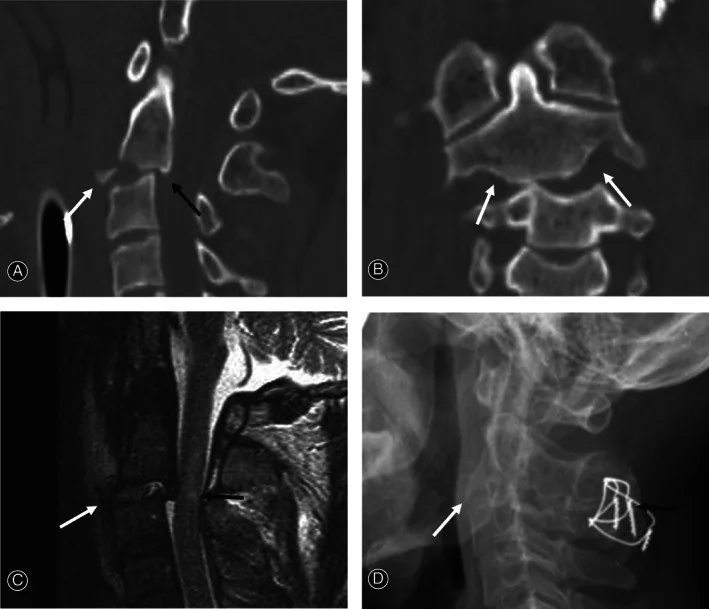
- Bilateral faset çıkığında her iki eklemde disloke üst vertebranın alt artiküler çıkıntısı, kaudal vertebranın üst artiküler çıkıntısına göre yer değiştirerek kilitli konuma geçer.
- Faset eklemlerinde örtüşme kaybı — komşu iki artiküler çıkıntının eklem yüzleri uzunluklarının %50'sinden az örtüşüyorsa eklem instabil kabul edilir.
- Vertebra korpus translasyonu — komşu vertebra gövdeleri arasında yer değiştirme veya translasyon izlenir; bilateral faset çıkığı tek taraflı çıkığa göre daha yüksek derecede displasmana yol açar.
- Fleksiyon-distraksiyon deformitesi — faset çıkığı çoğunlukla kombine fleksiyon ve distraksiyon kuvvetleriyle oluşur ve bir servikal vertebranın diğerine göre yer değiştirmesine yol açar.
- Eşlik eden kemik ve ligamentöz hasarlar — faset kırıkları, lamina kırıkları ve endplate kırıkları gibi kemik hasarları ile interspinöz ligament dahil bağ yaralanmaları tabloya eşlik edebilir.
- Spinal kanalda kemik daralma — kanal içine uzanan lamina fragmanı gibi kemik parçaları omurilik basısına ve kanal daralmasına yol açabilir.
- Prevertebral hematom, ligament yaralanmasına eşlik edebilir.
Ölçütler ve sınıflamalar
- AO Spine F4 bilateral
- AO Spine sisteminde faset yaralanmaları F alt grubu ile, bir vertebra gövdesinin diğerine göre yer değiştirmesi ise Tip C ile sınıflandırılır.
- AO Spine subaksiyel Tip C
- AO Spine sınıflamasında Tip C, bir vertebra gövdesinin diğerine göre yer değiştirmesi veya translasyonu olan yaralanmaları temsil eder; faset hasarı F alt grubu ile ayrıca tanımlanır.
Normalde
Normal anatomide komşu artiküler çıkıntıların faset eklem yüzleri karşılıklı örtüşür; eklem yüzlerinin %50'sinden az örtüşmesi instabil bir faset lezyonunu düşündürür. Sağ ve sol eklemde atlamayı ayrı ayrı doğrulayın, ardından aynı seviyede korpus kaymasını, disk aralığı açısını ve kanalın kemik sınırını komşu hareket segmentleriyle kıyaslayın.
Normal BT ile kıyasla
Aynı bölgenin, kaynak veri setinde patoloji içermediği belirtilen bir BT incelemesini kesit kesit kaydırın; organ sınırlarını açarak anatomiyi hasta görüntüsüyle karşılaştırın. Küçük rastlantısal bulgular tümüyle dışlanmamıştır.
Kaynak: TotalSegmentator v2.01 veri seti (Wasserthal ve ark., Radiology: Artificial Intelligence 2023), CC BY 4.0, vaka s1338; organ sınırları veri setinin otomatik segmentasyonundan, birleştirilerek sadeleştirildi. Görüntüler 2,5 mm kesit aralığına yeniden örneklendi.
Ayırıcı tanı
- Tek taraflı faset çıkığı
- yaralanmada rotasyon bileşeni rol oynar ve koronal rekonstrüksiyonda bilateral asimetri ile tek taraflı kilitlenme izlenir.
- Faset subluksasyonu
- fleksiyon-distraksiyon yaralanması faset subluksasyonundan tam çıkığa (%100 yer değiştirme) kadar değişen evrelerde izlenebilir; açık çıkık olmayan olgularda eklem yüzü örtüşmesi değerlendirilir.
- Servikal faset çıkıklarına faset kırıkları eşlik edebilir; ayrıca subaksiyel servikal omurganın minimal faset veya lateral kitle kırıkları düşük enerjili travma ya da hiperekstansiyonla ilişkili olabilir.
- Kronik servikal kifoz
- gecikmiş veya ihmal edilmiş faset çıkıkları sabit kifotik deformite ve faset füzyonu ile başvurabilir; BT ve MRG'de anterolistezis, kilitli faset ve kanal darlığı değerlendirilir.
Tuzaklar
- Bir taraftaki atlamayı saptayıp incelemeyi tamamlamayın; orta hattan sağa ve sola parasagittal kesitler açarak iki faset eklemini ayrı ayrı doğrulayın.
- Orta sagittal görüntüdeki translasyonu tek başına çıkığın kanıtı saymayın; kilitlenmenin anatomik kanıtı faset çıkıntılarının eklem yüzlerine göre yeridir.
- Belirgin deformite içinde korda bası yapabilecek kemik parçalarını gözden kaçırmayın; kanal konturunu ve özellikle kanal içine uzanabilecek lamina veya kemik fragmanlarını dikkatle inceleyin.
- AO Spine subaksiyel sınıflamasında kilitli faset lezyonları F4 olarak kodlanır; bilateral faset kilitlenmesinde bu durum F4 BL olarak belirtilir. Vertebra gövdeleri arasında translasyon varsa yaralanma C tipi olarak sınıflandırılır ve faset alt tipi ayrıca belirtilir.
Kendini dene
Bilateral kilitli faset yaralanması AO Spine sınıflamasında hangi faset koduyla gösterilir?
Cevabı göster
F4 BL. Bilateral kilitli faset yaralanması F4 BL olarak kodlanır.
Subaksiyel servikal bilateral faset çıkığı, tek taraflı faset çıkığı ile karşılaştırıldığında literatürde hangi özellikle karakterizedir?
Cevabı göster
Osteoligamentöz yapılarda belirgin derecede daha yüksek hasar ve daha yüksek displasman derecesi. Bilateral faset çıkıkları, tek taraflı çıkıklara kıyasla osteoligamentöz yapılarda daha ağır hasar, daha fazla yer değiştirme ve daha yüksek nörolojik yaralanma sıklığıyla seyreder.
İlgili konular
Kaynaklar
Bu sayfadaki 38 cümle ve 2 quiz sorusu aşağıdaki kaynaklardan alıntılarla otomatik olarak karşılaştırıldı; 21 cümle bu karşılaştırmada düzeltildi (2026-10-12).
- Sub-Axial Cervical Facet Dislocation: A Review of Current Conceptspmc.ncbi.nlm.nih.gov
- A novel 3D-printed locking cage for anterior atlantoaxial fixation and fusion: case report and in vitro biomechanical evaluation.pubmed.ncbi.nlm.nih.gov
- Influence of graft size on spinal instability with anterior cervical plate fixation following in vitro flexion-distraction injuries.pubmed.ncbi.nlm.nih.gov
- Neurologically intact patient following bilateral facet dislocation: case report and review of literature.pubmed.ncbi.nlm.nih.gov
- Nonmetallic posterior monosegmental cervical fusion of a dislocated C6/7 fracture in a 4-year-old girl : A case report.pubmed.ncbi.nlm.nih.gov
- Optimizing surgical strategies for subaxial cervical fracture-dislocation: a facet and disc injury-based approach.pubmed.ncbi.nlm.nih.gov
- [Study on the rotary angle, plain radiographs and CT appearance in unilateral locked facet of cervical spine].pubmed.ncbi.nlm.nih.gov
- Reduction of traumatic unilateral locked facet of the subaxial cervical spine: what predicts successful closed skeletal traction, and is anterior or posterior surgery superior after unsuccessful closed reduction?pubmed.ncbi.nlm.nih.gov
- 270-Degree Decompression, Fixation, and Realignment in a Neglected Cervical Facet Dislocation : A Case Report.pubmed.ncbi.nlm.nih.gov
- Subaxial cervical spine fractures with facet joint dislocation: Surgical management, technique, and results in a retrospective series of 36 patients.pubmed.ncbi.nlm.nih.gov
- Awake closed manual reduction of cervical spine dislocation as an emergency bridge to surgery: a case report.pubmed.ncbi.nlm.nih.gov
- Management of neurologically intact traumatic posterior atlantoaxial dislocation with odontoid fracture and bilateral locked facets: a case report and literature review.pubmed.ncbi.nlm.nih.gov
- Anterior Versus Posterior Stabilization of Subaxial Cervical Spine Fracture-Dislocations, Dislocations and Subluxations: A Retrospective Cohort Study of Neurological and Radiological Outcomes.pubmed.ncbi.nlm.nih.gov
- AO Spine Clinical Practice Recommendations for the Management of Subaxial Spine Fractures.pubmed.ncbi.nlm.nih.gov
- Uninstrumented anterior corpectomy with structural bone grafting for ventral reconstruction at the cervicothoracic junction: A technical case series.pubmed.ncbi.nlm.nih.gov
- Predictive Factors for Failure of Closed Reduction in Traumatic Cervical Facet Dislocations: A Systematic Review of 631 Patients.pubmed.ncbi.nlm.nih.gov
- Cervical Spine Pathology in the Context of Intimate Partner and Interpersonal Violence: A Case Series and Focused Narrative Review.pubmed.ncbi.nlm.nih.gov
- The evolution of cervical spine trauma classification: a paradigm shift from morphological description to clinical decision-making.pubmed.ncbi.nlm.nih.gov
- Endoscopic-assisted anterior transarticular screw fixation and arthrodesis for atlantoaxial instability via a retropharyngeal approach: technical note and preliminary clinical outcomes.pubmed.ncbi.nlm.nih.gov
- Cranial anatomy, palaeoneurology, palaeobiology and stratigraphic age of the large-bodied ornithopod, <i>Muttaburrasaurus langdoni</i> Bartholomai and Molnar, 1981, from the mid-Cretaceous of Australia.pubmed.ncbi.nlm.nih.gov
- A Proposal for a Standardized Imaging Algorithm to Improve the Accuracy and Reliability for the Diagnosis of Thoracolumbar Posterior Ligamentous Complex Injury in Computed Tomography and Magnetic Resonance Imaging.pubmed.ncbi.nlm.nih.gov
- Transoral digital reduction of complete anterior odontoid dislocation followed by fiducial-based navigated transcondylar screw fixation: illustrative case.pubmed.ncbi.nlm.nih.gov
- Diagnosis and management of esophageal perforation with necrotizing fasciitis in traumatic cervical spine injuries: illustrative case.pubmed.ncbi.nlm.nih.gov
- Reoperation Strategy for Failure of Cervical Disc Arthroplasty at Index and Adjacent Levels.pubmed.ncbi.nlm.nih.gov
- Magnetic Resonance Imaging for Spine Emergencies.pubmed.ncbi.nlm.nih.gov
- MDCT of acute subaxial cervical spine trauma: a mechanism-based approach.pubmed.ncbi.nlm.nih.gov
- Recent Progress in the Classification and Operation of Sacral Fractures.pubmed.ncbi.nlm.nih.gov
- Lumbosacral Dorsal Rhizotomy for Spastic Cerebral Palsy: A Health Technology Assessment.pubmed.ncbi.nlm.nih.gov
- Imaging and classifications of atlantoaxial dislocation: a narrative review.pubmed.ncbi.nlm.nih.gov
- Imaging of osteoarthritis from the ankle through the midfoot.pubmed.ncbi.nlm.nih.gov
- Surgical Reduction Techniques and Outcomes for Cervical Spondyloptosis: A Technical Report and Case Series.pubmed.ncbi.nlm.nih.gov
- Innovative One-Hole Split Endoscopy for Posterior Atlantoaxial Lateral Mass Joint Fusion: Technical Details and Preliminary Clinical Application.pubmed.ncbi.nlm.nih.gov
- Treatment Strategy for Subaxial Minimal Facet/Lateral Mass Fractures: A Comprehensive Clinical Review.pubmed.ncbi.nlm.nih.gov
- Basilar invagination and atlantoaxial dislocation as a complication of severe dystrophic cervical kyphosis correction in neurofibromatosis type 1: Report of a rare case and review of literature.pubmed.ncbi.nlm.nih.gov
- Role of 3D Printing in Preoperative Planning for Spine Surgery: A Scoping Review.pubmed.ncbi.nlm.nih.gov
- Non-Infectious Spinal Diseases Mimicking Infection: A Pictorial Essay.pubmed.ncbi.nlm.nih.gov
- Radiological findings of February 2023 twin earthquakes-related spine injuries.pubmed.ncbi.nlm.nih.gov
- Pediatric spinal injuries- current concepts.pubmed.ncbi.nlm.nih.gov
- Mechanisms of mid-thoracic spine fracture/dislocation due to falls during horse racing: A report of two cases.pubmed.ncbi.nlm.nih.gov
- Occipitocervical dissociation: A narrative review and case series with a novel management algorithm proposal.pubmed.ncbi.nlm.nih.gov
- Craniocervical traumatic ligamentous injuries - AO spine type B injuries - Anatomy, biomechanics and clinical perspectives.pubmed.ncbi.nlm.nih.gov
- Total joint replacement of the lumbar spine: surgical technique and procedural details.pubmed.ncbi.nlm.nih.gov
- Consensus practice guidelines on sacroiliac joint complex pain from a multispecialty, international working group.pubmed.ncbi.nlm.nih.gov
- Radiologically Devastating Yet Neurologically Intact: A Rare Case of Ambulatory C6-C7 Translational Injury with Bilateral Facet Dislocation and Vertebral Artery Thrombosis.pubmed.ncbi.nlm.nih.gov
- Subaxial Cervical Spine Fractures: Historical Systems and Advancements With the AO Spine Classification.pubmed.ncbi.nlm.nih.gov
- Surgical management protocol for anterior-only reduction and fixation for acute, delayed and old subaxial cervical facet dislocation: a retrospective study of 87 consecutive cases in China.pubmed.ncbi.nlm.nih.gov
- An Emergency Medicine Disposition Challenge: A Scoping Review of Isolated Transverse Process Fractures of the Cervical Spine.pubmed.ncbi.nlm.nih.gov
- Anatomical Variants of the Cervical Spine and Sports-Related Injury in Athletes: A Narrative Review.pubmed.ncbi.nlm.nih.gov
- The Effect of Axial Compression and Distraction on Cervical Facet Cartilage Apposition During Shear and Bending Motions.pubmed.ncbi.nlm.nih.gov
- Association of Chiropractic Colleges Educational Conference and Research Agenda Conference 2023: Leadership in Education.pubmed.ncbi.nlm.nih.gov
- Outcomes of Conservative Versus Surgical Treatment of Dropped Head Syndrome in a Single Institution: A Case Series and Review of the Literature.pubmed.ncbi.nlm.nih.gov
- Infectious Spondylodiscitis of Bacterial Causes in Adults: Epidemiology, Pathophysiology, Diagnostic and Treatment Challenges.pubmed.ncbi.nlm.nih.gov
- CT evaluation of pediatric craniocervical distraction injuries: a comprehensive review of morphometric parameters and practical applications.pubmed.ncbi.nlm.nih.gov
- Awareness of traumatic occult lateral mass fracture of the cervical spine triggered by the presence of unilateral vertebral artery occlusion: a case report.pubmed.ncbi.nlm.nih.gov
- The American Society of Pain and Neuroscience (ASPN) Evidence-Based Clinical Guideline of Interventional Treatments for Low Back Pain.pubmed.ncbi.nlm.nih.gov
- A specimen-level phylogenetic analysis and taxonomic revision of Diplodocidae (Dinosauria, Sauropoda).pubmed.ncbi.nlm.nih.gov
- Spine Trauma Classifications: Historical, Current, and Emerging Perspectives for Radiologists.pubmed.ncbi.nlm.nih.gov
- The value of magnetic resonance imaging and computed tomography in the study of spinal disorders.pubmed.ncbi.nlm.nih.gov
- Occipito-Cervical Fusion Using Screw Rod Plate System in Craniocervical Pathologies: A Prospective Cohort Analysis of Long-Term Functional and Radiological Outcome With Minimum Two Years of Follow-Up.pubmed.ncbi.nlm.nih.gov
- Catastrophic failure of anterior fusion for bilateral cervical facet dislocation: illustrative case.pubmed.ncbi.nlm.nih.gov
- Graft position versus material in posterior atlantoaxial fusion: establishing a clinical decision hierarchy.pubmed.ncbi.nlm.nih.gov
- Common sports-related nerve injuries seen by the electrodiagnostic medical consultant.pubmed.ncbi.nlm.nih.gov
- Computed tomography Osteoabsorptiometry: Review of bone density, mechanical strength of material and clinical application.pubmed.ncbi.nlm.nih.gov
- International Society of Paediatric Surgical Oncology (IPSO) Surgical Practice Guidelines.pubmed.ncbi.nlm.nih.gov
- Long-term safety and effectiveness of the "OptEase" vena cava filter.pubmed.ncbi.nlm.nih.gov
- Imaging of Spondylodiscitis: A Comprehensive Updated Review-Multimodality Imaging Findings, Differential Diagnosis, and Specific Microorganisms Detection.pubmed.ncbi.nlm.nih.gov
- A clinical review of hand manifestations of cervical myelopathy, cervical radiculopathy, radial, ulnar, and median nerve neuropathies.pubmed.ncbi.nlm.nih.gov
- Advancements in biomaterials and bioactive solutions for lumbar spine fusion cages: Current trends and future perspectives.pubmed.ncbi.nlm.nih.gov
- Acute management of spinal fractures: What you need to know.pubmed.ncbi.nlm.nih.gov
- Degenerative lumbosacral spondylolisthesis: Instability as the primary pathology and stabilization as definitive treatment. Experience with 28 cases treated by only fixation without any decompression.pubmed.ncbi.nlm.nih.gov
- The Konakondla-Telfeian-Shen (KTS) Pyramid: a safe entry zone for ventral thoracic pathologies.pubmed.ncbi.nlm.nih.gov
- Evaluation and Surgical Planning for Craniovertebral Junction Deformity.pubmed.ncbi.nlm.nih.gov
- Biomaterials for vertebral body repair: interior augmentation and total replacement-a literature review of bone fusion outcomes in clinical studies.pubmed.ncbi.nlm.nih.gov
- Congenital and Breed-Associated Vertebral Anomalies in Dogs and Cats: Developmental Anatomy, Genetic Determinants, and Biological Significance.pubmed.ncbi.nlm.nih.gov
- Rugby Injury Imaging.pubmed.ncbi.nlm.nih.gov
- Biomechanical compensatory chain and residual compensation potential in aging spinal deformity: a narrative review and multimodal assessment framework.pubmed.ncbi.nlm.nih.gov
- A Primer on Anatomy, Biophysics, Pathology, Imaging and Treatment of the Intervertebral Disc and the Anterior Spinal Column: The Discogenic, Intervertebral, Spinal Column (DISC) ASPN Workgroup.pubmed.ncbi.nlm.nih.gov
- Charcot spinal arthropathy: a case series.pubmed.ncbi.nlm.nih.gov
- Recommendations of the International Consensus Meeting (ICM) 2025 on Spinal Infections: Part B Tubercular Spondylodiscitis.pubmed.ncbi.nlm.nih.gov
- Diagnostic imaging confusion in infectious spondylitis.pubmed.ncbi.nlm.nih.gov
- Occipital plate-assisted posterior reduction for tumor-related severe atlantoaxial dislocation: a single-case surgical technique.pubmed.ncbi.nlm.nih.gov
- Posterior-Only Reduction of High-Grade Traumatic Thoracic Spondyloptosis.pubmed.ncbi.nlm.nih.gov
- Traumatic nerve root injury due to unilateral facet fracture of the cervical spine caused by a direct external force; a case report.pubmed.ncbi.nlm.nih.gov
- Isolated Spinous Process Fracture: A Commonly Missed Diagnosis.pubmed.ncbi.nlm.nih.gov
- In vivo 3D kinematic analysis of cervical facet joints under physiological loading in healthy individuals.pubmed.ncbi.nlm.nih.gov
- Traumatic lumbosacral instability: part 1 - proposing a definition and identifying underlying injury patterns.pubmed.ncbi.nlm.nih.gov
- Atlantoaxial rotary subluxation in children after trampoline injury: A critical but overlooked diagnosis.pubmed.ncbi.nlm.nih.gov
- Novel Coronoid Reconstruction Using a Patient-Specific 3-Dimensional Metal-Printed Prosthesis and Guide for Comminuted Coronoid Process Fractures.pubmed.ncbi.nlm.nih.gov
- Upright MRI Follow-Up for Decompression and Interlaminar Stabilization in Low-Grade L4/L5 Spondylolisthesis Suggests Reduced Reoperation Rates Compared With Fusion or Decompression Alone.pubmed.ncbi.nlm.nih.gov
- Mechanism of injury and fracture status influence outcomes after central cord injury.pubmed.ncbi.nlm.nih.gov
- Plough Fracture (Anterior Arch Fracture Type Traumatic Posterior Atlantoaxial Dislocation, TPAD-AOT Type III): A Retrospective Study of Nine Clinical Cases With Complete Imaging Data.pubmed.ncbi.nlm.nih.gov
- Degenerative Zygapophyseal Joint Subluxation of the Lumbar Spine: A Modified Classification and Clinical Considerations.pubmed.ncbi.nlm.nih.gov
- Chance fracture: A case report and review of the literature.pubmed.ncbi.nlm.nih.gov
- Three-dimensional morphometry and clinical implications of the atlantoaxial lateral mass joint: a study of sexual dimorphism.pubmed.ncbi.nlm.nih.gov
- 3D-printed patient-specific guides improve screw accuracy in upper cervical spine surgery: a comparative study.pubmed.ncbi.nlm.nih.gov
- Cervical Radiculopathy: Focus on Factors for Better Surgical Outcomes and Operative Techniques.pubmed.ncbi.nlm.nih.gov
- Facet joint disorders: from diagnosis to treatment.pubmed.ncbi.nlm.nih.gov
- Is atlantoaxial instability the cause of type 3 Klippel-Feil anomaly? Outcome analysis of 99 patients treated by atlantoaxial fixation: A case series.pubmed.ncbi.nlm.nih.gov
- Surgical Adverse Events After Anterior Stabilization of Subaxial Cervical Spine Injuries: A Nationwide Registry Study.pubmed.ncbi.nlm.nih.gov
- SURGICAL DELAY IN PATIENTS WITH SUBAXIAL FRACTURE.pubmed.ncbi.nlm.nih.gov
- Secondary Dislocations in Type B and C Injuries of the Subaxial Cervical Spine: Risk Factors and Treatment.pubmed.ncbi.nlm.nih.gov
- A Rare Case of C5-C6 Bilateral Facetal Dislocation with Central Cord Syndrome Managed by Staged Stabilization.pubmed.ncbi.nlm.nih.gov
- Outcome and complications of operatively treated subaxial cervical spine injuries: A population-based retrospective cohort study.pubmed.ncbi.nlm.nih.gov
- The role of cervical pedicle screw in cervical spine trauma: A single-center retrospective study.pubmed.ncbi.nlm.nih.gov
- Risk Factors for Failure of Non-operative Management in Isolated Unilateral Non-displaced Facet Fractures of the Subaxial Cervical Spine: Systematic Review and Meta-Analysis.pubmed.ncbi.nlm.nih.gov
- Traumatic cervical spine spondyloptosis: A systematic review.pubmed.ncbi.nlm.nih.gov
- Prevertebral Hematoma: A Potential Biomarker for the Severity of Upper Cervical Spine Trauma and a Predictor for the Need for Surgical Intervention.pubmed.ncbi.nlm.nih.gov
- Gorham-Stout disease of the craniovertebral junction presenting with bow hunter syndrome and cerebellar infarction treated by occipitocervical fusion: illustrative case.pubmed.ncbi.nlm.nih.gov
- Anterior Transoral Odontoid Reduction With Clivocervical Fusion in Revision Surgery for Craniovertebral Junction Anomalies: A Case Report and Technical Note.pubmed.ncbi.nlm.nih.gov
- Atlantoaxial Subluxation Related to Axial Spondylarthritis: A Case-Based Systematic Review.pubmed.ncbi.nlm.nih.gov
- Emergency radiology of severe acute injury in extreme alpine summer sports: a pictorial essay.pubmed.ncbi.nlm.nih.gov
Eğitim amaçlıdır; hasta başında tanı ve tedavi kararının yerine geçmez, tıbbi tavsiye değildir. Metinler yapay zekâ desteğiyle yazıldı ve otomatik bir adımda kaynak alıntılarıyla karşılaştırıldı; bu bir tıbbi doğrulama değildir ve içerik uzman radyolog incelemesinden geçmedi. Klinik kararlarda güncel kılavuzları, kurum protokollerini ve radyoloji raporunu esas alın.