Özet
Ani başlayan el ağrısı, soğukluk, solukluk, parestezi ve nabız kaybı olan hastada üst ekstremite akut iskemisinin en sık nedeni kardiyak kaynaklı embolidir. BTA, damar açıklığını ve girişim planlaması için gereken anatomik ayrıntıyı hızla değerlendirmeye yardımcı olur; segmental oklüzyon ve dolum defektleri bu değerlendirmeyle raporlanır. Brakiyal arter bifurkasyonu ve profunda brachii (derin brakiyal arter) kökeni sık tıkanma yerleridir; BTA'da önkol arterleri de damar açıklığı ve anatomik ayrıntı açısından değerlendirilir. Erken değerlendirme ve girişim gecikirse üst ekstremite akut iskemi nekroz veya gangren yol açabilir, bu nedenle BTA’da oklüzyon ve distal akım bilgisinin hızlı raporlanması önemlidir.
Faz ve pencere
- BTA tanısal
- BTA’da segmental oklüzyon ve arter lümenindeki dolum defektleri damar açıklığı açısından değerlendirilir; CTA preoperatif planlama için gereken anatomik ayrıntıyı sağlar.
- Gecikmiş tanısal
- Arteriyel seride önkola doğru azalan opasifikasyon edinim zamanlamasına bağlı olabileceğinden gerçek oklüzyondan ayrılmalı; kontrast dozu, enjeksiyon hızı/süresi ve opasifikasyon dengesi değerlendirilir.
Önerilen pencereler G genişlik, M merkez; değerler Hounsfield birimi (HU)
- AnjiyoG 600 / M +150
- Yumuşak dokuG 400 / M +40
BT bulguları
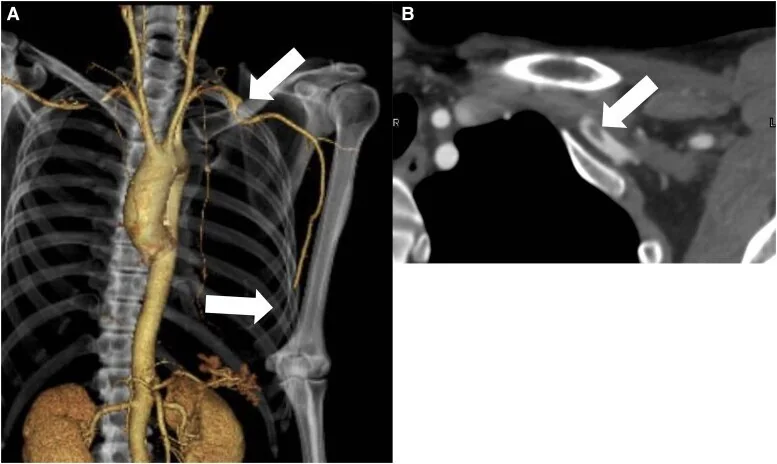
- BTA’da segmental oklüzyon, brakiyal, aksiller veya önkol arterinde lümen kontrast kaybı olarak gösterilebilir; tıkanmanın seviyesi ve proksimal-distal uzunluğu anatomik ayrıntıyla raporlanır.
- Oklüzyon sonrası distal yeniden doluş ve kollateral dolaşım değerlendirilir; CTA trombüsün uzunluğu, kollateral dolaşımı ve dal damar tutulumunu içeren anatomik ayrıntıyı sağlar.
- Akut üst ekstremite iskemisinin en sık nedeni kardiyak kaynaklı embolidir; mural trombüs periferik distal arterleri tıkayarak ani akım bozukluğuna yol açabilir ve embolik-trombotik ayrım yönetimi değiştirebileceğinden önemlidir.
- Akut üst ekstremite iskemisinin en sık nedeni kardiyak kaynaklı embolidir. Torasik çıkış sendromu, subklavyen veya aksiller arter anevrizması ve arterit üst ekstremite iskemisinin olası nedenleri arasında bildirilmiştir.
- Anevrizma veya psödoanevrizma içi trombüs — aksiller arter anevrizmasının duvar trombüsünün distal arter embolizasyonuna yol açabildiği ve brakiyal arter anevrizmasının tromboembolik olayın nedeni olabildiği göz önünde bulundurularak distal dolaşım değerlendirilir.
- Daha önce greft veya stent uygulanmış arterlerde akut tromboz gelişebilir; BTA damar açıklığını ve oklüzyonun anatomik yerini değerlendirmeye yardımcı olur.
- Yetersiz distal opasifikasyon — önkolda azalan opasifikasyon, edinim zamanlamasına bağlı artefakt olasılığı nedeniyle gerçek oklüzyondan ayrılmalı ve kontrast protokolü ile pitfall/artefakt bilgisi birlikte değerlendirilmeli.
Ölçütler ve sınıflamalar
- Rutherford akut ekstremite iskemisi sınıflaması
- Rutherford sınıflaması akut ekstremite iskemisini klinik bulgular ve Doppler ölçümlerine göre canlı, tehdit altında ve geri dönüşsüz olarak sınıflandırır; BTA damar açıklığını ve anatomik ayrıntıyı değerlendirebilir.
Normalde
Normal BTA’da subklavyen arter birinci kostanın lateral kenarını geçtikten sonra aksiller artere devam eder; brakiyal arter bifurkasyonu izlenir ve radial arter brakiyal arterin bir terminal dalı olarak seyrini sürdürür. Radial ve ulnar arter segmentlerinin opasifikasyonu değerlendirilirken normal varyantlar, CTA pitfall ve artefaktları akut oklüzyonla karıştırılmamaya çalışılır; şüpheli bulgu çok düzlemli değerlendirmeyle doğrulanır.
Ayırıcı tanı
- Kronik periferik arter hastalığı
- önceden var olan periferik arter hastalığına bağlı in situ tromboz, akut emboliden ayrılmalıdır; embolik ve trombotik nedenlerin ayrımı yönetimi değiştirebilir.
- Vazospazm
- üst ekstremite iskemisine yol açabilen nedenler arasında bildirilen bir olasılıktır; CTA pitfall ve artefaktları akut oklüzyon görünümünü taklit edebileceğinden dikkatli ayrım gerekir.
- Kontrast bolusunun edinim zamanlamasını geçmesi
- segmentin opasifikasyonunda azalma veya terslenme görülebilir ve bu durum yalancı oklüzyon izlenimi yaratabilir.
- Travmatik diseksiyon
- künt subklavyen/aksiller arter yaralanması şüphesinde CTA’da değerlendirilmesi gereken ayırıcı tanıdır; damar yaralanmasına ait bulgular acil değerlendirme ve hızlı raporlama ile belirlenmelidir.
- Eksternal bası
- torasik çıkış sendromu veya servikal kosta gibi nedenlerle subklavyen veya aksiller arterin dıştan daralması distal tromboz ve iskemiye yol açabilir.
Tuzaklar
- Distal arterlerde azalan opasifikasyon görülürse edinim zamanlaması artefaktı olasılığı değerlendirilmeli; kontrast protokolü ve opasifikasyon dengesi gözden geçirilmeli, CTA pitfall veya artefaktları gerçek oklüzyondan ayrılmalıdır.
- Lümen içinde şüpheli dolum defekti veya kesinti görülürse multiplanar CTA görüntüleriyle doğrulanmalı; normal varyantlar, anomaliler ve pitfall/artefaktlar oklüzyon veya dolum defekti taklit edebilir.
- Lümen içinde şüpheli kesinti veya çizgilenme görülürse komşu kesitler ve ortogonal rekonstrüksiyonlarla doğrulayın; pitfall ve artefaktlar akut oklüzyonu taklit edebilir veya maskeleyebilir.
- Akut üst ekstremite iskemisi acil değerlendirme gerektirir; torasik çıkış sendromu kuşkusunda görüntüleme, etkilenen damarları ve basıya yol açan anatomik nedenleri ortaya koymaya yardımcı olur.
Kendini dene
Ani başlayan el ağrısı, soğukluk, solukluk, parestezi ve nabız kaybı olan hastada üst ekstremite akut iskemisinin en sık nedeni hangisidir?
Cevabı göster
Kardiyak kaynaklı emboli. Üst ekstremitede ani başlayan iskemide en sık neden kalp kaynaklı bir embolidir. Akut oklüzyonda emboli ile yerinde trombozun ayırt edilmesi ve bu ayrımın yönetimi değiştirebileceği vurgulanır; değerlendirme ekstremitenin eksiksiz fizik ve damar muayenesi ile tamamlanır.
Arteriyel BT anjiyografide segmenterin opasifikasyonunun beklenenden azalmış/ters olması en olası hangi teknik nedeni düşündürür?
Cevabı göster
Edinim zamanlamasının gecikmesi. Opasifikasyonda azalma veya terslenme, gecikmiş edinim zamanlamasını gösterir. Kontrast dozu, enjeksiyon hızı ve süresi arteriyel opasifikasyonu etkiler; diseksiyon, trombüs ve transeksiyon yapısal lezyonlar olarak değerlendirilir.
İlgili konular
- Üst ekstremite travmatik intimal yaralanma ve oklüzyon
- Üst ekstremite arter psödoanevrizması
- Üst ekstremite arteriyovenöz fistülü ve travmatik AVF
Kaynaklar
Bu sayfadaki 38 cümle ve 2 quiz sorusu aşağıdaki kaynaklardan alıntılarla otomatik olarak karşılaştırıldı; 24 cümle bu karşılaştırmada düzeltildi (2026-10-12).
- Axillary artery pseudoaneurysm with concurrent distal thrombosis: a case reportpmc.ncbi.nlm.nih.gov
- Acute Upper Extremity Ischemia Due to Cardioembolism From Undiagnosed Atrial Fibrillationpmc.ncbi.nlm.nih.gov
- Axillary artery fibromuscular dysplasia in a symptomatic type B aortic dissection causing acute limb ischemiapmc.ncbi.nlm.nih.gov
- Contralateral brachial arterial access for endovascular treatment of recurrent axillofemoral bypass graft stump syndrome: A case reportpmc.ncbi.nlm.nih.gov
- Acute upper extremity ischemia and symptomatic popliteal artery aneurysm secondary to coronavirus disease 2019pmc.ncbi.nlm.nih.gov
- Endovascular management of radiation-induced subclavian and axillary artery aneurysms.pubmed.ncbi.nlm.nih.gov
- Acute Upper Extremity Ischemia Due to Cardioembolism From Undiagnosed Atrial Fibrillation.pubmed.ncbi.nlm.nih.gov
- Acute right upper extremity ischemia resulting from true aneurysmof right brachial artery: A case report.pubmed.ncbi.nlm.nih.gov
- Interarm blood pressure difference and mortality in patients with acute ischemic stroke.pubmed.ncbi.nlm.nih.gov
- Isolated Upper Limb Weakness From Ischemic Stroke: Mechanisms and Outcome.pubmed.ncbi.nlm.nih.gov
- Acute blue finger: a diagnostic challenge.pubmed.ncbi.nlm.nih.gov
- Cortical Hand Knob Stroke: Report of 25 Cases.pubmed.ncbi.nlm.nih.gov
- Aneurysms of the hand: Imaging and surgical technique.pubmed.ncbi.nlm.nih.gov
- Vascular TOS-Creating a Protocol and Sticking to It.pubmed.ncbi.nlm.nih.gov
- Possible Development of Burn-Out Nonalcoholic Steatohepatitis under Long-Term Steroid Use.pubmed.ncbi.nlm.nih.gov
- [Bilateral wrist drop - central or peripheral lesion?].pubmed.ncbi.nlm.nih.gov
- Acute Limb Ischemia in Cogan Syndrome.pubmed.ncbi.nlm.nih.gov
- High osteoprotegerin levels predict MACCE in STEMI patients, but are not associated with myocardial salvage.pubmed.ncbi.nlm.nih.gov
- Bilateral Acute Cardioembolic Limb Ischemia After Coronavirus Disease 2019 Pneumonia in a Lung Transplant Recipient: A Case Report.pubmed.ncbi.nlm.nih.gov
- Acute Limb Ischemia Presenting as a Clinical Conundrum: Stroke Mimic or Aortic Dissection?pubmed.ncbi.nlm.nih.gov
- Challenges in Diagnosis and Management of Acute Limb Ischemia 30 Days Postpartum in Lithotomy Position: A Case Report from Somalia Leading to Bilateral Lower Limb Amputation.pubmed.ncbi.nlm.nih.gov
- Concurrent Acute Limb Ischemia and Pulmonary Embolism in an Adult With Repaired Tetralogy of Fallot: A Case Report.pubmed.ncbi.nlm.nih.gov
- CT Angiography of the Upper Extremities: Review of Acute Arterial Entities.pubmed.ncbi.nlm.nih.gov
- Tissue-retained needles in people who inject drugs: A systematic review of case reports and series on clinical presentations, complications and management.pubmed.ncbi.nlm.nih.gov
- S1 Guideline on Infected Interdigital Intertrigo (also called Gram-Negative Toe Web Infection).pubmed.ncbi.nlm.nih.gov
- Chronic Bilateral Distal Radial and Ulnar Artery Occlusion Presenting as Peripheral Neuropathy in a Young Adult.pubmed.ncbi.nlm.nih.gov
- Valsalva Leading to Pain in the Left Arm: A Case of Paradoxical Embolism.pubmed.ncbi.nlm.nih.gov
- Acute upper limb ischemia secondary to crutch-induced brachial artery aneurysm.pubmed.ncbi.nlm.nih.gov
- Treatment of acute hand ischemia following a scald injury in a hemodialysis patient with central venous occlusion: a case report.pubmed.ncbi.nlm.nih.gov
- Upper-Limb Ischemia Due to Distal Embolization from a Dissecting Axillary Artery Pseudoaneurysm in an Elite Overhead Athlete: A Case Report.pubmed.ncbi.nlm.nih.gov
- Acute limb ischemia secondary to left brachial artery occlusion in a 45-year-old woman: A case report.pubmed.ncbi.nlm.nih.gov
- Multiterritory Bihemispheric Ischemic Stroke in the Setting of Unilateral Internal Carotid Artery Disease.pubmed.ncbi.nlm.nih.gov
- Multiterritory Acute Ischemic Stroke with Bilateral Middle Cerebellar Peduncle T2/FLAIR Hyperintensities in the Setting of a Fatal Systemic Arterial Thrombotic Process: A Case Report.pubmed.ncbi.nlm.nih.gov
- Arterial thoracic outlet syndrome due to a first-rib anomaly causing brachial artery embolic occlusion: a case report.pubmed.ncbi.nlm.nih.gov
- The spectrum of computed tomography findings in blunt trauma of the subclavian/axillary artery: a pictorial essay.pubmed.ncbi.nlm.nih.gov
- Roles of Trauma CT and CTA in Salvaging the Threatened or Mangled Extremity.pubmed.ncbi.nlm.nih.gov
- Operative Procedures for Ultrasound Assessment of Extracranial Artery Disease: A Narrative Review by the Italian Society for Vascular Investigation (SIDV).pubmed.ncbi.nlm.nih.gov
- Relationship of the pulmonary disease severity scoring with thromboembolic complications in COVID-19.pubmed.ncbi.nlm.nih.gov
- Multisystem Imaging Manifestations of COVID-19, Part 1: Viral Pathogenesis and Pulmonary and Vascular System Complications.pubmed.ncbi.nlm.nih.gov
- Imaging of cerebral ischemia: from acute stroke to chronic disorders.pubmed.ncbi.nlm.nih.gov
- International Society of Paediatric Surgical Oncology (IPSO) Surgical Practice Guidelines.pubmed.ncbi.nlm.nih.gov
- Commentary: an eye on PET quantification.pubmed.ncbi.nlm.nih.gov
- When Cancer Clots: An Extensive Radiologic Analysis of Cancer-Associated Thromboembolism.pubmed.ncbi.nlm.nih.gov
- Imaging insights in veno-venous and veno-arterial extracorporeal membrane oxygenation (ECMO): CT protocols, underlying pathophysiology, and main complications.pubmed.ncbi.nlm.nih.gov
- Mesenteric Ischemia: A Comprehensive Review of the Role of Radiology in Diagnosis.pubmed.ncbi.nlm.nih.gov
- Acute Lower Limb Ischemia-Etiology, Pathology, and Management.pubmed.ncbi.nlm.nih.gov
- 2022 ACC/AHA guideline for the diagnosis and management of aortic disease: A report of the American Heart Association/American College of Cardiology Joint Committee on Clinical Practice Guidelines.pubmed.ncbi.nlm.nih.gov
- 2022 ACC/AHA Guideline for the Diagnosis and Management of Aortic Disease: A Report of the American Heart Association/American College of Cardiology Joint Committee on Clinical Practice Guidelines.pubmed.ncbi.nlm.nih.gov
- Hybrid therapy for acute upper limb ischaemia with thoracic outlet syndrome: a case report.pubmed.ncbi.nlm.nih.gov
- Non-invasive Vascular Laboratory Evaluation of the Upper Extremity.pubmed.ncbi.nlm.nih.gov
- Risk factors of postoperative complications after F/B-TEVAR for aortic arch lesions: a multicenter retrospective analysis.pubmed.ncbi.nlm.nih.gov
- Left Subclavian Artery Thrombosis Causing Myocardial Ischemia in Patients With Prior Coronary Artery Bypass Grafting.pubmed.ncbi.nlm.nih.gov
- Long-term follow-up of the VORTEC technique: A clampless, sutureless technique for supra-aortic debrancing.pubmed.ncbi.nlm.nih.gov
- One-Stage Surgical Management of Adult Native Coarctation and Severe Aortic Stenosis: A Case Report.pubmed.ncbi.nlm.nih.gov
- Safety and efficacy of the pipeline vantage flow diverter for the treatment of saccular aneurysms in the posterior cerebral circulation.pubmed.ncbi.nlm.nih.gov
- Vascular CT and MRI: a practical guide to imaging protocols.pubmed.ncbi.nlm.nih.gov
- Prevalence of Radial Artery Variants and Their Relationship with Clinical Considerations of the Antebrachial Region: Systematic Review and Meta-Analysis.pubmed.ncbi.nlm.nih.gov
- Localized renal artery vasculopathy: avoiding misdiagnosis between inflammatory arteritis and isolated renal artery dissection.pubmed.ncbi.nlm.nih.gov
- Preliminary results of 3D MRI-DSA fusion for navigation planning in endovascular recanalization of chronic intracranial artery occlusion.pubmed.ncbi.nlm.nih.gov
- Ultra-High-Resolution Photon-Counting CT Angiography for Noninvasive Detection of Neurovascular In-Stent Restenosis.pubmed.ncbi.nlm.nih.gov
- Society for Cardiovascular Magnetic Resonance 2024 Cases of SCMR case series.pubmed.ncbi.nlm.nih.gov
- Characteristics and evaluation of atherosclerotic plaques: an overview of state-of-the-art techniques.pubmed.ncbi.nlm.nih.gov
- Brazilian Angiology and Vascular Surgery Society Guidelines for the treatment of extracranial cerebrovascular disease.pubmed.ncbi.nlm.nih.gov
- Where Does the Signal Go? Technical Challenges of CT Perfusion in Lacunar and Infratentorial Stroke.pubmed.ncbi.nlm.nih.gov
- Multimodal imaging in neuro-ophthalmology.pubmed.ncbi.nlm.nih.gov
- Acute Traumatic Aortic Injury: What the Radiologist Needs to Know.pubmed.ncbi.nlm.nih.gov
- Disrupted anastomotic pseudoaneurysm in arteriovenous grafts: an etiology-driven case series with a proposed preliminary management framework.pubmed.ncbi.nlm.nih.gov
- Ruptured Penetrating Aortic Ulcer With Hemopericardium in a Young Adult: A Case Report.pubmed.ncbi.nlm.nih.gov
- Severe celiac trunk stenosis following blunt trauma in a patient with diabetic ketoacidosis: a diagnostic dilemma of traumatic injury versus median arcuate ligament syndrome.pubmed.ncbi.nlm.nih.gov
- CT-Centered Multimodality Imaging of Arterial Wall Fragility in Acute Aortic Syndromes: A Narrative Review of Imaging Markers and Clinical Implications.pubmed.ncbi.nlm.nih.gov
- Neuroimaging for neurovascular complications of traumatic brain injury.pubmed.ncbi.nlm.nih.gov
- Imaging of acute pulmonary embolism: an update.pubmed.ncbi.nlm.nih.gov
- Multimodality Imaging of Thoracic Outlet Syndrome: Etiological and Anatomical Correlates.pubmed.ncbi.nlm.nih.gov
- Diagnostic and Therapeutic Approach to Thoracic Outlet Syndrome.pubmed.ncbi.nlm.nih.gov
- Lead-Related Venous Obstruction in Patients With Implanted Cardiac Devices: JACC Review Topic of the Week.pubmed.ncbi.nlm.nih.gov
- Individualized Management of Traumatic Limb Pseudoaneurysms: A Case-Based Comparison of Endovascular and Open Repair.pubmed.ncbi.nlm.nih.gov
- Beyond the Usual Suspects: Rare Causes of Hemoptysis.pubmed.ncbi.nlm.nih.gov
- Cannabis-Associated Spontaneous Coronary Artery Dissection in a Community Hospital: A Case-Based Focused Literature Review.pubmed.ncbi.nlm.nih.gov
- Unmasking the Imitators: Challenges in Identifying Intracranial Atherosclerosis-Related Large Vessel Occlusion Mimics During Mechanical Thrombectomy.pubmed.ncbi.nlm.nih.gov
- Vessel Wall Magnetic Resonance Imaging in Cerebrovascular Diseases.pubmed.ncbi.nlm.nih.gov
- Spectrum of Large and Medium Vessel Vasculitis in Adults: Primary Vasculitides, Arthritides, Connective Tissue, and Fibroinflammatory Diseases.pubmed.ncbi.nlm.nih.gov
- Hepatic Artery Infusion Pumps: A Surgical Toolkit for Intraoperative Decision-Making and Management of Hepatic Artery Infusion-Specific Complications.pubmed.ncbi.nlm.nih.gov
- Single rotation CTA of extracranial carotids integrated with cerebral CTP provides sufficient quality for decision making in patients with ischaemic stroke.pubmed.ncbi.nlm.nih.gov
- Long-term safety and effectiveness of the "OptEase" vena cava filter.pubmed.ncbi.nlm.nih.gov
- Patterns of injury and violence in Yaoundé Cameroon: an analysis of hospital data.pubmed.ncbi.nlm.nih.gov
- Acute aortic dissection presenting as crossed neurological symptoms: a case report.pubmed.ncbi.nlm.nih.gov
- C3 spinal cord infarction associated with cervical ossification of the posterior longitudinal ligament presenting as a stroke mimic: illustrative case.pubmed.ncbi.nlm.nih.gov
- Advanced Imaging in Methanol Toxicity: Bilateral Putaminal Necrosis and Frontal-Occipital Ischemia-A Case Report.pubmed.ncbi.nlm.nih.gov
- Staged Endovascular Intervention for Axillary Artery Aneurysm Complicated by Recurrent Upper Limb Arterial Embolism: A Case Report.pubmed.ncbi.nlm.nih.gov
- Superficial femoral artery thrombosis after PFNA in an intertrochanteric fracture patient with sarcopenia and copd: a rare case report.pubmed.ncbi.nlm.nih.gov
- Biliary Reconstruction in Liver Transplantation for Primary Sclerosing Cholangitis: Outcomes of an Anatomy-Driven Shift Towards Duct-to-Duct Anastomosis.pubmed.ncbi.nlm.nih.gov
- "Severe Aortic Regurgitation as the Initial Manifestation of Takayasu Arteritis in a Young Woman: A Case Report".pubmed.ncbi.nlm.nih.gov
- Self-Expanding metal stent placement for hepatic venous outflow obstruction following ex vivo liver resection and autotransplantation.pubmed.ncbi.nlm.nih.gov
- Late Complete Endograft Occlusion After Endovascular Aneurysm Repair Successfully Treated With Unilateral Endograft Relining and Femoro-femoral Bypass: A Case Report.pubmed.ncbi.nlm.nih.gov
- Idiopathic IgG4-negative perivascular fibrosis with extensive thoracic aortic, coronary artery, and supra-aortic branch involvement: A case report.pubmed.ncbi.nlm.nih.gov
- Cystic Medial Degeneration Leading to Popliteal Artery Aneurysm With Distal Embolization.pubmed.ncbi.nlm.nih.gov
- Crossing the Septum: May-Thurner Syndrome and Patent Foramen Ovale as a Dual Mechanism for Recurrent Ischemic Stroke.pubmed.ncbi.nlm.nih.gov
- A Case of High-Risk Acute Stanford Type B Aortic Dissection in a Right-Sided Aortic Arch Presenting With Transient Hemiparesis.pubmed.ncbi.nlm.nih.gov
- VIABAHN stent grafts for traumatic arterial injury: A case series.pubmed.ncbi.nlm.nih.gov
- Large vessel vasculitis reframed: integrating conceptual shifts and evidence into practice for Takayasu arteritis and giant cell arteritis.pubmed.ncbi.nlm.nih.gov
- Takayasu Arteritis and Giant Cell Arteritis: Results From a Cross-Sectional Study of 96 Italian Patients.pubmed.ncbi.nlm.nih.gov
- Ultrasound-Guided Direct Thrombolytic Injection for Acute and Early-Subacute Arterial Occlusions: Feasibility and Early Outcomes.pubmed.ncbi.nlm.nih.gov
- A rare presentation of nonbacterial thrombotic endocarditis.pubmed.ncbi.nlm.nih.gov
- Unusual painless upper limb ischemia in a patient with diabetes. A case study.pubmed.ncbi.nlm.nih.gov
- Clinical outcome of extremity arterial injuries in the modern era.pubmed.ncbi.nlm.nih.gov
- Extensive Iliofemoral Intimal Injury after Handlebar Trauma Requiring Iliac Exposure and Saphenous Vein Interposition Grafting: A Case Report.pubmed.ncbi.nlm.nih.gov
- Management of Acute Infrainguinal Graft Occlusion: Surgical and Endovascular Approaches in Contemporary Practice.pubmed.ncbi.nlm.nih.gov
- Blunt trauma precipitating arterial thoracic outlet syndrome: a case report.pubmed.ncbi.nlm.nih.gov
- Subclavian Artery Diseasepubmed.ncbi.nlm.nih.gov
- Recurrent Acute Limb Ischaemia due to Malignant Thromboembolism Involving Bilateral Lower Limbs Simultaneously.pubmed.ncbi.nlm.nih.gov
- Coronary-Driven Cerebral Revascularization in Type 2a Takayasu Arteritis: A Rare Multisystem Collateral Phenotype.pubmed.ncbi.nlm.nih.gov
- Carotid steal syndrome with recurrent syncope: A novel manifestation of Takayasu arteritis.pubmed.ncbi.nlm.nih.gov
- Giant ulnar artery aneurysm secondary to congenital arteriovenous fistula and trauma: a case report.pubmed.ncbi.nlm.nih.gov
- Atypical Takayasu Arteritis Presenting as Ischemic Stroke in a Young Female Despite Normal ESR and Preserved Peripheral Pulses: A Case Report.pubmed.ncbi.nlm.nih.gov
- Endovascular Revascularization of Symptomatic Superficial Femoral Artery (SFA) Occlusion After Below-Knee Amputation Despite Absent Distal Runoff.pubmed.ncbi.nlm.nih.gov
- pubmed.ncbi.nlm.nih.govpubmed.ncbi.nlm.nih.gov
Eğitim amaçlıdır; hasta başında tanı ve tedavi kararının yerine geçmez, tıbbi tavsiye değildir. Metinler yapay zekâ desteğiyle yazıldı ve otomatik bir adımda kaynak alıntılarıyla karşılaştırıldı; bu bir tıbbi doğrulama değildir ve içerik uzman radyolog incelemesinden geçmedi. Klinik kararlarda güncel kılavuzları, kurum protokollerini ve radyoloji raporunu esas alın.