Özet
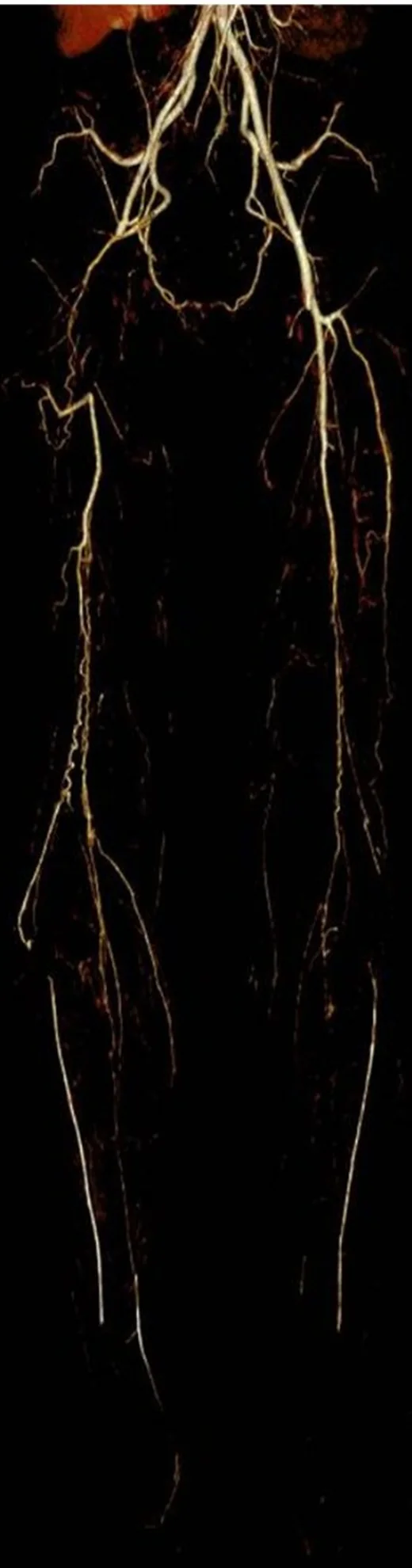
Kladikasyon, istirahat ağrısı veya iyileşmeyen ayak yarası bulunan hastada periferik arter hastalığı, akımı sınırlayan lezyonların yerini ve ayağa uzanan damar yatağını belirlemek için incelenir. Runoff BTA, aortoiliak inflow'dan tibial ve pedal arterlere kadar plak, darlık, oklüzyon ve distal yeniden doluşu anatomik olarak haritalar; özellikle revaskülarizasyon planlamasında yol gösterir. Görüntüleme klinik bulgular, risk profili veya yönetim üzerindeki olası etkisiyle gerekçelendirilmelidir; asemptomatik damar yataklarının rutin anatomik taraması desteklenmez. Ağır kalsifikasyon veya yavaş distal kontrast geçişi doğru açıklığı maskeleyebilir; kullanılabilir runoff damarının yanlışlıkla kaybedilmesi doku kaybı riski taşıyan hastada planlamayı etkiler.
Faz ve pencere
- BTA tanısal
- İyotlu kontrastın arteriyel geçişinde aort bifurkasyonundan ayaklara uzanan kontrastlı lümen boyunca eksantrik/çevresel plak, darlık, oklüzyon ve distal kollateral doluş incelenir. Damar duvarı kalsiyumu lümeni örtebilir; tibial opasifikasyonun zayıf olması gerçek kapanma kadar yavaş akım veya bolus zamanlamasıyla da ilişkili olabilir. Değerlendirme aksiyel kaynak kesitlerde, damar eksenine dik rekonstrüksiyonlarda ve MIP görüntülerinde çapraz doğrulanır.
Önerilen pencereler: Anjiyo (G 600 / M 150), Kemik (G 1800 / M 400), Yumuşak doku (G 400 / M 40).
BT bulguları
- Aterosklerotik plak — ortak iliak, ortak femoral, yüzeyel femoral veya popliteal arter duvarında kalsifiye, yumuşak ya da karmaşık plak ve eşlik eden lümen düzensizliği.
- Lümen darlığı — kontrast kolonunun fokal veya uzun segmentli incelmesi; darlığın yerini, uzunluğunu ve çevresindeki referans damar kesitini tarif et.
- Kronik oklüzyon — bir arter segmentinde kontrastlı lümen devamlılığının kaybı ve kapanma sonrasında distal yatağın yeniden doluş paterni.
- Kollateral yeniden doluş — profunda femoris, kas dalları veya geniküler ağ üzerinden hastalıklı segmentin distalindeki artere ulaşan kontrast yolu.
- Femoropopliteal hastalık — yüzeyel femoral arterin adduktor kanalından popliteal arter trifurkasyonuna uzanan tek ya da çok odaklı plaklı lezyonlar.
- Tibial arter hastalığı — anterior tibial, posterior tibial ve fibular arterlerin lümen açıklığı ile çevresel medial kalsifikasyonun birlikte değerlendirilmesi.
- Distal runoff — kruris damarlarının ayak bileğine ve görülebildiği ölçüde dorsalis pedis veya plantar arterlere kadar kesintisiz izlenebilirliği; her damarı ayrı kaydet.
Normalde
Hastalıklı segmenti aynı damarın daha az etkilenmiş komşu bölümü ve karşı tarafla karşılaştırırken gerçek lümen çapına, kapanma sonrası yeniden doluşa ve ayağa kadar izlenebilen tibial damarların hangileri olduğuna bakın.
Normal BT ile kıyasla
Aynı bölgenin, kaynak veri setinde patoloji içermediği belirtilen bir BT incelemesini kesit kesit kaydırın; organ sınırlarını açarak anatomiyi hasta görüntüsüyle karşılaştırın. Küçük rastlantısal bulgular tümüyle dışlanmamıştır.
Kaynak: TotalSegmentator v2.01 veri seti (Wasserthal ve ark., Radiology: Artificial Intelligence 2023), CC BY 4.0, vaka s0685; organ sınırları veri setinin otomatik segmentasyonundan, birleştirilerek sadeleştirildi. Görüntüler 2,5 mm kesit aralığına yeniden örneklendi.
Ayırıcı tanı
- Akut emboli
- önceden belirgin plak taşımayan damarda ani intraluminal kesinti; kronik aterosklerotik segmentlerdeki yaygın düzensizlik ve gelişmiş kollateraller eşlik etmeyebilir.
- Akut in situ tromboz
- aterosklerotik darlık, stent veya greft üzerinde yeni dolum kaybı; komşu damar yatağındaki kronik plak yükü zemini gösterir.
- Popliteal arter anevrizması
- popliteal arterin fokal dış çap genişlemesi ve olası mural trombüs, yalnız stenozdan ayrılır.
- Popliteal arter tuzaklanması
- popliteal arterin gastroknemius veya popliteusla anormal ilişkisi ve odaklı bası/deformasyon; yaygın çok seviyeli aterom paterni beklenmez.
Tuzaklar
- Kruris arterlerindeki yoğun medial kalsiyum, kontrast lümenine taşan blooming ile stenozu olduğundan ağır gösterebilir; şüpheli kesiti aksiyel kaynaklarda ve mümkünse damar eksenine dik düzlemde incele.
- Tibial arterin tek bir MIP görüntüsünde seçilmemesi oklüzyonu kanıtlamaz; gecikmiş kontrast geçişi ve bolusun distal yatağı görüntüleme başlamadan önce geçmesi de zayıf opasifikasyon yapabilir.
- Distal kruris arterlerinde yoğun kalsiyum veya yavaş akım lümen değerlendirmesini zorlaştırabilir; damar devamlılığını kaynak kesitlerde ve damar eksenine dik düzlemde çapraz doğrulayın.
- Kıvrımlı kollateral damarlar aksiyel kesitte normal kruris arteri sanılabilir; beklenen anatomik seyir ve distal devamlılık üzerinden gerçek tibial damardan ayır.
Kendini dene
Diyabetli hastanın BTA'sında tibial arter çevresinde yoğun kalsiyum var; MIP'de lümen kapanmış görünürken ince aksiyel kesitte kontrast seçiliyor. En olası neden nedir?
Cevabı göster
Kalsiyum blooming artefaktı. Çevresel kalsiyumun blooming'i küçük tibial lümenin üzerine taşarak MIP'de yalancı kapanma izlenimi yaratabilir. Taze emboli intraluminal kesinti oluşturur; anevrizma damar dış çapını genişletir; erken venöz doluş arteriyovenöz şant düşündürür.
Yüzeyel femoral arterde uzun segmentli oklüzyon görülebilir. Bu bulgular hangi tanıyla en uyumludur?
Cevabı göster
Kronik aterosklerotik oklüzyon. Uzun segmentli yüzeyel femoral kapanma çevresinde oluşmuş geniküler kollateraller kronik akım kısıtlanmasını destekler. İzole akut emboli genellikle önceden gelişmiş bu kollateral ağı açıklamaz; tuzaklanma odaklı popliteal bası yapar; fistülde arterle erken dolan ven arasında şant aranır.
İlgili konular
Kaynaklar
Bu sayfadaki 37 cümle ve 2 quiz sorusu aşağıdaki kaynaklardan alıntılarla otomatik olarak karşılaştırıldı; 4 cümle bu karşılaştırmada düzeltildi (2026-10-09).
- Multisystem Thromboembolic Shower in the Intensive Care Unitpmc.ncbi.nlm.nih.gov
- Coronary plaque burden and computed tomography-derived fractional flow reserve are predictors of 5-year mortality in peripheral artery disease patients with no known coronary artery diseasepmc.ncbi.nlm.nih.gov
- Photon-counting detector computed tomography angiogram more accurately characterizes lower extremity runoff than traditional computed tomograph angiogrampmc.ncbi.nlm.nih.gov
- Recurrent thoracic aortic stent graft thrombosispmc.ncbi.nlm.nih.gov
- Polyvascular Atherosclerotic Disease: A Narrative Review of the Role of Systematic Bedside Vascular Examinationpmc.ncbi.nlm.nih.gov
- Peripheral arterial occlusion due to COVID-19: CT angiography findings of nine patients.pubmed.ncbi.nlm.nih.gov
- The persistent sciatic artery: Report of ten cases.pubmed.ncbi.nlm.nih.gov
- Quiescent-Interval Single-Shot Magnetic Resonance Angiography.pubmed.ncbi.nlm.nih.gov
- Improving diagnostic accuracy for arteries of lower extremities with dual-energy spectral CT imaging.pubmed.ncbi.nlm.nih.gov
- CT angiography of the lower extremities.pubmed.ncbi.nlm.nih.gov
- Superficial Femoral Artery Recanalization Using Fiber Optic RealShape Technology.pubmed.ncbi.nlm.nih.gov
- Optimal table feed in run-off CT angiography in patients with abdominal aortic aneurysms.pubmed.ncbi.nlm.nih.gov
- Technical considerations for lower limb multidetector computed tomographic angiography.pubmed.ncbi.nlm.nih.gov
- Preprocedural Cross-Sectional Imaging Prior to Percutaneous Peripheral Arterial Disease Interventions.pubmed.ncbi.nlm.nih.gov
- [Application of low dose CT angiography with 70 kV in patients with peripheral arterial diseases].pubmed.ncbi.nlm.nih.gov
- Extravascular incidental findings in run-off CT angiography in patients with acute limb ischaemia: incidence and clinical relevance.pubmed.ncbi.nlm.nih.gov
- Structured Reporting of CT Angiography Runoff Examinations of the Lower Extremities.pubmed.ncbi.nlm.nih.gov
- ACR Appropriateness Criteria® Lower Extremity Arterial Claudication-Imaging Assessment for Revascularization: 2022 Update.pubmed.ncbi.nlm.nih.gov
- Toe-brachial index and toe systolic blood pressure for the diagnosis of peripheral arterial disease.pubmed.ncbi.nlm.nih.gov
- Prospective Evaluation of Peripheral Arterial Intervention Using Air Plethysmography.pubmed.ncbi.nlm.nih.gov
- Updates in antithrombotic therapy in coronary and peripheral artery disease.pubmed.ncbi.nlm.nih.gov
- A randomized controlled trial of drug-coated balloon versus conventional balloon angioplasty in diabetic patients with lower extremity arteriosclerosis obliterans: outcomes in ankle-brachial index and restenosis rate.pubmed.ncbi.nlm.nih.gov
- From Angiosome to Woundosome: An Interdisciplinary Approach to Personalized Revascularization in Chronic Limb-Threatening Ischemia.pubmed.ncbi.nlm.nih.gov
- Lesion Morphology and Technical Success in Diabetic vs. Non-Diabetic Patients with Chronic Limb-Threatening Ischemia Undergoing Endovascular Treatment: A Retrospective Single-Center Study.pubmed.ncbi.nlm.nih.gov
- Peripheral artery disease in diabetes.pubmed.ncbi.nlm.nih.gov
- 10th Anniversary of the European Association for Predictive, Preventive and Personalised (3P) Medicine - EPMA World Congress Supplement 2020.pubmed.ncbi.nlm.nih.gov
- Long-term safety and effectiveness of the "OptEase" vena cava filter.pubmed.ncbi.nlm.nih.gov
- Commentary: an eye on PET quantification.pubmed.ncbi.nlm.nih.gov
- CTA Imaging of Peripheral Arterial Injuries.pubmed.ncbi.nlm.nih.gov
- Clinical physiology: the crucial role of MRI in evaluation of peripheral artery disease.pubmed.ncbi.nlm.nih.gov
- Multi-detector row computed tomography angiography of peripheral arterial disease.pubmed.ncbi.nlm.nih.gov
- Evaluation of Atherosclerotic Changes in the Superior Mesenteric Artery Using MDCT.pubmed.ncbi.nlm.nih.gov
- Multimodal imaging in neuro-ophthalmology.pubmed.ncbi.nlm.nih.gov
- Narrower jugular bulbs and their tributaries are associated with skull base venous hyperintensity on arterial spin-labeling MRI.pubmed.ncbi.nlm.nih.gov
- Intravascular imaging in peripheral arterial disease: a contemporary literature review.pubmed.ncbi.nlm.nih.gov
- Monckeberg's Medial Sclerosis in Athletes: Report of Two Cases and Possible Pathophysiological Mechanisms.pubmed.ncbi.nlm.nih.gov
- Outcomes of intravascular lithotripsy for calcified femoropopliteal and infrapopliteal artery disease: A systematic review with qualitative synthesis.pubmed.ncbi.nlm.nih.gov
- Advanced quantitative CT for coronary artery disease: integrating stenosis quantification, plaque quantification, and fractional flow reserve-CT.pubmed.ncbi.nlm.nih.gov
- Stress CT myocardial perfusion imaging after arterial switch operation for transposition of the great arteries.pubmed.ncbi.nlm.nih.gov
- Coronary CT Angiography in PCI Planning: Advances, Clinical Applications, and Challenges.pubmed.ncbi.nlm.nih.gov
- Long Chronic Total Occlusions: Revascularization Strategies.pubmed.ncbi.nlm.nih.gov
- Global Vascular Guidelines on the Management of Chronic Limb-Threatening Ischemia.pubmed.ncbi.nlm.nih.gov
- Global vascular guidelines on the management of chronic limb-threatening ischemia.pubmed.ncbi.nlm.nih.gov
- Superficial femoral artery thrombosis after PFNA in an intertrochanteric fracture patient with sarcopenia and copd: a rare case report.pubmed.ncbi.nlm.nih.gov
- Wall shear stress and oscillatory shear index measured using ultrasound vector flow imaging in the femoropopliteal artery of adults without peripheral artery disease.pubmed.ncbi.nlm.nih.gov
- Peripheral Vascular Calcification.pubmed.ncbi.nlm.nih.gov
- Brazilian Society of Angiology and Vascular Surgery 2023 guidelines on the diabetic foot.pubmed.ncbi.nlm.nih.gov
- Management of calcific myonecrosis with a sinus tract: A case report.pubmed.ncbi.nlm.nih.gov
- Roles of Trauma CT and CTA in Salvaging the Threatened or Mangled Extremity.pubmed.ncbi.nlm.nih.gov
- Comparative angiotomographic study of swine vascular anatomy: contributions to research and training models in vascular and endovascular surgery.pubmed.ncbi.nlm.nih.gov
- Peripheral artery disease: how much inter-leg symmetry? A contrast-enhanced magnetic resonance angiography study.pubmed.ncbi.nlm.nih.gov
- Obesity and Cardiovascular Disease: An Obesity Medicine Association (OMA) Clinical Practice Statement (CPS) 2026.pubmed.ncbi.nlm.nih.gov
- Novel Therapeutic Approaches to Prevent Atherothrombotic Ischemic Stroke in Patients with Carotid Atherosclerosis.pubmed.ncbi.nlm.nih.gov
- Brazilian Angiology and Vascular Surgery Society Guidelines for the treatment of extracranial cerebrovascular disease.pubmed.ncbi.nlm.nih.gov
- Divergent management of a distal left main coronary artery aneurysm presenting as non-ST-elevation myocardial infarction: surgical vs. medical strategy in two cases-a case report.pubmed.ncbi.nlm.nih.gov
- Coronary Artery Ectasia and Aneurysm: Benign Variant or High-Risk Substrate in Need of Tailored Treatment?pubmed.ncbi.nlm.nih.gov
- Unmasking coronary embolism: rare non-atherosclerotic causes of acute coronary syndrome in the young: case series.pubmed.ncbi.nlm.nih.gov
- Spectral Computed Tomography Angiography in Visceral Artery Aneurysms: Technical Principles and Clinical Applications.pubmed.ncbi.nlm.nih.gov
- Integrated multidisciplinary approach to aneurysm hemodynamic analysis: numerical simulation, <i>in Vitro</i> experiment, and deep learning.pubmed.ncbi.nlm.nih.gov
- Vein graft failure: Pathophysiology, detection, prevention and emerging therapeutic strategies.pubmed.ncbi.nlm.nih.gov
- Imaging of penetrating vascular trauma of the body and extremities secondary to ballistic and stab wounds.pubmed.ncbi.nlm.nih.gov
- High-affinity alphavbeta3 integrin targeted optical probe as a new imaging biomarker for early atherosclerosis: initial studies in Watanabe rabbits.pubmed.ncbi.nlm.nih.gov
- Intravascular Lithotripsy and Drug-Coated Balloon Angioplasty for Severely Calcified Common Femoral Artery Atherosclerotic Disease.pubmed.ncbi.nlm.nih.gov
- 2024 ACC/AHA/AACVPR/APMA/ABC/SCAI/SVM/SVN/SVS/SIR/VESS Guideline for the Management of Lower Extremity Peripheral Artery Disease: A Report of the American College of Cardiology/American Heart Association Joint Committee on Clinical Practice Guidelines.pubmed.ncbi.nlm.nih.gov
- 2024 ACC/AHA/AACVPR/APMA/ABC/SCAI/SVM/SVN/SVS/SIR/VESS Guideline for the Management of Lower Extremity Peripheral Artery Disease: A Report of the American College of Cardiology/American Heart Association Joint Committee on Clinical Practice Guidelines.pubmed.ncbi.nlm.nih.gov
- Effect of Anatomic Variations in the Anterior Tibial Artery on Risk of Injury During Orthopaedic Knee Surgeries.pubmed.ncbi.nlm.nih.gov
- Variants of the popliteal artery terminal branches as detected by multidetector ct angiography.pubmed.ncbi.nlm.nih.gov
- A prospective study of preoperative computed tomographic angiographic mapping of free fibula osteocutaneous flaps for head and neck reconstruction.pubmed.ncbi.nlm.nih.gov
- Patterns of injury and violence in Yaoundé Cameroon: an analysis of hospital data.pubmed.ncbi.nlm.nih.gov
- Multisystem Thromboembolic Shower in the Intensive Care Unit: Acute Limb Ischemia and Mesenteric Embolism.pubmed.ncbi.nlm.nih.gov
- Acute aortic dissection presenting as crossed neurological symptoms: a case report.pubmed.ncbi.nlm.nih.gov
- Coronary plaque burden and computed tomography-derived fractional flow reserve are predictors of 5-year mortality in peripheral artery disease patients with no known coronary artery disease.pubmed.ncbi.nlm.nih.gov
- Dynamic Vascular Imaging Unveils Popliteal Artery Entrapment Syndrome in an Atypical Patient: A Case Report.pubmed.ncbi.nlm.nih.gov
- Popliteal artery aneurysm with popliteal artery entrapment syndrome: a case report and literature review.pubmed.ncbi.nlm.nih.gov
- Atypical presentation of symptomatic type III popliteal artery entrapment syndrome with resultant popliteal artery pseudoaneurysm formation.pubmed.ncbi.nlm.nih.gov
- Technology Update in Management of Multi-Ligament Knee Injuries.pubmed.ncbi.nlm.nih.gov
- Clinical Applications of Photon-counting CT: A Review of Pioneer Studies and a Glimpse into the Future.pubmed.ncbi.nlm.nih.gov
- Improving visualization of free fibula flap perforators and reducing radiation dose in dual-energy CT angiography.pubmed.ncbi.nlm.nih.gov
- Paediatric cerebrovascular syndromes: imaging clues to a diagnosis.pubmed.ncbi.nlm.nih.gov
- When Cancer Clots: An Extensive Radiologic Analysis of Cancer-Associated Thromboembolism.pubmed.ncbi.nlm.nih.gov
- Pearls and Pitfalls in the Management of Vascular Anomalies.pubmed.ncbi.nlm.nih.gov
- Absence of the genicular arterial anastomosis as generally depicted in textbooks.pubmed.ncbi.nlm.nih.gov
- Clinical Implications of Anatomical Variations in Nerves and Adjacent Structures for Regional Anesthesia: A Narrative Review.pubmed.ncbi.nlm.nih.gov
- Imaging Features of Soft Tissue Tumor Mimickers: A Pictorial Essay.pubmed.ncbi.nlm.nih.gov
- The potential role of ChatGPT and artificial intelligence in anatomy education: a conversation with ChatGPT.pubmed.ncbi.nlm.nih.gov
- Predictors of target lesion restenosis after endovascular therapy for lower-extremity atherosclerotic peripheral artery disease: a real-world single center cohort.pubmed.ncbi.nlm.nih.gov
- Genicular artery embolization in a patient with popliteal artery agenesis: a case report.pubmed.ncbi.nlm.nih.gov
- Vascular Complication After Revision of Total Knee Arthroplasty (R-TKA): A Case of Popliteal Branch Pseudoaneurysm Successfully Treated with Embolization-A Case Report and Mini Review of the Literature.pubmed.ncbi.nlm.nih.gov
- Application of Combined Superficial Femoral Artery Stenting and Deep Femoral Artery Profundoplasty in Chinese Patients With Lower Extremity Artery Disease.pubmed.ncbi.nlm.nih.gov
- Open Repair of a Giant Superficial Femoral-Popliteal Artery Aneurysm Using Autologous Saphenous Vein Bypass: A Case Report.pubmed.ncbi.nlm.nih.gov
- Safety and Feasibility of In Situ Fenestration in the Aortic Arch: A Prospective Single-Center Observational Cohort Study.pubmed.ncbi.nlm.nih.gov
- Clinical use of reserved guide wire fenestration and Viabahn-covered stent in Stanford type B aortic dissection with left subclavian artery involvement.pubmed.ncbi.nlm.nih.gov
- Proximal Internal Iliac Artery Ligation in Obstetrics and Gynecology: An 11-Year Retrospective Single-Center Experience with No Clinically Detected Ischemic Complications.pubmed.ncbi.nlm.nih.gov
- Imaging of Deep Venous Pathology.pubmed.ncbi.nlm.nih.gov
- A Review of Peripheral Vascular Intervention Technologies.pubmed.ncbi.nlm.nih.gov
- Intermuscular Adipose Tissue as a Multimodality Quantitative Imaging Biomarker: Evidence Across Metabolic, Cardiovascular and Oncologic Diseases.pubmed.ncbi.nlm.nih.gov
- Serum Trimethylamine N-Oxide Levels Are Associated with Peripheral Artery Disease in Patients with Type 2 Diabetes Mellitus.pubmed.ncbi.nlm.nih.gov
- A Modified Technique for Converting Retrograde Femoral Artery Access to Antegrade Access With the Assistance of a Long Sheath.pubmed.ncbi.nlm.nih.gov
- Photon-counting detector computed tomography angiogram more accurately characterizes lower extremity runoff than traditional computed tomograph angiogram.pubmed.ncbi.nlm.nih.gov
- Risk Screening, Early Detection, and Management of Acute Popliteal Artery Thrombosis Following Total Knee Arthroplasty: Three Case Reports.pubmed.ncbi.nlm.nih.gov
- Gangrene of the Foot After Coronary Artery Bypass Graft Surgery.pubmed.ncbi.nlm.nih.gov
- Cystic Medial Degeneration Leading to Popliteal Artery Aneurysm With Distal Embolization.pubmed.ncbi.nlm.nih.gov
- Case Report: A successful percutaneous revascularization of bilateral acute limb ischemia caused by an aortic saddle embolism in a patient with mitral stenosis.pubmed.ncbi.nlm.nih.gov
- Clinical outcomes of tibial cortex transverse transport versus antibiotic-loaded bone cement for Wagner grade 3-4 diabetic foot ulcers: a real-world retrospective cohort study.pubmed.ncbi.nlm.nih.gov
- When the Brainstem Is the Target: Cryptogenic Paramedian Pontine Infarction Associated With Patent Foramen Ovale.pubmed.ncbi.nlm.nih.gov
- Computed Tomographic Angiography (CTA)-guided precision reconstruction in complex lower leg wounds.pubmed.ncbi.nlm.nih.gov
- CT angiography of acute aortic syndrome in patients with chronic kidney disease.pubmed.ncbi.nlm.nih.gov
- Mechanisms of aortic dissection: From pathological changes to experimental and <i>in silico</i> models.pubmed.ncbi.nlm.nih.gov
- Ultrasound Assessment of Extracranial Carotids and Vertebral Arteries in Acute Cerebral Ischemia.pubmed.ncbi.nlm.nih.gov
Eğitim amaçlıdır; hasta başında tanı ve tedavi kararının yerine geçmez, tıbbi tavsiye değildir. Metinler yapay zekâ desteğiyle yazıldı ve otomatik bir adımda kaynak alıntılarıyla karşılaştırıldı; bu bir tıbbi doğrulama değildir ve içerik uzman radyolog incelemesinden geçmedi. Klinik kararlarda güncel kılavuzları, kurum protokollerini ve radyoloji raporunu esas alın.