Özet
Gerçek ECAA'ların en sık nedeni aterosklerozdur; travma yalancı anevrizmayla ilişkilidir; diseksiyon, fibromüsküler displazi, bağ dokusu hastalıkları ve önceki cerrahi de ECAA etiyolojileri arasında bildirilmiştir. BTA, kesenin arterle devamlılığını, morfolojisini, mural trombüsü ve distal damar açıklığını değerlendirmeye yardımcı olur. İntraluminal trombüs anevrizmanın dış duvar sınırını belirlemeyi güçleştirebilir; CTA'da anevrizma boyutu değerlendirilirken opak lümenle sınırlı kalmayıp tüm kese dikkate alınmalıdır. Ekstrakraniyal karotis anevrizmalarının yaklaşık yarısı tanı anında semptomatiktir; tromboemboliye bağlı inme, komşu yapılara bası bulguları görülebilir ve rüptür nadirdir.
Faz ve pencere
- BTA tanısal
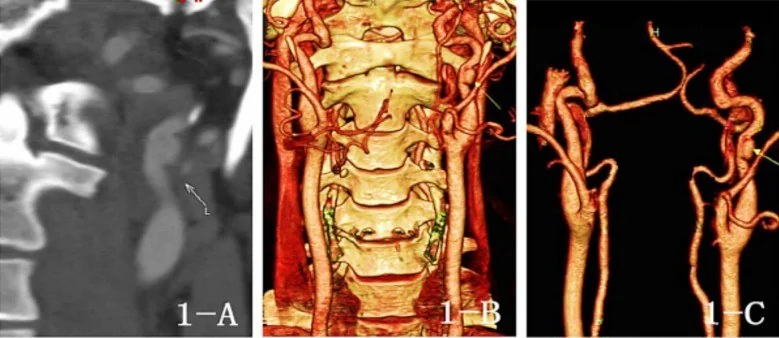
- Arteriyel BTA'da karotisle eşzamanlı kontrastlanan fokal sakküler ya da fusiform genişleme görülür; kısmi trombüs opak lümen çevresinde kontrastlanmayan bölüm olarak seçilebilir. BTA anevrizmanın biçimini, çapını ve intraluminal trombüsünü değerlendirmeye yardımcı olur; lezyonun çevre yapılarla ilişkisini de gösterebilir.
Önerilen pencereler G genişlik, M merkez; değerler Hounsfield birimi (HU)
- AnjiyoG 600 / M +150
- Yumuşak dokuG 400 / M +40
BT bulguları
- Ortak karotis veya internal karotis arterinde sakküler kese ya da damar boyunca uzanan fusiform genişleme görülür; fusiform çap karşılaştırmalı olarak değerlendirilir.
- Anevrizmanın kontrastlanan boşluğu ana arter lümeniyle devamlılık gösterir; kese ağzı ve lezyonun proksimal-distal sınırları çok düzlemli görüntülerde izlenebilir.
- Kese içindeki mural trombüs kontrastlanmayan materyal olarak izlenebilir; dış kese çapı opak lümen çapından daha büyük olabilir.
- ECAA'da en sık etiyoloji aterosklerozdur; BTA'da aterosklerotik plak bulguları anevrizma kesesinin konturuyla birlikte morfolojik olarak değerlendirilir.
- BTA'da diseksiyon düşünüldüğünde intimal flep ve lümen darlığı aranır; intramural hematom gibi duvar bulgularının değerlendirilmesinde damar duvarı MR tamamlayıcı olabilir.
- Distal ICA ve görüntü alanına giren intrakraniyel damarlar tromboembolik komplikasyon açısından değerlendirilmelidir.
- Çevre boyun dokusunda hematom damar dışı kanamayı, farinks basısı ise kitle etkisini düşündürebilir; enfeksiyon olasılığı klinik bulgular ve diğer görüntüleme verileriyle birlikte değerlendirilir.
Ölçütler ve sınıflamalar
- Ekstrakraniyal karotis anevrizmasının şekle göre radyolojik tanımı
- Fusiform genişleme için bir ECAA çalışmasında damar çapının beklenen çapın 1,5 katına ulaşması tanım olarak kullanılmıştır. ECAA için anevrizma eşiğini tanımlayan evrensel olarak kabul edilmiş bir referans çapı yoktur.
Normalde
Karotis bulbus anevrizması bazı ölçütlerde normal ortak karotis artere göre %50 artış veya internal karotis çapına göre %100 artış ile tanımlanır, ancak evrensel kabul gören bir referans çap yoktur ve ekstrakraniyal karotis anevrizmaları şekle göre sakküler ya da fusiform olarak sınıflandırılır. Fusiform genişlemede çap komşu normal segmente göre değerlendirilir; intraluminal trombüs anevrizmanın dış duvar sınırını belirlemeyi güçleştirebilir, bu nedenle yalnız opak lümene bakılmamalıdır.
Normal BT ile kıyasla
Aynı bölgenin, kaynak veri setinde patoloji içermediği belirtilen bir BT incelemesini kesit kesit kaydırın; organ sınırlarını açarak anatomiyi hasta görüntüsüyle karşılaştırın. Küçük rastlantısal bulgular tümüyle dışlanmamıştır.
Kaynak: TotalSegmentator v2.01 veri seti (Wasserthal ve ark., Radiology: Artificial Intelligence 2023), CC BY 4.0, vaka s0622; organ sınırları veri setinin otomatik segmentasyonundan, birleştirilerek sadeleştirildi. Görüntüler 2,5 mm kesit aralığına yeniden örneklendi.
Ayırıcı tanı
- Yalancı anevrizma
- travma, önceki cerrahi veya enfeksiyon öyküsünde akla gelmeli ve çevrede hematom eşlik edebilir; gerçek anevrizmada arter duvarının anevrizmal genişlemesi görülürken yalancı anevrizmada anjiyografide damar duvarından kontrast sızıntısı görülebilir.
- Diseksiyon
- intimal flep, daralmış gerçek lümen veya eksantrik duvar kalınlaşması diseksiyonu destekler; yalın fokal genişlemeden farklı bulgulardır.
- Karotis cisimciği paraganglioması
- bifurkasyonda yerleşen hipervasküler kitle ICA ve ECA'yı ayırabilir; arter lümeniyle devamlı bir kese oluşturmaz.
- Arteriyovenöz fistül
- komşu arter ve ven arasında doğrudan bağlantı ile eşzamanlı kontrastlanma görülebilir; yalnız damar dışı kitle görünümü yeterli değildir.
Tuzaklar
- Karotis bulbusunun doğal genişliği, özellikle tek aksiyel kesitte anevrizma izlenimi verebilir; bifurkasyonun üstü ve altındaki damar konturunu koronal-oblik planda takip et.
- Mural trombüs kontrastlanan lümeni küçültür; yalnız opak kan havuzunu ölçmek kese boyutunu olduğundan küçük gösterebilir.
- CTA gibi lümen görüntüleme yöntemleri damar duvarındaki patolojinin boyutunu göstermez; bu açıdan damar duvarı MR'si tamamlayıcı olabilir ve travma, cerrahi, enfeksiyon veya diseksiyon ipuçları yalancı ya da disekan anevrizmayı düşündürür.
- Karotis cisimciği kitlesi bifurkasyonda ICA ve ECA'yı ayırabilir; ince kesitlerde anevrizmanın arterle doğrudan devamlılığını ve kitlenin damarları dıştan ayırmasını karşılaştır.
Kendini dene
Bir olgunun kraniyoservikal BTA'sında sağ ortak karotis arterde hangi bulgu tanımlanmıştır?
Cevabı göster
Eksantrik trombüs içeren sakkülo-fusiform anevrizma. Olgu raporunda BTA, sağ ortak karotis arterde eksantrik trombüs içeren sakkülo-fusiform anevrizma göstermiştir.
Bifurkasyonda yoğun kontrastlanan doku ICA ile ECA'yı birbirinden ayırıyor; arterin dışında ayrı bir kitle var. En olası oluşum nedir?
Cevabı göster
Karotis cisimciği tümörü. Bifurkasyonda yerleşen hipervasküler kitlenin ICA ve ECA'yı ayırması karotis cisimciği paragangliomasını destekler. Lenf nodu damar dışı bir yapıdır; ektazi arter lümeninin yayvan genişlemesidir, juguler ven trombozu ise IJV içindedir.
İlgili konular
Kaynaklar
Bu sayfadaki 36 cümle ve 2 quiz sorusu aşağıdaki kaynaklardan alıntılarla otomatik olarak karşılaştırıldı; 20 cümle bu karşılaştırmada düzeltildi (2026-10-12).
- A review of the literature on extracranial carotid artery aneurysmspure.umcutrecht.nl
- CT and MRI imaging of mass in the carotid space: a pictorial reviewqims.amegroups.org
- Operative managements of extracranial carotid artery aneurysms: a report of three cases and literature reviewlink.springer.com
- A review of histopathologic and radiologic features of non-atherosclerotic pathologies of the extracranial carotid arteriespmc.ncbi.nlm.nih.gov
- Carotid duplex ultrasound: A review and update for cliniciansjournals.sagepub.com
- Invasive treatment for extracranial carotid artery aneurysm: a single-center case series and literature reviewpmc.ncbi.nlm.nih.gov
- Surgical Treatment of Saccular Extracranial Carotid Artery Aneurysmpmc.ncbi.nlm.nih.gov
- Hybrid treatment of large extracranial carotid artery aneurysmpmc.ncbi.nlm.nih.gov
- Transcarotid stenting of extracranial carotid artery aneurysm with covered stents and flow reversalpmc.ncbi.nlm.nih.gov
- The First Intraoperative EEG Monitoring during a Common Carotid Artery Endoaneurysmorrhaphy in a Philippine Tertiary Government Hospital: A Case Reportpmc.ncbi.nlm.nih.gov
- Peripheral arterial aneurysms: open or endovascular surgery?pubmed.ncbi.nlm.nih.gov
- Bilateral extracranial internal carotid artery aneurysms: Case report and review of literature.pubmed.ncbi.nlm.nih.gov
- Case Report: Therapy of an Enormous Extracranial Carotid Artery Aneurysm With a Covered Coronary Stent in an Infant and Review of Literature.pubmed.ncbi.nlm.nih.gov
- Volumetric assessment of extracranial carotid artery aneurysms.pubmed.ncbi.nlm.nih.gov
- Carotid-Carotid Bypass for a Carotid Artery Aneurysm.pubmed.ncbi.nlm.nih.gov
- Hybrid treatment of large extracranial carotid artery aneurysm.pubmed.ncbi.nlm.nih.gov
- Endovascular techniques in the treatment of extracranial carotid artery aneurysms.pubmed.ncbi.nlm.nih.gov
- Treatment of Extracranial Carotid Artery Aneurysm: Fifteen Years' Experience at a Single Institution.pubmed.ncbi.nlm.nih.gov
- Gadolinium Enhancement of the Aneurysm Wall in Extracranial Carotid Artery Aneurysms.pubmed.ncbi.nlm.nih.gov
- Carotid tortuosity is associated with extracranial carotid artery aneurysms.pubmed.ncbi.nlm.nih.gov
- Surgical and Endovascular Treatments of Extracranial Carotid Artery Aneurysms-Report of Six Cases.pubmed.ncbi.nlm.nih.gov
- Common carotid artery aneurysm revealing Takayasu's arteritis.pubmed.ncbi.nlm.nih.gov
- Symptomatic extracranial internal carotid artery aneurysm deferred repair.pubmed.ncbi.nlm.nih.gov
- Rationale and design of the extracranial Carotid artery Aneurysm Registry (CAR).pubmed.ncbi.nlm.nih.gov
- Inflammatory aneurysm of the C1 segment of the internal carotid artery linked to ipsilateral internal carotid artery occlusion due to otitis media: A Case Report and Literature Review.pubmed.ncbi.nlm.nih.gov
- Pseudoaneurysm of the superficial temporal artery after head-to-head collision between football players: A case report.pubmed.ncbi.nlm.nih.gov
- Hybrid zone 1 repair of a giant post-traumatic intrathoracic left subclavian artery pseudoaneurysm.pubmed.ncbi.nlm.nih.gov
- 2025 Heart Disease and Stroke Statistics: A Report of US and Global Data From the American Heart Association.pubmed.ncbi.nlm.nih.gov
- 2024 Heart Disease and Stroke Statistics: A Report of US and Global Data From the American Heart Association.pubmed.ncbi.nlm.nih.gov
- Initial magnetic resonance imaging/magnetic resonance angiography may miss intracranial artery dissection in young adults with stroke: the role of subsequent imaging.pubmed.ncbi.nlm.nih.gov
- Sonographic features associated with ischemic stroke in patients with extracranial internal carotid artery dissection: a single-center exploratory study.pubmed.ncbi.nlm.nih.gov
- Vertebral Artery Pseudoaneurysm in a Single-Vessel Posterior Circulation With Chronic Contralateral Occlusion and Recent Methamphetamine Use.pubmed.ncbi.nlm.nih.gov
- Giant cervical internal carotid artery aneurysm associated with multiple intra- and extracranial aneurysms: a case report.pubmed.ncbi.nlm.nih.gov
- Open resection and primary anastomosis repair of giant, symptomatic extracranial internal carotid artery aneurysm.pubmed.ncbi.nlm.nih.gov
- A rare case report of vascular Ehlers-Danlos syndrome as a pulsatile neck mass with an internal carotid artery aneurysm.pubmed.ncbi.nlm.nih.gov
- Mechanical Thrombectomy as First-line Endovascular Therapy for Acute Middle Cerebral Artery Occlusion Due to Arterial Dissection: A Case Report and Literature Review.pubmed.ncbi.nlm.nih.gov
- Clinical implications of vessel wall imaging-State-of-the-art review.pubmed.ncbi.nlm.nih.gov
- Redefining HIV-associated large-vessel vasculopathy in the antiretroviral therapy era: Multi-detector CT imaging findings and their correlation with intervention and patient outcomes.pubmed.ncbi.nlm.nih.gov
- Expert consensus on intracranial vessel wall MRI in cerebrovascular disease: Society for Magnetic Resonance Angiography recommendations.pubmed.ncbi.nlm.nih.gov
- Operative Procedures for Ultrasound Assessment of Extracranial Artery Disease: A Narrative Review by the Italian Society for Vascular Investigation (SIDV).pubmed.ncbi.nlm.nih.gov
- Bedside Ultrasound-Driven Emergency Stenting for Spontaneous Carotid Artery Dissection: Clinical and Technical Insights.pubmed.ncbi.nlm.nih.gov
- Open surgical repair of a loop-forming extracranial internal carotid artery aneurysm: a case report and literature review.pubmed.ncbi.nlm.nih.gov
- External Carotid Artery Pseudoaneurysm: A Rare Cause of Ischemic Stroke via Internal Carotid Artery Compression-A Case Report.pubmed.ncbi.nlm.nih.gov
- Multiple Overlapping Low-Profile Visualized Intraluminal Support Stents for Large Extracranial Carotid Artery Aneurysms: A Case Series.pubmed.ncbi.nlm.nih.gov
- Endovascular repair of traumatic innominate artery injury: case report.pubmed.ncbi.nlm.nih.gov
- Too Young, Too Silent: Painless Stanford Type A Aortic Dissection in a Young Adult.pubmed.ncbi.nlm.nih.gov
- RECOAT study - Retrospective evaluation of surface-modified and coated flow diverters for the treatment of unruptured intracranial aneurysms.pubmed.ncbi.nlm.nih.gov
- Flow Diversion Beyond the Brain: Endovascular Management of Wide-Neck Renal Artery Aneurysms Using Flow-Diverting Stents.pubmed.ncbi.nlm.nih.gov
- Commentary: an eye on PET quantification.pubmed.ncbi.nlm.nih.gov
- Patterns of injury and violence in Yaoundé Cameroon: an analysis of hospital data.pubmed.ncbi.nlm.nih.gov
- High-affinity alphavbeta3 integrin targeted optical probe as a new imaging biomarker for early atherosclerosis: initial studies in Watanabe rabbits.pubmed.ncbi.nlm.nih.gov
- Surgical Treatment of Saccular Extracranial Carotid Artery Aneurysm.pubmed.ncbi.nlm.nih.gov
- Parent Artery Disease-Related Stroke: What Is the Impact on Endovascular Treatment? A Narrative Review.pubmed.ncbi.nlm.nih.gov
- Imaging of cerebrovascular complications from blunt skull base trauma.pubmed.ncbi.nlm.nih.gov
- Carotid plaque vulnerability and circle of Willis anatomy predict ipsilateral brain infarcts and long-term mortality in carotid endarterectomy patients.pubmed.ncbi.nlm.nih.gov
- Coronary Artery Calcification: From Molecular Mechanisms to Interventional Strategies.pubmed.ncbi.nlm.nih.gov
- Multimodal imaging in neuro-ophthalmology.pubmed.ncbi.nlm.nih.gov
- Contralateral vertebral artery dissection after an unprecedented 14-year interval with a persistent intimal flap: A case report.pubmed.ncbi.nlm.nih.gov
- Tertiary Syphilitic Aortitis Manifesting as Ascending Aortic Aneurysm and Dissection.pubmed.ncbi.nlm.nih.gov
- Surgical management and clinical reflections on acute type A intramural hematoma with a focal intimal tear in an adult with double aortic arch: a case report.pubmed.ncbi.nlm.nih.gov
- Fatal Delayed Stent-edge Rupture Confirmed by Autopsy after Stent-assisted Coil Embolization for a Blood Blister-like Aneurysm.pubmed.ncbi.nlm.nih.gov
- Coil-Assisted Onyx Embolization of an Ophthalmic Artery-Supplied Anterior Cranial Fossa Dural Arteriovenous Fistula Mimicking an Intracranial Aneurysm.pubmed.ncbi.nlm.nih.gov
- Endovascular Embolization in Neurovascular Disease: Material Science, Multimodal Management, and Future Horizons.pubmed.ncbi.nlm.nih.gov
- Ruptured Infected Pseudoaneurysms of Bilateral Carotid Artery Treated with Viabahn Stent Graft: A Case Report.pubmed.ncbi.nlm.nih.gov
- Patterns of Arterial Wall Lesions in Eagle Syndrome: Case Series and Literature Review.pubmed.ncbi.nlm.nih.gov
- Intravascular lithotripsy followed by angioplasty and stenting for severely calcified carotid artery stenosis: technical note and case series.pubmed.ncbi.nlm.nih.gov
- Non-invasive imaging modalities for diagnosing pulsatile tinnitus: a comprehensive review and recommended imaging algorithm.pubmed.ncbi.nlm.nih.gov
- Comparison of GPT-4o With Human Performance in the Polish Vascular Surgery Specialty Examination.pubmed.ncbi.nlm.nih.gov
- When the Heart Holds Its Own Rupture: A Case Report of a Clinically Silent Left Ventricular Pseudoaneurysm Following Myocardial Infarction.pubmed.ncbi.nlm.nih.gov
- A case report of superficial temporal artery aneurysm associated with acupressure massage.pubmed.ncbi.nlm.nih.gov
- Giant left main coronary artery aneurysm in a young adult female with suspected incomplete Kawasaki disease: a case report.pubmed.ncbi.nlm.nih.gov
- Radiological insights into fibromuscular dysplasia unveiled by intracranial aneurysms and iliac vein hypoplasia in suspected DVT.pubmed.ncbi.nlm.nih.gov
- Coronary Artery Aneurysm or Ectasia as a Form of Coronary Artery Remodeling: Etiology, Pathogenesis, Diagnostics, Complications, and Treatment.pubmed.ncbi.nlm.nih.gov
- Deep Neck Infection Complicated by Internal Carotid Pseudoaneurysm: A Diagnostic and Therapeutic Challenge.pubmed.ncbi.nlm.nih.gov
- The "Transdural" Paradox: The Case of a Paraclinoid Internal Carotid Artery Aneurysm With an Intradural Neck and Extradural Dome.pubmed.ncbi.nlm.nih.gov
- A wide-necked saccular aneurysm of the middle cerebral artery bifurcation with neck atherosclerosis mimicking a fusiform aneurysm: illustrative case.pubmed.ncbi.nlm.nih.gov
- Carotid napkin-ring sign plaques are associated with early neurological deterioration in lenticulostriate artery branch atheromatous disease.pubmed.ncbi.nlm.nih.gov
- Carotid plaque inflammation and calcification on somatostatin receptor PET/CT imaging predict stroke and major adverse cardiovascular events.pubmed.ncbi.nlm.nih.gov
- Mini-sternotomy as a life-saving access for thoracic endovascular aortic repair in the absence of peripheral options.pubmed.ncbi.nlm.nih.gov
- Free-breathing, blood-flow-independent, three-dimensional relaxation-enhanced angiography without contrast and triggering (REACT) for aorta measurement and diagnosis in patients with aortic disease: a comparison with computed tomography angiography.pubmed.ncbi.nlm.nih.gov
- Spontaneous resolution of traumatic pseudoaneurysm: A case report.pubmed.ncbi.nlm.nih.gov
- Craniocervical arterial dissections with cerebral infarction: a five-case series with diagnostic application of vessel wall MRI.pubmed.ncbi.nlm.nih.gov
- Single-stage hybrid management of severe carotid stenosis and unruptured intracranial aneurysms using direct transcarotid access: Illustrative case.pubmed.ncbi.nlm.nih.gov
- Acute and Chronic Cerebral Hypoperfusion After Flow-Diverter Placement: Is There a Role for Extra-Intracranial Bypass? A Case Series and Narrative Literature Review.pubmed.ncbi.nlm.nih.gov
- Hypoglossal Nerve Neuropathies-Analysis of Causes and Anatomical Background.pubmed.ncbi.nlm.nih.gov
- Internal Carotid Artery Dissection Presenting with Transient or Subclinical Horner Syndrome.pubmed.ncbi.nlm.nih.gov
- Blind spots in brain imaging: a pictorial essay.pubmed.ncbi.nlm.nih.gov
- Neurovascular Involvement in Fibromuscular Dysplasia: A Clue for Reappraisal of Old Classifications.pubmed.ncbi.nlm.nih.gov
- A review of histopathologic and radiologic features of non-atherosclerotic pathologies of the extracranial carotid arteries.pubmed.ncbi.nlm.nih.gov
- Clinical characteristics of hypoglossal nerve palsy secondary to internal carotid artery dissection: a systematic review and illustrative case.pubmed.ncbi.nlm.nih.gov
- Unruptured distal anterior cerebral artery branch pseudoaneurysm in the setting of intracranial pressure monitor placement: illustrative case.pubmed.ncbi.nlm.nih.gov
- Clinical importance of the persistent primitive hypoglossal artery in vascular lesions and endovascular treatment: a narrative review.pubmed.ncbi.nlm.nih.gov
- Evaluating Animal Models of Arteriovenous Malformation and Intracerebral Aneurysm: A Mechanistic Approach.pubmed.ncbi.nlm.nih.gov
- Traumatic carotid artery dissection without head or neck trauma: a case report following thoracoabdominal crush injury.pubmed.ncbi.nlm.nih.gov
- Anatomical Variations of the Jugular Bulb: A Critical and Comprehensive Review.pubmed.ncbi.nlm.nih.gov
- Non-aortic vascular findings on chest CT angiogram: including arch vessels and bronchial arteries.pubmed.ncbi.nlm.nih.gov
- Embolization in Pediatric Patients: A Comprehensive Review of Indications, Procedures, and Clinical Outcomes.pubmed.ncbi.nlm.nih.gov
- Type A Aortic Intramural Hematoma Without Identifiable Intimal Tear Presenting With Minimal Initial Findings.pubmed.ncbi.nlm.nih.gov
- A surgical technique for lesions involving the ultra-high-riding carotid sheath based on the anatomical principles of the prevertebral fascia: cadaveric dissection and case illustrations.pubmed.ncbi.nlm.nih.gov
- Beyond vascular recanalization: precision medicine in cervical artery dissection guided by multiple mechanisms and multimodal imaging for brain functional recovery.pubmed.ncbi.nlm.nih.gov
- Unexpected Diagnosis of Concomitant Castleman's Disease Following Carotid Body Tumour Resection: A Case Report and Management Review.pubmed.ncbi.nlm.nih.gov
- Structural Restoration of an Unruptured Vertebral Artery Dissection Following Autologous Mesenchymal Stem Cell Therapy: A Case Report.pubmed.ncbi.nlm.nih.gov
- Isolated Hypoglossal Nerve Palsy Associated with Internal Carotid Artery Dissection: A Systematic Review.pubmed.ncbi.nlm.nih.gov
- Right internal carotid artery C7 segment aneurysm with carotid occlusion following traumatic brain injury: illustrative case.pubmed.ncbi.nlm.nih.gov
- Double-barrel STA-MCA bypass with endovascular parent artery occlusion for complex anterior circulation aneurysms: indications and outcomes.pubmed.ncbi.nlm.nih.gov
- Acute-phase bypass surgery for ruptured intracranial aneurysm: Selection criteria in the endovascular era.pubmed.ncbi.nlm.nih.gov
- Challenges and Future Trends in Large Vessel Vasculitis.pubmed.ncbi.nlm.nih.gov
- The Stroke Preclinical Assessment Network Multi-laboratory Model of Thromboembolic Stroke with Thrombolysis: TE-MCAo.pubmed.ncbi.nlm.nih.gov
- Cerebral arteries in mice with sickle cell disease are exposed to larger areas of low wall shear stress.pubmed.ncbi.nlm.nih.gov
- Sonographic Extracranial-Intracranial Bypass Monitoring: Technical Evolution and Current Evidence.pubmed.ncbi.nlm.nih.gov
- Management of a Female Patient With Traumatic Carotid Aneurysm and Depression.pubmed.ncbi.nlm.nih.gov
- Safety and efficacy of flow redirection endoluminal device (FRED) for treatment of intracranial aneurysm; A systematic review and meta-analysis.pubmed.ncbi.nlm.nih.gov
Eğitim amaçlıdır; hasta başında tanı ve tedavi kararının yerine geçmez, tıbbi tavsiye değildir. Metinler yapay zekâ desteğiyle yazıldı ve otomatik bir adımda kaynak alıntılarıyla karşılaştırıldı; bu bir tıbbi doğrulama değildir ve içerik uzman radyolog incelemesinden geçmedi. Klinik kararlarda güncel kılavuzları, kurum protokollerini ve radyoloji raporunu esas alın.