Özet
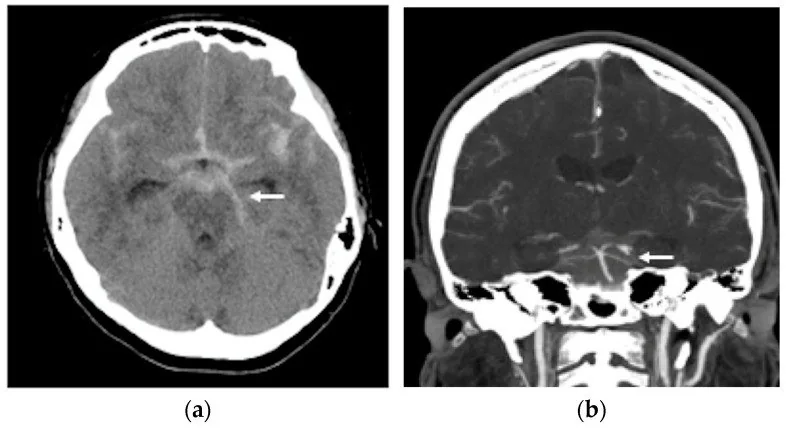
Diseksiyon, intimal yırtıktan giren kanın damar duvarı katmanları arasında ilerlemesiyle lümende stenoz veya çift kanal oluşturabilir; eşlik eden duvar defekti dış konturda psödoanevrizmal keseleşmeye yol açabilir. Blister anevrizma ise çoğunlukla supraklinoid ICA'nın dallanmayan yüzeyinde sığ ve geniş tabanlı çıkıntı biçimindedir. Her iki lezyon küçük ve değişken biçimli olabilir; subaraknoid kanama ya da distal iskemiyle başvurabilir. BT anjiyografi (BTA), intrakraniyal arterlerdeki anevrizma ve damar değişikliklerini tespit etmede güvenilir bir yöntemdir; değerlendirme protokolünde kontrastsız BT bulguları da incelenir. İnce blister odağı veya erken diseksiyon negatif BTA'da gözden kaçabileceğinden kanama paterni damar değerlendirmesinden bağımsız ele alınmamalıdır.
Faz ve pencere
- Kontrastsız
- Damar duvarı MR görüntüleme, intimal flep ve intramural hematom/trombus tespiti için yüksek çözünürlük sağlar; rutin MR anjiyografide akış sinyalleri nedeniyle hematom tespiti zor olabilir.
- BTA tanısal
- Damar duvarında uzun segmentli düzensiz daralma, konik stenoz-genişleme geçişi, yalancı lümen şüphesi veya supraklinoid ICA'da dallanmayan yüzeyden çıkan sığ, geniş tabanlı kontrast çıkıntısı aranır.
Önerilen pencereler: Anjiyo (G 600 / M 150), Beyin (G 80 / M 40), Kemik (G 1800 / M 400).
BT bulguları
- Supraklinoid internal karotid arterin dallanmayan yüzeyinde, belirgin boynu olmayan sığ ve geniş tabanlı fokal çıkıntı izlenir.
- Dallanmayan duvar yerleşimi — blister odağı ICA'nın dallanmayan duvar yüzeyine yerleşir; bu özellik nedeniyle konvansiyonel anjiyografide kolayca kaçırılabilir.
- İnce lüminal flep — kaynak BTA görüntülerinde opak lümeni ikiye ayıran ince çizgisel yapı diseksiyon flebini düşündürür.
- Uzun segmentli daralma — arter boyunca düzensiz veya düzgün stenoz, eşlik eden dış çap artışı ile birlikte izlenir.
- Yalancı kese — diseke duvarın dışına uzanan kontrast cebi ana lümenle dar bağlantı gösterebilir.
- SAK veya infarkt — sisternal kanama ya da damar bölgesine uyan parankimal iskemi, ilgili bir komplikasyon olarak raporlanır.
Normalde
Normal supraklinoid ICA duvarı tekdüze ve düzgün konturludur; dallanmayan duvar yüzeyinde fokal çıkıntı veya düzensizlik izlenmez. İntrakraniyal vertebral ve baziler arterleri de kesitler boyunca izleyin; lümen konturunun tekdüze olup olmadığını değerlendirin ve çift kanal veya uzun segmentli stenoz bulunup bulunmadığına bakın.
Normal BT ile kıyasla
Aynı bölgenin, kaynak veri setinde patoloji içermediği belirtilen bir BT incelemesini kesit kesit kaydırın; organ sınırlarını açarak anatomiyi hasta görüntüsüyle karşılaştırın. Küçük rastlantısal bulgular tümüyle dışlanmamıştır.
Kaynak: TotalSegmentator v2.01 veri seti (Wasserthal ve ark., Radiology: Artificial Intelligence 2023), CC BY 4.0, vaka s0103; organ sınırları veri setinin otomatik segmentasyonundan, birleştirilerek sadeleştirildi. Görüntüler 2,5 mm kesit aralığına yeniden örneklendi.
Ayırıcı tanı
- Sakküler anevrizma
- genellikle damar dallanma noktalarında oluşur.
- İnfundibulum
- dallanma noktasındaki çıkıntının morfolojisini ayırıcı tanıda değerlendirin.
- Aterosklerotik düzensizlik
- kalsifiye veya yumuşak plak duvar boyunca lümeni daraltır; yalancı kese ya da intimal flep oluşturmaz.
- Vazospazm
- SAK sonrası birden fazla damarda düzgün veya segmental daralma yapabilir; fokal duvar çıkıntısı beklenmez.
- Travmatik psödoanevrizma
- travma mekanizması ve yaralanma hattı ile uyumlu arter segmentinde dışa keseleşme görülür.
Tuzaklar
- Blister anevrizma, görünmez morfolojisi ve dallanmayan yerleşimi nedeniyle konvansiyonel anjiyografide kolayca gözden kaçabilir; ince kaynak kesitler ve çoklu düzlem rekonstrüksiyonlarla dikkatli tarama gereklidir.
- SAK varken negatif BTA küçük blister lezyonunu dışlamaz; kanama dağılımı ile ICA yüzeyini eşleştirip damar görüntüsündeki teknik sınırlılığı açıkça belirtin.
- Şüpheli intimal flep veya çift kanal izlenimi, komşu damar dallarının üst üste binmesinden kaynaklanan artefakt olabilir; kesin tanı için ortogonal düzlemdeki ince kaynak kesitler veya damar duvarı MR görüntülemesi ile doğrulanmalıdır.
- Blister ve disekte pseödoanevrizmalar akut dönemde hızlı büyüyebilir veya spontan olarak gerileyebilir; bu dinamik yapı nedeniyle önceki incelemelerle karşılaştırma ve yakın takibi zorunlu kılar.
Kendini dene
SAK bulunan hastada BTA, supraklinoid ICA'nın dallanmayan yüzeyinde sığ ve geniş tabanlı küçük çıkıntı gösteriyor. En olası lezyon nedir?
Cevabı göster
Blister anevrizma. Supraklinoid ICA'nın dallanmayan duvarındaki sığ geniş tabanlı çıkıntı blister anevrizma morfolojisidir. MCA anevrizmaları sık görülen sakküler anevrizma yerleşimlerindendir ve genellikle bifurkasyonda bulunur.
Vertebral arter BTA'sında uzun segment düzensiz stenoz, lümen içinde ince çizgisel flep ve distal infarkt görülüyor. En olası süreç nedir?
Cevabı göster
Arter diseksiyonu. Flep ile uzun segmentli düzensiz stenoz diseksiyon lehinedir; distal infarkt arter kaynaklı iskemiyle uyumludur. İnce intimal flep ve uzun segmentli daralma diseksiyon bulgularıdır; diseksiyonla ilişkili parankimal komplikasyon olarak inme görülebilir.
İlgili konular
Kaynaklar
Bu sayfadaki 37 cümle ve 2 quiz sorusu aşağıdaki kaynaklardan alıntılarla tek tek karşılaştırıldı; 19 cümle bu karşılaştırmada düzeltildi (2026-10-08).
- Imaging of Non-atherosclerotic Vasculopathiespmc.ncbi.nlm.nih.gov
- A Review of the Current Literature on Cerebral Aneurysmspmc.ncbi.nlm.nih.gov
- The endovascular treatment strategies of cerebrovascular injuries in traumatic brain injury.pubmed.ncbi.nlm.nih.gov
- Mechanisms of aortic dissection: From pathological changes to experimental and <i>in silico</i> models.pubmed.ncbi.nlm.nih.gov
- Neuroendovascular Surgery Applications in Craniocervical Trauma.pubmed.ncbi.nlm.nih.gov
- Fatal Delayed Stent-edge Rupture Confirmed by Autopsy after Stent-assisted Coil Embolization for a Blood Blister-like Aneurysm.pubmed.ncbi.nlm.nih.gov
- Single antiplatelet therapy and tirofiban bridged with surface modified flow diverters for ruptured blood blister-like aneurysms: single center experience and systematic review.pubmed.ncbi.nlm.nih.gov
- A ruptured blood blister like aneurysm in internal carotid artery communicating segment: An illustrated case.pubmed.ncbi.nlm.nih.gov
- Aortic coarctation revealed by subarachnoid hemorrhage in a 17-year-old patient: A rare association with multiple basilar trunk aneurysms.pubmed.ncbi.nlm.nih.gov
- Tenzingplasty for cerebral vasospasm following subarachnoid hemorrhage or meningitis: multicenter initial experience.pubmed.ncbi.nlm.nih.gov
- Two Cases of Flow Diverter Placement for Early Recurrence Following Stent-Assisted Coil Embolization for Ruptured Dissecting Cerebral Aneurysms.pubmed.ncbi.nlm.nih.gov
- A case-control study on blood vessel morphology, hemodynamic parameters, and rupture status of posterior communicating artery aneurysms.pubmed.ncbi.nlm.nih.gov
- Endovascular Parent Artery Reconstruction for Ruptured Intracranial Blister Aneurysms: Demonstrating Safety and Efficacy After Early Flow Diversion.pubmed.ncbi.nlm.nih.gov
- Expert consensus on intracranial vessel wall MRI in cerebrovascular disease: Society for Magnetic Resonance Angiography recommendations.pubmed.ncbi.nlm.nih.gov
- Interobserver reliability of computed tomography angiography in the assessment of ruptured intracranial aneurysm and impact on patient management.pubmed.ncbi.nlm.nih.gov
- Endovascular Treatment of Ruptured Blood Blister-like Aneurysms Using the LVIS EVO Stents.pubmed.ncbi.nlm.nih.gov
- Radiological investigations in non-aneurysmal subarachnoid haemorrhage: A 5-year review.pubmed.ncbi.nlm.nih.gov
- Beyond vascular recanalization: precision medicine in cervical artery dissection guided by multiple mechanisms and multimodal imaging for brain functional recovery.pubmed.ncbi.nlm.nih.gov
- Middle cerebral artery dissection: pathophysiology, diagnosis, and therapeutic options.pubmed.ncbi.nlm.nih.gov
- Extrinsic Left Atrial Compression: An Echocardiography-Guided Diagnosis Illustrated by Two Clinical Cases and a Structured Review of Published Cases.pubmed.ncbi.nlm.nih.gov
- Flow-Diverter Treatment for Unruptured but Growing Vertebral Artery Dissecting Aneurysm Accompanied by Simultaneous Contralateral Vertebral Artery Dissection in the Acute Phase: A Case Report and Review of the Literature.pubmed.ncbi.nlm.nih.gov
- Safety and hemodynamic efficacy of the LVIS stent in the endovascular treatment of intracranial wide-necked aneurysms: a single-center retrospective study.pubmed.ncbi.nlm.nih.gov
- Difficulty and prospects of endovascular treatment for spontaneous intracranial artery dissection.pubmed.ncbi.nlm.nih.gov
- Hybrid procedure combining clip on wrapping and stent placement for ruptured supraclinoid blood blister-like aneurysm of the internal carotid artery.pubmed.ncbi.nlm.nih.gov
- Endovascular treatment using predominantly stent-assisted coil embolization and antiplatelet and anticoagulation management of ruptured blood blister-like aneurysms.pubmed.ncbi.nlm.nih.gov
- Microsurgical treatment of saccular basilar artery trunk aneurysms: Results and case illustrations.pubmed.ncbi.nlm.nih.gov
- Efficacy and performance of the new pipeline vantage flow diverter stent with shield technology: Short-term results of a single-center experience.pubmed.ncbi.nlm.nih.gov
- Effectiveness of Flow Diverter Stents in the Treatment of Intracranial Aneurysms: Single-Center 10-Year Results.pubmed.ncbi.nlm.nih.gov
- Cardiac POCUS in Undifferentiated Shock Revealing Aortic Dissection.pubmed.ncbi.nlm.nih.gov
- Acute Traumatic Aortic Injury: What the Radiologist Needs to Know.pubmed.ncbi.nlm.nih.gov
- Extra-Carotid Arterial Webs: A Single-Center Series and Systematic Review.pubmed.ncbi.nlm.nih.gov
- Non-Atherosclerotic and Genetic Intracranial Stenoses: Diagnostic Challenges and Emerging Genetic Insights.pubmed.ncbi.nlm.nih.gov
- Cerebrovascular fibromuscular dysplasia.pubmed.ncbi.nlm.nih.gov
- Vertebral Artery Pseudoaneurysm in a Single-Vessel Posterior Circulation With Chronic Contralateral Occlusion and Recent Methamphetamine Use.pubmed.ncbi.nlm.nih.gov
- Upper-Limb Ischemia Due to Distal Embolization from a Dissecting Axillary Artery Pseudoaneurysm in an Elite Overhead Athlete: A Case Report.pubmed.ncbi.nlm.nih.gov
- Traxcess-14 Microguidewire-Assisted Electrocoagulation as a Therapeutic Option for Basilar Artery Pseudoaneurysm: A Case Report.pubmed.ncbi.nlm.nih.gov
- Extracranial Vertebral Artery Dissecting Aneurysm Presenting as Vertebrobasilar Stroke in a Young Adult: Case Report of Flow-Diverter Stenting.pubmed.ncbi.nlm.nih.gov
- Survival of a 2-month-old infant after clipping of ruptured middle cerebral artery aneurysm: A case report and review of the literature.pubmed.ncbi.nlm.nih.gov
- Postoperative rupture of an artery dissected from a cerebral aneurysm dome following clipping: A rare and fatal complication.pubmed.ncbi.nlm.nih.gov
- Endovascular treatment of posterior circulation aneurysms with flow diverters with hydrophilic polymer coating in patients receiving prasugrel single antiplatelet therapy: a multicenter case series presenting complication and occlusion rates.pubmed.ncbi.nlm.nih.gov
- An Anatomy-Guided, Stepwise Microsurgical Reconstruction of a Posteriorly Projecting ICA-PCoA Aneurysm Beneath the Optic Apparatus: A Detailed Operative Sequence.pubmed.ncbi.nlm.nih.gov
- Initial Experience with the New DERIVO ® Mini Embolisation Device for the Treatment of Intracranial Aneurysms.pubmed.ncbi.nlm.nih.gov
- Volumetric microscopy of cerebral arteries with a miniaturized optical coherence tomography imaging probe.pubmed.ncbi.nlm.nih.gov
- Intraprocedural re-rupture during endovascular treatment of ruptured intracranial aneurysms: A single-center experience.pubmed.ncbi.nlm.nih.gov
- Surgery for Superior Cerebellar Artery Aneurysm.pubmed.ncbi.nlm.nih.gov
- A Review of the Current Literature on Cerebral Aneurysms.pubmed.ncbi.nlm.nih.gov
- De novo twig-like middle cerebral artery after suspected M1 dissection in early childhood with coexisting KRAS-mutated brain arteriovenous malformation: illustrative case.pubmed.ncbi.nlm.nih.gov
- Prevalence of Intracranial and Cervical Artery Abnormalities in Patients with Hypermobile Ehlers-Danlos Syndrome and Hypermobility Spectrum Disorders Presenting to an Academic Headache Clinic.pubmed.ncbi.nlm.nih.gov
- Vessel Wall MR Imaging in the Pediatric Head and Neck.pubmed.ncbi.nlm.nih.gov
- Congenital and acquired anomalies of the basilar artery: A pictorial essay.pubmed.ncbi.nlm.nih.gov
- Delayed Stroke after Aneurysm Treatment with Flow Diverters in Small Cerebral Vessels: A Potentially Critical Complication Caused by Subacute Vasospasm.pubmed.ncbi.nlm.nih.gov
- Traumatic pseudoaneurysm of a distal middle cerebral artery branch with findings suggestive of an interdural location: illustrative case.pubmed.ncbi.nlm.nih.gov
- Post-Traumatic Middle Cerebral Artery Pseudoaneurysm Following Depressed Skull Fracture: Case Report and PRISMA-Guided Literature Review.pubmed.ncbi.nlm.nih.gov
- Unruptured distal anterior cerebral artery branch pseudoaneurysm in the setting of intracranial pressure monitor placement: illustrative case.pubmed.ncbi.nlm.nih.gov
- 2022 ACC/AHA guideline for the diagnosis and management of aortic disease: A report of the American Heart Association/American College of Cardiology Joint Committee on Clinical Practice Guidelines.pubmed.ncbi.nlm.nih.gov
- 2022 ACC/AHA Guideline for the Diagnosis and Management of Aortic Disease: A Report of the American Heart Association/American College of Cardiology Joint Committee on Clinical Practice Guidelines.pubmed.ncbi.nlm.nih.gov
- 2022 ACC/AHA Guideline for the Diagnosis and Management of Aortic Disease: A Report of the American Heart Association/American College of Cardiology Joint Committee on Clinical Practice Guidelines.pubmed.ncbi.nlm.nih.gov
- Longitudinal volume evolution of large and giant intracranial aneurysms following endovascular flow diversion.pubmed.ncbi.nlm.nih.gov
- CTA Imaging of Peripheral Arterial Injuries.pubmed.ncbi.nlm.nih.gov
- Imaging of the aortic root on high-pitch non-gated and ECG-gated CT: awareness is the key!pubmed.ncbi.nlm.nih.gov
- Bilateral Premammillary Artery Territory Infarctions After Clipping of a Ruptured Internal Carotid-Posterior Communicating Artery Aneurysm: A Case Report.pubmed.ncbi.nlm.nih.gov
- Role of Low-Field MRI in Acute Stroke.pubmed.ncbi.nlm.nih.gov
- Prognostic value of CT contrast staining after endovascular therapy in basilar artery occlusion stroke.pubmed.ncbi.nlm.nih.gov
- Vessel wall MRI detection of an angiographically occult A3 blister aneurysm presenting with subarachnoid hemorrhage: illustrative case.pubmed.ncbi.nlm.nih.gov
- Endovascular management of subarachnoid hemorrhage due to vertebrobasilar artery dissection using emergency flow-diverter stent placement combined with pseudoaneurysm coiling.pubmed.ncbi.nlm.nih.gov
- Ruptured Basilar Artery Blood Blister-Like Aneurysm Treated Using a Single Low-Profile Visualized Intraluminal Support (LVIS) Stent: A Case Report.pubmed.ncbi.nlm.nih.gov
- Imaging of Intracranial Saccular Aneurysms.pubmed.ncbi.nlm.nih.gov
- Long-term safety and effectiveness of the "OptEase" vena cava filter.pubmed.ncbi.nlm.nih.gov
- Retinoblastoma and beyond: pediatric orbital mass lesions.pubmed.ncbi.nlm.nih.gov
- Idiopathic intracranial hypertension: Imaging and clinical fundamentals.pubmed.ncbi.nlm.nih.gov
- Vessel wall MR imaging in neuroradiology.pubmed.ncbi.nlm.nih.gov
- Multiple Pipeline Embolization Devices for the Treatment of Complex Intracranial Aneurysm: A Multi-Center Study.pubmed.ncbi.nlm.nih.gov
- Non-contrast CT findings suggestive of secondary intracerebral haemorrhage.pubmed.ncbi.nlm.nih.gov
- Spot Sign in Intracerebral Hemorrhage: Critical Reappraisal and Future Clinical Implications.pubmed.ncbi.nlm.nih.gov
- Predictors and Outcomes of Hematoma Expansion and Neurological Decline in Intracerebral Hemorrhage: A Multisite Mobile Stroke Unit Study.pubmed.ncbi.nlm.nih.gov
- Comparison of safety and efficacy between double LVIS and flow diverter for Blister-Like aneurysms: a multicenter retrospective study.pubmed.ncbi.nlm.nih.gov
- Computational hemodynamic pathophysiology of internal carotid artery blister aneurysms.pubmed.ncbi.nlm.nih.gov
- Safety and efficacy of the pipeline vantage flow diverter for the treatment of saccular aneurysms in the posterior cerebral circulation.pubmed.ncbi.nlm.nih.gov
- Balloon Passage via Microwire Navigation Technology for Severe Stenosis of Middle Cerebral Artery: A Case Report.pubmed.ncbi.nlm.nih.gov
- Direct balloon dilatation angioplasty for intracranial atherosclerotic stenosis-related acute ischemic stroke: a single-arm retrospective study of technical feasibility and safety.pubmed.ncbi.nlm.nih.gov
- Retrieval of an atherosclerotic plaque-vessel wall complex during mechanical thrombectomy: illustrative case.pubmed.ncbi.nlm.nih.gov
- Endovascular Management of a Giant Supraclinoid Internal Carotid Artery Dissecting Pseudoaneurysm Using Flow Diversion and Coiling: A Case Report and Review of Literature.pubmed.ncbi.nlm.nih.gov
- Comparative analysis and influencing factors of aneurysm wall characteristics based on artificial intelligence-assisted 3.0T MRI and 5.0T MRI high-resolution vascular wall imaging.pubmed.ncbi.nlm.nih.gov
- Development and Validation of a Flow-Dependent Endothelialized 3D Model of Intracranial Atherosclerotic Disease.pubmed.ncbi.nlm.nih.gov
- <i>Ex vivo</i>, <i>in situ</i> perfusion protocol for human brain fixation compatible with microscopy, MRI techniques, and anatomical studies.pubmed.ncbi.nlm.nih.gov
- Clinical implications of vessel wall imaging-State-of-the-art review.pubmed.ncbi.nlm.nih.gov
- Small molecule inhibitors target multiple neuropathological signaling to exert novel neuroprotection in intracranial aneurysms.pubmed.ncbi.nlm.nih.gov
- Detection of aneurysms by 64-section multidetector CT angiography in patients acutely suspected of having an intracranial aneurysm and comparison with digital subtraction and 3D rotational angiography.pubmed.ncbi.nlm.nih.gov
- Spontaneous Coronary Artery Dissection and Takotsubo Syndrome: Converging Mechanisms, Diagnostic Pitfalls, and a Unified Clinical Algorithm.pubmed.ncbi.nlm.nih.gov
- A review of histopathologic and radiologic features of non-atherosclerotic pathologies of the extracranial carotid arteries.pubmed.ncbi.nlm.nih.gov
- Spontaneous resolution of traumatic pseudoaneurysm: A case report.pubmed.ncbi.nlm.nih.gov
- Japanese Clinical Practice Guidelines for Vascular Tumors, Vascular Malformations, Lymphatic Malformations, and Lymphangiomatosis 2022.pubmed.ncbi.nlm.nih.gov
- Current Knowledge of and Perspectives about the Pathogenesis of Blood Blister-like Aneurysms of the Internal Carotid Artery: A Review of the Literature.pubmed.ncbi.nlm.nih.gov
- Severe Recurrent Hemorrhage of an Oncogenic Vertebrobasilar Junction Aneurysm Following Stent-Assisted Coil Embolization in Metastatic Testicular Choriocarcinoma.pubmed.ncbi.nlm.nih.gov
- Machine Learning-Based Prediction of Delayed Cerebral Ischemia and Functional Outcome in Aneurysmal Subarachnoid Hemorrhage: The Role of CNS Infection-Related Parameters.pubmed.ncbi.nlm.nih.gov
- Varicella Zoster Virus Infection: Clinical Features, Molecular Pathogenesis, Treatment, and Prevention.pubmed.ncbi.nlm.nih.gov
- Beyond the "string of beads": case-based exploration of diagnostic pitfalls and solutions in reversible cerebral vasoconstriction syndrome.pubmed.ncbi.nlm.nih.gov
- Distal posterior inferior cerebellar artery dissecting aneurysms: a systematic review and meta-analysis.pubmed.ncbi.nlm.nih.gov
- Compression Syndromes of the Stylohyoid Complex: Neural, Arterial, and Venous Phenotypes in a Dynamic Neurovascular Corridor.pubmed.ncbi.nlm.nih.gov
- Outcomes after flow diversion for ruptured blood blister-like and dissecting aneurysms: A single-center series.pubmed.ncbi.nlm.nih.gov
- Flow Diverter Treatment for Ruptured Dissecting Aneurysm at A1-A2 Junction of the Anterior Cerebral Artery in a Young Adult: A Case Report.pubmed.ncbi.nlm.nih.gov
- Double stent-assisted coiling with Neuroform Atlas stents for treating ruptured blood blister-like aneurysms.pubmed.ncbi.nlm.nih.gov
- Multimodal Monitoring in Eclamptic Intracerebral Hemorrhage Complicated by Reversible Cerebral Vasoconstriction Syndrome (RCVS): A Case Report.pubmed.ncbi.nlm.nih.gov
- Development and internal validation of a macrophage migration inhibitory factor-based risk assessment model for delayed cerebral ischemia in patients with aneurysmal subarachnoid hemorrhage.pubmed.ncbi.nlm.nih.gov
- Staged coiling and flow diversion for a ruptured persistent primitive hypoglossal artery aneurysm: illustrative case.pubmed.ncbi.nlm.nih.gov
- Artificial intelligence in aortic CT angiography: current applications and future perspectives.pubmed.ncbi.nlm.nih.gov
- CT angiography of acute aortic syndrome in patients with chronic kidney disease.pubmed.ncbi.nlm.nih.gov
- Clinical Imaging and Innovations in Aortic Aneurysm and Dissection.pubmed.ncbi.nlm.nih.gov
- Preliminary experience of Tubridge Plus flow diverter in the treatment of intracranial aneurysms.pubmed.ncbi.nlm.nih.gov
Eğitim amaçlıdır; hasta başında tanı ve tedavi kararının yerine geçmez. İçerik yapay zekâ destekli bir süreçle güncel literatüre göre cümle cümle kaynaklarla karşılaştırıldı, ancak uzman radyolog incelemesinden geçmedi. Klinik kararlarda güncel kılavuzları, kurum protokollerini ve radyoloji raporunu esas alın.