Özet
Ani gelişen bilinç değişikliği, çift görme, dizartri, ataksi veya bulber ya da motor bulgular posterior dolaşım oklüzyonunda görülebilir. Kontrastsız BT kanamayı ve belirgin erken iskemi bulgularını araştırır; baş-boyun BTA lümen sonlanmasını, trombüs yükünü ve posterior kollateralleri değerlendirmeye yardımcı olur. Arka çukurda erken infarkt kontrastsız BT’de silik kalabileceğinden normal görünen parankim büyük damar tıkanıklığını dışlamaz. Özgül olmayan belirtiler ve muayene bulguları BAO tanısını geciktirebilir; baziler oklüzyon beyin sapı ve beyincikte ağır infarktla sonuçlanabilir.
Faz ve pencere
- Kontrastsız tanısal
- Baziler arter dansitesinin >61 HU ölçülmesi BAO kuşkusunu artırabilir; bu ölçüm özgüllüğü artırsa da duyarlılığı düşüktür ve tek başına tanı koydurmaz. Arka çukurda iskemi değerlendirmesi, görüntüleme artefaktları nedeniyle kontrastsız BT’de sınırlıdır.
- BTA tanısal
- İntrakraniyal vertebral arterlerden baziler gövde ve tepeye uzanan opaklaşma kesilmesi, lümen içi dolum defekti ve posterior serebral arterlere distal dolum değerlendirilir; karşı vertebral arter ile posterior komünikan arterlerden kollateral dolum kaydedilir.
Önerilen pencereler G genişlik, M merkez; değerler Hounsfield birimi (HU)
- İnmeG 40 / M +40
- BeyinG 80 / M +40
- AnjiyoG 600 / M +150
BT bulguları
- Hiperdens baziler arter — kontrastsız kesitlerde baziler arterde fokal dansite artışı trombüs kuşkusu doğurur; 61 HU üzerindeki yoğunluk özgüllüğü artırsa da arka çukur artefaktları yalancı hiperdensite yapabileceğinden bulgu duyarlı değildir ve tek başına tanı koydurmaz.
- BTA'da baziler arterde ani opaklaşma kesilmesi ve distal dolum azalması ya da kesilmesi oklüzyonu düşündürür.
- Vertebral arter kaynaklı uzanım — V4 segmentindeki trombüs baziler artere uzanabilir; uzanımın uzunluğu CTA’da değerlendirilir.
- Distal embolik uzanım — baziler tepeye veya posterior serebral arter başlangıçlarına uzanan trombüs bu segmentlerin opaklaşmasını azaltabilir ya da kesebilir.
- Kollateral dolum — posterior komünikan arterler internal karotid sistemden distal PCA’lara veya rostral baziler artere geriye doğru akım sağlayabilir; bu dolum tam lümen açıklığını kanıtlamaz.
- Arka çukur erken iskemi — NCCT’de pons veya serebellumda erken hipodensite ya da şişme olabilir, ancak kemik artefaktı bulguları silik bırakabilir.
- Ventriküler çıkış etkilenmesi — geniş serebellar infarkt dördüncü ventrikülü basılayıp hidrosefaliye eşlik edebilir.
Normalde
Normalde baziler arter vertebral arterlerin medullopontin bileşkede birleşmesiyle oluşur, pons ön yüzündeki baziler olukta yükselir ve tepesinde sağ/sol PCA’ya ayrılır. BTA’da baziler gövdenin opaklaşma sürekliliğini, her iki intrakraniyal vertebral arterin birleşmesini ve distal PCA dolumunu karşılaştır; kontrastsız görüntüde damar yoğunluğunu komşu pons ve venöz yapılardan ayır.
Normal BT ile kıyasla
Aynı bölgenin, kaynak veri setinde patoloji içermediği belirtilen bir BT incelemesini kesit kesit kaydırın; organ sınırlarını açarak anatomiyi hasta görüntüsüyle karşılaştırın. Küçük rastlantısal bulgular tümüyle dışlanmamıştır.
Kaynak: TotalSegmentator v2.01 veri seti (Wasserthal ve ark., Radiology: Artificial Intelligence 2023), CC BY 4.0, vaka s0849; organ sınırları veri setinin otomatik segmentasyonundan, birleştirilerek sadeleştirildi. Görüntüler 2,5 mm kesit aralığına yeniden örneklendi.
Ayırıcı tanı
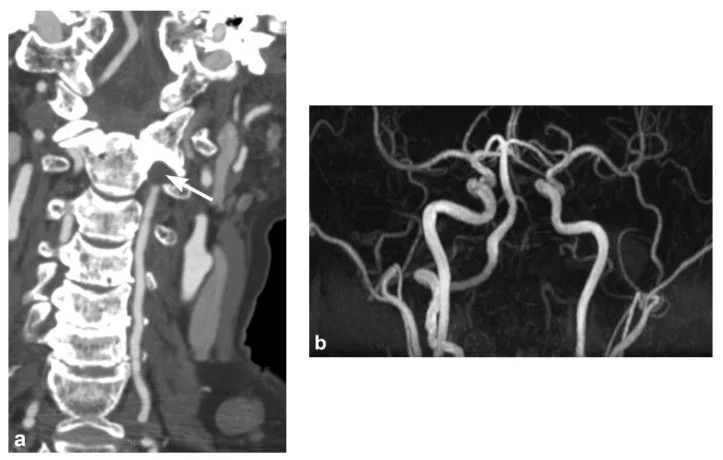
- Baziler arter fenestrasyonu bir damar varyantıdır ve doğru yorum için varyantların görüntüleme özelliklerinin tanınması ve tanısal tuzaklardan kaçınılması gerekir.
- Baziler oklüzyon ateroskleroz veya emboli ile gelişebilir.
- BTA değerlendirmesinde görüntüleme artefaktları bulguları gizleyebilir ve değerlendirmeyi güçleştirebilir, bu nedenle izole lümen değişikliği artefakt olasılığına karşı dikkatle yorumlanmalıdır.
- Vertebral arter diseksiyonu intima yırtığı ile arter duvarı içinde kan birikimine ve lümen darlığına yol açabilir ve ilk tarama ile tanıda BTA kullanılabilir.
Tuzaklar
- Baziler fenestrasyon kısa bir çift lümen segmenti ve distal yeniden birleşme oluşturabilir; bu görünümü trombüs veya odaksal diseksiyonla karıştırma.
- Arka çukurda görüntüleme artefaktları kontrastsız BT’de iskeminin değerlendirilmesini sınırlar; BAO şüphesinde CTA gibi damar görüntülemesi gerekir.
- Kontrastsız BT’de çok sayıda damarın yaygın hiperdens görünmesi yüksek hematokritte görülebilir; damar duvarındaki çevresel kalsifikasyon ise ayrı bir taklittir. BTA’da baziler lümenin açık olup olmadığını birlikte kontrol et.
- Posterior komünikan kollateral dolum distal damarı kısmen opaklaştırabilir; distal opaklaşma proksimal baziler oklüzyonu dışlamaz.
- Posterior dolaşım iskemi yaygınlığı pc-ASPECTS ile yapılandırılmış biçimde kontrastsız BT'de puanlanabilir; pc-ASPECTS ≥8 gibi yüksek skorlar arka dolaşımda ihmal edilebilir erken iskemik değişiklik olduğunu gösterir.
Kendini dene
Ani dizartrisi olan hastada BTA baziler gövdede ani kontrast sonlanması gösteriyor. En olası bulgu nedir?
Cevabı göster
Baziler arter oklüzyonu. BTA’da ani baziler lümen sonlanması baziler arter oklüzyonuyla uyumludur.
Kontrastsız BT'de baziler arter dansitesi 61 HU'nun üzerinde ölçüldü ve klinik tablo BAO'dan kuşkulandırıyor. Bu bulgu için en doğru yorum hangisidir?
Cevabı göster
BAO açısından yüksek özgüllük taşır ancak tek başına tanı için duyarlı değildir. 61 HU üzeri baziler dansitesi BAO için yüksek özgüllük gösterir ama duyarlılığı düşüktür; tanı doğrulaması için CTA gibi damar görüntülemesi gerekir.
Kaynaklar
Bu sayfadaki 38 cümle ve 2 quiz sorusu aşağıdaki kaynaklardan alıntılarla otomatik olarak karşılaştırıldı; 27 cümle bu karşılaştırmada düzeltildi (2026-10-12).
- Basilar artery occlusion: A review of clinicoradiologic features, treatment selection, and endovascular techniquespmc.ncbi.nlm.nih.gov
- Assessment of Vessel Density on Non-Contrast Computed Tomography to Detect Basilar Artery Occlusionpmc.ncbi.nlm.nih.gov
- European Stroke Organisation and European Society for Minimally Invasive Neurological Therapy guideline on acute management of basilar artery occlusionpmc.ncbi.nlm.nih.gov
- CTA Evaluation of Basilar Septations: An Entity Better Characterized as Aberrant Basilar Fenestrationspmc.ncbi.nlm.nih.gov
- The hyperdense vessel sign in cerebral computed tomography: pearls and pitfallspubmed.ncbi.nlm.nih.gov
- Anatomy, Head and Neck: Basilar Arteryncbi.nlm.nih.gov
- Imaging Characteristics of Symptomatic Vertebral Artery Dissection: A Systematic Reviewpmc.ncbi.nlm.nih.gov
- Sixty-four-section multidetector CT angiography of carotid arteries: a systematic analysis of image quality and artifactspubmed.ncbi.nlm.nih.gov
- Computed Tomography–Based Imaging Scores in Basilar Artery Occlusions: A Comparison of Predictive Abilities for Functional Outcomespmc.ncbi.nlm.nih.gov
- Mechanical Thrombectomy for Acute Vertebrobasilar Occlusion Associated with Mycoplasma pneumoniae Pneumonia in a Child: A Case Reportpmc.ncbi.nlm.nih.gov
- ransient Ischemic Attack Progressing to Top-of-the-Basilar Syndrome: A Case Reportpmc.ncbi.nlm.nih.gov
- Patterns of ischemic posterior circulation strokes: A clinical, anatomical, and radiological review.pubmed.ncbi.nlm.nih.gov
- Basilar artery occlusion.pubmed.ncbi.nlm.nih.gov
- Endovascular therapy for acute vertebrobasilar occlusion (VERITAS): a systematic review and individual patient data meta-analysis.pubmed.ncbi.nlm.nih.gov
- Hemodynamic stroke: A rare pitfall in cranio cervical junction surgery.pubmed.ncbi.nlm.nih.gov
- [Occlusion of the vertebrobasilar artery. Case presentation and literature review].pubmed.ncbi.nlm.nih.gov
- Cardiac Biomarkers Predict Large Vessel Occlusion in Patients with Ischemic Stroke.pubmed.ncbi.nlm.nih.gov
- Noncontrast CT vs CT Perfusion Imaging in Patients With Basilar Artery Occlusion: Analysis of the ATTENTION and ATTENTION IA Trials.pubmed.ncbi.nlm.nih.gov
- Large Vessel Occlusion in Acute Ischemic Stroke Patients: A Dual-Center Estimate Based on a Broad Definition of Occlusion Site.pubmed.ncbi.nlm.nih.gov
- Diagnostic and prognostic computed tomography imaging markers in basilar artery occlusion (Review).pubmed.ncbi.nlm.nih.gov
- Evaluation of Clinical Features and Stroke Etiology in Patients with Bilateral Middle Cerebellar Peduncle Infarction.pubmed.ncbi.nlm.nih.gov
- Rotational vertebral artery occlusion in a patient with basilar invagination.pubmed.ncbi.nlm.nih.gov
- Acute basilar artery occlusion (BAO): a pictorial review of multimodal imaging findings.pubmed.ncbi.nlm.nih.gov
- Where Does the Signal Go? Technical Challenges of CT Perfusion in Lacunar and Infratentorial Stroke.pubmed.ncbi.nlm.nih.gov
- Multimodal imaging in neuro-ophthalmology.pubmed.ncbi.nlm.nih.gov
- Dynamic bilateral vertebral artery occlusion owing to os odontoideum mimicking basilar artery occlusion: illustrative case.pubmed.ncbi.nlm.nih.gov
- The "fidget spinner" sign in cardioembolic bilateral medial medullary infarction: an imaging clue to proximal anterior spinal artery occlusion.pubmed.ncbi.nlm.nih.gov
- Evolving hemimedullary syndrome: A case report.pubmed.ncbi.nlm.nih.gov
- Isolated brainstem death: case presentation demonstrating preserved supratentorial perfusion on <sup>99m</sup>Tc-bicisate brain scintigraphy.pubmed.ncbi.nlm.nih.gov
- Postpartum Vertebral Artery Dissection After Neck Massage Resulting in a Right Cerebellar Infarct: A Case Report and Literature Review.pubmed.ncbi.nlm.nih.gov
- Vertebral Artery Dissection and PICA-Territory Stroke Associated with Chronic Atlantoaxial Structural Abnormality: A Case Report.pubmed.ncbi.nlm.nih.gov
- Mechanical Thrombectomy for Acute Vertebrobasilar Occlusion Associated with Mycoplasma pneumoniae Pneumonia in a Child: A Case Report.pubmed.ncbi.nlm.nih.gov
- Integrated predictors of outcome in vertebrobasilar artery occlusion treated With endovascular therapy.pubmed.ncbi.nlm.nih.gov
- Endovascular Revascularization for Chronic Vertebral Artery Occlusion with Poor Collateral Circulation and a Large Perfusion Abnormality Identified by Automated Perfusion Imaging: A Case Report.pubmed.ncbi.nlm.nih.gov
- Initial Experience With a Deep Learning Algorithm for Detecting Posterior Circulation Large Vessel Occlusion on Noncontrast Computed Tomography.pubmed.ncbi.nlm.nih.gov
- Influence of tube voltage on image quality in non-contrast photon-counting computed tomography of the head: Comparison of 120 kVp and 140 kVp.pubmed.ncbi.nlm.nih.gov
- Clinical importance of the persistent primitive hypoglossal artery in vascular lesions and endovascular treatment: a narrative review.pubmed.ncbi.nlm.nih.gov
- Vertebral Artery Pseudoaneurysm in a Single-Vessel Posterior Circulation With Chronic Contralateral Occlusion and Recent Methamphetamine Use.pubmed.ncbi.nlm.nih.gov
- The critical care management of spontaneous intracranial hemorrhage: a contemporary review.pubmed.ncbi.nlm.nih.gov
- Use of perfusion imaging and other imaging techniques to assess risks/benefits of acute stroke interventions.pubmed.ncbi.nlm.nih.gov
- The persistent proatlantal artery: types and subtypes.pubmed.ncbi.nlm.nih.gov
- Management of tandem occlusions in acute ischaemic stroke.pubmed.ncbi.nlm.nih.gov
- Ruptured vertebrobasilar junction aneurysm coexisting with isolated interrupted aortic arch and basilar artery hypoplasia in an adult female: illustrative case.pubmed.ncbi.nlm.nih.gov
- Benign versus sinister aetiologies underlying basal cistern subarachnoid haemorrhage: a case series.pubmed.ncbi.nlm.nih.gov
- Common and uncommon neuroimaging manifestations of ataxia: an illustrated guide for the trainee radiologist. Part 1 - acquired diseases.pubmed.ncbi.nlm.nih.gov
- Endovascular Treatment for Posterior Circulation Stroke: Ways to Maximize Therapeutic Efficacy.pubmed.ncbi.nlm.nih.gov
- Vertebral artery pseudoaneurysm with recurrent posterior circulation transient ischemic attacks in a post-radiotherapy nasopharyngeal carcinoma survivor: a case report.pubmed.ncbi.nlm.nih.gov
- Staged endovascular and surgical management of vertebral arteriovenous fistula with ruptured aneurysm and pseudoaneurysm in neurofibromatosis type 1 complicated by fatal reperfusion injury: illustrative case.pubmed.ncbi.nlm.nih.gov
- Flow diversion versus conventional endovascular treatment for ruptured basilar artery dissecting aneurysms: a single-center cohort study.pubmed.ncbi.nlm.nih.gov
- Secondary trigeminal neuralgia caused by vertebrobasilar dolichoectasia treated with flow-diverting stent reconstruction: a case report.pubmed.ncbi.nlm.nih.gov
- Evolving cerebrovascular pathology in fibromuscular dysplasia leading to aneurysmal subarachnoid hemorrhage.pubmed.ncbi.nlm.nih.gov
- Early Detection of Hyperdense Basilar Artery Signs Through Comparison With Previous Images.pubmed.ncbi.nlm.nih.gov
- Thrombus enhancement as a predictor of embolic in acute basilar artery occlusion.pubmed.ncbi.nlm.nih.gov
- Imaging of occlusive thrombi in acute ischemic stroke.pubmed.ncbi.nlm.nih.gov
- Computed Tomography-Based Imaging Scores in Basilar Artery Occlusions: A Comparison of Predictive Abilities for Functional Outcomes.pubmed.ncbi.nlm.nih.gov
- A Metallic Screw Gun-Traumatic Vertebral Artery Dissection Injury: A Case Report and Literature Review.pubmed.ncbi.nlm.nih.gov
- Historical evolution of microvascular decompression after Jannetta's establishment: Anatomical maps and physiological compasses-a narrative review.pubmed.ncbi.nlm.nih.gov
- Nomogram for Predicting 90-Day Outcomes in Patients with Acute Vertebrobasilar Artery Occlusion Undergoing Endovascular Treatment: A Multicenter Cohort Study.pubmed.ncbi.nlm.nih.gov
- Computed tomography perfusion-defined ischemic core predicts functional outcome after basilar artery thrombectomy.pubmed.ncbi.nlm.nih.gov
- Baseline ASPECTS predicts early neurological deterioration and functional outcomes after endovascular thrombectomy in acute ischemic stroke.pubmed.ncbi.nlm.nih.gov
- Operative Procedures for Ultrasound Assessment of Extracranial Artery Disease: A Narrative Review by the Italian Society for Vascular Investigation (SIDV).pubmed.ncbi.nlm.nih.gov
- Spinal Cord Infarction: Clinical and Neuroradiological Clues of a Rare Stroke Subtype.pubmed.ncbi.nlm.nih.gov
- Spectrum of Posterior Cerebral Artery Dissection: A Retrospective Observational Study and a Critical Review.pubmed.ncbi.nlm.nih.gov
- Exchange-free single-pass gateway balloon-assisted neuroform atlas stenting for symptomatic high-grade intracranial atherosclerotic stenosis: clinical and angiographic outcomes.pubmed.ncbi.nlm.nih.gov
- Pitfalls in Intracranial Aneurysm Clipping: How to Avoid and How to Get out of Them.pubmed.ncbi.nlm.nih.gov
- The holistic and local perspectives in teaching spinal arteriovenous malformations.pubmed.ncbi.nlm.nih.gov
- Congenital Anomalies and Variations of the Carotid and Vertebral Arteries: A Case-Based Imaging Review.pubmed.ncbi.nlm.nih.gov
- Case Report: Three cases involving the use of endovascular intervention for artery of Percheron infarction with a unilateral fetal-type posterior cerebral artery.pubmed.ncbi.nlm.nih.gov
- Case Report: A case of atypical persistent proatlantal intersegmental artery.pubmed.ncbi.nlm.nih.gov
- Stent Retriever-Assisted Embolic Protection During Recanalization of Chronic Internal Carotid Artery Occlusion with Contralateral Carotid Stenosis: A Case Report.pubmed.ncbi.nlm.nih.gov
- Challenging diagnosis of subaxial bow hunter's syndrome presenting with recurrent posterior circulation infarcts: illustrative case.pubmed.ncbi.nlm.nih.gov
- Transient Ischemic Attack Progressing to Top-of-the-Basilar Syndrome: A Case Report.pubmed.ncbi.nlm.nih.gov
- Blunt Cerebrovascular Injury: A Visual Case Report with Computed Tomography Angiography Findings Revealing Carotid and Vertebral Artery Dissection.pubmed.ncbi.nlm.nih.gov
- Aortic coarctation revealed by subarachnoid hemorrhage in a 17-year-old patient: A rare association with multiple basilar trunk aneurysms.pubmed.ncbi.nlm.nih.gov
- Cannabis-induced ischemic stroke involving the basilar and middle cerebral arteries in a 50-year-old man: a rare case report.pubmed.ncbi.nlm.nih.gov
- Mechanical Thrombectomy for Pediatric Acute Ischemic Stroke With Large Vessel Occlusion: Technical Guide and Case Series.pubmed.ncbi.nlm.nih.gov
- Endovascular Treatment Strategies for Acute Intracranial Atherosclerotic Stenosis-Related Large Vessel Occlusion.pubmed.ncbi.nlm.nih.gov
- Use of overlapping Surpass Evolve Flow Diverters for the treatment of a ruptured P1 dissecting aneurysm in the context of bilateral carotid artery occlusion: A case report.pubmed.ncbi.nlm.nih.gov
- Intravenous thrombolysis for acute ischemic stroke due to vertebral artery dissection: A case report.pubmed.ncbi.nlm.nih.gov
- Parent Artery Disease-Related Stroke: What Is the Impact on Endovascular Treatment? A Narrative Review.pubmed.ncbi.nlm.nih.gov
- Basilar artery occlusion due to vertebral artery injury treated with thrombectomy and distal vertebral artery embolization through the unaffected side.pubmed.ncbi.nlm.nih.gov
- Diagnostic Challenges in Acute Basilar Artery Occlusion Successfully Treated With Mechanical Thrombectomy: A Case Report.pubmed.ncbi.nlm.nih.gov
- Anatomic variations in basilar artery termination: a systematic review and meta-analysis with presentation of an illustrative case.pubmed.ncbi.nlm.nih.gov
- Incidental vascular findings on brain magnetic resonance angiography.pubmed.ncbi.nlm.nih.gov
- The Vertebrobasilar Trunk and Its Anatomical Variants: A Microsurgical Anatomical Study.pubmed.ncbi.nlm.nih.gov
- Accessory middle cerebral artery, hypoplasia of the A1 segment of the left anterior cerebral artery fenestration of the A2 segment of the left anterior cerebral artery and fetal variant of posterior cerebral artery.pubmed.ncbi.nlm.nih.gov
- Rare neurovascular variants that you probably have not seen before.pubmed.ncbi.nlm.nih.gov
- Cardiac intimal sarcoma presenting as basilar artery occlusion treated with tenecteplase and thrombectomy: a case report.pubmed.ncbi.nlm.nih.gov
- Beyond the "string of beads": case-based exploration of diagnostic pitfalls and solutions in reversible cerebral vasoconstriction syndrome.pubmed.ncbi.nlm.nih.gov
- Traumatic occipital artery pseudoaneurysm: Case report, anatomical considerations, and literature review.pubmed.ncbi.nlm.nih.gov
- Contemporary Methods for Detection and Intervention of Distal Medium and Small Vessel Occlusions.pubmed.ncbi.nlm.nih.gov
- Endovascular repair of traumatic innominate artery injury: case report.pubmed.ncbi.nlm.nih.gov
- A novel radiological score on digital subtraction angiography predicts prognosis for acute basilar artery occlusion treated with endovascular thrombectomy: a two-center retrospective study.pubmed.ncbi.nlm.nih.gov
- Brainstem Disconnection Syndrome in a Patient With Respiratory Failure and Failed Weaning From Oxygen: A Case Report.pubmed.ncbi.nlm.nih.gov
- Internal carotid artery fenestration with contralateral internal carotid artery dissection: a case report and literature review.pubmed.ncbi.nlm.nih.gov
- Persistent primitive hypoglossal artery: a classification-based approach to understanding and managing a rare vascular anomaly.pubmed.ncbi.nlm.nih.gov
- Clinical implications of vessel wall imaging-State-of-the-art review.pubmed.ncbi.nlm.nih.gov
- Artificial Intelligence-Assisted Intravascular Imaging in Percutaneous Coronary Intervention: Current Status and Advances.pubmed.ncbi.nlm.nih.gov
- Initial magnetic resonance imaging/magnetic resonance angiography may miss intracranial artery dissection in young adults with stroke: the role of subsequent imaging.pubmed.ncbi.nlm.nih.gov
- A Routine Neck Massage, a Devastating Stroke: Imaging Clues to Vertebral Artery Dissection.pubmed.ncbi.nlm.nih.gov
- Utility of Non-Contrast CT and MRA Fusion Images for Depicting Occluded Vessels in Mechanical Thrombectomy.pubmed.ncbi.nlm.nih.gov
- Retrieval of an atherosclerotic plaque-vessel wall complex during mechanical thrombectomy: illustrative case.pubmed.ncbi.nlm.nih.gov
- Atypical variants of the cerebral arterial circle beyond the Lazorthes classification: a retrospective morphologic and neuroradiologic study.pubmed.ncbi.nlm.nih.gov
- Prognostic Value of pc-ASPECTS Before Endovascular Therapy in Posterior Circulation Stroke: A Systematic Review and Meta-Analysis.pubmed.ncbi.nlm.nih.gov
- Dolichoectasia of Anterior and Posterior Circulation With Thrombosed Saccular Aneurysm of Vertebral Artery Presenting as Obstructive Hydrocephalus: A Case Report.pubmed.ncbi.nlm.nih.gov
- Delayed mass effect following endovascular coiling of posterior inferior cerebellar artery aneurysms: Mechanism and treatment strategy: A case report.pubmed.ncbi.nlm.nih.gov
- The Combination of Atrial Fibrillation and Occlusion Site Predicts In Situ Atherosclerotic Thrombosis in Basilar Artery Occlusion.pubmed.ncbi.nlm.nih.gov
- Pontine Tegmental Infarction With Cerebellar Involvement Mimicking Lateral Medullary Syndrome: A Clinico-Radiological Paradox.pubmed.ncbi.nlm.nih.gov
- Siltation and tidal effects: a comprehensive, clinical, and didactic approach to reasoning about vertebrobasilar hypoflow conditions.pubmed.ncbi.nlm.nih.gov
- Portal Vein Thrombosis: State-of-the-Art Review.pubmed.ncbi.nlm.nih.gov
- A Mechanistic and Pathophysiological Approach for Stroke Associated with Drugs of Abuse.pubmed.ncbi.nlm.nih.gov
- Carotid plaque vulnerability and circle of Willis anatomy predict ipsilateral brain infarcts and long-term mortality in carotid endarterectomy patients.pubmed.ncbi.nlm.nih.gov
- Spontaneous Intracranial Vertebral Artery Dissection: A Rare Cause of Ischemic Stroke.pubmed.ncbi.nlm.nih.gov
- An Integrated Approach on the Diagnosis of Cerebral Veins and Dural Sinuses Thrombosis (a Narrative Review).pubmed.ncbi.nlm.nih.gov
- Imaging of Cerebral Venous Thrombosis.pubmed.ncbi.nlm.nih.gov
- Non-Enhanced CT Mimicking Contrast Enhanced CT - A Case Report on Polycythemia.pubmed.ncbi.nlm.nih.gov
- Imaging Evaluation of Acute Traumatic Brain Injury.pubmed.ncbi.nlm.nih.gov
- Development, characterization, and curve fitting of rate-dependent models of calcified cerebral embolus analogs for acute ischemic stroke.pubmed.ncbi.nlm.nih.gov
- Utility of Hounsfield unit in the diagnosis of tandem occlusion in acute ischemic stroke.pubmed.ncbi.nlm.nih.gov
- Stridor in Bilateral Medial Medullary Infarction: A Case Report, Literature Review, and Pathophysiologic Insights Into a Rare Presentation of an Uncommon Stroke.pubmed.ncbi.nlm.nih.gov
Eğitim amaçlıdır; hasta başında tanı ve tedavi kararının yerine geçmez, tıbbi tavsiye değildir. Metinler yapay zekâ desteğiyle yazıldı ve otomatik bir adımda kaynak alıntılarıyla karşılaştırıldı; bu bir tıbbi doğrulama değildir ve içerik uzman radyolog incelemesinden geçmedi. Klinik kararlarda güncel kılavuzları, kurum protokollerini ve radyoloji raporunu esas alın.