Özet
Anevrizmal subaraknoid kanamadan sonraki günlerde yeni nörolojik kötüleşme gelişen hastada intrakraniyal arterlerin geçici daralması ve buna bağlı gecikmiş iskemi araştırılır. Kontrastsız BT subaraknoid kanamayı ve gelişen infarktı değerlendirmede kullanılır; BT anjiyografi arter lümenindeki daralmayı gösterir, BT perfüzyon ise serebral kan akımını ve perfüzyon bozukluğunu değerlendirmeye yardımcı olur. Anjiyografik vazospazm gecikmiş serebral iskemiyle eş anlamlı değildir ve tek başına klinik kötüleşmeyi kanıtlamaz. Daralma ya da eşlik eden iskemi atlanırsa geri dönüşsüz infarkt gelişene dek tanı gecikebilir.
Faz ve pencere
- Kontrastsız tanısal
- Kontrastsız BT'de yeni kanamayı ve gelişen infarktı arayın.
- BTA tanısal
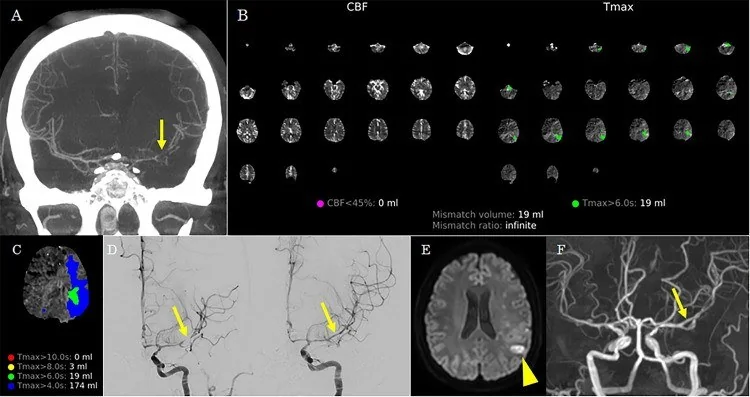
- Willis poligonu, supraklinoid internal karotid arterler ile A1, M1 ve P1 segmentlerinde karşılaştırmalı lümen daralması, düzensizlik ve distal dalların opasifikasyonunu gösterir; önceki BTA veya DSA varsa çap değişimi başlangıç incelemesiyle karşılaştırılarak daha güvenilir yorumlanır.
- BTP tanısal
- Gecikmiş transit ve azalmış serebral kan akımıyla birlikte uzamış ortalama geçiş zamanı, özellikle daralmış arterin beslediği alanda perfüzyon bozukluğunu gösterir; gecikmiş bolus nedeniyle çekirdek-kurtarılabilir doku ayrımı dikkatle yorumlanır.
Önerilen pencereler: Beyin (G 80 / M 40), İnme (G 40 / M 40), Anjiyo (G 600 / M 150).
BT bulguları
- Segmental lümen daralması — M1, A1 veya baziler arterde önceki incelemeye göre incelme; damar çapı yakın normal ICA segmenti veya karşı tarafla kıyaslanır.
- Stenozun ötesindeki distal arter dallarında opasifikasyon azalması veya geç dolum gözlenebilir; bu durum daralan proksimal segmentin distal perfüzyonu etkilediğini gösterir.
- Damar alanına uyan perfüzyon gecikmesi — daralmış damarın beslediği kortekste uzamış transit zamanı; geniş infarkt çekirdeği bulunmayabilir.
- Gelişen iskemik infarkt — BT veya MR'da saptanan yeni infarkt, gecikmiş serebral iskemiye bağlı doku hasarını düşündürür.
- Yeniden subaraknoid kan — yeni veya artmış sulkal/sisternal hiperdensite; önceki kan dağılımı ve girişim alanıyla karşılaştırılır.
- İşlem sonrası damar kontur değişikliği — Klip/koil çevresindeki metal blooming komşu lümeni örtebilir veya olduğundan dar gösterebilir; stent içi ya da kenarındaki mekanik stenoz ise gerçek cihaz ilişkili darlıktır. Cihaz konumu ve önceki incelemeler vazospazm ayrımına yardım eder.
Ölçütler ve sınıflamalar
- CTA/DSA lümen daralması için semikantitatif derece
- BT anjiyografide vazospazm, lümen azalmasının proksimal ve distal segmentler ile karşı taraf damarlarına göre değerlendirilmesiyle tanımlanır.
Normalde
Normal BTA'da supraklinoid internal karotid arterlerin, A1 ve M1 segmentlerinin ve baziler arterin lümen konturları kesintisizdir; aynı hastanın başlangıç anjiyogramı bu kıyas için en yararlı referanstır. BTA'da darlığı değerlendirirken ilgili damarı proksimal ve distal segmentleriyle ve karşı taraftaki damarlarla karşılaştırın.
Normal BT ile kıyasla
Aynı bölgenin, kaynak veri setinde patoloji içermediği belirtilen bir BT incelemesini kesit kesit kaydırın; organ sınırlarını açarak anatomiyi hasta görüntüsüyle karşılaştırın. Küçük rastlantısal bulgular tümüyle dışlanmamıştır.
Kaynak: TotalSegmentator v2.01 veri seti (Wasserthal ve ark., Radiology: Artificial Intelligence 2023), CC BY 4.0, vaka s0103; organ sınırları veri setinin otomatik segmentasyonundan, birleştirilerek sadeleştirildi. Görüntüler 2,5 mm kesit aralığına yeniden örneklendi.
Ayırıcı tanı
- Reversible serebral vazokonstriksiyon sendromu
- tekrarlayan gök gürültüsü baş ağrısı ve çok odaklı daralma görülebilir; eşlik eden tipik anevrizmal kan dağılımı bulunmayabilir.
- İntrakraniyal ateroskleroz
- fokal, sıklıkla eksantrik plak ve sabit darlık; başlangıç görüntülerinde aynı segmentte kronik değişiklik olabilir.
- İşleme bağlı stenoz
- klip veya stent bitişiğinde mekanik lümen daralması ve metal artefaktı; anatomik olarak cihazla ilişkilidir.
- Konjenital hipoplazi
- tek arter segmenti boyunca düzgün ve kalıcı küçük kalibre; karşı taraf ve eşlik eden damar varyantları yardımcıdır.
Tuzaklar
- CTA'daki metal klip/koil blooming'i komşu damarın lümenini yapay olarak daraltabilir; kaynak görüntülerde farklı düzlemlerde izle ve önceki CTA/DSA ile kıyasla.
- CTA'nın vazospazm taramasındaki duyarlılığı sınırlı olabilir; bu nedenle negatif CTA, klinik kuşku sürüyorsa vazospazmı tek başına dışlamaz.
- Anjiyografik daralma, gecikmiş serebral iskemi ile aynı kavram değildir; doku perfüzyonu ve yeni infarktı ayrı değerlendir.
- Vazospazmı yalnız tek bir damarın küçük görünmesine dayanarak adlandırma; başlangıç damar çapı, anatomik varyant ve teknik opasifikasyon farkını kontrol et.
Kendini dene
Anevrizmal subaraknoid kanama sonrası CTA'da arter lümenindeki daralmayı değerlendirirken hangi karşılaştırmalar yapılmalıdır?
Cevabı göster
Başlangıç BT anjiyografi, proksimal-distal segmentler ve karşı taraf damarlar. CTA'da vazospazm, lümen azalmasının proksimal ve distal segmentlere ve karşı taraftaki damarlara göre değerlendirilmesiyle tanımlanır. Başlangıç CTA'sı, aterosklerotik daralma ve hipoplaziyi vazospazm taklitçileri olarak dışlamaya yardımcı olur.
Subaraknoid kanama sonrası anjiyografide vazospazm saptanırsa, bu bulgu hangi klinik sonuçlarla birlikte yorumlanmalıdır?
Cevabı göster
Gecikmiş serebral iskemi veya işlevsel sonuçla. Anjiyografi veya transkraniyal Doppler'de saptanan vazospazm, gecikmiş serebral iskemi ya da işlevsel sonuçla birlikte yorumlanmalıdır.
Kaynaklar
Bu sayfadaki 36 cümle ve 2 quiz sorusu aşağıdaki kaynaklardan alıntılarla otomatik olarak karşılaştırıldı; 17 cümle bu karşılaştırmada düzeltildi (2026-10-09).
- Efficacy and safety of milrinone in the treatment of cerebral vasospasm after subarachnoid hemorrhage: a systematic reviewpmc.ncbi.nlm.nih.gov
- Herbal medicines for the prevention and treatment of cerebral vasospasm after subarachnoid hemorrhagepmc.ncbi.nlm.nih.gov
- Transcranial Doppler in the Detection of Cerebral Vasospasm After Subarachnoid Hemorrhagepmc.ncbi.nlm.nih.gov
- Feasibility of Flat-Panel CT-Based Perfusion Imaging for Early Diagnosis of Symptomatic Cerebral Vasospasm After Subarachnoid Hemorrhagepmc.ncbi.nlm.nih.gov
- Neuroprotective effects of hesperidin on cerebral vasospasm after subarachnoid hemorrhage in rats: an experimental studypmc.ncbi.nlm.nih.gov
- Diagnosis of Delayed Cerebral Ischemia in Patients with Aneurysmal Subarachnoid Hemorrhage and Triggers for Intervention.pubmed.ncbi.nlm.nih.gov
- Aneurysmal Subarachnoid Hemorrhage: Unanswered Questions.pubmed.ncbi.nlm.nih.gov
- Treatment of subarachnoid hemorrhage.pubmed.ncbi.nlm.nih.gov
- Reversible Cerebral Vasoconstriction Syndrome Following Carotid Endarterectomy: A Case Report.pubmed.ncbi.nlm.nih.gov
- Definition of delayed cerebral ischemia after aneurysmal subarachnoid hemorrhage as an outcome event in clinical trials and observational studies: proposal of a multidisciplinary research group.pubmed.ncbi.nlm.nih.gov
- Reversible cerebral vasoconstriction syndrome identification of prognostic factors.pubmed.ncbi.nlm.nih.gov
- Intracerebral hemorrhage associated with oral phenylephrine use: a case report and review of the literature.pubmed.ncbi.nlm.nih.gov
- Traumatic brain injury and intracranial hemorrhage-induced cerebral vasospasm: a systematic review.pubmed.ncbi.nlm.nih.gov
- Postinterventional critical care management of aneurysmal subarachnoid hemorrhage.pubmed.ncbi.nlm.nih.gov
- Subarachnoid Hemorrhage: Updates in Diagnosis and Management.pubmed.ncbi.nlm.nih.gov
- 36th International Symposium on Intensive Care and Emergency Medicine : Brussels, Belgium. 15-18 March 2016.pubmed.ncbi.nlm.nih.gov
- REACT: a randomized trial to assess the efficacy and safety of clazosentan for preventing clinical deterioration due to delayed cerebral ischemia after aneurysmal subarachnoid hemorrhage.pubmed.ncbi.nlm.nih.gov
- Imaging predictors of outcome in acute spontaneous subarachnoid hemorrhage: a review of the literature.pubmed.ncbi.nlm.nih.gov
- Ultra-early angiographic vasospasm associated with delayed cerebral ischemia and infarction following aneurysmal subarachnoid hemorrhage.pubmed.ncbi.nlm.nih.gov
- Phase 1/2a Trial of ISPASM.pubmed.ncbi.nlm.nih.gov
- Fatal malignant cerebral vasospasm following pediatric craniopharyngioma resection: A case report and literature review.pubmed.ncbi.nlm.nih.gov
- Cerebral Vasospasm After Traumatic Subarachnoid Hemorrhage: A Narrative Review.pubmed.ncbi.nlm.nih.gov
- Emerging Neurovascular Interventions for the Prevention of Cerebral Vasospasm and Delayed Cerebral Ischemia After Aneurysmal Subarachnoid Hemorrhage: A Systematic Review.pubmed.ncbi.nlm.nih.gov
- Aneurysmal subarachnoid hemorrhage: predictive score for angiographic vasospasm.pubmed.ncbi.nlm.nih.gov
- Time-to-maximum Analysis Using Rapid Processing of Perfusion and Diffusion Software for Assessment of the Risk of Delayed Cerebral Ischemia after Aneurysmal Subarachnoid Hemorrhage.pubmed.ncbi.nlm.nih.gov
- Cilostazol and Functional Outcomes in Poor-Grade Aneurysmal Subarachnoid Hemorrhage: A Multicenter Retrospective Analysis.pubmed.ncbi.nlm.nih.gov
- Intraventricular Hemorrhage Burden and Treatment-Specific Symptomatic Vasospasm After Aneurysmal Subarachnoid Hemorrhage.pubmed.ncbi.nlm.nih.gov
- Magnesium in Neurocritical Care: Clinical Relevance, Status Assessment, and Practical Implications for Outcomes-A Narrative Review.pubmed.ncbi.nlm.nih.gov
- Longitudinal Kinetics of Cerebrospinal Fluid and Serum S100B in Patients with Delayed Cerebral Ischemia After Aneurysmal Subarachnoid Hemorrhage.pubmed.ncbi.nlm.nih.gov
- Phase-Based Dynamic Prediction of Delayed Cerebral Ischemia After Aneurysmal Subarachnoid Hemorrhage: Comparison of a Large Language Model with Intensive Care Specialists.pubmed.ncbi.nlm.nih.gov
- Subarachnoid Hemorrhage Confirmed by Magnetic Resonance Imaging in a Patient with Brain Death owing to Hypoxic Encephalopathy Following Suicide by Hanging.pubmed.ncbi.nlm.nih.gov
- Hemorrhagic stroke: Uncommon complication of diabetic ketoacidosis in pediatric patients.pubmed.ncbi.nlm.nih.gov
- Spectrum of neurologic & neuroimaging manifestation in COVID-19.pubmed.ncbi.nlm.nih.gov
- Vasospasm following resection of olfactory groove meningiomas via orbitozygomatic craniotomy: illustrative cases.pubmed.ncbi.nlm.nih.gov
- Association between the A1 Segment Asymmetry and Severe Clinical Presentation in Ruptured Anterior Communicating Artery Aneurysms.pubmed.ncbi.nlm.nih.gov
- The predictive value of cerebral blood flow perfusion for cSAH following flow-restricting head and neck artery angioplasty.pubmed.ncbi.nlm.nih.gov
- Monitoring treatment of delayed cerebral ischaemia in unconscious patients after aneurysmal subarachnoid haemorrhage: a prospective multimodal neuromonitoring study.pubmed.ncbi.nlm.nih.gov
- Exchange-free single-pass gateway balloon-assisted neuroform atlas stenting for symptomatic high-grade intracranial atherosclerotic stenosis: clinical and angiographic outcomes.pubmed.ncbi.nlm.nih.gov
- Agreement between CT-Angiography and Digital Subtraction Angiography in Predicting Angiographic Vasospasm in Patients with Subarachnoid Hemorrhage.pubmed.ncbi.nlm.nih.gov
- Association of middle cerebral artery aneurysms and variation of the A1 segment.pubmed.ncbi.nlm.nih.gov
- Perforator-Sparing Microsurgical Clipping of Tandem Dominant-Hemisphere Middle Cerebral Artery Aneurysms: Geometry-Guided Reconstruction of a Wide-Neck Bifurcation and Dorsal M1 Fusiform Lesion.pubmed.ncbi.nlm.nih.gov
- Delay of late-venous phase cortical vein filling in acute ischemic stroke patients: Associations with collateral status.pubmed.ncbi.nlm.nih.gov
- Uveal vascular bed in health and disease: lesions produced by occlusion of the uveal vascular bed and acute uveal ischaemic lesions seen clinically. Paper 2 of 2.pubmed.ncbi.nlm.nih.gov
- Oxyhemoglobin and Cerebral Blood Flow Transients Detect Infarction in Rat Focal Brain Ischemia.pubmed.ncbi.nlm.nih.gov
- Commentary: an eye on PET quantification.pubmed.ncbi.nlm.nih.gov
- Refined AI-ASPECTS with modified atlas and lesion-load thresholds: advancing acute ischemic stroke imaging and prognostic prediction.pubmed.ncbi.nlm.nih.gov
- e-ASPECTS software improves interobserver agreement and accuracy of interpretation of aspects score.pubmed.ncbi.nlm.nih.gov
- A Case of Moyamoya Vasculopathy Presenting as Simultaneous Ischemic and Hemorrhagic Strokes.pubmed.ncbi.nlm.nih.gov
- Middle cerebral artery dissection: pathophysiology, diagnosis, and therapeutic options.pubmed.ncbi.nlm.nih.gov
- Pharmaceutically Assisted Angioplasty to Relieve Cerebral Vasospasm after Aneurysmal Subarachnoid Hemorrhage-A Retrospective, Single-Center, Observational Comparison of Established and New Treatment Techniques.pubmed.ncbi.nlm.nih.gov
- Electrochemotherapy in the Management of Vascular Malformations: An Updated Systematic Review.pubmed.ncbi.nlm.nih.gov
- The Falcate Artery: Its Dynamics in Vasospasm.pubmed.ncbi.nlm.nih.gov
- Graves' disease-related reversible intracranial arteriopathy presenting with ischemic stroke: A case report and literature review.pubmed.ncbi.nlm.nih.gov
- Cerebral Catheter Angiography Findings in Adult Filipinos: A Quantitative Study of Intracranial Vessel Diameters and Flow Patterns.pubmed.ncbi.nlm.nih.gov
- Tyrosine Kinase Inhibitors as Risk Factors for Cerebral Vascular Disease: Report of Two Cases and Literature Review.pubmed.ncbi.nlm.nih.gov
- Distal Flow Diversion with Anti-Thrombotically Coated and Bare Metal Low-Profile Flow Diverters-A Comparison.pubmed.ncbi.nlm.nih.gov
- Advanced imaging modalities in the detection of cerebral vasospasm.pubmed.ncbi.nlm.nih.gov
- Physical rehabilitation approaches for the recovery of function and mobility following stroke.pubmed.ncbi.nlm.nih.gov
- Physical rehabilitation approaches for the recovery of function and mobility following stroke.pubmed.ncbi.nlm.nih.gov
- Long-term safety and effectiveness of the "OptEase" vena cava filter.pubmed.ncbi.nlm.nih.gov
- Reversible Cerebral Vasoconstriction Syndrome Associated With Vortioxetine: A Case Report.pubmed.ncbi.nlm.nih.gov
- Reversible cerebral vasoconstriction syndrome with concomitant recurrent subarachnoid hemorrhage and coronary vasospastic angina: A manifestation of systemic vasoconstriction syndrome.pubmed.ncbi.nlm.nih.gov
- Clinical Spectrum of Reversible Cerebral Vasoconstriction Syndrome With and Without Angiographic Vasoconstriction: A Retrospective Study of 84 Hospitalized Patients.pubmed.ncbi.nlm.nih.gov
- Large Vessel Occlusion Stroke due to Intracranial Atherosclerotic Disease: Identification, Medical and Interventional Treatment, and Outcomes.pubmed.ncbi.nlm.nih.gov
- Endovascular Treatment of Large Vessel Occlusion Strokes Due to Intracranial Atherosclerotic Disease.pubmed.ncbi.nlm.nih.gov
- Vessel Wall MR Imaging in the Pediatric Head and Neck.pubmed.ncbi.nlm.nih.gov
- Incidence and Outcomes of Flow Diverter Braid Deformation following Treatment with Non-DFT Wire Devices.pubmed.ncbi.nlm.nih.gov
- Lattice innovative flow diverter with mechanical balloons: a new breakthrough and efficacy evaluation in the treatment of unruptured intracranial aneurysms.pubmed.ncbi.nlm.nih.gov
- Intracranial stenting as a bail-out option for posthemorrhagic cerebral vasospasm: a single-center experience with long-term follow-up.pubmed.ncbi.nlm.nih.gov
- A Practical Approach to Intracranial Dural Arteriovenous Fistulas: Pathogenesis, Classification and Management.pubmed.ncbi.nlm.nih.gov
- Surgical Outcomes in Chiari 1 and Chiari 1.5 Malformation Treated by Posterior Fossa Reconstruction: A Comprehensive Analysis of 110 Pediatric Cases and Literature Review.pubmed.ncbi.nlm.nih.gov
- The role of stents in the treatment of congenital heart disease: Current status and future perspectives.pubmed.ncbi.nlm.nih.gov
- Clinical characteristics and diagnostic challenges of non-ST-segment elevation acute coronary syndrome patients with normal electrocardiograms: a review.pubmed.ncbi.nlm.nih.gov
- Artificial intelligence in neurovascular surgery: advancing diagnosis, treatment, and outcomes.pubmed.ncbi.nlm.nih.gov
- Spontaneous Coronary Artery Dissection and Takotsubo Syndrome: Converging Mechanisms, Diagnostic Pitfalls, and a Unified Clinical Algorithm.pubmed.ncbi.nlm.nih.gov
- Efficacy and safety of milrinone infusion in patients with aneurysmal subarachnoid hemorrhage: a systematic review and meta-analysis.pubmed.ncbi.nlm.nih.gov
- Perforator-Aware Explainable Microsurgical Intelligence for Basilar Trunk Aneurysm Reconstruction: A Human-Centred Clinical AI Framework for Precision Neurovascular Surgery-A Retrospective Single-Centre Study.pubmed.ncbi.nlm.nih.gov
- Anterior interhemispheric vs. pterional approach in the microsurgical management of anterior communicating artery aneurysms: a comparative analysis employing a novel multidimensional matching-tool.pubmed.ncbi.nlm.nih.gov
- Management of patients with atrial tachycardia: a clinical consensus statement of the European Heart Rhythm Association (EHRA) of the ESC, endorsed by the Heart Rhythm Society (HRS), the Asia Pacific Heart Rhythm Society (APHRS), the Latin American Heart Rhythm Society (LAHRS), and the Association for European Paediatric and Congenital Cardiology (AEPC).pubmed.ncbi.nlm.nih.gov
- Automated Vessel Occlusion Software in Acute Ischemic Stroke: Pearls and Pitfalls.pubmed.ncbi.nlm.nih.gov
- What You Always Wanted to Know about Endovascular Therapy in Acute Ischemic Stroke but Never Dared to Ask: A Comprehensive Review.pubmed.ncbi.nlm.nih.gov
- Research advances in imaging markers for predicting hematoma expansion in intracerebral hemorrhage: a narrative review.pubmed.ncbi.nlm.nih.gov
- Multimodal Monitoring in Eclamptic Intracerebral Hemorrhage Complicated by Reversible Cerebral Vasoconstriction Syndrome (RCVS): A Case Report.pubmed.ncbi.nlm.nih.gov
- Stratified assessment of clazosentan efficacy following subarachnoid hemorrhage: A multi-center cohort study.pubmed.ncbi.nlm.nih.gov
- Reversible cerebral vasoconstriction syndrome: A narrative review.pubmed.ncbi.nlm.nih.gov
- Understanding late-window cerebral vasospasm in aneurysmal subarachnoid hemorrhage.pubmed.ncbi.nlm.nih.gov
- European Stroke Organisation (ESO), European Association of Neurosurgical Societies (EANS) and European Society for Minimally Invasive Neurological Therapy (ESMINT) guideline on aneurysmal subarachnoid haemorrhage.pubmed.ncbi.nlm.nih.gov
- Delayed cerebral ischaemia after subarachnoid haemorrhage: pathophysiology, diagnosis and neurotherapeutic opportunities.pubmed.ncbi.nlm.nih.gov
- Artificial Intelligence in the Diagnostic Use of Transcranial Doppler and Sonography: A Scoping Review of Current Applications and Future Directions.pubmed.ncbi.nlm.nih.gov
- Effect of Thrombectomy With Combined Contact Aspiration and Stent Retriever vs Stent Retriever Alone on Revascularization in Patients With Acute Ischemic Stroke and Large Vessel Occlusion: The ASTER2 Randomized Clinical Trial.pubmed.ncbi.nlm.nih.gov
- High-affinity alphavbeta3 integrin targeted optical probe as a new imaging biomarker for early atherosclerosis: initial studies in Watanabe rabbits.pubmed.ncbi.nlm.nih.gov
- Inflammation, coagulation, and nutritional reserves refine 90-day prognostic stratification after ruptured intracranial aneurysm repair.pubmed.ncbi.nlm.nih.gov
- Systemic metabolic reprogramming within 24 h predicts delayed cerebral ischemia after aneurysmal subarachnoid hemorrhage.pubmed.ncbi.nlm.nih.gov
- Noninvasive neurophysiological diagnostics of delayed cerebral ischemia in aneurysmal subarachnoid hemorrhage: a scoping review.pubmed.ncbi.nlm.nih.gov
- When Cancer Clots: An Extensive Radiologic Analysis of Cancer-Associated Thromboembolism.pubmed.ncbi.nlm.nih.gov
- Healthcare-Associated Infections After Aneurysmal Subarachnoid Hemorrhage: A Retrospective Single-Center Cohort Study.pubmed.ncbi.nlm.nih.gov
- Bilateral Vein of Trolard Thrombosis Presenting with Seizure and Minimal Deficits: A Rare Case Report.pubmed.ncbi.nlm.nih.gov
- Comparative performance of 4 image scoring systems for vasospasm prediction after aneurysmal subarachnoid hemorrhage: superiority of the modified Hijdra total score.pubmed.ncbi.nlm.nih.gov
- Computed Tomography-Based Imaging Scores in Basilar Artery Occlusions: A Comparison of Predictive Abilities for Functional Outcomes.pubmed.ncbi.nlm.nih.gov
- Non-contrast computed tomography at the end of the acute care phase as an additional prognostic tool after aneurysmal subarachnoid hemorrhage.pubmed.ncbi.nlm.nih.gov
- Excessive subgaleal suction from a variable vacuum drainage system used for managing chronic subdural hematomas: a cautionary note. Illustrative case.pubmed.ncbi.nlm.nih.gov
- Evolving cerebrovascular pathology in fibromuscular dysplasia leading to aneurysmal subarachnoid hemorrhage.pubmed.ncbi.nlm.nih.gov
- Tenzingplasty for cerebral vasospasm following subarachnoid hemorrhage or meningitis: multicenter initial experience.pubmed.ncbi.nlm.nih.gov
- Stroke risk following bee and wasp stings: a systematic review of ischemic and hemorrhagic events.pubmed.ncbi.nlm.nih.gov
- Moyamoya Vasculopathy and Atypical Moyamoya-like Patterns: Insights into Diagnosis and Therapeutic Implications.pubmed.ncbi.nlm.nih.gov
- COVID-19-Associated Reversible Cerebral Vasoconstriction Syndrome: A Rare Case of Secondary Thunderclap Headache.pubmed.ncbi.nlm.nih.gov
- Retrieval of an atherosclerotic plaque-vessel wall complex during mechanical thrombectomy: illustrative case.pubmed.ncbi.nlm.nih.gov
- Delayed identification and treatment of a cervicomedullary spinal vascular lesion following angiogram-negative, high-grade subarachnoid hemorrhage: illustrative case.pubmed.ncbi.nlm.nih.gov
- Early recurrence of ruptured distal anterior cerebral artery aneurysm following stent-assisted coiling and salvage treatment with flow diverter: a case report and mechanistic analysis.pubmed.ncbi.nlm.nih.gov
- Endovascular treatment for symptomatic vasospasm following traumatic brain injury: illustrative case.pubmed.ncbi.nlm.nih.gov
- RAPID CTA versus JLK LVO for large vessel occlusion detection: a pragmatic comparison of performance and common pitfalls.pubmed.ncbi.nlm.nih.gov
- The RED 43 catheter for aspiration thrombectomy of distal medium vessel occlusions (DMVOs): a multicenter experience.pubmed.ncbi.nlm.nih.gov
- Endovascular Treatment Strategies for Acute Intracranial Atherosclerotic Stenosis-Related Large Vessel Occlusion.pubmed.ncbi.nlm.nih.gov
- "Small ghost aneurysm": delayed visualization of a ruptured thrombosed nonbranching M2 aneurysm with pathological and hemodynamic correlation. Illustrative case.pubmed.ncbi.nlm.nih.gov
- Acute-phase bypass surgery for ruptured intracranial aneurysm: Selection criteria in the endovascular era.pubmed.ncbi.nlm.nih.gov
Eğitim amaçlıdır; hasta başında tanı ve tedavi kararının yerine geçmez, tıbbi tavsiye değildir. Metinler yapay zekâ desteğiyle yazıldı ve otomatik bir adımda kaynak alıntılarıyla karşılaştırıldı; bu bir tıbbi doğrulama değildir ve içerik uzman radyolog incelemesinden geçmedi. Klinik kararlarda güncel kılavuzları, kurum protokollerini ve radyoloji raporunu esas alın.