Özet
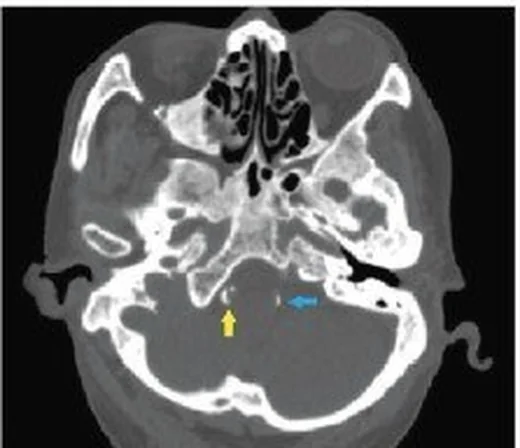
İntrakraniyal arter duvarı kalsifikasyonu en sık kavernöz internal karotid arterde (karotid sifonda), ayrıca vertebral ve baziler arterlerde görülen damar duvarı mineralizasyonudur. Kontrastsız BT kalsifikasyonun damar boyunca yerini ve şeklini gösterir; BT anjiyografi lümeni, plakla ilişkili daralmayı ve damar açıklığını değerlendirir. İntrakraniyal arter kalsifikasyonunun şiddeti kontrastsız BT'de görsel ölçeklerle değerlendirilebilir; damar lümenindeki stenoz CTA'da ölçülebilir ve MR teknikleri kalsifikasyonu diğer plak bileşenlerinden ayırmaya yardımcı olabilir. İntrakraniyal arter kalsifikasyonunun stenoz veya plak stabilitesiyle ilişkisi kesinleşmemiştir; MR'daki gelişmeler kalsifikasyonu fibroz doku, lipid ve trombüs gibi plak bileşenlerinden ayırmayı mümkün kılabilir.
Faz ve pencere
- Kontrastsız tanısal
- Kavernöz internal karotid arter ile vertebral ve baziler arter seyri boyunca duvarla ilişkili noktasal, kresentik ya da çevresel kalsifikasyon görülür. Kontrastsız görüntü damar kalsiyumunu doğrudan gösterir; lümen darlığının değerlendirilmesi lümen tabanlı incelemeye dayanır.
- BTA tanısal
- İntrakraniyal arter lümenindeki opaklaşma izlenir; kalsifiye segmentte eşlik eden plak, lümen daralması veya tıkanıklık araştırılır. BT anjiyografide kısmen kalsifiye plaklarda kalsiyum blooming artefaktı, esas olarak kısmi hacim etkisinden kaynaklanır ve yoğun kalsiyum komşuluğunda lümenin olduğundan dar görünmesine yol açarak stenoz değerlendirmesinin doğruluğunu sınırlayabilir; kalsiyum hacmi tek başına stenoz derecesi değildir.
Önerilen pencereler G genişlik, M merkez; değerler Hounsfield birimi (HU)
- BeyinG 80 / M +40
- AnjiyoG 600 / M +150
BT bulguları
- Sifon ve kavernöz internal karotid arter boyunca damar konturunu izleyen mural kalsiyum
- Kalsifikasyonun çevresel kapsamı ve kalınlığı görsel ölçeklerle değerlendirilebilir; intimal ve nonintimal alt tip ayrımı, morfolojik özellikleri kullanan ve histolojiye karşı doğrulanmış bir görsel ölçekle yapılmıştır.
- Vertebral arter intrakraniyal segmenti veya baziler arter duvarında benzer mineralizasyon
- Karşılıklı internal karotid arter kalsifikasyonlarını sağ ve sol için ayrı değerlendirin.
- BTA'da kalsifiye segment boyunca opak lümenin devamlılığı ve çapı
- Damar duvarı kalsiyumu ile komşu kafa tabanı kemiklerinin yüksek yoğunluğu arasındaki ayrım, yakın komşuluk nedeniyle güçleşebilir.
Normalde
Kavernöz internal karotid arter kalsifikasyonu yaşlı bireylerde sık görülen bir bulgudur ve kalsifikasyon şiddeti yaşla artma eğilimindedir. Karotid sifon kalsifikasyonunu komşu kafa tabanı kemiklerinden ayırmak gerekir; kalsifikasyonun şiddeti görsel ölçeklerle, lümen darlığı ise CTA'da ayrıca değerlendirilir.
Normal BT ile kıyasla
Aynı bölgenin, kaynak veri setinde patoloji içermediği belirtilen bir BT incelemesini kesit kesit kaydırın; organ sınırlarını açarak anatomiyi hasta görüntüsüyle karşılaştırın. Küçük rastlantısal bulgular tümüyle dışlanmamıştır.
Kaynak: TotalSegmentator v2.01 veri seti (Wasserthal ve ark., Radiology: Artificial Intelligence 2023), CC BY 4.0, vaka s0103; organ sınırları veri setinin otomatik segmentasyonundan, birleştirilerek sadeleştirildi. Görüntüler 2,5 mm kesit aralığına yeniden örneklendi.
Ayırıcı tanı
- Kafa tabanı kemiklerinin yüksek atenüasyonu, arter duvarı kalsifikasyonuna yakın komşuluğu nedeniyle karışıklığa yol açabilir.
- Akut intraluminal trombüs ile kronik mural kalsiyumun ayrımında MR'daki gelişmeler kalsifikasyonu trombüs gibi diğer plak bileşenlerinden ayırt etmeyi mümkün kılabilir.
Tuzaklar
- Kafa tabanı kemiklerinin yüksek yoğunluğu karotid sifon kalsiyumunu örtebilir; ardışık kesitlerde damar yolunu izleyerek kemikten ayırın.
- Eksantrik ve çevresel biçim intimal veya medial yerleşim hakkında ipucu verebilir, ancak BT görünümünden histolojik alt tipi kesinleştirmeyin.
- Kalsiyum blooming artefaktı esas olarak kısmi hacim etkisinden kaynaklanır ve yoğun kalsiyum komşuluğunda lümenini olduğundan dar gösterebilir; bu nedenle kalsiyumu stenoz yüzdesi yerine koymayın.
- Kalsifikasyon ile trombüs gibi diğer plak bileşenlerini ayırmada BT görünümü tek başına yeterli olmayabilir; MR'daki gelişmeler bu bileşenlerin ayırt edilmesini mümkün kılabilir.
Kendini dene
Kontrastsız BT'de karotid sifon boyunca damarın seyrini izleyen, duvara yapışık noktasal/çizgisel yüksek dansite izleniyor. Bu bulgu en çok hangisiyle ilişkilidir?
Cevabı göster
Mural aterokalsifikasyon. Karotid sifon intrakraniyal kalsifikasyonun en sık bildirilen yerleşimidir ve duvarla devamlılık gösteren yüksek dansite mural aterokalsifikasyonu destekler.
Kalsifiye damar segmentinde lümen darlığının derecesini hangi inceleme doğrudan değerlendirmeye yardım eder?
Cevabı göster
BT anjiyografi. BT anjiyografi opaklaşan lümeni göstererek daralma veya tıkanıklığın derecesini değerlendirmeye yardım eder. Kontrastsız BT kalsifikasyonu kolayca saptar; ancak kalsifikasyon ile iskemik inme arasındaki ilişkinin doğrudan arteriyel darlık mı yoksa plak stabilitesi mi yoluyla gerçekleştiği henüz aydınlatılamamıştır.
Kaynaklar
Bu sayfadaki 34 cümle ve 2 quiz sorusu aşağıdaki kaynaklardan alıntılarla otomatik olarak karşılaştırıldı; 16 cümle bu karşılaştırmada düzeltildi (2026-10-12).
- Intracranial Arterial Calcification on Computed Tomography and Risk of Cognitive Impairment or Dementia: A Systematic Review and Meta-Analysispmc.ncbi.nlm.nih.gov
- Intracranial Artery Calcification and Its Clinical Significancepmc.ncbi.nlm.nih.gov
- Intracranial Arterial Calcification and Its Impact on Subsequent Ischemic Cerebral Events: A Retrospective Cohort Studypmc.ncbi.nlm.nih.gov
- Systemic inflammation and cerebrovascular injury in acute strokepmc.ncbi.nlm.nih.gov
- Severity of Intracranial Arterial Calcification on Computed Tomography and Risk of Dementia in Patients With Stroke or Transient Ischemic Attack: A Population‐Based Studypmc.ncbi.nlm.nih.gov
- Intracranial Artery Calcification and Its Clinical Significance.pubmed.ncbi.nlm.nih.gov
- Intracranial Arterial Calcification: Prevalence, Risk Factors, and Consequences: JACC Review Topic of the Week.pubmed.ncbi.nlm.nih.gov
- The role of intracranial artery calcification (IAC) in stroke subtype and risk of vascular events.pubmed.ncbi.nlm.nih.gov
- Intracranial Arterial Calcification on Computed Tomography and Risk of Cognitive Impairment or Dementia: A Systematic Review and Meta-Analysis.pubmed.ncbi.nlm.nih.gov
- Cracking the Code of Calcification: How Presence and Burden among Intracranial Arteries Influence Stroke Incidence and Recurrence.pubmed.ncbi.nlm.nih.gov
- Impact of intracranial artery calcification on cerebral hemodynamic changes.pubmed.ncbi.nlm.nih.gov
- Intracranial arterial calcification in patients with unruptured and ruptured intracranial aneurysms.pubmed.ncbi.nlm.nih.gov
- Intracranial Arterial Calcificationes Can Reflect Cerebral Atherosclerosis Burden.pubmed.ncbi.nlm.nih.gov
- Relation of serum homocysteine levels to cerebral artery calcification and atherosclerosis.pubmed.ncbi.nlm.nih.gov
- Serum Aldosterone Is Associated with Cerebral Artery Atherosclerosis and Calcification.pubmed.ncbi.nlm.nih.gov
- Intracranial arterial calcification can predict early vascular events after acute ischemic stroke.pubmed.ncbi.nlm.nih.gov
- Computed tomography angiography findings predictive of post-intervention vasospasm in patients with aneurysmal subarachnoid hemorrhage.pubmed.ncbi.nlm.nih.gov
- Intracranial Arterial Calcification in Black Africans with Acute Ischaemic Stroke.pubmed.ncbi.nlm.nih.gov
- Increased pulsatility index is associated with intracranial arterial calcification.pubmed.ncbi.nlm.nih.gov
- Incidental Calcifications of Carotid and Vertebral Arteries: Frequency and Associations in Pediatric Population.pubmed.ncbi.nlm.nih.gov
- Variations in intracranial arterial anatomy of the circle of Willis and their association with arteriosclerosis in patients with ischemic cerebrovascular disease.pubmed.ncbi.nlm.nih.gov
- Current Insights into the Molecular Mechanisms of Intracranial Atherosclerosis and Their Therapeutic Implications.pubmed.ncbi.nlm.nih.gov
- Pericarotid fat density: a novel predictor of cognitive and functional outcomes in cerebral small vessel disease.pubmed.ncbi.nlm.nih.gov
- Optical coherence tomography evaluation of vessel wall microstructure before and after endovascular stent treatment for intracranial vertebrobasilar atherosclerotic stenosis.pubmed.ncbi.nlm.nih.gov
- From intravascular imaging to adaptive vascular care: intelligent photonics and digital twins in panvascular disease.pubmed.ncbi.nlm.nih.gov
- A wide-necked saccular aneurysm of the middle cerebral artery bifurcation with neck atherosclerosis mimicking a fusiform aneurysm: illustrative case.pubmed.ncbi.nlm.nih.gov
- Vertebral Artery Pseudoaneurysm in a Single-Vessel Posterior Circulation With Chronic Contralateral Occlusion and Recent Methamphetamine Use.pubmed.ncbi.nlm.nih.gov
- Impact of Intracranial Arterial Calcification on Outcomes of Mechanical Thrombectomy in Acute Ischemic Stroke: A Systematic Review and Meta-Analysis.pubmed.ncbi.nlm.nih.gov
- Clinical benefits and current challenges of photon-counting detector CT in vascular imaging.pubmed.ncbi.nlm.nih.gov
- Hybrid revascularization for acute common carotid artery occlusion after transcarotid transcatheter aortic valve implantation: illustrative case.pubmed.ncbi.nlm.nih.gov
- Multimodal ultrasound and computed tomography imaging may improve the discrimination between symptomatic and asymptomatic patients with carotid stenosis.pubmed.ncbi.nlm.nih.gov
- Differential associations of intracranial large artery phenotypes (calcification <i>vs.</i> stenosis) with topographical white matter hyperintensity patterns in minor stroke/transient ischemic attack (TIA).pubmed.ncbi.nlm.nih.gov
- Segmentation and morphometry of intracranial internal carotid artery calcification in relation to brain atrophy.pubmed.ncbi.nlm.nih.gov
- Clinical implications of vessel wall imaging-State-of-the-art review.pubmed.ncbi.nlm.nih.gov
- Long-term safety and effectiveness of the "OptEase" vena cava filter.pubmed.ncbi.nlm.nih.gov
- Incidental vascular findings on brain magnetic resonance angiography.pubmed.ncbi.nlm.nih.gov
- Association between extra- and intracranial calcifications of the internal carotid artery: a CBCT imaging study.pubmed.ncbi.nlm.nih.gov
- Feasibility and Early Results of Peripheral Intravascular Lithotripsy in Heavily Calcified Femoropopliteal Disease: Single-Center Experience.pubmed.ncbi.nlm.nih.gov
- Intracranial Arterial Stenosis beyond Atherosclerosis: Insights from RNF213.pubmed.ncbi.nlm.nih.gov
- Non-Atherosclerotic and Genetic Intracranial Stenoses: Diagnostic Challenges and Emerging Genetic Insights.pubmed.ncbi.nlm.nih.gov
- Retrograde endovascular recanalization via the ascending cervical artery for non-conical stump vertebral artery occlusion: a case report.pubmed.ncbi.nlm.nih.gov
- Endovascular Treatment Strategies for Acute Intracranial Atherosclerotic Stenosis-Related Large Vessel Occlusion.pubmed.ncbi.nlm.nih.gov
- Adult-recognized 22q11.2 deletion syndrome in adult neurology practice: a brief report of two diagnostic pitfalls.pubmed.ncbi.nlm.nih.gov
- Retinal Features and Preserved Vision in ENPP1 Deficiency: Long-Term Insights from Multimodal Imaging and Electrophysiology.pubmed.ncbi.nlm.nih.gov
- Topographic and morphometric anatomy of the superficial temporal artery for STA-MCA bypass in Vietnamese adults.pubmed.ncbi.nlm.nih.gov
- Coronary Computed Tomography Angiography as a Method for Diagnosing a Thrombotic Occlusion of a Giant Right Coronary Artery Aneurysm in a Patient with Difficulty in Visualizing the Right Coronary Artery During Invasive Coronary Angiography.pubmed.ncbi.nlm.nih.gov
- Diagnostic Performance of Photon-Counting CT Angiography in Vascular Stenosis Assessment: A Systematic Review and Meta-Analysis.pubmed.ncbi.nlm.nih.gov
- Role of the Ear in Meningitis: A Narrative Review of Neuroimaging.pubmed.ncbi.nlm.nih.gov
- Spontaneous Shrinking and Growing Skull Base Chordoma.pubmed.ncbi.nlm.nih.gov
- Chinese Guidelines for Diagnosis and Treatment of Chronic Rhinosinusitis (2024).pubmed.ncbi.nlm.nih.gov
- Epidemiology, Pathophysiology, and Imaging of Atherosclerotic Intracranial Disease.pubmed.ncbi.nlm.nih.gov
- Delayed cerebral ischemia after aneurysmal subarachnoid hemorrhage: a narrative review.pubmed.ncbi.nlm.nih.gov
- Diagnostic imaging and emerging image-guided neurointervention in brain tumors: a narrative review.pubmed.ncbi.nlm.nih.gov
- Current State-of-the-Art 3D MRI Sequences for Assessing Bone Morphology with Emphasis on Cranial and Spinal Imaging: A Narrative Review.pubmed.ncbi.nlm.nih.gov
- Malignant Meningiomas: From Diagnostics to Treatment.pubmed.ncbi.nlm.nih.gov
- Acute Thromboembolic Ischemic Stroke From Complex Aortic Arch Plaque.pubmed.ncbi.nlm.nih.gov
- 2022 ACC/AHA guideline for the diagnosis and management of aortic disease: A report of the American Heart Association/American College of Cardiology Joint Committee on Clinical Practice Guidelines.pubmed.ncbi.nlm.nih.gov
- Cervical Radiculopathy Caused by Epidural Venous Varix Associated with a Dural Arteriovenous Fistula in the Anterior Condylar Confluence: A Case Report.pubmed.ncbi.nlm.nih.gov
- MRI radiomics-based approach to predict pituitary neuroendocrine tumor invasiveness.pubmed.ncbi.nlm.nih.gov
- Imaging for Pediatric Head and Neck Emergencies: Critical Insights.pubmed.ncbi.nlm.nih.gov
- Coronary Artery Ectasia and Aneurysm: Benign Variant or High-Risk Substrate in Need of Tailored Treatment?pubmed.ncbi.nlm.nih.gov
- When Cancer Clots: An Extensive Radiologic Analysis of Cancer-Associated Thromboembolism.pubmed.ncbi.nlm.nih.gov
- Extra-Carotid Arterial Webs: A Single-Center Series and Systematic Review.pubmed.ncbi.nlm.nih.gov
- Osteoarthritis: Epidemiology, Diagnosis, and Treatment.pubmed.ncbi.nlm.nih.gov
- Society for Cardiovascular Magnetic Resonance 2024 Cases of SCMR case series.pubmed.ncbi.nlm.nih.gov
- Mechanisms of aortic dissection: From pathological changes to experimental and <i>in silico</i> models.pubmed.ncbi.nlm.nih.gov
- Advanced quantitative CT for coronary artery disease: integrating stenosis quantification, plaque quantification, and fractional flow reserve-CT.pubmed.ncbi.nlm.nih.gov
- Spectral computed tomography characterization of coronary atherosclerotic plaque: principles, imaging biomarkers, and clinical significance.pubmed.ncbi.nlm.nih.gov
- Simulation of calcium blooming artifacts in coronary CT angiography from digital phantoms.pubmed.ncbi.nlm.nih.gov
- Patterns of injury and violence in Yaoundé Cameroon: an analysis of hospital data.pubmed.ncbi.nlm.nih.gov
- MDCT Imaging of Non-Traumatic Thoracic Aortic Emergencies and Its Impact on Diagnosis and Management-A Reappraisal.pubmed.ncbi.nlm.nih.gov
- Cardiac Computed Tomography: Technological Developments and Clinical Applications.pubmed.ncbi.nlm.nih.gov
- Clinical Applications of Cardiac Computed Tomography: A Focused Review for the Clinical Cardiologists.pubmed.ncbi.nlm.nih.gov
- Precision percutaneous coronary intervention.pubmed.ncbi.nlm.nih.gov
- Diagnostic yield and utilization patterns of head and neck computed tomography angiography.pubmed.ncbi.nlm.nih.gov
- Perforator-Aware Explainable Microsurgical Intelligence for Basilar Trunk Aneurysm Reconstruction: A Human-Centred Clinical AI Framework for Precision Neurovascular Surgery-A Retrospective Single-Centre Study.pubmed.ncbi.nlm.nih.gov
- Guidelines for the primary prevention of stroke: a statement for healthcare professionals from the American Heart Association/American Stroke Association.pubmed.ncbi.nlm.nih.gov
- Association Between Ipsilateral Stroke and Nonstenotic (<50%) Carotid Disease: Secondary Analysis From the AcT Trial.pubmed.ncbi.nlm.nih.gov
- Deep learning and high-resolution magnetic resonance vascular wall imaging: current challenges and future perspectives.pubmed.ncbi.nlm.nih.gov
- Statin Use and Arterial Calcification in the General Population: A Longitudinal Analysis and a Negative Control Population.pubmed.ncbi.nlm.nih.gov
- Systemic inflammation and cerebrovascular injury in acute stroke.pubmed.ncbi.nlm.nih.gov
- Intracranial Arterial Calcification and Its Impact on Subsequent Ischemic Cerebral Events: A Retrospective Cohort Study.pubmed.ncbi.nlm.nih.gov
- Case Report: Intravascular lithotripsy combined with a new-generation 3-in-1 carotid stent for calcified carotid artery stenosis.pubmed.ncbi.nlm.nih.gov
- Compression Syndromes of the Stylohyoid Complex: Neural, Arterial, and Venous Phenotypes in a Dynamic Neurovascular Corridor.pubmed.ncbi.nlm.nih.gov
- Study on the combined application of selected virtual monoenergetic imaging, virtual non-contrast imaging, and adaptive statistical iterative reconstruction-V in head and neck CT angiography using 256-slice wide-body CT.pubmed.ncbi.nlm.nih.gov
- Distinction between acute and chronic carotid disease based on computed tomography angiography in acute ischemic stroke patients with carotid artery occlusion.pubmed.ncbi.nlm.nih.gov
- Clinical and neuroimaging review of monogenic cerebral small vessel disease from the prenatal to adolescent developmental stage.pubmed.ncbi.nlm.nih.gov
- A cross-sectional feasibility study of neurovascular ultrasound in Malawian adults with acute stroke-like syndrome.pubmed.ncbi.nlm.nih.gov
- Staged Carotid Endarterectomy Following Percutaneous Transluminal Angioplasty for Hemodynamically Compromised Internal Carotid Artery Stenosis at High Risk of Hyperperfusion: A Case Report.pubmed.ncbi.nlm.nih.gov
- Spontaneous resolution of traumatic pseudoaneurysm: A case report.pubmed.ncbi.nlm.nih.gov
- Paediatric cerebrovascular syndromes: imaging clues to a diagnosis.pubmed.ncbi.nlm.nih.gov
- Automated, anatomy-based, heuristic post-processing reduces false positives and improves interpretability of deep learning intracranial aneurysm detection models.pubmed.ncbi.nlm.nih.gov
- Prevalence, diagnosis and management of intracranial atherosclerosis in White populations: a narrative review.pubmed.ncbi.nlm.nih.gov
- Cinematic rendering-enhanced computed tomography of right intracardiac thrombi: A case report.pubmed.ncbi.nlm.nih.gov
- A Case of Sub-occlusive Free-Floating Thrombus in the Basilar Artery Causing Stroke-Like Symptoms: A Case Report.pubmed.ncbi.nlm.nih.gov
- Atherosclerotic Abdominal Aortic Aneurysms on Computed Tomography Angiography: A Narrative Review on Spectrum of Findings, Structured Reporting, Treatment, Secondary Complications and Differential Diagnosis.pubmed.ncbi.nlm.nih.gov
- A systematic review of intracranial atherosclerosis epidemiology-the largest contributor to the global ischemic stroke burden?pubmed.ncbi.nlm.nih.gov
- Coronary Artery Disease and Atherosclerosis in Other Vascular Districts: Epidemiology, Risk Factors and Atherosclerotic Plaque Features.pubmed.ncbi.nlm.nih.gov
- Association between vertebrobasilar artery calcification and artery-to-artery embolism in the posterior circulation.pubmed.ncbi.nlm.nih.gov
- A review of histopathologic and radiologic features of non-atherosclerotic pathologies of the extracranial carotid arteries.pubmed.ncbi.nlm.nih.gov
- Operative Procedures for Ultrasound Assessment of Extracranial Artery Disease: A Narrative Review by the Italian Society for Vascular Investigation (SIDV).pubmed.ncbi.nlm.nih.gov
- Current knowledge of large vascular occlusion due to intracranial atherosclerosis: focusing on early diagnosis.pubmed.ncbi.nlm.nih.gov
- Semi-automatic quantitative measurements of intracranial internal carotid artery stenosis and calcification using CT angiography.pubmed.ncbi.nlm.nih.gov
- Vascular Imaging With Ferumoxytol as a Contrast Agent.pubmed.ncbi.nlm.nih.gov
- CT and MRI imaging of mass in the carotid space: a pictorial review.pubmed.ncbi.nlm.nih.gov
- Unmet Needs in Acute Ischemic Stroke: Overcoming Recalcitrant Clots.pubmed.ncbi.nlm.nih.gov
- Accuracy of Distal Internal Carotid Artery Contrast Ratio to Infer Proximal Carotid Disease in the Mobile Stroke Unit.pubmed.ncbi.nlm.nih.gov
- Metastatic Meningioma: Neuroradiologic and Molecular Imaging Perspectives.pubmed.ncbi.nlm.nih.gov
- Multidisciplinary Management of Pediatric Craniopharyngioma: From Diagnosis to Long-Term Outcomes.pubmed.ncbi.nlm.nih.gov
- Simultaneous treatment of symptomatic cervical and tandem intracranial carotid lesions using transcarotid artery revascularization.pubmed.ncbi.nlm.nih.gov
- The persistent proatlantal artery: types and subtypes.pubmed.ncbi.nlm.nih.gov
- Severity of Intracranial Arterial Calcification on Computed Tomography and Risk of Dementia in Patients With Stroke or Transient Ischemic Attack: A Population-Based Study.pubmed.ncbi.nlm.nih.gov
- Multimodal imaging in neuro-ophthalmology.pubmed.ncbi.nlm.nih.gov
- Fatal Injuries Caused by Falling Trees: Correlation Between Postmortem Computed Tomography and Forensic Autopsy Findings in Eight Cases.pubmed.ncbi.nlm.nih.gov
- From hemodynamic stress to inflammatory wall remodeling in intracranial aneurysms.pubmed.ncbi.nlm.nih.gov
Eğitim amaçlıdır; hasta başında tanı ve tedavi kararının yerine geçmez, tıbbi tavsiye değildir. Metinler yapay zekâ desteğiyle yazıldı ve otomatik bir adımda kaynak alıntılarıyla karşılaştırıldı; bu bir tıbbi doğrulama değildir ve içerik uzman radyolog incelemesinden geçmedi. Klinik kararlarda güncel kılavuzları, kurum protokollerini ve radyoloji raporunu esas alın.