Özet
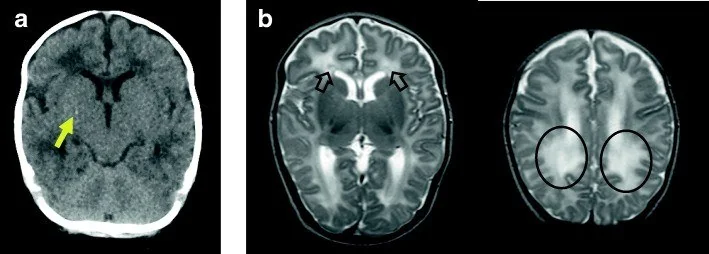
Konjenital enfeksiyon sekelleri, özellikle sitomegalovirüs (CMV) ve toksoplazmoz, bebek ve çocuklarda intrakraniyal kalsifikasyonla birlikte gelişen beyin hasarının nedenleri arasındadır. Kontrastsız BT kalsiyum odaklarını ve eşlik eden ventrikül genişlemesi ya da hacim kaybını gösterir; etkeni tek başına tayin etmez. Periventriküler ağırlıklı örüntü CMV'yi, daha dağınık kortikal ve derin çekirdek odakları ise toksoplazmozu düşündürebilir; örtüşme vardır ve klinik-laboratuvar doğrulaması gerekir. Gelişimsel anomali, ensefalomalazi veya mikrosefaliyi fark etmemek hasarın yaygınlığını olduğundan az gösterebilir.
Faz ve pencere
- Kontrastsız tanısal
- Periventriküler, subependimal, kortikal-subkortikal veya bazal ganglion yerleşimli yüksek atenüasyonlu kalsifikasyon odakları aranır. Kontrastsız BT kalsifikasyon odaklarını aynı incelemeye ek olarak ventrikül genişliği, parankimal hacim ve beyaz cevher durumu ile birlikte gösterir; kalsifikasyon dağılımını ayırt etmek için kontrast fazı gerekmez.
Önerilen pencereler: Beyin (G 80 / M 40), Kemik (G 1800 / M 400).
BT bulguları
- Ventrikül duvarına komşu subependimal ve periventriküler kalsifikasyonlar
- Korteks, subkortikal beyaz cevher, talamus veya bazal ganglionlara uzanan ek odaklar
- Dağınık ve daha periferik kalsifikasyonların ventrikül çevresi odaklarıyla birlikte bulunması
- Ventrikül çevresi beyaz cevherde hacim azalması veya düşük atenüasyon
- Parankim kaybına bağlı ex-vacuo ventrikül genişlemesi ya da hidrosefali görünümü
- Ensefalomalazi, porensefalik boşluk veya kortikal gelişim bozukluğu eşliği
- Kafa ve beyin hacminin yaşa göre küçük görünmesiyle uyumlu mikrosefali morfolojisi
Normalde
Aynı yaş düzeyindeki normal BT'de ventrikül kenarları boyunca noktasal ya da retiküler mineralizasyon ve beyaz cevherde yaygın hacim kaybı beklenmez. Lateral ventrikül gövdeleri ile atriumların genişliğini, periventriküler beyaz cevher kalınlığını ve kortikal sulkasyonun yaşa uygunluğunu karşılaştırın; geniş ventrikülün doku kaybına mı yoksa BOS basınç etkisine mi eşlik ettiğini çevre parankimden anlayın.
Normal BT ile kıyasla
Aynı bölgenin, kaynak veri setinde patoloji içermediği belirtilen bir BT incelemesini kesit kesit kaydırın; organ sınırlarını açarak anatomiyi hasta görüntüsüyle karşılaştırın. Küçük rastlantısal bulgular tümüyle dışlanmamıştır.
Kaynak: TotalSegmentator v2.01 veri seti (Wasserthal ve ark., Radiology: Artificial Intelligence 2023), CC BY 4.0, vaka s0103; organ sınırları veri setinin otomatik segmentasyonundan, birleştirilerek sadeleştirildi. Görüntüler 2,5 mm kesit aralığına yeniden örneklendi.
Ayırıcı tanı
- Sturge–Weber sendromunda; tek taraflı leptomeningeal anjiyomatozis, progresif kortikal kalsifikasyon ve ipsilateral hemisferik atrofi öne çıkar.
- Tüberoz skleroz
- subependimal nodüller ventrikül duvarına kabarıklık yapabilir ve kortikal tüberler eşlik edebilir
- Sekonder bazal ganglion kalsifikasyonu
- derin çekirdeklerde iki taraflı simetrik dağılım öne çıkar, periventriküler hasar tipik değildir
- Konjenital vasküler olaylar
- arteriyel iskemi veya venöz tromboz gibi — etkilediği parankimde porensefali veya çok keseli ensefalomalazi oluşturabilir ve kalsifikasyonlarla birlikte görülebilir; bu görüntüler TORCH enfeksiyonlarıyla benzeşir.
- Fizyolojik epifiz ve koroid pleksus kalsifikasyonu
- beklenen anatomik merkezlerde sınırlı görünür
Tuzaklar
- CMV ve toksoplazmoz kalsifikasyon paternleri örtüşür; dağılım etken için ipucudur, mikrobiyolojik tanı yerine geçmez.
- Geniş ventriküller ex-vacuo hacim kaybından veya hidrosefaliden kaynaklanabilir; ventrikül çevresi sulkus ve beyaz cevher durumunu beraber okuyun.
- İnce subependimal odaklar koroid pleksus fizyolojik kalsifikasyonu ile karışabilir; ventrikül duvarına göre konumunu ardışık kesitlerde izleyin.
Kendini dene
Yenidoğanda BT'de ependim boyunca kaba kalsifikasyonlar ve periventriküler beyaz cevher kaybı var. Hangi etken örüntüyle daha çok ilişkilidir?
Cevabı göster
Konjenital CMV. Ventrikül çevresi kalsifikasyon ile beyaz cevher hasarının birlikteliği konjenital CMV'de sık görülen bir örüntüdür. Sturge–Weber sendromunda tek taraflı leptomeningeal anjiyomatozis ve kortikal kalsifikasyonlar görülebilir; tüberoz sklerozda subependimal nodüller ve kortikal tüberler tanımlanır.
Bebekte ventrikül çevresinin yanı sıra korteks ve bazal ganglionlarda da çok sayıda kalsifikasyon var. En uygun çıkarım nedir?
Cevabı göster
Toksoplazmoz olasılığı artar. Daha yaygın ve periferik kalsifikasyonlar toksoplazmozu akla getirebilir; BT dağılımı kesin etken tayini değildir. Fizyolojik kalsifikasyon yenidoğanda beklenmez; ileri yaşlarda pineal bez, koroid pleksus gibi anatomik merkezlerde sınırlı görülür.
Kaynaklar
Bu sayfadaki 37 cümle ve 2 quiz sorusu aşağıdaki kaynaklardan alıntılarla tek tek karşılaştırıldı; 5 cümle bu karşılaştırmada düzeltildi (2026-10-08).
- From Fetal to Neonatal Neuroimaging in TORCH Infections: A Pictorial Reviewpmc.ncbi.nlm.nih.gov
- Intracranial calcifications in childhood: Part 1.pubmed.ncbi.nlm.nih.gov
- Intracranial calcifications in childhood: Part 2.pubmed.ncbi.nlm.nih.gov
- Hearing brain evaluated using near-infrared spectroscopy in congenital toxoplasmosis.pubmed.ncbi.nlm.nih.gov
- Neuroimaging in Children Born With Congenital Zika Syndrome: A Cohort Study.pubmed.ncbi.nlm.nih.gov
- Asymptomatic congenital cytomegalovirus infection with neurological sequelae: A retrospective study using umbilical cord.pubmed.ncbi.nlm.nih.gov
- Incidence of Symptomatic Congenital Toxoplasmosis During Ten Years in a Brazilian Hospital.pubmed.ncbi.nlm.nih.gov
- Congenital Toxoplasmosis and Long-term Outcomes.pubmed.ncbi.nlm.nih.gov
- Antenatal factors related to congenital toxoplasmosis in Rio De Janeiro, Brazil.pubmed.ncbi.nlm.nih.gov
- Intrauterine Zika virus infection: review of the current findings with emphasis in the prenatal and postnatal brain imaging diagnostic methods.pubmed.ncbi.nlm.nih.gov
- Bilateral striatal necrosis in two subjects with Aicardi-Goutières syndrome due to mutations in ADAR1 (AGS6).pubmed.ncbi.nlm.nih.gov
- Congenital cytomegalovirus infection and brain clefting.pubmed.ncbi.nlm.nih.gov
- Congenital toxoplasmosis with severe neurological disease in a referral hospital in Peru.pubmed.ncbi.nlm.nih.gov
- COL4A1 mutations associated with a characteristic pattern of intracranial calcification.pubmed.ncbi.nlm.nih.gov
- Severe congenital chorioretinitis caused by congenital lymphocytic choriomeningitis virus infection.pubmed.ncbi.nlm.nih.gov
- Congenital Toxoplasmosis With Atypical Neuroimaging: Hydrocephalus and Bilateral Chorioretinitis Without Intracranial Calcifications.pubmed.ncbi.nlm.nih.gov
- Treatment of congenital toxoplasmosis with pyrimethamine combined with sulfadiazine in a Chinese neonate: a case report.pubmed.ncbi.nlm.nih.gov
- Decoding neurodevelopment risks of exposures to intoxication, infection, and trauma during pregnancy.pubmed.ncbi.nlm.nih.gov
- Foetal disruptive brain injuries: Diagnosing the underlying pathogenetic mechanisms with cranial ultrasonography.pubmed.ncbi.nlm.nih.gov
- Paediatric cranial ultrasound: abnormalities of the brain in term neonates and young infants.pubmed.ncbi.nlm.nih.gov
- COL4A1 Gene Mutation Masquerading as Cerebral Palsy: Report of a Rare Case.pubmed.ncbi.nlm.nih.gov
- Fetal malformations of cortical development: review and clinical guidance.pubmed.ncbi.nlm.nih.gov
- Lymphocytic choriomeningitis virus: An under-recognized congenital teratogen.pubmed.ncbi.nlm.nih.gov
- Brain fetal neuroradiology: a beginner's guide.pubmed.ncbi.nlm.nih.gov
- Clinical and Imaging Findings in an Infant With Zika Embryopathy.pubmed.ncbi.nlm.nih.gov
- Unilateral calcification of the caudate and putamen: association with underlying developmental venous anomaly.pubmed.ncbi.nlm.nih.gov
- Prenatal magnetic resonance imaging findings of tuberous sclerosis complex in fetuses.pubmed.ncbi.nlm.nih.gov
- Rare Presentation of Homozygous S<i>LC20A2</i> Mutations Causing Intra-Arterial Cerebral Vasculopathy and Stroke in Infancy: Case Report and Review of the Literature.pubmed.ncbi.nlm.nih.gov
- Neuroimaging in inborn errors of immunity: More than infections.pubmed.ncbi.nlm.nih.gov
- Genetic Syndromes Including Intellectual Disability and Different Cancer Types.pubmed.ncbi.nlm.nih.gov
- Imaging Findings of Pediatric Rheumatic Disorders: JIA in the PRINTO Era and Autoimmune Interferonopathies.pubmed.ncbi.nlm.nih.gov
- RRP12 Variants Are Associated With Autosomal Recessive Brain Calcifications.pubmed.ncbi.nlm.nih.gov
- DOCK2 Deficiency and GATA2 Haploinsufficiency Can Underlie Critical Coronavirus Disease 2019 (COVID-19) Pneumonia.pubmed.ncbi.nlm.nih.gov
- Magnetic Resonance Imaging of the Neonatal Brain: Modalities, Scoring Systems, and Clinical Applications.pubmed.ncbi.nlm.nih.gov
- Two-year outcomes following modified transsylvian peri-insular hemispherotomy.pubmed.ncbi.nlm.nih.gov
- Diffusion tensor imaging and MR spectroscopy in the evaluation of neonatal encephalopathies.pubmed.ncbi.nlm.nih.gov
- Biomechanical instability of the brain-CSF interface in hydrocephalus.pubmed.ncbi.nlm.nih.gov
- Fetal mri of obstructive hydrocephalus: a review proposing a surgical etiology-based approach.pubmed.ncbi.nlm.nih.gov
- 'To improve is to change'-but is it safe? A single surgeon's transition from lateral to vertical hemispherotomy.pubmed.ncbi.nlm.nih.gov
- Fetal intracranial hemorrhage and infarct: Main sonographic and MRI characteristics: A review article.pubmed.ncbi.nlm.nih.gov
- Clinical, Neuroimaging and Video Electroencephalography Findings in Children With Congenital Zika Syndrome: An Analysis From a Neurorehabilitation Centre.pubmed.ncbi.nlm.nih.gov
- Ten Years of Congenital Zika Syndrome: From Outbreak to a Decade of Clinical, Therapeutic, and Preventive Advances in a Tropical Disease Context.pubmed.ncbi.nlm.nih.gov
- Neonatal Aicardi-Goutières syndrome presenting with macrophage activation syndrome-like hyperinflammation and severe congenital glaucoma: a case report.pubmed.ncbi.nlm.nih.gov
- Prenatal assessment of brain malformations on neuroimaging: an expert panel review.pubmed.ncbi.nlm.nih.gov
- Hemimegalencephaly With Diffuse Cortical Malformation in a Child With Drug-Resistant Infantile Epileptic Spasms: A Case Report.pubmed.ncbi.nlm.nih.gov
- A systematic approach to detection of epileptogenic foci on imaging: protocols, entities, search pattern, and reporting tools.pubmed.ncbi.nlm.nih.gov
- Rasmussen Encephalitis: Clinical Features, Pathophysiology, and Management Strategies-A Comprehensive Literature Review.pubmed.ncbi.nlm.nih.gov
- Delayed Diagnosis of Tuberous Sclerosis Complex: A Case Report of Abdominal Distension, Pain, and Severe Anemia.pubmed.ncbi.nlm.nih.gov
- Transmantle sign-like calcified radial lesion on CT serves as a potential imaging feature for epileptogenic foci in tuberous sclerosis complex: a Case Report.pubmed.ncbi.nlm.nih.gov
- Bilateral acquired chorea: a unique presentation of diabetic ketoacidosis.pubmed.ncbi.nlm.nih.gov
- Fahr's Syndrome Secondary to Hypoparathyroidism Presenting With Neurological and Cardiac Manifestations.pubmed.ncbi.nlm.nih.gov
- Neuroimaging of epilepsy.pubmed.ncbi.nlm.nih.gov
- Fetal MRI at 3 T: Principles to Optimize Success.pubmed.ncbi.nlm.nih.gov
- International Harmonization of Nomenclature and Diagnostic Criteria (INHAND): Nonproliferative and Proliferative Lesions of the Rabbit.pubmed.ncbi.nlm.nih.gov
- International Harmonization of Nomenclature and Diagnostic Criteria (INHAND): Non-proliferative and Proliferative Lesions of the Non-human Primate ( M. fascicularis ).pubmed.ncbi.nlm.nih.gov
- Emerging and re-emerging infectious disease in otorhinolaryngology.pubmed.ncbi.nlm.nih.gov
- Total laparoscopic radical hysterectomy for cervical cancer in prolapsed uterus.pubmed.ncbi.nlm.nih.gov
- A review of the oral health of individuals with disabilities in Puerto Rico and among U.S. Hispanics.pubmed.ncbi.nlm.nih.gov
- Human Brain Abnormalities Associated With Prenatal Alcohol Exposure and Fetal Alcohol Spectrum Disorder.pubmed.ncbi.nlm.nih.gov
- The human frontal lobes and frontal network systems: an evolutionary, clinical, and treatment perspective.pubmed.ncbi.nlm.nih.gov
- Utility of Biometric Measurements from Fetal Magnetic Resonance Imaging for Improved Antenatal Diagnosis of Dandy-Walker Spectrum Posterior Fossa Lesions.pubmed.ncbi.nlm.nih.gov
- From Fetal to Neonatal Neuroimaging in TORCH Infections: A Pictorial Review.pubmed.ncbi.nlm.nih.gov
- Definitions and classification of malformations of cortical development: practical guidelines.pubmed.ncbi.nlm.nih.gov
- Prenatal ultrasound findings associated with intrauterine CMV infection: a multicenter retrospective analysis of clinical and sonographic features.pubmed.ncbi.nlm.nih.gov
- Clinical manifestations and outcomes of fetal periventricular pseudocysts: a study of 38 cases.pubmed.ncbi.nlm.nih.gov
- Investigation of Pre- and Postnatal Abnormalities Caused by Prenatal CMV Infection-Systematic Review.pubmed.ncbi.nlm.nih.gov
- Clinical and neuroimaging features of familial hemophagocytic lymphohistiocytosis.pubmed.ncbi.nlm.nih.gov
- Review of imaging modalities and radiological findings of calvarial lesions.pubmed.ncbi.nlm.nih.gov
- Clinical Spectrum, Radiological Findings, and Outcomes of Severe Toxoplasmosis in Immunocompetent Hosts: A Systematic Review.pubmed.ncbi.nlm.nih.gov
- Guidelines on the Use of Therapeutic Apheresis in Clinical Practice-Evidence-Based Approach From the Writing Committee of the American Society for Apheresis: The Tenth Special Issue.pubmed.ncbi.nlm.nih.gov
- HIV-Related Cerebral Toxoplasmosis Revisited: Current Concepts and Controversies of an Old Disease.pubmed.ncbi.nlm.nih.gov
- Cerebral Toxocariasis: Silent Progression to Neurodegenerative Disorders?pubmed.ncbi.nlm.nih.gov
- 2019 HRS/EHRA/APHRS/LAHRS expert consensus statement on catheter ablation of ventricular arrhythmias.pubmed.ncbi.nlm.nih.gov
- 2019 HRS/EHRA/APHRS/LAHRS expert consensus statement on catheter ablation of ventricular arrhythmias.pubmed.ncbi.nlm.nih.gov
- Extensive Calcification of a Ventriculoperitoneal Shunt Causing Late Mechanical Failure in a Child.pubmed.ncbi.nlm.nih.gov
- Diagnostic challenges in an adult patient with Fanconi Anemia: Neuroinflammatory Syndrome (FANS) intertwined with infectious processes.pubmed.ncbi.nlm.nih.gov
- Bilateral Basal Ganglia Calcification (Fahr's Syndrome) Secondary to Hypoparathyroidism: A Case Series.pubmed.ncbi.nlm.nih.gov
- Encephalocraniocutaneous Lipomatosis, a Radiological Challenge: Two Atypical Case Reports and Literature Review.pubmed.ncbi.nlm.nih.gov
- Incidence of Sturge-Weber syndrome and associated ocular involvement in Olmsted County, Minnesota, United States.pubmed.ncbi.nlm.nih.gov
- Bilateral intracranial calcifications with bilateral facial cutaneous naevus: Sturge Weber syndrome.pubmed.ncbi.nlm.nih.gov
- Sturge-Weber Syndrome: A Narrative Review of Clinical Presentation and Updates on Management.pubmed.ncbi.nlm.nih.gov
- A rare type of congenital Sturge-Weber Syndrome: presenting with history of perinatal asphyxia.pubmed.ncbi.nlm.nih.gov
- The SLC-ome of membrane transport: From molecular discovery to physiology and clinical applications.pubmed.ncbi.nlm.nih.gov
- Longitudinal Neuroimaging of a Pediatric Patient With Sturge-Weber Syndrome: From Birth to Adolescence.pubmed.ncbi.nlm.nih.gov
- Norrie Disease: Cochlear Enhancement and Cerebellar Signal Abnormalities.pubmed.ncbi.nlm.nih.gov
- Case Report: A case series of Lhermitte-Duclos disease with surgical intervention.pubmed.ncbi.nlm.nih.gov
- Role of Ultrasound and Fetal MRI in the Prenatal Assessment of Congenital Cytomegalovirus Infection: A Systematic Review.pubmed.ncbi.nlm.nih.gov
- Congenital central nervous system malformations in piedmontese calves-part 1. structural brain disorders.pubmed.ncbi.nlm.nih.gov
- Early arteriopathy in Aicardi-Goutières syndrome 5. Case report and review of literature.pubmed.ncbi.nlm.nih.gov
- Clinical and neuroimaging review of monogenic cerebral small vessel disease from the prenatal to adolescent developmental stage.pubmed.ncbi.nlm.nih.gov
- Mimickers of hypoxic-ischaemic brain injury in term neonates: What the radiologist should know.pubmed.ncbi.nlm.nih.gov
- Cranial ultrasound for beginners.pubmed.ncbi.nlm.nih.gov
Eğitim amaçlıdır; hasta başında tanı ve tedavi kararının yerine geçmez. İçerik yapay zekâ destekli bir süreçle güncel literatüre göre cümle cümle kaynaklarla karşılaştırıldı, ancak uzman radyolog incelemesinden geçmedi. Klinik kararlarda güncel kılavuzları, kurum protokollerini ve radyoloji raporunu esas alın.