Özet
Hipoglisemi, bilinç bozukluğu, nöbet veya tek taraflı güçsüzlükle inme taklidi yapabilir; uzamış ağır glukoz düşüklüğü seçilmiş beyin bölgelerinde kalıcı hasar bırakabilir. Kontrastsız BT çoğu erken olguda normaldir, ancak ilerleyen hasarda bilateral hipodansite ve şişlik gösterebilir; duyarlılığı MR difüzyondan düşüktür. Simetrik kortikal, bazal gangliyon veya iç kapsül örüntüsü metabolik etiyolojiyi düşündürür; görünüm her zaman simetrik ya da klasik olmadığından glukoz ölçümüyle korelasyon gerekir. Hipoglisemi akut iskemi ile karıştırılarak yanlış tedaviye yol açabilir; bu nedenle klinik değerlendirme ile birlikte rutin kan glukoz ölçümü şarttır.
Okuma sırası
- Kaudat ve lentiform çekirdekler. Bazal gangliyon düzeyinde kaudat başı ile putamen ve globus pallidusun atenüasyonunu iki hemisferde eşleştirin; homojen olmayan solukluğu fark edin.
- Posterior internal kapsül. İç kapsülün posterior bacağını ve yukarıdaki korona radiatayı izleyin; ince çizgisel düşük atenüasyonun damar alanına oturup oturmadığını değerlendirin.
- Korteks ve hipokampus. Daha üst kesitlerde korteks ve medial temporal hipokampusları tarayarak derin gri cevher bulgusuna eşlik eden vasküler olmayan dağılımı arayın.
- Serebral sulkuslar ve arter alanları. Son olarak sulkus ve ventrikül konturlarında ödem etkisini, ayrıca tek taraflı ana arter alanına özgü bir lezyon bulunup bulunmadığını kontrol edin.
Faz ve pencere
- Kontrastsız tanısal
- Erken inceleme normal olabilir; görünür değişiklik varsa iki taraflı korteks, bazal gangliyon, hipokampus veya beyaz cevherde düşük atenüasyon ve bazen şişlik görülür. Tutulum vasküler alanı aşabilir; bu patoloji için kontrastlı faz gerekmez ve BT'nin normal olması hipoglisemik hasarı dışlamaz.
Önerilen pencereler: Beyin (G 80 / M 40).
BT bulguları
- Bilateral bazal gangliyon hipodansitesi — kaudat, putamen veya globus pallidus çevre parankime göre düşük atenüasyon gösterir.
- İki taraflı kortikal hipodansite — kortikal şerit ve gri-beyaz bileşke vasküler sınırlara uymadan etkilenebilir.
- Posterior iç kapsül tutulumu — iç kapsül ve komşu korona radiata boyunca diffüzyon ağırlıklı görüntülemede yüksek sinyal veya kısıtlama görülebilir.
- Hipokampal hipodansite — medial temporal yapılar tek veya iki taraflı tutulabilir ve rutin kesitlerde gözden kaçabilir.
- Arter sulama alanını aşan simetrik dağılım — lezyonlar tek bir ACA, MCA ya da PCA sulama alanına oturmaz.
- Kortikal şişlik ve sulkus silinmesi — yaygın veya bölgesel ödem eşlik edebilir; erken BT'de belirgin olmayabilir.
- Görece az etkilenen posterior fossa — serebellum ve beyin sapı tutulumu diğer bölgelere göre daha nadirdir, ancak özellikle orta serebellar pedunkul veya pons gibi alanlarda lezyon görülebilir ve bu durum hipoglisemik ensefalopatiyle çelişmez.
Normalde
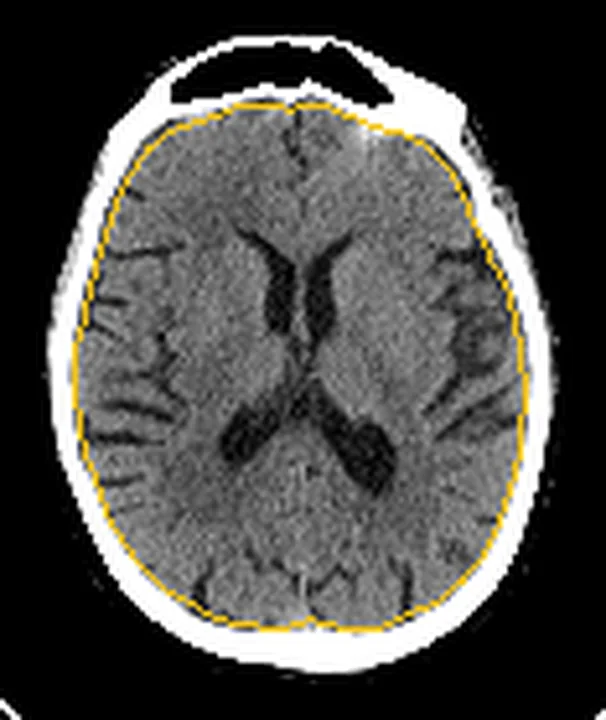
Hipoglisemik ensefalopatide BT'de iki taraflı bazal gangliyonlarda simetrik hipodansite görülebilir. İki tarafı aynı düzeyde karşılaştırıp asimetrik odak aramanın yanında, lezyonların aynı anda iki hemisferde ve arter sınırlarını aşan bir dağılımda olup olmadığını değerlendirin.
Normal BT ile kıyasla
Aynı bölgenin, kaynak veri setinde patoloji içermediği belirtilen bir BT incelemesini kesit kesit kaydırın; organ sınırlarını açarak anatomiyi hasta görüntüsüyle karşılaştırın. Küçük rastlantısal bulgular tümüyle dışlanmamıştır.
Kaynak: TotalSegmentator v2.01 veri seti (Wasserthal ve ark., Radiology: Artificial Intelligence 2023), CC BY 4.0, vaka s0103; organ sınırları veri setinin otomatik segmentasyonundan, birleştirilerek sadeleştirildi. Görüntüler 2,5 mm kesit aralığına yeniden örneklendi.
Ayırıcı tanı
- Global hipoksik-iskemik hasar
- küresel hipoperfüzyon ve yaygın beyin ödemi ile karakterizedir; kalp durması veya uzun süreli hipoksi öyküsü tanıyı destekler.
- Akut arteriyel infarkt
- çoğunlukla tek taraflı ve arter alanına uygun kortikal-subkortikal hipodansitedir; hipoglisemik lezyonlar sıklıkla vasküler olmayan ya da bilateral dağılım gösterir.
- Nöbet ilişkili değişiklikler
- periyiktal dönemde kortikal şişlik ve sinyal bozulmaları yapabilir; nöbetin zamanlaması ve EEG bulguları hipoglisemiyle ayrımda yardımcı olur.
- Ensefalit
- viral veya otoimmün süreçlerde temporal korteks ve hipokampus tutulabilir; CSF incelemesi ve kontrastlı görüntüleme bulguları metabolik olmayan etiyolojiyi düşündürür.
Tuzaklar
- İlk kontrastsız BT normalse hipoglisemik ensefalopatiyi dışlama; BT erken dönemde duyarsız olabilir ve klinik glukoz bilgisi görüntülemeden önce gelebilir.
- Tek taraflı hipoglisemik lezyonu sırf asimetrik diye infarkt kabul etme; lezyonun bir arter alanına uyup uymadığını ve ölçülmüş glukoz değerini birlikte ele al.
- İki taraflı bazal gangliyon hipodansitesini otomatik olarak anoksi sayma; korteks, hipokampus ve beyaz cevher dağılımı ile arrest ve metabolik öyküyü karşılaştır.
Kendini dene
Bilinç bulanıklığı olan hastada iki taraflı putamen ve posterior internal kapsülde hipodansite, tek arter alanına uymuyor. En olası neden?
Cevabı göster
Hipoglisemik ensefalopati. Bilateral derin gri cevher ve kapsüler dağılım, vasküler sınırları aşınca metabolik hasarı düşündürür; düşük glukoz öyküsü tanıyı destekler. MCA infarktı tek taraflı arter alanına uyar; subdural hematom ekstraaksiyel koleksiyondur; meningiom fokal kitle görünümündedir.
Hipoglisemi şüphesi sürüyor ancak ilk kontrastsız BT normal. En uygun yorum hangisidir?
Cevabı göster
Erken BT normal olabilir. Erken hipoglisemik beyin hasarında kontrastsız BT duyarsız ve normal olabilir. Bu görüntü tek başına embolik inmeyi kanıtlamaz ya da metabolik hasarı dışlamaz; klinik ve laboratuvar korelasyonu ve gerektiğinde daha duyarlı MR değerlendirmesi gerekir.
Bu konunun yer aldığı turlar
Kaynaklar
Bu sayfadaki 35 cümle ve 2 quiz sorusu aşağıdaki kaynaklardan alıntılarla tek tek karşılaştırıldı; 9 cümle bu karşılaştırmada düzeltildi (2026-10-08).
- Acute symptomatic hypoglycaemia mimicking ischaemic stroke on imaging: a systemic reviewpmc.ncbi.nlm.nih.gov
- Hypoglycemic Encephalopathypmc.ncbi.nlm.nih.gov
- [Hypoglycemic Hemiplegia].pubmed.ncbi.nlm.nih.gov
- Predictors of consciousness improvement in patients with hypoglycemic encephalopathy.pubmed.ncbi.nlm.nih.gov
- PET/CT in congenital hyperinsulinism: transforming patient's lives by molecular hybrid imaging.pubmed.ncbi.nlm.nih.gov
- Neonatal hypoglycemic brain injury is a cause of infantile spasms.pubmed.ncbi.nlm.nih.gov
- Early diffusion MR imaging findings and short-term outcome in comatose patients with hypoglycemia.pubmed.ncbi.nlm.nih.gov
- Decreased cholinergic receptor expression in the striatum: motor function deficit in hypoglycemic and diabetic rats.pubmed.ncbi.nlm.nih.gov
- Magnetic resonance imaging characteristics of persistent vegetative state due to prolonged hypoglycemia.pubmed.ncbi.nlm.nih.gov
- Magnetic resonance imaging brain yield in developmental delay: A developing country perspective.pubmed.ncbi.nlm.nih.gov
- Reversible Focal Splenial Lesion on Diffusion-Weighted MRI in Sulfonylurea Intoxication.pubmed.ncbi.nlm.nih.gov
- Surgical outcomes for medically refractory epilepsy secondary to posterior cortex ulegyria as sequelae of perinatal insults.pubmed.ncbi.nlm.nih.gov
- Dynamic magnetic resonance imaging findings in the early stages of neonatal hypoglycemic brain injury.pubmed.ncbi.nlm.nih.gov
- Electroclinical spectrum of childhood epilepsy secondary to neonatal hypoglycemic brain injury in a low resource setting: A 10-year experience.pubmed.ncbi.nlm.nih.gov
- Challenges in the management of epilepsy associated with posterior gliosis secondary to perinatal brain injury.pubmed.ncbi.nlm.nih.gov
- Atypical Hypoglycemia-Induced Stroke Mimic: A Case Report and Literature Review.pubmed.ncbi.nlm.nih.gov
- Hypoglycemic hemiparesis as stroke mimic with transient splenial lesion and internal capsule involvement: A reversible clinico-radiological concurrence.pubmed.ncbi.nlm.nih.gov
- Migraine - a borderland disease to epilepsy: near it but not of it.pubmed.ncbi.nlm.nih.gov
- Stepwise clinical and diagnostic strategy for coma of unknown origin.pubmed.ncbi.nlm.nih.gov
- Improved detection and localization of insulinoma using small field-of-view diffusion-weighted MRI: A case report.pubmed.ncbi.nlm.nih.gov
- Tissue clock-guided prediction and intervention of futile recanalization: towards precision therapy in mechanical thrombectomy.pubmed.ncbi.nlm.nih.gov
- Diffuse Cortical, Basal Ganglia, and Bilateral Middle Cerebellar Peduncle Diffusion Restriction in Severe Alcohol-Related Hypoglycemic Encephalopathy: A Case Report.pubmed.ncbi.nlm.nih.gov
- Myoclonus in Pediatric Metabolic Diseases: Clinical Spectrum, Mechanisms, and Treatable Causes-A Systematic Review.pubmed.ncbi.nlm.nih.gov
- Clinical and genetic spectrum of pediatric mitochondrial disorders in China: insights from a 47-case genetically confirmed cohort.pubmed.ncbi.nlm.nih.gov
- Clinical Utility of Circulating Biomarkers for Diagnosis and Prognosis of Acute Stroke in the Emergency Department: A Narrative Review from Current Evidence to Clinical Implementation.pubmed.ncbi.nlm.nih.gov
- Cerebral Kounis Syndrome-A Rare Case Report of Cerebral Vasospasm Following Anaphylaxis.pubmed.ncbi.nlm.nih.gov
- Impact of Glycemic Trajectory and Variability on Ischemic Stroke Prognosis and Exploration of Its Mechanisms: A Comprehensive Review.pubmed.ncbi.nlm.nih.gov
- Hypoglycemic Encephalopathy in a Patient With Diabetes Mellitus: A Case Report.pubmed.ncbi.nlm.nih.gov
- Clinical characteristics and associated factors of pediatric acute necrotizing encephalopathy: a retrospective study.pubmed.ncbi.nlm.nih.gov
- Neuroimaging for differential diagnosis of transient neurological attacks.pubmed.ncbi.nlm.nih.gov
- Moyamoya Vasculopathy with Atypical Cogan's Syndrome: A Case Report.pubmed.ncbi.nlm.nih.gov
- The Epidemiology and Clinical Presentation of the Acute Imbalance Syndrome (AIS)-A Systematic Review and Meta-Analysis.pubmed.ncbi.nlm.nih.gov
- Reversible coma and elevated central venous pressure: warning signs of acute superior vena cava graft thrombosis following Warden procedure: a case report.pubmed.ncbi.nlm.nih.gov
- Diabetic striatopathy: an updated overview of current knowledge and future perspectives.pubmed.ncbi.nlm.nih.gov
- Neurologic sequelae of phosphide poisoning: A case report.pubmed.ncbi.nlm.nih.gov
- Clinicoradiological Spectrum of L-2-Hydroxy Glutaric Aciduria: Typical and Atypical Findings in an Indian Cohort.pubmed.ncbi.nlm.nih.gov
- Vascular Cognitive Impairment and Dementia.pubmed.ncbi.nlm.nih.gov
- Generative pre-trained transformer (GPT)-4 support for differential diagnosis in neuroradiology.pubmed.ncbi.nlm.nih.gov
- Diagnosis and treatment of Watershed strokes: a narrative review.pubmed.ncbi.nlm.nih.gov
- Severe Diabetic Ketoacidosis With Fatal Cerebral Edema in an Adult.pubmed.ncbi.nlm.nih.gov
- Hypoglycemia-Induced Irreversible Brain Injury: A Case Report.pubmed.ncbi.nlm.nih.gov
- Rare Pediatric Posterior Stroke Case Report with Discussion of Brainstem Lesions.pubmed.ncbi.nlm.nih.gov
- Brain Magnetic Resonance Imaging of Children With Molybdenum Cofactor Deficiency.pubmed.ncbi.nlm.nih.gov
- A Case of Central Pontine Myelinolysis Unrelated Serum Sodium Level in Traumatic Brain Injury Patient.pubmed.ncbi.nlm.nih.gov
- Neuroimaging in Tremor.pubmed.ncbi.nlm.nih.gov
- Different diseases, same circuits: lessons from rare and overlooked causes of disorders of consciousness.pubmed.ncbi.nlm.nih.gov
- Organization, fine structure, and stereotaxic maps of the human Bed nucleus of the Stria terminalis.pubmed.ncbi.nlm.nih.gov
- The SLC-ome of membrane transport: From molecular discovery to physiology and clinical applications.pubmed.ncbi.nlm.nih.gov
- Multiomics Analysis-Based Biomarkers in Diagnosis of Polycystic Ovary Syndrome.pubmed.ncbi.nlm.nih.gov
- Effect of blending Jersey and Holstein-Friesian milk on Cheddar cheese processing, composition, and quality.pubmed.ncbi.nlm.nih.gov
- Neuroimaging of neonatal brain post therapeutic hypothermia: a practical guide to the non-pediatric neuroradiologist.pubmed.ncbi.nlm.nih.gov
- Mitochondrial dysfunction in neonatal brain injury: from molecular mechanisms to therapeutic interventions.pubmed.ncbi.nlm.nih.gov
- Ischemic stroke can have a T1w hyperintense appearance in absence of intralesional hemorrhage.pubmed.ncbi.nlm.nih.gov
- Preventing dementia by preventing stroke: The Berlin Manifesto.pubmed.ncbi.nlm.nih.gov
- Alternating Hemispheric Episodes in Bilateral Rasmussen Encephalitis: The Crucial Role of Sequential Multimodal Neuroimaging.pubmed.ncbi.nlm.nih.gov
- Reversible Lesions of the Genu of the Corpus Callosum and White Matter Detected by MRI in a Neonate With Apnea: A Case Report.pubmed.ncbi.nlm.nih.gov
- Post-stroke headache: a review of epidemiology, pathophysiology, and clinical management.pubmed.ncbi.nlm.nih.gov
- A Case of LGI1-Antibody Limbic Encephalitis Presenting With Faciobrachial Dystonic Seizures.pubmed.ncbi.nlm.nih.gov
- Research progress on abdominal epilepsy in children.pubmed.ncbi.nlm.nih.gov
- Early Clinical, Laboratory, and Imaging Correlates of Neurological Dysfunction in Adults Presenting to the Emergency Department with Sepsis: A Single-Center Retrospective Study.pubmed.ncbi.nlm.nih.gov
- Prevalence and patterns of abnormal metabolic screening in pediatric acute encephalopathy: a PICU study from Egypt.pubmed.ncbi.nlm.nih.gov
- Pediatric endocrine disorders: a review of intracranial findings and appropriate imaging.pubmed.ncbi.nlm.nih.gov
- Neurocognitive impairments and brain abnormalities resulting from opioid-related overdoses: A systematic review.pubmed.ncbi.nlm.nih.gov
- Classic neuroimaging findings of nonketotic hyperglycemia on computed tomography and magnetic resonance imaging with absence of typical movement disorder symptoms (hemichorea-hemiballism).pubmed.ncbi.nlm.nih.gov
- Diabetic Striatopathy in an Elderly Female With Poorly Controlled Type 2 Diabetes: A Case Report.pubmed.ncbi.nlm.nih.gov
- Two advanced-aged patients with diabetic striatopathy: a case report and literature review.pubmed.ncbi.nlm.nih.gov
- Role of Clinical and Multimodality Neuroimaging in the Evaluation of Brain Death/Death by Neurologic Criteria and Recent Highlights from 2023 Updated Guidelines.pubmed.ncbi.nlm.nih.gov
- Expanding the spectrum of Sideroblastic Anemia with B-cell Immunodeficiency, Periodic Fever and Developmental Delay (SIFD) syndrome: a case report with new clinical insights and novel genetic variant.pubmed.ncbi.nlm.nih.gov
- Non-diabetic hypoglycemia: bridging gaps in diagnosis and treatment: a position statement report by the Arabic Association for the Study of Diabetes and Metabolism (AASD).pubmed.ncbi.nlm.nih.gov
- Stroke Mimics in the Acute Setting: Role of Multimodal CT Protocol.pubmed.ncbi.nlm.nih.gov
- Vascular contributions to cognitive impairment and dementia: a statement for healthcare professionals from the american heart association/american stroke association.pubmed.ncbi.nlm.nih.gov
- Acute Necrotizing Encephalitis Due to Influenza B in a Child: A Case Report.pubmed.ncbi.nlm.nih.gov
- Metformin-associated Encephalopathy in Hemodialysis.pubmed.ncbi.nlm.nih.gov
- Diazoxide-Responsive Congenital Hyperinsulinism in a Preterm Infant With Homozygous <i>ABCC8</i> Mutation: A Case Report.pubmed.ncbi.nlm.nih.gov
- Ketone Bodies Derived From Medium-Chain Triglycerides Support Brain Metabolism and Function Under Hypoglycemia in Type 1 Diabetes Mellitus.pubmed.ncbi.nlm.nih.gov
- Long-Term Follow-Up of Patients With Mitochondrial Carbonic Anhydrase VA Deficiency. A Case Report and Literature Review.pubmed.ncbi.nlm.nih.gov
- Brain lesions in pediatric abusive head trauma: prevalence, pathophysiology, patterns, and a classification system.pubmed.ncbi.nlm.nih.gov
- 5-Fluorouracil-induced acute leukoencephalopathy: Case report and literature review.pubmed.ncbi.nlm.nih.gov
- Mechanical stress from the hyoid bone as a potential etiology of bony-related ischemic stroke secondary to carotid artery dissection: A case report and systematic review.pubmed.ncbi.nlm.nih.gov
- Evolutionary implications of <i>NOTCH2NLC</i> mutations: brain structural changes in neuronal intranuclear inclusion disease revealed by comprehensive morphometry.pubmed.ncbi.nlm.nih.gov
- Subtyping schizophrenia via machine learning by using structural neuroimaging.pubmed.ncbi.nlm.nih.gov
- Update of the recommendations of the Sociedade Portuguesa de Cuidados Intensivos and the Infection and Sepsis Group for the approach to COVID-19 in Intensive Care Medicine.pubmed.ncbi.nlm.nih.gov
- Assessing subcortical, brainstem and cerebellar metabolic patterns using [18F]FDG PET-CT imaging in dementia with Lewy bodies.pubmed.ncbi.nlm.nih.gov
- Functional remapping in networks of the Parkinsonian brain: A preclinical neuroimaging perspective with clinical correlates.pubmed.ncbi.nlm.nih.gov
- Mapping Fetal Brain Development of 10 Weeks' Gestational Age with 9.4T Postmortem MRI and Histologic Sections.pubmed.ncbi.nlm.nih.gov
- Beta-ketothiolase deficiency with progressive basal ganglia and extra basal ganglia involvement: CT-MRI correlation in a pediatric metabolic encephalopathy: A case report.pubmed.ncbi.nlm.nih.gov
- Diabetic striatopathy presenting as stroke-mimicking hemiparesis without involuntary movements: A case report.pubmed.ncbi.nlm.nih.gov
- Acute Acquired Metabolic Encephalopathy Based on Diffusion MRI.pubmed.ncbi.nlm.nih.gov
- Aphasic Syndromes in Cerebral Venous and Dural Sinuses Thrombosis-A Review of the Literature.pubmed.ncbi.nlm.nih.gov
- A Drug Safety Briefing (II) in Transplantation from Real-World Individual Pharmacotherapy Management to Prevent Patient and Graft from Polypharmacy Risks at the Very Earliest Stage.pubmed.ncbi.nlm.nih.gov
- Pathophysiology-driven neuroimaging: decoding brain injury in sepsis.pubmed.ncbi.nlm.nih.gov
- Severe hypoglycemic coma with radiological evidence of hypoglycemic encephalopathy due to impaired awareness to hypoglycemia: a case report.pubmed.ncbi.nlm.nih.gov
- Hypoxic-Ischemic Encephalopathy and Beyond: A Pictorial Review of Neuroimaging Findings in Neonatal Encephalopathy.pubmed.ncbi.nlm.nih.gov
- Adult-onset leukodystrophies: a practical guide, recent treatment updates, and future directions.pubmed.ncbi.nlm.nih.gov
- Neuronal intranuclear inclusion disease caused by NOTCH2NLC gene expansion: a case report and literature review.pubmed.ncbi.nlm.nih.gov
- Recurrent Takotsubo Cardiomyopathy With Variable Patterns and Psychiatric Comorbidities: A Case Report and Comprehensive Literature Review.pubmed.ncbi.nlm.nih.gov
- An Unusual Vascular Catastrophe: Atheromatous Aortic Dissection With Renal Artery Thrombosis and Cortical Laminar Necrosis Post Cerebral Ischemia.pubmed.ncbi.nlm.nih.gov
- Medication-induced changes on magnetic resonance imaging of the brain.pubmed.ncbi.nlm.nih.gov
- Magnetic resonance imaging pattern recognition of metabolic and neurodegenerative encephalopathies in dogs and cats.pubmed.ncbi.nlm.nih.gov
- Stroke: Epidemiology, Risk Factors, Signaling Pathways, and Clinical Management.pubmed.ncbi.nlm.nih.gov
- Protocol to optimize the Rice-Vannucci rat pup model of perinatal asphyxia to ensure predictable hypoxic-ischemic cerebral lesions.pubmed.ncbi.nlm.nih.gov
- EPIDEMIOLOGY, DIAGNOSIS, MANAGEMENT AND PREVENTION OF STROKE: A NARRATIVE REVIEW.pubmed.ncbi.nlm.nih.gov
- Pictorial Review on Imaging Findings in Cerebral CTP in Patients with Acute Stroke and Its Mimics: A Primer for General Radiologists.pubmed.ncbi.nlm.nih.gov
- Diagnosis and management of the neurological complications of falciparum malaria.pubmed.ncbi.nlm.nih.gov
- A systematic approach to MR spectroscopy of the brain: Indications, protocol, metabolites, and spectral analysis in neurologic diseases.pubmed.ncbi.nlm.nih.gov
- Adaptive immune dysregulation drives new-onset refractory status epilepticus.pubmed.ncbi.nlm.nih.gov
- Anti-Inflammatory and Antioxidant Strategies in Epilepsy: From Molecular Mechanisms to Threshold Management.pubmed.ncbi.nlm.nih.gov
- Magnetic Resonance Imaging of the Neonatal Brain: Modalities, Scoring Systems, and Clinical Applications.pubmed.ncbi.nlm.nih.gov
- Choking leading to cardiac arrest and subsequent atypical radiological features of brain damage: A case report.pubmed.ncbi.nlm.nih.gov
- Neonatal herpes simplex virus encephalitis: a single-center retrospective study of 14 cases.pubmed.ncbi.nlm.nih.gov
- Computed tomography perfusion stroke mimics on RAPID commercial software: A case-based review.pubmed.ncbi.nlm.nih.gov
- What does a migraine aura look like?-A systematic review.pubmed.ncbi.nlm.nih.gov
Eğitim amaçlıdır; hasta başında tanı ve tedavi kararının yerine geçmez. İçerik yapay zekâ destekli bir süreçle güncel literatüre göre cümle cümle kaynaklarla karşılaştırıldı, ancak uzman radyolog incelemesinden geçmedi. Klinik kararlarda güncel kılavuzları, kurum protokollerini ve radyoloji raporunu esas alın.