Özet
Beyin sapı gliomları anatomik yerleşim ve klinik davranışlarına göre farklı örüntüler gösteren heterojen bir gruptur; diffüz intrinsik pontin gliom çocuklarda görülür ve pons merkezlidir. DIPG tanısında tercih edilen görüntüleme yöntemi MR’dır; bazı durumlarda BT de kullanılabilir. DIPG lif traktları boyunca talamus ve serebellum gibi komşu bölgelere infiltratif yayılım gösterebilir; MR tanıda tercih edilen görüntüleme yöntemidir ve gadolinyumlu görüntüler tanıyı desteklemede veya diğer lezyonları dışlamada değer taşıyabilir. Tanı anında yüksek intrakraniyal basınçla birlikte obstrüktif hidrosefali hastaların %10'undan azında görülür.
Okuma sırası
- Pontin parankim ve ventral kontur. Pons merkezli intrinsik genişlemeyi değerlendirin; diffüz pontin gliomda tümör çekirdeği MR'da pons içinde merkezlenir.
- Prepontin sistern. Prepontin sistern ve dördüncü ventrikül düzeyindeki bası etkisini BT'de değerlendirin; DIPG'li hastalarda obstrüktif hidrosefali, tanı sırasında vakaların yalnızca küçük bir bölümünde (%10'un altında) izlenir.
- Dördüncü ventrikül. Ponsun arkasındaki dördüncü ventrikülün şekil ve boyutuna bakın; bası ventrikülü deforme edebilir veya yer değiştirebilir.
- Akuadukt, lateral ventriküller ve periventriküler beyaz cevher. Son olarak obstrüktif hidrosefaliyi değerlendirin; artmış intrakraniyal basıncın eşlik ettiği tablo tanı anında hastaların %10'undan azında görülür.
Faz ve pencere
- Kontrastsız tanısal
- BT’de diffüz pontin gliom hipodens görünebilir. Kontrastsız BT'de pons'ta hipodens genişleme görülebilir; sinyal özellikleri ve yayılımın ayrıntılı değerlendirmesi için MR gerekir.
Önerilen pencereler G genişlik, M merkez; değerler Hounsfield birimi (HU)
- BeyinG 80 / M +40
- Yumuşak dokuG 400 / M +40
BT bulguları
- Pons merkezli genişleme — diffüz pontin gliomda lezyon pons içinde yerleşir ve ponsun aksiyel çapının yarısından fazlasını tutabilir.
- BT'de pons ekspansedir; lezyon ponsun aksiyel çapının yarısından fazlasını tutabilir. DIPG tanısı klinik sunum ve nörogörüntüleme bulgularına dayanır.
- Diffüz pontin gliomda BT'de hipodens lezyon görülebilir.
- Belirsiz kenarlar ve kistik/eksofitik bileşenin yokluğu — diffüz pontin gliomda tümör kenarları belirsizdir; kistik alanlar veya dışa doğru çıkıntılar (eksofitik büyüme) tipik değildir.
- Dördüncü ventrikül çıkışının tıkanması obstrüktif hidrosefaliye yol açabilir.
Ölçütler ve sınıflamalar
- WHO CNS5'te “Diffüz orta hat gliomu, H3 K27-altered” olarak adlandırılır ve öncelikle pediatrik-tip diffüz yüksek dereceli gliomlar kategorisine alınır.
- WHO CNS5’te Diffüz orta hat gliomu, H3 K27-altered, ayrı bir histomoleküler tümör tipidir. DIPG, pons merkezli klinik-radyolojik örüntüyü ifade eder; H3 K27-altered tanısı için görüntülemenin yanında moleküler doğrulama gerekir.
Normalde
BT'de pons genişlemesini normal pons konturuyla karşılaştırarak değerlendirin; tümör çekirdeğinin pons içinde merkezlenmesi, baziler arterin sarılması ve komşu bölgelere infiltratif yayılım MR ile değerlendirilir.
Normal BT ile kıyasla
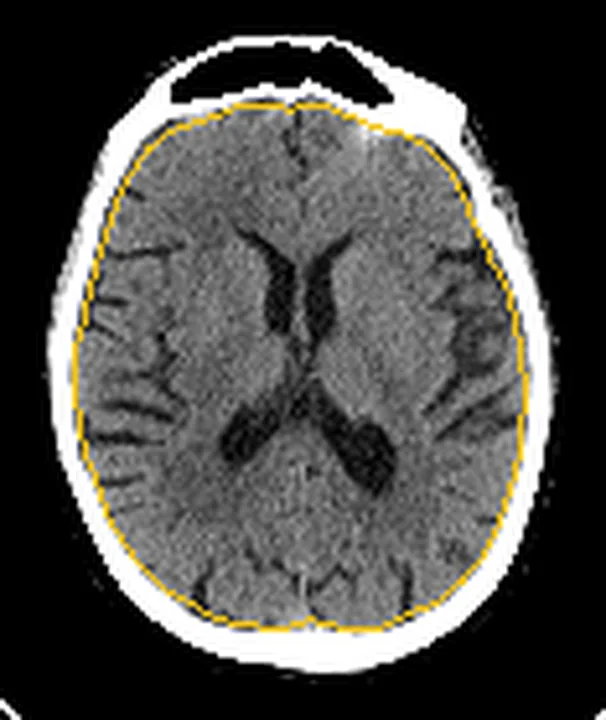
Aynı bölgenin, kaynak veri setinde patoloji içermediği belirtilen bir BT incelemesini kesit kesit kaydırın; organ sınırlarını açarak anatomiyi hasta görüntüsüyle karşılaştırın. Küçük rastlantısal bulgular tümüyle dışlanmamıştır.
Kaynak: TotalSegmentator v2.01 veri seti (Wasserthal ve ark., Radiology: Artificial Intelligence 2023), CC BY 4.0, vaka s0103; organ sınırları veri setinin otomatik segmentasyonundan, birleştirilerek sadeleştirildi. Görüntüler 2,5 mm kesit aralığına yeniden örneklendi.
Ayırıcı tanı
- BT'de arka çukur artefaktları nedeniyle beyin sapı lezyonlarının saptanması güçleşebilir.
- Enfeksiyöz rombensefalitte nörolojik muayene ve MR bulguları tanıyla uyumlu olabilir.
- Demiyelinizan hastalıklardan tumefaktif multipl skleroz, neoplazileri taklit edebilen geniş kitle benzeri lezyonlar oluşturabilir.
- Ekstrinsik bir kitle prepontin sisterni daraltıp beyin sapını yer değiştirebilir; diffüz pontin gliomda ise tümör çekirdeği pons içinde merkezlenir.
- Beyin sapı lezyonlarının görüntüleme ayırıcı tanısında metastaz ve primer parankimal lenfoma yer alabilir.
Tuzaklar
- Arka çukur değerlendirmesinde görüntü kalitesi düşebilir; beyin sapı ve derin lezyonların saptanması teknik açıdan daha kırılgandır.
- MR'da pons içindeki intrinsik, merkezî tümörü ve belirsiz tümör sınırlarını değerlendirin.
- MR, beyin sapı gliomu tanısını değerlendirmede tercih edilen noninvaziv görüntüleme yöntemidir; yalnız kontrastsız BT'nin normal görünmesi gliomu ekarte etmez.
Kendini dene
Diffüz intrinsik pontin gliomda tümör çekirdeği tipik olarak nerede merkezlenir?
Cevabı göster
Pons. Diffüz intrinsik pontin gliomda tümör çekirdeği pons içinde merkezlenir.
Kontrastsız BT'de pons merkezli genişleme saptanan ve klinik olarak DIPG'den şüphelenilen bir hastada tanıyı desteklemek ve tümörün yayılımını, sinyal özelliklerini değerlendirmek için bir sonraki adım hangisi olmalıdır?
Cevabı göster
Beyin MR'ı. MR, DIPG tanısında tercih edilen görüntüleme yöntemidir; lezyon tipik olarak T1 ağırlıklı görüntülerde hipointens, T2 ağırlıklı görüntülerde hiperintens, sınırları belirsizdir ve genellikle kontrastlanma göstermez. Gadolinyumlu görüntüler tanıyı desteklemede veya diğer lezyonları dışlamada değer taşır.
İlgili konular
Kaynaklar
Bu sayfadaki 34 cümle ve 2 quiz sorusu aşağıdaki kaynaklardan alıntılarla otomatik olarak karşılaştırıldı; 20 cümle bu karşılaştırmada düzeltildi (2026-10-12).
- Diffuse intrinsic pontine glioma: current insights and future directionspmc.ncbi.nlm.nih.gov
- Nanodynamic therapy for cancer: mechanistic innovations, targeting strategies and multimodal treatmentspmc.ncbi.nlm.nih.gov
- Addressing barriers in diffuse intrinsic pontine glioma: the transformative role of lipid nanoparticulate drug deliverypmc.ncbi.nlm.nih.gov
- Magnetic Resonance Imaging of Unusual Neoplasms Related to Foramen of Luschka: A Review for Differential Diagnosispmc.ncbi.nlm.nih.gov
- Role of Radiation Therapy in the Management of Diffuse Intrinsic Pontine Glioma: A Systematic Reviewpmc.ncbi.nlm.nih.gov
- Posterior Fossa Tumors.pubmed.ncbi.nlm.nih.gov
- [Pediatric brain tumors].pubmed.ncbi.nlm.nih.gov
- The intersect of neurosurgery with diffuse intrinsic pontine glioma.pubmed.ncbi.nlm.nih.gov
- Focal brainstem gliomas. Advances in intra-operative management.pubmed.ncbi.nlm.nih.gov
- Posterior fossa tumors in children: Radiological tips & tricks in the age of genomic tumor classification and advance MR technology.pubmed.ncbi.nlm.nih.gov
- Transmission of a TP53 germline mutation from unaffected male carrier associated with pediatric glioblastoma in his child and gestational choriocarcinoma in his female partner.pubmed.ncbi.nlm.nih.gov
- Magnetic Resonance Imaging in the Contemporary Management of Medulloblastoma: Current and Emerging Applications.pubmed.ncbi.nlm.nih.gov
- Brainstem gliomas in pregnancy: a systematic review†.pubmed.ncbi.nlm.nih.gov
- Long-term survival of an infant with diffuse brainstem lesion diagnosed by prenatal MRI: a case report and review of the literature.pubmed.ncbi.nlm.nih.gov
- Successful Surgery of Exophytic Brainstem Glioma Mimicking Cerebellar-Pontine Angle Tumor: Case Report and Review of Literature.pubmed.ncbi.nlm.nih.gov
- The Role of Advanced MRI Sequences in the Diagnosis and Follow-Up of Adult Brainstem Gliomas: A Neuroradiological Review.pubmed.ncbi.nlm.nih.gov
- Brainstem glioma: a review.pubmed.ncbi.nlm.nih.gov
- OKlahoma Nitrone-007: novel treatment for diffuse intrinsic pontine glioma.pubmed.ncbi.nlm.nih.gov
- A standardized autopsy procurement allows for the comprehensive study of DIPG biology.pubmed.ncbi.nlm.nih.gov
- Prevalence and Clinicoradiopathological Characterization of H3 K27-Altered Diffuse Midline Gliomas in Adults-A Retrospective Observational Study.pubmed.ncbi.nlm.nih.gov
- Case Report: A new noninvasive device-based treatment of a mesencephalic H3 K27M glioma.pubmed.ncbi.nlm.nih.gov
- Pediatric high-grade gliomas in patients with neurofibromatosis type 1-A collaborative cohort study from the SIOPE HGG/DIPG working group.pubmed.ncbi.nlm.nih.gov
- Case Report: A case series of Lhermitte-Duclos disease with surgical intervention.pubmed.ncbi.nlm.nih.gov
- Pilocytic astrocytoma: A rare case report.pubmed.ncbi.nlm.nih.gov
- Spinal cord diffuse midline glioma with postoperative acute swelling: A case report and review of literature.pubmed.ncbi.nlm.nih.gov
- Frameless VarioGuide biopsy for pediatric brainstem lesions in the molecular era: diagnostic performance and workflow characteristics in a comparative single-center series.pubmed.ncbi.nlm.nih.gov
- Feasibility evaluation of tumor treating fields for brainstem gliomas.pubmed.ncbi.nlm.nih.gov
- Treatment of acute demyelinating encephalomyelitis associated with recent rickettsial infection.pubmed.ncbi.nlm.nih.gov
- Hypothetical applications of MR-guided focused ultrasound in central nervous system tuberculosis: blood-brain barrier disruption, granulomatous lesion modulation, targeted drug delivery, and immune microenvironment reprogramming.pubmed.ncbi.nlm.nih.gov
- Incidentally Discovered Cerebellar Ganglioglioma in an Adult Following a Motor Vehicle Accident: A Case Report and Literature Review.pubmed.ncbi.nlm.nih.gov
- Beyond Chronological Age: A Scoping Review of Neurosurgical Intervention for Central Nervous System Tumors in the Very Elderly.pubmed.ncbi.nlm.nih.gov
- Bilateral thalamic infarcts: Percheron territory.pubmed.ncbi.nlm.nih.gov
- Artery of Percheron infarction a rare anatomical variant and a diagnostic challenge: Case report.pubmed.ncbi.nlm.nih.gov
- Bilateral lesions of the basal ganglia and thalami (central grey matter)-pictorial review.pubmed.ncbi.nlm.nih.gov
- Pediatric Trapped Fourth Ventricle: The Need for Objective Surgical-Selection Criteria and Long-Term Surveillance After Open Fenestration.pubmed.ncbi.nlm.nih.gov
- Treating the invisible target: treatment planning targeting the microscopic tumor spread in gliomas.pubmed.ncbi.nlm.nih.gov
- In Vivo CAR-Based Immune Cell Engineering: Future Applications and Challenges in Malignant Glioma.pubmed.ncbi.nlm.nih.gov
- Cellular and Immunotherapy for Pediatric Brain Tumors: A Primer.pubmed.ncbi.nlm.nih.gov
- Delivery of ATSP-7041 by Minimally Invasive Nasal Depot (MIND) to Target Diffuse Intrinsic Pontine Glioma.pubmed.ncbi.nlm.nih.gov
- Efficacy of CAR-T-Cell-Based Immunotherapies in Patients With Glioma: A Systematic Review and Meta-Analysis.pubmed.ncbi.nlm.nih.gov
- Brain stem tumors in children less than 3 months: Clinical and radiologic findings of a rare disease.pubmed.ncbi.nlm.nih.gov
- Early prognostication of overall survival for pediatric diffuse midline gliomas using MRI radiomics and machine learning: A two-center study.pubmed.ncbi.nlm.nih.gov
- Suprasellar Desmoplastic Infantile Ganglioglioma in a 7-Month-Old Infant: A Rare Diagnostic Consideration in Infant Suprasellar Masses.pubmed.ncbi.nlm.nih.gov
- Clinical Applications of Hyperpolarized Magnetic Resonance Imaging in Brain Tumors: Current Evidence and Future Opportunities.pubmed.ncbi.nlm.nih.gov
- Diffuse Midline Gliomas: Clinical, Diagnostic, and Therapeutic Perspectives.pubmed.ncbi.nlm.nih.gov
- Isolated primary craniopharyngioma of the fourth ventricle: a rare case report and literature update.pubmed.ncbi.nlm.nih.gov
- Endoscopic transclival decompression for ventral brainstem tuberculous abscess: illustrative case.pubmed.ncbi.nlm.nih.gov
- Brainstem tuberculoma mimicking brainstem stroke: Crossed syndrome in a young female.pubmed.ncbi.nlm.nih.gov
- Anatomy-Guided Microsurgical Resection of a Dominant Frontal Lobe Tumor Without Intraoperative Adjuncts: A Case Report from a Resource-Limited Context.pubmed.ncbi.nlm.nih.gov
- Case Report: Rare presentations of glioblastoma: three multifocal and one cerebellar cases highlighting the value of shared clinical experience.pubmed.ncbi.nlm.nih.gov
- Choroid plexus volume variation in patients with gliomas, glioneuronal and neuronal tumors: Associations with tumor characteristics.pubmed.ncbi.nlm.nih.gov
- Spontaneous complete regression of congenital brain tumors - a systematic literature review and case report.pubmed.ncbi.nlm.nih.gov
- Beyond Imaging: A 12-Year Clinicopathological Analysis of Surgically Excised Neurocysticercosis.pubmed.ncbi.nlm.nih.gov
- Illuminating radiogenomic signatures in pediatric-type diffuse gliomas: insights into molecular, clinical, and imaging correlations. Part I: high-grade group.pubmed.ncbi.nlm.nih.gov
- Subarachnoid cisterns as surgical corridors: Integrating microsurgical anatomy and neuroimaging for intracranial navigation.pubmed.ncbi.nlm.nih.gov
- Technical nuances of endoscopic transcortical transventricular fenestration for management of giant suprasellar arachnoid cysts in adults: illustrative cases.pubmed.ncbi.nlm.nih.gov
- Leptomeninges: Anatomy, Mechanisms of Disease and Neuroimaging.pubmed.ncbi.nlm.nih.gov
- Multiterritory Acute Ischemic Stroke with Bilateral Middle Cerebellar Peduncle T2/FLAIR Hyperintensities in the Setting of a Fatal Systemic Arterial Thrombotic Process: A Case Report.pubmed.ncbi.nlm.nih.gov
- Deep Learning Framework for Automated MRI Planimetry in Multiple Sclerosis.pubmed.ncbi.nlm.nih.gov
- The Vulnerable Conduit: Uncovering Segment-Specific Pathological Susceptibility and Bony Co-dependence of the Vertebral Artery in a South Indian Cohort.pubmed.ncbi.nlm.nih.gov
- [Recent Advances in the Classification and Treatment of Pediatric Gliomas].pubmed.ncbi.nlm.nih.gov
- The Price of Precision: A Critical Review of Molecular Diagnostics in Glioma, From Guidelines to Global Disparities.pubmed.ncbi.nlm.nih.gov
- AOSNP-ADAPTR resource level-based recommendations on practical diagnostic strategies for medulloblastomas and other embryonal tumors.pubmed.ncbi.nlm.nih.gov
- Diffuse midline glioma, H3 K27-altered, forming a suprasellar mass: A case report.pubmed.ncbi.nlm.nih.gov
- Diffuse intrinsic pontine glioma in the era of H3 K27-altered diffuse midline glioma.pubmed.ncbi.nlm.nih.gov
- Preoperative Prediction of H3 K27 Alteration Status in Diffuse Midline Glioma Using Intravoxel Incoherent Motion Imaging-based Habitat Imaging.pubmed.ncbi.nlm.nih.gov
- Suspected encephalitis in adults.pubmed.ncbi.nlm.nih.gov
- Diagnostic Uncertainty in Rapidly Progressive Brainstem Lesions: A Radiological Diagnosis of Probable CNS Relapse of Diffuse Large B-cell Lymphoma.pubmed.ncbi.nlm.nih.gov
- Obstacles and Trials in Treating Primary Brain Tumors.pubmed.ncbi.nlm.nih.gov
- A systematic approach to MR spectroscopy of the brain: Indications, protocol, metabolites, and spectral analysis in neurologic diseases.pubmed.ncbi.nlm.nih.gov
- Decompressive hemicraniectomy as a salvage therapy in the Neuro-ICU: a meta-analysis of neurologic outcomes for malignant middle cerebral artery infarction.pubmed.ncbi.nlm.nih.gov
- Listerial rhombencephalitis diagnosed by repeat blood culture despite negative CSF PCR: a case report.pubmed.ncbi.nlm.nih.gov
- A Rare Cause of Acute Dysphagia: Listeria Rhombencephalitis.pubmed.ncbi.nlm.nih.gov
- A Case of Persistent Ataxia and Atypical Brain Lesions: From the National Multiple Sclerosis Society Case Conference Proceedings.pubmed.ncbi.nlm.nih.gov
- Tumefactive Multiple Sclerosis Mimicking a High-Grade Glioma: A Case Report and Literature Review.pubmed.ncbi.nlm.nih.gov
- Acute Vertigo, Dizziness and Imbalance in the Emergency Department-Beyond Stroke and Acute Unilateral Vestibulopathy-A Narrative Review.pubmed.ncbi.nlm.nih.gov
- Engineering neuroimmune regulation: biomaterial and nanotechnology platforms for neuropathology diagnosis and targeted immunomodulation.pubmed.ncbi.nlm.nih.gov
- Surgical management of intramedullary cervical spinal sarcoidosis complicated by transient unilateral weakness: A case report.pubmed.ncbi.nlm.nih.gov
- ICARUS at the Fermilab Short-Baseline Neutrino program: initial operation.pubmed.ncbi.nlm.nih.gov
- Post-therapy imaging of adult brain tumours: patterns, pitfalls, and practical framework.pubmed.ncbi.nlm.nih.gov
- Repeatability and reproducibility of APT and GluCEST imaging at 5 T: phantom validation and clinical evaluation in patients with brain tumors.pubmed.ncbi.nlm.nih.gov
- Synergistic cell-cycle repression by HDAC/EZH2 co-targeting in H3K27-altered diffuse midline glioma.pubmed.ncbi.nlm.nih.gov
- Where Does the Signal Go? Technical Challenges of CT Perfusion in Lacunar and Infratentorial Stroke.pubmed.ncbi.nlm.nih.gov
- Marine Mobile Stroke Unit: A Pilot Study on the Feasibility and Quality of Brain Imaging.pubmed.ncbi.nlm.nih.gov
- Multimodal imaging in neuro-ophthalmology.pubmed.ncbi.nlm.nih.gov
- Disorders Mimicking Wilson's Disease: Clinical, Biochemical, and Molecular Perspectives for Accurate Differential Diagnosis.pubmed.ncbi.nlm.nih.gov
- Radiological assessment of dementia: the Italian inter-society consensus for a practical and clinically oriented guide to image acquisition, evaluation, and reporting.pubmed.ncbi.nlm.nih.gov
- The tauopathies: Neuroimaging characteristics and emerging experimental therapies.pubmed.ncbi.nlm.nih.gov
- Diffuse high-grade glioma with gliomatosis cerebri pattern mimicking symmetric white matter disease.pubmed.ncbi.nlm.nih.gov
- Prolonged survival in pediatric diffuse intrinsic pontine glioma following intensity-modulated radiation therapy: a case report.pubmed.ncbi.nlm.nih.gov
- Brain Stem Tumor in Early Gestation: Two Case Reports.pubmed.ncbi.nlm.nih.gov
- Infantile brainstem tumors presenting with recurrent pneumonia and dysphagia: a report of two cases and literature review.pubmed.ncbi.nlm.nih.gov
- IDH mutant high-grade gliomas.pubmed.ncbi.nlm.nih.gov
- Imaging features associated with H3 K27-altered and H3 G34-mutant gliomas: a narrative systematic review.pubmed.ncbi.nlm.nih.gov
- Incidental brain tumor findings in children: prevalence, natural history, management, controversies, challenges, and dilemmas.pubmed.ncbi.nlm.nih.gov
- Incidental vascular findings on brain magnetic resonance angiography.pubmed.ncbi.nlm.nih.gov
- Padua Days on Muscle and Mobility Medicine, March 25-29, 2025, Hotel Petrarca, Euganean Thermae, Italy: Program and Abstracts.pubmed.ncbi.nlm.nih.gov
- Masses of developmental and genetic origin affecting the paediatric craniofacial skeleton.pubmed.ncbi.nlm.nih.gov
- CNS Embryonal Tumor with PLAGL Amplification, a New Tumor in Children and Adolescents: Insights from a Comprehensive MRI Analysis.pubmed.ncbi.nlm.nih.gov
- Congenital and acquired anomalies of the basilar artery: A pictorial essay.pubmed.ncbi.nlm.nih.gov
- Cranial nerve schwannoma - A pictorial essay.pubmed.ncbi.nlm.nih.gov
- Magnetic resonance imaging of primary central nervous system neoplasms of dogs and cats: Basic concepts for diagnostic pathologists.pubmed.ncbi.nlm.nih.gov
- Bulbar "Red Flag" Symptoms and a 21-Year Diagnostic Delay in Adult Arnold-Chiari Type II Malformation With Tracheoesophageal Fistula and Syringomyelia: A Case Report.pubmed.ncbi.nlm.nih.gov
- Recurrence patterns in pediatric intracranial ependymal neoplasm: a systematic imaging work-up.pubmed.ncbi.nlm.nih.gov
- Fourth Ventricle Epidermoid Cyst: Case Report of Precision Telovelar Microsurgery, Functional Preservation, and Lifelong Surveillance.pubmed.ncbi.nlm.nih.gov
- Anatomically Precise Microsurgical Resection of a Posterior Fossa Cerebellar Metastasis in an Elderly Patient with Preservation of Venous Outflow, Dentate Nucleus, and Cerebrospinal Fluid Pathways.pubmed.ncbi.nlm.nih.gov
- Prenatal diagnosis of infratentorial anomalies: ultrasound, fetal MRI, and implications for counseling.pubmed.ncbi.nlm.nih.gov
- The neurotoxic legacy of CAR-T cells: where do we stand?pubmed.ncbi.nlm.nih.gov
- Nystagmus in Clinical Practice: From Diagnosis to Treatment-A Comprehensive Review.pubmed.ncbi.nlm.nih.gov
- Extended endoscopic endonasal transplanum-transtuberculum surgery for optic pathway-hypothalamic glioma presenting with tonsillar herniation and syringomyelia: illustrative case.pubmed.ncbi.nlm.nih.gov
- Three-Dimensional Constructive Interference in Steady State (3D CISS) Imaging and Clinical Applications in Brain Pathology.pubmed.ncbi.nlm.nih.gov
- Imaging in medically refractory epilepsy at 3 Tesla: a 13-year tertiary adult epilepsy center experience.pubmed.ncbi.nlm.nih.gov
- Intracranial Subdural Fluid Accumulation Associated with a Choroid Plexus Carcinoma in a Dog.pubmed.ncbi.nlm.nih.gov
- Can MRI Differentiate between Infectious and Immune-Related Acute Cerebellitis? A Retrospective Imaging Study.pubmed.ncbi.nlm.nih.gov
- Synchronous supratentorial and infratentorial oligodendrogliomas with incongruous IDH1 mutations, a case report.pubmed.ncbi.nlm.nih.gov
Eğitim amaçlıdır; hasta başında tanı ve tedavi kararının yerine geçmez, tıbbi tavsiye değildir. Metinler yapay zekâ desteğiyle yazıldı ve otomatik bir adımda kaynak alıntılarıyla karşılaştırıldı; bu bir tıbbi doğrulama değildir ve içerik uzman radyolog incelemesinden geçmedi. Klinik kararlarda güncel kılavuzları, kurum protokollerini ve radyoloji raporunu esas alın.