Özet
Medulloblastom, özellikle çocuklarda posterior fossada görülen embriyonal tümördür ve sıkça vermis ya da orta hat serebellumdan kaynaklanır. Kontrastsız BT, posterior fossadaki vermis kitlesini ve yüksek dansiteli bileşenini gösterebilir. MR, tüm beyin ve omurilik incelemesiyle tümörün yerleşim ve yayılımını değerlendirmede kullanılır; solid metastazlar ve leptomeningeal yayılımın saptanmasında duyarlıdır. Baş ağrısı, bulantı-kusma ve ataksi medulloblastomda sık görülen belirtilerdir; posterior fossa tümörlerinde bilişsel bozukluk hidrosefaliyle ilişkili olabilir.
Faz ve pencere
- Kontrastsız tanısal
- Tümörün yerleşimi ve yayılımı için tüm beyin ve omuriliğin MR ile görüntülenmesi standarttır; ileri MR teknikleri hücresellik gibi özellikler hakkında ek bilgi sağlar.
Önerilen pencereler G genişlik, M merkez; değerler Hounsfield birimi (HU)
- BeyinG 80 / M +40
- KemikG 1800 / M +400
BT bulguları
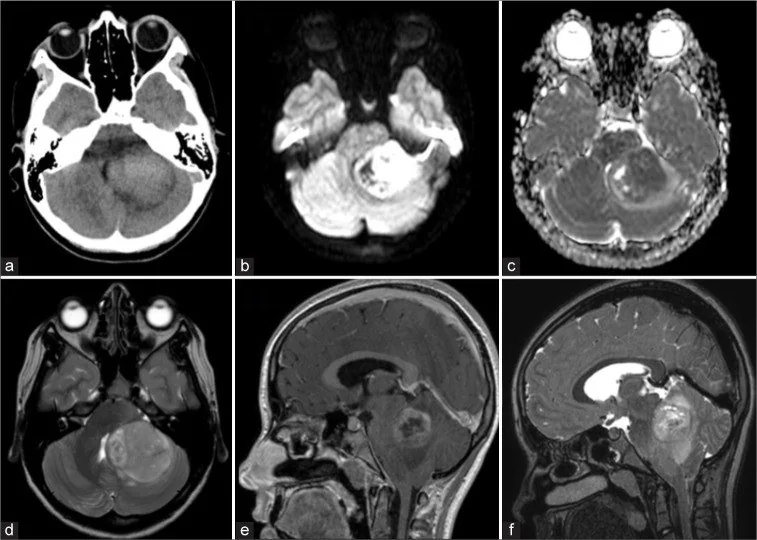
- Vermis veya orta hat serebellar kitle — çocukta posterior fossanın orta hattında yoğun yumuşak doku kitlesi olarak belirir.
- Yüksek hücreliliği nedeniyle tümör dokusu diffüzyon ağırlıklı görüntüleme (DWI) üzerinde kısıtlama gösterir ve ADC değerleri normal beyin dokusuna göre belirgin şekilde düşüktür.
- Dördüncü ventrikülün öne itilmesi veya silinmesi — kitle ventrikülü daraltır ve BOS geçişini engelleyebilir.
- Obstrüktif hidrosefali — lateral ve üçüncü ventriküller genişler; akut olguda periventriküler ödem de görülebilir.
- Kistik değişiklik veya nekroz — özellikle büyük kitlelerde heterojen düşük dansiteli iç alanlar bulunabilir.
- Tümör içi kalsifikasyon — mevcut olabilir, ancak tek başına tanımlayıcı özellik değildir.
- Beyin sapı basısı — posterior fossa kitlesi beyin sapına bası yapabilir.
- Medulloblastom BOS yoluyla kraniyal ve spinal leptomeninkslere yayılabilir; kontrastlı beyin ve tüm omurilik MRG’sinde subaraknoid ‘drop’ metastazları aranır.
Ölçütler ve sınıflamalar
- WHO CNS5 medulloblastom sınıflaması
- WHO CNS5’te medulloblastomlar WNT-aktive, SHH-aktive/TP53-yabanıl tip, SHH-aktive/TP53-mutant ve non-WNT/non-SHH olarak moleküler gruplara ayrılır. Risk sınıflaması cerrahi sonrası hastalık veya rezidü, yayılım, histoloji ve WNT alt grubu ile MYC durumu gibi moleküler özellikleri dikkate alır.
Normalde
Posterior fossa kitlesinin dansitesi, normal beyin parankiminin dansitesiyle karşılaştırılabilir. Şüpheli kitlenin dansitesini normal beyin parankimiyle karşılaştırın.
Normal BT ile kıyasla
Aynı bölgenin, kaynak veri setinde patoloji içermediği belirtilen bir BT incelemesini kesit kesit kaydırın; organ sınırlarını açarak anatomiyi hasta görüntüsüyle karşılaştırın. Küçük rastlantısal bulgular tümüyle dışlanmamıştır.
Kaynak: TotalSegmentator v2.01 veri seti (Wasserthal ve ark., Radiology: Artificial Intelligence 2023), CC BY 4.0, vaka s0103; organ sınırları veri setinin otomatik segmentasyonundan, birleştirilerek sadeleştirildi. Görüntüler 2,5 mm kesit aralığına yeniden örneklendi.
Ayırıcı tanı
- Ependimom
- dördüncü ventrikül içinde merkezlenir, ventrikülü genişletebilir ve çıkış foramenlerinden ince uzanım gösterebilir.
- Pilositik astrositom
- çocuklarda orta hat yerleşimi ergenlere göre daha sık görülebilir.
- Atipik teratoid/rabdoid tümör
- daha küçük çocukta posterior fossa kitlesi olabilir; BT görünümü örtüşür ve yaş tek başına tanı koydurmaz.
- Beyin sapı gliomu
- ponsu merkezden genişletir; dördüncü ventrikül kitlesinden farklı olarak pons dokusunun kendisi büyür.
- Serebellar metastaz
- özellikle erişkinde, bilinen primer tümör varlığında düşünülür; çoğu kez çevresel ödem ve birden fazla odak eşlik eder.
Tuzaklar
- Posterior fossa kitlesinde BT bulguları tanıya ipucu sağlayabilir; ileri MR teknikleri farklı tümör tiplerini ayırt etmeye yardımcı olur.
- Dördüncü ventrikülün küçük görünmesini tek başına kitle olarak yorumlama; vermis, pons ve ventrikül konturlarını kesitler boyunca takip et.
Kendini dene
Medulloblastom tipik olarak hangi bölgede ortaya çıkar?
Cevabı göster
Posterior fossada, serebellar vermis çevresinde. Medulloblastom tipik olarak posterior fossada, serebellar vermis çevresinde ortaya çıkar.
Lateral yerleşim medulloblastomda erişkin ve pediatrik olgularda nasıl karşılaştırılmıştır?
Cevabı göster
Erişkinlerde %57,6, pediatrik olgularda %14,4 bildirilmiştir.. Meta-analizde lateral yerleşim erişkin olgularda %57,6, pediatrik olgularda %14,4 bildirilmiştir.
Kaynaklar
Bu sayfadaki 34 cümle ve 2 quiz sorusu aşağıdaki kaynaklardan alıntılarla otomatik olarak karşılaştırıldı; 18 cümle bu karşılaştırmada düzeltildi (2026-10-09).
- Surgical resection in medulloblastoma: a crossroads in the molecular erapmc.ncbi.nlm.nih.gov
- Medulloblastoma in Adolescents and Young Adults: Molecular Subgroups, Prognostic Biomarkers, and Age-Specific Therapeutic Challengespmc.ncbi.nlm.nih.gov
- Strategies for the Molecular Classification of Medulloblastomapmc.ncbi.nlm.nih.gov
- Medulloblastoma: Current Standard of Care and Future Treatment Opportunitiespmc.ncbi.nlm.nih.gov
- Medulloblastoma: biology and immunotherapypmc.ncbi.nlm.nih.gov
- Medulloblastoma.pubmed.ncbi.nlm.nih.gov
- Cerebellar tumors.pubmed.ncbi.nlm.nih.gov
- Childhood medulloblastoma.pubmed.ncbi.nlm.nih.gov
- Childhood Medulloblastoma Revisited.pubmed.ncbi.nlm.nih.gov
- Posterior Fossa Tumors.pubmed.ncbi.nlm.nih.gov
- [Pediatric brain tumors].pubmed.ncbi.nlm.nih.gov
- Liquid Biopsy and Primary Brain Tumors.pubmed.ncbi.nlm.nih.gov
- MRI of intracranial intraventricular lesions.pubmed.ncbi.nlm.nih.gov
- Quantitative MRI in post-operative paediatric cerebellar mutism syndrome.pubmed.ncbi.nlm.nih.gov
- Factors affecting survival of medulloblastoma in children: the changing concept of management.pubmed.ncbi.nlm.nih.gov
- Medulloblastoma with Atypical Dynamic Imaging Changes: Case Report with Literature Review.pubmed.ncbi.nlm.nih.gov
- Neuroimaging Biomarkers and Neurocognitive Outcomes in Pediatric Medulloblastoma Patients: a Systematic Review.pubmed.ncbi.nlm.nih.gov
- The Neuroradiological Spectra of Adult and Pediatric Medulloblastoma Differ : Results from a Literature-based Meta-analysis.pubmed.ncbi.nlm.nih.gov
- Giant Posterior Fossa Tuberculoma Mimicking Atypical Teratoid/Rhabdoid Tumor in a Child: Illustrative Case.pubmed.ncbi.nlm.nih.gov
- Early Recurrence of an Adult Desmoplastic Medulloblastoma With Intramedullary Spinal and Suprasellar Metastases.pubmed.ncbi.nlm.nih.gov
- Risk factors associated with cerebellar mutism syndrome and late postoperative hydrocephalus following pediatric posterior fossa medulloblastoma surgery.pubmed.ncbi.nlm.nih.gov
- Cerebellar Tuberculoma as a Rare Manifestation of Central Nervous System Tuberculosis: Literature Review and Clinical Case.pubmed.ncbi.nlm.nih.gov
- Medulloblastoma in a 13-Year-Old Female: A Comprehensive Case Report.pubmed.ncbi.nlm.nih.gov
- Atypical Choroid Plexus Papilloma in a Newborn, Misdiagnosed by Ultrasound and MRI: A Case Report.pubmed.ncbi.nlm.nih.gov
- Cerebrospinal Fluid in Pediatric Neuro-Oncology: Molecular Diagnosis, Disease Monitoring, and Clinical Translation.pubmed.ncbi.nlm.nih.gov
- The value of cerebrospinal fluid cytology in the diagnosis of atypical medulloblastoma: a case report and review of the literature.pubmed.ncbi.nlm.nih.gov
- Significance of Early Proton Beam Therapy Initiation in Achieving Complete Response in Pediatric Medulloblastoma: A Retrospective Study.pubmed.ncbi.nlm.nih.gov
- Clinical experience with a rare brainstem tumor: ganglioglioma. Illustrative case.pubmed.ncbi.nlm.nih.gov
- Primary Intracranial Cholesteatoma Presenting as a Cerebellar Mass Without Otologic Symptoms.pubmed.ncbi.nlm.nih.gov
- Radiological Spectrum of Leptomeningeal Medulloblastoma: A Case-Based Literature Review With an Additional Case Report.pubmed.ncbi.nlm.nih.gov
- Fatal hemangioblastoma: a case report and literature review.pubmed.ncbi.nlm.nih.gov
- Does the surgical route matter in cerebellar mutism syndrome? Comparing transvermian and telovelar approaches for pediatric posterior fossa tumors.pubmed.ncbi.nlm.nih.gov
- Bridging pediatric and adult neuro-oncology: Insights into adolescents and young adults (AYA) central nervous system tumors.pubmed.ncbi.nlm.nih.gov
- Association of Recorded Cerebrospinal Fluid Diversion with Registry Outcome Status in Pediatric Medulloblastoma: An Exploratory 10-Year Single-Centre Cohort Study.pubmed.ncbi.nlm.nih.gov
- Predictors of pre-resection hydrocephalus in posterior cranial fossa tumors: development of a predictive scoring model.pubmed.ncbi.nlm.nih.gov
- Pilocytic Astrocytoma Causing Brainstem Compression in Pregnancy: Case Report with Literature Review.pubmed.ncbi.nlm.nih.gov
- Neuroimaging in inborn errors of immunity: More than infections.pubmed.ncbi.nlm.nih.gov
- Diagnostic Accuracy of MRI and CT Scan Features in Differentiation of Pediatric Ependymoma from Medulloblastoma.pubmed.ncbi.nlm.nih.gov
- Clinicopathological insights of supratentorial embryonal tumor with medulloblastoma-like histopathology in adulthood: A case report.pubmed.ncbi.nlm.nih.gov
- Pediatric high-grade neuroepithelial BCOR tandem duplicated tumor: An illustrative case.pubmed.ncbi.nlm.nih.gov
- Syndromic Multiple Odontogenic Keratocysts Associated With Impacted Teeth: A Rare Case Report.pubmed.ncbi.nlm.nih.gov
- Aggressive atypical teratoid/rhabdoid tumor with extensive leptomeningeal metastasis in an 8-year-old boy: a case report and narrative review.pubmed.ncbi.nlm.nih.gov
- Gorlin-Goltz syndrome: Multidisciplinary approach for early diagnosis of rare disease for better patient outcome.pubmed.ncbi.nlm.nih.gov
- Isolated fourth ventricle craniopharyngioma: Representative case illustration and review of literature.pubmed.ncbi.nlm.nih.gov
- Cerebellopontine angle meningioma originating from choroid plexus of the foramen of Luschka: An extremely rare entity and overlook of literature.pubmed.ncbi.nlm.nih.gov
- Three-Dimensional Constructive Interference in Steady State (3D CISS) Imaging and Clinical Applications in Brain Pathology.pubmed.ncbi.nlm.nih.gov
- Molecular profiling of pediatric medulloblastoma in Kazakhstan: Genomic alterations, subgroup distribution, and survival.pubmed.ncbi.nlm.nih.gov
- A Rare Instance of Adult Medulloblastoma Presenting Imaging Heterogeneity Correlating With Molecular Subtypes and Anatomical Locations.pubmed.ncbi.nlm.nih.gov
- AOSNP-ADAPTR resource level-based recommendations on practical diagnostic strategies for medulloblastomas and other embryonal tumors.pubmed.ncbi.nlm.nih.gov
- Early-Onset Medullocervical Low-Grade Glioma With FGFR1 Mutation and Leptomeningeal Spread in an Infant: A Case Report.pubmed.ncbi.nlm.nih.gov
- Surgical outcomes and clinical profile of pediatric brain tumors: A 3-year retrospective analysis.pubmed.ncbi.nlm.nih.gov
- MRI Differentiation of Anaplastic Ependymoma and Medulloblastoma with Fourth Ventricular Outlet Extension in Children.pubmed.ncbi.nlm.nih.gov
- Conventional MRI-Based Semantic Features for Differentiation of Pediatric Medulloblastoma and Ependymoma in the Fourth Ventricle: Insights From a Multi-Center Retrospective Study.pubmed.ncbi.nlm.nih.gov
- Neurosurgical Application of Artificial Intelligence in Pediatric Neuro-Oncology.pubmed.ncbi.nlm.nih.gov
- Infantile brainstem tumors presenting with recurrent pneumonia and dysphagia: a report of two cases and literature review.pubmed.ncbi.nlm.nih.gov
- Extra-Axial Cerebellopontine Angle Low Grade Glioma - Unusual Occurrence in a 43-year-old Woman.pubmed.ncbi.nlm.nih.gov
- A case-control study of MRI features in pediatric atypical teratoid rhabdoid tumor and medulloblastoma.pubmed.ncbi.nlm.nih.gov
- "Updates on diagnostic and prognostic molecular biomarkers of CNS tumors".pubmed.ncbi.nlm.nih.gov
- A MAGIBU-based model for pediatric and juvenile CNS tumors: an in-house epigenetic decision-support framework compared with online DNA methylation classifiers.pubmed.ncbi.nlm.nih.gov
- Mesenchymal tumors of the central nervous system: illustrative case.pubmed.ncbi.nlm.nih.gov
- A diagnostic headache: A rare case of adult onset primary leptomeningeal medulloblastoma.pubmed.ncbi.nlm.nih.gov
- Precision medicine directed therapy enabling long-term survival in medulloblastoma: a case report.pubmed.ncbi.nlm.nih.gov
- Sectional Anatomy Quiz-IΧ.pubmed.ncbi.nlm.nih.gov
- Internal Cerebral Vein in Susceptibility-Weighted Imaging: A Reliable Tool to Differentiate Among Calcification, Microbleed, and Gross Hemorrhage in Brain Tumors.pubmed.ncbi.nlm.nih.gov
- Extra-axial desmoplastic/nodular medulloblastoma in adult mimicking cerebellar metastasis: reappraisal of this rare presentation with literature review.pubmed.ncbi.nlm.nih.gov
- Outcomes of endoscopic third ventriculostomy in comparison to ventriculoperitoneal shunt in obstructive hydrocephalus - A randomized controlled trial.pubmed.ncbi.nlm.nih.gov
- Late peritoneal metastases of medulloblastoma following ventriculoperitoneal shunting: A case report.pubmed.ncbi.nlm.nih.gov
- Surgical resection in medulloblastoma: a crossroads in the molecular era.pubmed.ncbi.nlm.nih.gov
- Case series of choroid plexus papilloma in children at uncommon locations and review of the literature.pubmed.ncbi.nlm.nih.gov
- Hydrocephalus in pediatric posterior fossa tumors: predictors and outcomes from a single center in Latin America.pubmed.ncbi.nlm.nih.gov
- Diffuse Midline Gliomas: Clinical, Diagnostic, and Therapeutic Perspectives.pubmed.ncbi.nlm.nih.gov
- Unveiling the hidden danger: a rachnoid cyst in the fourth ventricle: a rare case report and review of the literature.pubmed.ncbi.nlm.nih.gov
- Pediatric Meningeal Diseases: What Radiologists Need to Know.pubmed.ncbi.nlm.nih.gov
- Basics for Pediatric Brain Tumor Imaging: Techniques and Protocol Recommendations.pubmed.ncbi.nlm.nih.gov
- Critical Review of Hearing Rehabilitation in Pediatric Oncology: Specific Considerations and Barriers.pubmed.ncbi.nlm.nih.gov
- CNS Embryonal Tumor with PLAGL Amplification, a New Tumor in Children and Adolescents: Insights from a Comprehensive MRI Analysis.pubmed.ncbi.nlm.nih.gov
- Imaging findings of intraventricular pilocytic astrocytoma.pubmed.ncbi.nlm.nih.gov
- Recurrence patterns in pediatric intracranial ependymal neoplasm: a systematic imaging work-up.pubmed.ncbi.nlm.nih.gov
- Congenital central nervous system malformations in piedmontese calves-part 1. structural brain disorders.pubmed.ncbi.nlm.nih.gov
- Canine brain imaging with a new low-field portable (0.05 T) MRI scanner: a pilot <i>in vivo</i> comparison to conventional 1.5 T.pubmed.ncbi.nlm.nih.gov
- Subarachnoid cisterns as surgical corridors: Integrating microsurgical anatomy and neuroimaging for intracranial navigation.pubmed.ncbi.nlm.nih.gov
- Ependymal Tumors: Overview of the Recent World Health Organization Histopathologic and Genetic Updates with an Imaging Characteristic.pubmed.ncbi.nlm.nih.gov
- A feasibility study of enzymatic methylation sequencing of cell-free DNA from cerebrospinal fluid of pediatric central nervous system tumor patients for molecular classification.pubmed.ncbi.nlm.nih.gov
- Radiomics and radiogenomics in pediatric neuro-oncology: A review.pubmed.ncbi.nlm.nih.gov
- Incidentally Discovered Cerebellar Ganglioglioma in an Adult Following a Motor Vehicle Accident: A Case Report and Literature Review.pubmed.ncbi.nlm.nih.gov
- Comparative study on imaging characteristics of pilocytic astrocytomas in children and adolescents.pubmed.ncbi.nlm.nih.gov
- Rosette-forming glioneuronal tumor of the cerebellum with intratumoral hemorrhage: case report with radiologic-pathologic correlation in a resource-limited setting.pubmed.ncbi.nlm.nih.gov
- Understanding DMG: current treatment options and prospective solutions using nanoparticles.pubmed.ncbi.nlm.nih.gov
- A novel radiological classification of midbrain pilocytic astrocytomas and its implication for surgical management: a single-institution experience of 57 cases.pubmed.ncbi.nlm.nih.gov
- An integrative survival analysis and a systematic review of the cerebellopontine angle glioblastomas.pubmed.ncbi.nlm.nih.gov
- Central Nervous System Tuberculoma in Qatar: Clinical, Radiological, and Pathological Insights From a Rare Case With Literature Review.pubmed.ncbi.nlm.nih.gov
- Case Report: Rare presentations of glioblastoma: three multifocal and one cerebellar cases highlighting the value of shared clinical experience.pubmed.ncbi.nlm.nih.gov
- Navigating complex presentations of central nervous system tuberculosis: A two-case analysis.pubmed.ncbi.nlm.nih.gov
- Pre-operative imaging and post-operative appearance of standard paediatric neurosurgical approaches: a training guide for neuroradiologists.pubmed.ncbi.nlm.nih.gov
- Commentary: an eye on PET quantification.pubmed.ncbi.nlm.nih.gov
- Susceptibility-weighted MR imaging: a review of clinical applications in children.pubmed.ncbi.nlm.nih.gov
- PITCH (pediatric infratentorial tumors - hydrocephalus-related complications) registry study design: observational, prospective, multicenter study evaluating the number of surgeries associated with the treatment of hydrocephalus secondary to infratentorial tumors in childhood and adolescence.pubmed.ncbi.nlm.nih.gov
- Delayed symptomatic cerebral vasospasm following vestibular schwannoma resection: illustrative case.pubmed.ncbi.nlm.nih.gov
- Intraoperative MRI in pediatric brain tumor surgery: Optimizing surgical decision-making and extent of resection.pubmed.ncbi.nlm.nih.gov
- Improving final diagnosis in paediatric posterior fossa tumours: Correlation and discrepancy between radiologic diagnosis, intraoperative surgeon's diagnosis, and histopathology.pubmed.ncbi.nlm.nih.gov
- Sodium fluorescein in pediatric brain tumor surgery: a retrospective volumetric analysis of resection extent and consistency.pubmed.ncbi.nlm.nih.gov
- Identifying central positional vertigo to prevent diagnostic pitfalls: A case series and review of literature.pubmed.ncbi.nlm.nih.gov
- "Genetic tumor syndromes of the head and neck: Update in the genomic era".pubmed.ncbi.nlm.nih.gov
- Common and uncommon neuroimaging manifestations of ataxia: an illustrated guide for the trainee radiologist. Part 2 - neoplastic, congenital, degenerative, and hereditary diseases.pubmed.ncbi.nlm.nih.gov
- MRI characteristics of intracranial masses in the paediatric population of KwaZulu-Natal: A neuroimaging-based study.pubmed.ncbi.nlm.nih.gov
- Characterizing Various Posterior Fossa Tumors in Children and Adults With Diffusion-Weighted Imaging and Spectroscopy.pubmed.ncbi.nlm.nih.gov
- MR Imaging of Pediatric Brain Tumors.pubmed.ncbi.nlm.nih.gov
- Precision Neuro-Oncology in Glioblastoma: AI-Guided CRISPR Editing and Real-Time Multi-Omics for Genomic Brain Surgery.pubmed.ncbi.nlm.nih.gov
- Advanced Neuroimaging Approaches to Pediatric Brain Tumors.pubmed.ncbi.nlm.nih.gov
- Advanced Magnetic Resonance Imaging in Pediatric Glioblastomas.pubmed.ncbi.nlm.nih.gov
- Molecular Pathogenesis, Tumor Microenvironment and Health Disparities in Select Pediatric Solid Tumors: An Integrative Narrative Review.pubmed.ncbi.nlm.nih.gov
- Heterogeneity, Measurement, and Clinical Implications of Oxygenation, Cell Signaling, and Redox Biology in Glioblastoma and Adult Diffuse Gliomas, with Context from Other Brain Tumors.pubmed.ncbi.nlm.nih.gov
- Ultra-high-field 7-Tesla MRI in neuro-oncology: a narrative review of current applications and future directions.pubmed.ncbi.nlm.nih.gov
- Posterior Fossa Astroblastoma: A Case Report.pubmed.ncbi.nlm.nih.gov
- Case Report: Unclassifiable cerebellar high-grade neuroepithelial tumor with a <i>CCDC6</i>::<i>RET</i> fusion manifesting explosive recurrence.pubmed.ncbi.nlm.nih.gov
Eğitim amaçlıdır; hasta başında tanı ve tedavi kararının yerine geçmez, tıbbi tavsiye değildir. Metinler yapay zekâ desteğiyle yazıldı ve otomatik bir adımda kaynak alıntılarıyla karşılaştırıldı; bu bir tıbbi doğrulama değildir ve içerik uzman radyolog incelemesinden geçmedi. Klinik kararlarda güncel kılavuzları, kurum protokollerini ve radyoloji raporunu esas alın.