Özet
Bilinen malignitesi olan hastada yeni sırt ağrısı, güçsüzlük veya duyu değişikliği metastatik epidural spinal kord basısı açısından şüphe uyandırmalıdır. BT kortikal bütünlüğü ve kemik yıkımını iyi gösterir; epidural yayılımı ve kord basısının derecesini değerlendirmede ise MR daha üstündür. BT, özellikle erken evre epidural metastazları saptamada sınırlıdır. Bu nedenle BT'de kanal daralması şüphesi klinik bulgularla önem kazanır ve kord basısının gerçek düzeyini tanımlamak için MR esastır. Kord veya kauda ekuina basısını atlamak kalıcı nörolojik işlev kaybı riskini doğurur.
Faz ve pencere
- Kontrastsız
- Kontrastsız BT kemik algoritması, korpusun litik destrüksiyonunu veya sklerotik metastatik lezyonunu ve posterior korteks bütünlüğünün bozulmasını yüksek çözünürlükte değerlendirir. Erken dönem epidural metastazlar ve yumuşak doku uzanımları BT ile saptanmakta zorlanabilir; ileri evrelerde ise belirsiz yumuşak doku kitlesi olarak görünür.
- Portal
- Toraks-abdomen evreleme BT'sinin kontrastlı yumuşak doku rekonstrüksiyonlarında epidural veya foraminal yumuşak doku kitlesi ve eşlik eden kemik destrüksiyonu seçilebilir; epidural yağ ve dural kese ilişkisi MR'da daha iyi değerlendirilir. BT'de görülen kanal daralması kord basısının derecesini kesinleştirmez; klinik şüphede değerlendirme MR ile yapılmalıdır.
Önerilen pencereler G genişlik, M merkez; değerler Hounsfield birimi (HU)
- KemikG 1800 / M +400
- Yumuşak dokuG 400 / M +40
BT bulguları
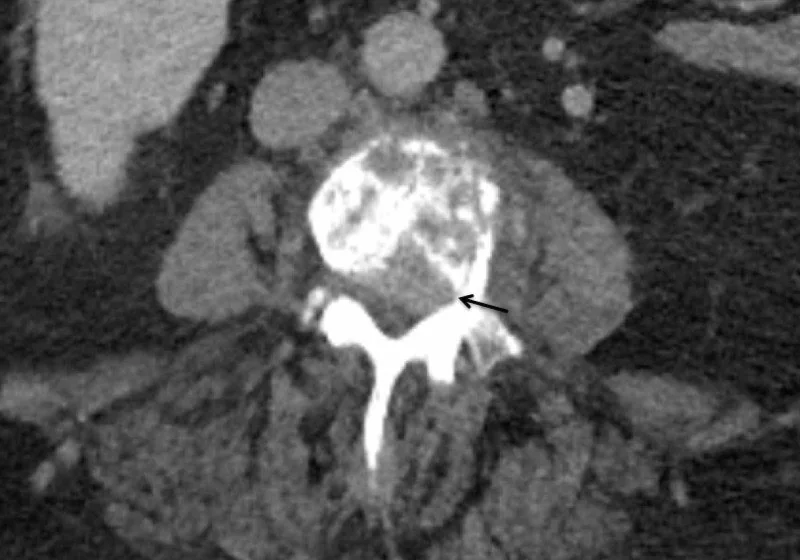
- Vertebra korpusundaki metastaz, komşu kemik metastazdan lokal invazyonla epidural alana yayılabilir; eşlik eden kemik destrüksiyonu görülebilir.
- Posterior korteksin bombe yapması ya da kırık parçanın spinal kanala yer değiştirmesi, kemik kaynaklı kanal daralmasıdır.
- BT'de ileri evre epidural yumuşak doku kitlesi izlenebilir; epidural yağın silinmesi ve dural kesenin itilmesi MR'da daha iyi değerlendirilir.
- Nöral foramen içindeki yumuşak doku genişlemesi, vertebral veya paraspinal lezyonun foramene uzanımını düşündürebilir.
- Paravertebral kitle ile aynı seviyedeki kemik destrüksiyonunun birlikteliği, ekstraosseöz ve epidural yayılımın ortak bir süreç olabileceğini düşündürür.
- Birden fazla vertebrada ayrı odaklar veya vertebralar arasında atlanan seviyeler, tüm omurganın klinik bağlam içinde incelenmesini gerektirir.
- Metastatik spinal kord basısı şüphesinde tüm omurganın MR ile görüntülenmesi gerekir; NICE, nörolojik bulgu veya belirtilerle birlikte sırt ağrısı olan hastalarda tüm omurga MR’ının 24 saat içinde yapılmasını önerir.
Ölçütler ve sınıflamalar
- Spinal Instability Neoplastic Score (SINS)
- SINS, spinal metastazlarda omurga stabilitesini değerlendiren ve metastatik hastada cerrahi/konservatif karar vermeye yapılandırılmış rehberlik sağlayan bir puanlama aracıdır. SINS 7–12 aralığı potansiyel instabil lezyonları tanımlar. SINS omurga stabilitesini değerlendirir; epidural kord basısı derecesi ESCC/Bilsky derecelendirmesiyle ifade edilir.
- Bilsky epidural spinal kord kompresyonu (ESCC) derecesi
- MR’da değerlendirilen ESCC derecelendirmesinde 3. derece, dural kesenin tamamen silinmesi ve kord basısının eşlik ettiği ağır epidural kompresyonu ifade eder.
Normalde
Normal vertebra korpusunun posterior korteksi düzgün bir çizgi halinde kalır; spinal kanal konturu simetrik, epidural yağ planı seçilebilir ve dural kese kemik yapılar tarafından belirgin biçimde itilmez. Aynı seviyede karşı nöral foramenin açıklığıyla kıyaslayın; bir taraftaki yağ planı kaybı ve dural kese yer değiştirmesi kitle etkisini düşündürür.
Normal BT ile kıyasla
Aynı bölgenin, kaynak veri setinde patoloji içermediği belirtilen bir BT incelemesini kesit kesit kaydırın; organ sınırlarını açarak anatomiyi hasta görüntüsüyle karşılaştırın. Küçük rastlantısal bulgular tümüyle dışlanmamıştır.
Kaynak: TotalSegmentator v2.01 veri seti (Wasserthal ve ark., Radiology: Artificial Intelligence 2023), CC BY 4.0, vaka s1338; organ sınırları veri setinin otomatik segmentasyonundan, birleştirilerek sadeleştirildi. Görüntüler 2,5 mm kesit aralığına yeniden örneklendi.
Ayırıcı tanı
- Retropulsiyon gösteren kırıkta kemik fragmanın posteriora yer değiştirmesi spinal kanalı daraltabilir ve kord basısına yol açabilir; agresif kemik yıkımı ve epidural yumuşak doku kitlesinin varlığı ya da yokluğu benign-malign ayrımı için ayrıca değerlendirilmelidir.
- Epidural apse spondilodiskit ile birlikte görülebilir ve epidural alanı doldurabilir; BT yumuşak doku ayrımında sınırlıdır.
- Epidural hematom posterior lomber dekompresyon ve füzyon gibi girişimler sonrasında görülebilen bir epidural komplikasyondur; eşlik eden kortikal bütünlük ve destrüktif değişiklikler BT ile ayrıca değerlendirilmelidir.
- Genişlemiş epidural venöz pleksus
- damar yapıları boyunca uzanan kontrastlanma ve birden çok düzeydeki damar devamlılığı kitleyi taklit edebilir.
- Primer vertebra tümörlerinin değerlendirilmesinde BT kemik mimarisini ve matriks özelliklerini tanımlamaya yardımcı olur; görüntüleme bulguları klinik sunumla birlikte yorumlanmalıdır.
Tuzaklar
- Kemik penceresinde kanalın açık görünmesi küçük epidural yumuşak doku kitlesini dışlamaz; yumuşak doku penceresindeki serileri ve sagittal rekonstrüksiyonları da inceleyin.
- Vertebra posterior duvarı boyunca kontrastlanan epidural venler, özellikle çok seviyeli ve tübüler dağılımda, metastatik kitleyi taklit edebilir.
- BT'de kanal daralması görülmemesi klinik kord basısını dışlamaz; NICE, şüpheli metastatik kord basısında MR'ı ilk görüntüleme yöntemi olarak önerir.
- Kemik destrüksiyonu ile birlikte epidural yumuşak doku kitlesi izlendiğinde, mekanik retropulsiyon ile tümör bazlı bası farklılaşmalıdır; her iki bileşen aynı düzeyde bulunabilir.
Kendini dene
Bilinen kanserli hastada T8 posterior korteks kesintili ve kanalda epidural doku dural keseyi itiyor. En doğru yorum nedir?
Cevabı göster
Metastatik epidural yayılım. Aynı seviyede kemik destrüksiyonu ile kanala uzanan kitle birlikteliği metastatik epidural yayılımı destekler; kontrastlanan venöz pleksus tümör uzanımını taklit edebilir.
BT'de şüpheli epidural doku izlenen ve yeni bacak güçsüzlüğü gelişen hastada bası derecesini en iyi hangi yöntem gösterir?
Cevabı göster
Tüm omurga MR. MR kemik iliği, epidural yumuşak doku ve kord/kauda ekuina ilişkisini doğrudan gösterir. Direkt grafi kanal içini değerlendiremez; sintigrafi kemik dönüşümünü gösterir, ultrason vertebral kanal için uygun değildir.
İlgili konular
Kaynaklar
Bu sayfadaki 44 cümle ve 2 quiz sorusu aşağıdaki kaynaklardan alıntılarla otomatik olarak karşılaştırıldı; 15 cümle bu karşılaştırmada düzeltildi (2026-10-12).
- Imaging of metastatic epidural spinal cord compressionpmc.ncbi.nlm.nih.gov
- Spinal granulocytic sarcoma with both extradural and intradural involvement: a case report.pubmed.ncbi.nlm.nih.gov
- Case Report: Thoracic spinal metastasis without definite intrahepatic recurrence after conversion therapy and hepatectomy for hepatocellular carcinoma.pubmed.ncbi.nlm.nih.gov
- Cervical Metastases Mimicking Ulnar Neuropathy in a 78-Year-Old Man With Advanced Oesophageal Squamous Cell Carcinoma.pubmed.ncbi.nlm.nih.gov
- Complications of vertebral augmentation in metastatic spinal fractures: a systematic review of multiple study designs.pubmed.ncbi.nlm.nih.gov
- Malignant mimic: pulmonary actinomycosis with contiguous vertebral involvement and spinal cord compression. Illustrative case.pubmed.ncbi.nlm.nih.gov
- Spinal lesions: a comprehensive radiologic overview.pubmed.ncbi.nlm.nih.gov
- Initial Negative MRI Spine and Persistent Staphylococcus aureus Bacteraemia Lead to Delayed Diagnosis of Lumbar Spondylodiscitis and Epidural Abscess: A Case Report.pubmed.ncbi.nlm.nih.gov
- Surgery of the tumors of the spine.pubmed.ncbi.nlm.nih.gov
- Clinical Outcomes of Image-Guided Spinal Laser Interstitial Thermal Therapy for Metastatic Epidural Spinal Disease: A Systematic Review and Narrative Synthesis.pubmed.ncbi.nlm.nih.gov
- Bone metastases from hepatocellular carcinoma: Guidance on the management of spinal and long bone lesions.pubmed.ncbi.nlm.nih.gov
- Case Report: Moxibustion-induced burns leading to disseminated methicillin-resistant <i>Staphylococcus aureus</i> infection in a patient with type 2 diabetes mellitus.pubmed.ncbi.nlm.nih.gov
- Multidisciplinary management of spinal metastases: what the radiologist needs to know.pubmed.ncbi.nlm.nih.gov
- Imaging for Plasma Cell Dyscrasias: What, When, and How?pubmed.ncbi.nlm.nih.gov
- Identifying osteoporotic vertebral endplate and cortex fractures.pubmed.ncbi.nlm.nih.gov
- Clinical applications of MRI-based artificial intelligence in spinal metastases: A systematic review.pubmed.ncbi.nlm.nih.gov
- Metastatic Carotid Body Paraganglioma Following Three Decades of Indolent Growth: A Case Report.pubmed.ncbi.nlm.nih.gov
- Radiomics in spinal research: a narrative review.pubmed.ncbi.nlm.nih.gov
- The value of magnetic resonance imaging and computed tomography in the study of spinal disorders.pubmed.ncbi.nlm.nih.gov
- Comparison Study between Conventional Sequence and Slice-Encoding Metal Artifact Correction (SEMAC) in the Diagnosis of Postoperative Complications in Patients Receiving Lumbar Inter-Body Fusion and Pedicle Screw Fixation Surgery.pubmed.ncbi.nlm.nih.gov
- Long-term safety and effectiveness of the "OptEase" vena cava filter.pubmed.ncbi.nlm.nih.gov
- Recommendations of the International Consensus Meeting (ICM) 2025 on Spinal Infections: Part B Tubercular Spondylodiscitis.pubmed.ncbi.nlm.nih.gov
- Applications of Artificial Intelligence and Machine Learning in Spine MRI.pubmed.ncbi.nlm.nih.gov
- Understanding a mass in the paraspinal region: an anatomical approach.pubmed.ncbi.nlm.nih.gov
- Pediatric Meningeal Diseases: What Radiologists Need to Know.pubmed.ncbi.nlm.nih.gov
- Endoscope-assisted prone lateral retropleural 360° reconstruction of thoracic pathological fracture in metastatic melanoma: a case report and technical note.pubmed.ncbi.nlm.nih.gov
- An exploratory multimodal imaging and clinicopathological strategy for suspected Kümmell's disease in the absence of MRI.pubmed.ncbi.nlm.nih.gov
- Cervical spine myxoid liposarcoma in a 30-year-old male: a rare case report.pubmed.ncbi.nlm.nih.gov
- The "Eagle Ray Sign" of the lumbar epidural space: A case of vascular-dominant spinal angiolipoma mimicking Aetobatus spp. morphology with favorable outcome and literature review.pubmed.ncbi.nlm.nih.gov
- Posterior Extradural Spinal Tumor Extending From T3 to T6 Presenting With Paraplegia.pubmed.ncbi.nlm.nih.gov
- Beyond Chordoma: A Comprehensive Review of Sacral Lesions.pubmed.ncbi.nlm.nih.gov
- Dumbbell Spinal Desmoid Tumor Mimicking a Giant Schwannoma: Case Report and Literature Review.pubmed.ncbi.nlm.nih.gov
- Extrapleural Malignant Solitary Fibrous Tumor Presenting as Invasive Bilateral Paravertebral Tumors: A Case Report.pubmed.ncbi.nlm.nih.gov
- Cervical spine chordoma: Imaging features and diagnostic challenges of a rare C6 localization.pubmed.ncbi.nlm.nih.gov
- Imaging features and atypical signs of symptomatic vertebral haemangioma: a retrospective single-centre analysis of 118 patients.pubmed.ncbi.nlm.nih.gov
- Differentiating Tuberculous and Pyogenic Spondylodiscitis: Part II: MRI/CT Features, Prediction Models, and the Role of PET/CT-A Narrative Review.pubmed.ncbi.nlm.nih.gov
- Diagnostic value of quantitative SPECT/CT integrated parameters for differentiating spinal tuberculosis from spinal metastases.pubmed.ncbi.nlm.nih.gov
- Cervical Skip Metastases and Extensive Central Venous Thrombosis as the Initial Presentation of High-Grade Prostate Adenocarcinoma With Discordant PI-RADS 3 Findings: A Case Report and Diagnostic Challenge.pubmed.ncbi.nlm.nih.gov
- Magnetic resonance imaging (MRI) vs. computed tomography (CT) in the diagnosis and classification of spondylolysis and spondylolisthesis-a narrative review.pubmed.ncbi.nlm.nih.gov
- Duropathies as Unifying Concept-Part Two: A Narrative Overview of Clinical and Neuroradiological Features.pubmed.ncbi.nlm.nih.gov
- International Society of Paediatric Surgical Oncology (IPSO) Surgical Practice Guidelines.pubmed.ncbi.nlm.nih.gov
- Tourniquet use for knee replacement surgery.pubmed.ncbi.nlm.nih.gov
- Feasibility of Using Short-Segment Instrumentation and Vertebral Body Reconstruction for the Treatment of Metastatic Disease in the Thoracic Spine.pubmed.ncbi.nlm.nih.gov
- Survival and Predictors in Patients With Breast Cancer Undergoing Surgery for Spinal Metastases: Insights From a Single-Center Cohort.pubmed.ncbi.nlm.nih.gov
- Multiphysics finite element analysis of vertebral stability in simulated osteolytic lumbar defects treated with <sup>125</sup>I brachytherapy and vertebroplasty.pubmed.ncbi.nlm.nih.gov
- Recommendations of the International Consensus Meeting (ICM) 2025 on Spinal Infections: Part A Pyogenic Spondylodiscitis.pubmed.ncbi.nlm.nih.gov
- Advances in imaging modalities for spinal tumors.pubmed.ncbi.nlm.nih.gov
- Surgical Intensity and Survival After Surgery for Extradural Spinal Metastases: Mechanical Instability, Tumor Biology, and Systemic Reserve.pubmed.ncbi.nlm.nih.gov
- Early Neurological Improvement and Ambulation Recovery After Delayed Surgery in Surgically Selected Nonambulatory Metastatic Epidural Spinal Cord Compression: A Retrospective Cohort Study.pubmed.ncbi.nlm.nih.gov
- Clinical Determinants of Functional Independence at Discharge in Patients With Spinal Cord Dysfunction Due to Metastatic Spinal Tumors.pubmed.ncbi.nlm.nih.gov
- Differential diagnosis of benign and malignant vertebral compression fractures based on CT radiomics model.pubmed.ncbi.nlm.nih.gov
- Performance Comparison of Machine Learning Using Radiomic Features and CNN-Based Deep Learning in Benign and Malignant Classification of Vertebral Compression Fractures Using CT Scans.pubmed.ncbi.nlm.nih.gov
- Helcococcus kunzii as a rare etiological agent of spondylodiscitis partially managed with oral antibiotic therapy in a patient with diabetes mellitus: a case report.pubmed.ncbi.nlm.nih.gov
- Infectious Spondylodiscitis of Bacterial Causes in Adults: Epidemiology, Pathophysiology, Diagnostic and Treatment Challenges.pubmed.ncbi.nlm.nih.gov
- Conference Proceedings: Select Abstracts Presented at the 2025 Advocate Aurora Scientific Day.pubmed.ncbi.nlm.nih.gov
- A guide to utilization of the microbiology laboratory for diagnosis of infectious diseases: 2013 recommendations by the Infectious Diseases Society of America (IDSA) and the American Society for Microbiology (ASM)(a).pubmed.ncbi.nlm.nih.gov
- The Spinal Dural Arteriovenous Fistula in a Patient With Metastatic Renal Cell Carcinoma.pubmed.ncbi.nlm.nih.gov
- Primary splenic angiosarcoma presenting with multiple bone destruction as the initial manifestation: a case report and narrative review.pubmed.ncbi.nlm.nih.gov
- ESR Essentials: bone marrow MRI in oncology-practice recommendations by the European Society of Musculoskeletal Radiology.pubmed.ncbi.nlm.nih.gov
- Unveiling Primary Bone Tumors of the Spine: A Review of Essential Imaging Clues.pubmed.ncbi.nlm.nih.gov
- Clinical TNM Lung Cancer Staging: A Diagnostic Algorithm with a Pictorial Review.pubmed.ncbi.nlm.nih.gov
- Advancements in metastatic spinal cord compression treatment: a narrative review of innovations, challenges, and future directions.pubmed.ncbi.nlm.nih.gov
- Spinal MRI in Patients with Suspected Metastatic Spinal Cord Compression: A Quality Improvement Audit in a District General Hospital in Kent, UK.pubmed.ncbi.nlm.nih.gov
- Advances in Supportive Care for Multiple Myeloma-Related Bone Disease-A Review.pubmed.ncbi.nlm.nih.gov
- Imaging of Multiple Myeloma: Present and Future.pubmed.ncbi.nlm.nih.gov
- The American Society of Pain and Neuroscience (ASPN) Evidence-Based Clinical Guideline of Interventional Treatments for Low Back Pain.pubmed.ncbi.nlm.nih.gov
- The 2023 WSES guidelines on the management of trauma in elderly and frail patients.pubmed.ncbi.nlm.nih.gov
- Impact of Paraspinal Muscle Characteristics on the Risk of Symptomatic Epidural Hematoma Following Transforaminal Lumbar Interbody Fusion.pubmed.ncbi.nlm.nih.gov
- Interlaminar Contralateral Endoscopic Foraminotomy Reduces Postoperative Dysesthesia in Patients With Degenerative Lumbar Deformity: A Multicenter Comparative Cohort Study.pubmed.ncbi.nlm.nih.gov
- Integrating AI Segmentation, Simulated Digital Twins, and Extended Reality into Medical Education: A Narrative Technical Review and Proof-of-Concept Case Study.pubmed.ncbi.nlm.nih.gov
- Development and validation of a nomogram model for predicting bone cement leakage during vertebroplasty.pubmed.ncbi.nlm.nih.gov
- Extrapedicular approach for basivertebral nerve radiofrequency ablation: a conceptual review.pubmed.ncbi.nlm.nih.gov
- Accuracy and Safety of a Triad-Dependent Technique for Subaxial Cervical Pedicle Screw Placement: A Prospective Cohort Study.pubmed.ncbi.nlm.nih.gov
- Case Report: Segment-specific minimally invasive surgical management of lumbar spinal epidural lipomatosis with adjacent-level degenerative stenosis.pubmed.ncbi.nlm.nih.gov
- Perioperative and 6-month outcomes of UNSES versus UBE for lumbar disc herniation with standardized annular suture.pubmed.ncbi.nlm.nih.gov
- Comparative efficacy of unilateral biportal endoscopy versus endoscopic foraminoplasty decompression for single-level lumbar spinal stenosis: a retrospective cohort study.pubmed.ncbi.nlm.nih.gov
- Primary intraosseous anastomosing hemangioma of the sacrum: illustrative case.pubmed.ncbi.nlm.nih.gov
- Nasopharyngeal carcinoma masquerading as a primary sinonasal mass: a case report.pubmed.ncbi.nlm.nih.gov
- Microsurgical Management of Carotid Body Tumors: An Educational Neurosurgical Perspective with Video Demonstrations.pubmed.ncbi.nlm.nih.gov
- Spinal hydatid disease with epidural extension and spinal cord compression: A radiology case report.pubmed.ncbi.nlm.nih.gov
- Total laparoscopic radical hysterectomy for cervical cancer in prolapsed uterus.pubmed.ncbi.nlm.nih.gov
- Interventional radiology management of disc herniation: a narrative review.pubmed.ncbi.nlm.nih.gov
- When a herniated disc masquerades as a tumor: Latero-posterior epidural migration mimicking cauda equina neoplasm-A case report and review.pubmed.ncbi.nlm.nih.gov
- Vertebral Augmentation Involving Vertebroplasty or Kyphoplasty for Cancer-Related Vertebral Compression Fractures: A Systematic Review.pubmed.ncbi.nlm.nih.gov
- Regression of a ventral epidural mass after posterior stabilization for cervical spinal metastasis: illustrative case.pubmed.ncbi.nlm.nih.gov
- Spinal Instability Neoplastic Score as a Predictor of Vertebral Fracture in Patients Undergoing Radiation Therapy for Spinal Metastases: A Single-Institution Study.pubmed.ncbi.nlm.nih.gov
- Large Language Model (LLM)-Predicted and LLM-Assisted Calculation of the Spinal Instability Neoplastic Score (SINS) Improves Clinician Accuracy and Efficiency.pubmed.ncbi.nlm.nih.gov
- Updating Prognostic Assessment for Spinal Metastases With a Combined Model of the Spinal Instability Neoplastic Score and the New Katagiri Score.pubmed.ncbi.nlm.nih.gov
- In-context learning enables large language models to achieve human-level performance in spinal instability neoplastic score classification from synthetic CT and MRI reports.pubmed.ncbi.nlm.nih.gov
- Assessing the reproducibility of a subject-specific finite element modelling pipeline for the human metastatic vertebrae.pubmed.ncbi.nlm.nih.gov
- A systematic review of the spinal instability neoplastic score and its relationship with peri-interventional patient-centered measures: The clinical impact of spinal instability.pubmed.ncbi.nlm.nih.gov
- Early Clinical Outcomes and Local Control Following Spine Stereotactic Proton Ablative Radiation Therapy.pubmed.ncbi.nlm.nih.gov
- Advances in Metastatic Disease Spinal Oncology: Novel Technology Without Forgetting the Fundamentals of Surgical Treatment.pubmed.ncbi.nlm.nih.gov
- Metastatic Retroperitoneal Rhabdomyosarcoma in a Child: A Case Report Highlighting the Role of Imaging in Diagnosis, Staging, and Follow-Up.pubmed.ncbi.nlm.nih.gov
- Primary Cutaneous Apocrine Carcinoma of the Scalp Arising in Syringocystadenoma Papilliferum: Report of a Rare Case.pubmed.ncbi.nlm.nih.gov
- Paravertebral soft tissue swelling on magnetic resonance images helps in differentiation between osteoporotic and malignant vertebral fractures.pubmed.ncbi.nlm.nih.gov
- Pseudomyogenic hemangioendothelioma of the thoracolumbar spine: A case-based review of a rare cause of vertebral collapse and neurological deficit.pubmed.ncbi.nlm.nih.gov
- The spinal lymphatic system: an emerging pathway bridging fluid homeostasis, immunity, and disease.pubmed.ncbi.nlm.nih.gov
- Artificial Intelligence for Detection and Characterisation of Bone Metastases on MRI: A Scoping Review.pubmed.ncbi.nlm.nih.gov
- Efficacy and safety of CT-guided 125 I seed implantation by coplanar template as a salvage therapy for vertebral metastases after failure of external beam radiation therapy: a retrospective study.pubmed.ncbi.nlm.nih.gov
- Special Issue: EACR 2026 Congress: Innovative Cancer Science, 8-11 June 2026.pubmed.ncbi.nlm.nih.gov
- Surgical Treatment of Spinal Metastatic Pheochromocytoma and Paraganglioma: A Single Institutional Cohort of 18 Patients.pubmed.ncbi.nlm.nih.gov
- Evaluating the Accuracy of Privacy-Preserving Large Language Models in Calculating the Spinal Instability Neoplastic Score (SINS).pubmed.ncbi.nlm.nih.gov
- Exercise for myeloma patients with bone disease: a scoping review.pubmed.ncbi.nlm.nih.gov
- Surgical timing, neurological recovery, and survival in spinal metastasis-induced paralysis: a retrospective cohort study with nomogram development.pubmed.ncbi.nlm.nih.gov
- Postoperative Epidural Disease and Local Control After Separation Surgery and Spine Stereotactic Body Radiation Therapy.pubmed.ncbi.nlm.nih.gov
- Spinal leptomeningeal disease in patients with solid tumors: A single-center study on clinical presentation, diagnosis, treatment, and outcomes.pubmed.ncbi.nlm.nih.gov
- Clinical Outcomes and Patterns of Neurological Toxicity After Stereotactic Body Radiotherapy Reirradiation (reSBRT) of Spine Metastases Previously Treated with SBRT.pubmed.ncbi.nlm.nih.gov
- Multifocal skeletal tuberculosis with posterior-element spinal, sternal, and pelvic involvement presenting as a pulmonary mass: A malignancy mimic.pubmed.ncbi.nlm.nih.gov
- Purely osteolytic bone lesions in the early osteoarticular phase of synovitis, acne, pustulosis, hyperostosis and osteitis syndrome.pubmed.ncbi.nlm.nih.gov
- Initial management and disposition of metastatic spinal cord compression in the emergency department: a review of the literature.pubmed.ncbi.nlm.nih.gov
- pubmed.ncbi.nlm.nih.govpubmed.ncbi.nlm.nih.gov
Eğitim amaçlıdır; hasta başında tanı ve tedavi kararının yerine geçmez, tıbbi tavsiye değildir. Metinler yapay zekâ desteğiyle yazıldı ve otomatik bir adımda kaynak alıntılarıyla karşılaştırıldı; bu bir tıbbi doğrulama değildir ve içerik uzman radyolog incelemesinden geçmedi. Klinik kararlarda güncel kılavuzları, kurum protokollerini ve radyoloji raporunu esas alın.