Özet
Çocuk pelvis kırıkları seyrektir ve çoğunlukla yüksek enerjili travmayla gelişir; açık triradiat kıkırdak ve esnek kemik erişkinden farklı kırık paternleri oluşturur. BT, sakrum, asetabulum, posterior halka ve apofiz avulsiyonları dahil pelvis kırıklarını standart pelvis grafisinden daha ayrıntılı gösterir. Kontrastlı BT eşlik eden karın yaralanmasını ve pelvik sıvı/hematom koleksiyonlarını gösterebilir; aktif ekstravazasyon saptanması arteriyel yaralanma açısından anjiyografik değerlendirmeyi gerektirir. Sakral kırık-dislokasyon ve spinopelvik ayrışma sıklıkla nörolojik tutulumla birliktedir ve kalıcı mesane-bağırsak işlev bozukluğu bırakabilir; şiddetli triradiat kıkırdak yaralanmasında büyüme bozukluğu bildirilmiştir.
Faz ve pencere
- Kemik algoritması tanısal
- Pelvis kırıklarında BT, standart pelvis grafisine göre kırıkları daha iyi gösterir ve daha ayrıntılı bilgi sağlar.
- Portal tanısal
- Kontrastlı BT pelvik yaralanmaya eşlik eden karın ve ürogenital yaralanmaların değerlendirilmesinde kullanılır; ekstravazasyon odağı görülmeyen sıvı/hematom tek başına aktif arteriyel kanama tanısı koydurmaz.
- BTA
- Aktif arteriyel kanama kuşkusu olan olgularda arteriyel faz/BT anjiyografi değerlendirilebilir; kontrastlı BT'de saptanan aktif ekstravazasyon arteriyel yaralanmayı düşündürür.
Önerilen pencereler G genişlik, M merkez; değerler Hounsfield birimi (HU)
- KemikG 1800 / M +400
- BatınG 400 / M +50
- AnjiyoG 600 / M +150
- Yumuşak dokuG 400 / M +40
BT bulguları
- Pubis kolu veya iliak kanat kırıklarında BT, kırığın yerini ve morfolojisini standart pelvis grafisinden daha ayrıntılı gösterir.
- Çocuklarda ön halka kırıklarına sakral veya iliak kanat kırıkları, sakroiliak bağ kompleksi yaralanması da eşlik edebilir; arka halka bileşenleri bu nedenle değerlendirilmelidir.
- Sakral kırıklar BT’de daha iyi saptanır; kırık hattının sakral foramenlere uzanımı değerlendirilmelidir.
- Asetabulum kırıklarında BT grafiden daha iyi tanı sağlar; kesitsel görüntüleme eklem instabilitesini ve sıkışmış kemik fragmanlarını gösterebilir, triradiat kıkırdak tutulumu Salter–Harris sistemiyle sınıflandırılabilir.
- İliak krest/iliak apofiz avulsiyonu 3B görüntüleme gerektirebilen ve instabil olabilen bir yaralanmadır; sakroiliak eklem yaralanması varlığında da aranmalıdır.
- Pelvik travmada BT, pelvik kavitedeki sıvı koleksiyonlarını gösterebilir.
- Kontrastlı BT’de aktif arteriyel ekstravazasyon görülebilir; ekstravazasyon saptanmaması önemli arteriyel yaralanmayı dışlamaz.
- Pelvik travmada karın, ürogenital sistem ve omurga eşlik eden yaralanmalar açısından değerlendirilmelidir.
- Çocuklarda BT, radyasyon maruziyeti nedeniyle her pelvik travmada rutin kullanılmamalı; kırıkların grafiden daha ayrıntılı değerlendirilmesinin hasta yönetimini etkileyeceği durumlarda düşünülmelidir.
Ölçütler ve sınıflamalar
- Modifiye Torode–Zieg sınıflaması
- Tip I avulsiyon; Tip II iliak kanat; Tip IIIA yalnız ön halkayı içeren stabil halka kırığı; Tip IIIB ön ve arka halkayı içeren stabil yaralanma; Tip IV instabil halka bozulması. Modifiye Torode–Zieg sınıflaması iskelet olgunlaşmasının farklı evrelerini dikkate almaz ve bazı kırıklar mevcut sınıflandırma sistemlerine uymayabilir.
- Salter–Harris (asetabular triradiat kıkırdak tutulumu)
- Çocuklarda asetabular triradiat kıkırdak tutulumu varsa kırık Salter–Harris sistemiyle sınıflandırılabilir.
Normalde
Pubik simfiz ve sakroiliak eklem genişliğini aksiyel ve koronal düzlemlerde ölçüp yayımlanmış standart değerlerle karşılaştırın. Açık fizisler ve kemikleşme merkezleri çocuk pelvis görüntülerinin yorumunu etkileyebilir; değerlendirmede iskelet olgunlaşmasını göz önünde bulundurun.
Normal BT ile kıyasla
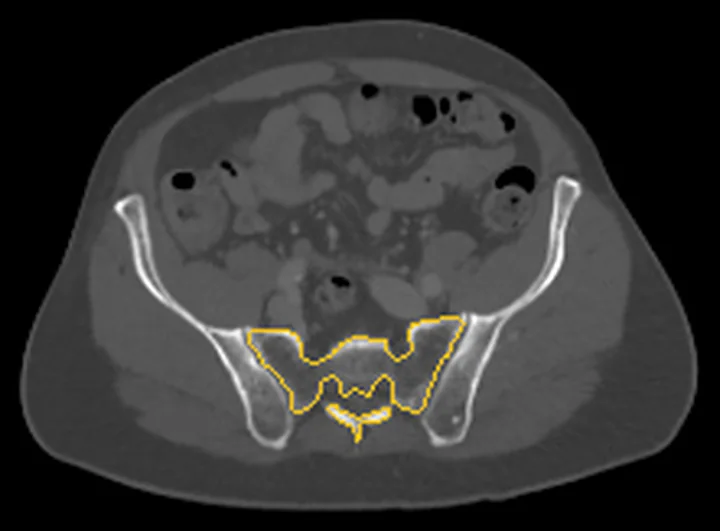
Aynı bölgenin, kaynak veri setinde patoloji içermediği belirtilen bir BT incelemesini kesit kesit kaydırın; organ sınırlarını açarak anatomiyi hasta görüntüsüyle karşılaştırın. Küçük rastlantısal bulgular tümüyle dışlanmamıştır.
Kaynak: TotalSegmentator v2.01 veri seti (Wasserthal ve ark., Radiology: Artificial Intelligence 2023), CC BY 4.0, vaka s1256; organ sınırları veri setinin otomatik segmentasyonundan, birleştirilerek sadeleştirildi. Görüntüler 2,5 mm kesit aralığına yeniden örneklendi.
Ayırıcı tanı
- Kemikleşme merkezleri ve açık fizisler pelvis görüntülerinin yorumunu etkileyebildiğinden iliak krest avülsiyonu kuşkusunda 3B görüntüleme yardımcı olabilir, çünkü iliak apofiz yaralanmaları instabil olabilir.
- Sakral kırık kuşkusu varsa BT grafiden daha iyi saptama sağlar.
- Çocuklarda asetabular triradiat kıkırdak tutulumu olan kırıklar Salter–Harris sistemiyle sınıflandırılabilir.
- Sakral stres kırığı, travmatik sakral kırıklardan ayrı, travma dışı bir sakral kırık olarak değerlendirilir.
- Pelvik apofiz avulsiyonu
- kas çekiş yönündeki küçük kemik fragmanı halka kırığından farklı, lokalize bir yaralanmadır.
Tuzaklar
- Çocuklarda halka tek noktadan kırılabilir; yalnız ön halka hasarı görülmesi posterior stabiliteyi otomatik olarak kanıtlamaz, SI eklemleri ve sakrumu inceleyin.
- Açık triradiat kıkırdak ve apofizler kırık hattı gibi algılanabilir; karşı taraf, kortikal kenar ve yaşa uygun ossifikasyonla karşılaştırın.
- Sakral kırıklarda koronal ve sagittal BT rekonstruksiyonları kırık morfolojisini değerlendirmeye yardımcı olur.
- Kontrastlı BT'de ekstravazasyon odağı görülmeyen pelvik sıvı/hematom tek başına aktif kanama tanısı koydurmaz; aktif ekstravazasyon şüphesinde arteriyel değerlendirme gerekir.
Kendini dene
Modifiye Torode–Zieg sınıflamasında hangi tip, ön ve arka halkayı içeren stabil halka kırığını tanımlar?
Cevabı göster
Tip III-B. Tip III-B ön ve arka halkayı içeren stabil pelvik halka kırığıdır. Tip III-A yalnız ön halkayı, Tip II iliak kanat kırığını, Tip I avulsiyon kırığını tanımlar.
Pelvik hematom yanında arter lümeninden ayrı kontrastlanan odak görülmesi öncelikle neyin lehinedir?
Cevabı göster
Aktif ekstravazasyon. Damar dışında kontrastlanan odak aktif ekstravazasyon lehinedir; ekstravazasyon odağı görülmeyen sıvı tek başına aktif kanama tanısı koydurtmaz.
İlgili konular
Kaynaklar
Bu sayfadaki 42 cümle ve 2 quiz sorusu aşağıdaki kaynaklardan alıntılarla otomatik olarak karşılaştırıldı; 16 cümle bu karşılaştırmada düzeltildi (2026-10-12).
- Paediatric pelvic fractures – an updated literature reviewpmc.ncbi.nlm.nih.gov
- Traumatic Uterine Rupture in a Nonpregnant Patient: A Case Reportpmc.ncbi.nlm.nih.gov
- The anatomical bone corridor study of schanz screw placement in adolescent pelvic ring fractures via three-dimensional CTpmc.ncbi.nlm.nih.gov
- Feasibility of AI-Denoised Ultra-Low-Dose CT for Detection of Acute Pelvic and Hip Fractures: A Pilot Multi-Reader Studypmc.ncbi.nlm.nih.gov
- Open and Percutaneous Fixation of Traumatic Sacral Fracture–Dislocation with Spinopelvic Dissociation: Two Adolescent Cases and a Systematic Literature Reviewpmc.ncbi.nlm.nih.gov
- Is the Iliac Cortical Density Similarly Positioned in the Developing Pediatric Pelvis?pubmed.ncbi.nlm.nih.gov
- Safe corridors for sacroiliac fixation in pediatric patients.pubmed.ncbi.nlm.nih.gov
- Do Safe Radiographic Sacral Screw Pathways Exist in a Pediatric Patient Population and Do They Change With Age?pubmed.ncbi.nlm.nih.gov
- Is spinal computed tomography necessary in pediatric trauma patients?pubmed.ncbi.nlm.nih.gov
- Optimal ilio-sacral screw trajectory in paediatric patients : a computed tomography study.pubmed.ncbi.nlm.nih.gov
- Percutaneous screw fixation of the iliosacral joint: optimal screw pathways are frequently not completely intraosseous.pubmed.ncbi.nlm.nih.gov
- Treatment of unilateral L5-S1 locked facet in a pediatric patient.pubmed.ncbi.nlm.nih.gov
- Predictors of Intrathoracic Injury after Blunt Torso Trauma in Children Presenting to an Emergency Department as Trauma Activations.pubmed.ncbi.nlm.nih.gov
- Risser growth plate injury in unstable paediatric pelvic fractures: a multicentre retrospective study.pubmed.ncbi.nlm.nih.gov
- The Unique Features of Pediatric Sports Injuries: The Hip.pubmed.ncbi.nlm.nih.gov
- Post-traumatic sacroiliac joint remodeling in a pediatric patient: a case report.pubmed.ncbi.nlm.nih.gov
- Bilateral Symmetric Fracture of the Iliac Wings: An Unusual Situation after a Car Accident.pubmed.ncbi.nlm.nih.gov
- 2.5-mm articulated endoluminal forceps using a compliant mechanism.pubmed.ncbi.nlm.nih.gov
- Long-term safety and effectiveness of the "OptEase" vena cava filter.pubmed.ncbi.nlm.nih.gov
- Computed tomography of renal emergencies: A comprehensive diagnostic guide for radiology residents.pubmed.ncbi.nlm.nih.gov
- Imaging findings of high-grade penetrating renal trauma in a pediatric patient.pubmed.ncbi.nlm.nih.gov
- Contrast-enhanced ultrasound (CEUS) in urgent and emergent pediatric conditions: a comprehensive review.pubmed.ncbi.nlm.nih.gov
- Surgical Management of Pediatric Acetabular Fractures: A Retrospective Study of 14 Rare Cases.pubmed.ncbi.nlm.nih.gov
- Angioembolization as a life-saving maneuver for unstable pelvic fractures in skeletally immature children: a multicenter case series.pubmed.ncbi.nlm.nih.gov
- Pneumothorax and Hemothorax: Practical Approaches for Radiologists.pubmed.ncbi.nlm.nih.gov
- Photon-Counting CT: Technology, Current and Potential Future Clinical Applications, and Overview of Approved Systems and Those in Various Stages of Research and Development.pubmed.ncbi.nlm.nih.gov
- Advances in multimodal imaging for adrenal gland disorders: integrating CT, MRI, and nuclear medicine.pubmed.ncbi.nlm.nih.gov
- Staged management of a Tile C3 pelvic ring injury with bilateral sacroiliac disruption and T-shaped sacral fracture.pubmed.ncbi.nlm.nih.gov
- Pelvic Fractures in Adults and the Importance of Associated Injuries-A Current Multi-Disciplinary Approach.pubmed.ncbi.nlm.nih.gov
- Surgical management of paediatric pelvic fractures: a prospective case series and early experience from a level one Egyptian trauma centre.pubmed.ncbi.nlm.nih.gov
- Value of MR arthrography for evaluation of children and adolescents with clinically suspected intraarticular cause of hip pain.pubmed.ncbi.nlm.nih.gov
- Computed tomography of pediatric abdominal trauma: optimizing utilization and enhancing diagnostic interpretation.pubmed.ncbi.nlm.nih.gov
- Best Practice Recommendations for Infertility Management.pubmed.ncbi.nlm.nih.gov
- Patterns of injury and violence in Yaoundé Cameroon: an analysis of hospital data.pubmed.ncbi.nlm.nih.gov
- Endovascular Treatment of an Iatrogenic Inferior Mesenteric Arteriovenous Fistula Presenting as Massive Lower Gastrointestinal Hemorrhage: A Case Report.pubmed.ncbi.nlm.nih.gov
- ESR Essentials: trauma team and the role of Interventional Radiology-practice recommendations by the Cardiovascular and Interventional Radiological Society of Europe.pubmed.ncbi.nlm.nih.gov
- Developing a decision instrument to guide abdominal-pelvic imaging of blunt trauma patients: Methodology and protocol of the NEXUS abdominal-pelvic imaging study.pubmed.ncbi.nlm.nih.gov
- Diagnostic Utility of Red Flags for Detecting Spinal Malignancies in Patients with Low Back Pain: A Scoping Review.pubmed.ncbi.nlm.nih.gov
- Coronavirus disease 2019 pandemic: staged management of surgical services for gynecology and obstetrics.pubmed.ncbi.nlm.nih.gov
- Clinical and surgical outcomes of pediatric pelvic fractures: experience from a mass-casualty and routine trauma cohort.pubmed.ncbi.nlm.nih.gov
- Limited ilioinguinal approach for unstable pelvic fractures in children aged <3 years.pubmed.ncbi.nlm.nih.gov
- Assessing Pediatric Pelvic Fracture Patterns: New Insights and Unique Fracture Characteristics.pubmed.ncbi.nlm.nih.gov
- Analysis of risk factors affecting the prognosis of external fixation in the treatment of unstable pelvic fractures in children: a retrospective study of 96 patients.pubmed.ncbi.nlm.nih.gov
- Modified Stoppa Approach for ORIF of a Paediatric Transverse Acetabular Fracture: Case Report and Systematic Review of Internal Fixation in Children.pubmed.ncbi.nlm.nih.gov
- Low osteotomy cut of Dega procedure for older children with developmental dysplasia of the hip.pubmed.ncbi.nlm.nih.gov
- Favorable Outcome Twenty-Two Months after Delbet Type Ib Capital Femoral Transepiphyseal Fracture and Posterior Column Acetabular Fracture in a Fifteen-Year-Old Male.pubmed.ncbi.nlm.nih.gov
- Paediatric pelvic fractures - an updated literature review.pubmed.ncbi.nlm.nih.gov
- Open and Percutaneous Fixation of Traumatic Sacral Fracture-Dislocation with Spinopelvic Dissociation: Two Adolescent Cases and a Systematic Literature Review.pubmed.ncbi.nlm.nih.gov
- Imaging of Sacroiliac Pain: The Current State-of-the-Art.pubmed.ncbi.nlm.nih.gov
- Pictorial Review of Paediatric Limp.pubmed.ncbi.nlm.nih.gov
- Ultrasound Applications in Pediatric Orthopedics.pubmed.ncbi.nlm.nih.gov
- Evaluation and management of lower back pain in young athletes.pubmed.ncbi.nlm.nih.gov
- The state of trial registrations in the field of Orthopaedics in years 2015-2020. A meta-epidemiological study.pubmed.ncbi.nlm.nih.gov
- Consensus practice guidelines on sacroiliac joint complex pain from a multispecialty, international working group.pubmed.ncbi.nlm.nih.gov
- Orthopedic preoperative evaluation and surgical strategies of hereditary multiple osteochondromas involving the spinal region.pubmed.ncbi.nlm.nih.gov
- Sacral intraosseous schwannoma in an adolescent patient: A case report.pubmed.ncbi.nlm.nih.gov
- Conference Proceedings: Select Abstracts Presented at the 2025 Advocate Aurora Scientific Day.pubmed.ncbi.nlm.nih.gov
- Vascular computed tomography angiography technique and indications.pubmed.ncbi.nlm.nih.gov
- Blunt pancreatic trauma: A persistent diagnostic conundrum?pubmed.ncbi.nlm.nih.gov
- Epidemiology and injury patterns of high-energy pediatric pelvic and acetabular fractures: A retrospective study with comparative outcomes.pubmed.ncbi.nlm.nih.gov
- Emphysematous conditions of the abdomen and pelvis: pearls and pitfalls.pubmed.ncbi.nlm.nih.gov
- ESR Essentials: Gynaecological causes of acute pelvic pain in women: a primer for emergent evaluation-practice recommendations by the European Society of Emergency Radiology.pubmed.ncbi.nlm.nih.gov
- Imaging of acute pelvic pain.pubmed.ncbi.nlm.nih.gov
- Isolated Unilateral Posterior Sacroiliac Dislocation With an Intact Anterior Pelvic Ring: Case Report of an Unusual Injury Pattern.pubmed.ncbi.nlm.nih.gov
- Successful management of severe pediatric cervical trauma emphasizing the role of surgical stabilization and intensive rehabilitation in achieving complete recovery: a case report.pubmed.ncbi.nlm.nih.gov
- Postpartum pelvic stress fractures with subsequent forefoot overload injury: A case report.pubmed.ncbi.nlm.nih.gov
- Are sacral stress fractures in young women truly rare? a retrospective MRI analysis of 1970 patients.pubmed.ncbi.nlm.nih.gov
- Risk Factors for Sacral Insufficiency Fracture After Pelvic Irradiation for Cervical Cancer.pubmed.ncbi.nlm.nih.gov
- Conservative Treatment of Pediatric Fractures-Narrative Review of Acceptable Deformity and Remodeling Potential.pubmed.ncbi.nlm.nih.gov
- Point-of-care ultrasound detection of anterior inferior iliac spine avulsion fracture in an adolescent: A case report.pubmed.ncbi.nlm.nih.gov
- Beyond the Bony Fragment: A Review of Limbus Vertebra.pubmed.ncbi.nlm.nih.gov
- Sports-related acute and chronic avulsion injuries in children and adolescents with special emphasis on tennis.pubmed.ncbi.nlm.nih.gov
- Associated injuries and complications in pediatric pelvic fractures requiring hospitalization: A series of 315 cases.pubmed.ncbi.nlm.nih.gov
- Traumatic Uterine Rupture in a Nonpregnant Patient: A Case Report.pubmed.ncbi.nlm.nih.gov
- Total laparoscopic radical hysterectomy for cervical cancer in prolapsed uterus.pubmed.ncbi.nlm.nih.gov
- Role of 3D Printing in Preoperative Planning for Spine Surgery: A Scoping Review.pubmed.ncbi.nlm.nih.gov
- Traumatic lumbosacral instability: part 1 - proposing a definition and identifying underlying injury patterns.pubmed.ncbi.nlm.nih.gov
- Hip Dysplasia and Dislocation in Down Syndrome: Is There Evidence to Support Consideration of Routine Hip Surveillance?pubmed.ncbi.nlm.nih.gov
- Identification and management of unrecognized femoral head epiphysiolysis: a case report.pubmed.ncbi.nlm.nih.gov
- A Review of Pediatric Orthopedic Disorders: Diagnosis and Treatment Updates.pubmed.ncbi.nlm.nih.gov
- [Pediatric Hip Disorders].pubmed.ncbi.nlm.nih.gov
- Do we need another screw? Sacroiliac screw fixation in open-book pelvic ring injuries (APC type II).pubmed.ncbi.nlm.nih.gov
- Fracture Patterns in Fatal Free Falls: A Systematic Review of Intrinsic and Extrinsic Risk Factors and the Role of Postmortem CT.pubmed.ncbi.nlm.nih.gov
- Bernese periacetabular osteotomy (PAO): from its local inception to its worldwide adoption.pubmed.ncbi.nlm.nih.gov
- Osteotomies: Indications, Imaging Appearance, Surgical Techniques, and Complications.pubmed.ncbi.nlm.nih.gov
- A Pattern-based Imaging Approach to Pediatric Jaw Lesions.pubmed.ncbi.nlm.nih.gov
- Escape the EM Boards: Interactive Virtual Escape Room for GI Board Review.pubmed.ncbi.nlm.nih.gov
- Case Report: Temporary supratrochanteric plating for the management of subtrochanteric femoral fracture in an immature dog.pubmed.ncbi.nlm.nih.gov
- A Systematic Approach to the Evaluation of Acute Musculoskeletal Injuries in the Emergency Department.pubmed.ncbi.nlm.nih.gov
- The approach to hip instability in children with cerebral palsy: an umbrella review.pubmed.ncbi.nlm.nih.gov
- Sequential Traumatic and Non-traumatic Slipped Upper Femoral Epiphysis in a Young Girl: A Case Report and Review of Diagnostic Challenges.pubmed.ncbi.nlm.nih.gov
- Occult bladder injury in low displacement anterior-posterior compression pelvic fractures type I: a retrospective analysis of incidence and predictors.pubmed.ncbi.nlm.nih.gov
- Ballistic injuries of the pelvis and acetabulum: a narrative review.pubmed.ncbi.nlm.nih.gov
- Clinical impact of early postoperative routine radiology in isolated pelvic injuries: a retrospective study.pubmed.ncbi.nlm.nih.gov
- Recent Advances in Musculoskeletal Radiology: Bridging Innovation and Clinical Application.pubmed.ncbi.nlm.nih.gov
- Severe trauma care: advances and future directions in diagnostic and therapeutic techniques and information technology support.pubmed.ncbi.nlm.nih.gov
- Adolescent Morel-Lavallée Lesions: A Case Report of Challenges in Diagnosis and Management in Atypical Locations.pubmed.ncbi.nlm.nih.gov
- Current approach to fibrous dysplasia of bone and McCune-Albright syndrome.pubmed.ncbi.nlm.nih.gov
- Development of a novel clinical decision support tool for determining the need for whole-body computed tomography in pediatric trauma patients: the WHOLE score.pubmed.ncbi.nlm.nih.gov
- The myth of 2.5 cm symphyseal diastasis.pubmed.ncbi.nlm.nih.gov
- Pediatric-Specific Lesions in Unstable Pelvic Ring Fractures of Skeletally Immature Children: Impact on Diagnosis and Management Decisions.pubmed.ncbi.nlm.nih.gov
- Imaging Approach and Diagnosis in a Case of Combined Intraperitoneal: Extraperitoneal Urinary Bladder Injuries in a Child.pubmed.ncbi.nlm.nih.gov
- Bladder Injuries in Pediatric Age: A 12-Year Experience in a Tertiary Center.pubmed.ncbi.nlm.nih.gov
- Modified Pemberton osteotomy for developmental dysplasia of the hip in children: a mid- to long-term follow-up study.pubmed.ncbi.nlm.nih.gov
- Intelligent robot-assisted fracture reduction for pelvic fractures: a clinical study.pubmed.ncbi.nlm.nih.gov
- Lateral Femoral Neck and Peritrochanteric Fractures: Anatomical Classifications and Pre-Operative Reduction Techniques-A Narrative Review.pubmed.ncbi.nlm.nih.gov
- Management and Outcomes of Anterior Hip Dislocation with Multiple Comminuted Fractures from a Vehicular Crush Injury in a 44-Year-Old Woman.pubmed.ncbi.nlm.nih.gov
- Rib construct for severe spinal deformity in young children: a 3-part investigation of biomechanical, animal, and clinical case data.pubmed.ncbi.nlm.nih.gov
- Operative management of sacroiliac joint dislocation in children with unstable pelvic fractures - A STROBE-compliant investigation.pubmed.ncbi.nlm.nih.gov
- Iliac Epiphyseal Avulsion Repair Using a Suture Bridge and Lag Screw Construct.pubmed.ncbi.nlm.nih.gov
- An Iliac Crest Avulsion with Meralgia Paresthetica in a Child: A Case Report.pubmed.ncbi.nlm.nih.gov
- Anatomy-driven automated subsegmentation of pelvic and proximal femoral CT into clinically relevant subregions and landmarks.pubmed.ncbi.nlm.nih.gov
- Association of Chiropractic Colleges Educational Conference and Research Agenda Conference 2023: Leadership in Education.pubmed.ncbi.nlm.nih.gov
- Achondroplasia current concept of orthopaedic management.pubmed.ncbi.nlm.nih.gov
- Anatomy of the intraosseous arterial microvasculature of the adult lumbar vertebral body and its role in fracture healing: a literature review and historical perspective.pubmed.ncbi.nlm.nih.gov
Eğitim amaçlıdır; hasta başında tanı ve tedavi kararının yerine geçmez, tıbbi tavsiye değildir. Metinler yapay zekâ desteğiyle yazıldı ve otomatik bir adımda kaynak alıntılarıyla karşılaştırıldı; bu bir tıbbi doğrulama değildir ve içerik uzman radyolog incelemesinden geçmedi. Klinik kararlarda güncel kılavuzları, kurum protokollerini ve radyoloji raporunu esas alın.