Özet
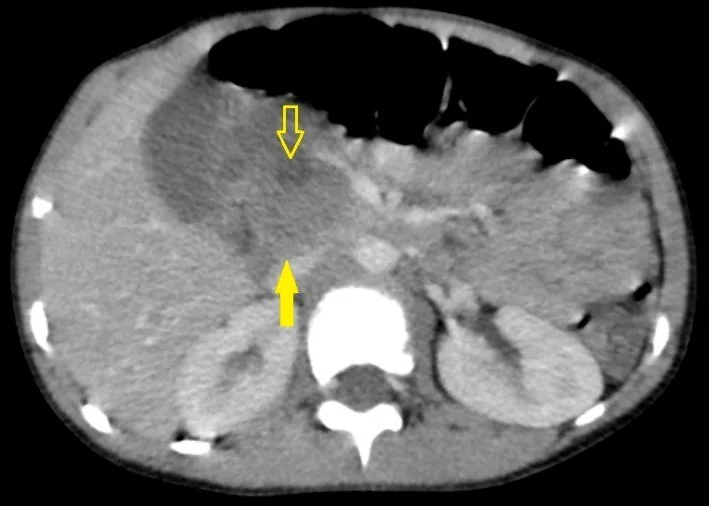
Bisiklet gidonu gibi epigastriuma doğrudan darbe alan çocukta pankreas omurgaya sıkışarak yaralanabilir. Kontrastlı BT parankim kontüzyonunu, laserasyonu ve çevresindeki sıvıyı gösterir; ancak ana pankreas kanalının bütünlüğünü her olguda kesinleştiremez. Retroperitoneal konum ve erken dönemde silik bulgular nedeniyle ilk görüntüleme tanısal olmayabilir. Kanal hasarının atlanması, ilerleyen dönemde pankreatik sıvı koleksiyonu, fistül veya psödokist gelişimini fark etmeyi geciktirebilir.
Faz ve pencere
- Portal tanısal
- Normal kontrastlanan pankreas içinde kontüzyon yamalı hipoenhansman; laserasyon gövde veya boyun boyunca uzanan çizgisel parankim kesintisi olarak görünür. Küçük peripankreatik sıvı, omental bursa ve ön pararenal alanda izlenebilir.
- Arteriyel tanısal
- Eşlik eden splenik arter, gastroduodenal arter veya çevre damar yaralanması ve aktif kanama araştırılır; pankreas kanal bütünlüğünü göstermede tek başına yeterli değildir.
Önerilen pencereler: Batın (G 400 / M 50), Anjiyo (G 600 / M 150).
BT bulguları
- Pankreas kontüzyonu — parankimde odaksal veya yamalı kontrastlanma azalması; dış kontur korunabilir.
- Parankimal laserasyon — pankreası enine ya da oblik kesen hipodens hat; kanal hasarını düşündürse de BT'de kanal kesintisi her zaman seçilmez.
- Derin laserasyonlar, gövde veya boyun düzeyinde komşu segmentler arasında sıvı veya hematom nedeniyle ayrışma oluşturabilir.
- Peripankreatik hematom — pankreas çevresinde ve omental bursada yüksek dansiteli veya heterojen koleksiyon.
- Ön pararenal sıvı — pankreas arkasından sol veya sağ ön pararenal boşluğa uzanan sıvı şeridi.
- Travmatik pankreatik psödokist — takip görüntülerinde pankreas komşuluğunda gelişen, sınırlı sıvı koleksiyonu.
- Eşlik eden duodenum yaralanması — duvar kalınlaşması, intramural hematom veya komşu retroperitoneal hava/sıvı.
- BT'de ana pankreas kanalının doğrudan seçilememesi kanalın sağlam olduğunu kanıtlamaz; çocuklarda BT'nin ana kanal yaralanmasını saptama duyarlılığı görece düşüktür.
Ölçütler ve sınıflamalar
- AAST pankreas yaralanma ölçeği, 2024 revizyonu
- I: Kanal yaralanması olmayan kontüzyon veya hematom. II: kanal yaralanması olmayan tüm laserasyonlar. III: portal ven/SMV’nin solundaki kanal yaralanması (şüpheli, kısmi veya tam transeksiyon alt tipleriyle). IV: portal ven/SMV’nin sağındaki kanal yaralanması. V: Pankreas başında parankim bozunması (disruption) içeren destrüktif pankreas başı yaralanması. BT kanal bütünlüğünü her zaman belirleyemez.
Normalde
Normal pankreas gövdesi ve kuyruğu homojen kontrastlanır; lobüle dış konturu kesintisizdir ve ana kanal bez boyunca ince, düzenli izlenir. Aynı kesitte vertebra önündeki pankreas dokusunu karşılaştırın; parankim içinden geçen yarık, segmentlerin ayrılması ve omental bursa ya da ön pararenal boşlukta yeni sıvı olup olmadığını inceleyin.
Normal BT ile kıyasla
Aynı bölgenin, kaynak veri setinde patoloji içermediği belirtilen bir BT incelemesini kesit kesit kaydırın; organ sınırlarını açarak anatomiyi hasta görüntüsüyle karşılaştırın. Küçük rastlantısal bulgular tümüyle dışlanmamıştır.
Kaynak: TotalSegmentator v2.01 veri seti (Wasserthal ve ark., Radiology: Artificial Intelligence 2023), CC BY 4.0, vaka s0119; organ sınırları veri setinin otomatik segmentasyonundan, birleştirilerek sadeleştirildi. Görüntüler 2,5 mm kesit aralığına yeniden örneklendi.
Ayırıcı tanı
- Akut pankreatitte BT’de fokal veya diffüz pankreas parankim ödemi ve peripankreatik yağ dokusu kirlenmesi görülebilir.
- Duodenum intramural hematomu
- duvar içinde konsantrik kalınlaşma ve lümen daralması vardır; pankreas parankimi korunabilir.
- Peripankreatik duodenal hematom
- retroperitoneal hematom pankreası yer değiştirmiş gösterebilir; bez içindeki kontrastlanma ve kontur sürekliliğini takip edin.
Tuzaklar
- İlk BT'de pankreas normal göründüğünde klinik şüpheyi görüntüyle kapatma; erken incelemede ödem ve yarık belirsiz kalabilir, sonraki değerlendirmede yeni sıvı veya bez ayrışması gelişebilir.
- Pankreas yaralanması retroperitoneal konumu nedeniyle BT’de gözden kaçabilir veya yanlış yorumlanabilir; klinik şüphe sürüyorsa görüntüleri bu olasılığı göz önünde bulundurarak yeniden değerlendirin.
- Peripankreatik sıvının varlığını ana kanal rüptürünün kanıtı sayma; BT kanal bütünlüğünü her zaman göstermez, sınıflamada belirsizliği belirt.
- İzole pankreas hasarında komşu duodenum ve mezenter kökünü atlama; retroperitoneal hava ve bağırsak duvarı bulguları eşlik eden yaralanmayı gösterebilir.
Kendini dene
Epigastrik darbe sonrası pankreas gövdesinde laserasyon ve ön pararenal sıvı görülüyor. Yaralanmanın yönetimini belirlemede en kritik yapı hangisidir?
Cevabı göster
Ana pankreas kanalı bütünlüğü. Ana pankreas kanalı yaralanmasının varlığı, pankreas travmasında yönetim kararlarını etkileyen önemli bir bulgudur. BT kanal bütünlüğünü her zaman gösteremez; ek kanal değerlendirmesinin gerekliliği klinik ve uzman ekip değerlendirmesiyle belirlenir.
İlk BT’de pankreas yaralanması belirgin olmayabilir; takip görüntülemesinde peripankreatik sıvı koleksiyonu ortaya çıkabilir. Bu tablo en çok neyi düşündürür?
Cevabı göster
Başlangıçta gözden kaçmış pankreas yaralanmasını. Pankreasın retroperitoneal konumu nedeniyle yaralanmalar başlangıçta gözden kaçabilir. İlk BT’de pankreas yaralanması belirgin olmayabilir; takipte yeni bir peripankreatik koleksiyon görülmesi pankreas yaralanması olasılığını destekleyen bir bulgudur.
Kaynaklar
Bu sayfadaki 44 cümle ve 2 quiz sorusu aşağıdaki kaynaklardan alıntılarla otomatik olarak karşılaştırıldı; 11 cümle bu karşılaştırmada düzeltildi (2026-10-09).
- Management of Blunt Pancreatic Trauma in Children: A Persistent Controversy—Case Report and Comprehensive Literature Reviewpmc.ncbi.nlm.nih.gov
- Pancreatic stent and transpapillary pseudocyst drainage via endoscopic retrograde cholangiopancreatography for children with blunt pancreatic duct injurypmc.ncbi.nlm.nih.gov
- Evaluation of Pediatric Patients with Blunt Abdominal Trauma: A Systematic Review, Meta-Analysis, and Practice Management Recommendationspmc.ncbi.nlm.nih.gov
- Pediatric blunt duodenal injury: a 9-year retrospective single-center series from Vietnampmc.ncbi.nlm.nih.gov
- A modified stent-free Chen's U-suture technique in pediatric pancreaticojejunostomy: safety and efficacypmc.ncbi.nlm.nih.gov
- Management of Blunt Pancreatic Trauma in Children: A Persistent Controversy-Case Report and Comprehensive Literature Review.pubmed.ncbi.nlm.nih.gov
- Image-guided prediction of pseudocyst formation in pediatric pancreatic trauma.pubmed.ncbi.nlm.nih.gov
- High-grade pancreatic trauma in pediatric patients: two cases of successful non-operative management.pubmed.ncbi.nlm.nih.gov
- Pediatric pancreatic trauma: trending toward nonoperative management?pubmed.ncbi.nlm.nih.gov
- Pediatric pancreatic trauma: a 10-year retrospective analysis from two high-complexity centers in Medellín, Colombia.pubmed.ncbi.nlm.nih.gov
- Isolated Blunt Pancreatic Head Injury with Evolving Acute Peripancreatic Fluid Collection in a Child Successfully Managed Conservatively.pubmed.ncbi.nlm.nih.gov
- Pediatric Abdominal Trauma.pubmed.ncbi.nlm.nih.gov
- CT Findings of Pediatric Handlebar Injuries.pubmed.ncbi.nlm.nih.gov
- PECARN prediction rules for CT imaging of children presenting to the emergency department with blunt abdominal or minor head trauma: a multicentre prospective validation study.pubmed.ncbi.nlm.nih.gov
- Contrast-enhanced ultrasound of blunt abdominal trauma in children.pubmed.ncbi.nlm.nih.gov
- Contrast-Enhanced Ultrasound in Children: Implementation and Key Diagnostic Applications.pubmed.ncbi.nlm.nih.gov
- Contrast-enhanced ultrasound (CEUS) in blunt abdominal trauma.pubmed.ncbi.nlm.nih.gov
- Splenic Rupture Secondary to Vascular Ehlers-Danlos Syndrome Managed by Coil Embolization of the Splenic Artery.pubmed.ncbi.nlm.nih.gov
- Diagnostic imaging of blunt abdominal trauma in pediatric patients.pubmed.ncbi.nlm.nih.gov
- Pediatric Spigelian Hernia and Spigelian-Cryptorchidism Syndrome: An Integrative Review.pubmed.ncbi.nlm.nih.gov
- Traumatic pancreatic ductal injury treated by endoscopic stenting in a 9-year-old boy: A case report.pubmed.ncbi.nlm.nih.gov
- Delayed distal pancreatectomy for isolated complete pancreatic disruption secondary to "trivial" blunt abdominal injury: A case report and literature review.pubmed.ncbi.nlm.nih.gov
- A modified stent-free Chen's U-suture technique in pediatric pancreaticojejunostomy: safety and efficacy.pubmed.ncbi.nlm.nih.gov
- Presentation and Management of High-Grade Pancreatic Injuries: Case Series.pubmed.ncbi.nlm.nih.gov
- Isolated Parotitis Following a Cheek Slap: A Case Report and Clinical Implications.pubmed.ncbi.nlm.nih.gov
- Evaluation of Pediatric Patients with Blunt Abdominal Trauma: A Systematic Review, Meta-Analysis, and Practice Management Recommendations.pubmed.ncbi.nlm.nih.gov
- Contrast-enhanced ultrasound (CEUS) in urgent and emergent pediatric conditions: a comprehensive review.pubmed.ncbi.nlm.nih.gov
- Improving pediatric hip fracture detection using deep learning: multicenter validation and clinical reader study.pubmed.ncbi.nlm.nih.gov
- Surgical and functional outcomes of pediatric pancreatic solid pseudopapillary neoplasm: A retrospective study.pubmed.ncbi.nlm.nih.gov
- Case Report: Delayed diagnosis of pancreatic solid pseudopapillary neoplasm in a boy initially misdiagnosed as traumatic retroperitoneal hematoma.pubmed.ncbi.nlm.nih.gov
- Laparoscopic Distal Pancreatectomy for Pediatric Blunt Pancreatic Injury: A Case Series.pubmed.ncbi.nlm.nih.gov
- Left Hepatic Artery Pseudoaneurysm and Arteriobiliary Fistula in an Adolescent: A Case Report.pubmed.ncbi.nlm.nih.gov
- CT-Based Reference Values for Splenic Artery and Vein Diameters in Individuals Aged 1-80 Years.pubmed.ncbi.nlm.nih.gov
- Adult Hepatic Infarction for Internists: A Practical Diagnostic and Management Pathway to Avoid Misdiagnosis, Unnecessary Drainage, and Delayed Vascular Recognition.pubmed.ncbi.nlm.nih.gov
- Application and value of CT-based 3D surgical modeling in the robotic management of grade V pancreatic trauma and grade III duodenal injury: a case report and literature review.pubmed.ncbi.nlm.nih.gov
- International Society of Paediatric Surgical Oncology (IPSO) Minimally Invasive Surgery (MIS) Guidelines.pubmed.ncbi.nlm.nih.gov
- Medical hyperspectral imaging: an updated review of technology advancements and biomedical applications.pubmed.ncbi.nlm.nih.gov
- A Rare Pediatric Intraductal Papillary Mucinous Neoplasm Presenting as a Pancreatic Pseudocyst With Splenic Vein Thrombosis and Gastric Variceal Hemorrhage.pubmed.ncbi.nlm.nih.gov
- Pediatric blunt duodenal injury: a 9-year retrospective single-center series from Vietnam.pubmed.ncbi.nlm.nih.gov
- Case Report: Robotic-assisted laparoscopic primary repair for pancreaticoduodenal grade V injury in a pediatric patient.pubmed.ncbi.nlm.nih.gov
- Surgical techniques for modular one-stage emergent pancreaticoduodenectomy for blunt abdominal trauma: experiences from three centres and a review of the literature.pubmed.ncbi.nlm.nih.gov
- Surgical management of high-grade pancreatic injuries: Insights from a high-volume pancreaticobiliary specialty unit.pubmed.ncbi.nlm.nih.gov
- Early Enteral Nutrition and Surgical Outcomes After Repair of Penetrating Bowel Injuries: A Retrospective Cohort Study From the Yemeni Civil War.pubmed.ncbi.nlm.nih.gov
- Severe post-traumatic Pancreatoduodenal injury with septic shock and enteric fistula: A multidisciplinary challenge - Case report.pubmed.ncbi.nlm.nih.gov
- The Diagnosis and Management of Pediatric Blunt Abdominal Trauma-A Comprehensive Review.pubmed.ncbi.nlm.nih.gov
- Revolutionizing non-traumatic acute care: a review of the role of artificial intelligence and machine learning in triaging and diagnosis.pubmed.ncbi.nlm.nih.gov
- Guidelines on the Use of Therapeutic Apheresis in Clinical Practice-Evidence-Based Approach From the Writing Committee of the American Society for Apheresis: The Tenth Special Issue.pubmed.ncbi.nlm.nih.gov
- Spontaneous rectus sheath hematoma: Beyond hematoma size, volume, and treatment method - The dominant influence of comorbidity on prognosis and mortality: A single-center retrospective study.pubmed.ncbi.nlm.nih.gov
- Imaging diagnosis and sequential conservative treatment of pediatric traumatic duodenal intraluminal hematoma.pubmed.ncbi.nlm.nih.gov
- Duodenal Trauma: Mechanisms of Injury, Diagnosis, and Management.pubmed.ncbi.nlm.nih.gov
- Total intestinal obstruction due to traumatic submucosal jejunal hematoma: A case report.pubmed.ncbi.nlm.nih.gov
- Computed tomography of pediatric abdominal trauma: optimizing utilization and enhancing diagnostic interpretation.pubmed.ncbi.nlm.nih.gov
- Challenges in the Management of Pediatric Pancreatic Hydatid Disease: A Systematic Review of the Literature and Our Clinical Experience.pubmed.ncbi.nlm.nih.gov
- Computed tomography for pancreatic injuries in pediatric blunt abdominal trauma.pubmed.ncbi.nlm.nih.gov
- Turkish Society of Gastroenterology: Pancreas Working Group, Acute Pancreatitis Committee Consensus Report.pubmed.ncbi.nlm.nih.gov
- SHIP-MR and Radiology: 12 Years of Whole-Body Magnetic Resonance Imaging in a Single Center.pubmed.ncbi.nlm.nih.gov
- Long-term safety and effectiveness of the "OptEase" vena cava filter.pubmed.ncbi.nlm.nih.gov
- Intramural Hematoma of the Duodenum in a Four-Year-Old Child Following a Blunt Bicycle Handlebar Injury: A Case Report.pubmed.ncbi.nlm.nih.gov
- Noise-optimized virtual monoenergetic imaging technology of the third-generation dual-source computed tomography and its clinical applications.pubmed.ncbi.nlm.nih.gov
- Patterns of injury and violence in Yaoundé Cameroon: an analysis of hospital data.pubmed.ncbi.nlm.nih.gov
- Clinical Profile and Management of Children with Pancreatic Fluid Collections: A Retrospective Observational Study.pubmed.ncbi.nlm.nih.gov
- Imaging and clinical features of intra-abdominal injuries in children with suspected physical abuse.pubmed.ncbi.nlm.nih.gov
- Acute pancreatitis: mechanisms and therapeutic approaches.pubmed.ncbi.nlm.nih.gov
- Complete traumatic transection of the fourth portion of the duodenum after blunt abdominal trauma: a case report.pubmed.ncbi.nlm.nih.gov
- Evidence-based, cost-effective management of gastric outlet obstruction: An algorithm of the Journal of Trauma and Acute Care Surgery , Emergency General Surgery Algorithms Work Group.pubmed.ncbi.nlm.nih.gov
- State of abdominal CT datasets: A critical review of bias, clinical relevance, and real-world applicability.pubmed.ncbi.nlm.nih.gov
- Endoscopic management of biliary leaks: Where are we now?pubmed.ncbi.nlm.nih.gov
- Management of Pediatric Solid Organ Injuries.pubmed.ncbi.nlm.nih.gov
- Analysis of the efficacy and safety of conservative treatment of blunt abdominal trauma in children: retrospective study. Conservative treatment of blunt abdominal trauma in children.pubmed.ncbi.nlm.nih.gov
- Spontaneous bacteremia and spontaneous bacterial peritonitis share similar prognosis in patients with cirrhosis: a cohort study.pubmed.ncbi.nlm.nih.gov
- Proceedings of the 15th International Congress on Circumpolar Health.pubmed.ncbi.nlm.nih.gov
- Pancreatic stent and transpapillary pseudocyst drainage via endoscopic retrograde cholangiopancreatography for children with blunt pancreatic duct injury.pubmed.ncbi.nlm.nih.gov
- International Society of Paediatric Surgical Oncology (IPSO) Surgical Practice Guidelines.pubmed.ncbi.nlm.nih.gov
- Seeing the invisible: Three-dimensional liver modeling from simulation to the scalpel.pubmed.ncbi.nlm.nih.gov
- Construction and validation of a high-precision annotated dataset for developing intelligent critical vein recognition models in laparoscopic pancreatic surgery.pubmed.ncbi.nlm.nih.gov
- Integrated Radiology-Biochemistry Diagnostic Flow Framework for Emergency Clinical Decision Support: A Simulation-Based Educational Model.pubmed.ncbi.nlm.nih.gov
- Tracheobronchial injury after blunt thoracic trauma-lessons to learn in diagnosis, treatment, and postoperative care: a case series.pubmed.ncbi.nlm.nih.gov
- Imaging in polytrauma - Principles and current concepts.pubmed.ncbi.nlm.nih.gov
- Solid Pseudopapillary Neoplasm of the Pancreas in an Adolescent: An Uncommon Finding.pubmed.ncbi.nlm.nih.gov
- Illustrator-anatomist-clinician triad based pedagogical model in anatomy education: An auxiliary resource amidst lack of hands-on human dissection.pubmed.ncbi.nlm.nih.gov
- Extravertebral low back pain: a scoping review.pubmed.ncbi.nlm.nih.gov
- International Harmonization of Nomenclature and Diagnostic Criteria (INHAND): Nonproliferative and Proliferative Lesions of the Rabbit.pubmed.ncbi.nlm.nih.gov
- Multidetector CT Imaging Biomarkers as Predictors of Prognosis in Shock: Updates and Future Directions.pubmed.ncbi.nlm.nih.gov
- Duodenal imaging on the spotlight: from A to Z.pubmed.ncbi.nlm.nih.gov
- The Pancreas in Child Abuse.pubmed.ncbi.nlm.nih.gov
- Rhinosinusitis: Evidence and experience - 2024.pubmed.ncbi.nlm.nih.gov
- Duodeno-pancreatic and extrahepatic biliary tree trauma: WSES-AAST guidelines.pubmed.ncbi.nlm.nih.gov
- Acute and Recurrent Pancreatitis in Children: Insights into Etiology and Clinical Course from a Retrospective Single-Center Study.pubmed.ncbi.nlm.nih.gov
- Echo-endoscopic drainage of retrogastric pancreatic pseudocysts as a bridge-to-surgery for complicated cases of duodenal duplication cyst: case report.pubmed.ncbi.nlm.nih.gov
- Genotype-Phenotype Correlations in Pediatric Hereditary Pancreatitis: Evidence from a Romanian Retrospective Cohort.pubmed.ncbi.nlm.nih.gov
- Common cystic pancreatic neoplasms: A comprehensive magnetic resonance imaging-based review of typical and atypical imaging features.pubmed.ncbi.nlm.nih.gov
- Expanding Role of Contrast-Enhanced Ultrasound and Elastography in the Evaluation of Abdominal Pathologies in Children.pubmed.ncbi.nlm.nih.gov
- Apoptotic cell death in disease-Current understanding of the NCCD 2023.pubmed.ncbi.nlm.nih.gov
- Complications after Nephron-sparing Interventions for Renal Tumors: Imaging Findings and Management.pubmed.ncbi.nlm.nih.gov
- Radiologic evaluation of the kidney transplant donor and recipient.pubmed.ncbi.nlm.nih.gov
- PSC-DM: A Validated Clinical Diagnostic Model for Distinguishing Primary From Secondary Sclerosing Cholangitis.pubmed.ncbi.nlm.nih.gov
- Human biomarker navigator.pubmed.ncbi.nlm.nih.gov
- The Immune Checkpoint Inhibitors Journey: From Early Promise to Lasting Impact.pubmed.ncbi.nlm.nih.gov
- Indications for abdominal imaging: When and what to choose?pubmed.ncbi.nlm.nih.gov
- CT of Penetrating Abdominopelvic Trauma.pubmed.ncbi.nlm.nih.gov
- Noninvasive Imaging Prior to Biliary Interventions.pubmed.ncbi.nlm.nih.gov
- Guidelines for Enhanced Recovery After Trauma and Intensive Care (ERATIC): Enhanced Recovery After Surgery (ERAS) and International Association for Trauma Surgery and Intensive Care (IATSIC) Society Recommendations: Paper 2: Postoperative and Intensive Care Recommendations.pubmed.ncbi.nlm.nih.gov
- Usefulness of Endoscopic Retrograde Cholangiopancreatography in the Diagnosis and Treatment of Traumatic Pancreatic Injury in Children.pubmed.ncbi.nlm.nih.gov
- Endoscopic Retrograde Cholangio-Pancreatography and Endoscopic Ultrasound in the Management of Paediatric Acute Recurrent Pancreatitis and Chronic Pancreatitis.pubmed.ncbi.nlm.nih.gov
- Minimally invasive surgery of the pancreas: a narrative review of current practice.pubmed.ncbi.nlm.nih.gov
- Assessing Pancreatic Enhancement Variability in ICU Patients with CT Hypoperfusion Complex: A Retrospective Single-Center Study.pubmed.ncbi.nlm.nih.gov
Eğitim amaçlıdır; hasta başında tanı ve tedavi kararının yerine geçmez, tıbbi tavsiye değildir. Metinler yapay zekâ desteğiyle yazıldı ve otomatik bir adımda kaynak alıntılarıyla karşılaştırıldı; bu bir tıbbi doğrulama değildir ve içerik uzman radyolog incelemesinden geçmedi. Klinik kararlarda güncel kılavuzları, kurum protokollerini ve radyoloji raporunu esas alın.