Özet
Hemodinamik olarak stabil hastada kontrastlı BT penetran yaralanmayı değerlendirmede tercih edilen yöntemdir; BT ve BT anjiyografi yara yolunu göstererek hasarlı organların belirlenmesine yardımcı olur. Giriş ve çıkış yaraları belirlendikten sonra kesit düzlemleri çift oblik çevrilerek yara yolu profilde görüntülenir; mermi yolunun her zaman düz olduğu varsayılmaz. Mermi fragmanlarına bağlı ışın sertleşmesi artefaktı, özellikle komşu damarların görüntülenmesini zorlaştırabilir. Barsak veya mezenter yaralanmasında gecikmiş tanı ve tedavi artmış morbidite ve mortalite ile ilişkilidir.
Faz ve pencere
- Portal tanısal
- Kontrastlı BT ve çok fazlı incelemede barsak duvarı ve mezenter değerlendirilir; aktif ekstravazasyon aranır ve arteriyel ya da venöz kökeni farklı kontrast fazlarındaki atenüasyon değişimiyle ayırt edilmeye çalışılır.
- Arteriyel tanısal
- Arter yaralanması şüphesinde BT anjiyografide damar lümenine uzanan intimal flep, psödoanevrizma ve damar dışına kontrast ekstravazasyonu gibi bulgular aranır.
Önerilen pencereler G genişlik, M merkez; değerler Hounsfield birimi (HU)
- BatınG 400 / M +50
- AnjiyoG 600 / M +150
- Yumuşak dokuG 400 / M +40
- KemikG 1800 / M +400
BT bulguları
- Giriş ve çıkış yaraları belirlendikten sonra kesit düzlemleri çift oblik çevrilerek yara yolu profilde izlenir.
- Mermi yolu her zaman düz olmadığı için yara yolu ardışık kesitlerde izlenerek takip edilir.
- Traktın uzağında bir damar içinde görülen mermi fragmanı, mermi embolizasyonunu düşündürür.
- Barsak duvarı kesintisi — mermi yoluna bitişik fokal duvar defekti, duvar kalınlaşması veya anormal kontrastlanma ve çevre yağ dokusunda kirlenme.
- Mezenterik arter dalı yaralanmasında BT anjiyografide aktif kontrast ekstravazasyonu ve mezenterik defekt görülebilir.
- Kalan mermi fragmanlarına bağlı ışın sertleşmesi artefaktı damarların değerlendirilmesini zorlaştırabilir.
Normalde
Normal kontrastlı BT'de yara yolu izlenmez ve barsak duvarında devamlılık kaybı, duvar kalınlaşması, anormal kontrastlanma, çevresel yağda kirlenme veya serbest sıvı gibi perforasyon bulguları görülmez. Yaralı tarafı karşı taraf ve komşu anslarla kıyaslarken, yalnız mermi merkezini değil, olası yolun yakınındaki duvar kalınlığı, kontrastlanma ve mezenterik yağ planlarını da karşılaştırın.
Normal BT ile kıyasla
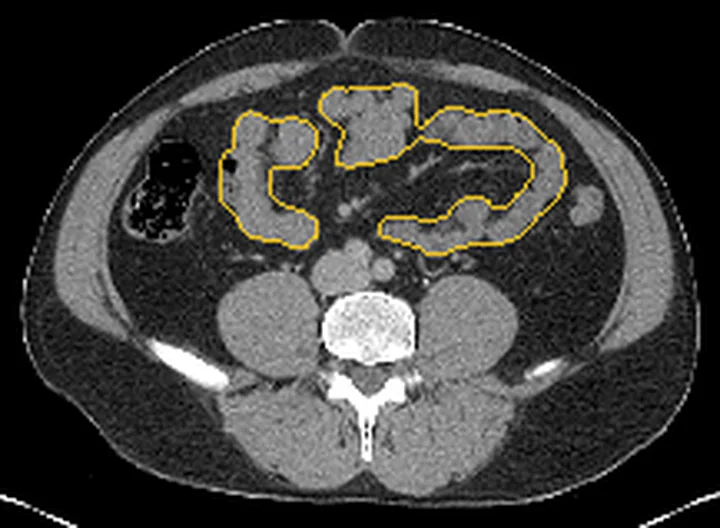
Aynı bölgenin, kaynak veri setinde patoloji içermediği belirtilen bir BT incelemesini kesit kesit kaydırın; organ sınırlarını açarak anatomiyi hasta görüntüsüyle karşılaştırın. Küçük rastlantısal bulgular tümüyle dışlanmamıştır.
Kaynak: TotalSegmentator v2.01 veri seti (Wasserthal ve ark., Radiology: Artificial Intelligence 2023), CC BY 4.0, vaka s0119; organ sınırları veri setinin otomatik segmentasyonundan, birleştirilerek sadeleştirildi. Görüntüler 2,5 mm kesit aralığına yeniden örneklendi.
Ayırıcı tanı
- Bıçak yarası traktı
- bıçak yaraları, ateşli silah yaralanmaları gibi penetran abdominopelvik travmaya yol açabilir.
- Künt mezenter yaralanmasında BT'de mezenterik hematom ve serbest sıvı gibi özgül olmayan bulgular görülebilir.
- İyatrojenik girişim yolu
- görüntülemede biyopsi iğnesinin hedef dokuya girdiği izlenebilir.
- Mermi embolizasyonu
- bir metalik cisim beklenen traktın dışında damar lümeninde görülür; damar boyunca uzak yerleşim ve eşlik eden giriş yarası araştırılır.
Tuzaklar
- Giriş ve çıkış yaralarını birleştiren düz çizgiyi gerçek trakt kabul etmeyin; mermi yolu her zaman düz olmayabileceğinden kesitlerdeki gerçek yara yolunu izleyin.
- Trakt barsak ansına değmese de trajektoriye dik radyal enerji aktarımı komşu dokuda kontüzyona yol açabilir; trakt yakınındaki duvar hasarını değerlendirin.
- Mermi artefaktını karanlık alan veya damar duvarı defekti sanma; aynı dokuyu ortogonal ve komşu kesitlerde izleyip metalin oluşturduğu çizgilenme ile anatomik devamlılığı ayır.
- Toraks, abdomen ve pelvis görüntüleri mevcutsa mermi yolunu yalnız giriş ve çıkış noktalarını birleştiren düz çizgiyle belirlemeyin; çift oblik rekonstrüksiyonla yara yolunu profilde izleyip komşu yapıları değerlendirin.
Kendini dene
Karın ateşli silah yaralanmasında çift oblik yara yolu ileum ansına dayanıyor; duvarda fokal kesinti var. Bu duvar bulgusunu en iyi açıklayan yaralanma hangisidir?
Cevabı göster
İleum perforasyonu. Yola bitişik ileum duvarında görünür kesinti barsak yaralanmasını destekler; embolizasyon damar lümeninde trakt dışı uzak fragman gerektirir.
Yaralı cilt noktalarını birleştiren çizgi duodenumdan geçmiyor; duodenum yanında yol ve duvar kalınlaşması görülüyor. Hangi yorum uygundur?
Cevabı göster
Duodenum kontüzyonu. Cilt noktalarını birleştiren geometrik çizgi gerçek mermi yolunu garanti etmez; kesitlerdeki traktın hemen yanındaki fokal duvar kalınlaşması duodenum yaralanmasını düşündürür. Embolizasyonda merminin dinlenme yeri giriş trajektorisiyle uyuşmaz ve damar lümeni içinde uzak metalik fragman görülür.
Kaynaklar
Bu sayfadaki 35 cümle ve 2 quiz sorusu aşağıdaki kaynaklardan alıntılarla otomatik olarak karşılaştırıldı; 17 cümle bu karşılaştırmada düzeltildi (2026-10-12).
- Imaging of penetrating vascular trauma of the body and extremities secondary to ballistic and stab woundspmc.ncbi.nlm.nih.gov
- CT of Penetrating Abdominopelvic Trauma.pubmed.ncbi.nlm.nih.gov
- Multimodal Imaging of a Post-Traumatic Cervical Arteriovenous Fistula with Concomitant Pseudoaneurysm After a Gunshot Wound Treated with a Covered Stent-Graft.pubmed.ncbi.nlm.nih.gov
- Ballistic fragment embolism to superior mesenteric artery after the shrapnel injury to the chest: a case report of casualty from Russia-Ukraine war.pubmed.ncbi.nlm.nih.gov
- Staged limb salvage of a Gustilo-Anderson type IIIC open distal tibial gunshot fracture using cross-leg pedicle flap and delayed intramedullary nailing with bone grafting: a case report.pubmed.ncbi.nlm.nih.gov
- A Diagnostic Algorithm for Reconstructing the Direction of Gunshots Using OsiriX and Maya in Living Patients: A Forensic Radiology Approach.pubmed.ncbi.nlm.nih.gov
- Bullet trajectory detection in the lung: Multiplanar reformatted imaging of multidetector computed tomography in children.pubmed.ncbi.nlm.nih.gov
- Spectral Computed Tomography Angiography in Visceral Artery Aneurysms: Technical Principles and Clinical Applications.pubmed.ncbi.nlm.nih.gov
- Intestinal perforation secondary to ingested chicken bone: case report and literature review.pubmed.ncbi.nlm.nih.gov
- Novel High-Atomic-Number Element and Nanoparticle-Based CT Contrast Agents: Advanced Design Strategies and Clinical Translational Barriers.pubmed.ncbi.nlm.nih.gov
- Early Enteral Nutrition and Surgical Outcomes After Repair of Penetrating Bowel Injuries: A Retrospective Cohort Study From the Yemeni Civil War.pubmed.ncbi.nlm.nih.gov
- Operative Versus Selective Non-operative Management in Adult Penetrating Abdominal Trauma With Bowel or Omental Evisceration: A Systematic Review and Meta-Analysis.pubmed.ncbi.nlm.nih.gov
- Minimally invasive management of penetrating thoracic and abdominal injuries: a case series.pubmed.ncbi.nlm.nih.gov
- From congenital variants to critical clues: A radiologic review of inferior vena cava pathologies.pubmed.ncbi.nlm.nih.gov
- Imaging of penetrating vascular trauma of the body and extremities secondary to ballistic and stab wounds.pubmed.ncbi.nlm.nih.gov
- Hepatic Arterioportal Fistula Following Liver Trauma: Case Series and Review of the Literature.pubmed.ncbi.nlm.nih.gov
- Visceral artery aneurysms: a literature review of etiology, natural history, diagnosis and treatment paradigms.pubmed.ncbi.nlm.nih.gov
- Traumatic superior mesenteric artery pseudoaneurysm complicated by high-output arteriovenous fistula.pubmed.ncbi.nlm.nih.gov
- Hemosuccus Pancreaticus from Large Inferior Pancreaticoduodenal Artery Pseudoaneurysm Complicating Chronic Pancreatitis.pubmed.ncbi.nlm.nih.gov
- Ricochet Penetrating Head Injury: A Case Report and Brief Review of the Literature.pubmed.ncbi.nlm.nih.gov
- Cauda equina syndrome caused by intradural migration of a bullet: A rare case presentation.pubmed.ncbi.nlm.nih.gov
- Few incidentally found interesting foreign objects in human body: a case series.pubmed.ncbi.nlm.nih.gov
- Proceedings of the 15th International Congress on Circumpolar Health.pubmed.ncbi.nlm.nih.gov
- Cause of Death in Charred Bodies: Reflections and Operational Insights Based on a Large Cases Study.pubmed.ncbi.nlm.nih.gov
- Does preliminary optimisation of an anatomically correct skull-brain model using simple simulants produce clinically realistic ballistic injury fracture patterns?pubmed.ncbi.nlm.nih.gov
- Battlefield radiology.pubmed.ncbi.nlm.nih.gov
- Innovative approaches in precision radiation oncology: advanced imaging technologies and challenges which shape the future of radiation therapy.pubmed.ncbi.nlm.nih.gov
- Gastrointestinal perforation: clinical and MDCT clues for identification of aetiology.pubmed.ncbi.nlm.nih.gov
- International Society of Paediatric Surgical Oncology (IPSO) Surgical Practice Guidelines.pubmed.ncbi.nlm.nih.gov
- Cholecystogastric fistula masquerading as gastrointestinal stromal tumour: Unusual presentation of gallbladder adenomyomatosis - a case report.pubmed.ncbi.nlm.nih.gov
- Appendiceal abscess: pathologic definitions and a diagnostic framework-SIRC/SICUT consensus.pubmed.ncbi.nlm.nih.gov
- Iatrogenic vesicocolic fistula after gynecologic surgery: a case report.pubmed.ncbi.nlm.nih.gov
- Multidisciplinary management of acute type A aortic dissection presenting with atypical symptoms, abdominal hemorrhage, and Rh-negative blood type: a case report.pubmed.ncbi.nlm.nih.gov
- Progressive seatbelt-related intramammary hematoma requiring surgical evacuation in an obese female: a case report.pubmed.ncbi.nlm.nih.gov
- High-Velocity Drag Racing Collision Leading to Rare Superior Mesenteric Branch Injury: A Case Report.pubmed.ncbi.nlm.nih.gov
- Acute Traumatic Aortic Injury: What the Radiologist Needs to Know.pubmed.ncbi.nlm.nih.gov
- Photoacoustic Imaging for Liver Disease: The Systems and the Molecules.pubmed.ncbi.nlm.nih.gov
- Vessel-targeted compensation of deformable motion in interventional cone-beam CT.pubmed.ncbi.nlm.nih.gov
- Case Report: Vascular abdominal pain in systemic sclerosis-chronic mesenteric ischemia from high-grade superior mesenteric artery stenosis with coexisting aortomesenteric narrowing.pubmed.ncbi.nlm.nih.gov
- Mesenteric Panniculitis and the Gut-Mesentery-Metabolic Axis: A Hypothesis-Generating Narrative Review.pubmed.ncbi.nlm.nih.gov
- An unusual superior mesenteric arteriovenous malformation causing obscure gastrointestinal bleeding: a case report.pubmed.ncbi.nlm.nih.gov
- Computed Tomography Accuracy for Prediction of Adrenal Tumor Adhesion With Organs and Vessels in Dogs and Cats.pubmed.ncbi.nlm.nih.gov
- A framework of biomarkers for adipose tissue aging: a consensus statement by the Aging Biomarker Consortium.pubmed.ncbi.nlm.nih.gov
- Retrocolic Fascia-An Anatomical and Multidetector Computed Tomographic Angiography (MDCTA) Morphometric Analysis in Patients with Right Colon Cancer.pubmed.ncbi.nlm.nih.gov
- The current state of forensic imaging - post mortem imaging.pubmed.ncbi.nlm.nih.gov
- Conservatively Managed Grade V Blunt Renal Injury.pubmed.ncbi.nlm.nih.gov
- Neuroimaging for neurovascular complications of traumatic brain injury.pubmed.ncbi.nlm.nih.gov
- Early Sodium Dynamics in Severely Injured Patients with Intestinal Perforations: A Multicenter Analysis.pubmed.ncbi.nlm.nih.gov
- Presentation and Management of High-Grade Pancreatic Injuries: Case Series.pubmed.ncbi.nlm.nih.gov
- Clinical Characteristics and In-Hospital Outcomes of Traumatic Bladder Rupture: An 11-Year Retrospective Cohort Study at a Single Regional Trauma Center.pubmed.ncbi.nlm.nih.gov
- Clinical Implications of Anatomical Variations in Nerves and Adjacent Structures for Regional Anesthesia: A Narrative Review.pubmed.ncbi.nlm.nih.gov
- Beyond Cartilage Regeneration: Targeting the Subchondral Bone with Extracorporeal Shock Wave Therapy and Regenerative Medicine in Knee Osteoarthritis.pubmed.ncbi.nlm.nih.gov
- Design and characterization of in situ cell-penetrating multi-modal gadolinium-gold nanoparticles for MR and CT imaging.pubmed.ncbi.nlm.nih.gov
- Delayed inferior vena cava-to-right ventricle bullet embolism following abdominal gunshot injury in somalia: a case report.pubmed.ncbi.nlm.nih.gov
- A shrapnel migration from a peripheral vein to the right ventricle: case report.pubmed.ncbi.nlm.nih.gov
- Inferior Wall Myocardial Infarction Due to Shotgun Pellet Embolization.pubmed.ncbi.nlm.nih.gov
- Animal Models of Traumatic Brain Injury and Their Relevance in Clinical Settings.pubmed.ncbi.nlm.nih.gov
- An Experimental Study on 3D-Printed Gyroid-Shaped TC4 Porous Scaffolds Guiding Angiogenesis and Osteogenesis in Bone Defect Areas.pubmed.ncbi.nlm.nih.gov
- Dual-energy computed tomography in children: Technique and clinical applications.pubmed.ncbi.nlm.nih.gov
- Does laparoscopic surgery decrease the risk of atrial fibrillation after foregut surgery?pubmed.ncbi.nlm.nih.gov
- Effect of blending Jersey and Holstein-Friesian milk on Cheddar cheese processing, composition, and quality.pubmed.ncbi.nlm.nih.gov
- Commentary: an eye on PET quantification.pubmed.ncbi.nlm.nih.gov
- Targeted Alpha Therapy as a Multiscale Design Problem: From Radioactive Decay to Therapeutic Outcome.pubmed.ncbi.nlm.nih.gov
- Engineering biopolymer nanoparticles for targeted nanomedicine in cancer therapy and food preservation.pubmed.ncbi.nlm.nih.gov
- A System to Track Stent Location in the Human Body by Fusing Magnetometer and Accelerometer Measurements.pubmed.ncbi.nlm.nih.gov
- Roles of Trauma CT and CTA in Salvaging the Threatened or Mangled Extremity.pubmed.ncbi.nlm.nih.gov
- The clinical applications of dual-layer spectral detector CT in digestive system diseases.pubmed.ncbi.nlm.nih.gov
- Acalculous cholecystitis- an imaging and therapeutic update.pubmed.ncbi.nlm.nih.gov
- Nanoparticle Contrast Agents for Photon-Counting Computed Tomography: Recent Developments and Future Opportunities.pubmed.ncbi.nlm.nih.gov
- Surgical decision-making in paediatric penetrating trauma: case report from two paediatric tertiary centres.pubmed.ncbi.nlm.nih.gov
- The Interface of Trauma Surgery and Interventional Radiology: The Trauma Surgeon's Perspective.pubmed.ncbi.nlm.nih.gov
- "Beyond saving lives": Current perspectives of interventional radiology in trauma.pubmed.ncbi.nlm.nih.gov
- Fetal demise due to stab wound with umbilical cord transection: a case report.pubmed.ncbi.nlm.nih.gov
- Effectiveness of clinical examination and radiological investigations in the success of selective non-operative management of abdominal gunshot injuries.pubmed.ncbi.nlm.nih.gov
- Prolonged atriocaval shunt utilization as a damage control tool for the management of juxtarenal IVC injury with a multitude of complex abdominal injuries.pubmed.ncbi.nlm.nih.gov
- Duodenal Trauma: Mechanisms of Injury, Diagnosis, and Management.pubmed.ncbi.nlm.nih.gov
- Paediatric pancreatic trauma in North Queensland: a 10-year retrospective review.pubmed.ncbi.nlm.nih.gov
- Citation versus disruption in the military: Analysis of the top disruptive military trauma research publications.pubmed.ncbi.nlm.nih.gov
- Firearm injury to the left buttock with uterus penetrating trauma.pubmed.ncbi.nlm.nih.gov
- Gunshot vaginal trauma.pubmed.ncbi.nlm.nih.gov
- Contemporary Strategies in the Management of Civilian Abdominal Vascular Trauma.pubmed.ncbi.nlm.nih.gov
- Radiologic Imaging of Traumatic Bowel and Mesenteric Injuries: A Comprehensive Up-to-Date Review.pubmed.ncbi.nlm.nih.gov
- Surgical decision-making in self-inflicted, non-ballistic penetrating neck injuries: a single-center retrospective study.pubmed.ncbi.nlm.nih.gov
- Injuries from blank cartridge shots in suicide attempts within the South Korean military: a case series of five patients.pubmed.ncbi.nlm.nih.gov
- Selective non-operative management of traumatic liver injury in Palestine: a retrospective single-center cohort study.pubmed.ncbi.nlm.nih.gov
- Prognostic Factors of Mortality and Clinical Characteristics of Patients Surgically Treated for Blunt Liver Injury-A Single-Center Experience.pubmed.ncbi.nlm.nih.gov
- Patterns of injury and violence in Yaoundé Cameroon: an analysis of hospital data.pubmed.ncbi.nlm.nih.gov
- Complete recovery and resolution of neurological symptoms following a penetrating gunshot in the left frontal lobe: a case report.pubmed.ncbi.nlm.nih.gov
- Review on fiber composites for sustainable high strain rate applications.pubmed.ncbi.nlm.nih.gov
- Spatial Multiplexing and Omics.pubmed.ncbi.nlm.nih.gov
- Analysis of gunshot injuries to the different surfaces of the shaft of a porcine femur with various lead airgun pellets fired from a 6.35 mm calibre air rifle using a human thigh model.pubmed.ncbi.nlm.nih.gov
- Analysis of ballistic trajectories and its association with clinical outcomes in civilian penetrating brain injury.pubmed.ncbi.nlm.nih.gov
- Diagnostic Challenges in Uncommon Firearm Injury Cases: A Multidisciplinary Approach.pubmed.ncbi.nlm.nih.gov
- Guidelines for Essential Trauma Care: Second Edition (2026).pubmed.ncbi.nlm.nih.gov
- Severe celiac trunk stenosis following blunt trauma in a patient with diabetic ketoacidosis: a diagnostic dilemma of traumatic injury versus median arcuate ligament syndrome.pubmed.ncbi.nlm.nih.gov
- Surgically confirmed mesenteric avulsion following blunt abdominal trauma: a contemporary case series.pubmed.ncbi.nlm.nih.gov
- Duodenal Obstruction and Grade III Acute Cholangitis Following Pancreaticoduodenal Artery Aneurysm Rupture During Conservative Management of Acute Type B Aortic Dissection: A Case Report.pubmed.ncbi.nlm.nih.gov
- A Guide to Utilization of the Microbiology Laboratory for Diagnosis of Infectious Diseases: 2018 Update by the Infectious Diseases Society of America and the American Society for Microbiology.pubmed.ncbi.nlm.nih.gov
- On methodology and application of smoothed particle hydrodynamics in fluid, solid and biomechanics.pubmed.ncbi.nlm.nih.gov
- Analysis of gunshot damage to the porcine femur in a human thigh model using 5.5 mm airgun pellet: 3D reconstruction of gunshot injuries.pubmed.ncbi.nlm.nih.gov
- Autopsy findings in victims of gunshot injuries: wound ballistic considerations based on test shots to simulants and composite models.pubmed.ncbi.nlm.nih.gov
- Penetrating neck trauma: a comprehensive review.pubmed.ncbi.nlm.nih.gov
- Ultra-High-Velocity Penetration Performance of Lightweight W-Based Ceramic Alloy Rod Penetrator Against Concrete Targets.pubmed.ncbi.nlm.nih.gov
- HR-pQCT and 3D Printing for Forensic and Orthopaedic Analysis of Gunshot-Induced Bone Damage.pubmed.ncbi.nlm.nih.gov
- Imaging assessment of penetrating injury of the neck and face.pubmed.ncbi.nlm.nih.gov
- Management of penetrating brain injury.pubmed.ncbi.nlm.nih.gov
- Case report: Zone 3 gunshot wound to the left neck treated with combined Foley catheter balloon tamponade and interventional radiology stent placement.pubmed.ncbi.nlm.nih.gov
- The current state of forensic imaging- clinical forensic imaging.pubmed.ncbi.nlm.nih.gov
- Guidelines for Enhanced Recovery After Trauma and Intensive Care (ERATIC): Enhanced Recovery After Surgery (ERAS) Society and International Association of Trauma Surgery and Intensive Care (IATSIC) Recommendations: Paper 1: Initial Care-Pre and Intraoperative Care Until ICU, Including Non-Operative Management.pubmed.ncbi.nlm.nih.gov
- Best Practice Recommendations for Infertility Management.pubmed.ncbi.nlm.nih.gov
- Management and outcomes of blunt and penetrating traumatic aortic injuries in children.pubmed.ncbi.nlm.nih.gov
Eğitim amaçlıdır; hasta başında tanı ve tedavi kararının yerine geçmez, tıbbi tavsiye değildir. Metinler yapay zekâ desteğiyle yazıldı ve otomatik bir adımda kaynak alıntılarıyla karşılaştırıldı; bu bir tıbbi doğrulama değildir ve içerik uzman radyolog incelemesinden geçmedi. Klinik kararlarda güncel kılavuzları, kurum protokollerini ve radyoloji raporunu esas alın.