Özet
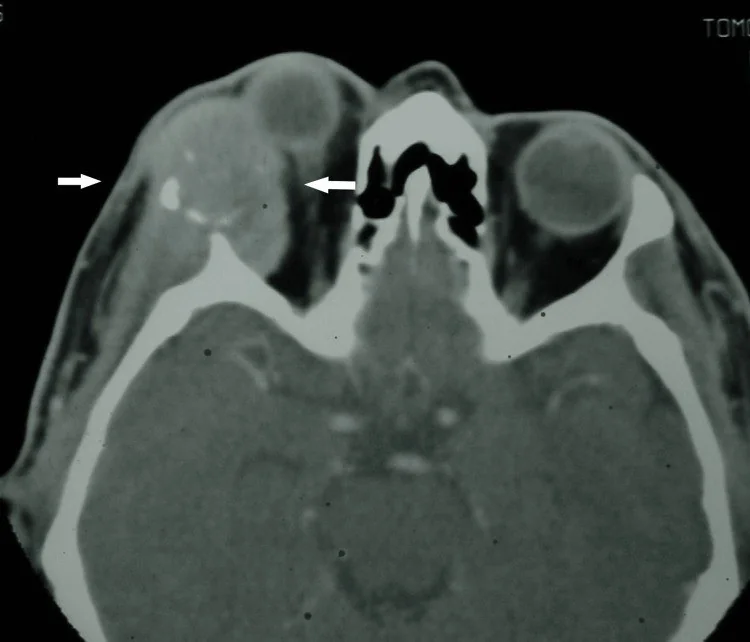
Tek taraflı bez belirginliği, normal anatomik farklılık veya inflamatuvar, lenfoid ve epitelyal hastalıkların görünümü olabilir. BT, bezin orbital ve palpebral loblarının devamlılığını, sınırlarını, kontrast sonrası boyanma paternini ve fossa ilişkisini birlikte değerlendirir; tek başına boyutsal farklılık tanısal değildir. Bez şeklinin korunması ve fossa sınırlarının bozulmaması düşük özgüllüklü asimetrinin yorumunda yardımcıdır. İnvaziv kitleyi ya da yayılımı gözden kaçırmak klinik değerlendirmeyi ve ileri görüntüleme gereksinimini geciktirebilir.
Faz ve pencere
- Kontrastsız
- Lakrimal bezlerin ekstraoküler kaslara göre dansitesi, iki taraflı şekli ve lakrimal fossadaki sınırları karşılaştırılır; kontrastsız BT tek başına doku karakterizasyonu sağlamaz.
- Gecikmiş tanısal
- Kontrast sonrası orbital yumuşak doku görüntülerinde bezlerin boyanma homojenliği ve simetrisi, orbital-palpebral lob devamlılığı ve çevre yağ planları değerlendirilir.
Önerilen pencereler: Yumuşak doku (G 400 / M 40), Kemik (G 1800 / M 400).
BT bulguları
- Lakrimal fossa içinde superolateral yerleşimli, badem biçimli bezin karşı tarafla hacim ve kontur kıyası
- Orbital lobun posterior-superior, palpebral lobun anterior-inferior uzanımının seçilebilir olması
- Tek taraflı büyümede oval konturun korunması veya lobüle/fokal kitleye dönüşmesi
- Kontrast sonrası iki bezde benzer yoğunlukta homojen boyanma ya da gerçek fokal/heterojen farklılık
- Lateral rektus ve üst rektusla temasın, kas içine uzanım olup olmadığının incelenmesi
- Lakrimal fossa korteksinde düzgün remodelleme ile destrüktif erozyon ayrımı
- Periglandüler yağda çizgilenme, infiltrasyon veya bez dışına taşan yumuşak doku
Normalde
Normal karşılaştırmada iki lakrimal bez frontal kemiğin superolateral fossalarında benzer badem biçimli kontur ve benzer hacimde izlenir. Aksiyel ve koronal kesitlerde ekstraoküler kaslarla dansite ilişkisini, lateral rektus komşuluğunu, orbital-palpebral lobların devamını ve kontrast sonrası boyanma simetrisini eş düzeyde kıyasla.
Ayırıcı tanı
- Akut dakrioadenit
- bez çevresinde yağ kirlenmesi ve bazen komşu yumuşak doku ödemi eşlik eder.
- Lenfoma
- BT veya MRI'da bez çevresindeki yapıları kavrayan (molding), homojen kontrastlanan ve genellikle iyi sınırlı bir lezyon oluşturur.
- Pleomorfik adenom
- çoğunlukla tek taraflı, iyi sınırlı kitle etkisi ve uzun sürede fossa remodelingi yapabilir.
- IgG4 ilişkili orbital hastalık
- bez büyümesine başka orbital yapılar veya infraorbital sinir tutulumu eşlik edebilir.
- Lakrimal bez karsinomu
- düzensiz sınır, komşu doku invazyonu ve kemik destrüksiyonu şüpheyi artırır.
Tuzaklar
- Hafif hacim farkını tek başına bez tümörü sayma; kontur, loblar, boyanma ve çevre planları birlikte tutarlı değilse asimetri özgül değildir.
- Asimetrik bilateral büyümeyi tek taraflı hastalık sanma; her iki bezin mutlak görünümünü ve eşlik eden orbital bulguları ayrıca incele.
- Lakrimal bezdeki boyutsal farklılıklar, yalnızca hacim kıyasına dayanılarak kitle tanısı koydurmaz; kontur, lob ilişkisi, kontrast boyanması ve komşu kemik ilişkisi gibi yapısal bulgularla birlikte değerlendirilmelidir.
Kendini dene
Kontrastlı BT'de bir bez hafif büyük; konturu korunmuş, boyanması homojen ve kemik sağlam. En doğru yorum?
Cevabı göster
Tek başına özgül olmayan asimetri. Kontur korunumu, homojen boyanma ve kemik hasarı olmaması yalnız boyut farkının tanısal olmadığını destekler. Lakrimal bez karsinomlarında genellikle düzensiz sınır, kemik yıkımı veya kas tutulumu gibi invaziv özellikler görülür; diğer seçenekler (variks, gliom) bu bez patolojileriyle uyumlu değildir.
Tek taraflı lakrimal kitlede düzensiz sınır ve fossa korteksinde yıkım görülüyor. Hangi tanı daha kaygı vericidir?
Cevabı göster
Lakrimal bez karsinomu. Düzensiz infiltratif sınır ve kemik destrüksiyonu lakrimal malignite şüphesini artırır. Normal varyasyonda kemik sağlamdır; diğer lezyonlar tipik olarak bu bez merkezli invazyon örüntüsünü göstermez.
Kaynaklar
Bu sayfadaki 37 cümle ve 2 quiz sorusu aşağıdaki kaynaklardan alıntılarla tek tek karşılaştırıldı; 4 cümle bu karşılaştırmada düzeltildi (2026-10-08).
- Orbital asymmetry degree: a potential 99m Tc-DTPA SPECT/CT imaging marker for diplopia in thyroid-associated ophthalmopathypmc.ncbi.nlm.nih.gov
- Mechanical Ptosis as the Initial Presentation of Eosinophilic Granulomatosis with Polyangiitispmc.ncbi.nlm.nih.gov
- SPECT/CT imaging in thyroid eye disease: an emerging role in assessing sub-clinical activitypmc.ncbi.nlm.nih.gov
- Non-Scar Fixation Technique for Zygomaticomaxillary Complex Tripod Fracture Using Upper Lid Transconjunctival Incisionpmc.ncbi.nlm.nih.gov
- Metastasis of Castration-Resistant Prostate Adenocarcinoma to the Lacrimal Gland: A Case Reportpmc.ncbi.nlm.nih.gov
- From post-war reconstruction to the twenty-first century - ophthalmic pathology in Freiburg 1945-2015. Part 2: review of 43,169 histological diagnoses from 39,256 specimens collected over 71 years at a large German tertiary eye care centre.pubmed.ncbi.nlm.nih.gov
- Rare Diseases of the Orbit.pubmed.ncbi.nlm.nih.gov
- Imaging features of lacrimal gland disease.pubmed.ncbi.nlm.nih.gov
- Clinical characteristics, management, and outcomes of lacrimal gland adenoid cystic carcinoma: a single-center series with contextual comparison to SEER data.pubmed.ncbi.nlm.nih.gov
- Blind spots in brain imaging: a pictorial essay.pubmed.ncbi.nlm.nih.gov
- Lateral transorbital neuroendoscopic approach using the superior eyelid incision: A straightforward, comprehensive, and illustrative step-by-step review.pubmed.ncbi.nlm.nih.gov
- Imaging for Pediatric Head and Neck Emergencies: Critical Insights.pubmed.ncbi.nlm.nih.gov
- Endoscopic Orbital and Periorbital Approaches in Minimally Disruptive Skull Base Surgery.pubmed.ncbi.nlm.nih.gov
- Resection of Liver Metastasis from Lacrimal Gland Adenoid Cystic Carcinoma: A Case Report and Review of the Literature.pubmed.ncbi.nlm.nih.gov
- Conjunctival Squamous Cell Carcinoma Masquerading as Orbital Cellulitis in a Patient With Relapsed Mixed Phenotype Acute Leukemia.pubmed.ncbi.nlm.nih.gov
- Adenoid Cystic Carcinoma of the Lacrimal Gland With Late Mandibular Metastasis Presenting as an Intraoral Mass: A Case Report and Literature Review.pubmed.ncbi.nlm.nih.gov
- Anatomical, histological and computed tomography comparisons of the eye and adnexa of crab-eating fox (Cerdocyon thous) to domestic dogs.pubmed.ncbi.nlm.nih.gov
- Magnetic resonance imaging of the orbit, Part 2: Characterization of orbital pathologies.pubmed.ncbi.nlm.nih.gov
- Spotlight on the pediatric eye: a pictorial review of orbital anatomy and congenital orbital pathologies.pubmed.ncbi.nlm.nih.gov
- Treatment and Survival Outcomes in Rhino-Orbital Mucormycosis with and without Orbital Exenteration: A Retrospective Case Series and Literature Review.pubmed.ncbi.nlm.nih.gov
- Reconstructive cranial surgery for invasive and non-responsive mucormycosis.pubmed.ncbi.nlm.nih.gov
- Surgical Anatomy in Orbital Fractures: A Surgeons Perspective.pubmed.ncbi.nlm.nih.gov
- Magnetic Resonance Imaging-Based Delineation of Organs at Risk in the Head and Neck Region.pubmed.ncbi.nlm.nih.gov
- Postoperative outcomes of biopsy versus debulking surgery for immunoglobulin G4-related ophthalmic disease: a retrospective comparative study.pubmed.ncbi.nlm.nih.gov
- Eyelid Malpositions and Ocular Surface Disease: Clinical Correlations and Management Strategies.pubmed.ncbi.nlm.nih.gov
- Magnetic resonance imaging findings in central nervous system tuberculosis: A pictorial review.pubmed.ncbi.nlm.nih.gov
- Evaluate the Differences in CT Features and Serum IgG4 Levels between Lymphoma and Immunoglobulin G4-Related Disease of the Orbit.pubmed.ncbi.nlm.nih.gov
- Bridging Preclinical and Clinical Gaps in Ocular Therapeutics: Hydrogel Drug Delivery and 3D Tissue Models.pubmed.ncbi.nlm.nih.gov
- Treatment planning comparison of focused very high energy electron and volumetric modulated arc therapy.pubmed.ncbi.nlm.nih.gov
- A rare case of lacrimal gland adenocarcinoma successfully treated with carbon ion radiotherapy.pubmed.ncbi.nlm.nih.gov
- Painful acute esotropia as a presenting sign of presumed post-infectious orbital myositis in a child: a case report.pubmed.ncbi.nlm.nih.gov
- Pediatric orbital IgG4-related disease: A case series.pubmed.ncbi.nlm.nih.gov
- Clinical and Radiologic Features Correlated with Eye-Sparing Surgery vs. Orbital Exenteration for Lacrimal Gland Adenoid Cystic Carcinoma.pubmed.ncbi.nlm.nih.gov
- Application of imaging studies for orbital tumors: a practical review and representative cases.pubmed.ncbi.nlm.nih.gov
- Orbital masses: a review of CT imaging characteristics.pubmed.ncbi.nlm.nih.gov
- Meibomian gland dropout in Sjögren's syndrome and non-Sjögren's dry eye patients.pubmed.ncbi.nlm.nih.gov
- Desmoplastic fibroblastoma presenting as a parotid tumour: a case report and review of the literature.pubmed.ncbi.nlm.nih.gov
- Guidelines for standard operation of imaging modalities in orbital diseases (2024).pubmed.ncbi.nlm.nih.gov
- Extracranial Extension of a Convexity Meningioma into the Temporal Fossa: A Rare Case Report and Literature Review.pubmed.ncbi.nlm.nih.gov
- Magnetic resonance imaging of the orbit, Part 1: Basic principles and radiological approach.pubmed.ncbi.nlm.nih.gov
- Orbital Myositis in Pediatric and Adult Patients: A Comparative Case Report and Review of the Literature.pubmed.ncbi.nlm.nih.gov
- Bilateral Idiopathic Dacryoadenitis in an Infant: A Case Report and Review of the Literature.pubmed.ncbi.nlm.nih.gov
- The application of ultrasonography in the differential diagnosis of orbital lesions.pubmed.ncbi.nlm.nih.gov
- Unilateral Orbital Lymphomas: A Structured Multidisciplinary Workflow for Diagnosis and Management.pubmed.ncbi.nlm.nih.gov
- Unusual progression of Rosai-Dorfman disease in a pediatric patient.pubmed.ncbi.nlm.nih.gov
- Atypical imaging characteristics in patients with epithelial tumors of lacrimal gland and impact on initial surgical planning.pubmed.ncbi.nlm.nih.gov
- Unmasking Orbital Myopathy: When Enlarged Extraocular Muscles Indicate More Than Thyroid Eye Disease: Report of Two Cases.pubmed.ncbi.nlm.nih.gov
- Clinical, CT, and MR Findings for the Pretreatment Diagnosis of Primary Epithelial Tumors of the Lacrimal Gland.pubmed.ncbi.nlm.nih.gov
- Clinicopathological Pearls and Diagnostic Pitfalls in IgG4-Related Disease: Challenging Case Series and Literature Review.pubmed.ncbi.nlm.nih.gov
- Mikulicz's disease and Küttner's tumor as manifestations of IgG4-related diseases: a review of the literature.pubmed.ncbi.nlm.nih.gov
- Cranial anatomy, palaeoneurology, palaeobiology and stratigraphic age of the large-bodied ornithopod, <i>Muttaburrasaurus langdoni</i> Bartholomai and Molnar, 1981, from the mid-Cretaceous of Australia.pubmed.ncbi.nlm.nih.gov
- A prospective study of cavernous sinus surgery for meningiomas and resultant common ophthalmic complications (an American Ophthalmological Society thesis).pubmed.ncbi.nlm.nih.gov
- A Simple and Cost-Effective Retractor for Transorbital Neurosurgery: Technical Note and Application in Lacrimal Keyhole Approaches.pubmed.ncbi.nlm.nih.gov
- Human cerebral arterial morphogenesis explored by 3D microscopic imaging of cleared embryos: Bridging the gap between embryonic and adult anatomy.pubmed.ncbi.nlm.nih.gov
- Cranio-Orbito-Zygomatic Approach.pubmed.ncbi.nlm.nih.gov
- Orbital computed tomography biomarkers for the assessment of activity of Thyroid Eye Disease.pubmed.ncbi.nlm.nih.gov
- Comparative treatment planning of photon, proton and carbon ion radiotherapy for sphenoid wing meningiomas.pubmed.ncbi.nlm.nih.gov
- Knowledge based automated planning for non-coplanar VMAT stereotactic radiosurgery in ocular malignancies.pubmed.ncbi.nlm.nih.gov
- Malignant Transformation of a Giant Solitary Trichoepithelioma With Extensive Craniofacial Invasion: An Unusual Case Report and Review of Literature.pubmed.ncbi.nlm.nih.gov
- Retinoblastoma and beyond: pediatric orbital mass lesions.pubmed.ncbi.nlm.nih.gov
- Clinical and microdissection genotyping analyses of the effect of intra-arterial cytoreductive chemotherapy in the treatment of lacrimal gland adenoid cystic carcinoma.pubmed.ncbi.nlm.nih.gov
- Autoimmune disease of head and neck, imaging, and clinical review.pubmed.ncbi.nlm.nih.gov
- Chronic Unilateral Proptosis in Primary Care: A Case of IgG4-Related Orbital Disease.pubmed.ncbi.nlm.nih.gov
- Imaging of adult ocular and orbital pathology--a pictorial review.pubmed.ncbi.nlm.nih.gov
- High-affinity alphavbeta3 integrin targeted optical probe as a new imaging biomarker for early atherosclerosis: initial studies in Watanabe rabbits.pubmed.ncbi.nlm.nih.gov
- Pheochromocytomas and Paragangliomas-Current Management.pubmed.ncbi.nlm.nih.gov
- Diaspora of oral maxillofacial pathology and dermatopathology-A review.pubmed.ncbi.nlm.nih.gov
- Chronic Sarcoidosis: Diagnostic Difficulties and Search for New Criteria of Inflammatory Activity (A Case Report and Literature Review).pubmed.ncbi.nlm.nih.gov
- Cardiac Masses and Pseudomasses: An Overview about Diagnostic Imaging and Clinical Background.pubmed.ncbi.nlm.nih.gov
- Collaborative Diagnostic Pathways for Unilateral Orbital Disease: A Clinicopathological Series.pubmed.ncbi.nlm.nih.gov
- Case Report: A rare case of over 45 years' survival in a patient with tonsillar adenoid cystic carcinoma.pubmed.ncbi.nlm.nih.gov
- Unilateral progressive painless proptosis: a case report of isolated orbital perineurioma with myxoid changes.pubmed.ncbi.nlm.nih.gov
- Adenoid cystic carcinoma of the lacrimal gland - A major review.pubmed.ncbi.nlm.nih.gov
- Adenoid cystic carcinoma of the parotid gland in a 27-year-old female patient: a case report.pubmed.ncbi.nlm.nih.gov
- International Harmonization of Nomenclature and Diagnostic Criteria (INHAND): Non-proliferative and Proliferative Lesions of the Non-human Primate ( M. fascicularis ).pubmed.ncbi.nlm.nih.gov
- Orbital asymmetry degree: a potential <sup>99m</sup>Tc-DTPA SPECT/CT imaging marker for diplopia in thyroid-associated ophthalmopathy.pubmed.ncbi.nlm.nih.gov
- Mechanical Ptosis as the Initial Presentation of Eosinophilic Granulomatosis with Polyangiitis.pubmed.ncbi.nlm.nih.gov
- SPECT/CT imaging in thyroid eye disease: an emerging role in assessing sub-clinical activity.pubmed.ncbi.nlm.nih.gov
- Head of the Syrian Hamster (<i>Mesocricetus auratus</i>): Planar Anatomy with Correlative Micro-Computed Tomography and Magnetic Resonance Imaging.pubmed.ncbi.nlm.nih.gov
- Autoimmune fibroinflammation in IgG4-related ophthalmic disease: TLR8-dependent signaling pathways and fibrotic remodeling revealed by proteomic profiling.pubmed.ncbi.nlm.nih.gov
- Imaging techniques in veterinary medicine . Part II: Computed tomography, magnetic resonance imaging, nuclear medicine.pubmed.ncbi.nlm.nih.gov
- Descriptive comparative morphology of the eye and ocular adnexa in Felidae: observations from a clouded leopard (Neofelis nebulosa), African lion (Panthera leo), and Pallas's cat (Otocolobus manul).pubmed.ncbi.nlm.nih.gov
- From inflammatory initiation to fibrotic remodeling: mechanisms and precision therapeutic strategies in otorhinolaryngologic involvement of IgG4-related disease.pubmed.ncbi.nlm.nih.gov
Eğitim amaçlıdır; hasta başında tanı ve tedavi kararının yerine geçmez. İçerik yapay zekâ destekli bir süreçle güncel literatüre göre cümle cümle kaynaklarla karşılaştırıldı, ancak uzman radyolog incelemesinden geçmedi. Klinik kararlarda güncel kılavuzları, kurum protokollerini ve radyoloji raporunu esas alın.