Özet
Nörofibromlar benign periferik sinir kılıfı tümörleridir; pleksiform nörofibromlar NF1 ile ilişkilidir ve orbital tutuluma eşlik eden göz kapağı şişliği, ekzoftalmi ve göz hareketlerinde kısıtlılık görülebilir. BT, orbital pleksiform nörofibromlarda sfenoid kanat displazisi ve orbital genişleme gibi kemik değişikliklerini değerlendirmede yararlıdır; lezyonun yumuşak doku ve sinir uzanımını tanımlamada MR daha üstündür. Orbital pleksiform nörofibrom varlığı NF1 için tanısal kabul edilir. Hızlı büyüme, yeni veya artan ağrı ya da nörolojik kötüleşme malign periferik sinir kılıfı tümörü açısından acil yeniden değerlendirmeyi gerektirir; orbital kitle globu veya optik siniri yer değiştirebilir.
Faz ve pencere
- Kontrastsız
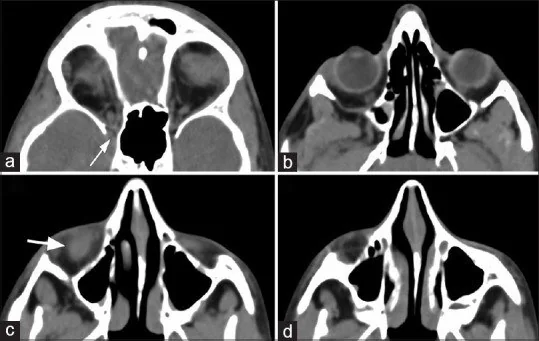
- Kontrastsız BT’de izole orbital nörofibrom ekstraoküler kaslara benzer yoğunlukta görülebilir; orbital pleksiform nörofibromda sfenoid kanat displazisi ve orbital duvar değişiklikleri de değerlendirilebilir.
- Kontrastlı tanısal
- BT’de nörofibromlar düzensiz dansiteli olabilir; pleksiform nörofibromda sinir boyunca kıvrımlı ve diffüz büyüme görülebilir.
Önerilen pencereler G genişlik, M merkez; değerler Hounsfield birimi (HU)
- Yumuşak dokuG 400 / M +40
- KemikG 1800 / M +400
BT bulguları
- Orbital nörofibromlar düzenli morfoloji ve heterojen dansite gösterebilir.
- Pleksiform nörofibrom, birden fazla sinir dalı boyunca diffüz ve infiltratif büyüme gösterebilir.
- Orbital pleksiform nörofibromda BT’de göz kapağı kalınlaşması ve periorbital yumuşak doku kalınlaşması görülebilir.
- BT'de orbital nörofibromlar heterojen dansite gösterebilir.
- Orbital nörofibrom olgularında genişlemiş inferior orbital fissür ve daha az belirgin genişlemiş superior orbital fissür bildirilebilir; sfenoid kanat displazisi eşlik edebilir.
- Orbital-periorbital pleksiform nörofibromda etkilenen tarafta orbital displazi ve orbital genişleme görülebilir.
- Orbital pleksiform nörofibromda ekzoftalmi ve glob yer değiştirmesi görülebilir; kitle optik siniri yer değiştirebilir.
- Pleksiform nörofibrom kesitsel görüntülemede serpijinöz yumuşak doku kitlesi şeklinde geniş alanlara uzanabilir; MR lezyonun yayılımını değerlendirmede özellikle önemlidir.
Normalde
Normal orbitte orbital yağ planları temiz ve sfenoid kanat konturu sağlamdır. Etkilenen ve karşı taraf orbital rim ile superior orbital fissür ölçülerini karşılaştır; orbital pleksiform nörofibromda etkilenmiş tarafta bu ölçüler artmış olabilir. BT’de orbital yumuşak doku oluşumunun ekstraoküler kaslarla ilişkisini ve intrakonal yağa olası uzanımını değerlendir.
Ayırıcı tanı
- Orbital schwannomlar çoğunlukla intramüsküler yerleşimli ve küçük hacimlidir; kemik tutulumu nadirdir.
- Optik sinir gliomu, orbital kitlelerin ayırıcı tanısında yer alan intrakonal lezyonlardan biridir.
- Optik sinir kılıfı menenjiyomu, orbital kitlelerin ayırıcı tanısında yer alan intrakonal lezyonlardan biridir.
- Orbital venöz-lenfatik malformasyonlar bağlantılı venöz ve lenfatik bileşenler içerebilir; dinamik görüntüleme venöz distansibiliteyi değerlendirebilir.
- Yeni veya artan ağrı, büyüme hızında değişiklik ya da nörolojik kötüleşme malign periferik sinir kılıfı tümörü açısından yeniden değerlendirmeyi gerektirir; MR lezyonun yayılımını ve kuşkulu özelliklerini değerlendirmede temel yöntemdir.
Tuzaklar
- Pleksiform nörofibromu tek bir kapsüllü orbital kitle gibi ölçüp sınırlandırma; dallanan yumuşak doku kapak ve yüz dokularına taşabilir.
- NF1’de sfenoid kanat displazisi kemik eksikliği veya belirgin kemik azalması şeklinde olabilir; eşlik eden yumuşak doku kitlesiyle kemik ilişkisinin niteliği ayrıca değerlendirilmelidir.
- Sinir hattındaki her kitleye nörofibrom deme; düzgün sınırlı schwannom ile pleksiform, infiltratif büyüme örüntüsünü ayır.
- Ağrı, hızlı büyüme veya nörolojik kötüleşme varsa malign periferik sinir kılıfı tümörü açısından acil yeniden değerlendirme gerekir; boyut değişikliği seri görüntülemeyle izlenmelidir.
- NF1’de yüz kemiklerinde displazi görülebilir; deformiteye bağlı kemik değişikliklerini infiltratif ve yıkıcı tümör değişikliklerinden ayırmak, özellikle hızlı yerel kemik kaybında güç olabilir.
Kendini dene
Orbital pleksiform nörofibrom şüphesinde BT, aşağıdaki bulgulardan hangisini değerlendirmede özellikle yararlıdır?
Cevabı göster
Sfenoid kanat displazisi. BT, sfenoid kanat displazisi gibi kemik anormalliklerini değerlendirmede yararlıdır.
İzole orbital nörofibrom kontrastsız BT’de hangi yapıya benzer yoğunlukta görülebilir?
Cevabı göster
Ekstraoküler kaslara. İzole orbital nörofibrom kontrastsız BT’de homojen yoğunlukta ve ekstraoküler kaslara benzer radyodensitede olabilir.
İlgili konular
Kaynaklar
Bu sayfadaki 38 cümle ve 2 quiz sorusu aşağıdaki kaynaklardan alıntılarla otomatik olarak karşılaştırıldı; 21 cümle bu karşılaştırmada düzeltildi (2026-10-12).
- Radical Resection of a Giant Facial Plexiform Neurofibroma in a Resource-Limited Settingpmc.ncbi.nlm.nih.gov
- Diffuse Maxillofacial Neurofibromas with Orbital and Cranial Extension Suggestive of Neurofibromatosis Type I: A Comparative Case Series from Ugandapmc.ncbi.nlm.nih.gov
- Surgical management of plexiform neurofibromas: An imaging-based perioperative frameworkpmc.ncbi.nlm.nih.gov
- Radiological insights into orbital and periorbital plexiform neurofibromas in children with neurofibromatosis type 1pmc.ncbi.nlm.nih.gov
- Internal carotid artery sympathetic plexus neurofibroma - A case reportpmc.ncbi.nlm.nih.gov
- Orbital Involvement In Sinonasal Diseases.pubmed.ncbi.nlm.nih.gov
- Isolated Neurofibroma of the Orbit: Case Report and Literature Review.pubmed.ncbi.nlm.nih.gov
- Orbital tumours and tumour-like lesions: exploring the armamentarium of multiparametric imaging.pubmed.ncbi.nlm.nih.gov
- Imaging Findings of Pediatric Orbital Masses and Tumor Mimics.pubmed.ncbi.nlm.nih.gov
- Orbital malformation with dysplastic infraorbital artery in neurofibromatosis type 1.pubmed.ncbi.nlm.nih.gov
- Imaging characteristics of orbital peripheral nerve sheath tumors: Analysis of 34 cases.pubmed.ncbi.nlm.nih.gov
- Isolated nonpulsatile enophthalmos in neurofibromatosis: An uncommon entity.pubmed.ncbi.nlm.nih.gov
- Novel Three-Dimensional Morphometry to Reassess Orbit Deformities Associated With Orbital-Periorbital Plexiform Neurofibroma.pubmed.ncbi.nlm.nih.gov
- Orbital and Lumbosacral Plexiform Neurofibroma with PTPN11 Mutation: A Form of the RASopathy.pubmed.ncbi.nlm.nih.gov
- Dysplasia of the orbit and adjacent bone associated with plexiform neurofibroma and ocular disease in 42 NF-1 patients.pubmed.ncbi.nlm.nih.gov
- Radical Resection of a Giant Facial Plexiform Neurofibroma in a Resource-Limited Setting.pubmed.ncbi.nlm.nih.gov
- Profile and Outcomes of Neurofibromatosis Type 1 (NF1) Patients in a Tertiary Government Hospital in the Philippines: A Retrospective Descriptive Study.pubmed.ncbi.nlm.nih.gov
- Diffuse Maxillofacial Neurofibromas with Orbital and Cranial Extension Suggestive of Neurofibromatosis Type I: A Comparative Case Series from Uganda.pubmed.ncbi.nlm.nih.gov
- Radiological insights into orbital and periorbital plexiform neurofibromas in children with neurofibromatosis type 1.pubmed.ncbi.nlm.nih.gov
- Collaborative Diagnostic Pathways for Unilateral Orbital Disease: A Clinicopathological Series.pubmed.ncbi.nlm.nih.gov
- One Clinical Picture, Two Clinical Entities: A Case Report and Literature Review of Neurofibromatosis and Hemochromatosis.pubmed.ncbi.nlm.nih.gov
- Internal carotid artery sympathetic plexus neurofibroma - A case report.pubmed.ncbi.nlm.nih.gov
- Surgical management of plexiform neurofibromas: An imaging-based perioperative framework.pubmed.ncbi.nlm.nih.gov
- Treatment of Plexiform Neurofibromas : Current Perspectives on Surgery and Medical Treatment.pubmed.ncbi.nlm.nih.gov
- Retinoblastoma and beyond: pediatric orbital mass lesions.pubmed.ncbi.nlm.nih.gov
- Adult-onset multifocal retroperitoneal plexiform neurofibromas: a case report.pubmed.ncbi.nlm.nih.gov
- Sporadic abdominopelvic neurofibroma presenting with genitourinary symptoms: A case report.pubmed.ncbi.nlm.nih.gov
- Peripheral trigeminal nerve branch lesions: CT and MRI findings in a pathologically confirmed case series.pubmed.ncbi.nlm.nih.gov
- Clinical characteristics of 59 orbital space-occupying lesions: A retrospective case series.pubmed.ncbi.nlm.nih.gov
- Long-term Stable Unilateral Mandibular Deformity Associated With Ipsilateral Skull-base Soft-tissue Lesion and Degenerated Pterygoid Muscles in Neurofibromatosis Type 1.pubmed.ncbi.nlm.nih.gov
- Magnetic Resonance Imaging of Paediatric Orbital Tumors With Pathological Correlation.pubmed.ncbi.nlm.nih.gov
- Retroperitoneal malignant peripheral nerve sheath tumor in a patient with neurofibromatosis type 1: a case report.pubmed.ncbi.nlm.nih.gov
- Orbital mucinous tumor and systemic multiple mucinous tumors: Radiological analysis, differential diagnosis, and case report.pubmed.ncbi.nlm.nih.gov
- Malignant Peripheral Nerve Sheath Tumor (MPNST) Arising from Orbital Plexiform Neurofibroma in a Small Child With Neurofibromatosis Type 1.pubmed.ncbi.nlm.nih.gov
- Non-Oncological Neuroradiological Manifestations in NF1 and Their Clinical Implications.pubmed.ncbi.nlm.nih.gov
- Unilateral progressive painless proptosis: a case report of isolated orbital perineurioma with myxoid changes.pubmed.ncbi.nlm.nih.gov
- Ocular Misalignment and Motility Limitation in Orbital Tumors.pubmed.ncbi.nlm.nih.gov
- Endoscopic Transorbital Approach and Transcranial Approach in Spheno-Orbital Meningiomas: A Comparative Qualitative and Preliminary Quantitative Anatomical Study.pubmed.ncbi.nlm.nih.gov
- Imaging features of lacrimal gland disease.pubmed.ncbi.nlm.nih.gov
- Treatment and Survival Outcomes in Rhino-Orbital Mucormycosis with and without Orbital Exenteration: A Retrospective Case Series and Literature Review.pubmed.ncbi.nlm.nih.gov
- Giant elephantiasis neuromatosa in the setting of neurofibromatosis type 1: A case report.pubmed.ncbi.nlm.nih.gov
- Diagnostic Approach to Macrocephaly in Children.pubmed.ncbi.nlm.nih.gov
- Rare Diseases of the Orbit.pubmed.ncbi.nlm.nih.gov
- Harmonizing Multi-Institutional Clinical Documentation Using Natural Language Processing in Neurofibromatosis Type 1.pubmed.ncbi.nlm.nih.gov
- Bibliometric mapping of the 100 most-cited publications on optic nerve and optic pathway glioma: A cross-sectional bibliometric analysis.pubmed.ncbi.nlm.nih.gov
- Diagnostic challenges of the neurofibroma-malignant peripheral nerve sheath tumor spectrum in neurofibromatosis type 1: illustrative case.pubmed.ncbi.nlm.nih.gov
- From Somatic Driver to Molecular Therapy in Retinal, Choroidal and Periocular Vascular Disease: Mosaicism, Targetable Pathways and Ocular Toxicity.pubmed.ncbi.nlm.nih.gov
- Combined Soft and Hard Tissue Facial Lesions In Early Childhood Pioneering the Diagnosis of the Tumor Predisposition Syndrome Neurofibromatosis Type 1.pubmed.ncbi.nlm.nih.gov
- Sella turcica measurements on lateral cephalograms of patients with neurofibromatosis type 1.pubmed.ncbi.nlm.nih.gov
- Cancer predisposition syndromes: an imaging review.pubmed.ncbi.nlm.nih.gov
- RASopathies: The musculoskeletal consequences and their etiology and pathogenesis.pubmed.ncbi.nlm.nih.gov
- The Complexities of Periorbital Neurofibroma: Diagnostic Ambiguity and Therapeutic Dilemmas: A Case Report and Literature Review.pubmed.ncbi.nlm.nih.gov
- Case Report: Multifocal plexiform neurofibromas presenting as a paratesticular "string-of-beads" mass in a 7-year-old boy with neurofibromatosis type 1.pubmed.ncbi.nlm.nih.gov
- Magnetic resonance imaging of the orbit, Part 2: Characterization of orbital pathologies.pubmed.ncbi.nlm.nih.gov
- Advancing neurofibromatosis research: a comparative review of animal models and their utility in dissecting the tumor microenvironment.pubmed.ncbi.nlm.nih.gov
- Consensus on Malignant and Benign Tumors in Pediatric Patients with Neurofibromatosis Type 1: On Behalf of the Brazilian Society of Pediatric Oncology (SOBOPE).pubmed.ncbi.nlm.nih.gov
- Surgical Measures Improving Functional Limitations of the Masticatory System, Aesthetic Deficits, and Skeletal Malformations in Neurofibromatosis Type 1-associated Hemifacial Diffuse Plexiform Neurofibroma Complicated by Rapidly Growing Midfacial Peripheral Nerve Sheath Tumor.pubmed.ncbi.nlm.nih.gov
- A Schwannoma in the Anterior Orbit: Case Report and Literature Review.pubmed.ncbi.nlm.nih.gov
- Surgical excision of an infraorbital nerve schwannoma via a transconjunctival approach with lateral canthotomy: a case report.pubmed.ncbi.nlm.nih.gov
- Optimizing imaging in orbital vascular anomalies: a review on matching modality to pathology for effective diagnosis and treatment planning.pubmed.ncbi.nlm.nih.gov
- Classification, diagnosis, and management of orbital venous-lymphatic malformations: Current state-of-the-art.pubmed.ncbi.nlm.nih.gov
- Neurolymphomatosis: A Comprehensive Review of Clinical and Imaging Features.pubmed.ncbi.nlm.nih.gov
- Plastinated sectional anatomy applied in CT and MRI studies of the body of the crab-eating fox (Cerdocyon thous).pubmed.ncbi.nlm.nih.gov
- Magnetic resonance imaging of the orbit, Part 1: Basic principles and radiological approach.pubmed.ncbi.nlm.nih.gov
- Delayed Evolution of Neurofibromatosis Type 1 in a Child With an Isolated Cervical Plexiform Neurofibroma Initially Mimicking Cystic Lymphangioma.pubmed.ncbi.nlm.nih.gov
- Benign and Malignant Peripheral Nerve Sheath Tumors of the Oral Cavity: Two-Case Series Emphasizing Diagnostic Challenges.pubmed.ncbi.nlm.nih.gov
- Conservative management of neck and thoracic pain in an adult with neurofibromatosis-1.pubmed.ncbi.nlm.nih.gov
- Orbital apex disorders: Imaging findings and management.pubmed.ncbi.nlm.nih.gov
- Palatal malignant peripheral nerve sheath tumor: A case report and review of literature.pubmed.ncbi.nlm.nih.gov
- Facial Diffuse Plexiform Neurofibroma-associated Mandibular Deformities: Surgical Interventions and Monitoring of Treatment Results in a Patient for Over 40 Years.pubmed.ncbi.nlm.nih.gov
- Ophthalmic screening in phakomatoses.pubmed.ncbi.nlm.nih.gov
- Optic Nerve Glioma, Plexiform Neurofibroma, and Secondary Glaucoma in a Child With a Rare NF1 Variant (p.Gln83Ter): A Case Report.pubmed.ncbi.nlm.nih.gov
- Masses of developmental and genetic origin affecting the paediatric craniofacial skeleton.pubmed.ncbi.nlm.nih.gov
- Neuroimaging of Meckel's cave in normal and disease conditions.pubmed.ncbi.nlm.nih.gov
- The Solitary Fibrous Tumor, the Chameleon of the Head and Neck Region-Clinical, Epidemiological, and Histopathological Aspects.pubmed.ncbi.nlm.nih.gov
- Solitary fibrous tumors from A to Z: a pictorial review with radiologic-pathologic correlation.pubmed.ncbi.nlm.nih.gov
- Imaging of congenital anomalies and defects of the skull base and calvarium.pubmed.ncbi.nlm.nih.gov
- An Unusual Location for Orbital Schwannoma: A Case Report.pubmed.ncbi.nlm.nih.gov
- Epidemiological, Clinical, and Histopathological Features of the Head and Neck Region Schwannomas-Our Experience in the Western Part of Romania with Surgical Insights.pubmed.ncbi.nlm.nih.gov
- Manual volumetric segmentation of brain hyperintensities on T2-weighted imaging (T2WI) and fluid-attenuated inversion recovery (FLAIR) sequences in children with neurofibromatosis type 1: inter-rater reliability and clinical correlates.pubmed.ncbi.nlm.nih.gov
- Clinical and Imaging Phenotype of Schwannomatosis in Children, Adolescents and Young Adults.pubmed.ncbi.nlm.nih.gov
- Clinical spectrum and clinicopathological correlation of pediatric orbital tumors: 20 years' experience from a tertiary eye care center.pubmed.ncbi.nlm.nih.gov
- Slow-Flow Venous Vascular Malformation in the Carotid Sheath.pubmed.ncbi.nlm.nih.gov
- Ganglioneuroblastoma associated with neurofibromatosis type 1: a case report with a systematic review.pubmed.ncbi.nlm.nih.gov
- Surgical Treatment of Cranial Fasciitis in an Atypical Maxillary Region of a Pediatric Patient: A Case Report.pubmed.ncbi.nlm.nih.gov
- Orbital Tumors-Clinical, Radiologic and Histopathologic Correlation.pubmed.ncbi.nlm.nih.gov
- Clinical, Pathologic, and Radiologic Features of Orbital Solitary Fibrous Tumors and Meningiomas.pubmed.ncbi.nlm.nih.gov
- Pediatric endocrine disorders: a review of intracranial findings and appropriate imaging.pubmed.ncbi.nlm.nih.gov
- Cardiac Monitoring for Patients Undergoing Treatment With MEK Inhibitor Monotherapy.pubmed.ncbi.nlm.nih.gov
- The application of ultrasonography in the differential diagnosis of orbital lesions.pubmed.ncbi.nlm.nih.gov
- Multimodal imaging in neuro-ophthalmology.pubmed.ncbi.nlm.nih.gov
- Imaging for Pediatric Head and Neck Emergencies: Critical Insights.pubmed.ncbi.nlm.nih.gov
- Plexiform neurofibroma of the scrotum in a 16-year-old male: A case report.pubmed.ncbi.nlm.nih.gov
- Isolated Plexiform Neurofibroma at the Liver Hilum in a Pediatric Patient: A Case Report.pubmed.ncbi.nlm.nih.gov
- Management of plexiform neurofibromas in neurofibromatosis type 1: An Italian Delphi consensus.pubmed.ncbi.nlm.nih.gov
- An unexpected challenge: intra-abdominal neurofibromatosis during biliary reconstruction: a case report.pubmed.ncbi.nlm.nih.gov
Eğitim amaçlıdır; hasta başında tanı ve tedavi kararının yerine geçmez, tıbbi tavsiye değildir. Metinler yapay zekâ desteğiyle yazıldı ve otomatik bir adımda kaynak alıntılarıyla karşılaştırıldı; bu bir tıbbi doğrulama değildir ve içerik uzman radyolog incelemesinden geçmedi. Klinik kararlarda güncel kılavuzları, kurum protokollerini ve radyoloji raporunu esas alın.