Özet
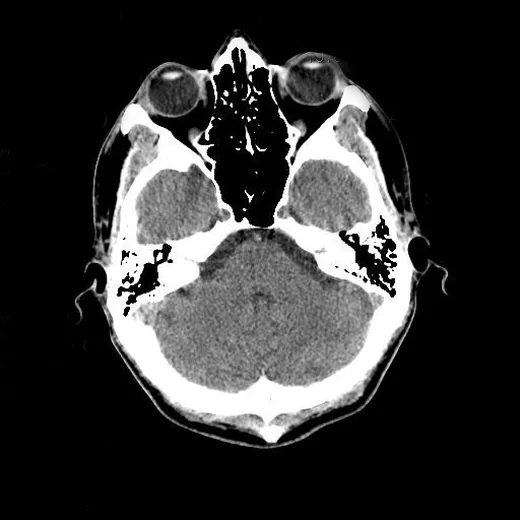
Tiroid göz hastalığının yağ baskın fenotipinde retrobulber yağ hacmi artar; ekstraoküler kas büyümesi belirgin olmayabilir. BT, globların öne yer değiştirmesini, yağ kompartımanlarının genişlemesini ve olası apeks daralmasını kemik sınırlarla birlikte gösterir. Bu patern kas baskın hastalık kadar belirgin kas kalınlaşması olmadan da proptozis yapabilir, bu nedenle iki orbita karşılaştırması önemlidir. Distiroid optik nöropati optik sinir basısı ve/veya gerilmesiyle ilişkili olabilir; bir klinik seride kas baskın grupta yağ baskın gruba göre daha sık görülmüş, apikal kalabalıklık ve belirgin ekstraoküler kas büyümesi DON’u destekleyen görüntüleme bulguları olarak bildirilmiştir; yağ baskın grupta da DON görülebilir.
Faz ve pencere
- Kontrastsız tanısal
- Orbital BT’de yağ genişlemesi ve globların öne yer değiştirmesi değerlendirilebilir; yağ baskın fenotipte ekstraoküler kas tutulumu görece hafif olabilir. Kemik duvarlar ve orbital apeks aynı kontrastsız BT serisinde değerlendirilebilir; yağ genişlemesi ve kas dağılımı da bu seride görülebilir.
Önerilen pencereler G genişlik, M merkez; değerler Hounsfield birimi (HU)
- Yumuşak dokuG 400 / M +40
- KemikG 1800 / M +400
BT bulguları
- Yağ baskın tiroid göz hastalığında orbital yağ genişlemesi ön plandadır; ekstraoküler kas tutulumu görece hafif olabilir.
- Globların öne yer değiştirmesi — korneaların interzigomatik hatta göre konumu karşı tarafla kıyaslanır; proptozis tek başına etiyolojiyi belirlemez.
- Ekstraoküler kasların normal veya hafif kalın olması — belirgin kas baskınlığı olmaksızın yağ artışı ön plandadır.
- Retrobulber yağ hacmi artışı globun öne yer değiştirmesine ve proptozise yol açabilir; apeks kalabalıklığı ve optik sinir basısı açısından orbital apeks ayrıca değerlendirilmelidir.
- Bilateral ve asimetrik görünüm — her iki orbitada yağ artışı bulunabilir, ancak proptozis derecesi eşit olmak zorunda değildir.
- Kemik orbitanın sınırları BT’de iyi değerlendirilir; bu inceleme orbital yumuşak dokularla kemik anatomisini birlikte gösterir.
- Periorbital yumuşak dokularda ödem ve şişkinlik BT'de eşlik eden yumuşak doku kalınlaşması olarak görülebilir.
- Proptozis, orbital BT’de ölçülebilir.
- BT, orbital yağ ve ekstraoküler kas genişlemesini gösterebilir; inflamatuvar ve fibrotik değişiklikleri ayırt etmeye yardımcı olmak için gerektiğinde MRG, özellikle STIR ve difüzyon ağırlıklı sekanslarla değerlendirilebilir.
Normalde
Sağlıklı orbitanın BT referansından glob boyutları, optik sinir uzunluğu ve kesiti ile dört rektus kasına ait ölçümler alınabilir. Globların ön-arka konumunu interzigomatik hatta göre iki tarafta kıyasla.
Ayırıcı tanı
- Kas baskın tiroid göz hastalığında ekstraoküler kas büyümesi ve tendonların korunması tipiktir; en sık inferior rektus etkilenir.
- Orbital lenfoma
- MRG’de orbital yapılara kalıplanan, iyi sınırlı ve homojen kontrastlanan lezyonlar görülebilir.
- Karotiko-kavernöz fistül gibi orbital venöz konjesyon yapan durumlarda genişlemiş superior oftalmik ven BT anjiyografide görülebilir.
Tuzaklar
- Sadece proptozise bakarak yağ baskın alt tip koyma; globun pozisyonunu artmış retrobulber yağ hacmi ve kas dağılımıyla birlikte değerlendir.
- İki tarafın yağ hacmini karşılaştırırken aynı standartlaştırılmış koronal BT düzlemini kullanın.
- Kasların normal görünmesini tiroid göz hastalığına karşı kanıt sayma; yağ baskın fenotipte belirgin kas büyümesi olmayabilir.
- Yağ baskın görünüm distiroid optik nöropatiyi dışlamaz; DON kuşkusunda orbital apeks bulgularını da değerlendirin.
Kendini dene
Yağ baskın tiroid göz hastalığında orbital BT'de beklenen patern hangisidir?
Cevabı göster
Belirgin orbital yağ artışı, hafif kas tutulumu ve proptozis. Yağ baskın paternde intraorbital yağ artışı ön plandadır, kas tutulumu görece hafiftir ve yağa bağlı proptozis olur.
Yağ baskın tiroid göz hastalığında BT'de beklenen patern hangisidir?
Cevabı göster
Belirgin orbital yağ artışı, hafif kas tutulumu ve proptozis. Yağ baskın paternde intraorbital yağ artışı ön plandadır ve ekstraoküler kas tutulumu görece hafiftir.
İlgili konular
Kaynaklar
Bu sayfadaki 33 cümle ve 2 quiz sorusu aşağıdaki kaynaklardan alıntılarla otomatik olarak karşılaştırıldı; 17 cümle bu karşılaştırmada düzeltildi (2026-10-12).
- Finite Element Analysis of Extraocular Muscle and Adipose-Dominant Pathogenesis in Thyroid Eye Disease With Clinical Implicationspmc.ncbi.nlm.nih.gov
- Orbital Myositis in Pediatric and Adult Patients: A Comparative Case Report and Review of the Literaturepmc.ncbi.nlm.nih.gov
- How to manage thyroid eye disease: recent advances – a narrative reviewpmc.ncbi.nlm.nih.gov
- Unilateral lower limb cellulitis-like edema as an atypical cutaneous manifestation of antisynthetase syndrome: a case report and targeted literature reviewpmc.ncbi.nlm.nih.gov
- Suspected Thymoma as the Initial Presentation of Graves’ Disease: A Report of a Rare Case and Comprehensive Literature Reviewpmc.ncbi.nlm.nih.gov
- Efficacy and safety of secondary infero-medial orbital wall decompression after orbital fat decompression in Graves' orbitopathy: A 12-year experience.pubmed.ncbi.nlm.nih.gov
- MRI-based evaluation of orbital structures in relation to thyroid function in thyroid eye disease.pubmed.ncbi.nlm.nih.gov
- A Korean Clinical Practice Framework for Thyroid Eye Disease: Integrating International Recommendations with Survey-Informed Consensus.pubmed.ncbi.nlm.nih.gov
- Reduction in extraocular muscle and orbital fat volumes after teprotumumab treatment in Japanese patients with thyroid eye disease: an exploratory magnetic resonance imaging analysis from the OPTIC-J trial.pubmed.ncbi.nlm.nih.gov
- How to manage thyroid eye disease: recent advances - a narrative review.pubmed.ncbi.nlm.nih.gov
- Finite Element Analysis of Extraocular Muscle and Adipose-Dominant Pathogenesis in Thyroid Eye Disease With Clinical Implications.pubmed.ncbi.nlm.nih.gov
- Contiguous orbital inflammation from paranasal sinus abnormalities in etiology of thyroid-associated ophthalmopathy.pubmed.ncbi.nlm.nih.gov
- Multimodal imaging in neuro-ophthalmology.pubmed.ncbi.nlm.nih.gov
- Orbital masses: a review of CT imaging characteristics.pubmed.ncbi.nlm.nih.gov
- Changes in multimodal MRI parameters following orbital decompression surgery for thyroid-associated ophthalmopathy and their associations with clinical outcomes.pubmed.ncbi.nlm.nih.gov
- Case Report: Marked bilateral optic disc edema as the presenting manifestation of thyroid eye disease with dysthyroid optic neuropathy.pubmed.ncbi.nlm.nih.gov
- The application value of quantitative analysis of orbital soft tissue parameters on plain CT scans in evaluating the activity of thyroid-associated ophthalmopathy.pubmed.ncbi.nlm.nih.gov
- Imaging the brain: diagnosis aided by structural features on neuroimaging studies.pubmed.ncbi.nlm.nih.gov
- Management of thyroid eye disease: a Consensus Statement by the American Thyroid Association and the European Thyroid Association.pubmed.ncbi.nlm.nih.gov
- Application of imaging studies for orbital tumors: a practical review and representative cases.pubmed.ncbi.nlm.nih.gov
- Simultaneous Thyroid Eye Disease and IgG4-Related Orbital Disease in a Patient With Diabetes Mellitus: A Case Report.pubmed.ncbi.nlm.nih.gov
- Orbital Myositis in Pediatric and Adult Patients: A Comparative Case Report and Review of the Literature.pubmed.ncbi.nlm.nih.gov
- The application of ultrasonography in the differential diagnosis of orbital lesions.pubmed.ncbi.nlm.nih.gov
- Isolated superior rectus-levator complex enlargement: Inflammatory etiology, clinicoradiological features, and treatment outcomes.pubmed.ncbi.nlm.nih.gov
- Quantitative evaluation of synthetic MRI for assessing disease activity in thyroid eye disease.pubmed.ncbi.nlm.nih.gov
- Thyroid eye disease in paediatric Graves' disease: a case series from the Gulf region with comparison to adults.pubmed.ncbi.nlm.nih.gov
- Unilateral Orbital Lymphomas: A Structured Multidisciplinary Workflow for Diagnosis and Management.pubmed.ncbi.nlm.nih.gov
- Unmasking Orbital Myopathy: When Enlarged Extraocular Muscles Indicate More Than Thyroid Eye Disease: Report of Two Cases.pubmed.ncbi.nlm.nih.gov
- Patient-specific finite element analysis of orbital biomechanical responses to malpositioned self-inflating hydrogel implants in congenital microphthalmia.pubmed.ncbi.nlm.nih.gov
- A Whole-Head Finite Element Model for Electrical Neuromodulation via Visual Brain-Machine Interfaces.pubmed.ncbi.nlm.nih.gov
- Congenital encephalomeningocele presenting as a giant orbital mass in a neonate: a case report.pubmed.ncbi.nlm.nih.gov
- Personalized orbital decompression surgery for thyroid-associated orbitopathy: a comprehensive retrospective analysis of efficacy, safety, and surgical strategy.pubmed.ncbi.nlm.nih.gov
- Interpretable machine learning for severity classification of thyroid eye disease using orbital anatomical features.pubmed.ncbi.nlm.nih.gov
- Orbital manifestations of inflammatory bowel disease - a systematic review.pubmed.ncbi.nlm.nih.gov
- Bilateral invasive lobular breast carcinoma with synchronous gastric metastasis and orbital pseudotumor mimicking metastasis: a case report.pubmed.ncbi.nlm.nih.gov
- What the Eyelid Can Tell You: The Unexpected Initial Presentation of De Novo Stage IV Breast Carcinoma.pubmed.ncbi.nlm.nih.gov
- Solitary fibrous tumor: an updated review.pubmed.ncbi.nlm.nih.gov
- MRI characteristics of appendicular soft tissue lymphoma: a retrospective analysis.pubmed.ncbi.nlm.nih.gov
- Clinical and imaging manifestations of metastases from rare sites.pubmed.ncbi.nlm.nih.gov
- Longitudinal refractive changes following orbital decompression in thyroid eye disease: dominant role of axial configuration and globe position with contributions from surgical technique and corneal biomechanics.pubmed.ncbi.nlm.nih.gov
- Impacts of physical, metabolic, and immunological factors on the exophthalmometry values of a contemporary Japanese population with/without Graves' disease.pubmed.ncbi.nlm.nih.gov
- Imaging for Pediatric Head and Neck Emergencies: Critical Insights.pubmed.ncbi.nlm.nih.gov
- A Rare Case of Concurrent Carotid Cavernous Fistula and Orbital Cellulitis: Challenging Diagnosis and Divergent Management.pubmed.ncbi.nlm.nih.gov
- Acute Orbital Inflammation following Neridronate Therapy: A Case Report.pubmed.ncbi.nlm.nih.gov
- Clinicopathological Pearls and Diagnostic Pitfalls in IgG4-Related Disease: Challenging Case Series and Literature Review.pubmed.ncbi.nlm.nih.gov
- A Unilateral Nasal Mass With Generalized Seizures: Potential Diagnostic Pitfalls in Giant Pituitary Adenoma.pubmed.ncbi.nlm.nih.gov
- MIRD Pamphlet No. 34, Part 1: MIRDct-A Customizable Software Tool for CT Dosimetry.pubmed.ncbi.nlm.nih.gov
- Slice Level Classification of Parathyroid Adenoma Using Arterial Phase CT Images with Hybrid Light Attention Mechanism Based Residual Framework.pubmed.ncbi.nlm.nih.gov
- Use of Deep Learning Models in the Diagnosis of Proptosis Through Orbital Magnetic Resonance Imaging.pubmed.ncbi.nlm.nih.gov
- SPECT/CT imaging in thyroid eye disease: an emerging role in assessing sub-clinical activity.pubmed.ncbi.nlm.nih.gov
- Transorbital Resection of an Optic Nerve Glioma with Severe Proptosis: Technical Note.pubmed.ncbi.nlm.nih.gov
- When patients present with bulging eyes: A case series of proptosis.pubmed.ncbi.nlm.nih.gov
- Dysthyroid Optic Neuropathy in Graves' Orbitopathy: Insights from a Single Centre and Limitations of the Radiological Indices.pubmed.ncbi.nlm.nih.gov
- Collaborative Diagnostic Pathways for Unilateral Orbital Disease: A Clinicopathological Series.pubmed.ncbi.nlm.nih.gov
- Orbital tuberculosis mimicking a vascular emergency: A case report of superior ophthalmic vein engorgement.pubmed.ncbi.nlm.nih.gov
- Selective extraocular muscle regression following tocilizumab in active thyroid associated ophthalmopathy: a 3D MRI-based retrospective study.pubmed.ncbi.nlm.nih.gov
- PET-CT in Clinical Adult Oncology-VI. Primary Cutaneous Cancer, Sarcomas and Neuroendocrine Tumors.pubmed.ncbi.nlm.nih.gov
- Not All Orbitopathy Is Graves': Discussion of Cases and Review of Literature.pubmed.ncbi.nlm.nih.gov
- Atypical fibrolipomatous vascular proliferative lesion mimicking Orbital fat prolapse in the lower eyelid: A case report and literature review.pubmed.ncbi.nlm.nih.gov
- Retroperitoneal Myolipoma with Hip Invasion: A Case Report.pubmed.ncbi.nlm.nih.gov
- Clinical Presentation and Tumour Burden in Head and Neck Sarcomas: Implications for Early Diagnosis and Referral.pubmed.ncbi.nlm.nih.gov
- Giant Lipoma Involving the Face in a Child: A Rare Case Report.pubmed.ncbi.nlm.nih.gov
- Head and neck sarcomas: imaging "pearls" and "mimics".pubmed.ncbi.nlm.nih.gov
- Spectrum of Surgically Resected Lesions of the Cavernous Sinus: A Neuropathologic Audit.pubmed.ncbi.nlm.nih.gov
- Orbital asymmetry degree: a potential <sup>99m</sup>Tc-DTPA SPECT/CT imaging marker for diplopia in thyroid-associated ophthalmopathy.pubmed.ncbi.nlm.nih.gov
- From pixels to precision: Imaging technologies shaping oculofacial plastic surgery practice.pubmed.ncbi.nlm.nih.gov
- Renal clear cell carcinoma with bilateral parotid and orbital metastases - case report.pubmed.ncbi.nlm.nih.gov
- Quantitative MRI Assessment of Orbital Structures in Radioactive Iodine-131 Therapy for Inactive Graves' Ophthalmopathy.pubmed.ncbi.nlm.nih.gov
- Clinical application of cone beam CT in intensity-modulated radiotherapy for the moderate to severe thyroid-associated ophthalmopathy.pubmed.ncbi.nlm.nih.gov
- A novel nomogram based on orbital MRI parameters for early prediction of dysthyroid optic neuropathy in thyroid-associated ophthalmopathy.pubmed.ncbi.nlm.nih.gov
- Orbital computed tomography imaging characteristics of thyroid-associated ophthalmopathy.pubmed.ncbi.nlm.nih.gov
- Metamaterial Antennas Enhance MRI of the Eye and Occipital Brain.pubmed.ncbi.nlm.nih.gov
- Cranial anatomy, palaeoneurology, palaeobiology and stratigraphic age of the large-bodied ornithopod, <i>Muttaburrasaurus langdoni</i> Bartholomai and Molnar, 1981, from the mid-Cretaceous of Australia.pubmed.ncbi.nlm.nih.gov
- Diagnostic value of MRI and diffusion-weighted imaging in dysthyroid optic neuropathy: a cross-sectional study providing insights into predictive parameters and pathogenesis.pubmed.ncbi.nlm.nih.gov
- Puzzling Late Relapse of Thyroid Eye Disease: A Case Series.pubmed.ncbi.nlm.nih.gov
- Euthyroid Graves' Ophthalmopathy With Negative Antibodies (EGONA): A Comprehensive Case-Based Review.pubmed.ncbi.nlm.nih.gov
- Predictive markers for anti-inflammatory treatment response in thyroid eye disease.pubmed.ncbi.nlm.nih.gov
- A randomized controlled trial on the effect of hydroxychloroquine in mild Graves' orbitopathy (GO-HCQ): study protocol.pubmed.ncbi.nlm.nih.gov
- Validation of exophthalmos magnetic resonance imaging measurements in patients with Graves' orbitopathy, compared to ophthalmometry results.pubmed.ncbi.nlm.nih.gov
- Development and evaluation of AI model with deep learning for segmentation of extraocular muscles in thyroid eye disease.pubmed.ncbi.nlm.nih.gov
- A cardiac debut: Myocarditis revealing seronegative primary Sjögren's syndrome in a young woman-A case report.pubmed.ncbi.nlm.nih.gov
- Assessment of disease activity in Graves' orbitopathy.pubmed.ncbi.nlm.nih.gov
- Guidelines for standard operation of imaging modalities in orbital diseases (2024).pubmed.ncbi.nlm.nih.gov
- Evaluation of fibroinflammatory activity in thyroid eye disease using [<sup>18</sup>F]AlF-NOTA-FAPI-04 PET/CT: A prospective study.pubmed.ncbi.nlm.nih.gov
- Correlation between extraocular muscle enlargement and thyroid autoantibodies in thyroid eye disease.pubmed.ncbi.nlm.nih.gov
- Metastasis of Castration-Resistant Prostate Adenocarcinoma to the Lacrimal Gland: A Case Report.pubmed.ncbi.nlm.nih.gov
- Impact of Optic Nerve Tortuosity, Globe Proptosis, and Size on Retinal Ganglion Cell Thickness Across General, Glaucoma, and Myopic Populations.pubmed.ncbi.nlm.nih.gov
- Thyroid hormone signaling in ocular development and diseases.pubmed.ncbi.nlm.nih.gov
- Multisystem infection with cavernous sinus thrombosis in seropositive rheumatoid arthritis: a clinico-radiological case report.pubmed.ncbi.nlm.nih.gov
- Spontaneous Resolution of a Bilateral Barrow Type D Indirect Carotid-Cavernous Fistula: A Rare Case Report and Literature Review.pubmed.ncbi.nlm.nih.gov
- Ocular Color Doppler Ultrasound (OCDUS) in Diagnosis and Monitoring of Ophthalmological, Cerebrovascular and Systemic Diseases: A Narrative Review.pubmed.ncbi.nlm.nih.gov
- The Visual Function of Emergent Transnasal Endoscopic Orbital Decompression Surgery for Patients With Steroid-Resistant Dysthyroid Optic Neuropathy.pubmed.ncbi.nlm.nih.gov
- The Relevance and Potential Role of Orbital Fat in Inflammatory Orbital Diseases: Implications for Diagnosis and Treatment.pubmed.ncbi.nlm.nih.gov
- Imaging features of lacrimal gland disease.pubmed.ncbi.nlm.nih.gov
- A Pilot MRI Study of Upward Gaze-Induced Intraocular Pressure Elevation in Thyroid Eye Disease.pubmed.ncbi.nlm.nih.gov
- Effects of endoscopic transnasal orbital decompression on anterior segment ocular blood flow and clinical outcome in thyroid-associated ophthalmopathy: a retrospective study.pubmed.ncbi.nlm.nih.gov
- Enophthalmospubmed.ncbi.nlm.nih.gov
- Unilateral Proptosis Mimicking an Eye Tumour: A Case Report.pubmed.ncbi.nlm.nih.gov
- Effect of orbital fat decompression on eyelid contour according to midpupil lid distance in graves' ophthalmopathy.pubmed.ncbi.nlm.nih.gov
- Morphologic Cross-Sectional Imaging Features of IgG4-Related Orbitopathy in Comparison to Ocular Adnexal Lymphoma.pubmed.ncbi.nlm.nih.gov
- Orbital masses: CT and MRI of common vascular lesions, benign tumors, and malignancies.pubmed.ncbi.nlm.nih.gov
- Artificial Intelligence for In-Flight Detection of Space-Related Ocular Trauma: Bridging Diagnostic Gaps in Microgravity.pubmed.ncbi.nlm.nih.gov
- Ectropion uveae in a pediatric patient with refractory NF1-associated glaucoma: a 4-year case report.pubmed.ncbi.nlm.nih.gov
- Imaging characteristics of orbital tumors: A case series analysis.pubmed.ncbi.nlm.nih.gov
- Three-Dimensional Globe Repositioning Following Orbital Reconstruction Independent of Bony Landmarks and Fracture Pattern Associations.pubmed.ncbi.nlm.nih.gov
- Managing Orbital Floor Fractures With Three-Dimensional (3D)-Printed Surgical Guides: A Narrative Review.pubmed.ncbi.nlm.nih.gov
- Personalized 3D-Printed Hybrid PDMS and PEEK Implants for Revisional Orbitomaxillary Reconstruction: A Translational Case-Based Technical Note.pubmed.ncbi.nlm.nih.gov
- Orbital computed tomography biomarkers for the assessment of activity of Thyroid Eye Disease.pubmed.ncbi.nlm.nih.gov
- The radiological assessment of orbital fat in patients with thyroid eye disease.pubmed.ncbi.nlm.nih.gov
- Case Report: Teprotumumab treatment in an HIV-infected patient with refractory thyroid eye disease: clinical and quantitative MRI evidence.pubmed.ncbi.nlm.nih.gov
- The traditional Chinese medicine bloodletting therapy at the Taiyang acupoint (No.EX-HN5) for the treatment of periorbital venous malformation: a case report.pubmed.ncbi.nlm.nih.gov
- Choroidal Detachment in a Patient on a CPAP Therapy.pubmed.ncbi.nlm.nih.gov
- Lateral Orbital Rim Advancement and Balanced Orbital Decompression for Exorbitism Regression in Crouzon Syndrome.pubmed.ncbi.nlm.nih.gov
- Introduction of the Ex/AxI ratio for optimized assessment of exophthalmos based on bulbar position parameters examined in a population-based MRI study.pubmed.ncbi.nlm.nih.gov
- Orbital pseudotumor and skull base infiltration as the sole manifestation of granulomatosis with polyangiitis.pubmed.ncbi.nlm.nih.gov
Eğitim amaçlıdır; hasta başında tanı ve tedavi kararının yerine geçmez, tıbbi tavsiye değildir. Metinler yapay zekâ desteğiyle yazıldı ve otomatik bir adımda kaynak alıntılarıyla karşılaştırıldı; bu bir tıbbi doğrulama değildir ve içerik uzman radyolog incelemesinden geçmedi. Klinik kararlarda güncel kılavuzları, kurum protokollerini ve radyoloji raporunu esas alın.