Özet
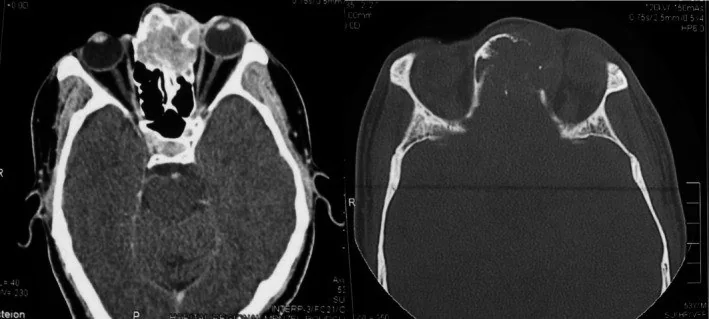
Estesioneuroblastom, olfaktör epitel bölgesinden gelişen ve üst nazal kaviteden etmoid çatıya ilerleyebilen nadir malign tümördür. İntravenöz kontrastlı BT kitlenin kemik sınırları, kribriform plak ve orbita ile ilişkisini gösterirken MR intrakraniyal yumuşak doku uzanımını daha iyi tanımlar. Kribriform plakta dar bel ve iki tarafta nazal-kafa içi komponent oluşması klasik dumbbell görünümünü verebilir. Kafa tabanı veya orbita yayılımının gözden kaçması hastalık yaygınlığının eksik değerlendirilmesine neden olur.
Faz ve pencere
- Kontrastsız tanısal
- Kemik algoritmalı görüntüde olfaktör oluk, kribriform plak, fovea ethmoidalis ve lamina papyracea konturları izlenir; olası kemik erozyonu veya remodelingi değerlendirilir.
- Kontrastlı tanısal
- Üst nazal kavitedeki solid kitle postkontrast BT’de belirgin kontrastlanabilir; kribriform plak ve kemik değişiklikleri BT’de değerlendirilir. Kafa tabanı, dural ve intrakraniyal uzanımın sınırlandırılmasında MR tamamlayıcıdır.
Önerilen pencereler: Yumuşak doku (G 400 / M 40), Kemik (G 1800 / M 400).
BT bulguları
- Üst nazal kavite ve olfaktör olukta yumuşak doku kitlesi.
- Olfaktör oluk kökenli kitle etmoid çatı, orbita, ön kafa çukuru veya orofarenkse yayılım gösterebilir.
- Kribriform plakta düzgün remodeling, incelme veya destrüktif kesinti.
- Kribriform plak seviyesinde daralan, üstte intrakraniyal ve altta nazal komponentli dumbbell biçimi.
- Kontrast sonrası solid tümör dokusunda belirgin boyanma.
- Lamina papyracea veya medial orbita duvarına komşuluk ve olası geçiş.
- Mukus retansiyon kisti kontrastlanmaz; bu özellik, kontrastlanan tümör dokusundan ayırmaya yardımcı olabilir.
Ölçütler ve sınıflamalar
- Modifiye Kadish sınıflaması
- A: yalnız nazal kavite; B: nazal kavite ve paranazal sinüsler; C: bu sınırların ötesinde komşu ekstrasinüs dokulara yayılım (ör. orbita veya kafa içi komşu yapılar); D: servikal lenf nodları ya da uzak bölgelere metastaz.
Normalde
Kribriform plak düzeyinde kemik destrüksiyonunu ve tümörün ön kafa çukuruna uzanımını birlikte değerlendir.
Normal BT ile kıyasla
Aynı bölgenin, kaynak veri setinde patoloji içermediği belirtilen bir BT incelemesini kesit kesit kaydırın; organ sınırlarını açarak anatomiyi hasta görüntüsüyle karşılaştırın. Küçük rastlantısal bulgular tümüyle dışlanmamıştır.
Kaynak: TotalSegmentator v2.01 veri seti (Wasserthal ve ark., Radiology: Artificial Intelligence 2023), CC BY 4.0, vaka s0849; organ sınırları veri setinin otomatik segmentasyonundan, birleştirilerek sadeleştirildi. Görüntüler 2,5 mm kesit aralığına yeniden örneklendi.
Ayırıcı tanı
- Sinonazal skuamöz hücreli karsinom
- maksiller sinüsün medial duvarını destrükte ederek nazal kaviteye uzanabilir.
- Menenjiom
- kafa içinden paranazal sinüslere uzanabilir.
- Ensefalosel
- kafa tabanı açıklığından geçen beyin/meninks dokusu; kontrastlanan solid sinonazal kitle biçiminde değildir.
- Lenfoma
- sinonazal kaviteyi tutabilir; maksiller sinüsten premaxiller boşluğa uzanan lenfoma bildirilmiştir.
Tuzaklar
- Mukus retansiyon kisti kontrastlanmaz; bu özelliği kontrastlanan tümör dokusundan ayırmada kullan.
- Dumbbell morfoloji tanıyı destekler ancak tek başına histolojik kanıt değildir; olfaktör oluk başlangıç merkezini de doğrula.
- BT kafa tabanı kemiğini iyi gösterir, dural veya beyin parankimi invazyonunu dışlamaz; yumuşak doku yayılımı için MR korelasyonu gerekir.
Kendini dene
Üst nazal kavite merkezli, kribriform plakta daralarak kafa içi ve nazal komponentlere ayrılan kitle hangi tanıyı düşündürür?
Cevabı göster
Estesioneuroblastom. Olfaktör oluk başlangıcı ve kribriform plak çevresindeki dumbbell uzanım estesioneuroblastom için tipiktir.
Tümör nazal kaviteyle sınırlı; paranazal sinüs veya kafa içi yayılım yok. Kadish evresi nedir?
Cevabı göster
Kadish A. Modifiye Kadish A yalnız nazal kaviteyi, B paranazal sinüs uzanımını, C komşu ekstrasinüs yayılımını, D ise bölgesel nodal veya uzak metastazı ifade eder.
Kaynaklar
Bu sayfadaki 34 cümle ve 2 quiz sorusu aşağıdaki kaynaklardan alıntılarla tek tek karşılaştırıldı; 7 cümle bu karşılaştırmada düzeltildi (2026-10-08).
- A rare presentation of esthesioneuroblastoma: a case report and review of the literaturepmc.ncbi.nlm.nih.gov
- Characterization of Sinonasal Lesions on CT, MRI, and PET/CTpmc.ncbi.nlm.nih.gov
- Pathological Pathways of Olfactory Neuroblastoma: From Molecular Mechanisms to Targeted Therapy: A Narrative Reviewpmc.ncbi.nlm.nih.gov
- Treatment Strategies and Outcomes of Pediatric Esthesioneuroblastoma: A Systematic Reviewpmc.ncbi.nlm.nih.gov
- Esthesioneuroblastoma: Summary of Single-center Experiences with Focus on Adjuvant Therapy and Overall Survivalpmc.ncbi.nlm.nih.gov
- Endoscopic Management of Esthesioneuroblastoma.pubmed.ncbi.nlm.nih.gov
- High grade neuroendocrine neoplasm of the antrum and orbit.pubmed.ncbi.nlm.nih.gov
- Radiologic overview of sinonasal lesions.pubmed.ncbi.nlm.nih.gov
- Intraoperative hypertensive crisis due to a catecholamine-secreting esthesioneuroblastoma.pubmed.ncbi.nlm.nih.gov
- Esthesioneuroblastoma: the complete picture - case report and review of the literature.pubmed.ncbi.nlm.nih.gov
- Advanced olfactory neuroblastoma in a teenager: a clinical case and short review of literature.pubmed.ncbi.nlm.nih.gov
- Primary sellar neuroblastoma mimicking invasive pituitary adenoma: a systematic review.pubmed.ncbi.nlm.nih.gov
- Olfactory neuroblastoma (esthesioneuroblastoma): towards minimally invasive surgery and multi-modality treatment strategies - an updated critical review of the current literature.pubmed.ncbi.nlm.nih.gov
- Enhancing Diagnostic Accuracy in Sinonasal Neuroendocrine Tumors: The Case for DOTATATE PET Over FDG PET.pubmed.ncbi.nlm.nih.gov
- Sphenoidal esthesioneuroblastoma treated with sequential chemo radiotherapy: a case report and review of the literature.pubmed.ncbi.nlm.nih.gov
- Sinonasal Schwannomas: Imaging Findings and Review of Literature.pubmed.ncbi.nlm.nih.gov
- Characterization of Sinonasal Lesions on CT, MRI, and PET/CT.pubmed.ncbi.nlm.nih.gov
- Oral & maxillofacial manifestations in pediatric esthesioneuroblastoma-report of a case and review of literature.pubmed.ncbi.nlm.nih.gov
- Atypical esthesioneuroblastoma invading oral cavity: a case report and review of the literature.pubmed.ncbi.nlm.nih.gov
- Combined Interhemispheric and Endoscopic Endonasal Resection of a Rare Olfactory Schwannoma with Preservation of Olfactory Function.pubmed.ncbi.nlm.nih.gov
- SMARCB1-deficient sinonasal carcinoma in a pediatric patient: Imaging findings and differential diagnosis of a rare entity.pubmed.ncbi.nlm.nih.gov
- The Endoscopic Versus Open Approach for Anterior Skull Base Tumors: A Systematic Review of Comparative Outcomes and a Framework for Surgical Selection.pubmed.ncbi.nlm.nih.gov
- Dural reconstruction with or without a bone graft of paranasal and anterior skullbase malignancies: Retrospective single-center analysis of 11 cases and review of literature.pubmed.ncbi.nlm.nih.gov
- Esthesioneuroblastoma located in the thoracic extradural space: Case report.pubmed.ncbi.nlm.nih.gov
- Rare Diseases of the Nose, the Paranasal Sinuses, and the Anterior Skull Base.pubmed.ncbi.nlm.nih.gov
- Kadish C/Hyams II Esthesioneuroblastoma With Atypical Immunophenotype Mimicking NK/T-Cell Lymphoma: Endoscope-Assisted Transcranial Resection and Adjuvant Intensity-Modulated Radiotherapy.pubmed.ncbi.nlm.nih.gov
- Orbital rhabdomyosarcoma in an adult: a misleading presentation.pubmed.ncbi.nlm.nih.gov
- Chronic Invasive Fungal Sinusitis Concerning for Sinonasal Malignancy With Unique Intracranial Extension.pubmed.ncbi.nlm.nih.gov
- Craniofacial surgery for removing tumors in advanced stages that invade the anterior skull base.pubmed.ncbi.nlm.nih.gov
- Molecular Brain Tumor Imaging Beyond [<sup>18</sup>F]FDG: Somatostatin Receptor PET, Amino Acid PET, and Emerging Applications-From the <i>AJR</i> Special Series on Molecular Imaging.pubmed.ncbi.nlm.nih.gov
- Ectopic Olfactory Neuroblastoma of the Maxillary Sinus: A Case Report.pubmed.ncbi.nlm.nih.gov
- Strategic Management of Anterior Skull Base Schwannomas and Their Outcomes.pubmed.ncbi.nlm.nih.gov
- An adolescent girl with syndrome of inappropriate antidiuretic hormone secretion preceding the diagnosis of olfactory neuroblastoma - a case report.pubmed.ncbi.nlm.nih.gov
- Uncommon Nasal Mass Presentation: A Radiological Case Series.pubmed.ncbi.nlm.nih.gov
- Mixed olfactory neuroblastoma and neuroendocrine carcinoma: An unusual case report and literature review.pubmed.ncbi.nlm.nih.gov
- Successful Management of Advanced Olfactory Esthesioneuroblastoma: A Case Report.pubmed.ncbi.nlm.nih.gov
- Delayed Diagnosis and Multimodality Management of a Primary Myxoid Chondrosarcoma of the Skull Base: A Case Report.pubmed.ncbi.nlm.nih.gov
- A practical overview of CT and MRI features of developmental, inflammatory, and neoplastic lesions of the sphenoid body and clivus.pubmed.ncbi.nlm.nih.gov
- Anatomic, Radiographic, and Computed Tomographic Study of the Skull in the Persian Squirrel (Sciurus anomalus).pubmed.ncbi.nlm.nih.gov
- Olfactory Groove Meningioma Presenting With Visual Decline and Gait Disturbance: A Case Report.pubmed.ncbi.nlm.nih.gov
- Surgical Management of Esthesioneuroblastoma at a Single Tertiary Care Center.pubmed.ncbi.nlm.nih.gov
- Esthesioneuroblastoma: Unraveling the Enigma and Emerging Paradigms With a Retrospective Cohort and Review of Literature.pubmed.ncbi.nlm.nih.gov
- PET/CT Imaging in Treatment Planning and Surveillance of Sinonasal Neoplasms.pubmed.ncbi.nlm.nih.gov
- Emerging concepts in sinonasal tumor research.pubmed.ncbi.nlm.nih.gov
- ESR Essentials: imaging in nasal obstruction and epistaxis-practice recommendations by the European Society of Head and Neck Radiology.pubmed.ncbi.nlm.nih.gov
- Ga-68 DOTATATE PET/CT in the Evaluation of Paragangliomas and Other Indeterminate Lesions in the Head and Neck.pubmed.ncbi.nlm.nih.gov
- Special Considerations in Pediatric Endoscopic Skull Base Surgery.pubmed.ncbi.nlm.nih.gov
- Sinonasal Inflammation or Neoplasm: Raise the Red Flagsǃ-A Pictorial Review.pubmed.ncbi.nlm.nih.gov
- The cavernous sinus: An anatomic study with clinical implication.pubmed.ncbi.nlm.nih.gov
- Case report: Neuroendocrine carcinoma of the nasal cavity in a roe deer ( Capreolus capreolus ).pubmed.ncbi.nlm.nih.gov
- Alveolar Rhabdomyosarcoma of Nasopharynx and Paranasal Sinuses in Children Diagnosis and Treatment-Review of the Literature and Case Report.pubmed.ncbi.nlm.nih.gov
- Assessing Olfactory Bulb Infiltration and Morphological Changes in Olfactory Neuroblastoma Using Magnetic Resonance Imaging.pubmed.ncbi.nlm.nih.gov
- Imaging of Skull Base and Orbital Invasion in Sinonasal Cancer: Correlation with Histopathology.pubmed.ncbi.nlm.nih.gov
- Ectopic Adrenocorticotropic Hormone (ACTH)-Dependent Cushing Syndrome Secondary to Olfactory Neuroblastoma: A Rare Entity.pubmed.ncbi.nlm.nih.gov
- Endoscopic endonasal approach with extended orbital roof removal for a giant esthesioneuroblastoma: illustrative case.pubmed.ncbi.nlm.nih.gov
- Septal flip flap for anterior skull base reconstruction after endoscopic resection of sinonasal cancers: preliminary outcomes.pubmed.ncbi.nlm.nih.gov
- Imaging of sinonasal tumours.pubmed.ncbi.nlm.nih.gov
- Neoadjuvant Chemotherapy-Induced Downstaging Enables R0 Craniofacial Combined Resection in AJCC (American Joint Committee on Cancer) Stage IV Olfactory Neuroblastoma: A Case Report of 12-Year Disease-Free Survival.pubmed.ncbi.nlm.nih.gov
- Clinical characteristics, advanced imaging findings, and long-term outcomes in 50 dogs with calvarial multilobular tumor of bone treated with craniectomy.pubmed.ncbi.nlm.nih.gov
- Vasospasm following resection of olfactory groove meningiomas via orbitozygomatic craniotomy: illustrative cases.pubmed.ncbi.nlm.nih.gov
- Chinese expert consensus on imaging examination and diagnosis of nasal cavity and paranasal sinus tumors.pubmed.ncbi.nlm.nih.gov
- Ethmoidal synovial sarcoma presenting with epistaxis and nasal deformity: A case report.pubmed.ncbi.nlm.nih.gov
- Airtight compartmentalization of the anterior skull base reconstructed using a pedicled pericranial periosteal flap: illustrative case.pubmed.ncbi.nlm.nih.gov
- Operative Corridors in Endoscopic Skull Base Tumor Surgery.pubmed.ncbi.nlm.nih.gov
- Intracranial extension of Schneiderian inverted papilloma: a case report and literature review.pubmed.ncbi.nlm.nih.gov
- Sinonasal Squamous Cell Carcinoma Mimicking a Brain Abscess: Report of a Unique Case.pubmed.ncbi.nlm.nih.gov
Eğitim amaçlıdır; hasta başında tanı ve tedavi kararının yerine geçmez. İçerik yapay zekâ destekli bir süreçle güncel literatüre göre cümle cümle kaynaklarla karşılaştırıldı, ancak uzman radyolog incelemesinden geçmedi. Klinik kararlarda güncel kılavuzları, kurum protokollerini ve radyoloji raporunu esas alın.