Özet
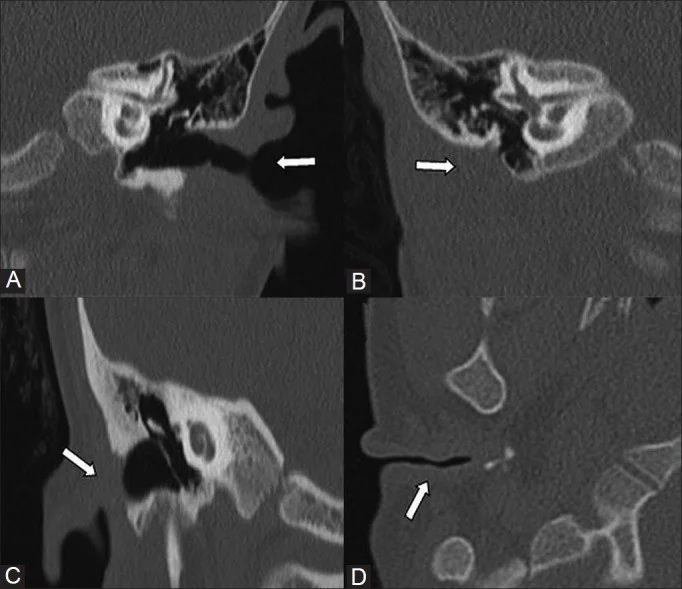
Konjenital dış kulak yolu atrezisi veya stenozu, dış kulak yolu gelişiminin kısmi ya da tam yetersizliği olup aurikula ve orta kulak anomalileriyle birlikte görülebilir. Cerrahi planlama veya kolesteatom kuşkusunda yüksek çözünürlüklü temporal kemik BT'si cerrahi açıdan önemli temporal kemik ve orta kulak anatomisini değerlendirmede kullanılır. Görüntü, yalnız kanalın kapalı olup olmadığını değil, işitme iletim zincirinin ve kritik komşulukların gelişimini de ortaya koyar. Kolesteatom kuşkusu ve fasiyal sinir kanalının seyri, cerrahi açıdan önemli temporal kemik anatomisinin BT değerlendirmesine dahil edilir.
Faz ve pencere
- Kontrastsız tanısal
- İnce kesit temporal kemik BT'sinde dış kulak yolu anomalileri ile timpanik kavite, kemikçik zinciri ve mastoid havalanması değerlendirilir; kanal anomalileri kısmi stenozdan tam atreziye kadar uzanabilir. Konjenital aural atrezide ameliyat öncesi radyolojik değerlendirme için temporal kemik BT'si kullanılır.
- Aynı kontrastsız BT verisinin kemik algoritmalı rekonstrüksiyonu tanısal
- Çok düzlemli temporal kemik BT rekonstrüksiyonları dış kulak yolu atrezisi ve orta kulak yapılarını değerlendirmeye; kemikçik zinciri, oval ve yuvarlak pencereler ile fasiyal sinir kanalını incelemeye yardımcı olur. Bu ayrı bir kontrast fazı değil, aynı BT verisinin rekonstrüksiyonudur.
Önerilen pencereler G genişlik, M merkez; değerler Hounsfield birimi (HU)
- KemikG 1800 / M +400
BT bulguları
- Kanal lümeninde gelişimsel darlık — dış kulak yolu mevcuttur ancak stenotiktir.
- Atrezik plak — konjenital atrezi cerrahisinde çıkarılan kemik ve kıkırdak bileşenleri içerebilir.
- Konjenital aural atrezide dış kulak yolu anomalileri kısmi stenozdan tam atreziye kadar uzanabilir. Kanalın tam tıkalı olduğu durumlarda timpanik membran BT'de seçilemeyebilir.
- Timpanik kavite hipoplazisi — orta kulak boşluğu küçük, dar veya kısmen havalanmış görünür.
- Ossiküler malformasyon — malleus ve inkus füzyonu görülebilir.
- Fasiyal sinir kanalında anormal seyir — kanalın konumu ve olası yer değiştirmesi tarif edilir.
- Mastoid hipopnömatizasyon — etkilenen kulakta mastoid hava hücresi hacmi azalmış olabilir.
- Stenozla ilişkili kolesteatom — stenotik dış kulak yolunda kolesteatom gelişebilir; BT'de kanal içinde yumuşak doku, genişleme ve kemik duvarlarında erozyon görülebilir.
- Jahrsdoerfer'in değiştirilmiş BT skorunda stapes 2 puan; oval ve yuvarlak pencere, orta kulak boşluğu, fasiyal sinir, malleus-inkus kompleksi, mastoid havalanması, inkus-stapes bağlantısı ve dış kulak yolu varlığı birer puandır; toplam 10 puan olup yüksek skor daha elverişli temporal kemik anatomisini gösterir.
Ölçütler ve sınıflamalar
- Weerda tipleri
- Cerrahi uygunluk değerlendirmesinde temporal kemiğin iyi havalanması, pencerelerin varlığı, fasiyal sinirin normale yakın konumu ve hareketli kemikçik zinciri dikkate alınır. Cerrahiye elverişli temporal kemik anatomisini değerlendirmede Jahrsdoerfer BT skoru kullanılır.
- Jahrsdoerfer BT skoru
- BT'de stapes 2 puan; oval pencere açıklığı, orta kulak boşluğu, fasiyal sinir seyri, malleus-inkus kompleksi, mastoid havalanması, inkus-stapes bağlantısı, yuvarlak pencere ve dış kulak görünümü birer puan alır; toplam 10 puandır. Bu skor anatomik ve prognostik değerlendirmede kullanılır.
Normalde
Normal temporal kemikte dış kulak yolu açık ve timpanik membrana kadar izlenir; orta kulak boşluğu havalı, kemikçik zinciri ayrık ve mastoid hücreler havalanmıştır. Aynı seviyedeki karşı tarafla kıyaslarken kanalın kör sonlanıp sonlanmadığına, atrezik plağın medialindeki timpanik kavite hacmine ve kemikçiklerin pencere/fasiyal sinir kanalıyla ilişkisine bakın.
Ayırıcı tanı
- Edinsel kanal stenozu
- inflamasyon, travma veya otolojik cerrahi sonrası gelişebilir; konjenital atreziden ayrımda gelişimsel dış kulak yolu ve orta kulak anomalileri değerlendirilir.
- Dış kulak yolu kolesteatomu
- BT'de kanal içinde yumuşak doku, genişleme ve kemik duvarlarında erozyon görülebilir.
- Orta kulak kolesteatomu
- epitympanumda yumuşak doku ve kemikçik/scutum erozyonu yapar; dış kanal darlığına bağlı doğumsal patern değildir.
- Travmatik dış kulak yolu hasarı
- künt travma, edinsel dış kulak yolu stenozunun bildirilen nedenleri arasındadır.
Tuzaklar
- Küçük kanal açıklığını tam atrezi olarak adlandırmayın; lümenin stenotik olarak mevcut olup olmadığını tam kanal atrezisinden ayırarak kaydedin.
- Stenotik dış kulak yolunda kolesteatom olasılığını değerlendirin; BT'de kanal içi yumuşak doku, genişleme ve kemik duvarlarında erozyon bulgularını inceleyin.
- Mastoid havalanmasının azalmasını tek başına atrezi derecesi saymayın; timpanik kavite ve kemikçik gelişimini ayrı ayrı tarif edin.
- Fasiyal sinir kanalının oval pencereye yakın anormal seyrini atlamayın; bu anatomik varyant cerrahi yaklaşımın güvenliğini etkiler.
Kendini dene
Çocukta kanalın medialinde kemik plak, küçük timpanik kavite ve malleus-inkus füzyonu var. En uygun tanı hangisidir?
Cevabı göster
Konjenital aural atrezi. Atrezik plakla birlikte orta kulak hipoplazisi ve kemikçik füzyonu konjenital aural atrezinin tipik birleşik gelişim paternidir. Konjenital aural atrezide dış kulak yolu anomalileriyle kemikçik füzyonu ve diğer orta kulak gelişim kusurları birlikte görülebilir; bu nedenle diğer seçenekler bu birleşik gelişim paternini açıklamaz.
BT'de dış kulak yolu lümeni daralmış ancak devam ediyor. Bu bulgu nasıl adlandırılır?
Cevabı göster
Dış kulak yolu stenozu. Devam eden ancak daralmış kanal stenozdur; tam atrezide kanal kapalıdır.
Kaynaklar
Bu sayfadaki 47 cümle ve 2 quiz sorusu aşağıdaki kaynaklardan alıntılarla otomatik olarak karşılaştırıldı; 13 cümle bu karşılaştırmada düzeltildi (2026-10-10).
- Relationship Between External Ear Severity and Temporal Bone Malformation in Microtia: A Computed Tomography Studypmc.ncbi.nlm.nih.gov
- Novel TCOF1 Frameshift Variant and Phenotypic Heterogeneity in a Chinese Family With Treacher Collins Syndromepmc.ncbi.nlm.nih.gov
- Acquired external auditory canal stenosis: clinical characteristics, surgical strategies and prognostic analysispmc.ncbi.nlm.nih.gov
- Middle ear malformations combined with cerebrospinal fluid otorrheapmc.ncbi.nlm.nih.gov
- Middle Fossa Dura Implantation of the Bonebridge in Children With Craniofacial Malformations: A Case Reportpmc.ncbi.nlm.nih.gov
- Does microtia predict severity of temporal bone CT abnormalities in children with persistent conductive hearing loss?pubmed.ncbi.nlm.nih.gov
- Microtia with Coexistent Large External Auditory Canal Cholesteatoma: A Case Report.pubmed.ncbi.nlm.nih.gov
- Relationship Between External Ear Severity and Temporal Bone Malformation in Microtia: A Computed Tomography Study.pubmed.ncbi.nlm.nih.gov
- Advances in prenatal ultrasound diagnosis of fetal tympanic ring anomalies.pubmed.ncbi.nlm.nih.gov
- Middle ear malformations combined with cerebrospinal fluid otorrhea: A case report.pubmed.ncbi.nlm.nih.gov
- Anatomical Characteristics of the Facial Nerve in Patients With Cochlear Hypoplasia.pubmed.ncbi.nlm.nih.gov
- The preoperative temporal bone CT: a mnemonic for reducing surgical risk.pubmed.ncbi.nlm.nih.gov
- Rare Cause of Congenital Unilateral Facial Palsy: High-Resolution Computed Tomography (HRCT) Findings of Isolated Facial Canal Hypoplasia and Aplasia.pubmed.ncbi.nlm.nih.gov
- Pre-operative High-Resolution CT and MRI Evaluation in Pediatric Cochlear Implant Candidates: Correlation With Surgical Findings and Outcomes.pubmed.ncbi.nlm.nih.gov
- Imaging in a Rare Case of Unilateral External and Middle Ear Anomalies Associated with Inner Ear Malformation.pubmed.ncbi.nlm.nih.gov
- Acquired external auditory canal stenosis: clinical characteristics, surgical strategies and prognostic analysis.pubmed.ncbi.nlm.nih.gov
- Otitis Externa in a Newborn After Waterbirth-A Case Report Followed by a Literature Review.pubmed.ncbi.nlm.nih.gov
- Structural Phenotype of High-Frequency Recurrent Facial Palsy.pubmed.ncbi.nlm.nih.gov
- Brazilian Society of Otology Task Force - bone-anchored hearing system - recommendations based on strength of evidence.pubmed.ncbi.nlm.nih.gov
- Congenital Arrhinia with Profound Hearing Loss and Complete Cleft Palate: A Challenging Triad.pubmed.ncbi.nlm.nih.gov
- Novel TCOF1 Frameshift Variant and Phenotypic Heterogeneity in a Chinese Family With Treacher Collins Syndrome.pubmed.ncbi.nlm.nih.gov
- Improved radiological imaging of congenital aural atresia using flat-panel volume CT.pubmed.ncbi.nlm.nih.gov
- Multislice Spiral Computer Tomography Findings of Simple Congenital Middle Ear Malformations.pubmed.ncbi.nlm.nih.gov
- Anatomical and audiological considerations in branchiootorenal syndrome: A systematic review.pubmed.ncbi.nlm.nih.gov
- Current Treatments for Congenital Aural Atresia.pubmed.ncbi.nlm.nih.gov
- Multimodal imaging in conductive hearing loss: Optimising CT, MRI and CTA for accurate diagnosis and management.pubmed.ncbi.nlm.nih.gov
- Evaluation of mastoid volume and dimensions in unilateral microtia patients: retrospective study using High Resolution Computed Tomography (HRCT).pubmed.ncbi.nlm.nih.gov
- "Leave me alone": anatomical structures and variations seen on computed tomography of the temporal bone.pubmed.ncbi.nlm.nih.gov
- Mastoid cortex osteoma associated with middle-ear and mastoid cholesteatoma: a case report.pubmed.ncbi.nlm.nih.gov
- Necrotizing Otitis Externa Due to Scedosporium sp.: A Case Report.pubmed.ncbi.nlm.nih.gov
- Non-invasive imaging modalities for diagnosing pulsatile tinnitus: a comprehensive review and recommended imaging algorithm.pubmed.ncbi.nlm.nih.gov
- Diagnosis and Management of Middle Ear Neuroendocrine Tumour (MeNET).pubmed.ncbi.nlm.nih.gov
- Pediatric Cholesteatoma Presenting as Persistent Otorrhea: A Case of Delayed Diagnosis Across Multiple ENT Specialists.pubmed.ncbi.nlm.nih.gov
- An Overview of the Currently Used Congenital Auricular Anomalies (CAA) Classifications for Surgical Reconstruction: A Scoping Review.pubmed.ncbi.nlm.nih.gov
- Integrated microtia and aural atresia management.pubmed.ncbi.nlm.nih.gov
- Diagnostic and Surgical Challenges in External Auditory Canal Cholesteatoma: Experience from a Tertiary Care Centre.pubmed.ncbi.nlm.nih.gov
- Diagnosis of osteopetrosis in bilateral congenital aural atresia: Turning point in treatment strategy.pubmed.ncbi.nlm.nih.gov
- Effectiveness of meatoplasty techniques alone or as adjunct to other surgeries in chronic ear disease: A systematic review.pubmed.ncbi.nlm.nih.gov
- Canal Cholesteatoma Presentation and Management: A Systematic Review and Meta-Analysis.pubmed.ncbi.nlm.nih.gov
- Diagnostic Pitfalls of External Auditory Canal Cholesteatoma: Insights From a Case Report.pubmed.ncbi.nlm.nih.gov
- External and middle ear diseases: radiological diagnosis based on clinical signs and symptoms.pubmed.ncbi.nlm.nih.gov
- Neuroradiology of cholesteatomas.pubmed.ncbi.nlm.nih.gov
- Rare Diseases of the Orbit.pubmed.ncbi.nlm.nih.gov
- 2025 Heart Disease and Stroke Statistics: A Report of US and Global Data From the American Heart Association.pubmed.ncbi.nlm.nih.gov
- Position paper of the German Society of Oto-Rhino-Laryngology, Head and Neck Surgery and the German Society of Phoniatrics and Pediatric Audiology - Current state of clinical and endoscopic diagnostics, evaluation, and therapy of swallowing disorders in children.pubmed.ncbi.nlm.nih.gov
- Brazilian Society of Otology task force - cochlear implant ‒ recommendations based on strength of evidence.pubmed.ncbi.nlm.nih.gov
- Implantable hearing devices in clinical practice. Systematic review and consensus statements.pubmed.ncbi.nlm.nih.gov
- Biomedical application of materials for external auditory canal: History, challenges, and clinical prospects.pubmed.ncbi.nlm.nih.gov
- Congenital aural atresia and first branchial cleft anomalies: Cholesteatoma and surgical management.pubmed.ncbi.nlm.nih.gov
- Rare Diseases of the Middle Ear and Lateral Skull Base.pubmed.ncbi.nlm.nih.gov
- Anatomic Variants on Computed Tomography in Congenital Aural Atresia and Stenosis.pubmed.ncbi.nlm.nih.gov
- Individualized, Additively Manufactured Drug-Releasing External Ear Canal Implant for Prevention of Postoperative Restenosis: Development, In Vitro Testing, and Proof of Concept in an Individual Curative Trial.pubmed.ncbi.nlm.nih.gov
- Congenital facial nerve palsy: Single center study.pubmed.ncbi.nlm.nih.gov
- The "boomerang" malleus-incus complex in congenital aural atresia.pubmed.ncbi.nlm.nih.gov
- Task force Guideline of Brazilian Society of Otology - hearing loss in children - Part II - Treatment.pubmed.ncbi.nlm.nih.gov
- Reconstruction of middle ear malformations.pubmed.ncbi.nlm.nih.gov
- Classification and diagnosis of ear malformations.pubmed.ncbi.nlm.nih.gov
- Clinical manifestations and treatment strategies for congenital aural atresia with temporomandibular joint retroposition: a retrospective study of 30 patients.pubmed.ncbi.nlm.nih.gov
- First branchial cleft cyst accompanied by external auditory canal atresia and middle ear malformation: A case report.pubmed.ncbi.nlm.nih.gov
- Anatomy and Development of the Mammalian External Auditory Canal: Implications for Understanding Canal Disease and Deformity.pubmed.ncbi.nlm.nih.gov
- Eight months of misdiagnosis: Intra-articular osteoid osteoma in a 48-year-old woman.pubmed.ncbi.nlm.nih.gov
- Photon-counting detector computed tomography for temporal bone: does higher resolution matter?pubmed.ncbi.nlm.nih.gov
- Beyond the limits of space and time: Can 4D imaging enhance postmortem investigation?pubmed.ncbi.nlm.nih.gov
- Microsurgical Reconstruction of the Ear and Temporal Region: Structural and Functional Considerations Including Hearing Rehabilitation-A Narrative Review.pubmed.ncbi.nlm.nih.gov
- A review of the oral health of individuals with disabilities in Puerto Rico and among U.S. Hispanics.pubmed.ncbi.nlm.nih.gov
- Study on Recovery Strategy of Hearing Loss & SGN Regeneration Under Physical Regulation.pubmed.ncbi.nlm.nih.gov
- X-linked deafness/incomplete partition type 3: Radiological evaluation of temporal bone and intracranial findings.pubmed.ncbi.nlm.nih.gov
- Genotype-phenotype associations in microtia: a systematic review.pubmed.ncbi.nlm.nih.gov
- International Consensus Recommendations on Microtia, Aural Atresia and Functional Ear Reconstruction.pubmed.ncbi.nlm.nih.gov
- Developmental disorders of the ear in children and adolescents: conservative and surgical treatment options.pubmed.ncbi.nlm.nih.gov
- Guidelines for cochlear implantation in Saudi Arabia.pubmed.ncbi.nlm.nih.gov
- International Harmonization of Nomenclature and Diagnostic Criteria (INHAND): Nonproliferative and Proliferative Lesions of the Rabbit.pubmed.ncbi.nlm.nih.gov
- Evaluation of GPT-4 Accuracy in the Interpretation of Medical Imaging: Potential Benefits, Limitations, and the Future.pubmed.ncbi.nlm.nih.gov
- High resolution, contrast-enhanced X-ray microscopy of the <i>ex vivo</i> human cochlea: technical feasibility and biometric case analysis.pubmed.ncbi.nlm.nih.gov
- Understanding Photon-Counting CT: Physics, Detector Technology, and Image Reconstructions.pubmed.ncbi.nlm.nih.gov
- Clinician-Guided Deep Learning Segmentation of Skull Base Pneumatization on Computed Tomography Using 3D Slicer and MONAI Label.pubmed.ncbi.nlm.nih.gov
- Two-dimensional to three-dimensional knee reconstruction from radiographs and fluoroscopy: A systematic review of methods and accuracy (1995-2025).pubmed.ncbi.nlm.nih.gov
- Development of CBCT-Guided Online Adaptive Radiotherapy.pubmed.ncbi.nlm.nih.gov
- Compression Syndromes of the Stylohyoid Complex: Neural, Arterial, and Venous Phenotypes in a Dynamic Neurovascular Corridor.pubmed.ncbi.nlm.nih.gov
- [Improved radiological imaging of congenital aural atresia using flat-panel volume CT. German version].pubmed.ncbi.nlm.nih.gov
- The Relationship Between the Third Window Abnormalities and Inner Ear Malformations in Children with Hearing Loss.pubmed.ncbi.nlm.nih.gov
- Spectrum of temporal bone abnormalities in patients with Waardenburg syndrome and SOX10 mutations.pubmed.ncbi.nlm.nih.gov
- Inner-Ear Disorders Presenting with Air-Bone Gaps: A Review.pubmed.ncbi.nlm.nih.gov
- Vaginal Agenesis (Mayer-Rokitansky-Kuster-Hauser Syndrome) Presenting with Exertional Dyspnoea, Fatigue and Intermittent Palpitations.pubmed.ncbi.nlm.nih.gov
- Application of an active middle ear implant in congenital middle ear malformations: A contemporary review.pubmed.ncbi.nlm.nih.gov
- Congenital microtia-atresia in Iran: a case report.pubmed.ncbi.nlm.nih.gov
- The Effect of Gel Application on the Transducer in Cartilage Conduction Hearing Aids: A Case Series Study.pubmed.ncbi.nlm.nih.gov
- Imaging-identified round window niche veil and intratympanic therapy efficacy in sudden sensorineural hearing loss.pubmed.ncbi.nlm.nih.gov
- A brief history of otologic surgery: restoring hearing through the ages.pubmed.ncbi.nlm.nih.gov
- The Current Situation and Development of Endoscopic Ear Surgery in China.pubmed.ncbi.nlm.nih.gov
- External Auditory Canal: Computed Tomography Analysis and Classification.pubmed.ncbi.nlm.nih.gov
- [Contemporary diagnosis and management of congenital microtia and aural atresia : Part 1: Principles and diagnosis].pubmed.ncbi.nlm.nih.gov
- [Contemporary diagnosis and management of congenital microtia and aural atresia : Part 2: Overview of therapeutic approaches].pubmed.ncbi.nlm.nih.gov
- Middle Fossa Dura Implantation of the Bonebridge in Children With Craniofacial Malformations: A Case Report.pubmed.ncbi.nlm.nih.gov
- Late postpartum hemorrhage caused by rupture of a uterine artery aneurysm in a patient with Takayasu arteritis: a case report.pubmed.ncbi.nlm.nih.gov
- Audiometric Trends Among Children With Congenital Aural Atresia or External Auditory Canal Stenosis.pubmed.ncbi.nlm.nih.gov
- Postoperative recurrence of traumatic acquired external auditory canal atresia: a case report.pubmed.ncbi.nlm.nih.gov
- Task force Guideline of Brazilian Society of Otology ‒ hearing loss in children - Part I ‒ Evaluation.pubmed.ncbi.nlm.nih.gov
- Epidemiology of Vestibular Impairments in a Pediatric Population.pubmed.ncbi.nlm.nih.gov
- External auditory canal osteoma with coexisting canal wall cholesteatoma: a case report and review of literature.pubmed.ncbi.nlm.nih.gov
- Pediatric Congenital External Auditory Canal Cholesteatoma Extending Beyond the External Auditory Canal: A Case Report.pubmed.ncbi.nlm.nih.gov
- Danger of Delay: A Case Report of a Hidden, Extensive, Congenital External Auditory Canal Cholesteatoma in a Pediatric Patient.pubmed.ncbi.nlm.nih.gov
- External auditory canal cholesteatoma in children: clinical manifestations.pubmed.ncbi.nlm.nih.gov
- A Practical Guide to Microtia Scoring: Step-by-Step.pubmed.ncbi.nlm.nih.gov
- Hearing Outcomes After Surgical Repair for Posttraumatic External Auditory Canal Stenosis.pubmed.ncbi.nlm.nih.gov
- Analysis of complication management strategies after tympanoplasty under otoendoscopy.pubmed.ncbi.nlm.nih.gov
- External auditory canal cholesteatoma presenting with facial nerve palsy: rare clinical entity.pubmed.ncbi.nlm.nih.gov
- Primary external auditory canal cholesteatoma in a young adult: Diagnostic challenges and surgical management of a rare otologic entity.pubmed.ncbi.nlm.nih.gov
- Trichoepithelioma of the External Auditory Canal Mimicking Cholesteatoma.pubmed.ncbi.nlm.nih.gov
- Congenital anomalies of the upper digestive tract: a review of esophageal and gastric embryology and malformations.pubmed.ncbi.nlm.nih.gov
- Management of Unilateral Hearing Loss in a 14-Year-Old with Internal Auditory Canal Duplication Using a Bonebridge Bone Conduction Implant.pubmed.ncbi.nlm.nih.gov
- Effect of Using the External Auditory Canal Skin of the Healthy Side to Treat Unilateral Congenital Aural Atresia: A Randomized Clinical Trial.pubmed.ncbi.nlm.nih.gov
- Rating the aesthetic results after auricular reconstructive surgery for congenital aural atresia with microtia.pubmed.ncbi.nlm.nih.gov
- Hidden Peril in the Ear: A Case of External Auditory Canal Cholesteatoma in a Teenager.pubmed.ncbi.nlm.nih.gov
Eğitim amaçlıdır; hasta başında tanı ve tedavi kararının yerine geçmez, tıbbi tavsiye değildir. Metinler yapay zekâ desteğiyle yazıldı ve otomatik bir adımda kaynak alıntılarıyla karşılaştırıldı; bu bir tıbbi doğrulama değildir ve içerik uzman radyolog incelemesinden geçmedi. Klinik kararlarda güncel kılavuzları, kurum protokollerini ve radyoloji raporunu esas alın.